Tag: Memorandum of Understanding

  • Murata and Xona Space sign MOU on LEO satnav for industrial applications

    Murata and Xona Space sign MOU on LEO satnav for industrial applications

    Murata Manufacturing Co. Ltd. and Xona Space Systems have signed a memorandum of understanding to improve the accuracy and reliability of satellite PNT technologies.

    The companies will explore the potential to provide optimal products and solutions by combining Murata’s long-standing expertise in high-frequency and wireless communications, sensors, timing devices and module design with Xona’s advanced low-Earth-orbit (LEO)-based positioning and timing synchronization technologies.

    Benefit of LEO satellites

    Because LEO satellites orbit closer to Earth, they can deliver stronger signals to the ground, which improves signal reception in city centers and indoor environments. Their higher orbital speed compared with GNSS enables observation data in a shorter period of time, which enhances performance in urban areas via accelerated convergence times and reduction in multipath errors.

    Against this backdrop, technologies that combine satellites in different orbital layers, including LEO, are attracting attention as an approach to complement and strengthen the accuracy and reliability of PNT, with growing interest in their adoption for higher precision and enhanced resilience.

    The role of Pulsar

    Xona offers Pulsar, a PNT service based on a satellite network composed of a constellation of dedicated LEO satellites with significantly stronger signals than traditional GNSS systems. Pulsar is compatible with GNSS, enabling these enhanced capabilities to be integrated with typical GNSS user equipment in a way that complements and improves existing systems.

    As a purpose-built modern PNT service, Pulsar aims to achieve centimeter-level positioning accuracy, greater performance in urban areas, and enhanced resilience against jamming and spoofing.

    Previous venture and latest MOU

    Murata has previously invested in Xona through Wonderstone Ventures, Murata’s corporate venture capital arm. This initiative represents part of an ongoing collaboration built upon the existing relationship between the two companies.

    Based on this MOU, the two companies will explore the potential to provide optimal products and solutions by combining Murata’s long-standing expertise in high-frequency and wireless communications, sensors, timing devices, and module design with Xona’s advanced LEO-based PNT positioning and timing synchronization technologies, with the goal of realizing highly accurate and highly reliable positioning and timing synchronization.

    Looking ahead, the companies will evaluate potential applications in data centers and financial institutions that require highly accurate timing synchronization to support 5G/6G communications, as well as in off-road industries such as construction and agricultural machinery, where positioning needs are high in environments where GNSS is difficult to use.

    Through these efforts, the companies aim to enhance performance and create new solutions across various sectors.


  • Hexagon | NovAtel joins Xona on assured PNT LEO constellation

    Hexagon | NovAtel joins Xona on assured PNT LEO constellation

    The launch of Xona’s test satellite begins a new era of innovation in assured PNT, with NovAtel receivers demonstrating early support of Xona’s signals

    Hexagon | NovAtel has signed a memorandum of understanding with Xona Space Systems to collaborate in the positioning, navigation and timing (PNT) development of Xona’s new low-Earth orbit (LEO) constellation.

    LEO constellations offer a new avenue of assuring PNT by providing stronger signals with satellites closer to Earth and improved positioning accuracy with rapidly changing geometry, NovAtel explained. Additional constellations and a larger number of available satellites improve visibility in cases where parts of the sky are obstructed by buildings and other obstacles.

    Also, as the threat of unintentional or malicious jamming and spoofing increases, it becomes important to consider alternative sources of PNT and resiliency methods, the companies said.

    “Precise and robust PNT forms the foundation for safe operation of modern applications such as automotive and autonomy,” said Brian Manning, CEO of Xona. “We are thrilled to be collaborating with NovAtel to demonstrate the benefits that our combined technologies can bring to these markets and many more.”

    Xona’s new constellation will transmit encrypted signals on two frequencies, both offering authentication, further building new levels of resilience against malicious interference. NovAtel is an early adopter of Xona’s signals and an industry leader in resilient assured PNT.

    “This agreement accelerates the future of alternative PNT,” said Sandy Kennedy, vice president of innovation at Hexagon’s Autonomy & Positioning division. “Our collaboration will demonstrate the complete assured PNT ecosystem that Xona has envisioned, and of which NovAtel is very excited to be part.”

    Xona and NovAtel will be presenting innovations in assured PNT and the future of GNSS at the Autonomy & Positioning Reality Summit during HxGN LIVE Global in Las Vegas, June 20-23.

    Image: Xona Space Systems
    Image: Xona Space Systems

  • U-blox and Geespace join on automotive high-precision positioning

    U-blox and Geespace join on automotive high-precision positioning

    The partnership will help to grow global adoption of the u-blox PointPerfect high-precision positioning service, in particular for automotive applications.

    Logo: u-bloxU-blox and Geespace have signed a memorandum of understanding (MOU) on the expansion of their respective augmentation services for high-precision applications.

    Geespace is a provider of aerospace information and communications infrastructure and application solutions. Both partners will be able to extend their service offering to the U.S., European and Chinese markets, primarily in the automotive sector.

    The rise of reliable and cost-effective high-precision positioning has improved the accuracy of GNSS solutions to the order of tens of centimeters, enabling a plethora of new applications in automotive, as well as industrial and robotics segments. Global adoption has, however, been hampered by a fragmentation of the augmentation services landscape, thee companies said.

    For global adoption to become a reality, worldwide coverage is required, as is unified pricing and business models designed to serve mass-market high-precision solutions for automotive and industrial customers operating on a global scale. The resulting differences in technical specifications have also made development of such solutions requiring different services complex.

    The MoU between u-blox and Geespace seeks to create a combined offering that will enable both companies to offer full-stack high-precision positioning software and hardware solutions to customers across the U.S., European and Chinese markets.

    Also, it will enable Geespace, which provides automotive GNSS augmentation services to its parent company Geely Group, to use the u-blox PointPerfect GNSS augmentation service to grow its coverage to serve Geely’s automotive brands. Headquartered in Hangzhou, China, Geely Group brands include Geely Auto, Lynk & Co, Zeekr, Volvo Cars, Polestar, Lotus, London Electric Vehicle Company, Farizon Auto and CAOCAO Mobility.

    The MOU also will enable u-blox to expand coverage of PointPerfect to offer customers a comprehensive high-precision solution for products sold in China, and benefit from simplified development and logistics efforts.

  • ISRO partners with OPPO on NavIC messaging app

    ISRO partners with OPPO on NavIC messaging app

    logoThe Indian Space Research Organization (ISRO) and India’s Department of Space have signed a memorandum of understanding (MOU) with OPPO India to strengthen the research and development of the NavIC messaging service to provide a convenient and user-friendly platform.

    The MoU will pave the way for future collaborations between ISRO and OPPO India to develop indigenous solutions by incorporating the NavIC short-messaging feature into smartphones released by OPPO India.

    The MoU will enable ISRO and OPPO India to exchange technical information on the NavIC messaging services. This will enable the building of rapid, ready-to-use, end-to-end application-specific solutions that integrate the NavIC messaging service with OPPO’s mobile handset platform, with Indian end-users in mind.

    The MOU also aims to help fulfill “Atmanirbhar Bharat,” which translates to “self-reliant India.” Atmanirbhar Bharat is a phrase used and popularized by Indian Prime Minister Narendra Modi and the Government of India in relation to the country’s economic development and vision.

  • DroneShield to collaborate with Collins Aerospace on anti-drone tech

    Photo: DroneShield
    DroneGun, part of the DroneShield anti-UAV system. (Photo: DroneShield)

    DroneShield Ltd. and Collins Aerospace Systems, a unit of United Technologies, have entered a Memorandum of Understanding (MOU) to collaborate on opportunities with the Australian military, as well as globally.

    The intent is to add DroneShield’s counter-drone capabilities to Collins’ surveillance systems that its customers are already using.

    Collins Aerospace is a supplier of aerospace and defense products. In Australia, it holds current contracts within the Australian Defence Force.

    DroneShield is a public Australian company whose products include a suite of counter-drone technologies capable of protecting bases and forward-deployed groups against enemy drone threats.

    DroneShield’s products include DroneSentinel (a sensor fusion, multi-method drone detection system), DroneSentry (a combined detection and interdiction system), DroneGun Tactical (a handheld rifle-shaped drone-mitigation device) and RfPatrol (a body-worn drone detection device).

    DroneShield Chief Executive Officer Oleg Vornik commented, “Collins Aerospace has a leading position in the Australian defence market and we’re pleased to work together on opportunities that complement our capabilities to enhance customer value.”

    Updated Software.
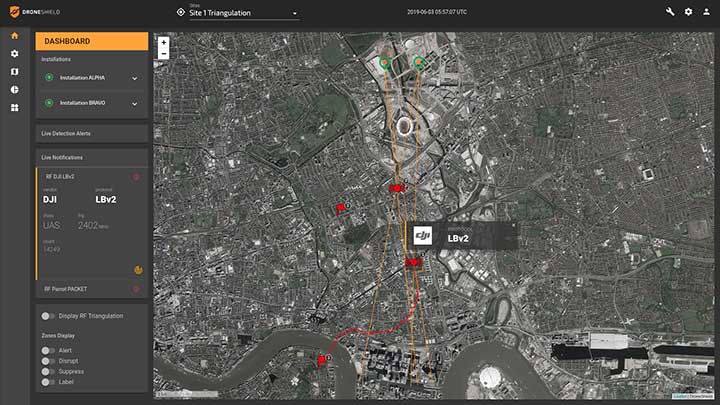
     DroneShield has begun the rollout of firmware version 1.1 of its DroneShieldComplete software for its DroneSentinel and DroneSentry counter-drone systems.

    Enhancements include a number of features, such as pinpointing locations of pilots of detected drones. This allows for additional counterdrone procedures by customers, such as apprehending the pilots instead of neutralizing the drones directly.

    This is expected to be of a substantial benefit for customers who are not legally able to deploy drone countermeasures, as well as enabling them to deal with the cause of the drone-related issues.

    DroneShieldComplete 1.1 firmware, showing pilot detection capability with flags. (Photo: DroneShield Ltd.)

    DroneShieldComplete 1.1 firmware, showing pilot detection capability with flags. (Photo: DroneShield Ltd.)

    “The addition of the capability to locate and apprehend drone pilots without the need for taking down the drone has been developed in response to significant customer demand, and we expect this feature to be utilised by a number of our customers,” Vernik said.

  • UK’s Westfield and Ordnance Survey work on autonomous vehicles

    Westfield Technology Group, a British vehicle manufacturer, and Ordnance Survey have signed a Memorandum of Understanding (MoU) to support autonomous vehicle development.

    The MoU will support a wider range of autonomous vehicle operations by improving access to detailed and accurate mapping.

    Project LAVIS is investigating how autonomous vehicles, particularly shared PODs, could offer residents and visitors sustainable and shared transport around the Lake District National Park area.

    Previous collaborations between Westfield Technology Group and Ordnance Survey include jointly collaborating with Emirates Airlines in Dubai and mapping potential autonomous vehicle routes in the Lake District for the Innovate U.K.-funded Project LAVIS.

    Recognizing the mutual benefits of collaborating on domestic and international activities, the organizations will continue developing and advancing autonomous vehicle capability. By utilizing 3D high-definition mapping capability, this partnership will add significant value the autonomous vehicle industry, the companies said.

    “We’re very excited about strengthening our working relationship with Ordnance Survey,” said Julian Turner, CEO at Westfield Technology Group. “This MoU will allow us to further advance and improve our autonomous vehicle operations, particularly in areas which desperately need access to sustainable, reliable and flexible transport.”

    “This MoU further cements our relationship with Westfield Technology Group,” said Andy Wilson, region director for Europe and Africa at Ordnance Survey. “We’re excited about collaborating on this important project, which is another example of how accurate, up-to-date geospatial data and mapping is key to the success of new and emerging technologies.”

  • US, Cuba agree to improve maritime navigation safety

    President Obama’s trip to Cuba this week marks a historic milestone in the normalization process between the U.S. and Cuba. At the same time, the two countries are working to improve maritime navigation safety and related areas of mutual interest to protect lives and property at sea.

    Ambassador Jeffrey DeLaurentis, the chief of mission at the U.S. Embassy in Havana, and Col. Candido Alfredo Regalado Gomez, chief of Cuba’s National Office of Hydrography and Geodesy (ONHG), signed a Memorandum of Understanding (MOU) on maritime navigation.

    The MOU calls for cooperation in the areas of hydrography, oceanography, geodesy and related services of mutual interest. One of the major focuses will be to improve maritime navigation safety including efforts to ensure the accuracy of both electronic and paper charts, eliminate charting overlaps and fill in gaps in navigational chart coverage.

    In addition to updating data on domestic charts like the NOAA chart above, the U.S. and Cuba agreed to work together on a new international paper chart which will cover south Florida, the Bahamas and northern Cuba. (NOAA)
    In addition to updating data on domestic charts like the NOAA chart above, the U.S. and Cuba agreed to work together on a new international paper chart which will cover south Florida, the Bahamas and northern Cuba. (NOAA)

    In February 2015, less than two months after President Obama announced the United States’ new approach toward Cuba, the National Oceanic and Atmospheric Administration (NOAA) and the ONHG, through a set of reciprocal exchanges, launched what became a year-long effort to formulate the technical exchange that is a normal course of affairs between most of the other maritime nations of the world. Both agencies are working on plans for monitoring and forecasting tides and currents for ports and improving positioning networks among other related scientific and technical activities.

    “NOAA has a strong interest in both improving navigational safety and in protecting the marine environment in the heavily travelled and vibrant waters between our two countries in the Straits of Florida,” said Russell Callender, Ph.D., assistant NOAA administrator for the National Ocean Service. “We welcome this agreement and the progress it represents.”

    “Improved navigation services are important for commercial mariners and individual boaters alike,” said Ambassador DeLaurentis, “and it is particularly important as authorized trade and authorized travel increase between the two countries.”

    “This MOU will allow us to fill gaps in essential navigational data, working on a practical level with our Cuban counterparts,” said Kathryn Ries, deputy director of NOAA’s Office of Coast Survey. “The U.S. works with hydrographic offices of all nations that have waters adjacent to the United States and our territories, and this agreement improves the exchange of charting information with Cuba as well.”

    The MOU is the first step in what is expected to be a long-term collaboration between the two countries.

    In addition to aligning each country’s navigational charts, NOAA and ONHG are sharing data for the creation of a new international chart (known in mariner’s parlance as “INT chart”) 4149, which will cover south Florida, the Bahamas, and north Cuba. NOAA plans to publish the new chart this year.