Tag: Mobile World Congress

  • Septentrio, Imec Co-Design Antenna for High-Precision GNSS

    Septentrio, Imec Co-Design Antenna for High-Precision GNSS

    antenne copy-W
    photo: Imec and Septentrio

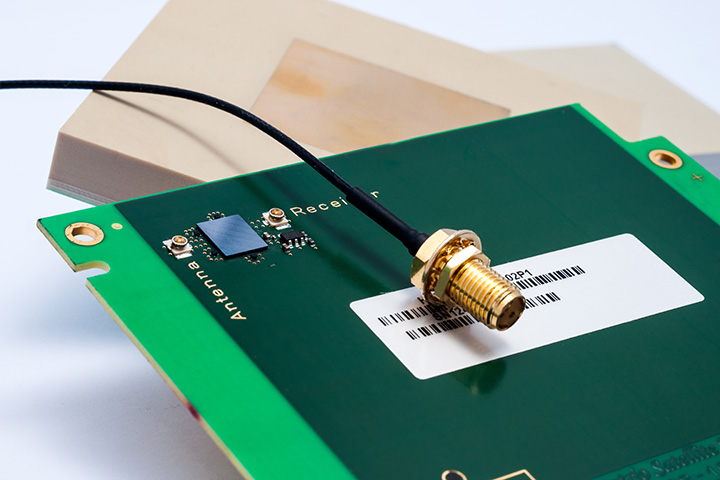
    Imec and Septentrio have collaborated to design multi-frequency GNSS antenna that simultaneously receives all GPS, GLONASS, BeiDou, and Galileo bands. Developed under the European Community’s Seventh Framework Programme project Handheld, the compact antenna can be integrated in multi-frequency handheld GNSS devices for high-precision location applications up to 1 centimeter.

    The announcement came at the Mobile World Congress being held this week in Barcelona, Spain.

    The compact antenna integrates Imec’s GNSS antenna and Septentrio’s GNSS RF front-end. Imec’s antenna design satisfies the requirements for the high-accuracy GNSS market while remaining small enough to fit in a handheld surveyor device, the companies said. The antenna has desired uniform gain and phase coverage over the complete upper hemisphere, with strong suppression of unwanted reflected signals below or in the vicinity of the GNSS receiver.

    The GNSS RF front-end, based on established front-end technology developed by Septentrio, is characterized by a superb out-of-band interference rejection to avoid notably device self-interference with other radiation sources such as Bluetooth and WLAN radios, as well as other ambient intentional and non-intentional interference. The compact multi-frequency antenna is a perfect companion of Septentrio’s compact and low-power AsteRx-m receiver, a credit card-sized dual frequency GNSS receiver that provides centimeter accuracy at less than 500-mW power consumption, by far the lowest power consumption in the professional GNSS market.

    The research leading to these results has received funding from the European Union Framework Programme (FP7/2007-2013) under grant agreement n°287183.

  • MWC: Is the Connected Car the New Mobile Phone?

    This year’s Mobile World Congress, held late last month in Barcelona, featured the world’s largest mobility conference. While there was not a lot of strictly location-based services news, connected vehicles seemed to be the big deal. Ford and GM both made important announcements, sending a signal that wireless information and connectivity is here to stay in a vehicle — and location will be a big part of the growth. On the downside, MWC is becoming a mini Consumer Electronics Show with hotels gouging attendees, long cab lines, heavy traffic, expensive meals and long commutes to the show for those wanting to pay less than $400 a night for a room. Sounds like Las Vegas in January.

    By Kevin Dennehy

    The recent Mobile World Congress, held at Barcelona’s Fira Gran Via conference center, featured big connected vehicle announcements from Ford and GM. Ford announced a slew of deals, one partnering with Spotify to make Spotify Premium available through its Sync AppLink. GM’s big announcement is that its OnStar safety, security and navigation service will use AT&T Mobility’s network for LTE modules in 2014.

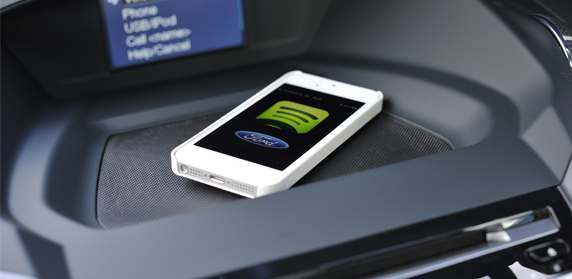
    Ford launches Spotify connection.
    Ford’s partnership with Spotify gives drivers access to millions of tunes on the road.

    Industry observers believe that GM’s announcement indicates the new AT&T deal could give the connected vehicle market a big boost as the units will go into most cars, including entry-level vehicles. Wireless carriers have indicated that transportation remains one of the key vertical markets they are aggressively getting in to.

    AT&T pulled a big coup as GM uses Verizon Wireless for its OnStar service. However, published reports indicate that the company has been disconnecting subscribers who are not currently using the service. Verizon said it had lost 490,000 connections in late 2011 — and said the losses were due to decline in telematics customers.

    There is no word on whether 2012’s $617 million purchase of Hughes Telematics had any effect on the Verizon-GM relationship.

    Overall, OnStar, which costs $18.95 per month, has more than 6 million customers worldwide.

    A concern with connected vehicles, and this is an issue that has been around for the past few years, is that automobile manufacturers do not believe the vehicle isn’t the new mobile phone — though some carriers believe it will be. Another concern is the form factor itself — what is better? What will the winner be? An embedded system or a system that integrates with a user’s smartphone?

    Not to be outdone by GM, Ford also said its 2104 Ford Ecosport will feature AppLink capabilities. The company also said it would be offering, in Europe, applications from Kaliki, Glympse and Aha. Ford says it now has 2,500 folks registered in its developer program — doubling the numbers from last month.

    Ultimately, many analysts say that two major market issues will need to be resolved for the connected vehicle segment to take off. One is what will consumers want? The other is standardization — will every vehicle have the same system in use? Already Ford and GM seem to have differing technology and business models for this market.

    Is Mobile World Congress Getting Too Big to be Useful?

    With more than 72,000 attendees this year, which is a little more than half the size of the gigantic Las Vegas-based Consumer Electronics Show, is MWC becoming too big and less focused for wireless application developers, LBS companies looking to partner and other location company entities?

    Does this sound like a mini CES? The Fira Grand Via had 1 million square feet of exhibit space, 1,700 exhibitors and 72,000 attendees from 200 countries. All of this is puzzling for a conference that had no Google (the company had a big exhibit last year) or Microsoft.

    In addition, there were no huge announcements — even the connected vehicle news would be mid-level news at CES. Does it say something strange about a big wireless show when your main news is connected vehicles?

    Deciding not to get lost in the hugeness of a big trade show, most of the wireless companies and handset manufacturers choose to make their own product and deal announcements at their own branded shows or independent press conferences. Outside of a handset having LBS capability rolled out, and companies saying they are rolling out capability in European nations, there wasn’t much location-specific news.

    With no big indoor position news at MWC, does that spell a struggle for the new technology and potential gigantic market? Many publications, including this one, has touted indoor positioning as one of the technologies that will spur LBS’ market growth.

    A few smaller companies did display indoor positioning products at MWC. Rx Networks rolled out its Xybrid Synchro that allows a device to self-located without an active data network connection. The company also rolled out a cloud-based GNSS systems that allows users to determine a location even when weak location signals are available, the company said.

    Another indoor positioning company, Insiteo, showed off its products that work on iOS and Android devices to allow users to find booths at MWC. The company says product finding, location-based marketing and data mining are all applications for the platform.

    In other Mobile World Congress news:

    • Telit launched m2mLOCATE, a feature that adds Cell-ID location for a range of its cellular connectivity modules. The company uses RX Networks’ XYBRID RT service, a database that encompasses 40 million cell-IDs.
    • CSR demonstrated its Location Services Platform, which features context detection and user self-learning to deliver indoor and outdoor location for the consumer and enterprise markets. The company says the platform has an indoor accuracy of less than 10 meters.
    • TeleCommunication Systems shopped its LBS suite of services at MWC to both enterprise and consumer companies. TCS recently deployed four new mobile operators on its hosted cloud LBS product. The company says it offers revenue-producing branded and private-labeled applications for navigation, hyper-local search, enterprise and family locators.
    • ALK Technologies, now owned by Trimble Navigation, said its CoPilot GPS navigation apps for smartphones and tablets will be available for Windows Phone 8 and Windows 8. The company said it’s always been high on Microsoft’s mobile products, as CoPilot was originally developed for Microsoft’s Pocket PC. CoPilot features voice-guided GPS navigation, turn-by-turn guidance, trip planning and automotive-grade street maps, the company said. The unit’s live services include Yelp, ActiveTraffic, Wikipedia and Google Search.
  • Connected Car Biggest MWC News, 2G to Retire

    Janice Partyka
    Janice Partyka

    It’s a streak. The Connected Car was yet again the most exciting emerging technology in the room, this time at the Mobile World Congress (MWC). The connected car service includes navigation, infotainment and location offerings. The big news in this sphere has come from General Motors, but more about that later. Do you remember the death of cellular digital packet data (CDPD)? Now it’s 2G’s turn. The 2G network used by many asset M2M tracking devices is going away. And Amazon is getting in Google’s face with a giant, well-oiled mobile ad network.

    Beginning with 2015 car models, AT&T will replace Verizon Wireless as GM’s communications partner. Next year, GM plans to install AT&T LTE modems into many of its vehicles and Verizon will be the network behind GM’s OnStar service. The new modems will enable richer, faster content, including streaming video and radio.

    The Connected Car squabbles. Should in-vehicle connectivity be controlled by a smartphone or by an embedded device? There are arguments on both sides. Ford’s forward-thinking connectivity choices have helped elevate what was a dowdy brand. “The last thing we want to do is take this [smartphone] thing that updates every 12-18 months and embed it into a car that has a lifecycle of at least 10 years,” asserted Doug VanDagens of Ford Motor Company. “Users are already paying for the data connection on their phone, and so they shouldn’t be assessed another fee for their car to access a network.” On the flip side, Glenn Lurie of AT&T raised concerns about software updates in a smartphone tethered scenario, in which a user might have to pay for data charges incurred by software updates that auto makers push to vehicles.

    Vast market. No matter the approach, the connected car is a huge market opportunity. By 2020, Machina Research predicts that 90 percent of new passenger cars will have some sort of a connectivity platform and the market will reach $600 billion. There are concerns that in-vehicle service offerings may be too complex and could delay uptake. Drivers will want to pay one vendor for in-vehicle services and have pricing and billing options that are not complex.

    Prepare for the death of 2G. AT&T plans to shut down its 2G networks by 2017. Verizon is planning to shut down its 2G and 3G EV-DO by 2021. The majority of small enterprises that track assets use 2G GPS modems. Many larger enterprises have been transitioning to 3G (HSPA) in this space. Companies that are considering M2M solutions may want devices that will work long into the future, and as the cutoff date approaches, customers will be increasingly reluctant to make purchases of 2G devices. LTE modems are currently about three times as expensive as 2G modems, which will put a dent in ROI calculations.

    Amazon is joining the game. Amazon is rolling out a mobile ad network juggernaut. The mobile ads API, now in beta, enables third-party developers to integrate advertising into Android games and applications. Ad targeting options include GPS coordinates, gender and product floor prices. Android developers have struggled to make money through Google’s own storefront. The Amazon App store for Android has proven lucrative. For every $1 generated by Apple’s App Store for iOS, Amazon generates an average of $.89 per user and Google Play generates just $.23 per user, reports Flurry. Apple has been laying the golden egg, but Amazon knows how to sell and just may surpass Apple.

    It’s smartphones. It has finally happened. This year, worldwide shipments of smartphones will squeak by feature phones shipments, predicts analyst firms IHS iSuppli and IDC. Falling smartphone prices and the rise of LTE networks have contributed to the growth in smartphone adoption.

    Who were we talking about? Lissted analyzed more than 7,000 tweets about the Mobile World Congress sent by 619 journalists and bloggers and 419 media outlets. Nokia was tweeted about more than any other company, followed by Samsung and Android. Who will lead the hashtag race at CTIA?

    Contact: [email protected]


  • FICOSA Integrates OriginGPS Antenna Module in Telematic Unit

    FICOSA demonstrated a telematic unit integrating a multi-service antenna module for positioning and satellite navigation supporting all the geographic positioning standards at the 2013 Mobile World Congress in Barcelona in February.

    The major advantage of this technological innovation is that the proposed multi-channel GPS/Galileo/GLONASS/BeiDou/QZSS receiver allows tracking across all the different navigation and positioning satellite standards worldwide, so that automakers can  the having to manage different variants of in-vehicle telematic units (iVTUs) depending on the geographical market. iVTUs are needed for emergency call function, fleet management, and other functions. It incorporates an OriginGPS antenna.

    The new module is a complete system-in-package featuring miniature surface mount device technology footprint designed to commit unique integration features for high volume, low power and cost-sensitive applications.

    In addition, the reduced size of the receiver module makes the most of a stacked-up in board integration through miniaturized integrated circuits and surface mount devices, allows an aggressive reduction of the iVTU packaging, which is advantageous for the OEM for car assembly, iVTU localization inside the vehicle, and weight reduction.

    The innovation represents the result of the international collaboration between FICOSA and OriginGPS. “We view the telematics market as a growing market and it is our privilege to cooperate and partner with Ficosa and its excellent engineering team,” said Haim Goldberger, CEO and founder of OriginGPS.

    “In FICOSA, innovation and technology are two main tools for our future and working with OriginGPS is a great issue,” said Jose María Forcadell, Advanced Communications Business Unit Director at FICOSA.

  • SIMcom Launches Modules at Mobile World Congress

    SIMCom Wireless Solutions Ltd. of Shanghai launched its first compact LGA 2G module SIM900E at Mobile World Congress 2013 today. The module’s small size and LGA encapsulation suit M2M applications of all sizes, especially satisfying requirements for slim, compact design, SIMcom said. The Mobile World Congress is being held in Barcelona, Spain, this week.

    With operations from 2002 to 2013, SIMCom has just celebrated its 10th anniversary. The company has developed into a global leader of wireless solutions with the integration of R&D, production, sales and after-sales services, and with products covering technologies such as GPS, GLONASS, GSM/GPRS, WCDMA/HSPA, TD-SCDMA, CDMA EVDO, SRD, and Wi-Fi. The products have been sold in more than 100 countries and regions, involving almost all M2M industries. With the celebration of its 10th anniversary, SIMCom also launched its first company magazine, SIMCom Inside.

    SIMCom launched its module series of 2G/3G, with the same size of 30 x 30 millimeters, including SIM928, SIM968, SIM5310 and more. Integrated with GSM/GPRS and GPS, the SIM928 module is a compact quad-Band GSM/GPRS-enabled module based on the PNX4851 platform. SIM968 is a combo module featuring quad-band GSM/GPRS and combining GLONASS technology for satellite navigation. SIM5310 is a low-cost 3G module that supports WCDMA 384Kbps and single frequency band 2100 MHz. In addition, SIMCom will also introduce the first LTE intelligent module SIM7290.

    The compact module SIM900E released today has an LGA encapsulation of 19.8 x 19.8 x 2.7 millimeters, and its LGA encapsulation is suitable for automatic assembly with SMT equipment, the company said. The configuration of four frequencies of GSM/GPRS — 850/900/1800/1900MHz — and wide temperature range of -40C to +85C is designed for global seamless coverage and various industrial application environments.

  • Continued Growth of Connected Vehicle and M2M Highlighted at MWC

    The Mobile World Congress in Barcelona is getting bigger every year — so much that it’s almost a mini CES that is hard to navigate and find companies…much less big location-based services news. While there were no big jaw-dropping mergers and acquisitions, big product roll-outs and partnerships, this conference will continue to be the main showcase for location companies wishing to establish a presence in Europe.


    BARCELONA — It was tough to find out what might be the big deal for the location industry here at the Mobile World Congress, among 67,000 attendees and more than 1,500 exhibitors. Two areas continued to stand out, as they had at the January Consumer Electronics Show: the rise of the connected vehicle and machine-to-machine connections.

    An MWC keynote was given by Ford Motor Co.’s chairman Bill Ford (right), who gave long-term strategies for the company, which includes big connected car components. Ford’s Sync, which is already on 4 million cars in the United States since it was launched in 2007, now is available in Europe. The company hopes to have 13 million cars equipped with the connected service by 2015 — 3.5 million of those in Europe.

    One of the more significant deals at MWC was Sprint Nextel’s announcement that it will be the strategic wireless partner for Chrysler Group’s Uconnect voice-activated vehicle communications system.

    In keeping with the connected theme, GSMA’s Connected House featured such companies as AT&T and Airbiquity that showcased the transfer of connected lifestyle from car to house. Airbiquity demonstrated its products for cloud-based services, mobile phones and application integration into vehicles. The company launched its Application Developer Program at MWC.

    TCS Offers Family Locator to Auto Makers for Connected Car Initiatives

    TeleCommunication Systems announced at the MWC that it’s incorporating the TCS Family Locator into connected vehicles and is offering it on the iPhone and Android platforms. TCS Family Locator allows users to locate family members’ vehicles through aerial photos or maps to monitor when they arrive or leave specific areas.

    TCS was a pioneer in enhanced 911 roll outs, which was the basis of today’s location-based services, said Jay Whitehurst, TCS senior vice president, commercial software group.

    The cloud-based Family Locator product is being offered to vehicle manufacturers, telematics service providers, and wireless carriers for connected car initiatives, the company said.

    Currently, Family Locator supports BlackBerry and other phones.

    For the enterprise market, TCS said its Workforce Locator mobile resource management product now has extended coverage to data cards and any device with a SIM card, which includes mobile Wi-Fi hotspots and tablets.

    Also at MWC, TomTom said it partnered with HTC to provide the maps, points of interest, and turn-by-turn directions for a line of HTC smartphones in India. TomTom views India as a growing market, citing a study that forecasts more than 5.2 million smartphones will ship to the country this year.

    The HTC deal is TomTom’s first major partnership in India, said Nuno Campos, the company’s vice president of sales and marketing for its licensing division. Campos said that Jocelyn Vigreux, formerly president of TomTom USA, has been consolidating all business units in India to steward the company’s HTC partnership there.


    TomTom also announced a partnership with NDrive to deliver maps and other content to its location-based applications. The three-year deal is big for TomTom as NDrive has millions of users worldwide, Campos said.

    When asked how TomTom is competing against the Googles of the world, Campos said that the market is big enough to run a profitable mapping business. His only crack at Google was that “they are finding that making maps isn’t easy.”

    TomTom, through its joint venture partner AutoNavi Holdings Limited, also announced a seven-year agreement with Qoros Auto, an international automotive corporation. TomTom and AutoNavi will deliver HD Traffic, marking the first real-time traffic customer for the newly expanded joint venture. In 2013 the first cars — aimed at young metropolitan users — will hit the streets in China equipped with HD Traffic, providing drivers with the most accurate, comprehensive, and up-to-date traffic information available.

    In other Mobile World Congress news:

    • Urban Airship said its new Unique Opt-In Report allows users to gain insight in to the numbers of distinct users opting in or out of push notifications. This enables companies to hone mobile messaging strategy based on users’ behavior.
    • Locaaid rolled out its Global Cell-ID at MWC. This new feature, accessible via Locaid’s Location-as-a-Service (LaaS) platform, allows enterprise mobile developers to acquire carrier-certified, permission-based location on their devices in more than 165 countries around the globe.
    • American Roamer changed its name to Mosaik Solutions at MWC. Through its partnership with Europa, the company’s Global Coverage Analyzer and CellMaps are marketed in Europe. Mosaik Solutions’ customers include AT&T International, OnStar, and Comcast.
    • ALK Technologies Inc., which previously charged for its navigation applications, now said its CoPilot GPS is a free app for iPhone, iPad, and Android devices. The company contends that CoPilot is a lot more than Google’s free map service and allows users to search millions of pre-installed points of interest for nearby restaurants, hotels, and gas stations. The company had a booth at MWC and exhibited at Showstoppers, as did Poynt.

    Indoor positioning continued to be a big topic to enable LBS markets at the Mobile World Congress. Richard Najarian, Broadcom senior director, business development, said that market is shaping up. The company also showed off its Bluetooth Low Energy modules that enable indoor location positioning.


    Some other MWC observations:

    1. Qualcomm had an off-site reception for its indoor positioning partners that included Cisco and others.
    2. The Android room at MWC was huge…with such companies as Glympse participating.
    3. Telmap, now owned by Intel, which has recently said it will invest millions into connected vehicle initiatives, has a strong presence in Europe with many LBS applications.

    The company says it’s the No. 1 local content aggregator in Europe, according to Motti Kushner, Telmap’s chief marketing officer.

    Neustar, which is partnering with TELUS and other major operators in North America to create mobile services, had a large presence at MWC. The company’s intelligent cloud helps operators to integrate location and messaging, said Gary Zimmerman, Neustar’s director of product marketing.

    Some of these applications include geofence, which Neustar works with partner ZOS, to create opt-in mobile campaigns that send offers to subscribers based on their location. The company also offers enhanced location that shows how a brand can personalize location information once a consumer gives consent to participate.

    GPS World Partnering with GPS-Wireless

    GPS World is the GPS-Wireless (www.gps-wireless.com) conference’s exclusive media partner. GPS World’s Chris Litton will be on site at GPS-Wireless 2012, which is March 21-22 at the Hyatt Regency San Francisco Airport, to discuss why location companies should advertise in the magazine and LBS Insider, which has more than 10,000 worldwide subscribers.
  • Brave New World of Data via the Cloud

    The frightening thing about the Mobile World Congress in Barcelona, the bloody awful frightening thing is the sheer amount of data talked about, enthusiastically envisioned, planned for. Planned for in the sense of throwing up business cases and wheeling and dealing new products and services for millions and billions of users that will pump vast amounts of data, countless numbers of gigabytes, terabytes, petabytes, exabytes per second through the cloud.

    Not planned for in the sense of actually making provision for.  Seeing if there’s enough resource on hand. Calculating if the ecosystem will handle it.

    No, wireless carriers and everyone else involved in this industry make money on data. So let’s make, make, make, more, more, more.

    Did anyone happen to estimate the amount of bandwidth needed to upload and download all this data? Has anyone thought about what pressure it might bring on other spectrum users such as, perhaps, GNSS?

    My guess is no, and no, and we don’t care. Because we are creating the future, don’t you see?!!?

    From this brave new world sprang LightSquared, born of the ravenous need for more wireless data. It doesn’t take much time at the Mobile World Congress to see that venture as just the first very tentative probe. Armies are massed at our borders.

    I didn’t get to location as a blue-chip commodity, as promised yesterday. That will have to come tomorrow.

  • Our Man in Barcelona

    Smartphones are taking over the world, and not just modern industrialized societies. A Broadcom executive predicted today at the Mobile World Congress in Barcelona that, with costs going down for less expensive models, smartphones will not only be the first phone of any kind for many people in India and other developing nations, it will constitute their first Internet experience.

    There’s a whole lot of change coming for North America and European users, too, and much of that is being envisioned, enthusiastically promulgated, and occasionally even demonstrated at this global village of 60,000 modcom movers and shakers that congregate here every year.  Just a few examples:

    • granting access to one’s location data for only a set period, from 15 minutes to 4 hours, via Glympse.
    • location-based display advertising, not just coupons, but glossy little ads on your screen, called up by proximity to the advertiser, via Sofialys.
    • centimeter-accurate indoor navigation, to the product on the shelf and not to its competitor product next to it on the same shelf, via Wi-Fi and near-field communication (NFC), Broadcom again but others including LocAid are talking about it too.
    • An alarm clock function on your phone that will wake you (or let you sleep) at exactly the right time for that morning, based on real-time traffic and weather conditions on your commute route, from Airbiquity.

    All this with either a few deft touches of the smartphone screen, or automatically enabled.

    And this is just the location aspect of smartphones, which represents maybe 5 percent of what’s being talked about here.  Tons of other apps for health and entertainment and more.

    Tomorrow: location as a blue-chip commodity.

  • With Record Crowd, Mobile World Congress Market Emphasis Shifts

    The recent Mobile World Congress in Barcelona had a record 60,000 attendees. Many industry companies were either exhibiting or attending to kick tires to see how the international location-based services market is faring. Industry observers are saying the focus of the trade show has gone from European-centric markets to a broader view, particularly as new technology and standards evolve and mature.


    The recent Mobile World Congress in Barcelona proved that the market for location-based services is on a worldwide stage — and not sequestered to certain regions. Clay Babcock, Rand McNally director of advanced navigation technology, says the Mountain World Congress traditionally focused on European markets.

    “The MWC, and the 3GSM show that preceded it, were primarily European affairs that highlighted the latest hardware in the GSM world. While the shining stars came from places like Espoo, Finland, and Stockholm Sweden, even the second-tier players were European, with Bosch, Siemens, Alcetel, Sendo, and Phillips all making phones for the growing market,” he said. “For the most part, the North American and Asian players sat on the sidelines. A possible exception was Motorola, who had two brief moments in the sun with their Startac and then Razr phones. Asian companies seemed content to make phones for the proprietary Japanese and Korean markets.”

    Several technology events have changed the market—and the key part of the shift has been the dominant role that software, ecosystems, and the well-used line of ‘user experience’ now plays a major part in the world of mobile telephony, Babcock said.

    “And with it, the center of the mobile world has moved to the west coast of the United States. The rise of the Apple iOS, Google Android–and now a lesser degree Microsoft WM7–has created new opportunities for many, but has also caught some big players off guard,” he said. “Nokia, for all its brilliance in making hardware, has been forced to drop its long-in-the-tooth Symbian OS in favor of WM7. This has angered many in the installed user base, but they miss the point. Nokia had to make a move, and a move to Android would have been a fatal step.”

    Babcock contends that with Microsoft, Nokia at least gets an OS partner that they can look upon as equals. “That was never going to happen with Google. The state of affairs is so dire at Nokia that for the second year in a row, they failed to display at the show,” he said.

    Missing at MWC is Apple, which Babcock says never comes anyway–and says that absence opened the door wide for Android. “The Android booth was a buzz of activity and excitement. Following a theme with other large booths at the show, a large section of the floor space was dedicated to partners’ applications and solutions,” he said. “The show is really all about software.”

    As GPS World reported, the Nielsen Company said that Android appears to be pulling ahead of RIM Blackberry and Apple iOS in the market share battle for smartphone operating systems. But an analysis by manufacturer shows Research in Motion and Apple to be the winners compared to other device makers since they are the only ones creating and selling smartphones with their respective operating systems.

    Location Just a Feature?

    As for location-based services, they are maturing, becoming ubiquitous in the hardware, Babcock said. “Companies are starting to understand that location is a feature, not a business. This will affect business models that were once designed as end-user plays,” he said. “Everybody still can get paid, but maybe not by entities you first thought would pay.”

    Babcock said that while the focus was on software at MWC, there was brilliant hardware on display. “The new Samsung Galaxy S II features a dual core 1-GigHz CPU and 4.3 inch super AMOLED display. Motorola, who like Sony-Ericsson is thriving after switching to Android, announced a new phone with an array of amazing accessories, one that turns the phone into a mini-laptop,” he said.

    Babcock said that, even on his cab ride to the airport to return home, there was a poster for a mobile taxi application that would locate customers and dispatch a car to their location — and let them know the estimated time of arrival. “Neat, maybe not earth-shattering, but the platforms it supported were Android, iOS and Research in Motion. The new world of phone operating systems, were found in the back of a Barcelona taxi,” he said.

    A number of such LBS industry companies as Navteq, ALK Technologies, deCarta and other entities had large presences or meeting rooms at MWC. Show organizers say the crowd topped out at 60,000, which was significantly higher than in 2010 or 2009. Like the Consumer Electronics Show in January, it appears that trade show attendance is up for the first time since 2008. It will be interesting to see if this trend continues for this month’s CTIA in Orlando.

    Foursquare Expands Language Capability

    In other MWC news, Dennis Crowley, CEO and co-founder of Foursquare, delivered a mini-keynote at the trade show about “Making Apps Smarter Through Location/Localization.” The company has made rapid expansion throughout the past year—and now has check-ins from nearly 200 countries.

    Foursquare recently announced that its service is available in French, Italian, German, Spanish, and Japanese. Users can update Foursquare on their Blackberry, iPhone, or Android, to switch to the default language of the device.

    In other LBS news:

    • TCS said that U.S. Cellular has extended its agreement to offer the company’s Your Navigator service on BREW phones. Your Navigator is an LBS application for GPS-enabled mobile phone, offering personal navigation and real-time, turn-by-turn visual and audio directions. TCS, which has worked with U.S. Cellular since 2007, signed a two-year software licensing agreement extension.
  • Mobile World Congress 2010: Planet of the Apps

    Mobile World Congress 2010: Planet of the Apps

    APP PLANET featured 100 exhibitors and a lounge for old-fashioned social networking.
    APP PLANET featured 100 exhibitors and a lounge for old-fashioned social networking.

    By Moni Malek

    It’s that time of year, around Valentine’s Day, when most of the who’s who in the mobile phone industry meet at the Mobile World Congress. I have been attending this event for nearly 15 years, and have seen the location change from Cannes to Barcelona, and the name change from GSM World Congress to 3GSM World Congress to Mobile World Congress.

    At the same time, the number of mobile phone users shot up from the millions to the billions. A new feature this year was the App Planet hall. The attendance of 47,000 was only marginally down from the 49,000 visitors in 2009, making it still a very busy a event, with no sign of the recession compared to other shows I’ve seen. It’s still the best place to meet companies in the mobile space — I met 25 in three days, as well as running into ex-colleagues and contacts who, like me, have been attending for years.

    Smartphone Entry. The trend of the last year or so has been the burst entry of smartphones. First started by Apple iPhone for consumers and to some extent Blackberry for professionals (the so-called fruit phones), operating systems (OS) have evolved to include Android from Google, Palm Pre’s webOS, Nokia and Intel merging their top-end smartphone operating systems, and Symbian going open source. Microsoft has people excited with Windows Phone 7, with the first handsets running on it scheduled to hit the markets around the holiday season.

    Most of the smartphones are GPS-enabled, and as these phones increase the market penetration of GPS, GPS use will increase, leading to more use of location-based applications.

    Deep Pockets. For those of you who think GPS personal navigation device market pricing is tough, the mobile phone market is cut throat. Volumes are out of this world, and in lots of countries around the globe, the volumes are more than the population! These volumes require deep pockets to keep up the investment to make money on decreasing margins.

    There has been a trend toward  consolidation in the GPS chip industry. Less than a year or two ago in Barcelona booths represented eRide (acquired by Furuno), Global Locate (acquired by Broadcom), GloNav (acquired by NXP, then wound up in ST Ericsson), Nemerix (which seems to have disappeared, though it’s rumored some assets went to another chip company), and finally SiRF (now part of CSR-SiRF). CSR-SiRF’s booth was more like a fortress, but at least I got to talk to the SiRF founder.

    It will be interesting to see what a Bluetooth-GPS company with a lot of cash in the bank plans as a next move. As for survivors, u-blox still had a booth (they weren’t acquired; they did an Initial Public Offering), and CellGuide had a small section of the Israel booth.

    App Planet. Since I first attended this show, global mobile-phone technology has gone from GSM voice to GPRS data to 3G voice/data to HSPA. Now comes LTE (Long Term Evolution), which is really a packet data network that can use VoIP.  Together, 3G and smartphones give us an environment which lets apps become a new business model worth billions. The Apps Planet hall showcased a lot of these models. The hall didn’t exist last year, but this year had 100 exhibitors. It easy to predict this number will grow.

    There are so many applications, they will need to differentiate to stand out from the crowd and gain mass. I think location-based apps need to get better, and I see that happening at the show. deCarta allows searches for places based on real walking distances or near the route you are traveling. Aloqa has clients for every smartphone with channels that you can choose for your interest. Mireo impressed me with not only natural text guidance (“turn left after the Apple store”) but its super-fast routing in less that 2 seconds, as opposed to 30-seconds-plus on other devices. It features algorithms with pre-stored routes to major junctions, so only the rest is routed. In any case, the net effect is you are routed before you have to think which way to drive or walk. I always say mobile phone users have short attention spans and expect instant gratification, and fast routing certainly helps.

    Finally, an Audi A5 Cabriolet displayed a solution for the European Commission’s eCall emergency call initiative, a car which automatically sends your position after an accident to a Public Safety Answering Point. eCall should be implemented in Europe by 2014, but Qualcomm is looking to put the system into the Audi A8 this year.
    Moni Malek is CEO of ML-C MobileLocation-Company GmbH, a new company integrating location and communication in a system platform.

    Motorola’s Christian Kurzke discusses Android with developers.
    Motorola’s Christian Kurzke discusses Android with developers.