Tag: MOU

  • Sri Lanka’s Global GIS and Uni­versity of Ruhuna enter into MoU

    Sri Lanka’s Global GIS and Uni­versity of Ruhuna enter into MoU

    GNSS CORS network to be established on university grounds

    Global GIS (Pvt) Ltd, a pion­eer in geo­spa­tial pos­i­tion­ing solu­tions in Sri Lanka, has entered a Memor­andum of Under­stand­ing with the Uni­versity of Ruhuna to col­lab­or­ate with the Depart­ment of Civil and Envir­on­mental Engin­eer­ing and the Depart­ment of Elec­trical and Inform­a­tion Engin­eer­ing of the Fac­ulty of Engin­eer­ing.

    Areas iden­ti­fied for col­lab­or­a­tion include con­duct­ing research and devel­op­ment activ­it­ies, devel­op­ing and com­mer­cial­iz­ing new inven­tions and solu­tions, industry projects and con­sult­ing oppor­tun­it­ies, and dis­sem­in­at­ing sci­entific know­ledge to meet the grow­ing demand of sur­vey­ing and geo­spa­tial tech­no­lo­gies and to increase effi­ciency and sus­tain­ab­il­ity in the nation’s engin­eer­ing indus­tries and its them­atic require­ments.

    “We are hon­ored to enter this mutu­ally bene­fi­cial col­lab­or­a­tion with the Uni­versity of Ruhuna to enhance capa­city and sup­port the grow­ing geo­spa­tial and sur­vey­ing industry in Sri Lanka,” said Nish­shanka De Silva, sureyor and CEO-man­aging dir­ector of Global GIS. “We aim to take the industry in Sri Lanka to the next level with new innov­at­ive products and solu­tions while build­ing suf­fi­cient capa­city to under­take the coun­try’s next phase of growth. Geo­spa­tial and sur­vey­ing tech­no­logy plays a sig­ni­fic­ant role in sus­tain­able infra­struc­ture plan­ning, renew­able energy, dis­aster man­age­ment, optim­iz­ing nat­ural resource alloc­a­tion, and many other areas as Sri Lanka pur­sues its national devel­op­ment goals.”

    Under the MOU, Global GIS will estab­lish a high-pre­ci­sion GNSS Con­tinu­ously Oper­at­ing Ref­er­ence Sta­tion (CORS) net­work sta­tion at the uni­versity to enhance the uni­versity’s capa­city for advanced GNSS-based research and applic­a­tions to pro­mote GNSS tech­no­logy among gov­ern­ment, semigov­ern­ment, and private organ­iza­tions.

    Global GIS will also open a fund­ing avenue to

    • sup­port research and devel­op­ment activ­it­ies for the dur­a­tion of the agree­ment,
    • provide neces­sary com­mer­cial­iza­tion exper­i­ence and busi­ness know­ledge for new inven­tions and solu­tions,
    • con­duct train­ing and intern­ship oppor­tun­it­ies for the under­gradu­ates on sur­vey­ing and geo­spa­tial tech­no­lo­gies to foster skill devel­op­ment and prac­tical exper­i­ence, and
    • lever­age its “Author­ized Agent” status for the brands it pro­motes in Sri Lanka to enhance the Uni­versity of Ruhuna’s capa­city in the latest sur­vey­ing and geo­spa­tial tech­no­lo­gies.
  • Furuno and Xona Space Systems sign MoU to develop innovative LEO PNT solutions

    Furuno and Xona Space Systems sign MoU to develop innovative LEO PNT solutions

    Furuno Electric and Xona Space Systems have signed a Memorandum of Understanding (MoU) to collaborate on solutions using Xona Pulsar, a low-Earth-orbit positioning, navigation and timing (LEO PNT) service for next-generation satellite navigation.

    Through the agreement, both companies will leverage their respective technological expertise and business strengths to explore opportunities for delivering advanced and promising LEO PNT solutions.

    Furuno has been actively pursuing LEO PNT as a promising technology capable of complementing or even substituting for GNSS.

    LEO PNT refers to systems that use a satellite constellation of 200 to 400 satellites deployed in low Earth orbit at an altitude of 500 km to 2,000 km. The LEO constellation is designed for PNT rather than non-terrestrial networks to provide global positioning and timing services similar to GNSS, but with significantly better performance.

    Xona is a pioneer in LEO PNT technology and offers a commercial service called Pulsar, which uses a dedicated LEO PNT constellation of 258 satellites. Compared to conventional GNSS, this service enhances resiliency and improves the accuracy of positioning and timing — the proximity of LEO satellites to Earth makes their signal power about 100 times stronger.

    Pulsar adopts a signal architecture similar to GNSS for compatibility, making it easy to integrate into existing GNSS products. Integrating Xona Pulsar into Furuno’s products will provide an alternative to GNSS while significantly boosting performance by complementing existing GNSS services.

    Furuno’s Pulsar-enabled timing solutions allow users to maintain accurate synchronization even when GNSS is degraded due to unexpected failures, including jamming and spoofing, the companies said.

  • Hexagon signs UN pledge to ensure robust PNT services

    Hexagon signs UN pledge to ensure robust PNT services

    Hexagon has joined the Multilateral Memorandum of Understanding (MMoU) on Strengthening the Global Geodesy Supply Chain.

    The MMOU is a shared recognition by the United Nations Global Geodetic Centre of Excellence (UN-GGCE) — alongside member state government departments and agencies, private sector companies, organizations, associations, and academic institutions — that action is required to make the foundations of positioning, navigation and timing services robust. 

    With HxGN SmartNet, Hexagon has built a reliable, scalable GNSS infrastructure that integrates physical reference stations, specialized software such as Leica Spider, and a secure environment for distributing precise positioning data. Supporting tens of thousands of users worldwide, SmartNet delivers the accuracy and continuity essential for daily operations across many sectors.

    The MMoU  signatories hope to advance resilient positioning services and strengthen geospatial capabilities for nations around the world. Through joint initiatives, they aim to: 

    • Enhance continuity and accuracy of GNSS-based positioning services
    • Strengthen resilience against signal interference
    • Support countries in developing and maintaining geodetic infrastructure
    • Expand education and workforce development in geodesy.

    These initiatives ultimately help end users access more consistent accuracy, higher service availability, and stronger resilience against jamming or spoofing.

    The MMoU was signed by Henning Sandfort, president, Geosystems Business Area, Hexagon, and Dieter Fritsch, Hexagon’s representative to the UN-GGIM Private Sector Network, on Nov. 17.

    “Joining the MMoU underscores our commitment to ensuring that accurate, dependable geospatial information is accessible to governments and organisations worldwide,” Sandfort said.

    “Hexagon’s contribution under the MMoU demonstrates the importance of global collaboration between Member States, UN and the geospatial industry,” said Nicholas Brown, head of Office at the UN-GGCE. “Hexagon is a key player of GNSS technology and digital reality solutions and therefore mostly welcomed to contribute the future vision of a strengthened global geodesy supply chain.

  • DroneShield to collaborate with Collins Aerospace on anti-drone tech

    Photo: DroneShield
    DroneGun, part of the DroneShield anti-UAV system. (Photo: DroneShield)

    DroneShield Ltd. and Collins Aerospace Systems, a unit of United Technologies, have entered a Memorandum of Understanding (MOU) to collaborate on opportunities with the Australian military, as well as globally.

    The intent is to add DroneShield’s counter-drone capabilities to Collins’ surveillance systems that its customers are already using.

    Collins Aerospace is a supplier of aerospace and defense products. In Australia, it holds current contracts within the Australian Defence Force.

    DroneShield is a public Australian company whose products include a suite of counter-drone technologies capable of protecting bases and forward-deployed groups against enemy drone threats.

    DroneShield’s products include DroneSentinel (a sensor fusion, multi-method drone detection system), DroneSentry (a combined detection and interdiction system), DroneGun Tactical (a handheld rifle-shaped drone-mitigation device) and RfPatrol (a body-worn drone detection device).

    DroneShield Chief Executive Officer Oleg Vornik commented, “Collins Aerospace has a leading position in the Australian defence market and we’re pleased to work together on opportunities that complement our capabilities to enhance customer value.”

    Updated Software.
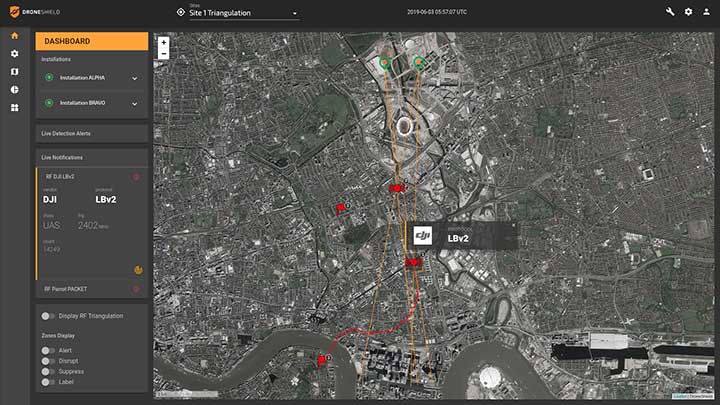
     DroneShield has begun the rollout of firmware version 1.1 of its DroneShieldComplete software for its DroneSentinel and DroneSentry counter-drone systems.

    Enhancements include a number of features, such as pinpointing locations of pilots of detected drones. This allows for additional counterdrone procedures by customers, such as apprehending the pilots instead of neutralizing the drones directly.

    This is expected to be of a substantial benefit for customers who are not legally able to deploy drone countermeasures, as well as enabling them to deal with the cause of the drone-related issues.

    DroneShieldComplete 1.1 firmware, showing pilot detection capability with flags. (Photo: DroneShield Ltd.)

    DroneShieldComplete 1.1 firmware, showing pilot detection capability with flags. (Photo: DroneShield Ltd.)

    “The addition of the capability to locate and apprehend drone pilots without the need for taking down the drone has been developed in response to significant customer demand, and we expect this feature to be utilised by a number of our customers,” Vernik said.