Tag: NAD83

  • Datums, feet and GNSS vectors: The 2022 NGS upgrade

    Datums, feet and GNSS vectors: The 2022 NGS upgrade

    In what seems like just yesterday, GPS World published my article in the May 2017 issue of Survey Scene on the upcoming datum change by the National Geodetic Survey (NGS) in 2022.

    With the calendar pages turning rapidly and as we get closer to the witching hour of geospatial voodoo, more items have surfaced to discuss and educate ourselves on in relation to “the change.”

    Let’s delve into these topics and break each down into what the common surveying and geospatial practitioner will need to know with the advancements in coordinates, geodesy and our everyday uses.

    NATRF2022: The continental U.S. replacement for NAD83 and NAVD88

    It is no secret that with the advancing use of GNSS technology, flaws in both existing horizontal and vertical datums establishing our National Spatial Reference System (NSRS) have been identified and exposed.

    NGS estimates that NAD83 is non-geocentric by over two meters, while the model establishing NAVD88 contains a tilt of approximately one meter across our continent.

    For most geospatial practitioners, these flaws are minimal to the integrity of their data. It does, however, give us a glimpse of how assumptions of geodetic information can produce incorrect modeling of surveying and mapping data and could lead to more flawed earth models without significant changes to their structure.

    With a great number of surveying and mapping practitioners using GNSS technology with little or no knowledge of the origins of our NSRS, it is a good time to provide the primers below to explain the history of our geodetic datums.

    Besides my previous article, follow these links for much more thorough technical information:

    GPS World Contributing Author David Zilkoski

    NGS 2022 Informational Videos

    NGS Publications and Webinars

    NGS Video Library

    NGS / COMET Program YouTube Channel

    With changes in both horizontal and vertical datums, slight variations in the data we are used to seeing will seem insignificant, but will require the user to pay close attention to potential data traps when converting between the old and new systems. The NGS graphics below depict the severity of datum change in the horizontal and vertical component across the U.S.
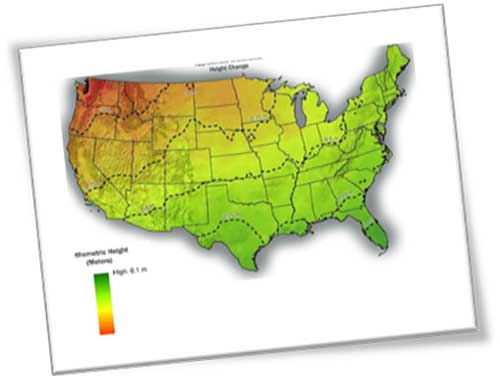
    Image: NGS
    Image: NGS

    Depending on where you are working, new state plane coordinates will vary from –2 meters to +4.5 meters from previously published values, with elevations fluctuating up to one meter from previous norms. All these changes are due to the increased knowledge of our world using various forms of emerging technology not thought possible several decades ago.

    These new measuring methods and studies, including GNSS and gravity monitoring, have allowed scientists and geodesy experts to establish more accurate geographic location systems than past terrestrial ways and procedures.

    We have geodetic monuments and marks everywhere; will they still be usable?

    The short answer to this question is an unequivocal yes, but with some caveats. Use of GNSS monitoring has proven we reside on tectonic plates that move slowly over time; thus, the geographic values (latitude and longitude) used to calculate any number of coordinate value systems are changing as well.
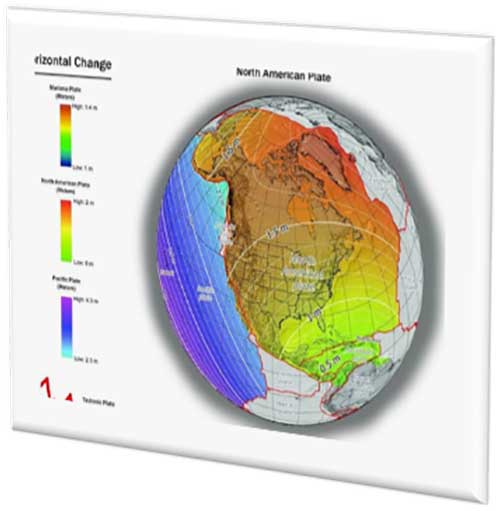
    Image: NGS
    Image: NGS

    Relational data between established points are not likely to change, but studies have shown significant shifts in areas that result in movement of our previously considered “unmovable” monuments.

    With additional parameters and characteristics being introduced with the 2022 datum, time and tectonic plate shift are main factors in establishment of a point.

    The concept of a “permanent” point no longer exists in relation to a published and unchangeable coordinate value of horizontal and vertical data. The surveying and geospatial data collector must recognize that the user is establishing a particular X/Y/Z or N/E/Z value for that exact moment in time and it, theoretically, will change from the moment one steps away from the point.

    This may be too “splitting of hairs” for most users, but the new system simply recognizes the reality of the moving data-collection stage, no matter how minute.

    This datum re-establishment has been a monumental undertaking (no pun intended), and NGS deserves many kudos for coming up with a realistic solution for a complex problem.

    However, most of its users still have a problem, and it lies within the standard unit of measurement: the U.S. survey foot. NGS (and its predecessor, U.S. Coastal and Geodetic Survey) have always used the meter for the basis of all units of measurement (as does the rest of the world.) The new 2022 datum is bringing us, the surveyors and mappers, to a new reality — nationwide adoption of the international foot. Let the grumbling and arguments begin!

    The meter vs. international foot vs. US survey foot

    The unit of measurement aptly named the “foot” has existed since early times, with most sources crediting King Henry I of England making a decree that his foot shall become the standard for measurement.

    No matter where the definition of the foot came from, it has varied slightly throughout history. The origin of the meter (or metre, as it’s known worldwide) also has a variety of beginnings. The most established story starts from John Wilkins, an English philosopher, who published in 1668 what he described as a new standard of measurement based upon the length of a pendulum that swings approximately 38 inches across in one second. This length was eventually named the meter by an Italian scientist.

    Another century later, King Louis XVI of France issued a integration law establishing the modern metric system with weights and measures having a base-ten system of units and sub-units. Within this system was the meter with a new length definition of being one ten millionth (1/10,000,000) of the distance from the North Pole to the Equator.

    Upon completion of the calculations, a rectangular bar made of platinum and iridium was created to establish the “standard” meter from which all future measurements would be based.

    The United States first recognized in 1866 the metric system and the meter (set forth as one meter equaling 39.37 inches). During this time, the International Commission of the Meter officially adopted the physical meter bar as the standard.

    Over the next 100+ years, many studies were undertaken to re-establish the length of the meter. Using wavelengths of various elements, including cadmium, mercury, neon, zinc, helium, thallium and krypton, new definitions were created. In 1983, the current definition of the length of the meter was finalized.

    The meter is now based upon the speed of light in a vacuum (299,792,458 m/s) with the meter being the length traveled in 1/299,793,458 of a second. While the length is very close to the original measurements set forth over the centuries, it is better defined for reproduction worldwide without having to possess a standard bar or other device.

    To further muddy the standardization of units, in 1959 an international agreement was made by Australia, Canada, New Zealand, South Africa and the United Kingdom so one yard would equal 0.9144 meters. Meanwhile, the U.S. National Bureau of Standards published a notice that all survey-related measurements will remain based so one one yard equals 3600/3937 meters or 0.91441083 meters.
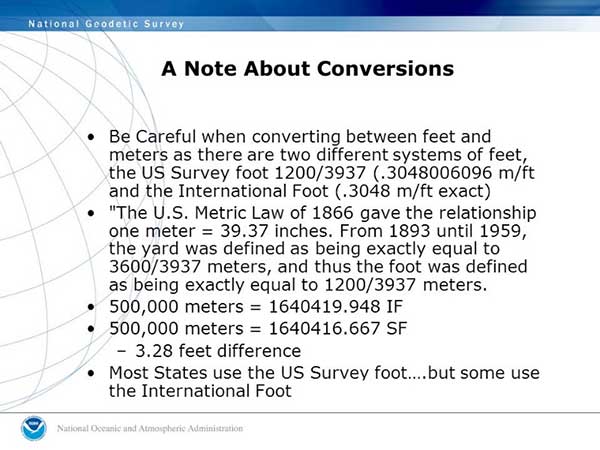
    Image: NGS
    Image: NGS

    We have two different measurements for the foot. What’s the big deal?

    The difference between the two standards is two parts in one million; while that doesn’t affect everyday physical measurement, it does cause havoc on coordinate systems with values beyond the millions. (See NGS video “Two Right Feet?” for details).

    What makes it even more confusing is that states across our country vary on which “foot” is standard within their legislation and daily practice. Currently (at the date of publication), six states recognize the International Foot as their standard unit of measurement, with four states not defining it. The remaining states have officially adopted the U.S. survey foot as their standard unit of measurement.

    NGS has suggested that starting with the 2022 datum change, the U.S. survey foot will not be supported in applications and software produced by them for geodetic computations. It will be limited to meters and the international foot, so they are recommending that states update their existing definitions to change to the international foot along with recognizing the 2022 datum as the official coordinate-system base.

    How to train our profession, the construction industry and John Q. Public on the new datum

    I would be lying to you if I said I’m not concerned with the rollout of the new datum and with converting all surveying and mapping work to the international foot. My biggest concern is not with those direct relationships I have with my staff and fellow professionals within my company.

    My main concern starts with these two areas: the tens of thousands of surveying practitioners working within projects containing state-plane coordinate systems in addition to contractors and other mapmaking providers using survey-grade equipment for construction and other mapping applications.

    Both groups have little to no technical knowledge of the intricacies of state-plane coordinate systems and the geodesy network “behind the curtain.” To paraphrase a well-known mortgage company with an app-based home loan system, “push button, get data” is the limit of most users’ knowledge when it comes to state-plane coordinates.

    Add to this the double-edged sword of real-time networks, where the user does not have to be concerned with setting up a base station, and the potential problems could get worse.

    While there will be a few early and timely embracers of the new datum, the majority will dig their heels in and refuse to switch. When the conversion to the 2022 datum is upon us, many users will drag their feet on learning about the new system as existing projects continue under the old datums.

    Until there is a mandate by government agencies and others, many newer projects beginning around the adopting time will remain on NAD83 and NAVD88 until directed otherwise.

    Most practitioners I have spoken with on this issue agree that it will be a tricky period for surveying and mapping. Rather than get bogged down with negativity and fight change, the surveying, mapping and geospatial community should do the following:

    • Rally our professions around these significant changes to educate our technicians and future professionals.
    • Coach contractors and other trades who rely on the technology to understand the new system.
    • Work with governmental agencies at all levels to educate them about what these changes entail and why to make the appropriate revisions to codes and statutes now.
    • Capitalize on this opportunity to teach the public about who we are and how spatial data is part of everyone’s life.

    All these points are paramount to the success of the datum upgrade and need to be followed through to the end. Ultimately, the faster we adopt and adapt, the better our geospatial world will be. There is lots of work ahead of us, but as the staff at NGS has shown us, the hard work necessary to make significant change is well worth the effort.


    CALLING ALL SURVEYORS AND GEOSPATIAL PROVIDERS!

    NGS announces GVX data format for GNSS vector processing

    The National Geodetic Survey (NGS) is requesting input and feedback on a new data format for sharing real-time kinematic (RTK) GNSS vector information.

    The new format will be like the static GNSS standard, Receiver Independent Exchange (RINEX), and is utilized by most software packages and the Online Positioning User System (OPUS).

    The new GNSS Vector Exchange format (GVX), will introduce a new industry standard for sharing of RTK vectors across differing platforms and software packages.

    Earlier users of GPS-based data collection remember the number of proprietary files created by each manufacturer, and having their own unique format for data and attribute interpretation. In response, the NGS created RINEX to help standardize data collection as a universal file format that would easily be adopted by receiver and software producers.

    That same goal is being set with the introduction of the GVX format as the next step in data-collection standardization for GNSS RTK vectors. GVX elements include (but are not limited to) the following:

    • Mark-to-mark Earth-Centered, Earth-Fixed (ECEF) vector components
    • Variances and covariances of vector components’
    • Reference frame information
    • Start and stop time of the observation
    • A-priori coordinates for the end points of each vector
    • Receiver and antenna types
    • RTK and real-time network (RTN) settings, if applicable
    • Quality control metadata (e.g., PDOP, number of satellites used, orbit type, etc.)

    The introduction to the new format along with technical specifications and examples are on the NGS website.

    The National Society of Professional Surveyors (NSPS) works directly with NGS to provide input on maintaining and updating the National Spatial Reference System and will include significant assistance with educating geospatial data providers with the upcoming 2022 datum change and implementation of the North American Terrestrial Reference Frame of 2022 (NATRF2022).
    Image: NGS
    Image: NGS

    You can send your feedback here.

    For more information, visit the NGS website.

    Takeaways from this geospatial refresher…

    The surveying, mapping and geospatial professions have exciting times ahead with these cool upgrades from NGS, so we need to take advantage of the calm before the storm to educate ourselves to make the most of the opportunity.

    Geospatial data surrounds all of us, and we are the profession specifically educated for correctly and efficiently keeping a handle on it all. It all starts with growing your knowledge a little bit each day. Please join me in growing the profession as well.

  • Data collection of WGS 84 information — or is it?

    Location, location, location. It’s not just the tagline for real estate and sales; it’s about all of us, all of the time.

    Thanks to technology, everything revolves around location these days. It is in our cars, smartphones, exercise trackers, and even our packages. GPS has revolutionized so many things in our lives, but most people do not know how it truly works. They get the general idea of satellites beaming radio signals to Earth and translated into a position on the Earth, but that’s as far as it gets for most.

    Understanding the location relationship by points on the face of the Earth is something much more involved and gets quite complicated. Thanks to sophisticated computers and programming power, this complex bundle of formulas and computations are solved behind the scenes with little effort. All we know is that when our location shows up on our phone, we can share it with friends and family, search for the closest coffee shop, or have it tell us how long until we get home.

    This also affects professional surveyors more than many of them truly understand. The introduction of GPS has allowed many to produce work products with greater efficiency, but without understanding the true geodesy, math and positional accuracies behind the technology.

    Let’s take a look back in time to understand where we have come, to better understand why knowing the basis of datums is so important:

    IN THE BEGINNING

    Until the early 1900s, surveyors only measured what they could see and didn’t allow for any curvature of the Earth, (it is round, by the way…). Only after the introduction of long-baseline survey projects was there any consideration for adjustment to survey measurements.

    Extensive surveying observations were performed nationwide to establish a network of standardized horizontal positions throughout the land. Using least-square adjustment methods originally developed by Carl Friedrich Gauss to help with estimation of orbital movement of the planets, this network was developed using the Clarke Ellipsoid of 1866 with a base point of Meade’s Ranch, Kansas.

    The observed location of the initial point was determined at 39°13’26.686” North latitude, 98°32’30.506” West longitude; from here, all latitudes and longitudes are measured using the Clarke Ellipsoid for reference.

    This datum, called the North American Datum of 1927 (NAD27), was used extensively by government surveyors and geodesists for many decades, but because of the highly involved mathematics involved in the computations, very few private surveyors were trained to work within the datum.

    More than 26,000 survey stations were used in the computation of NAD27, all being manually observed and measured. The electronic distance meter and long-range theodolite help proliferate more reference points over time, but still required heavy-duty computation to determine results for the new positions.

    THE COMPUTER AGE

    The implementation of computers, both mainframe and personal computers, allowed for further development of programming that analyzed survey data faster and more accurately than humanly possible. This technology allowed geodesists to compute positions with more reliable results, but still lacked significant involvement by professional surveyors.

    As I’ve covered in previous articles, the development of a global positioning system by the Department of Defense created the ability to establish locations nearly anywhere. Their work started in the late 1950s with the development of an inter-continental geodetic system (World Geodetic System 1960 or WGS 60) to work with other nations. Continued refinement in the WGS data allowed for the development of a new geodetic datum that would be Earth-centered rather than the fixed-station method used by NAD27.

    In addition to the measuring method, there was also a much larger number of monuments now available for implementing into the new system. Approximately 250,000 points were included in the initial database for the new datum along with additional terrestrial and Doppler satellite data to create the North American Datum of 1983 (NAD83). Improvements with NAD83 over NAD27 included the correction and improvement of data distortion from earlier observations through the increased densification of information.

    A big difference from the previous datum was the use of the Geodetic Reference System of 1980 (GRS80) instead of the previously implemented Clarke Ellipsoid. It also offered global projection rather than localized realization of data. Because of these large differences based on projection methods, use of a larger ellipsoid and basis of coordinate values, it is somewhat easy to distinguish the difference between the two datums. But like life itself, everything is subject to change.

    BUT CHANGE IS INEVITABLE

    nga-logoThe National Geospatial-Intelligence Agency (NGA) published a Standardization Document in July 2014 outlining WGS 84, its parameters and history, along with the intended relationship with local geodetic systems.

    The standards covered in the document included:

    • Coordinate Systems
    • The use of GPS in the development of the WGS84 Reference Frame
    • Ellipsoid and its defining parameters
    • Ellipsoidal Gravity formula
    • Earth Gravitational Model 2008 (EGM2008)
    • EGM2008 Geoid Model
    • The World Magnetic Model (WMM)
    • WGS 84 relationships with other Geodetic Systems
    • Accuracy of WGS 84 and its models
    • Implementation Guidelines

    NGA continues to improve and refine the WGS 84 reference frame in order to standardize all future GNSS measurement. Let’s take a look at a few more specific characteristics of our current reference frames.

    WGS 84 BASICS

    The WGS 84 Coordinate System is a Conventional Terrestrial Reference System (CTRS). It has a right-handed, Earth-fixed orthogonal coordinate format. The system origin also serves as the geometric center of the WGS 84 ellipsoid, and the Z-axis serves as the rotational axis of this ellipsoid of revolution.

    It was established in 1987 with the intent of aligning with the Bureau International de l’Heure (BIH) Terrestrial System, also known as the BTS reference frame. Initial accuracies of the reference frame were 1-2 meters; ongoing refinement was important to the NGA team and development continued.

    The WGS 84 Reference Frame has been updated six times, with revisions taking place in 1994, 1997, 2002, 2012 and 2013. These updates are intended to incorporate international conventions and to align with the International Terrestrial Reference Frame 2008 (ITRF2008).

    Environmental changes in updated models and methods have begun to make discrepancies in the relationship between the reference frames, so improvements have been made to cause these periodic changes to the WGS 84 frame. The intent and result of each revision has been to improve its accuracy and precision, so applying constraints to WGS 84 in order to align it with ITRF results in maintaining continuity with other GNSS worldwide.

    With this latest revision to the WGS 84 reference frame, WGS 84 (G1762), the transformation differences with the International GNSS Service (IGb08) is essentially zero. This means users of the latest version of WGS 84 can use the data in its original state to translate to international measurements when necessary.

    ITRF2008 was recently updated to ITRF2014, but maintains its consistent relationship with WGS 84 (G1762) with centimeter-level accuracy.

    The original WGS 84 reference frame is still used by most consumer-grade GPS devices (smartphones, vehicle navigation, etc.). It has retained the original major-axis value to eliminate the need for various updates and modifications for these devices and mapping software. This allows existing collections of geospatial data to retain its values and not be subject to transformation or additional computation.

    NAD83 BASICS

    The NAD83 coordinate reference system is a horizontal adjustment of existing data from previous surveys, Doppler and Very Long Baseline Interferometry (VLBI) data. The geocentric datum is earth-centered/Earth-fixed, utilizes the GRS80 ellipsoid, and is intended to be identical to the original WGS 84 reference frame with the origin at the center of the mass of the Earth.

    The implementation of GPS-based data collection uncovered a discrepancy with the originally calculated center of the reference frame of up to 2 meters. This revelation rendered the reference frame flawed under its original configuration with positional errors up to 1-2 meters being commonplace.

    By 1997, additional observation data was introduced along with application of high-accuracy reference network (HARN) information to greatly increase horizontal accuracy. This was followed by the addition of continuously operating reference station (CORS) data through 2002, and then by the implementation of the National Spatial Reference System (NSRS) in 2007. The last major re-adjustment occurred in 2011 with more observation and CORS data.

    It is from this framework that the State Plane Coordinate (SPC) systems were developed for localized use. Transformation parameters were created to allow smaller coordinate values for easier use in all types for mapping and data collection. This is also where most surveyors were introduced to a simplified form of geodesy, but without the complicated formulas generally associated with its use.

    Hardware and software enhancements have made the implementation of SPC systems much easier than past computations. The continued refinement of the NAD83 system through significant adjustments and equipment upgrades has given the surveyor a lot of confidence in this system, but I still caution our profession to promote QA/QC programs to verify the information being collected. GPS data acquisition techniques are not infallible and appropriate caution during use is still required.

    SYSTEM COMPARISON

    The concept of a world geodetic system is to provide a globally dedicated reference system and to minimize or eliminate the need for local systems. The usual reason for a local coordinate system was to meet the needs for an area before the implementation of a larger system was possible. So often, the worst part of having and maintaining a horizontal system separate from a world system is the means and methods of transformation/translation of data.

    In the meantime, here are a few of the main differences between WGS 84 and NAD83:

    • While both use a similar ellipsoid, they differ slightly and thus create different results.
    • The coordinate system for WGS 84 is geographic, and the NAD83 system is projected.
    • WGS 84 values are points in space, while NAD83 coordinates are physical locations on the Earth.
    • WGS 84 is based upon the NAVSTAR satellite system, and the NAD83 system is based upon a network of ground points, observation data and CORS.
    • WGS 84 ellipsoid is defined as a geocentric, equipotential frame, whereas NAD83 considers GRAV-D data collection and tectonic plate velocities.
    • While the original WGS 84 system aligns with the NAD83 (1986) adjustment, further refinement of WGS 84 has been completed to maintain similarity to ITRF realizations.


    Until there is a redevelopment of the GPS system (including hardware), we must realize the limitation of each system and work together to make sure the relationship is understood by all who work with it.

    DATA COLLECTION NOTES

    With the advances in GNSS receivers, data collectors and RTK network opportunities, GPS data has proliferated greatly in the past 20+ years. What began as simple data collection with complex computing necessary to determine positional values has now turned into a plethora of available systems at your fingertips. Surveyors are now considered an “expert” in geodesy overnight, with very little education or knowledge of what they are truly measuring and publishing for coordinate and geodetic values.


    A majority of GPS data collection happens in a real-time network (RTN) scenario: (1) with a base station on a published coordinate point or OPUS-derived value, or (2) with a cellular-based RTN. Both situations are typically constrained by built-in NAD83 parameters within the data collector software to produce localized or state plane coordinate values. For projects that rely on these coordinates, these methods are perfectly acceptable.

    google-earthWhere the fork in the road appears is when geodetic values are required for data collection of geographic information system (GIS) database creation. Many GIS users understand the difference between WGS 84 and NAD83 data, whereas the typical professional surveyor does not. The data required for GIS use (such as Esri, Google Earth and Microsoft Virtual Earth) is typically defaulted to WGS 84 because most mapping is done for use by those with the simplest needs: the consumer. Consumers are using GPS in many personal devices, and keeping the programming and mapping requirements simple is key to their success. Excessive accuracy is not necessary when it comes to these devices, so a meter or two variations is perfectly acceptable. That is why the original WGS 84 reference frame is programmed into these devices and is still utilized for most large-scale mapping needs. But what happens when the mapping needs to be more precise?

    The need for precise data collection gets us back to the surveying community. Information collected by most surveyors is assumed to be in WGS 84 because “That’s what my data collector told me it was.” Ideally, the best way to gather actual WGS 84 values is to occupy the required locations and collect satellite data using a stationary, dual-frequency GPS receiver and noting the correct epoch and associated fixed-station GPS coordinate data used. Locations derived from data collected in local coordinate systems and transformed to WGS 84 values will be subject to characteristics and distortions potentially affecting the local system. This leads your subject data down an uncertainty path that may not be acceptable to your delivered product.

    Typically, data collected in NAD83 (2011) is in the 1- to 2-meter accuracy range from WGS 84 as previous discussed. These accuracies are not usually acceptable in the surveying world and hopefully not in most GIS base-layer situations either.

    One of the best solutions for high-accuracy data collection that will be more compatible with GIS database needs is to start your data collection with ITRF-based points, if possible. This method keeps your data consistent with current WGS 84 reference frame parameters and will fit seamlessly into most systems as required. Most hardware and software systems allow for its implementation as a coordinate system option and is just as easy to use as our normal NAD83 based systems. This helps provide less headache with data correlation to the client’s requirements and keeps the playing field closer to level.

    For surveyors, here’s the bottom line: our responsibility is to provide the client data in the most accurate and precise condition possible. Our profession needs to re-educate ourselves to better understand what the data collector is truly producing rather than relying on a wing and prayer that it meets the client’s needs.

    Think back to your early math class days; we spent many hours learning trigonometry functions by hand before we were turned loose with a calculator with sin, cos, and tan buttons. Learning longhand what was being produced helped us to understand how those complex calculations were completed.

    We need to think of this GPS data collection process in the same manner, and not just hope the “ghost in the machine” spits out the right numbers for the project. The worst thing you can tell a client is that you “think” the data is correct because you’re just not sure…

    BUT THERE IS GOOD NEWS…

    The good news for geographic data users in the United States is that the National Geodetic Survey (NGS) is working on a new datum that will incorporate radical new changes in combining horizontal and vertical datums. Visit the NGS website for more information. The initial framework sounds very robust and user-friendly, so keep your eyes and ears open for more details as they develop. I’m looking forward to the new system and so should surveyors everywhere.

    The problem sometimes with technology is that it moves forward so quickly  that good innovations get passed over due to previous acceptance and reluctance to upgrade (such as Sony Betamax, Microsoft Zune, etc.). This has been true with geodetic datums and the introduction of GPS for mainstream use. It will be an age-old issue, but I look forward to better and brighter days ahead.

    Now, where did I leave my trusty Junior Geodesist Secret Decoder Ring?