Photo: iStock.com/NiseriN via the Federal Aviation Administration
In cooperation with the U.S. Department of Defense (DoD), the Federal Aviation Administration (FAA) is establishing restrictions on drone flights up to 400 feet within the lateral boundaries of National Geospatial-Intelligence Agency (NGA) facilities.
The temporary flight restrictions — specific to unmanned aircraft systems (UAS) — apply to three NGA facilities in or near St. Louis:
National Geospatial-Intelligence Agency (NGA) West
NGA Next West
NGA Arnold
In June, the FAA responded to federal agency requests and restricted drone operations over penitentiaries and Coast Guard bases.
The Federal Aviation Administration (FAA) is using its existing authority under Title 14 of the Code of Federal Regulations § 99.7 — “Special Security Instructions” — to address concerns about drone operations over national security-sensitive facilities.
The changes, which are highlighted by FAA NOTAM FDC 8/7350, are pending until they become effective on Aug. 30.
Only a few exceptions permit drone flights within these restrictions, and they must be coordinated with the individual facility and/or the FAA.
Operators who violate the flight restrictions may be subject to enforcement action, including potential civil penalties and criminal charges.
To ensure the public is aware of restricted locations, the FAA website also provides an interactive map, downloadable geospatial data and other important details. The restrictions also are depicted in the FAA’s B4UFLY mobile app. Broader information regarding flying drones in the National Airspace System, including frequently asked questions, is available on the FAA’s UAS website.
The FAA continues to consider additional requests by eligible federal security agencies for UAS-specific flight restrictions using the agency’s § 99.7 authority as they are received. Additional changes to these restrictions will be announced by the FAA as appropriate.
Harris Corporation has been awarded three multi-award indefinite delivery/indefinite quantity (IDIQ) contracts with ceilings totaling $1.5 billion to provide the National Geospatial-Intelligence Agency (NGA) with geospatial data services for up to 10 years.
Harris will create, manage and disseminate high-quality geospatial-intelligence (GEOINT) information for use by the U.S. intelligence community and military worldwide under contracts that cover all three areas of NGA’s JANUS program — geography, imagery and elevation.
The JANUS program will contribute to and maintain comprehensive, geospatially accurate databases of the world that can be accessed quickly as intelligence, operational and crisis needs arise.
Harris will use its predictive analytics technology to continuously evaluate the health of NGA databases and to guide the acquisition, creation and integration of all forms of geospatial data. Harris’ cloud-based tools will validate and correct the data — pinpointing locations that require updates.
“Winning JANUS continues our long-standing legacy of providing high-quality, responsive GEOINT and analytics to the intelligence and military communities,” said Bill Gattle, president, Harris Space and Intelligence Systems. “Our analytics technology provides NGA with fit-for-purpose data, reduced production costs and cloud-based access to geospatial products and content.”
Harris is investing in new technologies that improve the speed and accuracy of providing GEOINT products. The company has partnered with the NGA for almost 20 years to provide automated geospatial data processing, data management, and geospatial systems design and development. Harris provides high resolution geospatial data content and products under NGA’s Foundation GEOINT Content Management program, and previously supported the Global Geospatial-Intelligence program.
Hexagon US Federal Also Contracted
The NGA also has selected Hexagon US Federal as a prime contractor on two multiple award, indefinite delivery/indefinite quantity contracts for amounts totaling $1.17 billion for the JANUS Geography and JANUS Elevation contracts.
JANUS Geography. Hexagon’s tasks for the JANUS Geography program will support the creation, conflation, integration and enrichment of Foundation GEOINT data used to produce a comprehensive and seamless dataset for NGA partners and customers.
The creation of this dataset will ensure more accurate and readily available geospatial data for military and intelligence operations as well as disaster relief missions saving time and lives.
JANUS Elevation. As a prime contractor on the JANUS Elevation contract, Hexagon will support NGA’s Office of Geomatics with maintenance to an existing worldwide library of digital elevation models. The effort includes products generated, modified or assessed by the office that are a digital representation of the terrain surface of the Earth.
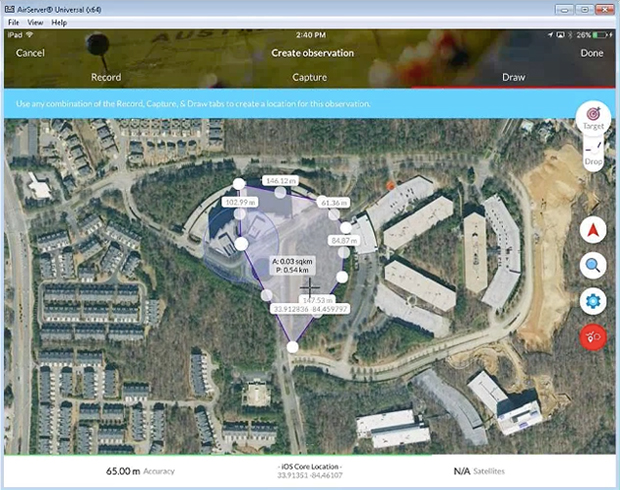
TerraGo, a provider of dissemination and collaboration software for defense and intelligence agencies, has announced the availability of R3 for immediate download in the National Geospatial-Intelligence Agency’s (NGA) GEOINT App Store.
R3 is a mobile data collection and collaboration app customized for the missions of reconnaissance, response and recovery. Designed for the most challenging missions and environments, R3 lets users keep working offline and off the grid with customizable workflows for security, humanitarian and disaster relief programs, the company said.
“R3 enhances situational awareness, search and rescue, damage assessments and recovery efforts,” said Scott Lee, director of federal programs at TerraGo. “It really gives users the best of both worlds with mobile technology that can go anywhere, and will also work even when the network doesn’t.”
Image: TerraGo
Designed with a simplified user interface, R3 provides a robust standalone capability for a variety of field-based collection activities. Users can access custom basemaps from numerous GIS, map and imagery sources including GeoPDF, ArcGIS, USGS and GXP, while collecting and exchanging location-tagged notes using smart forms, photos, videos and audio files.
Pre-loaded forms are available for structured assessments, and users can connect to a secure server to create unique mission packages and enable synchronous collaboration. R3 supports important standards like OGC GeoPackage interoperability and sharing geospatial assets among mission partners.
Registered GEOINT App Store users can download TerraGo R3 for iOS here. The Android version is complete and coming soon, the company added.
Harris Corporation and the National Geospatial-Intelligence Agency (NGA) are partnering to provide industry training for NGA employees, including skills in industrial practices and procedures which are not available through military or civil education programs.
Participants in the Training with Industry (TWI) program spend a year at Harris learning its business practices — such as workflows, innovative technologies and commercial processes — and then execute an assignment directly related to the training they received.
Harris Corporation and the National Geospatial-Intelligence Agency (NGA) are partnering to provide industry training for NGA employees, including skills in industrial practices and procedures which are not available through military or civil education programs.
Participants in the Training with Industry (TWI) program spend a year at Harris learning its business practices — such as workflows, innovative technologies and commercial processes — and then execute an assignment directly related to the training they received.
Boundless Desktop is a native, cross-platform desktop GIS built upon open-source software.
Boundless has been awarded a $36 million contract by the National Geospatial-Intelligence Agency (NGA), the primary source of GEOINT for the U.S. Department of Defense and the U.S. Intelligence Community.
The new contract supports NGA GEOINT Services and purchases services required to package, deliver, maintain and patch accredited open-source geospatial software packages.
NGA delivers geospatial intelligence, or GEOINT, that provides a decisive advantage to warfighters, policymakers, intelligence professionals and first responders. Both an intelligence agency and combat support agency, NGA fulfills the president’s national security priorities in partnership with the intelligence community and the Department of Defense.
NGA also is the lead federal agency for GEOINT and manages a global consortium of more than 400 commercial and government relationships.
Boundless offers an open GIS ecosystem through a combination of technology, products and experts that gives enterprises deeper intelligence and insights using location-based data. The Boundless platform is built upon open source technology and open APIs that generate actionable location intelligence across third-party apps, content services and plugins for enterprise applications.
In November 2016, the company extended its GIS platform with Boundless Connect, a subscription service to a comprehensive repository of GIS data, and Boundless Desktop, a full-featured, professional desktop GIS.
“It is great to see an organization like NGA adopting open source GIS,” said Andy Dearing, CEO of Boundless. “So many organizations are quickly realizing the power and flexibility of open source and the value that Boundless brings to market. This announcement further demonstrates the NGA’s commitment to Boundless and we are excited to continue our work with the agency.”
Last year, Huntsville, Alabama, was the site of the National Geospatial-intelligence Agency’s (NGA’s) first HackAThon — just one outreach event to take advantage of talent and skills outside the agency that could enrich the efforts of NGA.
The HackAThon was an initiative of both previous NGA Director Letitia Long and current Director Robert Cardillo. It was so successful that NGA had four other HackAThons in major cities, including New York, Boston and San Francisco, with a repeat this year in Huntsville.
The weekend HackAThon led up to the GeoHuntsville Summit, a geospatial conference that has been an annual event for more than 10 years. The conference was opened by long-time geospatial professional and advocate Chris Johnson and Huntsville Mayor Tommy Battle, who both have had supportive connections with NGA. The mayor highlighted the fact that for its size, Huntsville was somewhat unique in that it had a higher per capita population of Ph.D.s and engineers than any other city in the U.S. That same wealth of talent extends into geospatial, with more than 70 geospatial firms in the area.
New GeoHuntsville Director
GeoHuntsville Executive Director Jorge Garcia
Chris then introduced Jorge Garcia, who is taking over as the GeoHuntsville Executive Director. Jorge retired from the FBI, where he served as assistant director, Directorate of Intelligence. His 16-year military career includes combat tours in Iraq, which preceded 21 years with the FBI, and later intelligence work in Iraq during Operation Iraqi Freedom.
Jorge highlighted the goals of GeoHuntsville that were his marching orders, including the advancement of geospatial tools to prevent and/or mitigate natural and manmade threats to the region while fostering research, development and education of the geospatial tradecraft.
Presentation Highlights
Ken Graham, Director, Platform Services Division, National Geospatial Intelligence Agency (NGA)
As a sponsor of the event, and active part of GeoHuntsville, there was heavy participation by NGA staff, including NGA recruiters eyeing the 15,000-plus geospatial talent located in Huntsville. Ken discussed the success of the HackAThons and other outreach efforts developed by NGA’s Enterprise Innovation Office. Its focus on unclassified open source tools is changing the culture away from “that’s the way we always did it” to completely out-of-the-box thinking including “Shark Tank”-like evaluations of tools developed outside the agency, without the very slow and expensive procurement methods that took years to place new innovations into the hand of NGA users.
Ken explained that rather than NGA developing exact descriptions and specification of what the agency wanted, it instead describes a problem or need. The NGA then leaves it up to the creativity of outside developers to think of new approaches and solutions to the problem.
Most of the solutions can be created in unclassified environments and then tested by NGA staff using real agency data. In many cases, this negates the need for outside developers to have TS/SCI clearances, which are expensive and time consuming to obtain. The NGA goal, which sounds very ambitious, is to be able to get new tools into the hands of users less than 24 hours after a problem is identified!
Dan Koch, Oak Ridge National Laboratory (ORNL)
Koch demonstrated a system developed by ORNL that integrates various GIS tools in one easy-to-use environment called the Incident Management Preparedness Coordination Tool Kit, or IMPACT for short. This system was initially designed for EOD use during potential bombing events, but the system also proved useful to a broad audience of first responders.
The system can be used with web services, but also can operate in a disconnected environment, since much of the needed data resides locally. IMPACT includes traditional GIS tools and external data access augmented with bomb-blast patterns, crowd evacuation animations, plume models, contagion spread simulations, active shooter view-sheds, antenna placements and patterns and real-time live data feeds.
The afternoon breakout sessions included a detailed demonstration of IMPACT. You can see a demonstration of IMPACT in this youtube video. Some of the attendees mentioned that the system would be even nicer if it used the new CESIUM WebGL virtual globe to show 3D data.
Alabama Department of Transportation (ALDOT)
J.D. D’Arville of the ALDOT explained ALDOT’s use of off-the-shelf UAVs (DJI Phantom 3s and 4s) with eMotion software and senseFly S.O.D.A. cameras to capture very high-quality aerial imagery in multiple spectrums (see the senseFly video.} The imagery was then assembled into metric 3D models using Pix4D that permitted them to monitor contractor work. One early success was discovering poor “cut and fill” procedures by a contractor.
John Russell of ALDOT then explained survey data collection using what I believe is very disruptive technology —AeroPoints, developed by Propeller Aero. AeroPoints is a very accurate automated system that uses UAVs with innovative ground control pads to capture 2-cm-accurate aerial imagery. See a video of it in operation here.
Mike Botts, OpenSensorHub
Botts presented the latest examples of work he and his colleagues have done to advance the practical use of remote sensors. He pointed out a key advantage of working with GeoHuntsville, in that both developers and end users had the ability to learn from each other.
One example he cited was showing the display of live UAV video on a static map to a participating local fire chief. Since the video was related to the geography but not accurately geo-referenced, the fire chief said that it wouldn’t be useful. He explained that trying to figure out exactly what he was looking at and from which direction would be too time-consuming and potentially confusing. Botts and his staff took the problem in hand and developed a simple way to place the video footprint in the exact location and orientation that was spatially correct. This had been done before with high-end military systems, but never so simply and effectively.
UAVs
There were also several presentations by UAV users and the UAV users’ group that addressed both hardware and software. However, the UAV topics that still dominate the discussions are the administrative and legal issues that still cloud the use of the technology.
These were only the highlights of the conference. Although lasting one day, this was an information-rich conference worth attending.
The National Geospatial-Intelligence Agency (NGA) has signed a $20 million introductory contract with Planet that will provide small satellite collection and coverage of most of the Earth’s landmass.
The agreement is a step toward harnessing the potential, capabilities and services of the small sat and commercial imagery environment.
The NGA will have access to a global imagery refresh every 15 days of most of Earth’s landmass through the new contract. Planet is a commercial imagery provider operating the largest constellation of Earth-imaging satellites.Its feed, known as the Planet Feed, will be used across the National System for Geospatial Intelligence (NSG) and select members of the civil federal community. The NSG is the operating framework supported by producers, consumers or influencers of geospatial intelligence, or GEOINT.
“Improving our profession means further committing to the use of innovative capabilities being developed and deployed by commercial data providers and analytic companies for mission accomplishment,” said NGA Director Robert Cardillo at the May 2016 GEOINT Symposium in Washington, D.C. “Our commercial space partners will provide meaningful, higher revisit capabilities this year and we look forward to turning their exciting potential into our mission reality.”
The introductory contract includes a seven-month period of performance, beginning Sept. 15 and valued at $20 million.
The Planet Feed includes multispectral imagery from constellations at 3-5 meter and 6.7 meter resolutions. The imagery products will include unrectified and orthorectified images and orthomosaic single-pass tiles. The global scope of coverage and high temporal frequency of collection from Planet provides NGA with new data sources to support the agency’s many missions including foundation GEOINT, humanitarian assistance, disaster response and intelligence.
“Planet’s mission to provide timely, global imagery to empower informed, deliberate and meaningful stewardship of the planet is directly in line with our mission,” said John Charles, NGA commercial imagery lead. “We’re no longer simply admiring the potential of small satellites and their persistent capabilities, we’re harnessing that potential.”
Autumn in New Hampshire on Oct. 17. (Photo: Planet)
Planet designs, builds, and operates a constellation of Earth imaging nano-satellites. The global scope of coverage and high temporal frequency of collection from Planet will provide NGA with new data sources to use for geospatial intelligence analysis.
Commercial GEOINT Activity. Earlier this year, NGA, together with the National Reconnaissance Office, also launched a new office to synchronize activities for collection and analytic capabilities that can benefit both agencies.
Commercial GEOINT Activity (CGA) allows both agencies to assess current capabilities and develop strategies to ensure the timely and successful integration of commercial innovations that will benefit NGA and NRO.
This activity serves as a voice for NGA and NRO to the commercial GEOINT enterprise. The CGA conducts joint assessments, recommends investment decisions, and engages user communities. It advises NGA and NRO on synchronizing joint acquisition activities for vendors who can provide both collection and analytic capabilities to benefit the agencies. The CGA also develops strategies to access, acquire and integrate commercial GEOINT capabilities.
Most of you are familiar with hackathons, but this one was focused on geospatial solutions for first responders with NGA’s GeoQ as a foundation. The goal was to hack unclassified geospatial datasets and open-source tools to build effective solutions for disaster response and recovery.
The foundation – NGA’s GeoQ
Ray Bauer, who heads up the NGA GeoQ effort, was the keynote speaker. He explained how GeoQ meets the goals set by former NGA Director Latisha Long and current Director Robert Cardillo to take advantage of open-source data, applications and most important talent. Ray explained how the growing complexity of the GEOINT world forces NGA to take advantage of every geospatial resource available while keeping their classified work secure.
Ray stated NGA’s hackathon goals, specifically:
“We are interested in working with participants to identify and create new, interactive and efficient ways of reading, disseminating and analyzing tons of data from disparate systems. We highly encourage leveraging open-source tools and other software solutions participants bring to the table. This hackathon is not just for those entrenched in the geo world! We’re interested in everything from new mapping interfaces, mobile solutions, lightweight and portable information dashboards, hardware integrations with commercial off-the-shelf tools like sensors and UAVs, and everything in between!
“The intent of this event is to think outside the box and employ new tools and alternative open-source data to more efficiently and accurately send the most relevant data to emergency responders quickly. Currently there are dozens of data sets that make it difficult to quickly search and integrate into a common operational environment, particularly across the sectors: firefighter, police, hospital, dispatcher, HEMSI, air evacuation, utilities, Department of Transportation, etc. How do we share information among these groups during disaster situations such as tornadoes, hurricanes, shootings, flooding, significant traffic events, chemical spills and other potentially catastrophic events?”
For those of you not familiar with GeoQ, there is an excellent overview produced by NGA that is on Youtube.
GeoHuntsville hackathon goals
The pre-event announcements listed the following goal.
Combine commercial and proprietary hardware and software solutions to create unique concepts/solutions. Specifically:
Solve disparate data problems among current open source data sets (i.e. overlaying multiple shape files with real-time data from multiple sources such as emergency responder software, sensors in the field, social media, e.g.).
Recreate more aesthetically appealing user interfaces considering numerous data sets — to include mobile solutions.
Suggest new solutions leveraging a subset of currently available data. (Use the data we give you, use the data you bring, use the data we don’t know about — and create a solution to a problem we don’t know exists.)
Integrate new solutions or disparate data into open source tools, like GeoQ.
Identify ways to more efficiently and accurately receive and analyze updates from the field. (This could be anything from a tool an emergency responder uses or social media resources.)
Come up with a way to disseminate critical information across agencies and geographic locations.
First responder involvement
The aspect of this hackaton that was particularly valuable was the direct involvement of numerous Huntsville first responders. Policemen and firemen were able to explain their difficulties and needs face to face with the programmers and engineers who were participating in the hackathon, so the participants were not operating in a vacuum. See my interview with the Huntsville fire chief.
Fueled with sodas, chips and snacks, the hackers worked overnight to accomplish the goals. At stake were three prizes, including a top prize of $1,000. The prizes were not huge, but they provided some incentive including bragging rights.
Although some results were similar to existing applications, the different approaches were still very impressive for a two-day event. You may find one or two applications worth your further investigation for integration in your systems.
The teams
Mobile Damage Assessment
Micah Cleveland and Larry Wilbourn provided firefighters with a way to directly report the status of damaged structures or casualties and triage via a smartphone.
Situational Awareness
The team of Larry Mason, Tyler Hughes and Michael Carroll built an application displaying real-time locations of all emergency vehicles and the display of preplan floor plans and imagery to show details such as electric and gas cut offs.
Virtual Reality GIS Display
Jason Rade and Jason Nofki demonstrated their system of displaying GIS data and imagery using a virtual reality headset. They indicated that the next step was to display the data as augmented reality.
OpenSensorHub
Steve Jones demonstrated a system to display Internet of Things (IoT) devices as live links on a map to display data, imagery and video from those sources. (Steve participated in the event, but did not enter into the competition.)
WEBEOC data to current devices
Two team members worked a problem proposed by Madison County Emergency Management Agency. They read legacy format WEBEOC data and converted the information into more modern device data structures.
And the winners are…
First Place: Mobile Damage Assessment
Second Place: WEBEOC data to current devices
Third Place: a tie between Situational Awareness and Virtual Reality GIS Display
A few gems developed at the hackathon may be useful with your applications effort. If you need additional information regarding the hackathon and participants, contact Chris Johnson of GeoHuntsville at [email protected].
When I was the GIS manager of the Atlanta Regional Commission, the most rewarding and important work we did was geospatial support for our first responders. The culmination of this effort was creation of a portable GIS that we could set up in the field on short notice anywhere in the region to provide situational awareness for first responders.
The system consisted of two laptops, external hard drives, a HP “E”-size plotter, foam-board laminator and an LCD projector — all housed in a portable tent. We used ArcInfo and ArcView to build and overlay vector data on ortho/oblique aerial imagery to aid visualization.
We found that police and firefighters especially liked our large laminated plots of imagery overlaid with street data, because the aerial images were easy to understand and the GIS data provided needed location references. The hard-copy plots required no computer and could be marked up with grease pencils.
Helping in our small way, we provided the same kind of large plots of New Orleans to the Louisiana National Guard days after Hurricane Katrina hit. We later learned that the plots were used by National Guard headquarters to keep track of search-and-rescue efforts by marking up neighborhood blocks with grease pencils and recording search results. They crossed off buildings that had been searched and recorded urban rescue information such as who did the search, and the date and number of live or deceased bodies found. The hard-copy plots were a low-tech embodiment of higher tech GIS data and imagery.
Nine years later, the National Geospatial-Intelligence Agency (NGA) developed a similar but higher tech and more robust system called GeoQ.
GeoQ: Geographic Work Queueing and Tasking System
GeoQ is an open-source geographic tasking and management system that facilitates collection and display of diverse geographic and geographically tagged data across large areas to provide situational awareness for all involved. As needed, the large areas can be broken down into small grid squares and assigned to teams or team members for detailed analysis or tasking.
The system is designed to be very transparent so all involved can view the workflow and assist as needed, while avoiding duplication of effort. This NGA video is a well done and rapid overview of GeoQ.
GeoQ software was developed by NGA and the MITRE Corporation to leverage NGA tools and data to the benefit of Homeland Security personnel. In 2013, the leadership at NGA made a gutsy decision to share some of their unclassified geospatial tools with the nation’s first responders through GitHub, an open-source software developers’ online collaboration environment. With more than 2 million participating programmers, GitHub hosts more software source code than any other single service in the world.
GeoQ was the first NGA product shared through GitHub, and was in keeping with a change in philosophy at NGA to take advantage of feedback and improvements generated by the huge and diverse talent pool available through GitHub. NGA was the first intelligence agency to share some of its work in this open-source environment, and the results have been extremely beneficial to all involved.
The Huntsville Connection
With more than 70 geospatial firms and agencies, Huntsville, Ala., has always been an early adopter of geospatial technology. Several years ago it was again a Huntsville team that developed a first-ever Google Earth Enterprise-based emergency response system called Virtual Alabama. The system was so effective that eight other states adopted the model. Work was underway to build a national version when Google announced the phasing out of Google Earth Enterprise. We now know that Google was not motivated to build authoritative geospatial systems, but was focused on building products and services that attracted customers so it could accomplish its primary business of selling advertising.
Fortunately, the work of the Virtual Alabama team was not wasted. Team members became experts regarding first-responder operations and their unique situational awareness requirements. They learned that first responders needed much more than just a GIS. The best analogy I can think of is that one could use PowerPoint as a word processor, but that wouldn’t be a very efficient system. Likewise, MS Word could be used for presentations, but not as elegantly as PowerPoint. The same holds true for rapid dissemination, communication and perception of a common operational picture. Geospatial tools and analysis are part of situational awareness, but the work flow and many components are different, not necessarily spatial and need to be assembled and processed at their own pace.
The timing was almost perfect, since GeoQ was released as Google Earth Enterprise was being phased out. Huntsville again seized the opportunity to build on its experience, and GEOHuntsville became a prime GeoQ testbed. I recently met with Chris Johnson, one of the early Virtual Alabama leaders and president of A Visual Edge, Inc., a Huntsville geospatial firm. She demonstrated GeoQ and Huntsville’s role in advancing the technology.
GitHub has a very thorough description of GeoHuntsville, a non-profit 501c6, and its role with NGA to test and share lessons learned through a “Blueprint for Safety” pilot project involving other cities to improve rapid disaster response. The sharing of lessons learned, code sets and documentation through the multi-city collaboration is called “Exemplar City.”
Another aspect of the Blueprint for Safety is support of rapid sensor deployment in support of first responders through common standards. Sort of a “plug-and-play” for complex devices. (See the GeoQ projects page and the OpenSensorHub.)
There is quite an extensive collection of material on GitHub regarding GeoQ and other NGA, projects including support of FEMA and GeoQ technical specifications. NGA doesn’t directly support these efforts, with legal language such as “NGA assumes no responsibility for the use of the software by any parties, and makes no guarantees, expressed or implied, about the software quality, reliability, or any other characteristic.” Still, NGA is behind the creation of the software and is working on other tools and support that will expand the capabilities. Participation of both GeoHuntsville and the Federal Emergency Management Agency (FEMA) bodes well for future use, since I don’t envision the same situation we ran into with Google and Virtual Alabama/USA.
Update on What3Words
In February, I wrote about what3words. The simple what3words system is now available as a locator, accessible via the Esri ArcGIS platform.
Editor’s Note:This week, Geointelligence Insider’s Art Kalinski reports from GEOINT 2015, being held in Washington, D.C., June 22-25.
GEOINT 2015 is not your daddy’s geospatial conference. If there is a common theme to this convention, it’s the problem of too much data and not enough analysts, so there are many exhibitors addressing the issue with automated systems that merge the “man and machine,” taking advantage of the best capabilities of each.
Introduction
NGA Director Robert Cardillo on the Agency’s Strategy
NGA Director Robert Cardillo discusses the agency’s new strategy at GEOINT 2015. Cardillo became the sixth director of the National Geospatial-Intelligence Agency in October 2014.
A Demonstration of Esri’s ArcGIS Full Motion Video Add-In
Geointelligence Insider’s Art Kalinski talks with Craig Cleveland, Esri solution engineer, about the ability to geo-register full motion video inside an ArcMap.
Thad Allen Discusses eLoran at GEOINT 2015
In this interview Admiral Thad Allen, former commandant of the U.S. Coast Guard, discusses PNT alternatives to GPS for navigation, including eLoran and the activation June 19 of a signal on an eLoran tower in preparation for a timing signal trial.
Allan is an executive vice president at Booz Allen Hamilton, and a leader in the firm’s Departments of Justice and Homeland Security business in the civil market. In 2010, President Obama selected him to serve as the National Incident Commander for the unified response to the Deepwater Horizon oil spill in the Gulf of Mexico.
Geoweb 3D Demonstration at GEOINT 2015
Vincent Autieri, vice president and CEO of Geoweb 3D, explains the company’s 3D mapping engine.
CACI Predictive Tool Using Social Media Discussed at GEOINT 2015
Andrew Doyle, engineering senior manager of CACI, describes the EMBERS system, which uses social media to predict socially significant events such as protests or disease outbreaks.
The National Geospatial-Intelligence Agency (NGA) has awarded Image Matters LLC a contract to address some of the agency’s most pressing challenges through its Accelerating Map of the WorldInitiative. The initiative will deliver innovative solutions that expedite and strengthen the agency’s Map of the World (MoW). MoW is foundational to the Intelligence Community’s object-based production environment.
MoW will provide easy access to an expanded web of integrated intelligence (content within context), grounded by authoritative geospatial features, for everyday decision makers, operational users, and intelligence analysts.
Image Matters LLC was selected for its proposed linked-data strategy addressing the integration of object-based-intelligence (OBI) with foundation geospatial intelligence. NGA seeks to enhance the capability to generate, curate, analyze and share structured OBI as linked data with originating information tracking.
“This award builds upon a decade of advanced research and development into innovative analysis techniques for OBI,” said Harry Niedzwiadek, CEO of Image Matters LLC. “Our efforts began with NGA’s $1M Innovations in Geospatial Intelligence Award (2005), through which we pursued a vastly improved solution to what former Director James Clapper referred to as the ‘volume, velocity, variety and veracity (4V) problem’, known commonly today as the ‘Big Data problem’. Following this pioneering work, and complementary extended research with DARPA and others, we set our sights on next generation object-based production and analysis tools and services. Accelerating Map of the World has great potential to dramatically enhance the effectiveness and productivity of analysts, in a far more seamless and integrated fashion than ever before.”