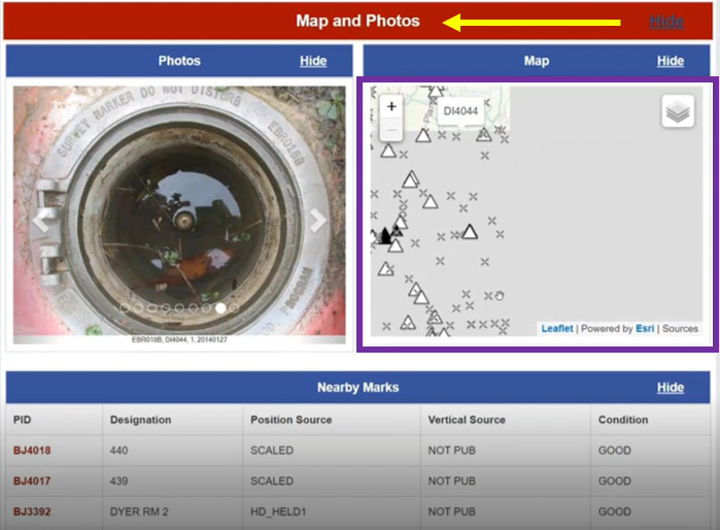
Tag: NOAA CORS Network

  • NGS new alpha preliminary products in support of the modernized NSRS

    NGS new alpha preliminary products in support of the modernized NSRS

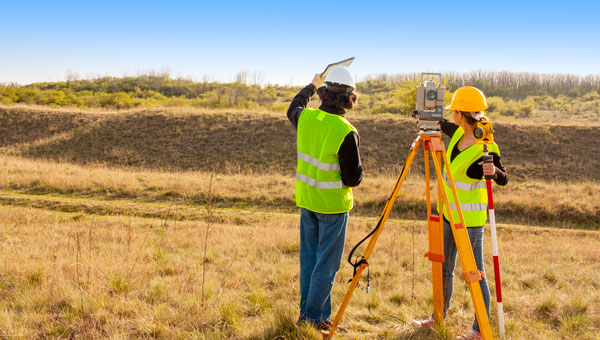
    Photo: SonjaBK / iStock / Getty Images Plus / Getty Images
    Photo: SonjaBK / iStock / Getty Images Plus / Getty Images

    In my last newsletter, I highlighted the release of a beta version of a new NOAA CORS Network (NCN) Station Web Page. As demonstrated in my newsletter, each CORS in the NCN has its own page with data, metadata, maps and photos for that station displayed in a modular layout so information is easily found all in one location. This past month, I had the privilege of participating in a meeting with representatives from the American Association for Geodetic Surveying (AAGS), the National Society of Professional Surveyors (NSPS) and the National Geodetic Survey (NGS). As a Past President of AAGS and the current Chair of the AAGS Membership Committee, I participate in these quarterly meetings.

    AAGS aims to lead the community of geodetic, surveying, and land information data users through the 21st century. AAGS members develop new educational programs, including presentations, seminars, and workshops on topics related to geodetic surveying; and articles and papers that inform the membership of the latest scientific and technological developments and how to implement them in the most cost-effective and efficient manner.

    In my previous newsletters, I have reminded everyone that time is running out to obtain a working knowledge of the new, modernized National Spatial Reference System (NSRS). The release of the new, modernized NSRS is only about a year away. As of July 2024, NGS plans to have a beta version of the new, modernized NSRS available around the summer of 2025 for users to test and evaluate new products and services. After enough testing has been performed, the new, modernized NSRS will be officially published – probably in early to mid-2026.

    At the meeting, NGS highlighted some new products on its Alpha Preliminary Products site. The alpha site provides products that are useful for individuals who want to obtain a better understanding of the products that will be distributed as part of the new, modernized NSRS.
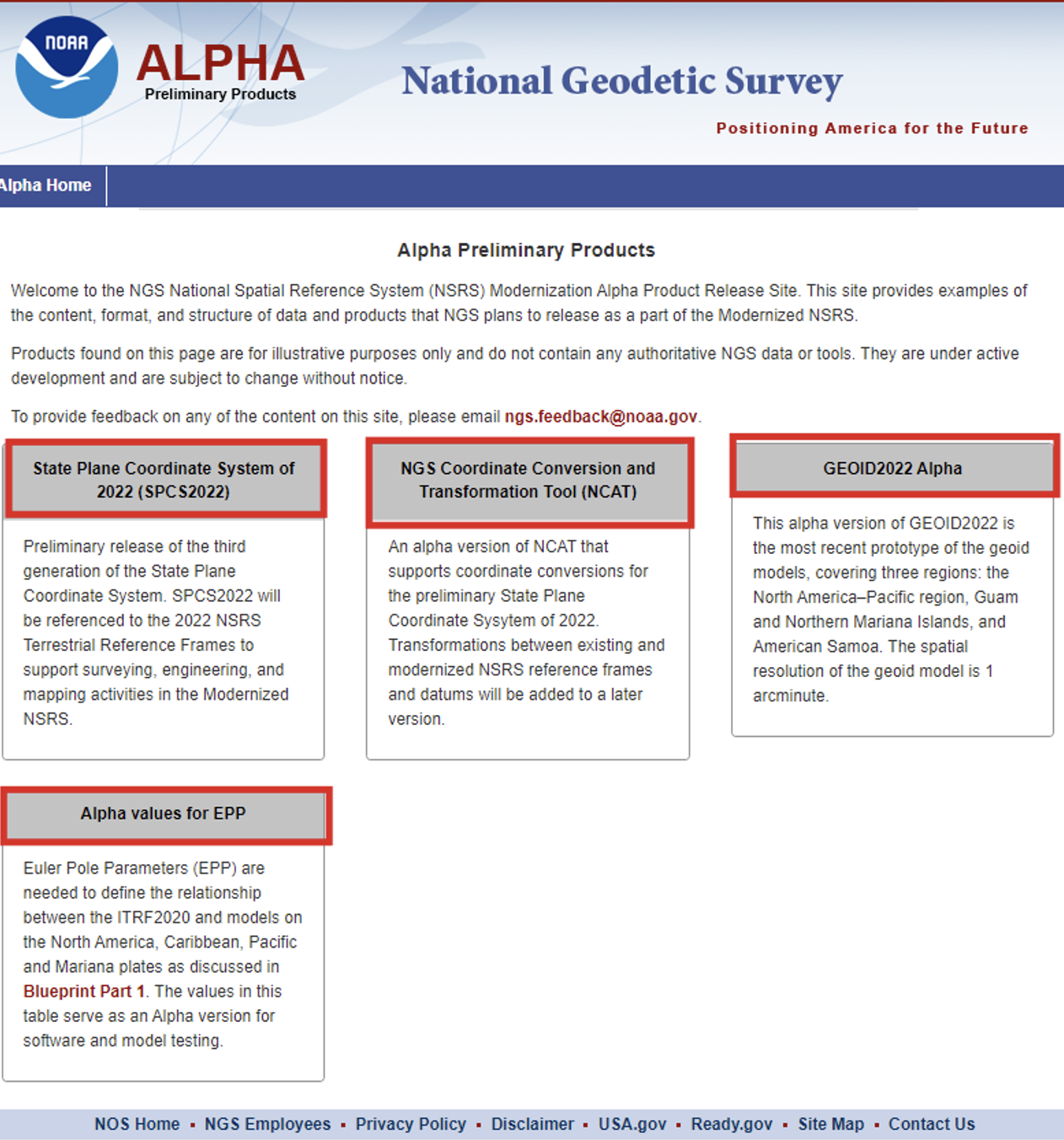
    Photo:

    Some of my previous newsletters have discussed the Alpha product concept.  My September 2023 newsletter highlighted the first two Alpha products; that is, State Plane Coordinate System of 2022 (SPCS2022) and NGS Coordinate Conversion and Transformation Tool (NCAT).  As of June 2024, two more products have been added to the Alpha Preliminary Products site – “GEOID2022 Alpha” and “Alpha Values for EPP.”  The State Plane Coordinate System of 2022 (SPCS2022) is probably the most important to land surveyors.  There are significant changes between the SPCS2022 and the State Plane Coordinate System of 1983 (SPCS83). I will highlight the latest options in the alpha site later in this newsletter.

    First, I want to bring attention to the importance of ensuring that the state’s legislation is modified or rewritten, if required, to include that the current horizontal and vertical datums are being replaced with the new, modernized NSRS. The “Learn More” button on the SPCS2022 Alpha site provides information about legislation.
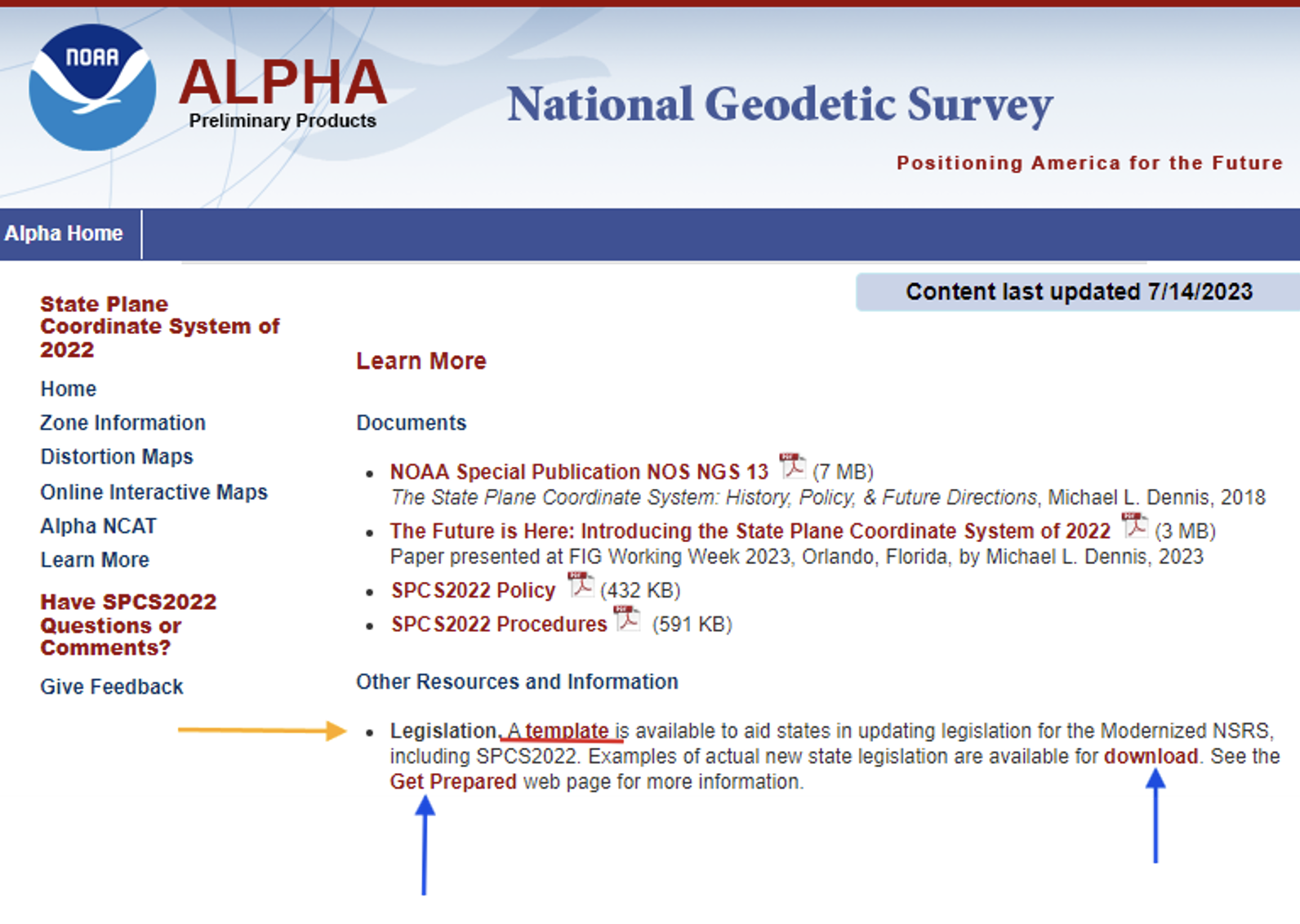
    Photo:

    On the “Learn More” site, NGS provides an SPCS legislation template.

    Per personal communication with Michael Dennis, Ph.D., NGS SPCS2022 Manager, as of June 26, 2024, the following 12 states have have enacted into law NSRS modernization: Alaska, Idaho, Iowa, Kansas, Kentucky, Louisiana, Nebraska, North Carolina, South Dakota, Vermont, Washington, and Wyoming.

    Users can download examples of actual new state legislation here.
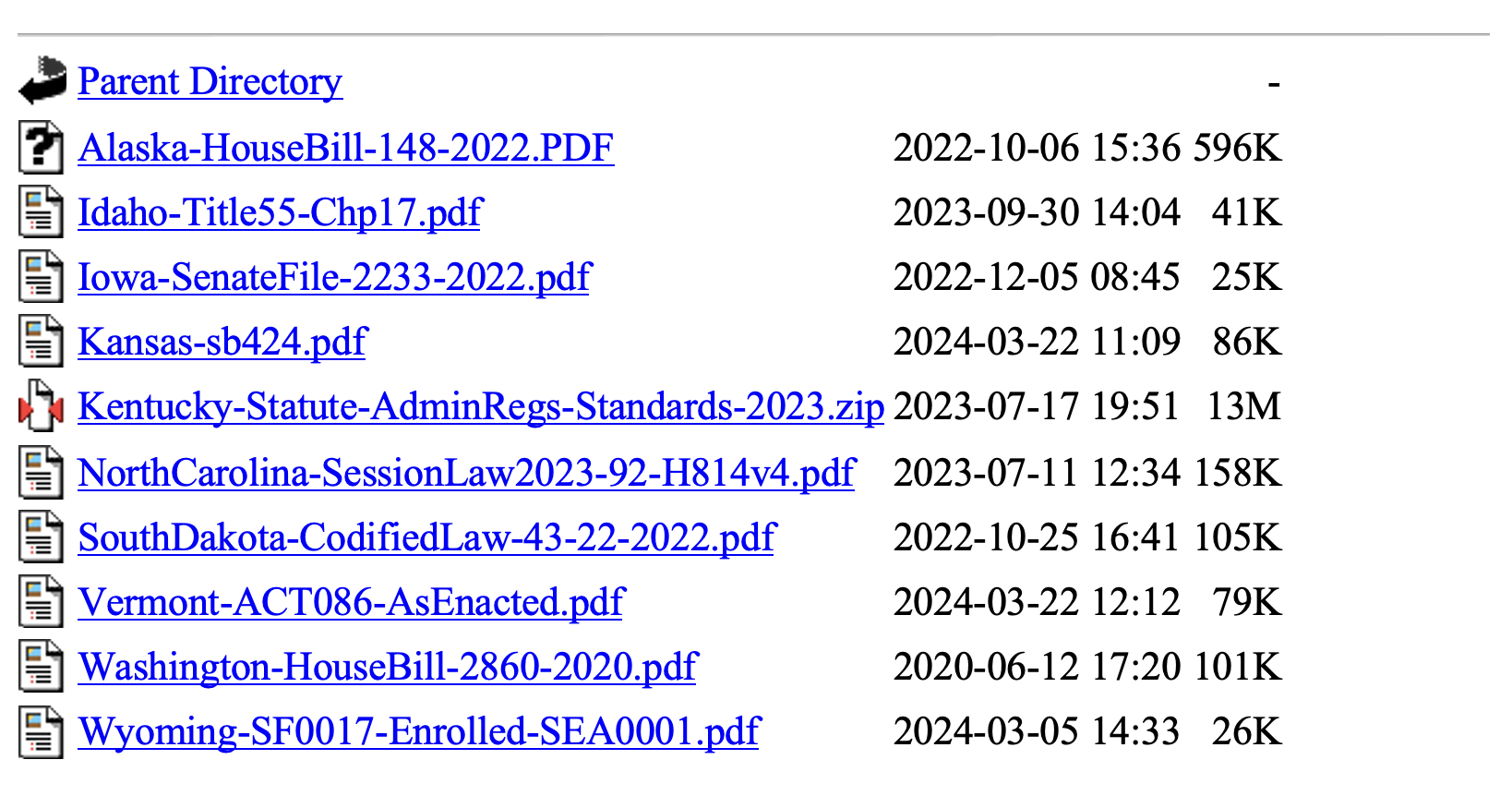
    Photo:
    Examples of legislation.

    During the joint AAGS/NSPS/NGS meeting, Tim Birch, the executive director of NSPS, said that anyone who has questions about updating legislation for the new, modernized NSRS, including SPCS2022, can contact him directly. NSPS has experience working with agencies and individuals to develop legislation as indicated in the following statement on the NSPS website.

    “We are the voice of the professional surveying community in the US and its territories. Through its affiliation agreements with the respective state surveying societies, NSPS has a strong constituency base through which it communicates directly with lawmakers, agencies, & regulators at both the national and state level. NSPS monitors and comments on legislation, regulation, & policies that have potential impact on the activities of its members and their clients, and collaborates with a multitude of other organizations within the geospatial community on issues of mutual interest.”

    Tim’s contact information is provided on the NSPS home webpage: Staff List – National Society of Professional Surveyors (nsps.us.com).

    As previously stated, the two latest alpha products are the “GEOID2022 Alpha” and “Alpha Values for EPP.” My December 2017 newsletter discussed GEOID 2022 and the North American-Pacific Geopotential Datum of 2022 (NAPGD2022), and my February 2022 newsletter discussed the Euler Pole Parameters process and use in the new, modernized NSRS.

    The GEOID2022 Alpha page provides a version of GEOID2022, which is the most recent prototype of the geoid models. The reference ellipsoid is Geodetic Reference System 1980 (GRS 80, but the geometric reference frame is ITRF2020). The Alpha GEOID2022 prototype data is available for download in two formats, “ASCII” and “.b.” There is a static component (SGEOID2022) and a dynamic component (DGEOID2022). These grids will be useful to programmers who want to develop and test their systems. Additional grids and tools will be available in the future.


    Technical Details of the Alpha prototype of GEOID2022

    GEOID2022 alpha is the last prototype of GEOID2022. It covers three regions: the North America–Pacific region, Guam and Northern Mariana Islands, and American Samoa. The spatial resolution of the geoid model is 1 arcminute. The geoid heights, which are in the tide-free system, are with respect to the reference ellipsoid of the Geodetic Reference System 1980 (GRS80) in the ITRF2020 geometric reference frame. GEOID2022 alpha includes static and dynamic components for the geoid heights. For detailed fundamental parameters of the geoid model, refer to NOAA Technical Report 78.
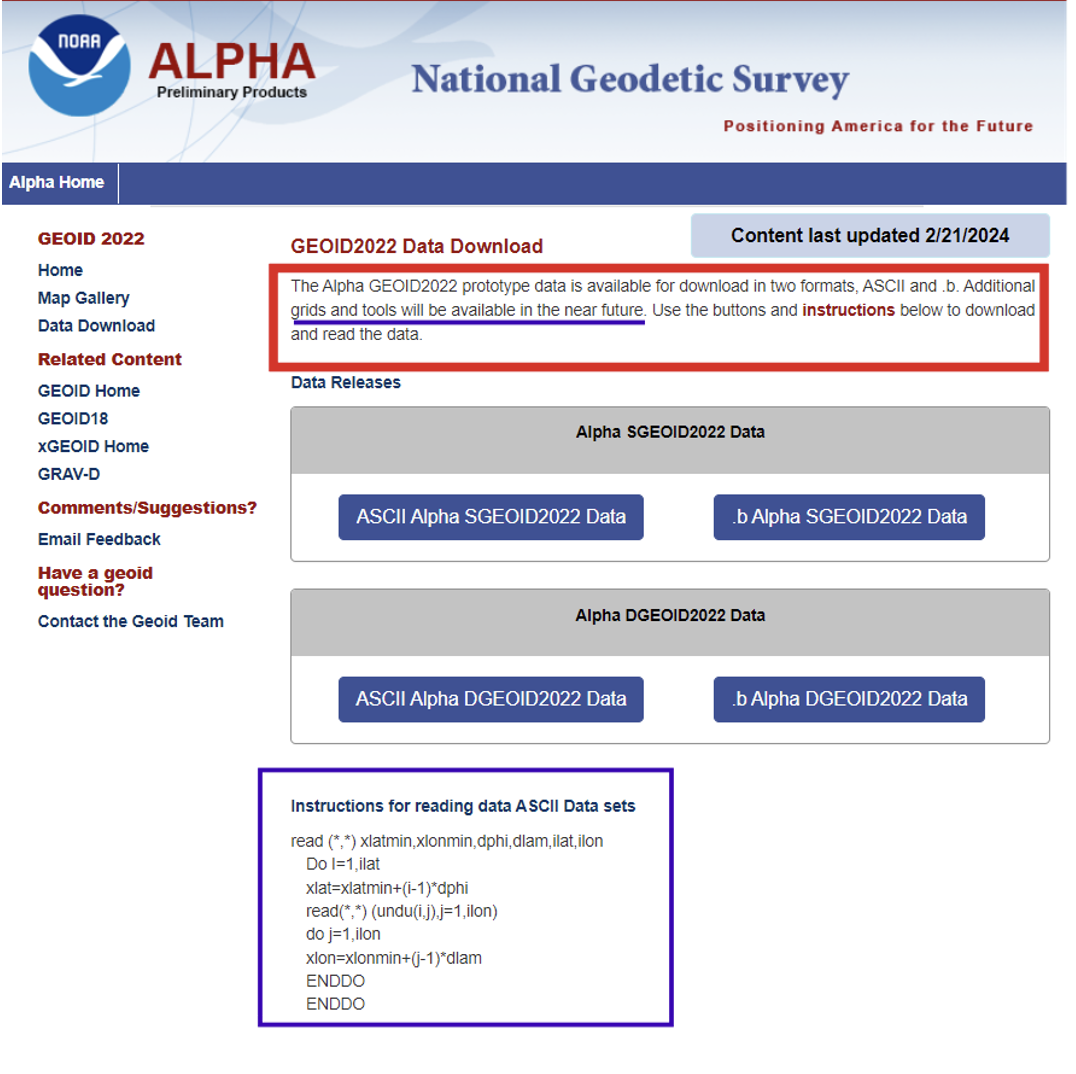

    Photo:
    GEOID2022 Alpha


    The Alpha EPP site provides the Euler Pole Parameters (EPP) that are needed to define the relationship between the ITRF2020 and models on the North America, Caribbean, Pacific and Mariana plates as discussed in NGS’s Blueprint Part 1 document.
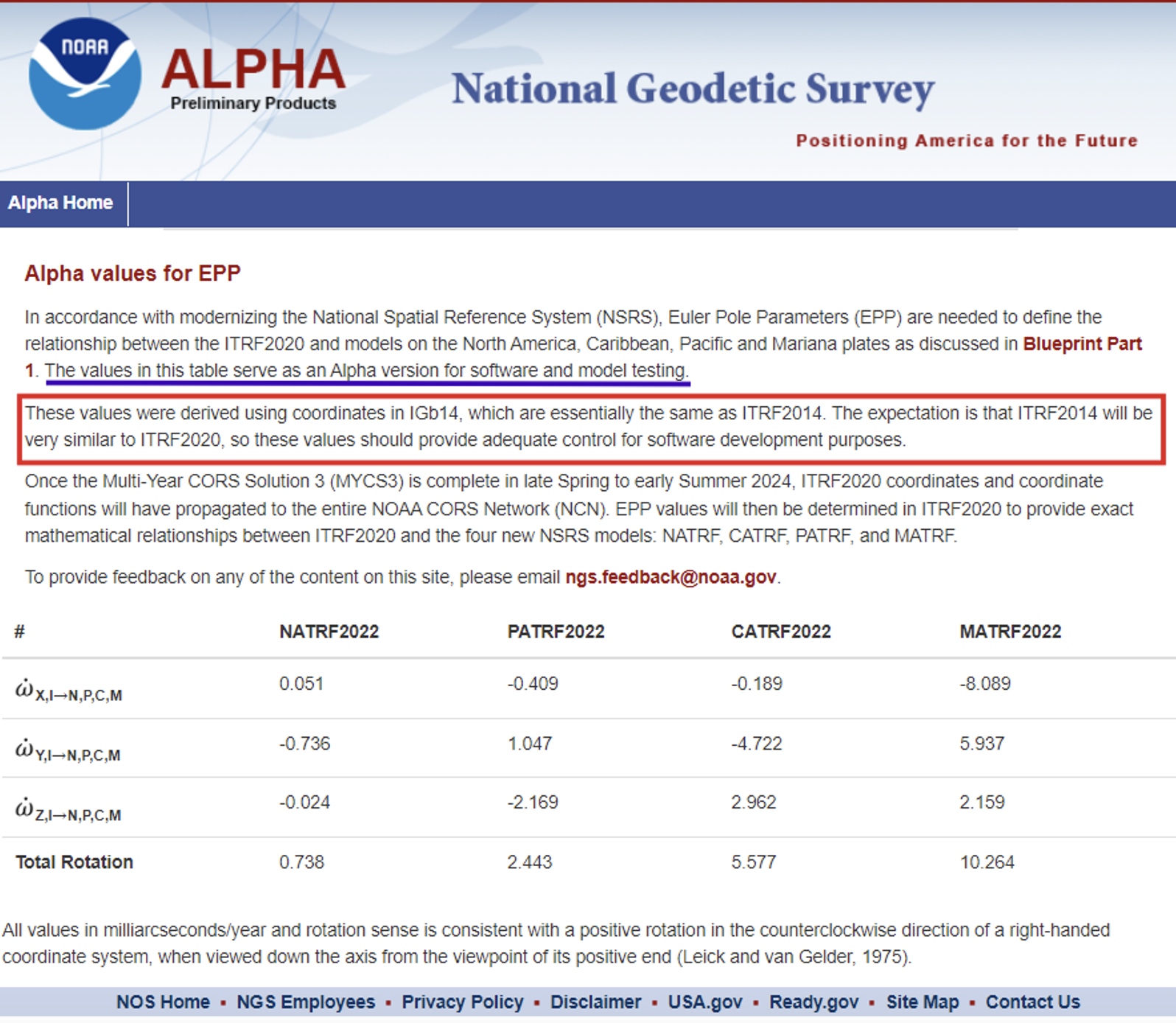
    Photo:
    Alpha Values for EPP

    As stated in Blueprint Part 1, NGS will define the official relationship between ITRF2020 and the four NSRS TRFs through equation 59, using the rotation matrix in equation 58 resulting in equation 60.

    I programmed this using a simple Excel spreadsheet to compute some of the potential changes between epochs for North Carolina. They were very similar to the ones that I depicted in my February 2022 newsletter that discussed the Euler Pole Parameters process and provided plots depicting the movement.

    Photo:

    I would like to highlight the latest information available on the State Plane Coordinate System of 2022 alpha site. As previously stated, in about a year, the new, modernized NSRS will be available as a beta product. Users must get prepared by accessing NGS’s alpha products as well as taking the opportunity to provide feedback to NGS to improve their products and services. The Online Interactive Maps page provides information about the zones for every U.S. state and territory.

    Photo:

    Clicking on the Online Interactive Maps link opens a NOAA ArcGIS online website that provides information about the Alpha State Plane Coordinate System 2022 preliminary zone designs. I have highlighted a few items that may be of interest to users.

    The site provides a description of the site, links to various types of zones, links to data sources and information about distortion.

    SPCS2022 online interactive maps
    SPCS2022 online interactive maps.


    Clicking on the link for zone definitions provides a list of zones and their parameters. This same information is also provided when users click on a zone on the map. I will demonstrate this later in this newsletter.

    Per personal communication with Dennis, as of June 26, 2024, seven states have some or all their SPCS2022 zone definitions formally finalized, consisting of 205 out of the 965 zones (the total number of zones is still preliminary):

    • Alaska (partial coverage multizone layer)
    • Arizona (both multizone layers)
    • Idaho (both multizone and statewide)
    • Kentucky (both multizone and statewide)
    • North Carolina (statewide zone; it has no other zones)
    • South Dakota (both multizone and statewide)
    • Wisconsin (multizone)

    Dennis informed me that the information on the alpha SPCS2022 Experience has been updated. He told me that the total number of zones decreased from 967 to 965, but based on coordination with the International Association of Oil & Gas Producers (IOGP) Geodesy Subcommittee the number may eventually increase to 972 (more about that in a future newsletter).

    He stated that his goal is to finalize the zone definitions by the end of this calendar year or early 2025. Users should keep checking the alpha site.

    Dennis mentioned that the website now offers a new feature that provides the distortion value when users click on the map. A nice thing about that is the site can be used on a smartphone, allowing users to obtain real-time distortion information from their location.

    Clicking on the link titled “View” in the upper right corner of the box brings up a map that depicts the SPCS2022 zones.

    View of ALPHA (preliminary) SPCS2022 zone designs.
    View of ALPHA (preliminary) SPCS2022 zone designs.

    When you click on the note about the ALPHA being preliminary, the map underneath appears where the user can select the type of maps they wish to review.

    The following options are available: All Zone Layers, Statewide Zone Layers, Multizone Complete Layers, Multizone Partial Layers, and Special Use Zone Layers.

    Users can use their mouses or the “+” button on the left-hand side” to zoom to a particular region, or use the search button on the right-hand side to select a State or zone.

    Photo:

    Using the search box.
    Using the search box.

    Information about a particular zone pops up by clicking on a point on the map.

    Detailed information provided for a zone.
    Detailed information provided for a zone.

    Each zone provides links to other features based on the location of the point selected on the map.

    The image below provides the distortion in ppm for the point selected on the map.

    Photo:

    Photo:

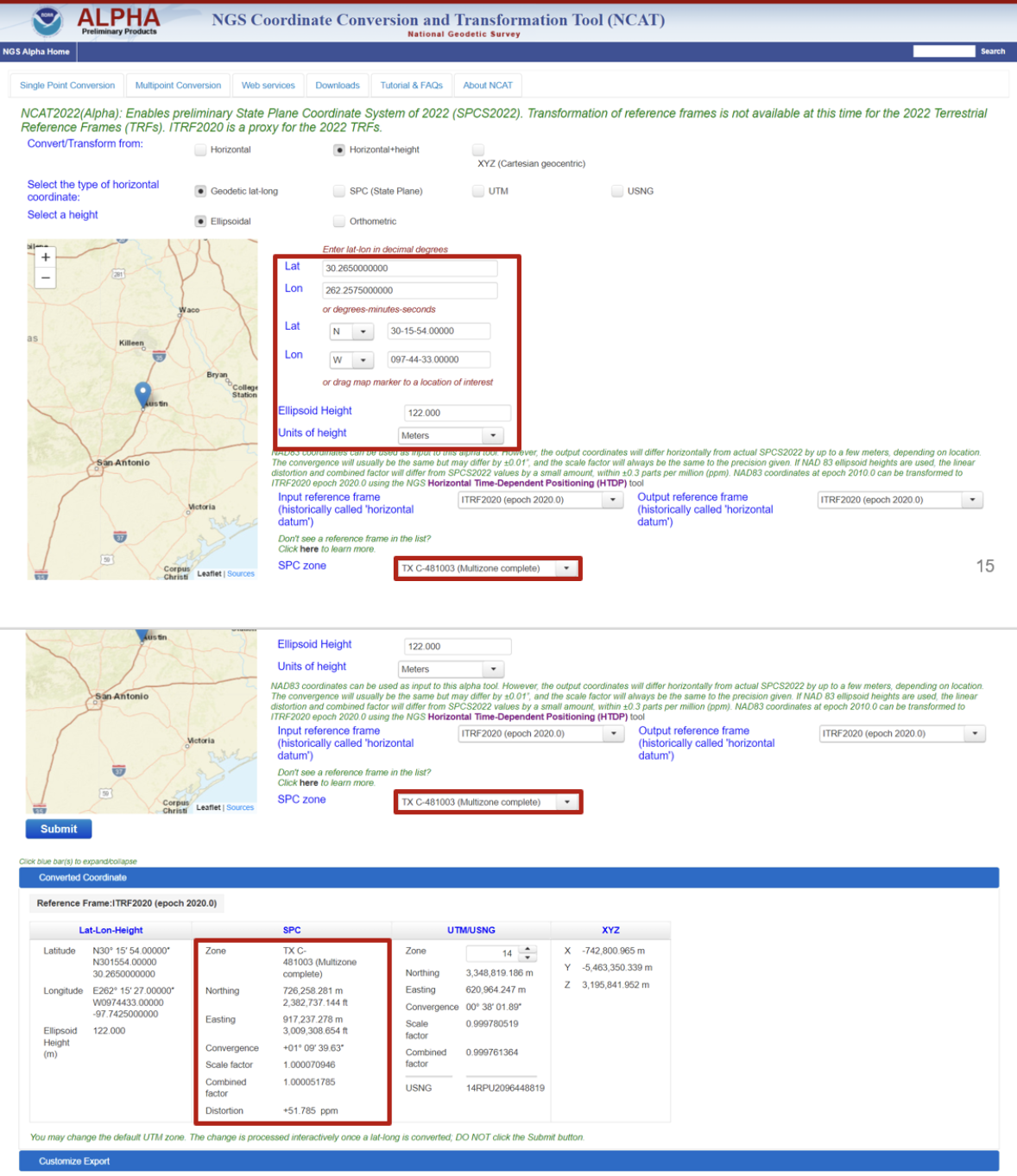
    The Alpha NCAT site can be used to obtain an estimate of the changes between SPCS83 and SPCS2022. It should be noted that all values will be in meters (m) and international feet (ft).

    International feet may be new to some surveyors who were previously using the U.S. survey feet in SPCS83. The U.S. survey foot will not be used with the NSRS, including SPCS2022 coordinates. NGS and the National Institute of Standards and Technology (NIST) have taken action to deprecate the U.S. survey foot. What does that mean?. NIST has the following statement on its website: “Beginning on January 1, 2023, the U.S. survey foot should be avoided, except for historic and legacy applications, and has been superseded by the international foot.” This means that NGS will not be publishing SPCS2022 in U.S. survey feet but all historic products and services such as SPCS83 will still be provided in U.S. survey feet (sft) and international feet (ift).

    More information and resources about the deprecation of the sft are listed below (personal communication from Dennis):

    • The official announcement is the final determinationFederal Register Notice (FRN) on deprecation of the sft issued on 10/5/2020. It was jointly issued by the National Institute of Standards and Technology (NIST) and NGS. I encourage everyone concerned about this topic to read it closely and in its entirety; it can likely answer most questions. The FRN includes information on the continued use of sft for legacy applications (such as SPCS 83). That is stated in the last paragraph of the “Notice of Final Determination” section; in items #1 and #2 in the “Counterpoints to Feedback Expressing Opposition”section; and in the second paragraph of the “Implementation Summary and Actions” section.
    • The legacy issue is also addressed in the 10th FAQon the NIST website and in the 11th FAQon our “new datums” FAQs web page.
    • The 40 states that officially adopted the sft for SPCS 83 are listed in Table C.1 of Appendix C of NOAA Special Publication NOS NGS 13, “The State Plane Coordinate System History, Policy, and Future Directions.”
    • Although the final determination FRN is itself not a law, Congress has passed several laws giving NIST the authority to maintain national standards of measurement. These and other related federal laws are given in the initial sft FRNissued on 10/17/2019.
    • An NGS webinar given on 11/10/2022 addresses the deprecation of the sft in the context of state plane. Two previous NGS webinars also provide additional background and historical information on the sft, one given on 4/25/2019 and the other on 12/12/2019.
    Input to Alpha NCAT.
    Input to Alpha NCAT.
    Photo:
    Photo:Output from Alpha NCAT.

    This newsletter highlighted the products on NGS’s Alpha Preliminary Products site. The alpha site provides products that can be useful for individuals to obtain a better understanding of the products that will be distributed as part of the new, modernized National Spatial Reference System (NSRS). NGS is providing these products on an alpha site so that they can get feedback from users. I would encourage all users to access the alpha sites and provide comments to NGS so that their products and services better meet the needs of the surveying and mapping community.


    Alpha Preliminary Products

    Welcome to the NGS National Spatial Reference System (NSRS) Modernization Alpha Product Release Site. This site provides examples of the content, format, and structure of data and products that NGS plans to release as a part of the Modernized NSRS.

    Products found on this page are for illustrative purposes only and do not contain any authoritative NGS data or tools. They are under active development and are subject to change without notice.

    To provide feedback on any of the content on this site, please email [email protected].
  • NGS Discusses the New NSRS at the International 2023 FIG Working Week

    NGS Discusses the New NSRS at the International 2023 FIG Working Week

    Anyone reading my previous columns knows that I have been highlighting the new, modernized, National Spatial Reference System (NSRS) of the National Geodetic Survey (NGS). During the 2023 Fédération Internationale des Géomètres (FIG) Working Week held on May 28 – June 30, in Orlando, Florida, NGS held an all-day session addressing various topics related to the NSRS modernization project.

    More than 30 NGS staff members supported two days of sessions that included a day on the NSRS modernization, sessions for the Young Surveyors Network, and FIG Commission 5 meetings, which focused on meeting the highest accuracy levels for positioning and measurement.

    Juliana Blackwell, director of NGS, kicked off the third plenary session tackling the global challenges, with a presentation titled “The Modernized U.S. National Spatial Reference System — Aligning National Geospatial Data to the Globe.”

    Blackwell highlighted the importance of geospatial data from many different sources being interoperable and defined within a modern reference frame. She noted that NGS is part of the National Oceanic and Atmospheric Administration (NOAA), the mission of which is to understand and predict changes in climate, weather, ocean, and coasts. This includes a mandate to define, maintain and provide access to the NSRS.

    NGS’s NSRS modernization project has been underway for a decade and is nearly complete. Blackwell explained that the new NSRS will align critical U.S. geospatial data assets within global data inventories and enable improved analysis and modeling of climate changes and impacts to society and the environment. The modernized NSRS will enable data integration of new and old technologies, adopts modern standards, and empowers growth in new fields and applications.

    The remainder of the presentations during the all-day event covered three themes: the practical implications of NSRS modernization — changing survey methodology; an update on the NOAA CORS Network and the Online Positioning User Service (OPUS); and case studies of surveys — what NGS does now and how they will change.

    Many of these topics have been discussed by NGS during their webinar series, but during these presentations NGS provided the latest information on many of the activities associated with the modernization of the NSRS. This venue allowed for participants to ask questions as opposed to typing them in a box. Also, the NGS employees that participated in the FIG working week were available for discussions before and after the session. I enjoyed my discussions with old colleagues as well as meeting some new NGS employees.

    The session titled “Practical Implications of NSRS Modernization — Changing Survey Methodology” addressed the following topics:

    practical impacts of the modernized NSRS

    Canada’s implementation of the modernized frames

    changes afoot: State Plane 2022 and Retirement of the U.S. Survey Foot and

    preparing for the modernization of the NSRS.

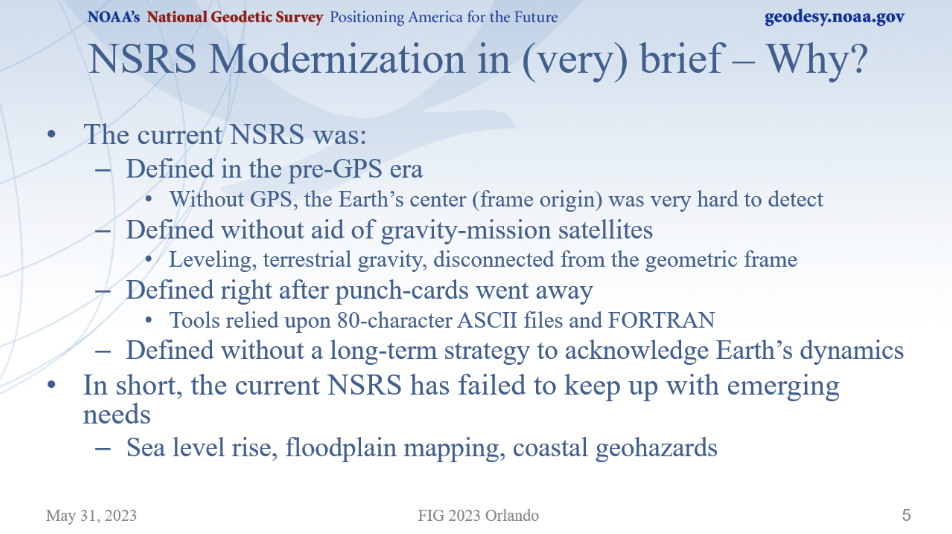
    Dru Smith, NSRS modernization manager, started by explaining the practical impact of the modernized NSRS and why it is needed. He mentioned that the current NSRS was defined in the pre-GNSS era and that it has failed to keep up with emerging requirements, such as accurately measuring sea level rise.

    (Image: NGS Website)
    (Image: NGS Website)

    He highlighted the practical implications of the modernized NSRS, such as that every latitude, longitude, and ellipsoid height will change from its NAD 83 values in the +/-2-meter range, and every orthometric height will change from its NAVD 88 values in the +/-2-meters median range.

    He mentioned that the published coordinate functions of the NOAA CORS Network (NCN) will be the primary geodetic control of the NSRS. He noted that NGS is working on the integration of web-based tools to improve consistency and reduce confusion, such as enhancements to NGS’s OPUS to ingest digital data from surveying instruments directly into OPUS 6 via a Geodetic Data Exchange (GDX) format. This would include raw measurements from GNSS receivers, levels, total stations, and gravimeters. The talk titled “Augmenting Data Exchange Formats for OPUS of the Future” by Ryan Hardy, discussed the GDX format in more detail.

    As with the International Terrestrial Reference Frame, the modernized NSRS will have a time-dependency component. It will be built into the new NSRS, but users will have the ability to disengage from it.

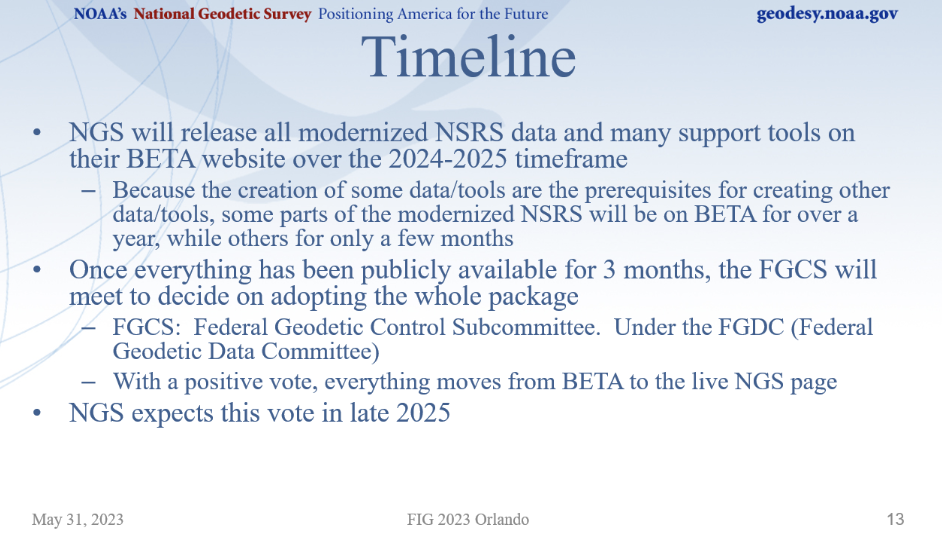
    Smith provided a timeline of the project for the next couple of years, which can be referenced in the image below. NGS plans to release data and support tools on their BETA website during 2024 and 2025.

    (Image: NGS Website)
    (Image: NGS Website)

    Smith discussed how some products will be released early for users to test and evaluate how the new NSRS products will affect their products and services, and to be ready for their customers after the new NSRS is released for publication. Products scheduled for early releases (Alpha Release), include SPCS2022, EPP2022, and GEOID2022.

    He emphasized that Alpha products, by definition, can be one or more of the following:

    • incomplete
    • inaccurate
    • buggy
    • subject to change without notice

    As such, their early release is primarily for users to see the “big picture” such as formats of data and the general direction that NGS is taking.

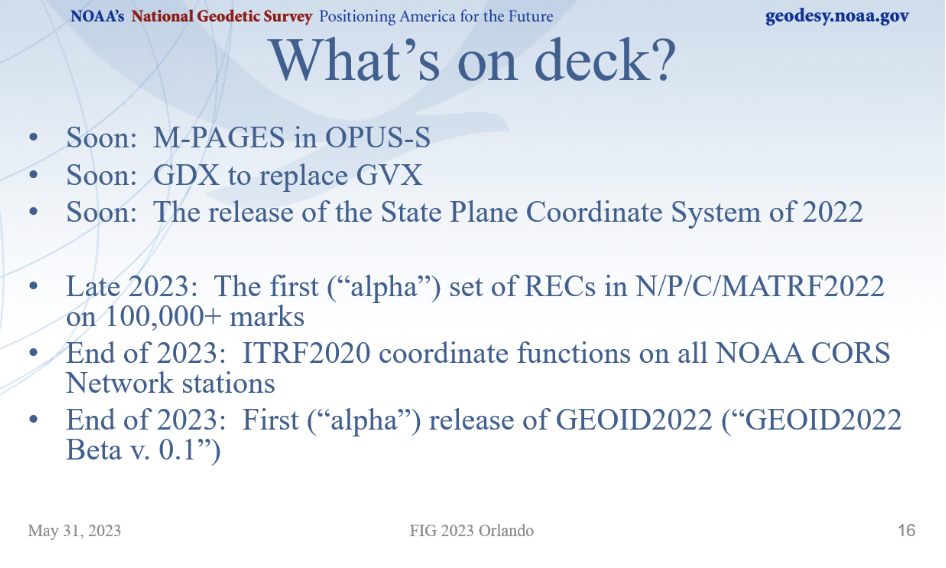
    He provided a list of new products that will be announced soon, and some alpha products tentatively planned for release in 2023.

    (Image: NGS Website)
    (Image: NGS Website)

    Michael Dennis did a nice job of discussing the State Plane Coordinate System of 2022 (SPCS 2022) and the retirement of the U.S. Survey Foot. He mentioned that the U.S. Survey Foot was superseded by the international foot on December 31, 2022. His presentation gave a brief overview on the status and rollout plans for SPCS2022, along with how and why NGS will continue to support the U.S. Survey Foot in the existing NSRS (but not in the modernized NSRS).   

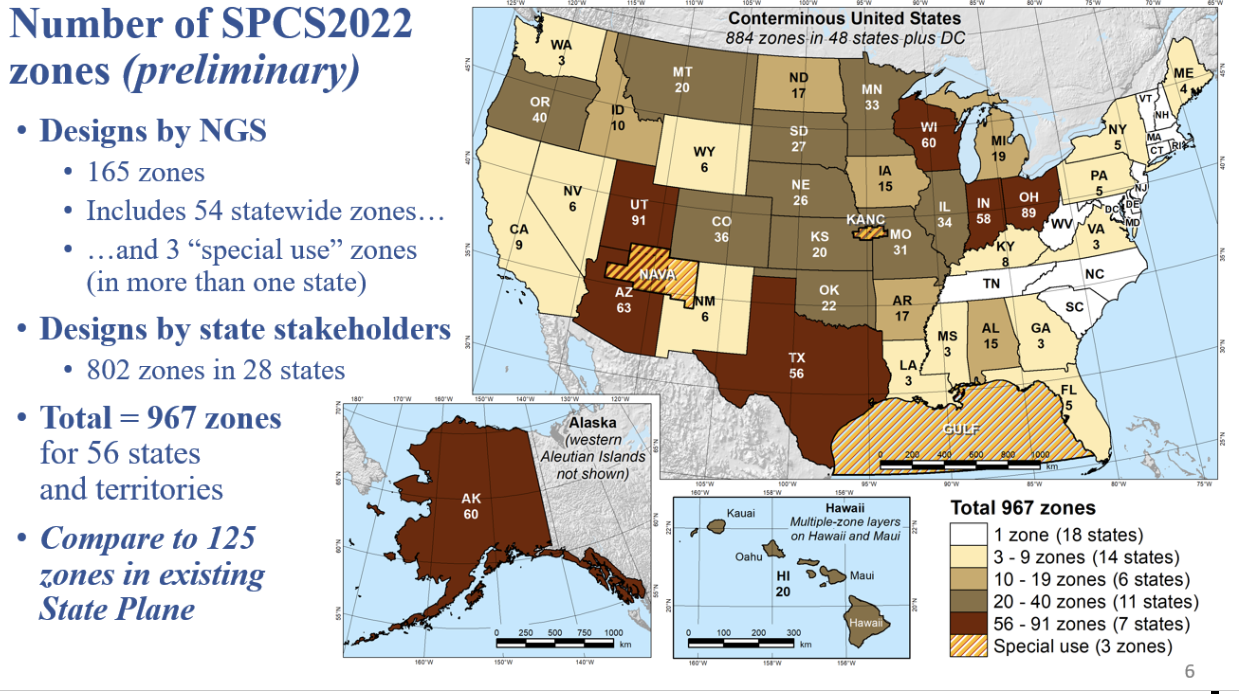
    See the image below for the number of zones for each state.  

    (Image: NGS Website)
    (Image: NGS Website)

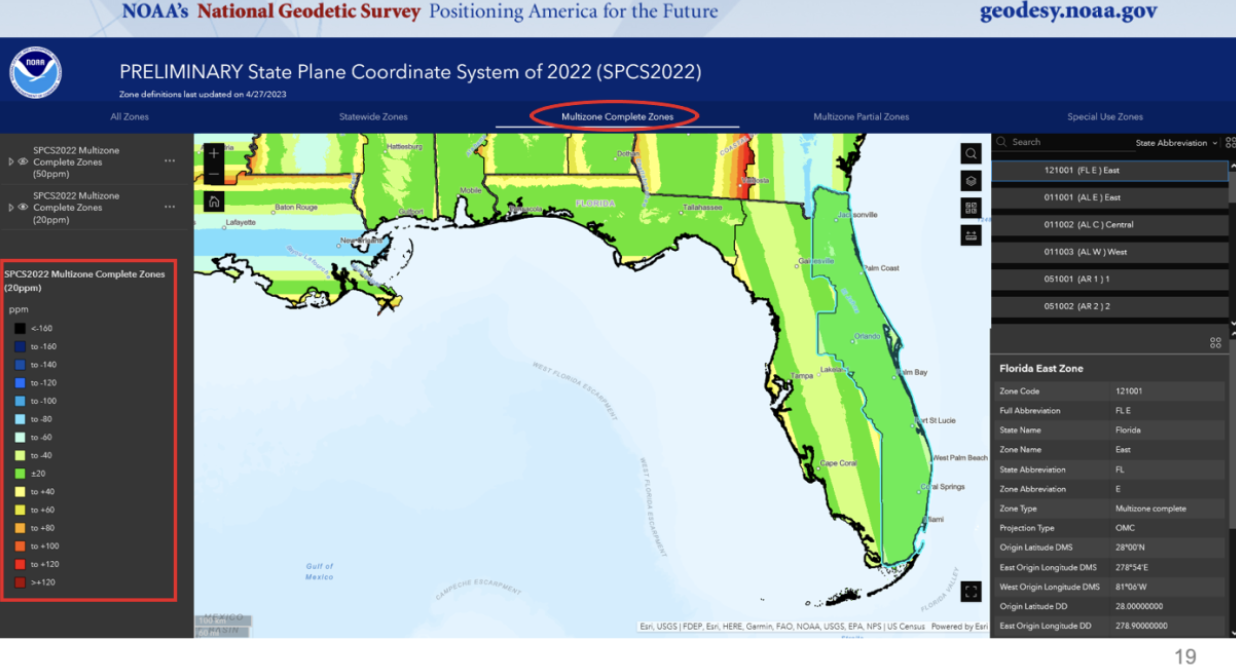
    The SPCS2022 will be an alpha product released soon. Part of the alpha product will have options to view maps depicting the different zones in each state.  

    Example of Florida Multizone Complete Zones. (Image: NGS Website)
    Example of Florida Multizone Complete Zones. (Image: NGS Website)

    When NCAT2022 is released in alpha product it will contain the SPCS2022.   

    Example of NCAT2022 (Alpha). (Image: NGS Website)
    Example of NCAT2022 (Alpha). (Image: NGS Website)

    Representatives from the Canadian Geodetic Survey presented and participated in the discussions. 

    The session titled “Update on the NOAA CORS Network and OPUS” addressed the following topics: 

    • the NOAA CORS Network (NCN) services 
    • updating OPUS-S to support multi-GNSS 
    • OPUS -Projects 5: supporting RTK for establishment of geodetic control 
    • OPUS projects for manager’s training – transitioning from instructor-led to online, self-paced instruction and 
    • augmenting data exchange formats for OPUS of the future. 

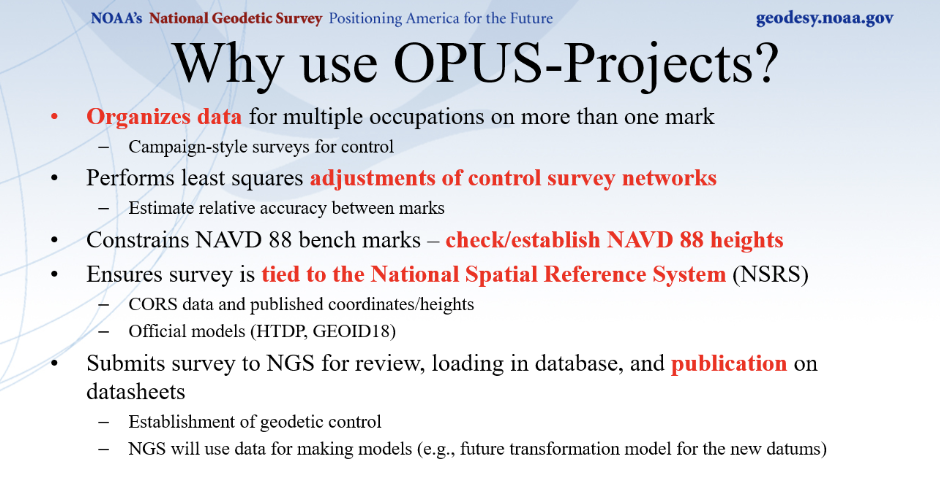
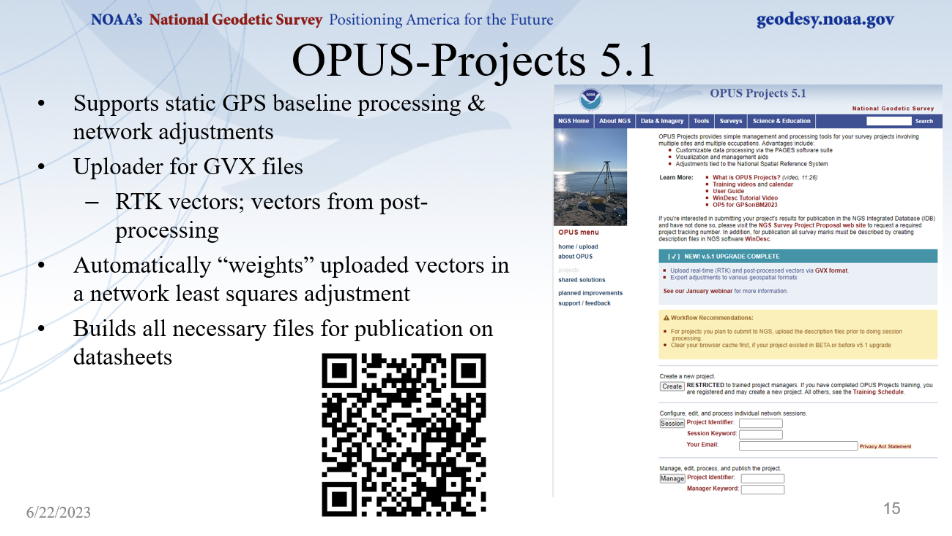
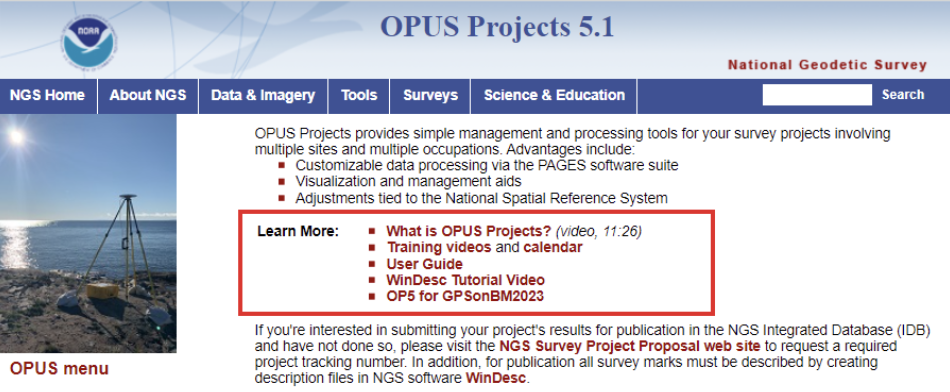
    Dan Gillins gave a presentation on the advantages of using NGS’s OPUS-Projects 5 web routine. OPUS-Projects make it easier for users to submit a GNSS project to NGS for publication. I discussed OPUS-Project 5.1, when it was released as a Beta product, in my October 2021 column.  

    (Image: NGS Website)
    (Image: NGS Website)
    (Image: NGS Website)
    (Image: NGS Website)

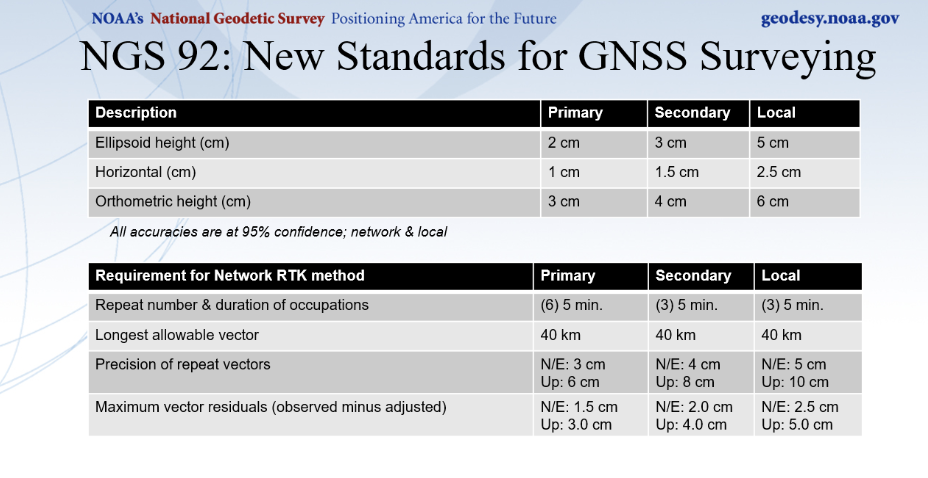
    Gillins mentioned that a new publication providing guidance to meet standards for GNSS surveying is being reviewed and will be available soon. I discussed these new standards in my May 2023 column.

    (Image: NGS Website)
    (Image: NGS Website)

    Another presentation titled “OPUS-Projects for Manager’s Training – Transitioning from Instructor-Led to Online, Self-Paced Instruction” by Erika Little, described how NGS is transitioning to providing OPUS projects training on an online, self-paced instruction site. NGS has training material available for OPUS-Projects.

    (Image: NGS Website)
    (Image: NGS Website)

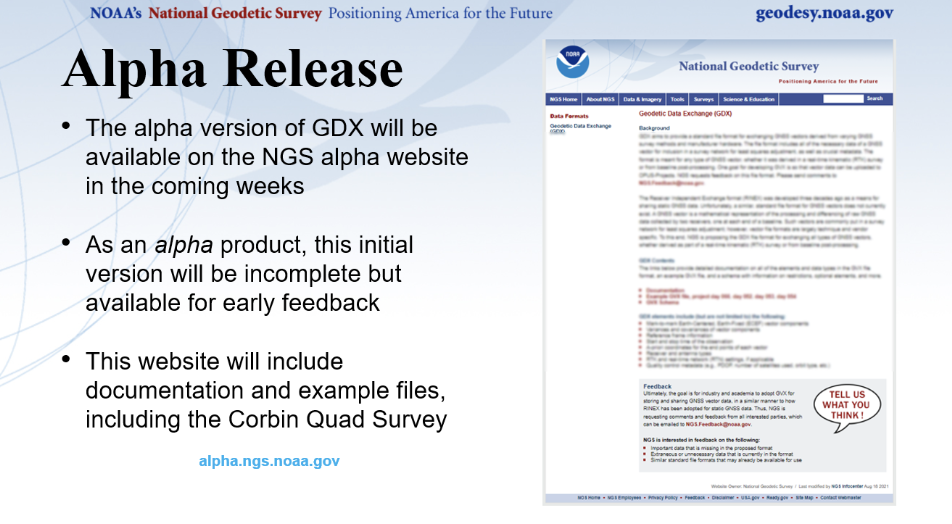
    Ryan A. Hardy gave a talk describing the new Geodetic Data Exchange (GDX). As previously mentioned, GDX is an XML-based data format that will be the input format for OPUS. GDX will be the successor to the GNSS Vector Exchange (GVX) format. GDX currently supports GNSS, classical, and leveling measurements.

    The GDX structure will have the following fields[[these are clearly the names of database fields; if it were a list of different types of information, we would not put them in all caps and would not use the underscores]]:

    • SOURCE_DATA
    • PROJECT_INFORMATION
    • PERSONNEL
    • UNITS
    • EQUIPMENT
    • POINTS
    • MEASUREMENT_SETTINGS
    • MEASUREMENTS
    • REDUCTIONS
    • OBSERVATIONS

    NGS is planning to release an alpha version of GDX soon.

    (Image: NGS Website)
    (Image: NGS Website)

    The session titled “Case Studies of Surveys — NGS Does Now and How They will Change” addressed the following topics: 

    • implementing NGS OPUS-Projects’ GVX feature to align RTK vectors to the NSRS to establish geodetic control for FirstNet indoor mapping 
    • IGLD: a case study for leveraging digital tools to enhance QA/QC on large scale static GNSS observation campaigns 
    • geodetic leveling in the modernized NSRS and 
    • NGS field operations: modernizing in many ways. 

    Ben Erickson gave a good presentation on leveling in the new NSRS, a topic about which I am very interested in knowing more[[Please avoid dangling participles, prepositions, conjunctions, and modifiers.]]. I discussed the new procedures in my June 2020 column.  
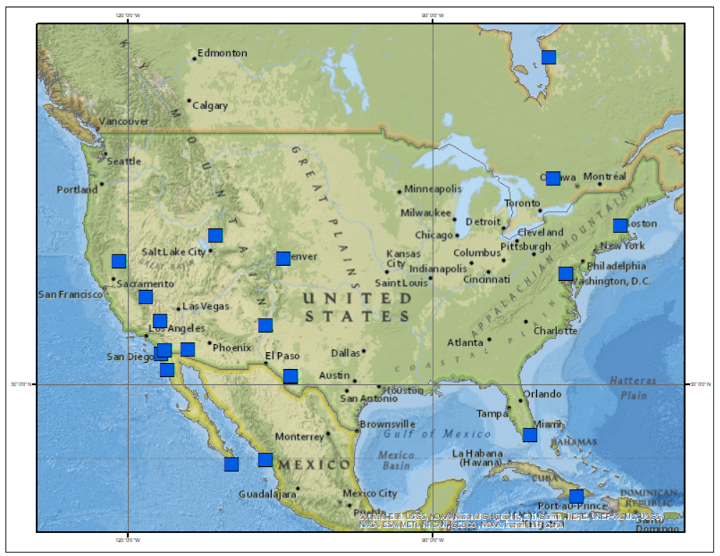
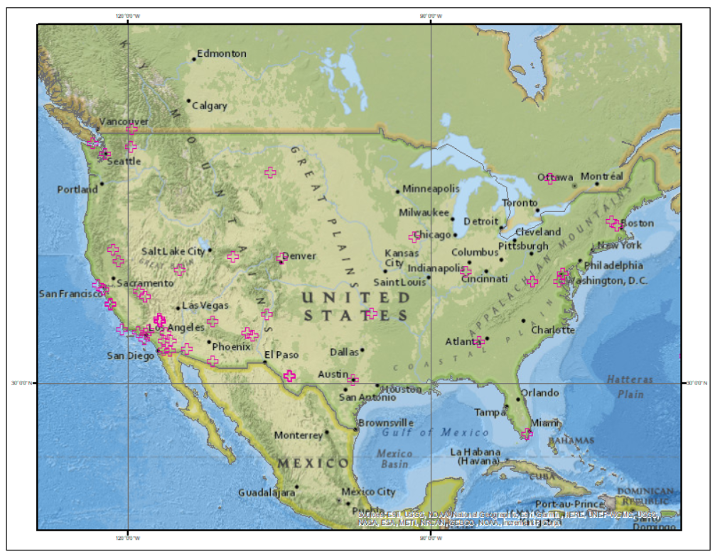
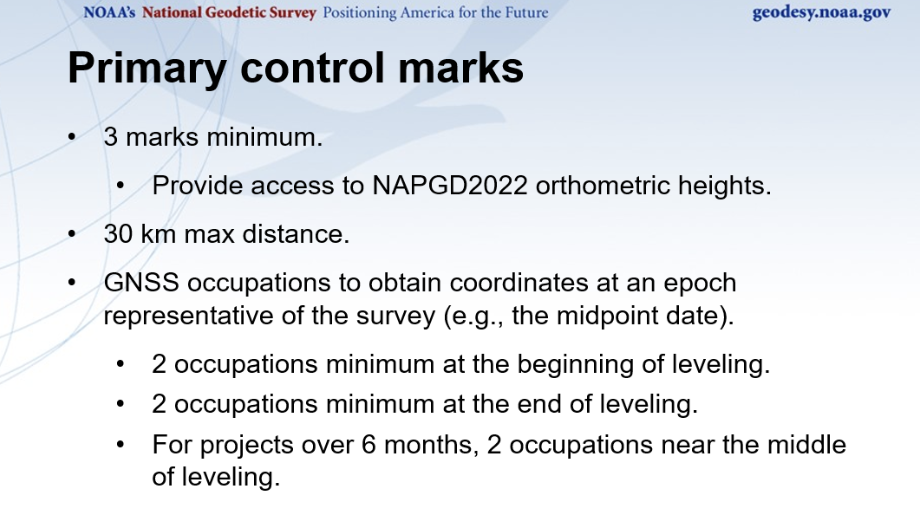
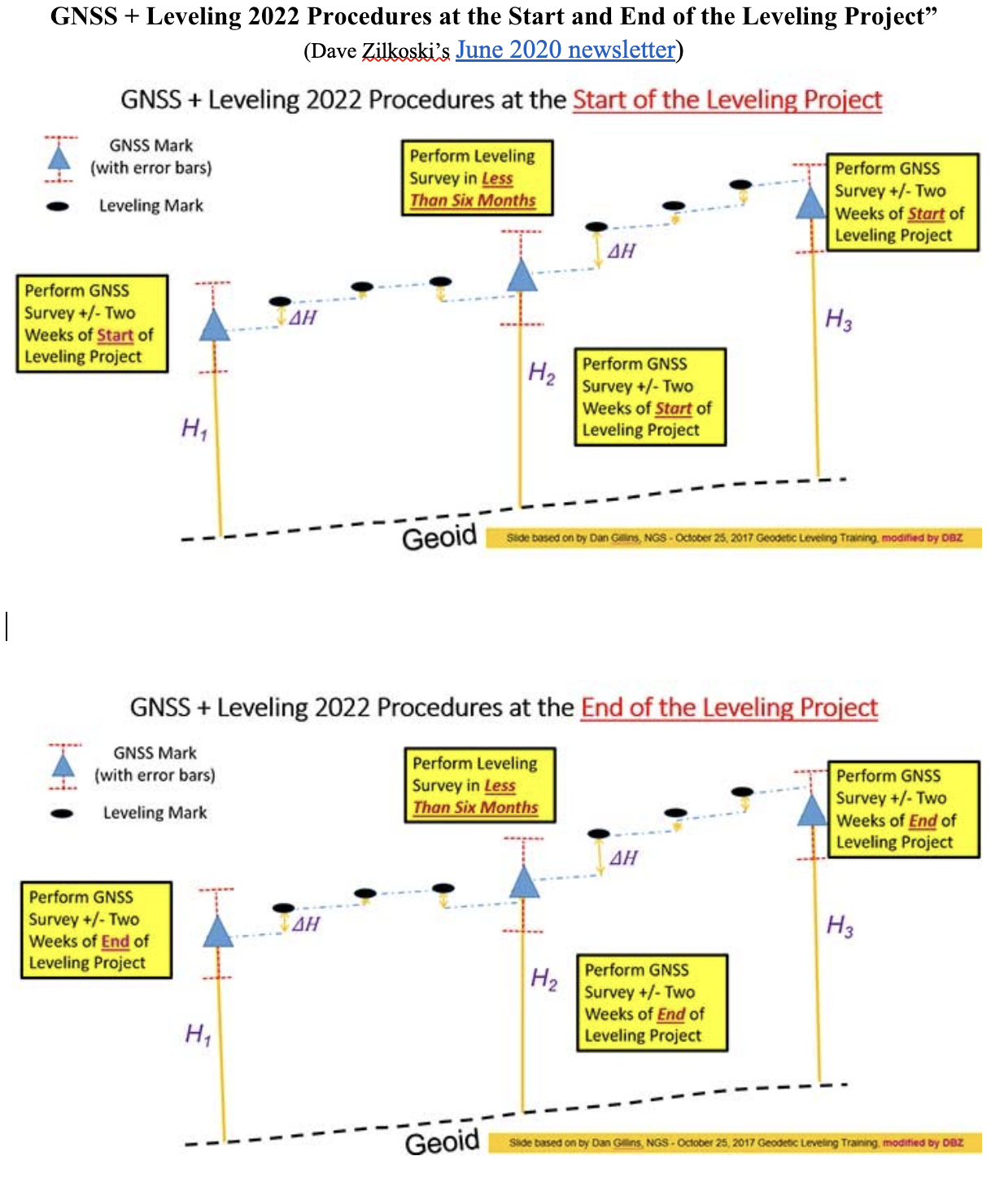
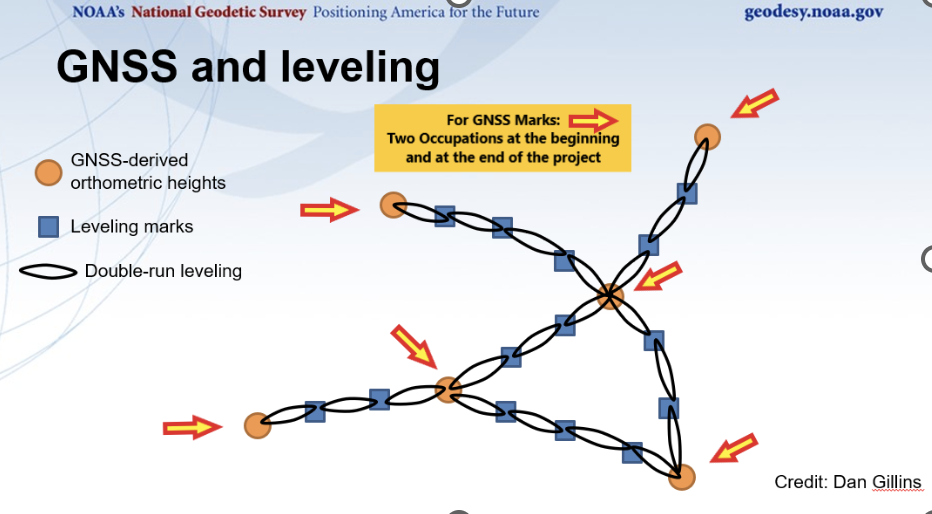
    One major change is that leveling surveys will require GNSS occupations to ensure that orthometric heights computed in leveling surveys are up to date and are connected to the NSRS through the NOAA CORS Network. The network accuracy is obtained through GNSS data and a high-accuracy geoid model, and the local accuracy is provided through the leveling data. Specific procedures will be required to incorporate leveling data in the North American Pacific Geopotential Datum (NAPGD2022).  

    Basic Procedures for NAPGD2022 Orthometric Heights. (Image: NGS Website)
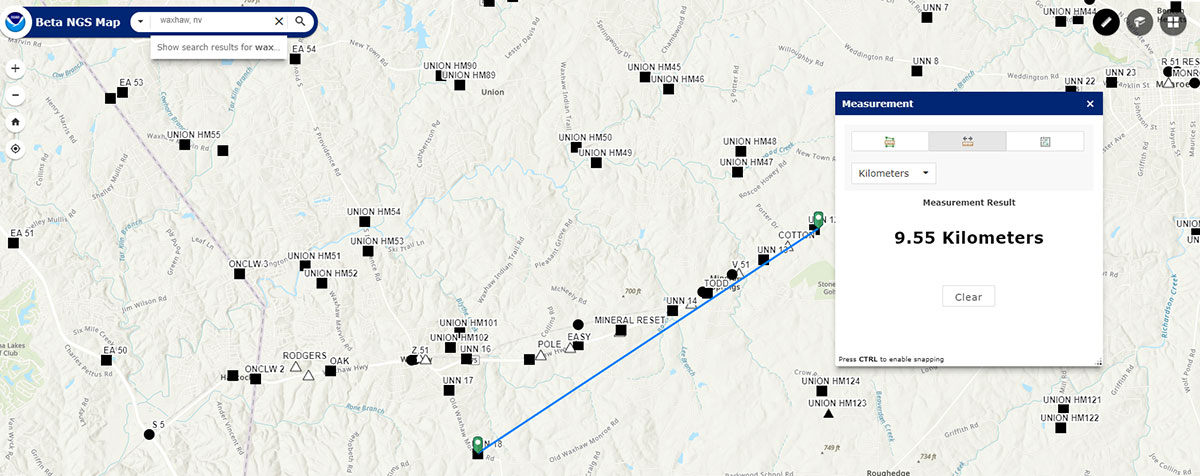
    Basic Procedures for NAPGD2022 Orthometric Heights. (Image: NGS Website)

    I discussed these procedures in more detail in my June 2020 column. The image below provides a conceptual diagram that illustrates what this means to a typical leveling project.

    GNSS + Leveling 2022 Procedures at the Start and End of the Leveling Project”. (Image: Diagram based on information from Dan Gillins, NGS, and modified by David B. Zilkoski)
    GNSS + Leveling 2022 Procedures at the Start and End of the Leveling Project”. (Image: Diagram based on information from Dan Gillins, NGS, and modified by David B. Zilkoski)

    Erickson provided a diagram of a level network that contained a loop, which can be referenced below.

    (Image: NGS Website)
    (Image: NGS Website)

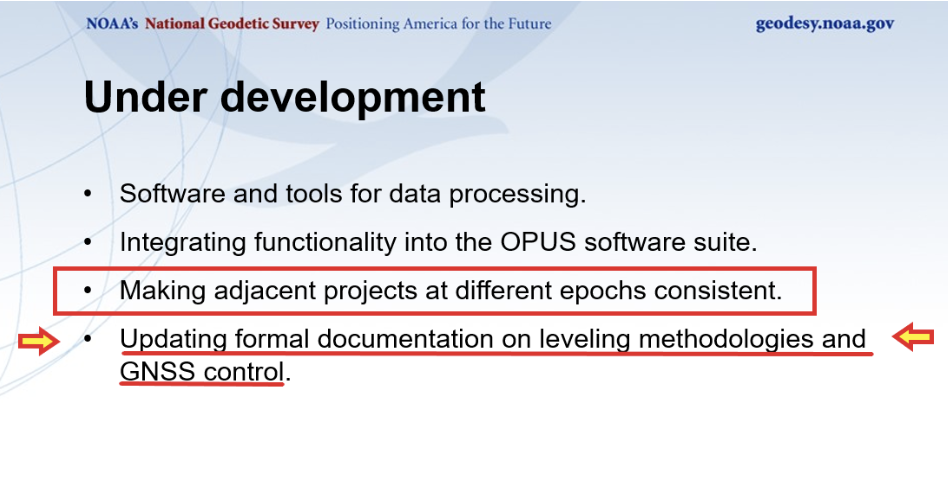
    I have worked with leveling data for most of my career and I am pleased to know that NGS is going to provide tools to incorporate leveling data into the new, modernized NSRS. When performing leveling projects, there is a requirement to level to previously established benchmarks that were within a certain distance from the project. This helped to ensure that different leveling projects were consistent with each other. NGS stated that making adjacent projects at different epoch consistent is under development, and their plans include updating leveling documentation to explain the leveling methodologies and GNSS control.

    (Image: NGS Website)
    (Image: NGS Website)

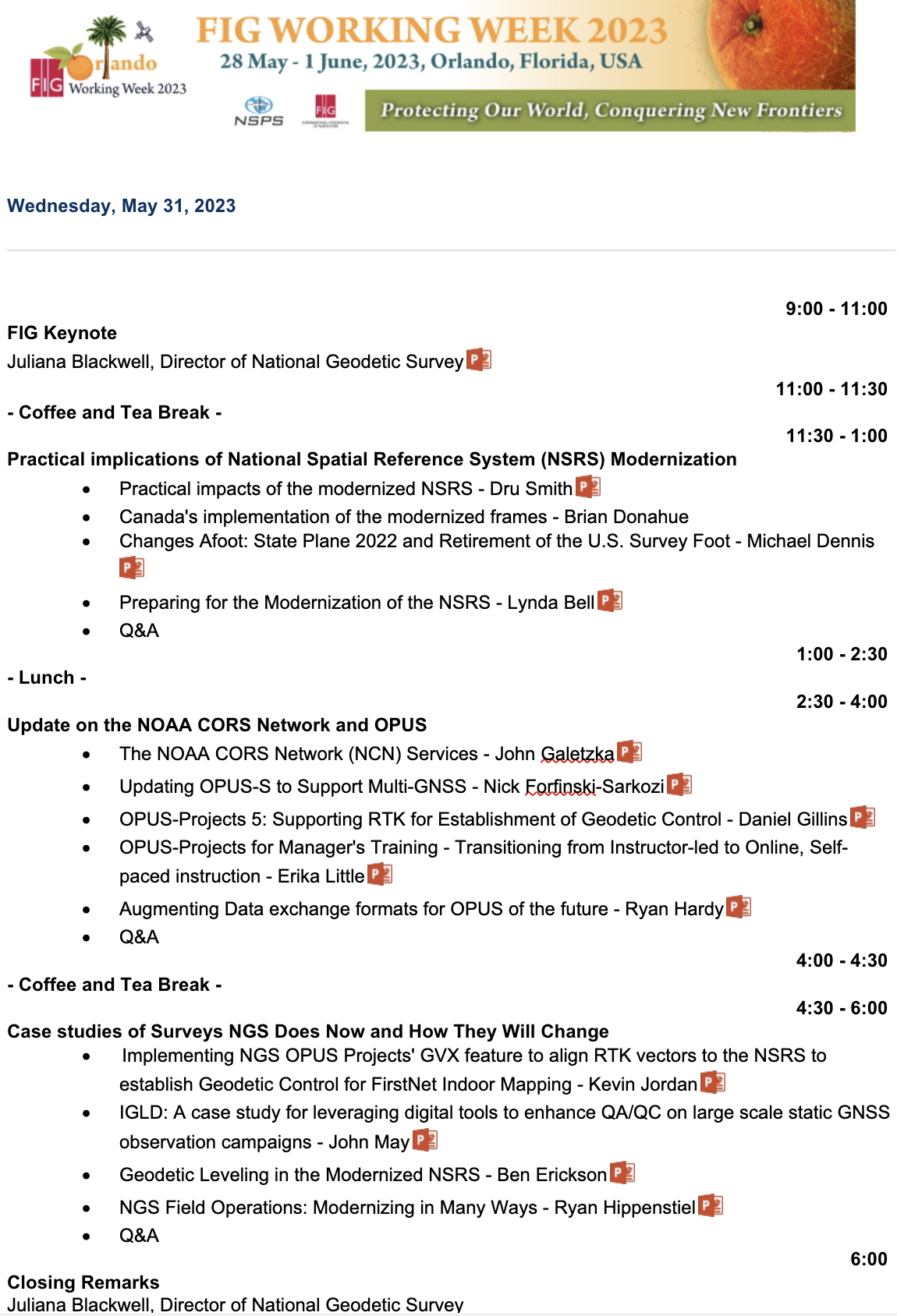
    I have only highlighted a few of the presentations. It was an all-day session, and a lot of information was presented on the new, modernized NSRS. The presentations can be downloaded from the NGS website at https://geodesy.noaa.gov/datums/newdatums/fig-2023.shtml. I would encourage everyone to download the presentations to obtain the latest information on NGS’s modernization of the NSRS. See the image below for the list of presentations and the links to download specific presentations.

    NGS Presentations at FIG 2023 Working Week. (Image: NGS Website)
    NGS Presentations at FIG 2023 Working Week. (Image: NGS Website)
  • The inverted geospatial pyramid shows our vulnerability

    The inverted geospatial pyramid shows our vulnerability

    Last year I was privileged to be part of a Blue-Ribbon Review Panel for an American Society of Civil Engineers (ASCE) surveying publication. The book is Surveying and Geomatics Engineering: Principles, Technologies, and Applications. I recently received my copy of the published book in the mail and decided to highlight some sections. While preparing this column, the chapters reminded me of how geodesy has expanded into so many different disciplines.

    I first mentioned this in my July 2020 article for the “First Fix” column of GPS World, where I stated that the shortage of American trained geodesists poses a significant economic risk for the United States. In that column, I mentioned how geodetic science and technology now underpin many sciences, large areas of engineering (such as driverless vehicles and drones), navigation, precision agriculture, smart cities and location-based services. That is why I believe understanding geodesy is more critical today than ever. In January 2022, Mike Bevis, collaborating with others, prepared a white paper titled “The Geodesy Crisis,” documenting the concern about the lack of trained geodesists in the United States.

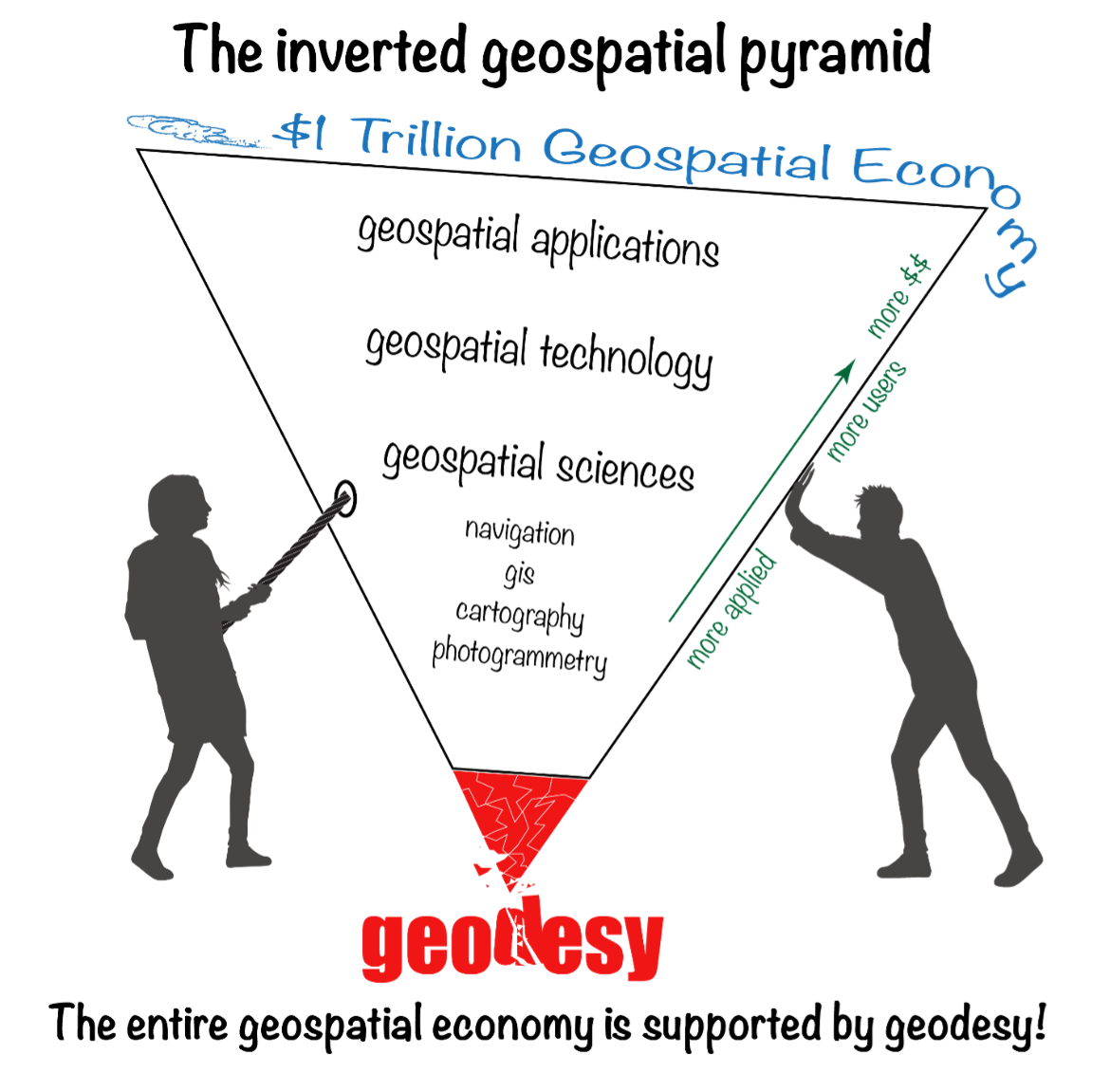
    Image: Dana Caccamise II
    Image: Dana Caccamise II

    “The inverted geospatial pyramid” graphic depicts how the entire $1 trillion geospatial economy is supported and dependent on geodesy, and how it’s close to collapsing without an increase of support for geodesy. A lack of geodetic expertise in the United States presents a significant challenge, with future impacts on positioning, navigation, mapping and dependent geospatial technologies.

    In my opinion, without investment in geodesy, the United States will not have the available skills and knowledge to develop new geodetic technologies and improve models to address challenges to society, such as

    • how the Earth’s surface is changing as sea level rises and the Earth’s glaciers and ice sheets change on timescales of months
    • how the tectonic plates are deforming and what physical processes control earthquakes, and
    • the ability to monitor the temporal changes in Earth’s water reservoirs by measuring changes in Earth’s gravitational field as it responds to the moving water mass and the deformation of the solid Earth caused by moving water.

    These challenges need a well-maintained, stable terrestrial reference frame (TRF) with sub-1 mm/year vertical accuracy. Errors in TRF heights can propagate systematically into estimates of atmospheric water vapor, sea level, satellite orbits and other parameters. An accurate TRF can lead to important observations and discoveries because it enables revelations from coherent global motions. (My previous column described the latest International Reference Frame of 2020 [ITRF2020].)

    Geodesy has been a significant part of my life for 50 years. I’ve seen a lot, and unless we address the Geodesy Crisis, the innovations in geodetic science of the past will not continue in the future. At least not in the United States.

    The Geodesy Crisis paper was mentioned in the Fall 2022 ION Quarterly Newsletter by Everett Hinkley (see the box below). Hinkley noted, “The geospatial community relies on geodesists, though few in the community are fully aware of this connection nor understand the importance of geodesy to their work.” I encourage everyone to download the white paper and the ION Quarterly Newsletter to understand the importance of the need for more trained geodesists.

    Excerpt from Everett Hinkley’s Article

    “In January 2022, a white paper entitled America’s loss of capacity and international competitiveness in geodesy, the economic and military implications, and some modes of corrective action was released (Bevis et al.). This collaborative paper paints an alarming picture of the dwindling pool of trained geodesists within the United States. The report highlights America’s loss of capacity and international competitiveness in geodesy and states: ‘The U.S. is on the verge of being permanently eclipsed in geodesy and the downstream geospatial technologies. This decline in capability threatens our national security and poses major risks to an economy strongly tied to the geospatial revolution, on Earth and, eventually, in space.’ Though the word crisis correctly describes the dire predicament well, it didn’t occur overnight. Due to several converging trends, the geodesy crisis has been decades in the making. A national lack of geodetic expertise presents a significant challenge with downstream impacts on positioning, navigation, mapping, and dependent geospatial technologies. The Department of Defense, intelligence community, and federal civil agencies’ mapping entities rely on accurate and precise maps for a broad range of purposes, and reliable maps depend on an accurate geodetic underpinning. The geospatial community relies on geodesists, though few in the community are fully aware of this connection nor understand the importance of geodesy to their work.” (Reproduced with permission from ION.)

    In my “First Fix” column, I mentioned that I attended The Ohio State University (OSU) to obtain my graduate degree in Geodetic Science in 1979. Therefore, I admitted that I am a little biased — once a geodesist, always a geodesist. That said, in OSU’s geodesy heyday (1960–1990s), many Americans trained were sent there by federal agencies: National Geospatial-Intelligence Agency (NGA), NOAA/National Geodetic Survey (NGS), USGS, Army, Navy and Air Force. During the 1970s, NGS sent two employees back to school every year. These agencies needed geodesists because they were undertaking significant projects, such as the NGS projects to readjust the U.S. national horizontal (NAD83) and vertical geodetic (NAVD88) networks. I was one of the employees NGS sent to OSU to be trained to support the NAD83 and NAVD88.

    Today, the environment is different. U.S. federal agencies still need geodesists to develop enhanced and refined geodetic models and tools. However, major U.S. companies, such as Google and FedEx, the automobile industry, the construction industry (automated machine guidance), precision farming companies and mining companies also need more accurate geodetic models, tools and algorithms. Therefore, these companies also need trained geodesists to perform essential research on topics that address their geodetic requirements. As indicated in “the inverted geospatial pyramid” graphic, the entire $1 trillion geospatial economy is supported by geodesy.

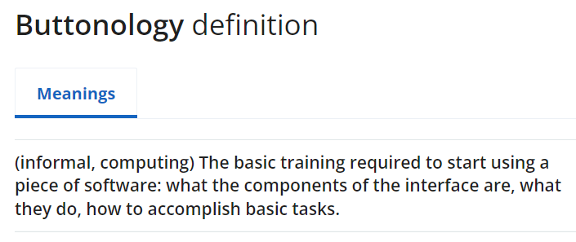
    As implied in Hinkley’s article, geodesy has played a role in developing geospatial products but most users didn’t realize that it was their foundation. Since it’s been in the background, everyone assumes it will always be there. A participant at one of my workshops stated that “GPS has made geodesists out of all of us.” In my opinion, the advancements in GNSS equipment and processing software provided some users with a “false sense of knowledge or security” that they understood what was happening within the “black box.” One of my colleagues at NGS said that the new equipment and software programs were creating a field force of “buttonologists.”

    https://www.yourdictionary.com/buttonology

    These statements concerned me at the time and concern me today. With the last generation of trained geodesists either retired or getting ready to retire, we are at a critical stage of not being able to meet the geospatial needs of the future. As indicated in the white paper, there are significant challenges in rebuilding programs that support the training of geodesists.

    Hinkley’s article summarized several action items that could help improve the lack of trained geodesists in the United States. I’ve provided his list in the box below. I’ve highlighted several items the surveying and mapping community can help achieve.

    So how do we build and educate the next generation of geodesists?

    • Make the White House and Congress aware of this crisis, particularly its national security implications; seek direct support in the federal budget to correct this issue. It has become clear that, without engagement at the highest echelons of the U.S. government, averting this current crisis and its eventual outcome is unlikely.
    • Teach rigorous math in our public schools; follow the scholastic math approach used in many Asian and European countries.
    • Encourage creative thinking!
    • Actively market geodesy in high schools as a rewarding career for the math stars before college entry.
    • Build back, support and sponsor geodesy programs at select universities. This support needs to be strategic, with backing from the highest levels of the U.S. government.
    • Break our cultural trend of reactions to crises and seize the opportunity to be proactive and prevent the foreseen consequences of this crisis.
    • Encourage U.S. government support in the form of grants, professional development of staff, and research collaborations/affiliations. There are early efforts underway to bring new talent into the pipeline:
      • the National Geospatial-Intelligence Agency (NGA) is forming an emerging scientist consortium (ESCON) with partnerships that exist with Ohio State, UT-Austin, and other industry/academic/government partners
      • a pilot Ph.D. geodesy educational program with three NGA and one NGS employee is in place; the NGA expects to continue growing this program.
      • the NGA’s new western headquarters in St. Louis will bring 350 companies and organizations into the regional GEOINT ecosystem.

    If we answer this call to action collectively, there is hope that a new cadre of U.S. geodesists can be cultivated before it’s too late to recover.

    (Reproduced with permission from ION.)

    With all that said about the need for more geodesists, one thing that this ASCE publication may do is make some readers realize how much they don’t know about the roots of the technology that they’re using to create geospatial products and services. This knowledge gap is not just correctly using GNSS and other geospatial technology to perform a survey, but also integrating various instruments to create an accurate mapping system, such as mobile mapping and terrestrial laser systems. My intent is not to criticize the expertise or knowledge of anyone, and I only mean to point out that in today’s use of computers and programs, many technical concepts are hidden in “black boxes.” I learned many things about some topics by reviewing this book.

    The book is 556 pages and has 15 chapters. As part of my responsibilities as a Blue-Ribbon Panel member, I read every word in the book, and not many people will read the entire book. Still, I would encourage surveyors, engineers, geodesists, photogrammetrists and GIS and remote-sensing practitioners to obtain a copy of the book for reference and to understand the limitations of geospatial technology.

    Surveying and Geomatics Engineering: Principles, Technologies, and Applications Edited by Daniel T. Gillins, Ph.D., P.L.S. ; Michael L. Dennis, Ph.D., P.E., P.L.S.; and Allan Y. Ng, P.L.S.
    Surveying and Geomatics Engineering: Principles, Technologies, and Applications
    Edited by Daniel T. Gillins, Ph.D., P.L.S.; Michael L. Dennis, Ph.D., P.E., P.L.S.; and Allan Y. Ng, P.L.S.

    Now to the book’s content. I want to highlight that the forward is written by Juliana Blackwell, director of the National Geodetic Survey (NGS). She states that “A common thread running through the manual is the importance of the National Spatial Reference System (NSRS) to modern geospatial applications.”

    Most of my columns highlight something relevant to the NSRS. That’s because the NSRS is the foundation layer for United States federal geospatial products, and geodesy provides the foundation for all geospatial products and services as indicated in the “The inverted geospatial pyramid” figure.

    I would also like to highlight a statement by Gene Roe in the preface. He states, “Because entire books could be devoted to each of these topics, this manual only provides a summary, and it points the readers to important references where they can find more details. The manual is meant to provide a comprehensive but general overview to help support education and inform practicing engineers on the important role of the surveying engineer. It is too important for this not to occur.”

    I agree with Roe’s statement that the book is important for surveying engineers. Still, I would add that this book is important to anyone working with GNSS and other geospatial data, especially geodesists, surveyors and GIS practitioners.

    This publication is edited by three individuals that are licensed surveyors; two of them are geodesists who work for NGS. These individuals have performed a fantastic job of ensuring that all chapters have been reviewed for correctness and that the information provided is current and essential for users of geospatial data.

    Readers can download copies of the book and specific chapters here. You can buy it as an e-book or in print. The “Abstract” box summarizes the book from the ASCE Library website.

    Abstract

    Sponsored by the Surveying Committee of the Surveying and Geomatics Division of the Utility Engineering and Surveying Institute of ASCE and the National Geodetic Survey of the US National Oceanic and Atmospheric Administration

    Surveying and Geomatics Engineering: Principles, Technologies, and Applications, MOP 152, is a comprehensive yet general overview to help support education and inform practicing engineers on the important role of the surveying engineer. It provides a much-needed update on the modern practice of surveying and geomatics engineering.

    Topics include:

    • geodesy
    • coordinate systems and transformations
    • least squares adjustments and error propagation
    • modern surveying and remote sensing technology
    • analysis and establishment of control
    • geographic and building information systems
    • construction surveying, and
    • best practices.

    MOP 152 can be used as a summary and a reference for practicing engineers, surveying and otherwise, to help provide a solid understanding of the state of the surveying and geomatics engineering field.

    Below is a list of the chapters and their authors. This column cannot highlight everything important in this book, but I will select a few items to which I believe users of geospatial data should pay attention.

    Chapter Titles

    Chapter Number Chapter Title Author(s)
    Forward Juliana P. Blackwell
    Preface Gene V. Roe
    Acknowledgments Daniel T. Gillins
    1 Engineering Surveying Within ASCE Gene V. Roe
    2 Geodesy and Geodetic Computations Earl F. Burkholder
    3 Map Projections and Local Coordinates Systems Michael L. Dennis
    4 Local, Regional, and Global Coordinates Transformations Michael L. Dennis
    5 Analysis and Adjustment of Observational Errors Charles D. Ghilani
    6 Satellite-Based Surveying Technology Jan Van Sickle
    7 Leveling and Total Stations N.W.J. Hazelton
    8 Terrestrial Laser Scanning Michael J. Olsen
    9 Mobile Terrestrial Laser Scanning and Mapping Michael j. Olsen, Jaehoon Jung, Erzhuo Che, Chris Parrish
    10 Aerial Surveying Technology Michael J. Starek, Benjamin E. Wilkinson
    11 Survey Control Daniel T. Gillins
    12 Construction Surveys Marlee A. Walton
    13 Survey Records Andrew C. Kellie
    14 Information Systems in Civil Engineering Yelda Turkan, Dimitrios Bolkas, Jaehoon Jung, Matthew S. O’banion, Michael Bunn
    15 Professional Services and Design Professionals Agreements David E. Woolley, Lisa D. Herzog

    As a geodesist, I usually focus on topics relevant to geodetic science. This book has a lot of topics that use geodesy concepts to create an engineering product or service. For example, chapter 2, “Geodesy and Geodetic Computation” by Earl Burkholder, provides a good summary of geodetic concepts that anyone using or generating geospatial products should know and understand. It gives basic equations without lengthy derivations of how they were developed.

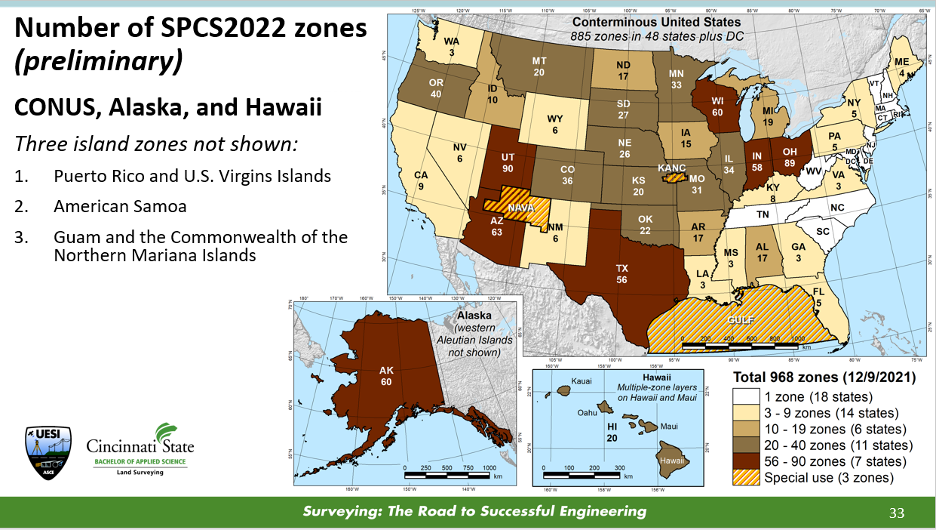
    In my opinion, chapter 3, “Map Projections and Local Coordinates Systems” by Michael Dennis, does the best job of explaining the concepts of map projections that are relevant to the surveying and mapping community. Many GIS practitioners use map projections in their software but don’t have a working knowledge of what’s happening to their original data. This chapter describes the current United States State Plane Coordinate System of 1983 (SPCS83) and the future State Plane Coordinate System of 2022 (SPCS2022) that is scheduled to be adopted in 2025. Dennis uses figures and diagrams to describe map projections, angular and linear distortion, and methods for reducing map projection distortion to make it easier for readers to understand the concepts. One section of interest to many surveyors after SPCS2022 is adopted is the Low-Distortion Projection (LDP) Coordinate Systems section. This is useful because, in SPCS2022, many states have designed LDP systems for their state’s SPCS2022. The box below provides a diagram with the number of zones for each state.

    Photo:
    Image: NGS Presentations Webpage “Grids for the Future: A New Approach for Designing State Plane Coordinate System Zones” by Michael Dennis.

    One purpose of an LDP is to reduce linear distortion; it is not a new concept. Many surveyors have performed a simplified form of it for decades. It’s known by many as a “modified” or “scaled” State Plane. The American Congress on Surveying and Mapping (ACSM) taught a workshop for decades describing how to compute a “modified” State Plane Coordinate. I was an instructor of this class in the 1980s and 1990s. “Modified” State Plane Coordinates had several issues, but they worked reasonably well in small areal extents. Today, with the advancements in computers and computer software, there are better ways to accomplish an LDP. Dennis’ section does a great job explaining the new SPCS2022 and the design of LDPs in the SPCS2022. The use-case examples provide a simplified description of understanding the linear distortion behavior in an area.

    Chapter 4, “Local, Regional, and Global Coordinate Transformation” by Michael Dennis, is one that every surveyor and GIS practitioner should read. Dennis highlighted the differences between “equation-based” transformations and “grid-based” transformations, as well as combined equation-based transformations with grid-based transformations. Understanding the information provided in chapter 4 will be important when NGS replaces the NAD 83 (2011) and NAVD 88 datums with the new, modernized NSRS in 2025. NGS will provide models and tools for users to perform coordinate transformations, but hopefully, some users will want to understand what’s happening behind the scenes.

    Chapters 8 and 9 discuss laser scanning systems. In chapter 8, “Terrestrial Laser Scanning,” the “Data Quality Considerations” section highlights common artifacts or limitations encountered with terrestrial lidar system data. The authors provide many examples of these artifacts, making the concept easy to understand. At the end of this chapter, there are 14 pages of references that will be very helpful to users involved with terrestrial laser scanning systems.

    Chapter 9, “Mobile Terrestrial Laser Scanning and Mapping,” is very informative, especially the section on georeferencing. This section is not just the description of properly using GNSS to perform a survey, but also the integration of various instruments to create an accurate mobile mapping system. I like how the authors discussed the error sources in georeferencing the system, listed the source, and provided an explanation of the error.

    Anyone performing a GNSS survey project that meets NGS’s requirements needs to read chapter 11. I like the section describing how users should evaluate CORSs before using them as control. Evaluating CORS is something all users should do before using any CORS in their project, because not all CORS are created equal. See the excerpt from chapter 11 below for the recommended steps from the author.

    Excerpt from Chapter 11 – Steps for Evaluation of CORS

    The author recommends the following steps:
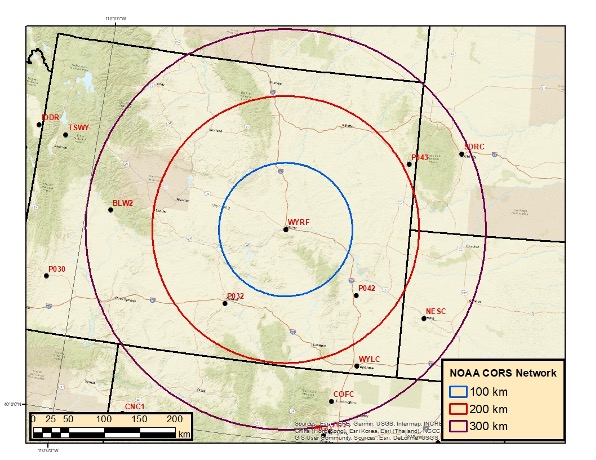
    1. Choose stations that are within 100-300 km of a project site. It is well known that errors in GNSS baseline processing are directly correlated with baseline length (Chapter 6). Tropospheric delay is reduced when baselines are shorter and atmospheric conditions at each end of the line are similar. In addition, mutual satellite visibility at each end of the line for differencing diminishes as baselines grow longer. That said, errors in GNSS processing are more occupation time-dependent than baseline length-dependent (Eckl et al. 2001). Therefore, for short GNSS sessions (i.e., < 2 hours), choose CORS within approximately 100 km as control; for moderate GNSS sessions (i.e., 2 to 8 h), choose CORS within approximately 300 km. Note that even longer baselines can be successfully processed when GNSS sessions are very long in duration (e.g., up to 2,000 km for 24 h sessions).

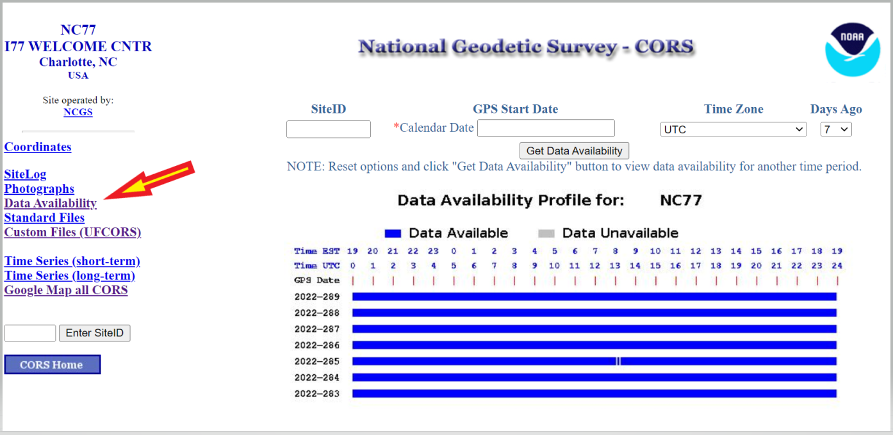
    2. Determine if GNSS data are available at a given CORS during the time of your survey. Of course, if data are unavailable, then the station simply cannot be used as control. NGS provides a tool known as “User Friendly CORS (UFCORS)” for entering a date and time range to view available data at a given station (NGS 2021c). This tool can also be used to download the raw GNSS data for processing and adding a station to the survey network.

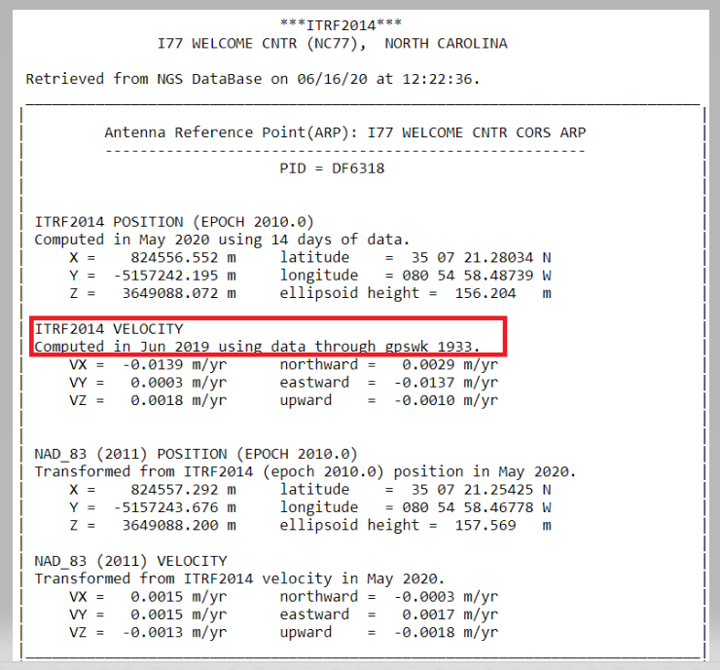
    3. As discussed previously and when possible, choose a CORS with computed velocities rather than modeled velocities from HTDP. NGS provides tables of official coordinates with “computed” versus “htdp” coordinates and velocities on the website for CORS.

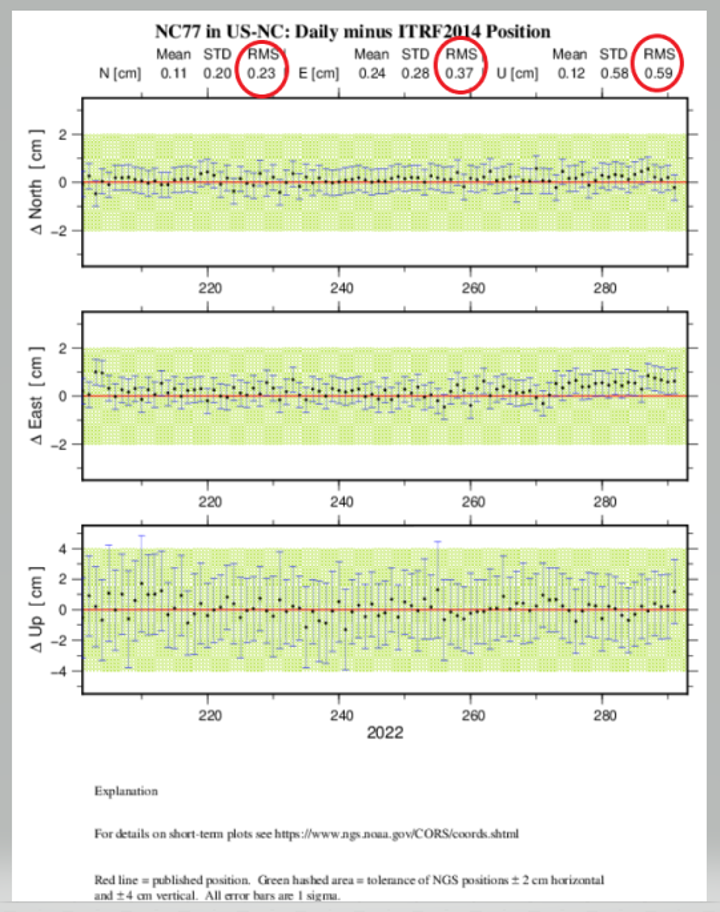
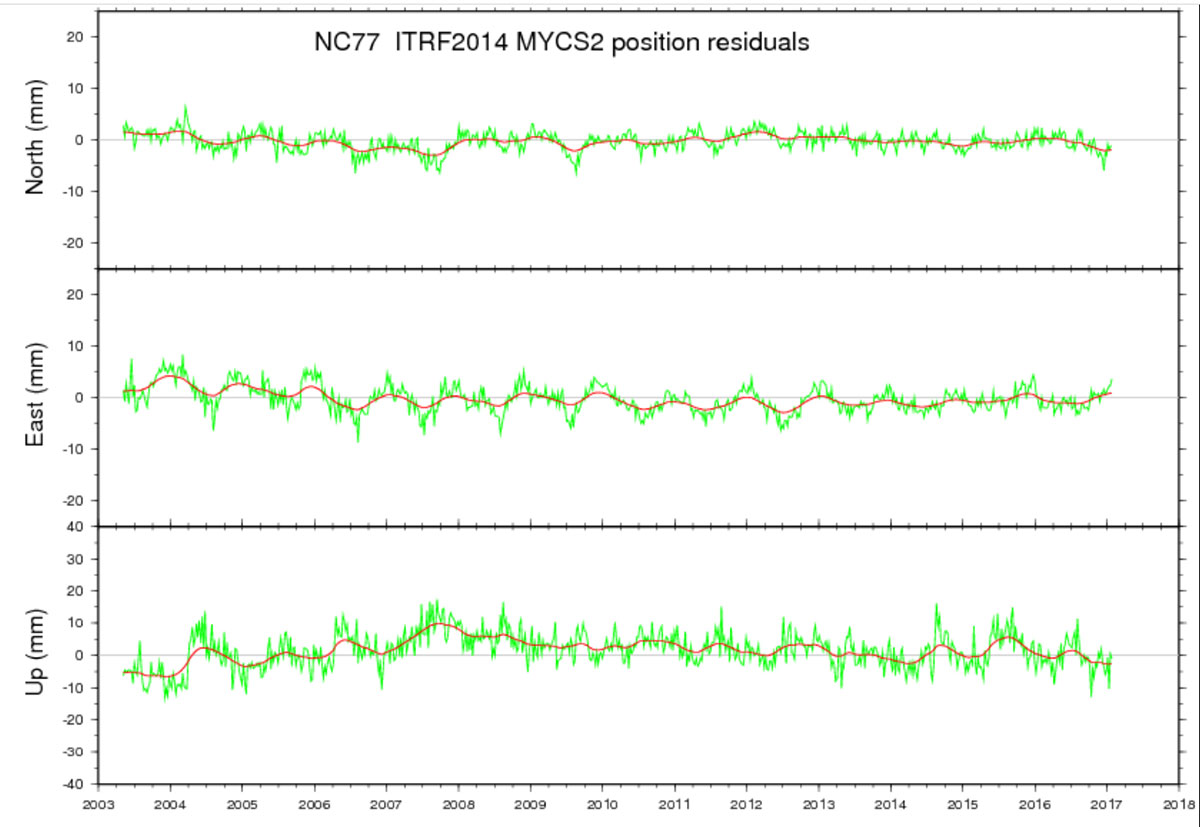
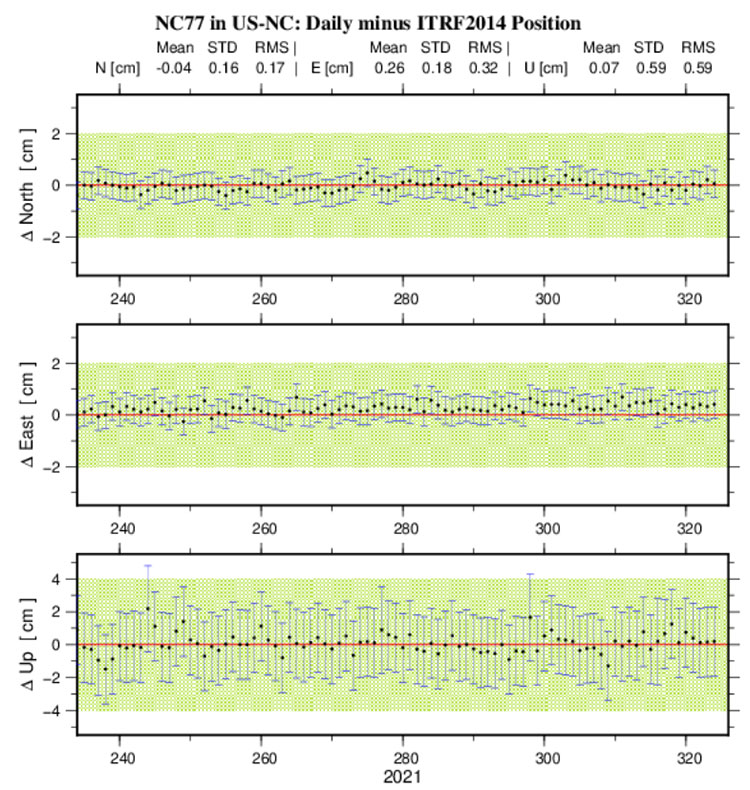
    4. Review the aforementioned short-term time-series plot for the station, ideally at the time of the project. Stations with large spikes, data gaps, bias from the published “red” line, or large standard deviations should be avoided. A good rule-of-thumb is for the RMS in the short-term time-series plot (Figure 11-2) to be less than 1.0 cm in north and east and 2.0 cm in the up direction in a local geodetic horizon frame at the station.

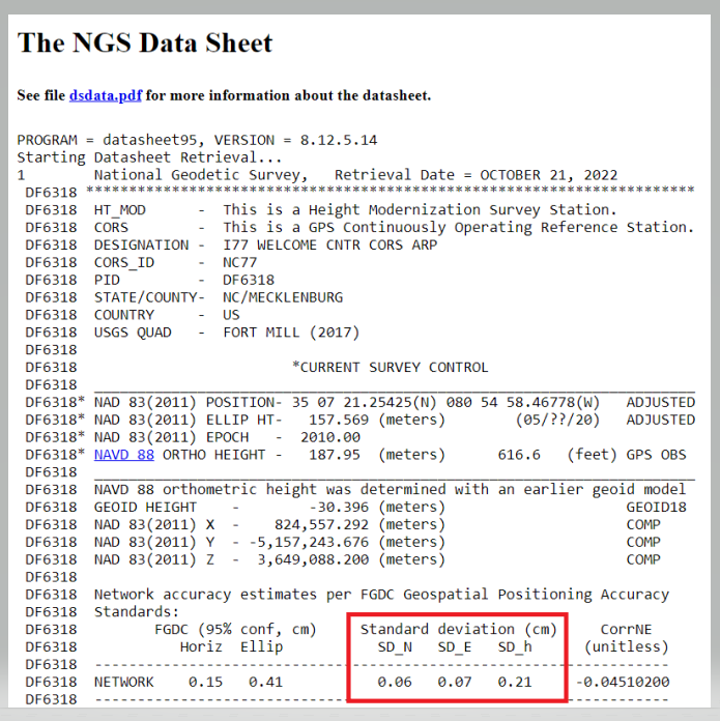
    5. Examine the formal uncertainties for the official coordinates of the CORS. Standard deviations in north, east, and up are provided on the station’s datasheet, accessible from the webpage for the CORS (more on datasheets are discussed in the following under Passive Control). Stations with unusually large standard deviations (> 3 cm) should be avoided. Note that standard deviations are not available for CORSs with modeled velocities.

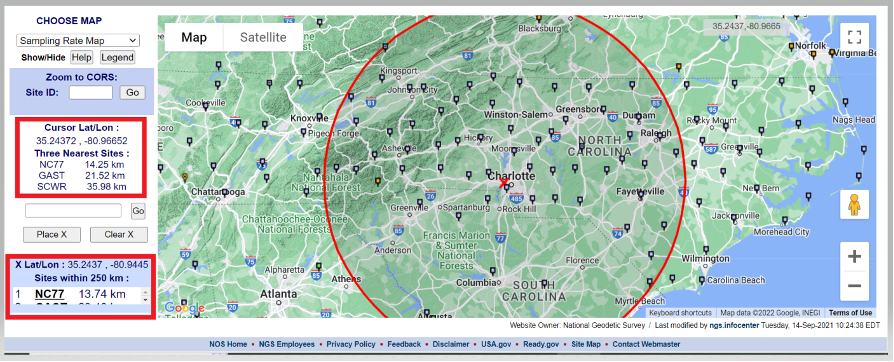
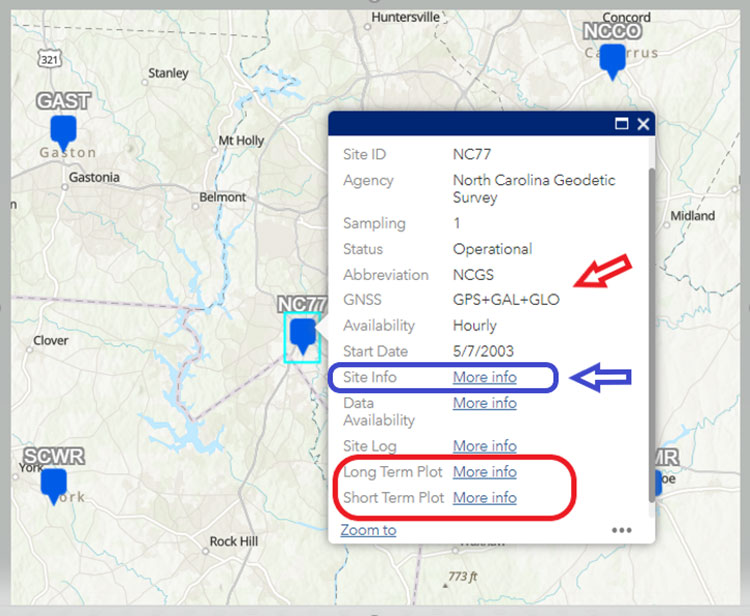
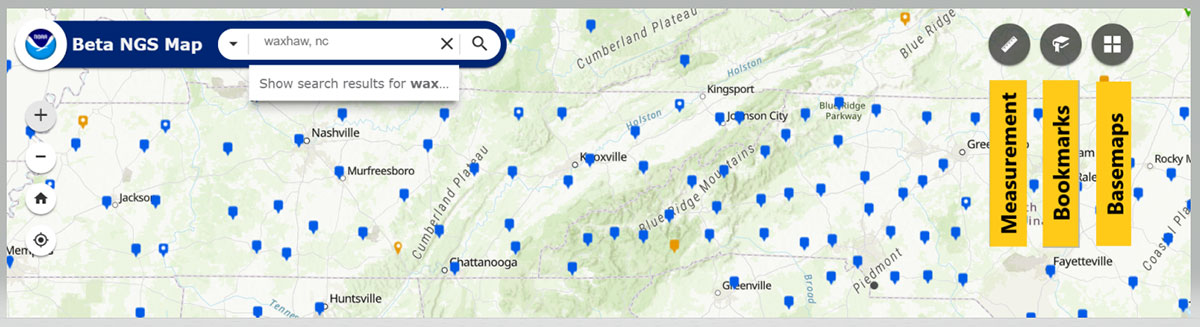
    I believe that the evaluation of NOAA CORS is critical, so I’ve described Dan Gillins’ “Steps for Evaluation of CORS” below. First, users can access the NOAA CORS using the NGS CORS Map utility. After the map appears, users can move the cursor over the center of the project area, where it provides the location of the cursor and the three closest CORS. Users can click on a CORS icon and get coordinates and other information about the CORS. Also, they can place an X on the map, and the utility will draw a 250-km circle around the point. The box in the lower left-hand side of the map provides a list of the sites within 250 km of the marked location.

    Using CORS Map to Identify CORS

    Image: https://geodesy.noaa.gov/CORS_Map/
    Image: https://geodesy.noaa.gov/CORS_Map/

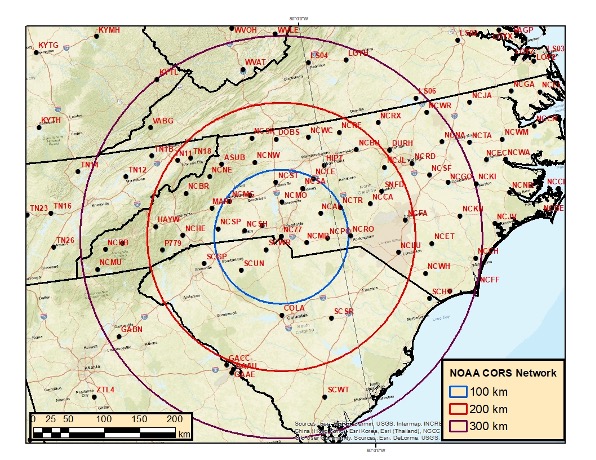
    Users can download the NOAA CORS coordinates and velocities (computed and modeled). I downloaded the files and plotted three circles (with radii of 100, 200, and 300 km) around CORS NC77 in Charlotte, North Carolina. I only plotted CORS that are operational and have computed velocities. North Carolina has a lot of CORS to select from. In contrast, I’ve plotted three circles (also with radii of 100, 200 and 300 km) around CORS WYRF in Casper, Wyoming.

    Buffer Zones around Charlotte, NC

    Image: Dave Zilkoski
    Image: Dave Zilkoski

    The plot depicting the buffer zones around Casper indicates that there are no CORS within the 100-km circle and only a few between 100 and 200 km.

    Buffer Zones around Casper

    Image: Dave Zilkoski
    Image: Dave Zilkoski

    The data availability of the CORS site can be obtained by clicking on the CORS icon, selecting “Get Site Information,” and then selecting “Data Availability.”

    Data Availability at CORS NC77

    Image from https://geodesy.noaa.gov/cgi-cors/corsage_2.prl?site=nc77
    Image: https://geodesy.noaa.gov/cgi-cors/corsage_2.prl?site=nc77

    The position and velocity for the CORS can be obtained by clicking on the Coordinates button on that CORS webpage.

    Position and Velocity Sheet for CORS NC77

    Image from https://www.ngs.noaa.gov/cgi-cors/CorsSidebarSelect.prl?site=nc77&option=Coordinates14
    Image: https://www.ngs.noaa.gov/cgi-cors/CorsSidebarSelect.prl?site=nc77&option=Coordinates14

    The CORS Short- and Long-Term plots can be obtained by clicking on the Time Series button on that CORS webpage.

    Short-Term Plot of CORS NC77

    Image from https://www.ngs.noaa.gov/cgi-cors/CorsSidebarSelect.prl?site=nc77&option=Time%20Series%20(short-term)
    Image: https://www.ngs.noaa.gov/cgi-cors/CorsSidebarSelect.prl?site=nc77&option=Time%20Series%20(short-term)

    The Datasheet for the CORS can be obtained by clicking on the Coordinates button and then on the Datasheet button on that CORS webpage.

    Datasheet for CORS NC77

    Image from https://www.ngs.noaa.gov/cgi-bin/ds_cors.prl?CorsSelected=|NC77&CorsTypeSelected=Arp
    Image: https://www.ngs.noaa.gov/cgi-bin/ds_cors.prl?CorsSelected=|NC77&CorsTypeSelected=Arp

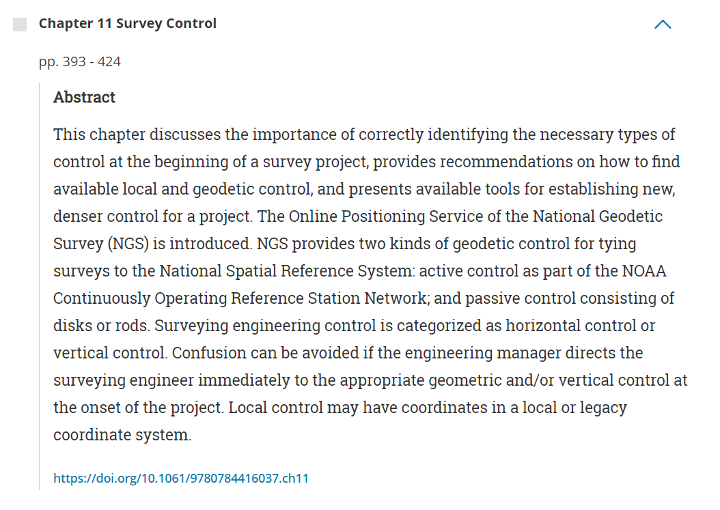
    There are too many chapters to describe each one, but I encourage users to check each chapter’s abstract on the ASCE website and decide which ones would be the most beneficial to them (see the box titled “Abstract for Chapter 11 Survey Control”). The manual provides numerous references and can serve as a helpful resource for finding further details on the fields of geodesy and surveying.

    Abstract for Chapter 11 Survey Control

    Image from https://ascelibrary.org/doi/10.1061/9780784416037.ch11
    Image: https://ascelibrary.org/doi/10.1061/9780784416037.ch11

    A goal of mine is for some readers of this column to obtain enough knowledge to “whet their appetite” and encourage them to pursue an education in geodesy and surveying. Others who are influential in federal government programs and those responsible for geospatial research for industries will recognize the need for more trained geodesists in the United States and help by doing the following:

    • actively market geodesy in high schools as a rewarding career for the math stars before college entry
    • build back, support, and sponsor geodesy programs at select universities; this support needs to be strategic with backing from the highest levels of the U.S. government
    • encourage U.S. government support in the form of grants, professional development of staff, and research collaborations/affiliations.
  • NGS will soon compute third multi-year CORS solution

    NGS will soon compute third multi-year CORS solution

    On Aug. 5, the National Geodetic Survey (NGS) stated it will be updating the NOAA CORS to be aligned with the latest International Terrestrial Reference frame, ITRF2020 (see below). As stated in the announcement, NGS will soon compute a third multi-year continuously operating reference station (CORS) solution, MYCS3.

    The last multi-year CORS solution, MYCS2, was performed by NGS in 2019. I discussed the MYCS2 in my February 2019 and April 2019 columns. This new multi-year CORS solution will be important to the 2022 modernized National Spatial Reference System (NSRS), because NGS will establish a strict mathematical relationship between the 2022 NSRS frames and the ITRF2020 frame. This will allow direct access to the NSRS (NOAA Technical Report NOS NGS 67).

    NGS Aligns National System to Global Reference Frame

    August 5, 2022

    The International Global Navigation Satellite System (GNSS) Service, which provides GNSS data products globally, recently released a new GNSS-only version of the International Terrestrial Reference Frame. This provides GNSS users access to the reference frame through coordinate functions for a global set of reference stations. In response, NGS will soon compute the multi-year Continuously Operating Reference Station (CORS) Solution 3, which will modernize the National Spatial Reference System. Aligning the National Spatial Reference System with the updated global reference frame will allow greater access for the global community of scientists, educators, and commercial users of location science.

    For more information, contact: Phillip McFarland

    As in the past, the multi-year CORS solution will mean that the NOAA CORS coordinates will be updated to be consistent with the latest International Terrestrial Reference Frame of 2020 (ITRF2020). The International GNSS Service provides information about its GNSS products and services. Readers can find information on the latest International Terrestrial Reference Frame 2020 here. This column will provide basic information on the ITRF2020. Please note: NGS stated that it will soon start computing the third multi-year CORS solution, but — as of October — all NOAA CORS coordinates are still based on MYCS2 and provide coordinates in ITRF2014 epoch 2010.00 and NAD 83 (2011, MA11, PA11) epoch 2010.00. As in the past, NGS will provide advance notice before publishing the results of its third multi-year CORS solution.

    A document on the ITRF website stated the ITRF2020 is expected to be an improved solution compared to the previous solution, ITRF2014. It listed several innovations introduced in the ITRF2020 processing.

    Description from ITRF2020 Document

    ITRF2020 is the new realization of the International Terrestrial Reference System. Following the procedure already used for previous ITRF solutions, the ITRF2020 uses as input data time series of station positions and Earth Orientation Parameters (EOPs) provided by the Technique Centers of the four space geodetic techniques (VLBI, SLR, GNSS and DORIS), as well as local ties at colocation sites. Based on completely reprocessed solutions of the four techniques, the ITRF2020 is expected to be an improved solution compared to ITF2014. A number of innovations were introduced in the ITRF2020 processing, including:

    • The time series of the four techniques were stacked all together, adding local ties and equating station velocities and seasonal signals at colocation sites;
    • Annual and semi-annual terms were estimated for stations of the 4 techniques with sufficient time spans;
    • Post-Seismic Deformation (PSD) models for stations subject to major earthquakes were determined by fitting GNSS/IGS data. The PSD models were then applied to the 3 other technique time series at earthquake colocation sites.

    The box below provides a good summary of the International Reference Frame and why it’s important to the scientific community as well as the surveying and mapping community. Readers can download the article from the June 2022 International GNSS Service Issue 4 newsletter. Users also can sign up to receive notices and newsletters from the International GNSS Service.

    ITRF2020: A new release of the International Terrestrial Reference Frame By Zuheir Altamimi

    What is the current rate of sea level rise in different regions of the globe? How does our Earth deform under the effect of plate tectonics, seismic phenomena, or the melting of ice caps? How the Earth’s center of mass is varying? How to determine the position of a point on the surface of a constantly deforming Earth and compare it to positions estimated decades apart? The answers to these fundamental questions for understanding the dynamics of our planet require the availability of a global, long-term stable terrestrial reference frame, but preferably a standard reference so to ensure interoperability and consistency of various measurements collected by sensors on the ground, or via artificial satellites. The International Terrestrial Reference Frame (ITRF) is the standard reference recommended by a number of international scientific organizations, including the International Union of Geodesy and Geophysics (IUGG) and the International Association of Geodesy (IAG) for earth science, satellite navigation and operational geodesy applications. The ITRF is an international effort that is built on the investments of space and mapping agencies, universities and research groups in operating geodetic observatories, archiving and analyzing the collected geodetic observations to derive not only the ITRF, but also critical geodetic products for science and society.

    The ITRF integrates and unifies technique-specific reference frames provided by the four IAG’s international services of space geodetic technique (DORIS/IDS, GNSS/IGS, SLR/ILRS, VLBI/ IVS). It is supplied to the users in the form of temporal coordinates of more than 1500 stations, Earth Orientation Parameters, as well as parametric functions describing nonlinear station motions: seasonal signals due to mainly loading effects and post-seismic deformations for sites subject to major earthquakes. It is necessary to regularly update the ITRF (approximately every 5 years) in order to benefit from continuous observations so to improve its accuracy, considering station position temporal variations due to geophysical phenomena.

    The ITRF is maintained by a research group at IGN-France and IPGP (Institut de Physique de Globe de Paris), and whose new release called ITRF2020 was published on April 15 and accessible here: https://itrf.ign.fr/en/solutions/ITRF2020. The ITRF2020 brings significant improvements compared to previous achievements: it confirms the estimate of the position of the center of mass of the Earth as it was determined in 2016, but also provides its seasonal variations; it improves the accuracy of the scale of the frame at the millimeter level, which represents a gain in precision of a factor of 8 on the measurement of the size of the Earth (compared to that determined in 2016); it provides a precise quantification of co- and post-seismic displacements caused by devastating earthquakes, such as that of Sumatra in 2004, Chile in 2010 and Japan in 2011. The IAG Services rely on the ITRF to align their geodetic products to it, and therefore disseminate it widely among the various users. In particular, using the IGS products, such as the orbits, allows a universal access in space and time to the ITRF.

    As stated in the article by Zuheir Altamimi, ITRF2020 involves IAG’s international services of four space geodetic techniques: DORIS/IDS, GNSS/IGS, SLR/ILRS, VLBI/ IVS. Computing an International Terrestrial Frame is very complex and requires analyses of difference types of geodetic and geophysical data. It is beyond the scope of this column, but online is more detailed technical information.

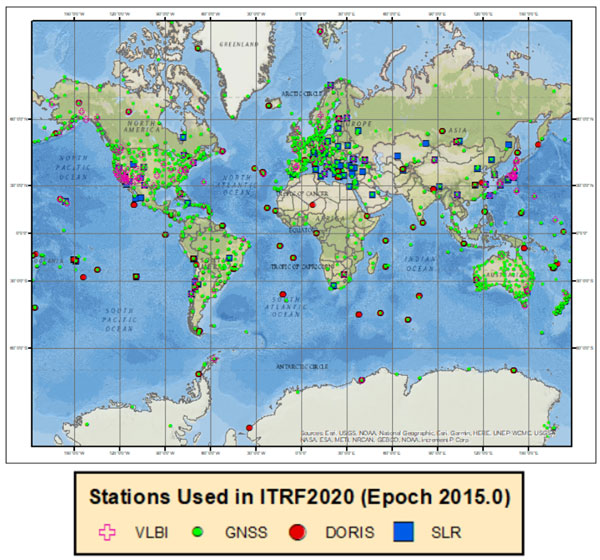
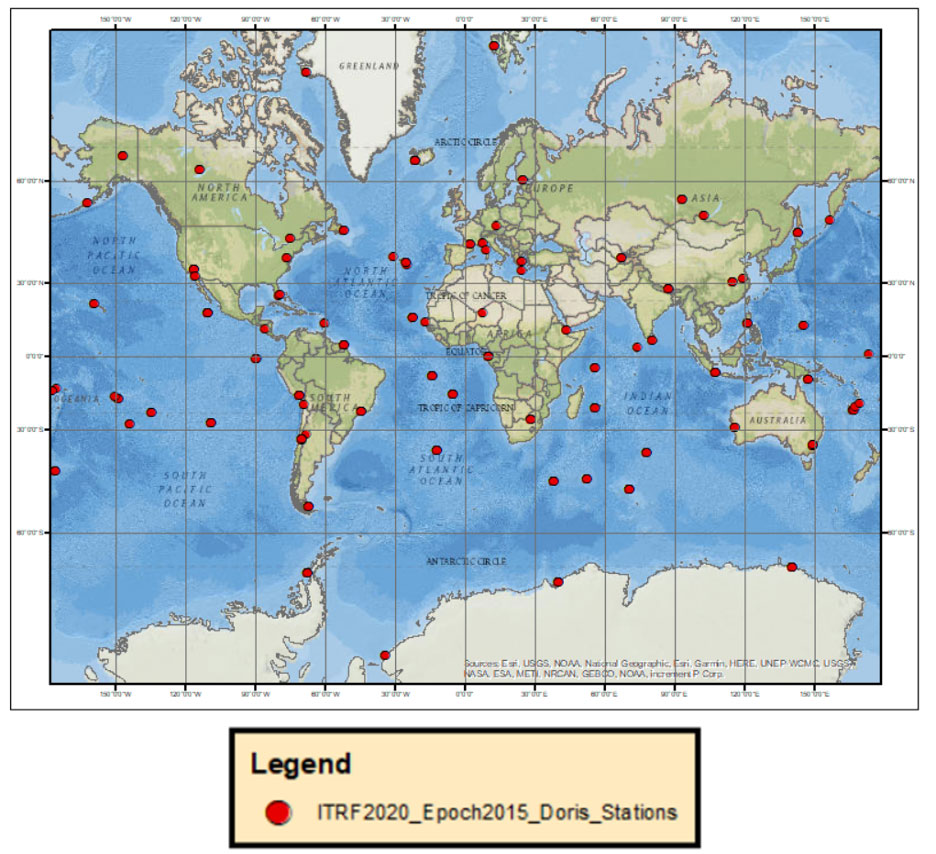
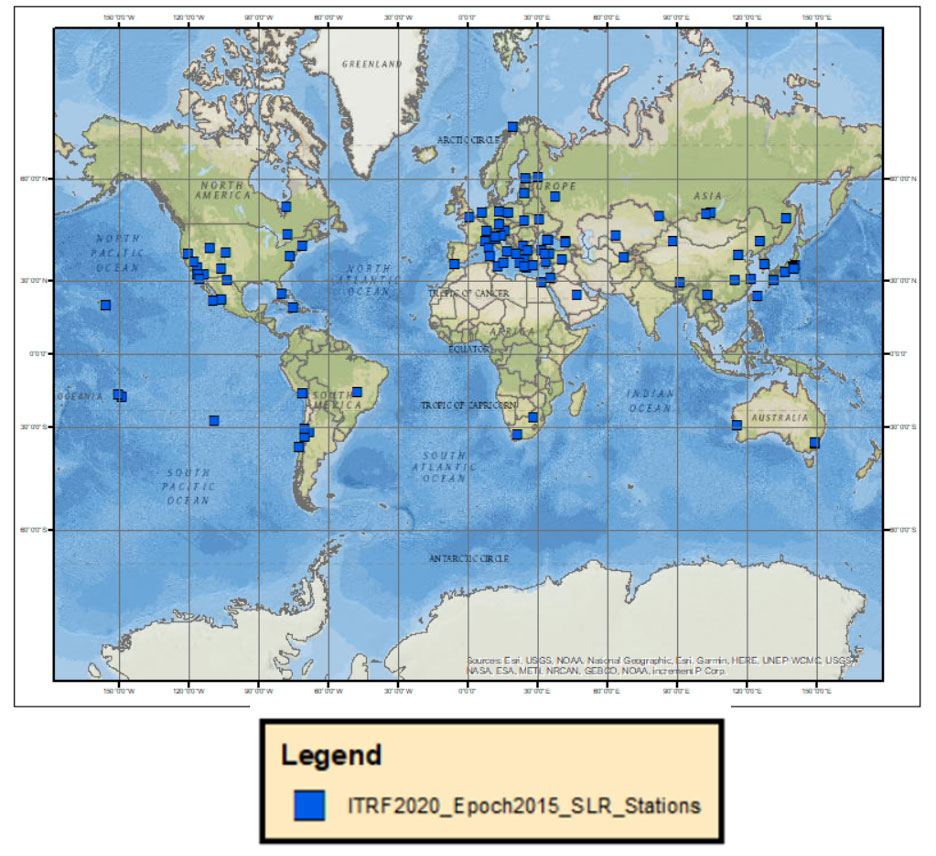
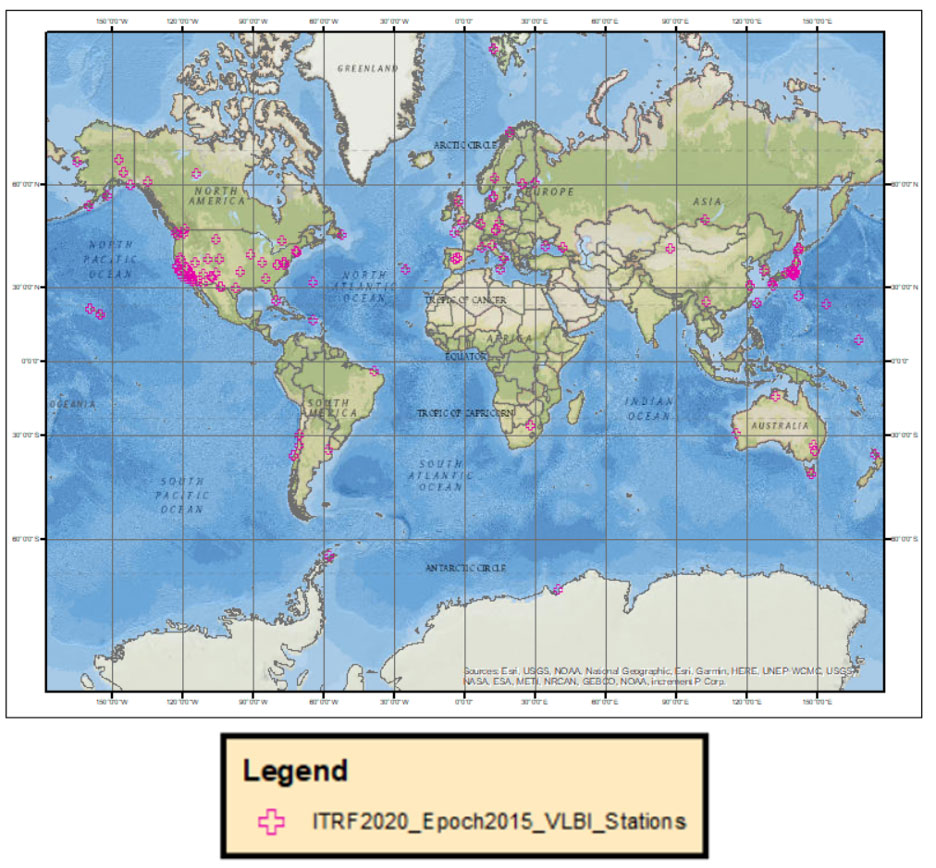
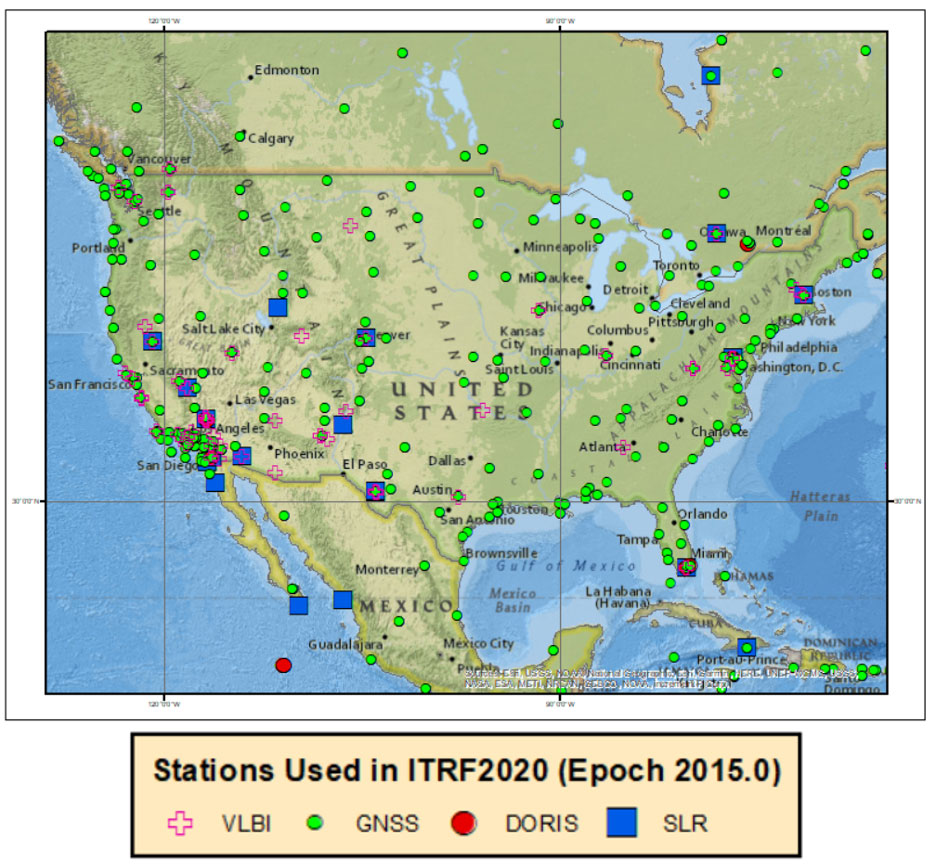
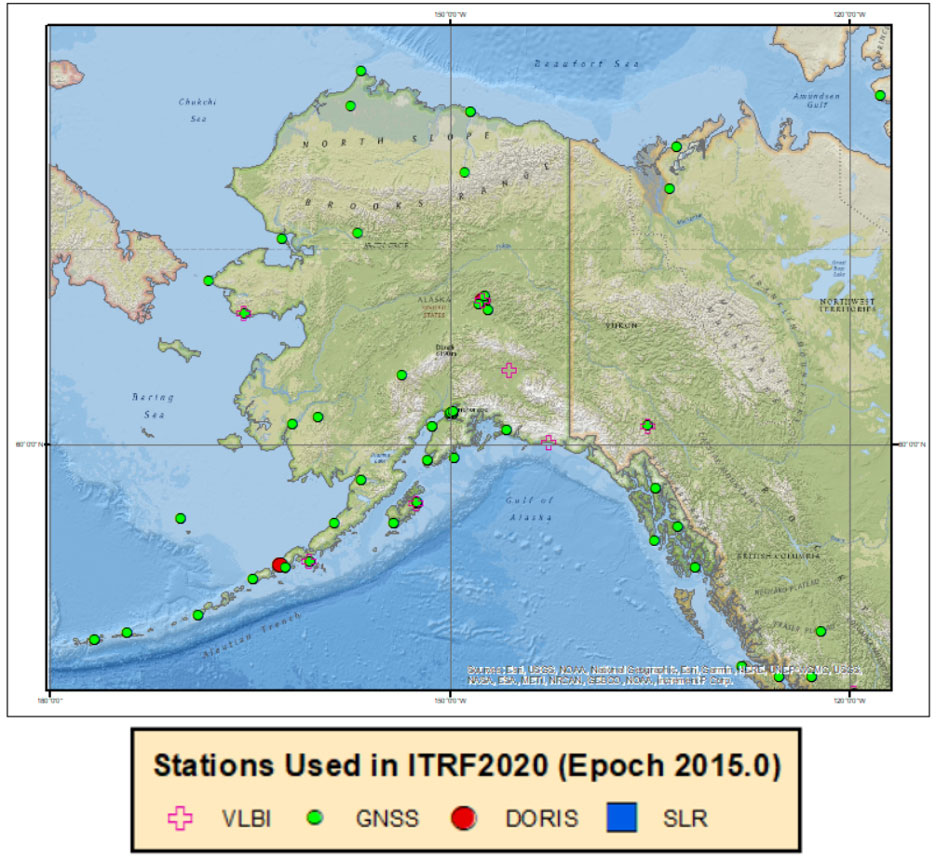
    For this column, I downloaded the station lists from the four space geodetic techniques and provided a few plots that depict the location and velocities of these sites. The box below depicts the location of the space geodetic techniques around the world. As indicated in the plot, some locations have more than one technique collocated at the same site.

    Plot of the Four Different Space Geodetic Techniques

    Image: David Zilkoski
    Image: Dave Zilkoski

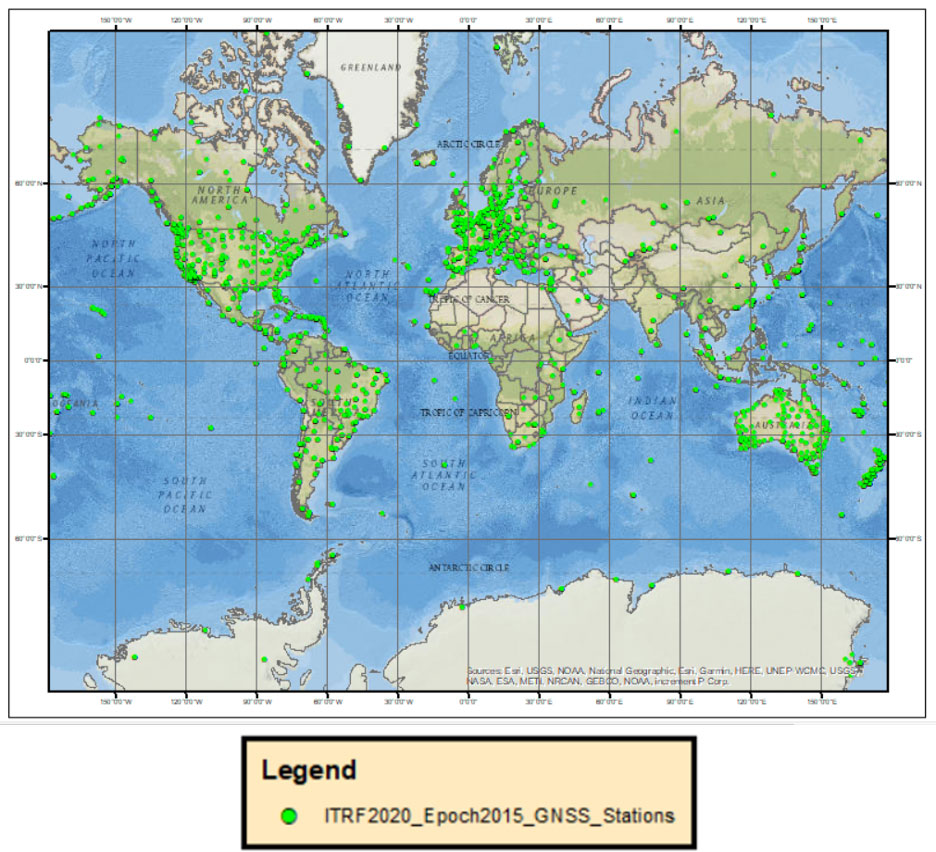
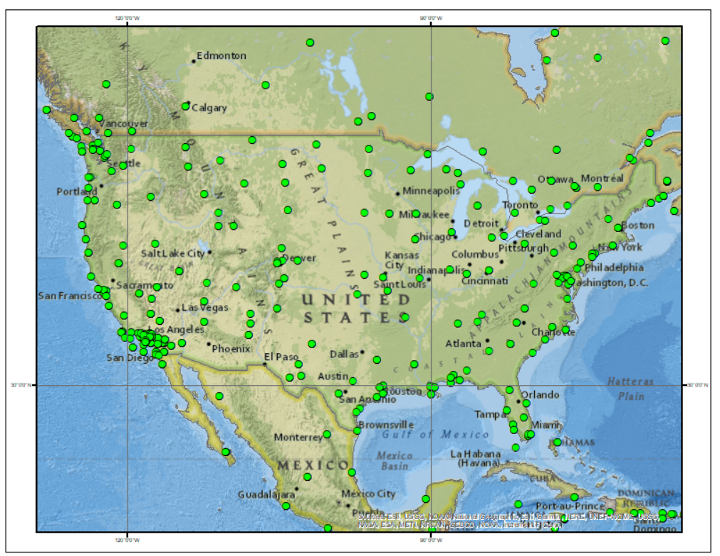
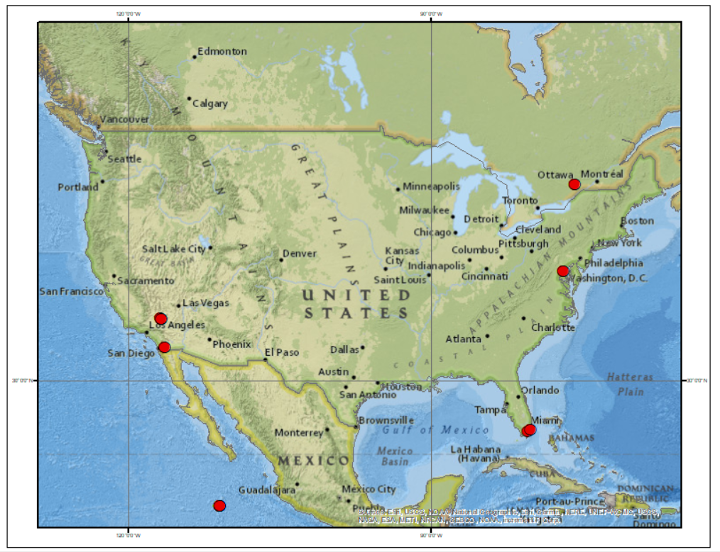
    The following plots depict the locations using each space geodetic techniques: GNSS sites, DORIS sites, SLR sites and VLBI sites.

    Plot of GNSS Sites

    Image: David Zilkoski
    Image: Dave Zilkoski


    Plot of DORIS Sites

    Image: David Zilkoski
    Image: Dave Zilkoski

    Plot of SLR Sites

    Image: Dave Zilkoski
    Image: Dave Zilkoski

    Plot of VLBI Sites

    Image: Dave Zilkoski
    Image: Dave Zilkoski

    The box below shows the location of the techniques in the conterminous United States.

    Plot of the Four Different Space Geodetic Techniques in the CONUS

    Image: Dave Zilkoski
    Image: Dave Zilkoski

    The plot below depicts the sites in the state of Alaska.

    Plot of the Four Different Space Geodetic Techniques in the Alaska

    Image: Dave Zilkoski
    Image: Dave Zilkoski

    The images below depict each of the four space geodetic techniques in the conterminous United States.

    Plots of the Space Geodetic Techniques by Technique in the CONUS

    Image: Dave Zilkoski
    Plot of GNSS Sites in CONUS Image: Dave Zilkoski
    Image: Dave Zilkoski
    Plot of DORIS Sites in CONUS (Image: Dave Zilkoski)
    Image: Dave Zilkoski
    Plot of SLR Sites in CONUS (Image: Dave Zilkoski)
    Image: Dave Zilkoski
    Plot of VLBI Sites in CONUS (Image: Dave Zilkoski)

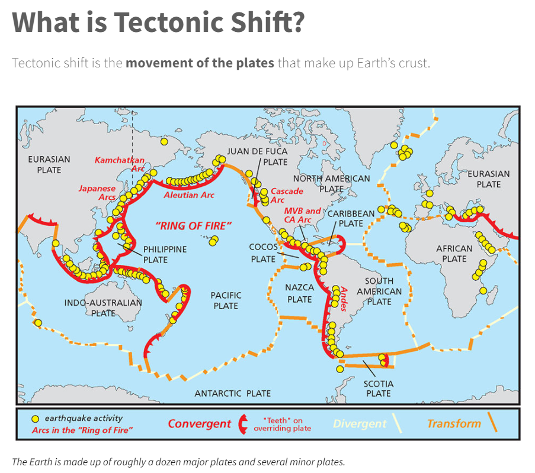
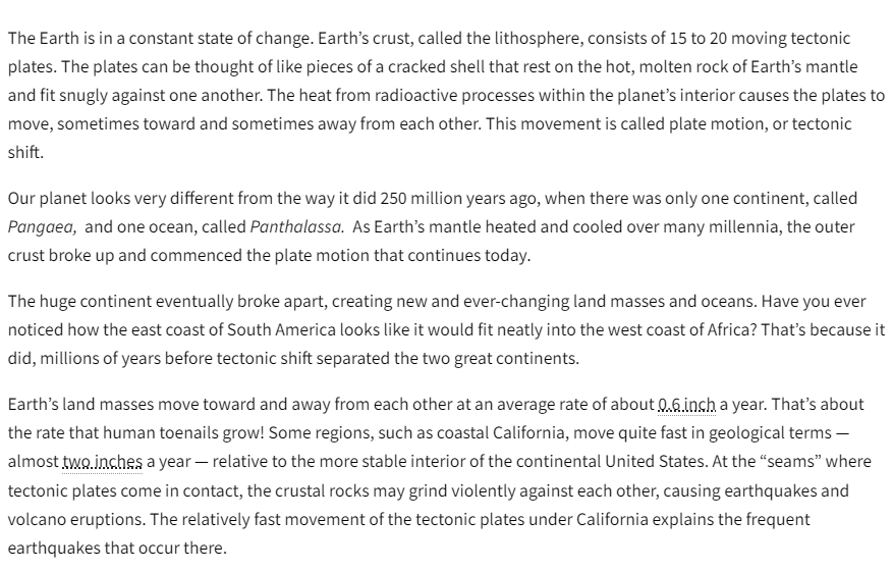
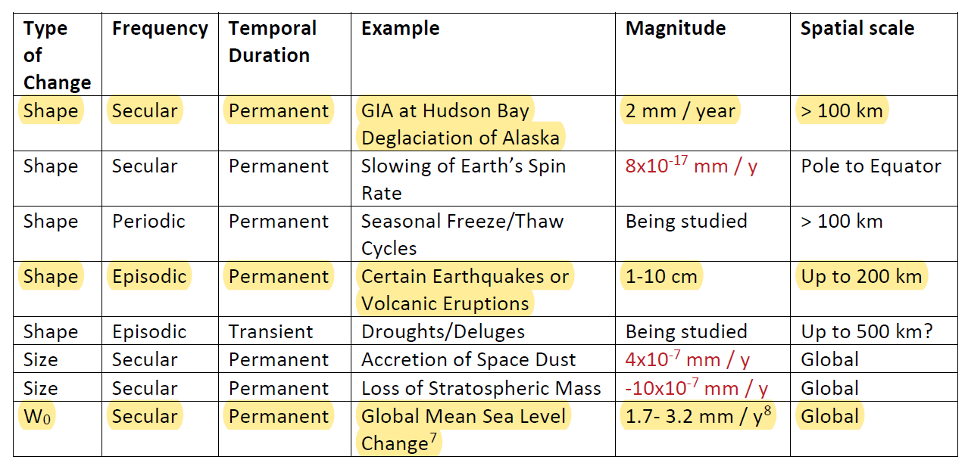
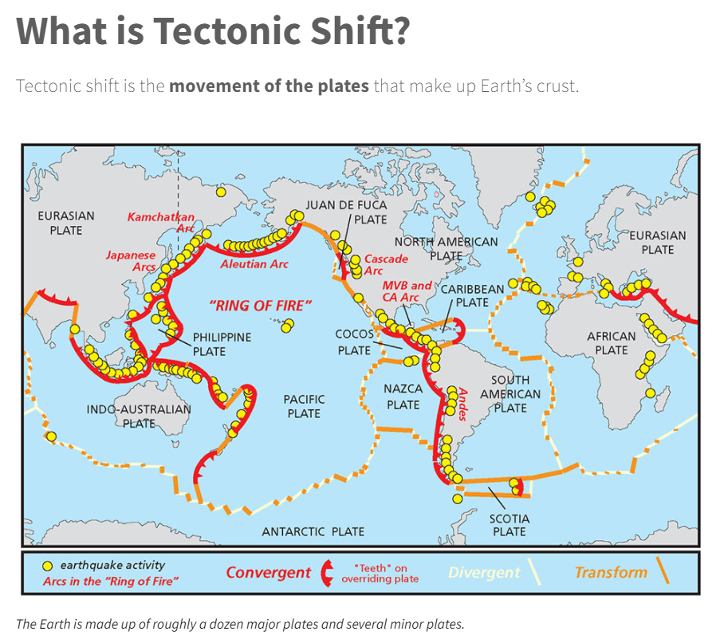
    Altamimi’s article on the ITRF2020 stated it is “necessary to regularly update the ITRF (approximately every 5 years) to account for station position temporal variations due to geophysical phenomena.” My February 2022 column discussed the tectonic plates and why is it necessary to account for movement in a geodetic reference frame. As I stated then, coordinates basically change because the Earth’s surface is moving due to the movement of major tectonic plates. See the box titled “What is Tectonic Shift?” for information about why it is called plate movement or tectonic shift. The world’s geodesists understand this and are attempting to manage the changing coordinates by providing a time-dependent component of the international terrestrial reference frame.

    Image: National Ocean Service Website
    Image: National Ocean Service website
    Image: National Ocean Service Website
    Image: National Ocean Service website

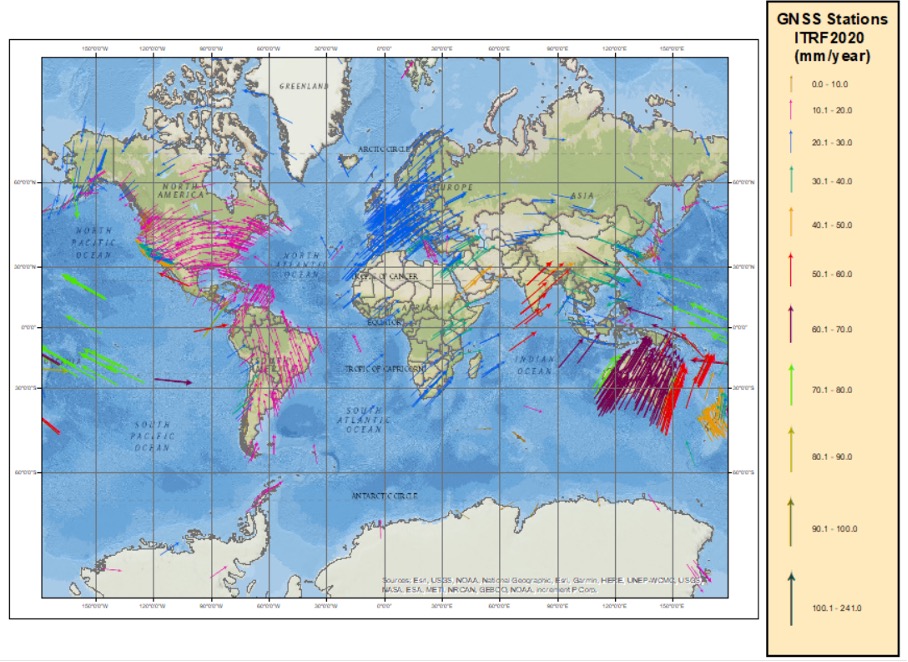
    The box below depicts the horizontal velocity based on the ITRF2020 velocities (downloaded on 08/12/2022).

    Plot of the Horizontal Velocity Vectors based on the ITRF2020 Velocities

    (Image: Dave Zilkoski)
    Image: Dave Zilkoski

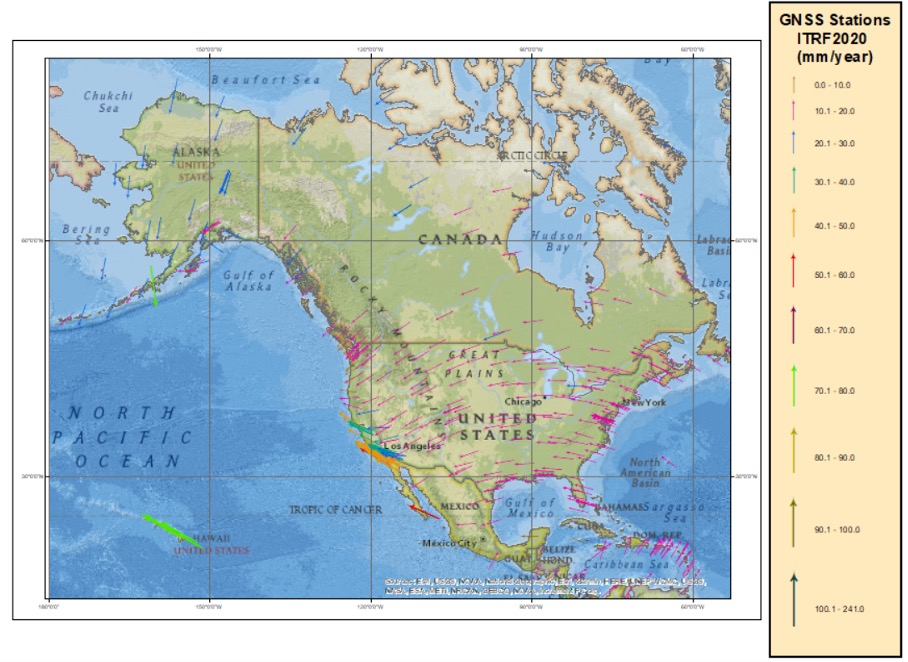
    The box below depicts the horizontal velocities in the North America. These vectors look very similar to the velocities reported in my February 2022 column.

    Plot of the Horizontal Velocity Vectors in North America based on the ITRF2020 Velocities

    Image: Dave Zilkoski
    Image: Dave Zilkoski

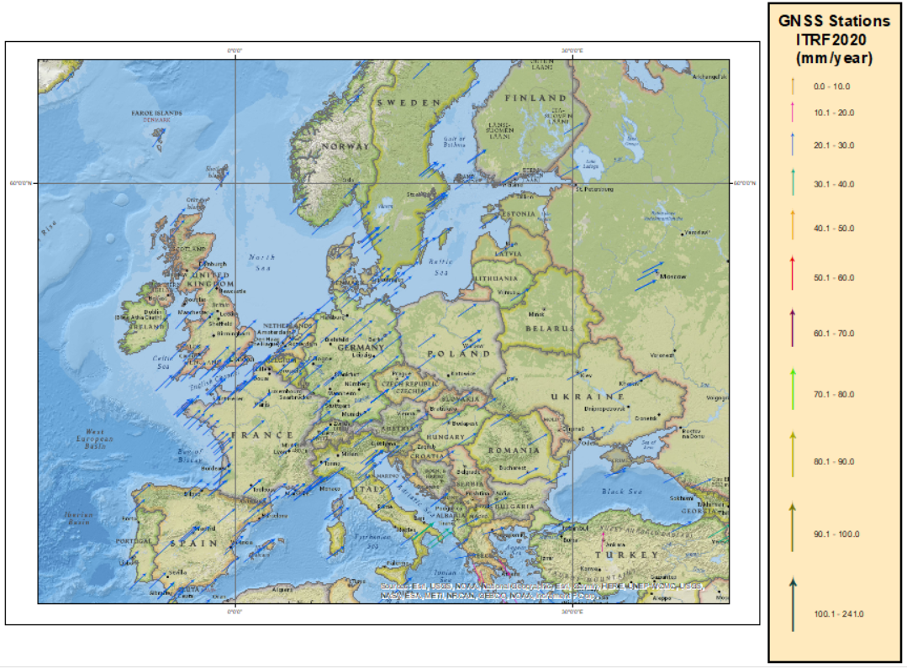
    For a comparison to North America vectors, the box below depicts the velocity vectors in Europe.

    Plot of the Horizontal Velocity Vectors in Europe based on the ITRF2020 Velocities

    Image: Dave Zilkoski
    Image: Dave Zilkoski

    They are similar in magnitude, but not in direction. Once again, looking at the map of tectonic plates, North America is located mostly on the North American plate and Europe is on the Eurasian plate.

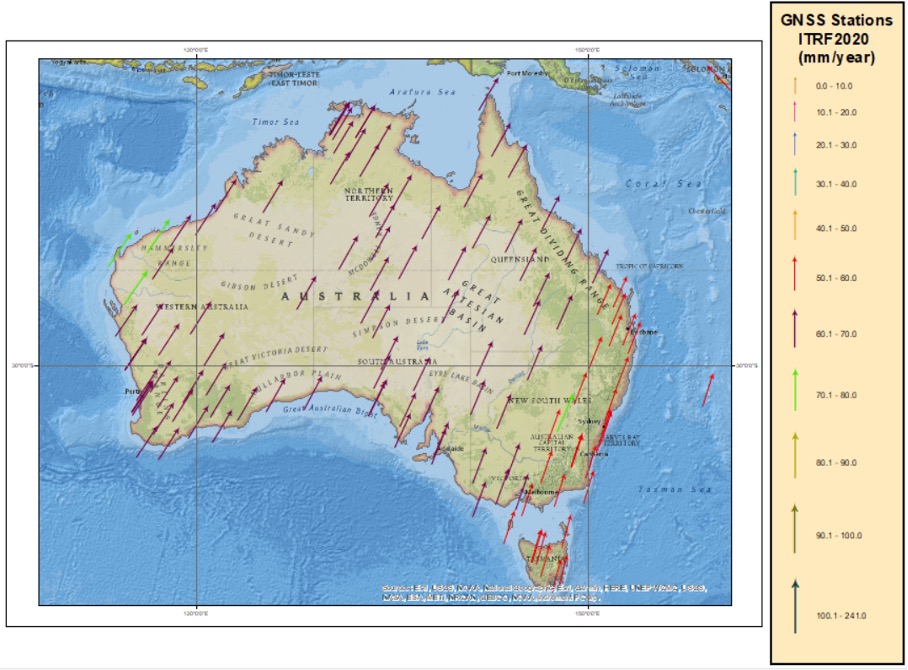
    Australia is on the Indo-Australian plate and has some fairly large horizontal velocities vectors. See the box below.

    Plot of the Horizontal Velocity Vectors in Australia based on the ITRF2020 Velocities

    Image: Dave Zilkoski
    Image: Dave Zilkoski

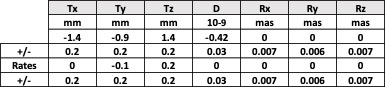
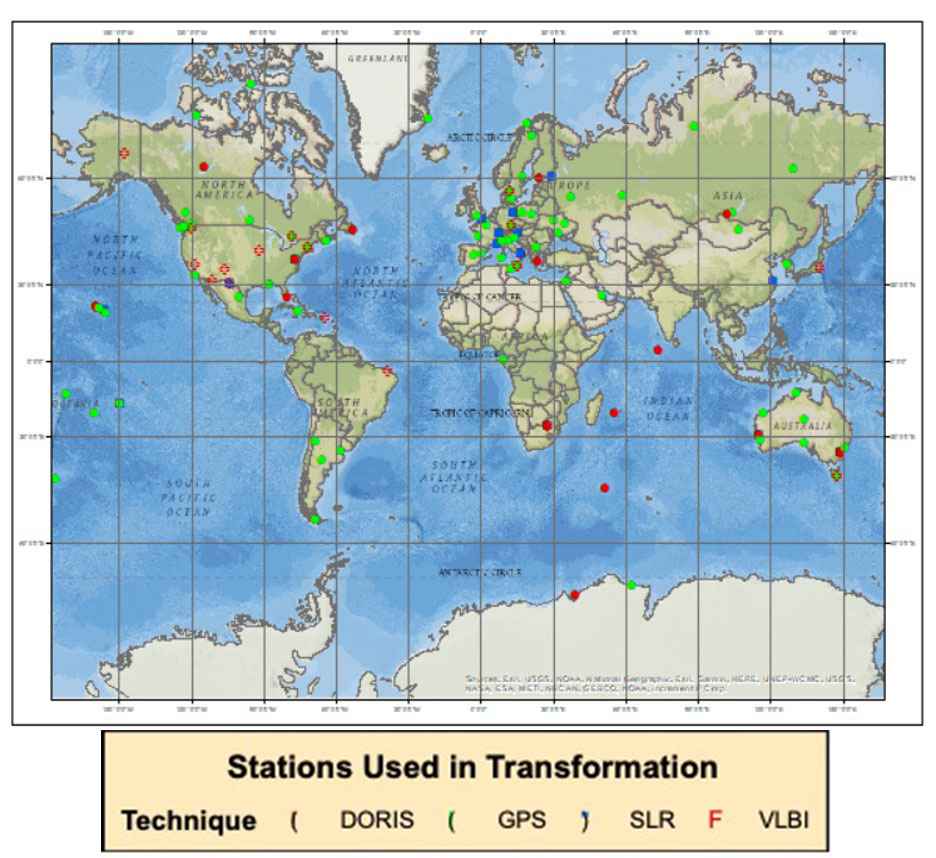
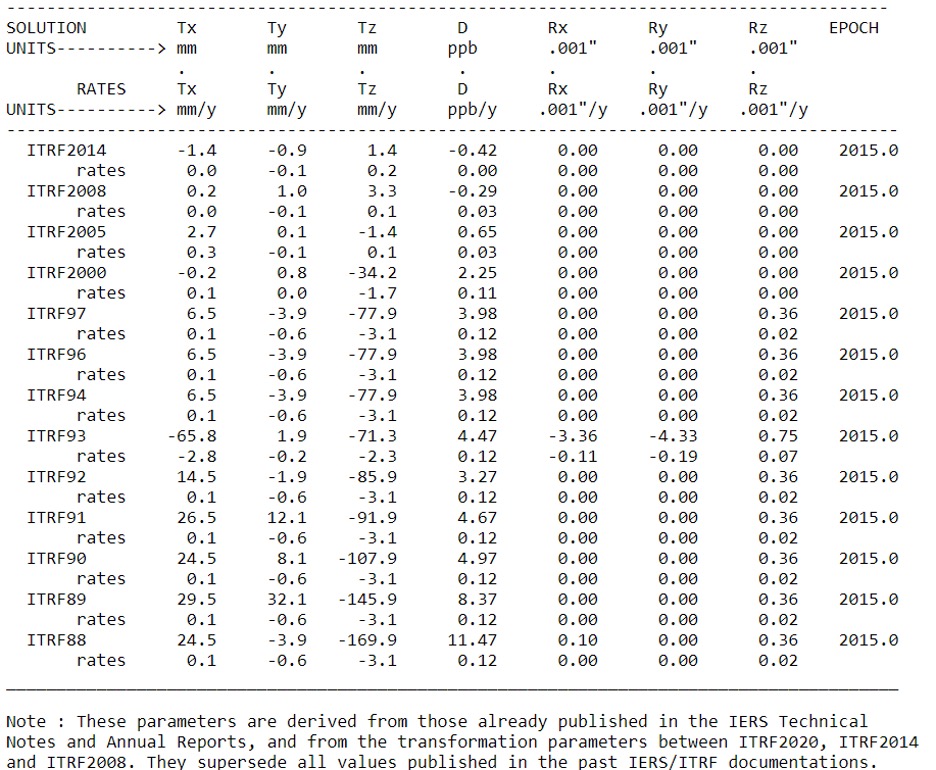
    So, what’s the difference between ITRF2014 and the new ITRF2020? The box below provides the 14 transformation parameters from ITRF2020 to ITRF2014. These transformation parameters have been estimated using 131 stations located at 105 sites. See the box “Plot of the Stations used in the Transformation Parameters from ITRF2020 to ITRF2014” for the location of these stations. Notice that the translation values in X,Y,Z are very small (<1.5 mm) between the two reference frames.

    Transformation Parameters from ITRF2020 to ITRF2014

    (https://itrf.ign.fr/en/solutions/ITRF2020)
    (https://itrf.ign.fr/en/solutions/ITRF2020)

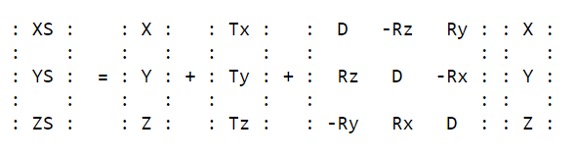
    Transformation parameters at epoch 2015.0 and their rates from ITRF2020 to ITRF2014 (ITRF2014 minus ITRF2020)

    (https://itrf.ign.fr/en/solutions/ITRF2020)
    (https://itrf.ign.fr/docs/solutions/itrf2020/Transfo-ITRF2020_TRFs.txt)

    X,Y,Z are the coordinates in ITRF2020, and XS,YS,ZS are the coordinates in ITRF2014.

    Plot of the Stations used in the Transformation Parameters from ITRF2020 to ITRF2014

    Image: Dave Zilkoski
    Image: Dave Zilkoski

    The transformation parameters from ITRF2020 and past ITRFs are provided in the table below. As indicated in the table, most of the changes in X,Y and Z are very small since ITRF2005.

    Transformation Parameters from ITRF2020 to Past ITRFs

    (https://itrf.ign.fr/docs/solutions/itrf2020/Transfo-ITRF2020_TRFs.txt )
    (https://itrf.ign.fr/docs/solutions/itrf2020/Transfo-ITRF2020_TRFs.txt)

    As previously stated, the third multi-year CORS solution will be important to the new 2022 modernized National Spatial Reference System (NSRS) because NGS will establish a strict mathematical relationship between the 2022 NSRS frames and the ITRF2020 frame. This will allow direct access to the NSRS, according to NOAA Technical Report NOS NGS 67. Again, there will not be any changes to NGS’s NOAA CORS coordinates due to ITRF2020 until NGS completes its third multi-year CORS solution.

    Users can receive emails about the latest NGS News by signing up for NGS’s newsletters. These notices will highlight the release of new products, updates to existing services, progress reports for major projects, information about upcoming NGS-sponsored events, and job opportunities at NGS.

  • What will the data delivery system of the modernized 2022 NSRS look like?

    What will the data delivery system of the modernized 2022 NSRS look like?

    My previous column highlighted that orthometric heights in NAPGD2022 will be defined through ellipsoid heights and a geoid model, such as GEOID2022. Therefore, changes in the geoid model will be very important to users estimating orthometric heights using GNSS. I briefly described the geophysical reasons for changes in the geoid that affect the orthometric height of a mark.

    For the past four years, I have discussed in my columns the tasks associated with the new, modernized 2022 reference frames. It’s now the middle of 2022, so where are the new reference frames? Well, on June 9, Dru Smith, NSRS modernization manager for the National Geodetic Survey (NGS), provided an update on the status of the modernization in a webinar. The Powerpoint slides and video of the presentation can be downloaded from the NGS website under the following title: It’s 2022…Are You Done Yet? I will highlight some of the items from the webinar, but I encourage everyone to download the video and listen to the webinar.

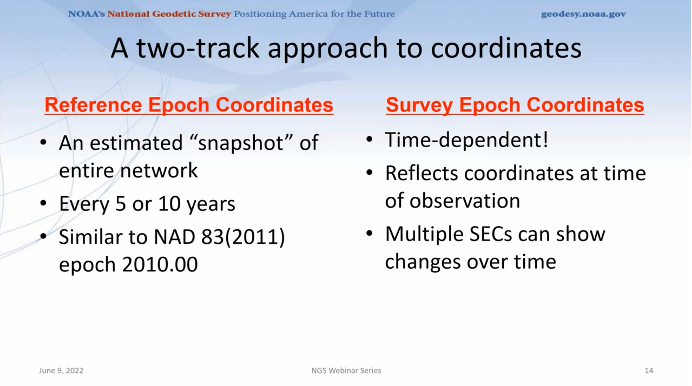
    First, Smith mentioned that NGS will be providing new types of coordinates. The NGS denotes this as a two-track approach to coordinates: Reference Epoch Coordinates (REC) and Survey Epoch Coordinates (SEC). See the box below.

    New Types of Coordinates (Image: NGS June 6th Webinar - It's 2022…are we done yet?)
    New types of coordinates (Image: NGS June 6 webinar)

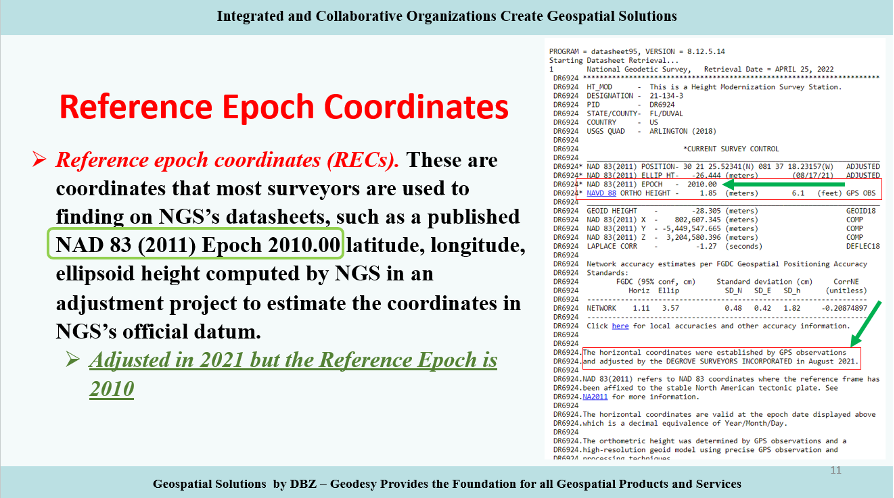
    Reference Epochs Coordinates (REC) are defined in NGS Blueprint for the Modernized NSRS, Part 3 as coordinates computed by NGS in an adjustment project to estimate the coordinates at one of the official reference epochs that NGS will define in 2025. RECs are similar to coordinates computed by NGS in a nationwide adjustment project such as the National Adjustment of 2011 (see the box below).

    NAD 83 (2011) Epoch 2010,00 Coordinates (Image: Dave Zilkoski)
    NAD 83 (2011) epoch 2010.00 coordinates (Image: NGS)

    NGS has not determined what data will be included in the first iteration of RECs. For the 2020.00 project, the current cutoff date for incorporating data is Dec. 31. Users can submit the data to NGS via OPUS projects and the OPUS-Share tool. To increase the submission of GNSS observations on marks, NGS has developed a beta OPUS-Projects 5.0 webtool that will allow real-time kinematic and real time network (RTK/RTN) observations to be submitted.

    As previously mentioned, at this time, the NGS has not determined the cutoff for the earliest data to be included in the determination of the 2020.00 RECs. The agency will be conducting experiments to determine the appropriate cutoff date. These coordinates will require an intra-frame velocity model (IFVM) to generate the RECs at the specific reference epoch.

    As of February 2021, based on NGS’ Blueprint for the Modernized NSRS, Part 3, version February 2021, the following is the agency’s policy with regard to RECs:

    • For a given mark and a given reference epoch, the REC will never be changed–except to correct a blunder.
    • This does not prevent NGS from adding new RECs
      • on points with new data that have not yet had an REC computed
      • for marks that do not have an REC in the most recently passed reference epoch, a new REC can be computed and added to the NSRS.
    • Per NGS’ Blueprint for the Modernized NSRS, Part 3, version February 2021, for simplicity, RECs may happen on the same schedule as SECs.

    Survey epoch coordinates (SECs) are defined as coordinates computed by NGS at a specific survey epoch. Users will submit their data and its metadata to NGS, and NGS will then check, adjust and define the coordinates at one “survey epoch.” These coordinates will be “part of the NSRS,” Smith said. NGS is computing coordinates in this manner to provide the best estimate of the coordinates at any mark at a specific moment in time, which is very important in areas influenced by crustal movement.

    So, how will NGS process and generate these SECs?

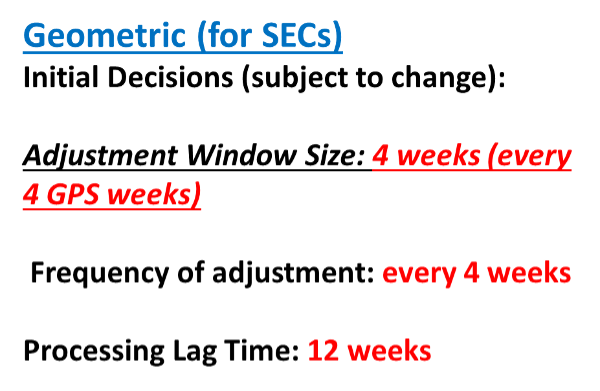
    Survey epoch coordinates (SECs) are designed to provide time-dependent geodetic coordinates. Therefore, NGS has to choose some time span in which all observations will be processed together to yield a single SEC of a mark. NGS denotes this time span as a “geometric adjustment window.” NGS wants the adjustment window to be short enough so that movement of a mark did not occur between repeat observations (or was small enough to be ignored) and long enough for users to efficiently and effectively collect redundant observations for submission to NGS (see the box below).

    Proposed SEC Geometric Adjustment Window
    Proposed SEC geometric adjustment window. (Image: NGS)

    As of February 2021, based on the NGS Blueprint for the Modernized NSRS, Part 3, the following is the policy with regard to SECs:

    • One or more GNSS occupation(s) over a single mark will be processed into one survey epoch coordinate when all occupations take place within one geometric adjustment window.
    • If a user submits two occupations on one mark, but they happen to fall in two consecutive geometric adjustment windows, NGS will use them to create two distinct survey epoch coordinates. Each SEC will be based on one occupation.

    Future columns will provide more explanation about this concept of a geometric adjustment window and how NGS will process the data to generate survey epoch coordinates.

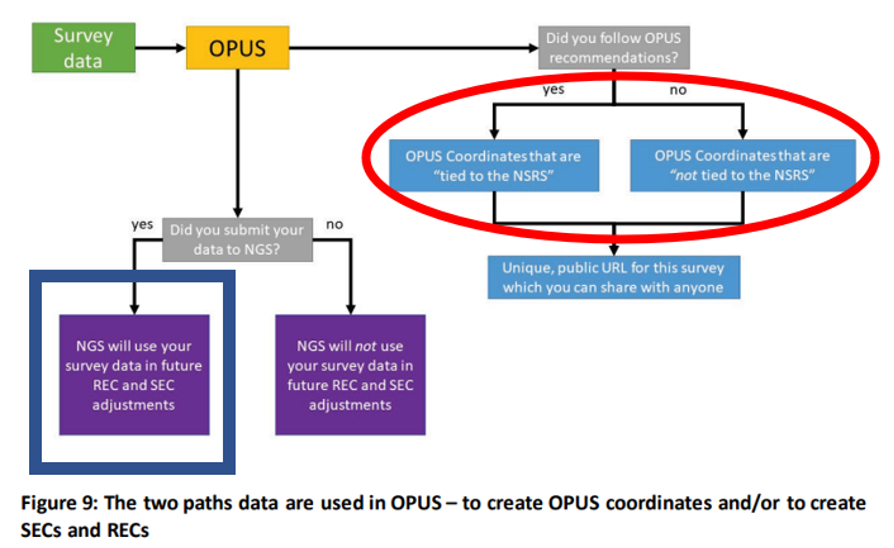
    NGS is developing models and tools for users to submit data to NGS to compute coordinates — including OPUS coordinates, reference epoch coordinates and survey epoch coordinates. Figure 9 from Blueprint for the Modernized NSRS, Part 3, version February 2021, is a schematic that shows the flexibility NGS is building into an OPUS-type webtool. Basically, if users follow NGS guidelines and rules, and submit their data to NGS, then NGS will compute and publish REC and SEC coordinates (see the blue outline in the box below). If users only want to compute OPUS coordinates, then they can use NGS’s webtool without submitting the data to NGS (see the red outline in the box below).

    Photo:
    Building flexibility into OPUS (Image: NGS)

    Dru Smith’s June 9 update on the status of the modernization provided a mockup of how users will be able to retrieve data using their web browsers — a prototype is being developed. The data will also be available in downloadable form such as an XML file for users to input the data and metadata into their programs or databases. I recently discussed some of this material at seminars I presented at the Florida Surveyors and Mapping Society’s 67th annual conference held in Palm Beach Gardens. The participants were very interested in the prototype, but really wanted to learn more about the format and process of the downloadable XML files. I’m sure future NGS webinars will address this topic. I emphasized to the group that they should watch the entire presentation and provide feedback to NGS. As mentioned above, Powerpoint slides and video can be downloaded from the NGS webinar website.

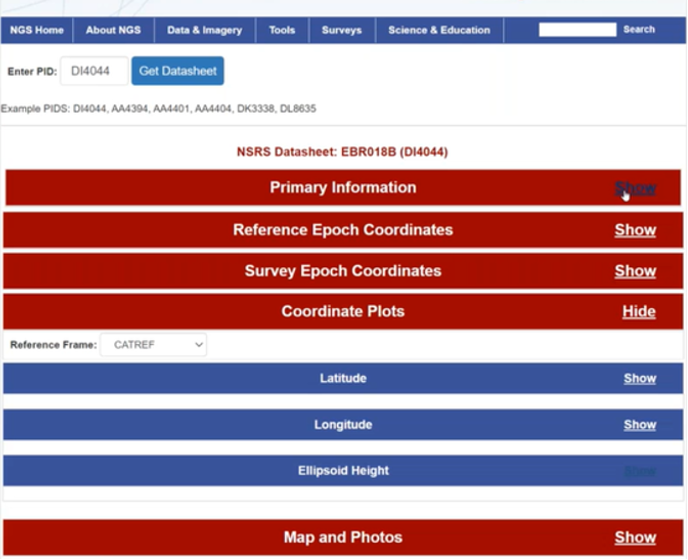
    The boxes below highlight a few of the options NGS is considering. The box “Data Delivery – Prototype” is an example provided by Smith during his webinar. It should be noted that the images of the prototype are not included in the downable slides, but they are part of the video. The images presented in this column are screen captures from the video.

    Data Delivery - Prototype (Image: NGS June 6th Webinar - It's 2022…are we done yet?)
    Data delivery prototype. (Image: NGS)

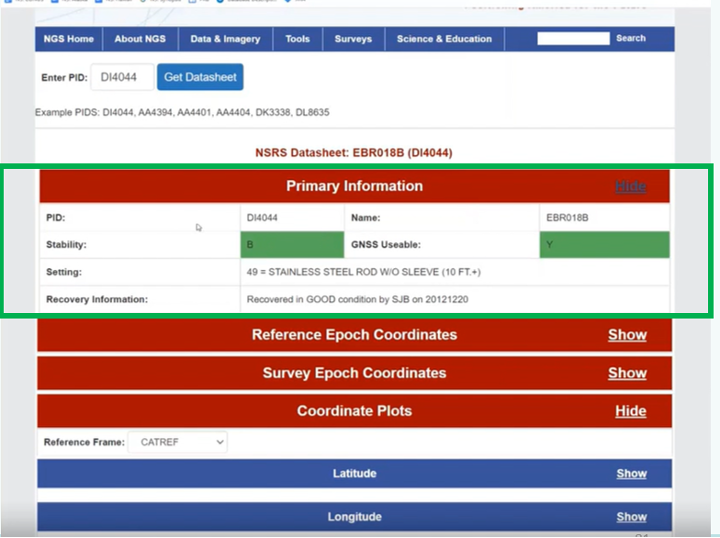
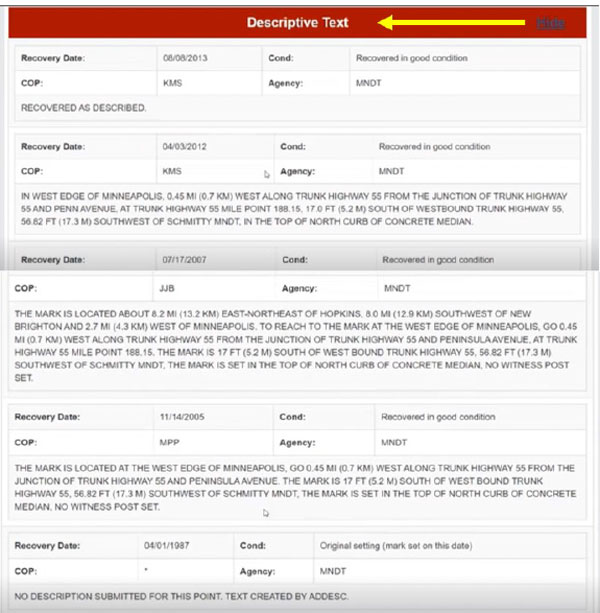
    The box below provides some of the basic information of a mark, such as its PID, name, stability, GNSS usable code, setting and the latest recovery information. Again, this is a prototype, so users should feel free to send feedback to NGS. NGS wants to generate a usable product, and is interested in user feedback.

    Primary Information – Prototype (Image: NGS June 6th Webinar - It's 2022…are we done yet?)
    Primary information prototype. (Image: NGS)

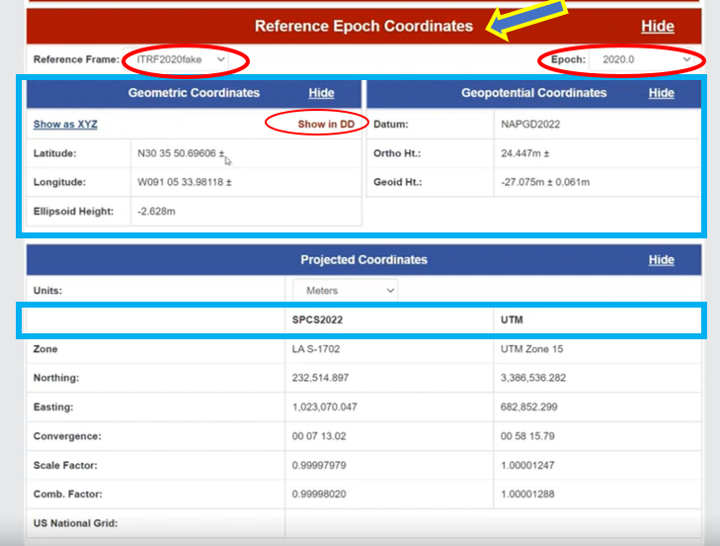
    As previously stated, NGS is implementing a two-track approach to coordinates: publishing REC and SEC. The box below provides the REC information of a mark when a user clicks the “Show” button. As shown in the diagram, the reference frame and epoch are provided, as well as the geometric coordinates (latitude, longitude, ellipsoid height) and geopotential coordinate information (NAPGD2022 orthometric height and geoid height).

    Reference Epoch Coordinates – Prototype (Image: NGS June 6th Webinar - It's 2022…are we done yet?)
    Reference epoch coordinates prototype. (Image: NGS)

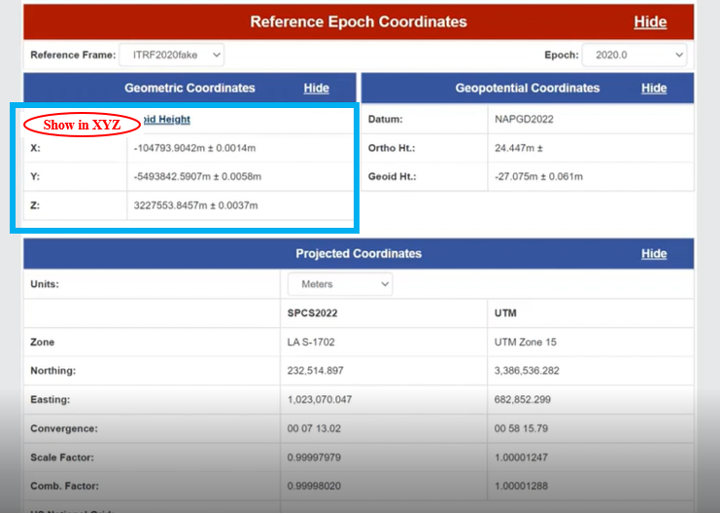
    NGS provides an option for individuals who want the geometric coordinates in the X, Y, Z format (see the box below). Remember, this is only a mockup of a prototype, to give us an idea of the direction NGS is going with its data delivery system in the new, modernized 2022 NSRS.

    REC Shown in X,Y,Z (Image: NGS June 6th Webinar - It's 2022…are we done yet?)
    REC Shown in X,Y,Z. (Image: NGS)

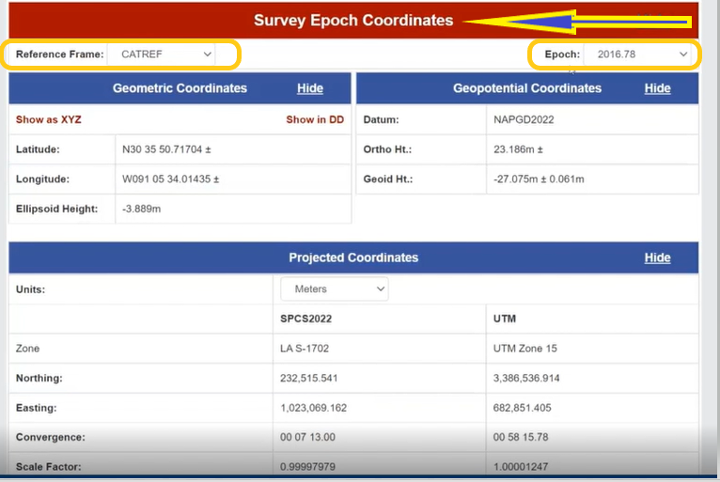
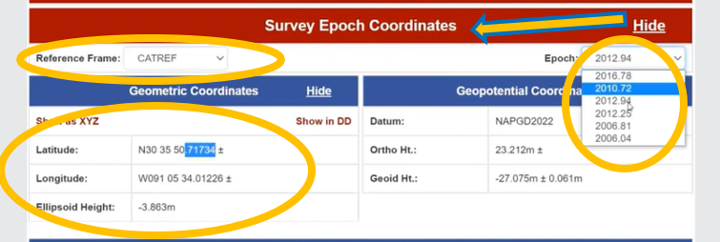
    Similar to the REC, the prototype includes SEC. For a mark, the latter are different from the former because SEC are computed at the epoch of the survey observations (see the box below).

    Survey Epoch Coordinates – Prototype (Image: NGS June 6th Webinar - It's 2022…are we done yet?)
    Survey epoch coordinates – prototype. (Image: NGS)

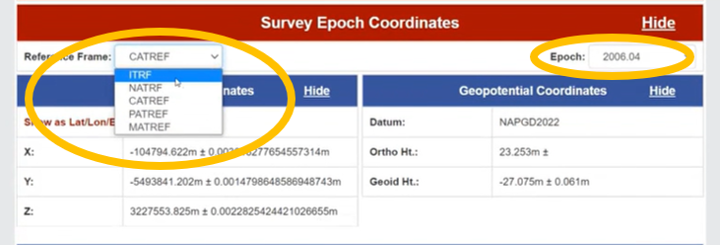
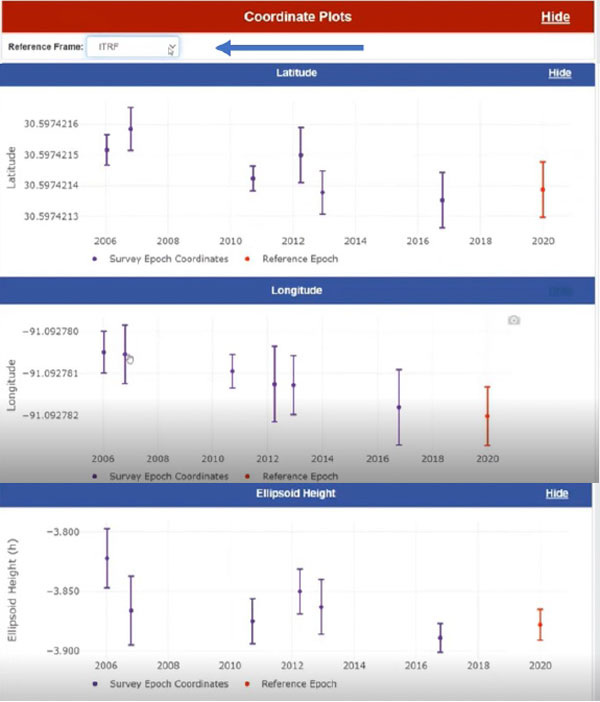
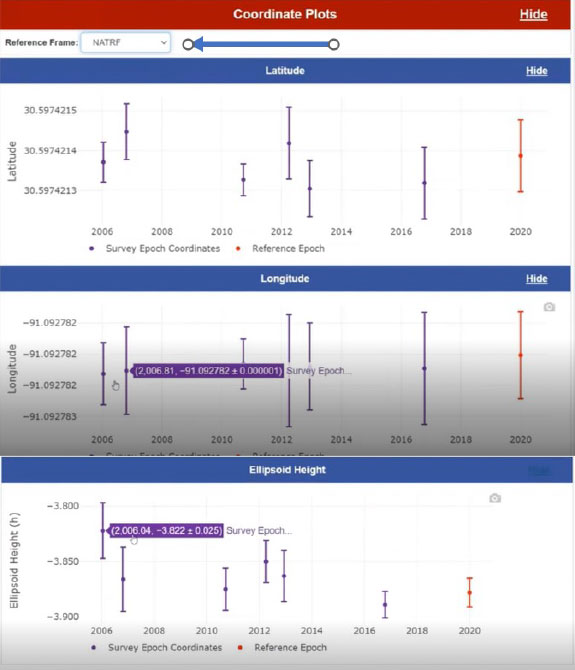
    The box titled “SEC in CATRF – Prototype” is an example of a mark in the CATRF reference frame and the survey epoch of 2012.94. As indicated in the diagrams, users will be able to select the reference frame (ITRF, NATRF, CATRF, PATRF and MATRF) and the survey epoch.

    SEC in CATRF – Prototype

     (Image from: NGS June 6th Webinar - It's 2022…are we done yet?)
    Option to Select Survey Epoch
    Photo:
    Options to select reference frame (Images: NGS)

    Another feature of the data delivery system is that it provides plots of a mark’s survey epoch coordinate values at different epochs. In the example shown in the box below, the plots provide values of a mark’s latitude, longitude and ellipsoid heights based on each survey epoch data. The user can select various reference frames of the mark to understand the change based on the reference frame.

    Coordinates Plots in ITRF – Prototype (Image: NGS June 6th Webinar - It's 2022…are we done yet?)
    Coordinate plots in ITRF prototype. (Image: NGS)

    The box below clearly shows a slope in the changes in coordinates based on survey epochs, especially in the longitude. This is the plate rotating in time. You can see the changes in latitude, longitude and ellipsoid height in the NATRF reference frame for the same mark. The latitude and longitude plots do not show a slope because the plate rotation is removed using a model to change from the ITRF reference frame to the NATRF reference frame. That said, the ellipsoid height plots look the same because the rotation model does not change the ellipsoid height.

    Coordinate Plots in NATRF – Prototype (Image: NGS June 6th Webinar - It's 2022…are we done yet?)
    Coordinate plots in NATRF prototype. (Image: NGS)

    The prototype also provides maps, photos and descriptive text of the mark.

    Map and Photos – Prototype (Image: NGS June 6th Webinar - It's 2022…are we done yet?)
    Map and photos of a mark in the prototype. (Image: NGS)
    Descriptive Text – Prototype (Image: NGS June 6th Webinar - It's 2022…are we done yet?)
    Descriptive text prototype (Image: NGS)

    Some of this data delivery output may seem familiar to users who have used the NGS beta routines (see the box below).

    Beta Routines

    NGS's Beta Routines (Images: NGS)
    Beta routines (Image: NGS)

    For example, the Passive Mark Page Webtool provides the coordinate information for a mark. My October 2020 column described the tool is detail. See below for an example of the passive mark tool.

    Beta Passive Mark of KK1531 (Image: National Geodetic Survey)
    Beta Passive Mark of KK1531 (Image: NGS)

    The NGS Beta Map routine enables users to link to NGS datasheets, the passive mark tool and mark recovery, as well as connect to OPUS Shared Solutions and the NOAA CORS Network. See below for an example. It also provides a measuring tool, multiple basemaps and the ability to export data. My December 2021 column described the NGS Beta Map in detail.

    Example of NGS Beta Map Routine for KK1531 (Image: National Geodetic Survey)
    Example of NGS Beta Map Routine for KK1531 (Image: National Geodetic Survey)

    Only three years remain before the release of the new, modernized NSRS. I encourage everyone to try all of the beta products, and download Dru Smith’s June 6 webinar for a better understanding of the agency’s current thoughts on how it will provide data to users in the new, modernized NSRS. As for all the NGS beta products, the agency would like users to try the tools and provide feedback on what they liked and what they didn’t like, as well as any additional information you need or would like to see. The NGS is trying to develop tools useful to everyone, but that won’t be possible unless they hear from users.

    The following statement on NGS beta products explains how to provide feedback and why it is important:

    “This is a beta product. NGS is interested in your feedback concerning its function and usability as well as how users would like to interact with NGS datasheet information in the future. Email us at [email protected].”

  • The effects of geoid changes in NGS’s new, modernized 2022 NSRS

    The effects of geoid changes in NGS’s new, modernized 2022 NSRS

    My April column addressed the vertical movement at the NOAA CORS Network (NCN). The values at the sites indicate the potential movement of marks in the area of the CORS. The rates are based on GNSS data and have an estimate of error associated with them.

    As I mentioned in my previous column, I’m not sure how the National Geodetic Survey (NGS) will address the vertical movement effects in the new, modernized National Spatial Reference System (NSRS). That said, NGS will be monitoring the CORS and looking for trends to help describe the vertical movement at the CORS. These trends are an indication of what may be happening in that area.

    As stated in previous columns, orthometric heights in NAPGD2022 will be defined through ellipsoid heights and a geoid model, for example GEOID2022. In addition to the movement of individual marks due to crustal movement, there are geophysical reasons for changes in the geoid that affect the orthometric height of a mark. Therefore, changes in the geoid model will be very important to users estimating orthometric heights using GNSS.

    As stated in the NOS NGS 64 report, NGS has set a goal of maintaining geoid accuracy at 1 centimeter (1 standard deviation) in both absolute and differential geoid undulations. The box titled “Figure 13 from NOS NGS 64 Report” depicts an estimate of the secular change in the geoid. As indicated in the plot, the changes are very small, ranging from -1.25 mm/year to 1.5 mm/year.

    What I find interesting is the small negative change in the southeastern United States. There are other drivers for geoid changes. This column will address some of these changes and what they mean to users.

    Secular geoid change

    Photo: NGS
    Figure 13 from NOS NGS 64 Report (Image: NGS)

    As mentioned in many of my articles, the new, modernized NSRS has a time-dependent component. This includes the geoid modelTable 5-1 from NOS NGS 64 report are examples of some of the physical processes being investigated by NGS to account for changes in the geoid.  (See the box titled “Some of the geophysical drivers of geoid change.”) As mentioned in the NOS NGS 64 report, the magnitudes in red have already been determined to be too small for NGS to model. The examples highlighted in yellow have magnitudes that are significant and NGS will attempt to account for these changes to the geoid. 

    Table 5-1: Some of the geophysical drivers of geoid change
    Table 5-1: Some of the geophysical drivers of geoid change

    NGS classifies the changes in the geoid in three different groups: Shape Change, Size Change, and W0 Change. The box titled “The Groups of Geoid Change” provides NGS’s definition and explanation of the terms.

    The groups of geoid change

    Photo: Dave Zilkoski

    NGS’s report on their Geoid Monitoring Service (GeMS) program provides figures that depict an estimate of the secular geoid rate trend based on the NASA GSFC mascon model. See the boxes titled “Estimate of Geoid Rate Over CONUS” and “Estimate of Geoid Rate Over Alaska.” For more details on GeMS, download the report NOAA Technical Report NOS NGS 69: A Preliminary Investigation of the NGS’s Geoid Monitoring Service (GeMS), and read my December 2019 Survey Scene column. The secular geoid rate trend is an example of the geoid changing its shape, but not the W0 value. What this means is that the local geoid undulations will change, but the overall size of the geoid will not.

    Estimate of geoid rate over CONUS

    Figure 32: Geoid rate over CONUS based on the GSFC mascon model [mm/yr] (Image: NOAA)
    Figure 32: Geoid rate over CONUS based on the GSFC mascon model [mm/yr] (Image: NOAA)
    Estimate of geoid rate over Alaska

    Figure 33: Geoid rate over Alaska from GSFC mascon model [mm/yr] (Image: NOAA)
    Figure 33: Geoid rate over Alaska from GSFC mascon model [mm/yr] (Image: NOAA)
    These changes in the geoid are fairly small values (+/- 1.3 mm/year), but they will accumulate over a decade. As previously stated, NGS’s goal is to maintain geoid accuracy at the centimeter level (1 standard deviation) in both absolute and differential geoid undulations. In my February 2022 column, I discussed how coordinates change because Earth’s surface is moving due to the movement of major tectonic plates. It’s fairly obvious how the tectonic shift affects horizontal coordinates, but earthquakes and volcanic eruptions can also cause large shifts in vertical coordinates.

    In recent history, on May 18, 1980, geologists watched in awe as Mount St. Helens erupted in a gigantic explosion. After the eruption, the volcanic cone of Mount St. Helens had been completely blasted away; the peak, which was at an elevation of 9,677 feet (2,950meters) was changed to a horseshoe-shaped crater with an elevation of 8,363 feet (2,549 meters). Extreme crustal movements such as the Mount St. Helens eruption can change the shape of the geoid. As explained in my April 2022 newsletter, NGS understands this and is attempting to manage the changing coordinates by providing a time-dependent component to a mark’s ellipsoid height, but there is also a time-dependent component to the geoid that affects the mark’s orthometric height.

    Ring of Fire

    Image: National Ocean Service
    Image: National Ocean Service

    The “Ring of Fire” map highlights earthquake activities around the world. As indicated in Table 5.1, earthquake or volcanic eruptions can change the shape of the geoid. Of course, they also can change the height of a mark due to crustal movement, which would typically be larger than the change in the geoid height. The amount of movement would be due to the size and magnitude of the event, but even small earthquakes could cause a change in the height of a mark located near the event. Earthquakes are occurring all over the world every day. 

    Earthquakes with large magnitudes are highlighted by news media outlets, but ones with smaller magnitude typically are not highlighted. The four figures below provide examples of earthquakes that have occurred over 30 days. This information can be obtained from the United States Geological Survey (USGS).

    Earthquakes during the past 30 Days
    Date: May 20, 2022

    Image: USGS
    Image: USGS

    Earthquakes in the lower 48 during the past 30 days
    Date: May 20, 2022

    Image: USGS
    Image: USGS

    Earthquakes in eastern United States in the past 30 days
    Date: May 20, 2022

    Image: USGS
    Image: USGS

    I found the large number of earthquakes that occurred in Oklahoma in just 30 days to be very interesting.  This isn’t something that I thought occurred in the eastern region of the United States. 

    Earthquakes in Oklahoma during the past 30 days
    Date: May 20, 2022

    Image: USGS
    Image: USGS

    The image below depicts earthquakes that have occurred in Oklahoma in the past five years. They are fairly small in magnitude, but what is the cumulative effect on the geoid in the region, as well as changes to the orthometric heights of marks due to crustal moment in the region?  This is why it is important for the new, modernized NSRS to implement time-dependent coordinates. 

    Earthquakes in Oklahoma in the last 5 years
    Dates: 2017 to 2022

    Image: USGS
    Image: USGS

    To better understand the changes to the geoid, NGS performed a survey in Alaska to obtain geodetic data as part of its GeMS program.  On May 12, 2022, Kevin Ahlgren, a geodesist at NGS, described in a webinar the observations collected and some of the results. 

    The presentation provided an overview of a field campaign performed in support of the GeMS program and a time-dependent geoid model. The campaign included static GNSS, relative gravity, and deflection of the vertical techniques on 50 stations in Alaska. The webinar was can be downloaded.

    I encourage everyone to download the presentation.  The change in the geoid due to geophysical drivers is small, but if the new, modernized NSRS is going to include time-dependent coordinates, then changes in the geoid must be accounted for.  For demonstration purposes, NGS provides an example of the time-dependent geoid change in the xGEOID20 webtool.  The box below, “xGEOID20 interactive computation output,” is an example of using this tool. The two stations are located in Alaska. As indicated in the output from the tool, the change in the geoid is 8 mm in five years. Again, NGS’s goal is to maintain geoid accuracy at the centimeter level (1 standard deviation) in both absolute and differential geoid undulations.  These small changes can become significant over time. 

    xGEOID20 interactive computation output

    Note: DN is the time-dependent geoid change computed between user inputted epoch (t) and t.
    Note: DN is the time-dependent geoid change computed between user inputted epoch (t) and t. (Image: NGS)

    The last geoid change group that I’ll highlight has to do with the change in the gravity potential (W0) value that defines the model. The NOS NGS 64 Report states that the standing definition of the geoid, as adopted and used at NGS, is the following:  

    The geoid is the equipotential surface of the Earth’s gravity field which best fits, in a least squares sense, global mean sea level. 

    As stated in the NOS NGS 64 report, over a century of sea-level measurements imply that global mean sea level (GMSL) was rising at a rate of approximately 1.7 millimeters per year and was rising at a rate of 3.2 millimeters per year between 1993 and 2010 (IPCC, 2014). If NGS is going to define the geoid as the equipotential surface of the Earth’s gravity field that best fits, in a least squares sense, global mean sea level, then the geoid in the new, modernized NSRS must change when the GMSL exceeds a certain threshold. 

    Again, NGS’ goal is to maintain geoid accuracy at the centimeter level (1 standard deviation) in both absolute and differential geoid undulations.  What this means is that as GMSL rises, the value of gravity potential which best fits to GMSL (called W0) will also change.  In other words, the surface which was called “the geoid” and had W=W0 in 2022 will no longer be the geoid. A new value of W0 (W0new) is chosen, and “the geoid” would now be the surface W=W0new.   

    So, what does this really mean to users? The NOS NGS 64 Report states on page 37:

    “NGS and the Canadian Geodetic Survey have jointly adopted the value of 2.0 m^2/s^2 as the replacement threshold for a new geoid model (and new geopotential datum). This represents approximately 20 centimeters of GMSL (and thus geoid) rise. At the current rate of sea-level change of about +3 millimeters per year (IPCC, 2014), this means NGS expects to replace NAPGD2022 in approximately 60 to 70 years.” 

    Therefore, this should not be a major concern of users for a long time. 

    This column highlighted that orthometric heights in NAPGD2022 will be defined through ellipsoid heights and a geoid model, for instance GEOID2022; and therefore, changes in the geoid model will be very important to users estimating orthometric heights using GNSS.  It briefly described the geophysical reasons for changes in the geoid that affect the orthometric height of a mark. 

    If NGS is going to meet the goal of maintaining geoid accuracy at 1 centimeter (1 standard deviation) in both absolute and differential geoid undulations, they will have to address changes in the geoid. The secular changes in the geoid, as indicated in Figure 13 in the NOS NGS 64 report, are very small, ranging from -1.25 mm/year to 1.5 mm/year. Once again, these are small changes to the geoid, but they will accumulate over time, and that is why NGS is including time-dependent coordinates in the new, modernized NSRS.

  • The effects of vertical movement on NGS’s modernized 2022 NSRS

    The effects of vertical movement on NGS’s modernized 2022 NSRS

    My February column explained why it is important to account for horizontal movement of marks everywhere, and not just in areas influenced by active crustal movement due to earthquakes such as Southern California.

    It provided information about the NOAA CORS Network (NCN) rates of movement based on International Reference Frame of 2014 (ITRF2014) coordinates and horizontal velocity information.  It highlighted reports from the National Geodetic Survey (NGS) that describe models that will facilitate users transferring coordinates between reference frames and dealing with intra-frame movement between marks based on surveys performed at different epochs.


    NAPGD2022 orthometric heights will primarily be accessed through GNSS technology.


    As I stated in my February column, this is not just a horizontal positioning issue. In this month’s column, I address estimates of vertical movement that will have to be accounted for in the new, modernized National Spatial Reference System (NSRS).

    The NGS 2021 revised Blueprint 2, NOAA Technical Report NOS NGS 64 Blueprint for the Modernized NSRS, Part 2: Geopotential Coordinates and Geopotential Datum, addresses the geopotential aspects of the new, modernized NSRS.  The modernized Geopotential Datum will be called the North American-Pacific Geopotential Datum of 2022 (NAPGD2022).  There will be four primary, interrelated time-dependent products of NAPGD2022:

    • a global model of Earth’s geopotential field (GM2022)
    • regional gridded geoid undulation models (GEOID2022)
    • regional gridded deflection of the vertical models (DEFLEC2022)
    • regional gridded surface gravity models (GRAV2022).

    NAPGD2022 will provide gridded models for North America (that includes CONUS, Alaska, Hawaii, the Caribbean, Canada, Mexico, Central America and Greenland), American Samoa and Guam/Commonwealth of Northern Mariana Islands (CNMI). My previous columns have described the NAPGD2022 in detail.  The revised NOS NGS 64 report mentioned that NAPGD2022 will be built upon ITRF2020.  It states that NAPGD2022 will operate equally well in any of the four new terrestrial reference frames developed as part of the new, modernized NSRS in 2022.

    As I stated in previous columns, orthometric heights in NAPGD2022 will be defined through GNSS ellipsoid heights and GEOID2022. This means NAPGD2022 orthometric heights will primarily be accessed through GNSS technology. GEOID2022 will be defined in a manner that best fits global mean sea level at the epoch of NAPGD2022.

    As in my previous column, to better visualize the potential size of the vertical movement, I used the CORS ITRF2014 coordinates and velocities from the NGS website to create plots depicting the upward velocity (Vu) values for CORS that are designated as operational and have computed velocities. [Note: I use the term upward because that is how it is reported on the NGS CORS website under the tab labeled “position and velocity.”  The term upward velocity means movement in both directions — negative is downward and positive is upward.] The box below shows maximum, minimum, average and standard deviations of upward velocity values for each state and territory of the United States.

    Table of ITRF 2014 Upward Velocities of US CORSs

    Photo:

    The upward velocity values are not as systematic as the horizontal velocity values, and they are significantly smaller.  I have highlighted the average value velocity column.  As indicated in the table, the values vary from state to state, but they are all small relative to the horizontal movement values. (See my previous column for plots depicting the horizontal values.)

    What is interesting is the range of values in some states. For example, Alaska and California have a very large range — understandable because of the active earthquakes and other movement that occur in these states. Also, Louisiana and Texas have a very large range due to local subsidence.

    I decided to highlight the values for the conterminous United States (CONUS) in two separate plots.  The box “Upward Velocities (Vu) Between +/–5 mm/year in CONUS” depicts upward velocities (Vu) between +/–5 mm/year in CONUS. The box “Upward Velocities Greater than Absolute Values of 5 mm/year in CONUS” depicts upward velocity values greater than +/–5 mm/year.

    Upward Velocities (Vu) between +/- 5 mm/year in CONUS

    Image: Dave Zilkoski
    Image: Dave Zilkoski

    It’s obvious that most of the vertical movement values are between +/–5 mm/year in CONUS.  There are some large values in California, Louisiana and Texas.  This is highlighted in both plots.

    Upward Velocities (Vu) Greater than Absolute Values of 5 mm/year in CONUS

    (Image: Dave Zilkoski)
    (Image: Dave Zilkoski)

    As indicated in the plots, some of the values exceed 10 mm/year. In five years, the heights of marks in these regions could potentially change by 5 cm.  An example of the potential subsidence in the Houston-Galveston, Texas, region is depicted in the box below. As indicated in the plot, some marks are subsiding greater than 2 cm/year.  That means in five years the marks in that region could have subsided more than 10 centimeters.

    Estimate of Subsidence in the Houston-Galveston, Texas, Region

    Photo: HGSD WebsitePhoto: HGSD Website

    Harris-Galveston Subsidence District Website

    The box below depicts the values in Alaska. Most of these values indicate that the marks are uplifting. Some of these values exceed 10 mm/year. Once again, height coordinates in some regions will potentially change 5 cm in five years. I generated a separate plot for the southeastern region of Alaska. (See the box titled “Upward Velocities (Vu) in Southeastern Alaska.”)

    Upward Velocities (Vu) in Alaska [All Values]

    (Image: Dave Zilkoski)
    Image: Dave Zilkoski


    Upward Velocities (Vu) in Southeastern Alaska [All Values]

    (Image: Dave Zilkoski)
    Image: Dave Zilkoski

    As I did in my previous columns, I prepared several plots that depict the upward velocities in various regions of the United States. See the boxes below for North Carolina, Missouri Southwest U.S. The plots indicate that the magnitude of the vertical movement varies from state to state, as well as within the states.

    CORS ITRF 2014 Upward Velocities (Vu) in Missouri [All Values]

    (Image: Dave Zilkoski)
    Image: Dave Zilkoski


    CORS ITRF 2014 Upward Velocities (Vu) in Southwest U.S. [All Values]

    (Image: Dave Zilkoski)
    Image: Dave Zilkoski


    CORS ITRF 2014 Upward Velocities (Vu) in Southwest U.S. [Values Between +/- 5 mm/year]

    (Image: Dave Zilkoski)
    Image: Dave Zilkoski

    I also generated plots that separately depict the positive and negative upward velocities for the conterminous United States. There are more negative upward velocity values than positive values.

    CORS ITRF 14 Positive Upward Velocities (Vu) in Conterminous U.S. (Values between 0 and 5 mm/year)

    (Image: Dave Zilkoski)
    Image: Dave Zilkoski


    CORS ITRF 2014 Negative Upward Velocities (Vu) in Conterminous U.S. (Values between -5 and 0 mm/year)

    (Image: Dave Zilkoski)
    Image: Dave Zilkoski

    The table below provides the number of CORS with negative upward velocity values and the number of CORS with positive values for every state and territory of the United States. I have highlighted the states and territories that have more positive values than negative values. As you can see, only six states have more positive upward velocities than negative values. Four of the six states are in Northeastern United States.

    Table of ITRF 2014 Positive and Negative Upward Velocities for United States

    (Image: Dave Zilkoski)

    So far, this column has only addressed the vertical movement at the NCN CORS.  The values at the sites indicate the potential movement of marks in the area of the CORS. The rates are based on GNSS data and have an estimate of error associated with them.

    I’m not sure how NGS will address the vertical movement effects in the new, modernized NSRS. That said, NGS will be monitoring the CORS and looking for trends to help describe the movement at the CORS. These trends will be an indication of what may be happening in the area.

    In addition to the movement of individual marks, there are geophysical reasons for changes in the geoid. As I stated in previous columns, orthometric heights in NAPGD2022 will be defined through ellipsoid heights and GEOID2022. Therefore, changes in the geoid model will be very important to users estimating orthometric heights using GNSS.

    As stated in the NGS 64 report, NGS has set a goal of maintaining geoid accuracy at 1 centimeter (1 standard deviation) in both absolute and differential geoid undulations. Figure 13 from the NGS 62 Report depicts an estimate of the secular change in the geoid. As indicated in the plot, the changes are very small, ranging from –1.25 mm/year to 1.5 mm/year.

    What I find interesting is the small negative change in the southeastern United States. There are other drivers for geoid changes. Future columns will address some of these changes and what it means to users.

    Figure 13 from NOS NGS 62 Report

    (Image From NGS Website: Blueprint 2 Revised NOAA_TR_NOS_NGS_0064.pdf)
    Image from NGS website: Blueprint 2 Revised NOAA_TR_NOS_NGS_0064.pdf

    Figure 13 – Secular Geoid Change


    Lastly, I’d like to highlight a new service from NGS: “NGS Webinar Series Certificates of Attendance.” See the box titled “Ways to Earn a Certificate of Attendance.” Basically, users can earn certificates by viewing a webinar after it has been posted by NGS.  This is very useful for users who could not attend the original webinar. I encourage all users to check out the site to find out more information about the new service.

    Ways to Earn a Certificate of Attendance

    (Image from NGS Website: (https://geodesy.noaa.gov/web/science_edu/webinar_series/certificates.shtml )
    Image from NGS website: https://geodesy.noaa.gov/web/science_edu/webinar_series/certificates.shtml


  • A guide to the latest Beta NGS Map

    A guide to the latest Beta NGS Map

    On Nov. 9, the National Geodetic Survey (NGS) announced the release of a new Beta NGS Map. This web application allows users to view multiple datasets that are useful to anyone planning or performing a survey project, or anyone that’s just looking for NGS marks.

    The map enables users to access NGS datasheets, OPUS Shared Solutions, and the NOAA CORS Network. It also provides a measuring tool, multiple basemaps, and the ability to export data.

    I recently used this tool on my iPhone to locate marks when I was traveling. It’s an amazing tool that is easy to navigate, and a useful tool for identifying marks to be included in a project.

    The NGS homepage provides a link to the Beta NGS Map (see below).

    Image: NGS Website
    Image: NGS Website

    When you first click on the NGS Map link a short narrative appears that provides a brief set of instructions on how to use the map (see below). There’s a box that you can check so that the narrative will not appear every time you access the site. It’s important to note that the data for the CORS and OPUS Shared results are updated monthly. This could be an issue in some instances, therefore users should always check the NGS website for the latest information for the NOAA CORS Network or OPUS Shared map.

    Sample map of Denver region. (Image: NGS website)
    Beta NGS Map. (Image: NGS website)

    After you click OK at the bottom right of the page, a sample map will appear.

    Sample map of Denver region. (Image: NGS website)
    Sample map of Denver region. (Image: NGS website)

    The map allows the user to type in a location (geographic location, CORS Site ID, OPUS PID, Datasheet PID or Datasheet Name) to start a search. See the “Waxhaw, North Carolina, Region” map as an example of entering a geographic location.

    Waxhaw, North Carolina, Region. (Image: NGS Website)
    Waxhaw, North Carolina, Region. (Image: NGS Website)

    The bottom navigation bar has eight buttons.

    List of buttons at the bottom of the map. (Image: Dave Zilkoski)
    List of buttons at the bottom of the map. (Image: Dave Zilkoski)

    When clicked, a window pops up providing information about that particular button. (For example, see “Map with Legend Information” below.) The legend will include all layers that have been selected. In my example, the datasheet layer was the only layer I had selected (see “Map with Layer Information”.)

    Map with legend information. (Image: NGS Website highlighted by Dave Zilkoski)
    Map with legend information. (Image: NGS Website highlighted by Dave Zilkoski)
    Photo:Map with layer information. (Image: NGS Website highlighted by Dave Zilkoski)
    Map with layer information. (Image: NGS website highlighted by Dave Zilkoski)

    When the user clicks on a symbol, a box will appear with information about the mark. See “Information for Station UNN 12” below.

    Information for Station UNN 12. (Image: NGS Website)
    Information for Station UNN 12. (Image: NGS Website)

    The box contains information from the NGS datasheet as well as a link to the actual NGS database. A nice feature of this webtool is that it provides a link to NGS’s Beta Passive Mark webtool. My October 2020 Survey Scene column highlighted the features of the NGS’s Passive Mark tool. The box captioned “Passive Mark Page for Station UNN 12” is an example of the tool. I’ve highlighted several items important to individuals planning surveys, such as the mark’s coordinates, datums and source, and the Orthometric Height residual (the difference between the estimated geoid height and the modeled hybrid geoid height).

    Passive Mark Page for Station UNN 12. (Image: NGS Website)
    Passive Mark Page for Station UNN 12. (Image: NGS website)

    Another great feature is that the user can click on the Mark Recovery link to provide the latest recovery information for a mark (see the box titled “Mark Recovery Link for Station UNN 12 “).

    Mark Recovery Link for Station UNN 12. (Image: NGS website)
    Mark Recovery Link for Station UNN 12. (Image: NGS website)

    When a user clicks on the More info link for the Recovery Mark option, a Mark Recovery Form is provided for the user to enter the recovery information for the mark. The routine fills in the fields based on the current data in NGS’s database (see the box titled “Mark Recovery Form for Station UNN 12”). The user can enter changes or new information about the mark. This information is very important to users planning surveys. Just because a mark has been occupied by GNSS in the past doesn’t mean that it’s still a good station for occupation by GNSS. The environmental conditions around the mark could have changed since the last time it was occupied; for example, new buildings and/or growth of trees may now obstruct the GNSS signals.

    Mark Recovery Form for Station UNN 12. (Image: NGS website)
    Mark Recovery Form for Station UNN 12. (Image: NGS website)

    As previously stated, the NOAA CORS Network is one of the layers available. The box titled “Map of NOAA CORS Network in the North Carolina Region” depicts the locations of the NOAA CORS in North Carolina. The layer list provides some of the attributes of the CORS, such as the sampling rate and which GNSS signal are collected at the site.

    Map of NOAA CORS Network in the North Carolina Region. (Image: NGS website)
    Map of NOAA CORS Network in the North Carolina Region. (Image: NGS website)

    When a user clicks on a specific CORS, a box appears with information for that particular CORS. I’ve highlighted several items in the box titled “Information on CORS Site ID NC77.” In my example, CORS NC77 collects GPS, Galileo,and GLONASS data. Also, users can obtain long-term and short-term plots of the CORS.

    Once again, this feature is important to users planning and performing GNSS survey projects. As in the other features, clicking on the More Info link will bring up the plots. The plots for CORS NC77 are provided in the boxes titled “Long-Term Plot Information on CORS Site ID NC77” and “Short-Term Plot Information on CORS Site ID NC77” below.

    Information on CORS Site ID NC77. (Image: NGS Website)
    Information on CORS Site ID NC77. (Image: NGS website)
    Long-Term Plot Information on CORS Site ID NC77. (Image: NGS website)
    Long-Term Plot Information on CORS Site ID NC77. (Image: NGS website)

    In the short-term plot, the red line is the published position, and the green hashed area is the tolerance of the NGS position, that is +/- 2 cm horizontal and +/–4 cm vertical. All the error bars are 1 sigma values. This information is useful when selecting NOAA CORS to be included in a survey project.

    The short-term plot contains the mean, standard deviation and RMS values for the north, east and up components of the site. When planning a GNSS project, users typically identify several NOAA CORS to be included in the project. However, not all CORS are equal.

    I evaluate CORS using the following criteria:

    1. Designated as “operational”
    2. Computed (i.e., measured) velocities rather than modeled (i.e., predicted) velocities.
    3. “Consistent” data depicted in short-term time-series plots.
    4. Network accuracies ~1 to 1.5 cm horizontally and less than ~2 to 3 cm in ellipsoid height.

    Clicking on the More Info button for Site Info of NC77 provides a webpage where most of this information can be obtained.

    Before conducting any post-processing, the analyst should ensure that all CORS included in the project have data for all of the occupations and that the station’s short-term plots indicate stability.

    Short-Term Plot Information on CORS Site ID NC77. (Image: NGS website)
    Short-Term Plot Information on CORS Site ID NC77. (Image: NGS website)

    Tool buttons are situated in the top right section of the map. Included are a measurement tool to measure distances between marks and areas, a bookmarks tool to zoom to areas, and a basemaps tool to change the basemap. See the box titled “Useful Tools.”

    Useful tools. (Image: NGS website)
    Useful tools. (Image: NGS website)

    Some users may find the measurement tool helpful when planning a survey. The box titled “Using the Measurement Tool” is an example of measuring the distance between two stations.

    Using the measurement tool. (Image: NGS website)
    Using the measurement tool. (Image: NGS website)

    The last item that I’d like to highlight is that on Nov. 18, NGS has officially extended the GPS on Bench Marks campaign’s cut-off date for one year until December 31, 2022. See the box titled “NGS GPS on Bench Marks Notice.”

    NGS GPS on Bench Marks Notice. (Image: NGS website)
    NGS GPS on Bench Marks Notice. (Image: NGS website)

    NGS is anticipating that this extra time will allow users to provide additional GPS on Bench Marks data using the recently released beta version of OPUS Projects 5.0.

    OPUS Projects 5.0 enables users to incorporate their RTK and RTN observations and post-processed vendor data using the GNSS Vector eXchange file format (GVX). My October 2018 Survey Scene column described NGS’s GPS on Bench Mark program, and my October 2021 Survey Scene column described NGS’s Beta OPUS Projects 5.0.

    As stated in the NGS news release, this extension reflects NGS’ commitment to include as much data as possible in determining the Reference Epoch Coordinates (REC) that will be used to create the Transformation Tools to be released with the Modernized NSRS.

    I encourage everyone to try the new Beta NGS Map. As in all of NGS beta products, NGS would like users to try the tools and provide feedback on what they liked and what they didn’t like. They are trying to develop tools useful to everyone, but that won’t be possible unless they hear from users.