Tag: North American Vertical Datum of 1988

  • Discussing the new North American-Pacific Geopotential Datum of 2022 — Part 1

    Discussing the new North American-Pacific Geopotential Datum of 2022 — Part 1

    On April 24-25, 2017, the National Geodetic Survey (NGS) hosted the 2017 Geospatial Summit in Silver Spring, Maryland, to discuss its plans for replacing the North American Datum of 1983 (NAD 83) and the North American Vertical Datum of 1988 (NAVD 88) in 2022.

    The summit was a day and a half long and provided an opportunity for NGS to share updates and discuss the progress of projects related to National Spatial Reference System (NSRS) Modernization. Stakeholders across the federal, public and private sectors also provided feedback and impacts of New Datums on their products and services.

    The absolute differences between the new vertical reference frame, North American-Pacific Geopotential Datum of 2022 (NAPGD2022), and NAVD 88 are going to be large but, in most regions of the country, the relative differences over small areal extents will be small.

    NGS is developing geodetic routines and tools to transform heights from NAVD 88 to NAPGD2022, and to facilitate the incorporation of geodetic leveling data into NAPGD2022 to establish NAPGD2022 heights. To prepare for the new datums and develop implementation plans, stakeholders should obtain an understanding of the differences between NAPGD2022 and NAVD 88.

    My previous columns provided figures that demonstrated the approximate differences between NAPGD2022 and NAVD 88 heights at a national level. (See figure 1.) This column will provide feedback from stakeholders that participated in the Geospatial Summit and, using NGS’ GPS on BMs dataset, a discussion on the differences between NAPGD2022 and NAVD 88 (and NGVD 29) at a local level.
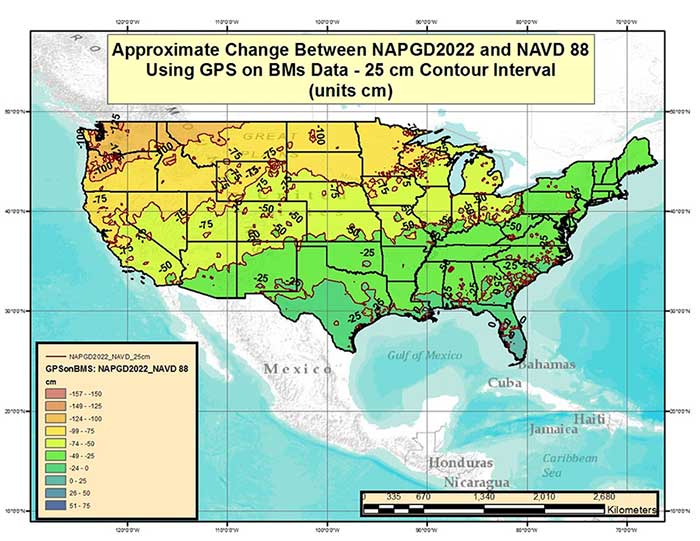
    Figure 1 – Approximate Change Between NAPGD2022 and NAVD 88 Using GPS on BMs Data (units = cm). (Image: National Geodetic Survey)
    Figure 1 – Approximate Change Between NAPGD2022 and NAVD 88 Using GPS on BMs Data (units = cm). (Image: National Geodetic Survey)

    Information about the summit and Summit Documents can be downloaded here.

    Read an excerpt from website here.

    If you check on the tab titled “Summit Documents” you can download the agenda and documents provided to participates. Read excerpts from the summit here.

    The first day consisted of presentations by NGS leadership and personnel providing updates and discussing the progress of projects related to the NSRS modernization. The presentations by NGS employees can be downloaded from NGS’ presentations library at this web link. View an excerpt from NGS’ presentations library here.

    The afternoon of day 2 were presentations by partners and stakeholders. (See box titled “Excerpt from NGS 2017 Geospatial Summit Agenda – Afternoon of Day 2.”)

    Excerpt from NGS 2017 Geospatial Summit Agenda – Afternoon of Day 2
    Day 2 Afternoon Agenda from NGS’ 2017 Geospatial Summit
    Day 2: Tuesday, April 25, 20171:30 – 3:05 Impacts of New Datums on Programs and Partners (Part 1)
    Coastal Mapping Program and VDatum: Mike Aslaksen and Stephen White, NOAA/NGS
    Federal Emergency Management Agency (FEMA): Kimberly Pettit, FEMA
    U.S. Geological Survey (USGS): Kari Craun, USGS
    U.S. Army Corps of Engineers (USACE): Jim Garster, USACE
    National Geospatial-Intelligence Agency (NGA): Stephen Malys, NGA
    3:05 – 3:25 Break
    3:25 – 4:55 Impacts of New Datums on Programs and Partners (Part 2)
    Geospatial and Remote Sensing Customers: Amar Nayegandhi, Dewberry
    Geographic Information System (GIS) Customers: Kevin Kelly, Esri
    Global Navigation Satellite System (GNSS) Equipment Customers: Hamid Mahmoudabadi, Trimble Kyle Snow, Topcon
    State Government Partners: Gary Thompson, N.C. Department of Public Safety
    Local Government Partners: Vickie Anglin, Fairfax County Government, Virginia; Patrick Simon, Baltimore County Land Survey, Maryland
    4:55 – 5:00 Wrap-up and closing

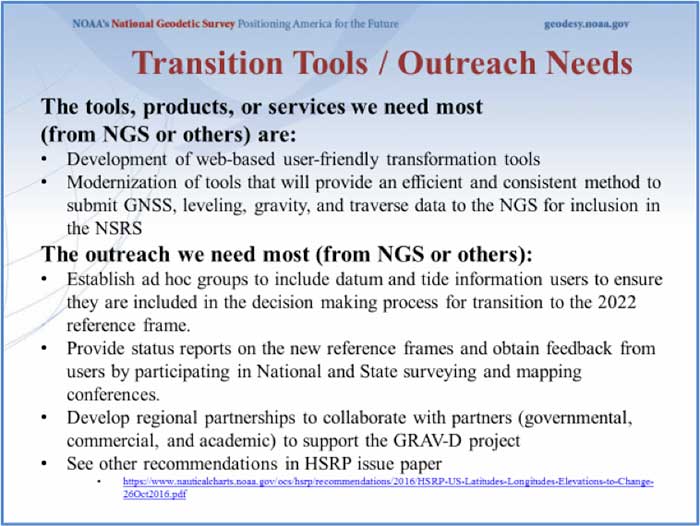
    In order for consistency, NGS provided guidance and a set of template slides for guest presenters to use. Guest presenters were allotted 10 minutes to present and limited to four slides. The presentation by the guest presenters are not on NGS’ Presentations Library but I’ve been told that they will be available on the Summit website later this year. Gary Thompson, Chief of the North Carolina Geodetic Survey (NCGS), provided me a copy of his slides and gave me permission to include them in this column. (See box titled “Power point Slides Presented by Gary Thompson, Chief of NCGS, at the NGS 2017 Geospatial Summit.”) North Carolina has been very proactive in addressing the impacts of the new datums on NC products and services. North Carolina Geodetic Survey has established a North Carolina Geodetic Survey Advisory Committee that reviews NCGS products and services, and they have established the North Carolina 2022 Reference Frame Working Group to prepare for the new datums.

    Slide: National Geodetic Survey
    Slide: National Geodetic Survey

    Powerpoint slides presented by Gary Thompson, chief of NCGS, at the NGS 2017 Geospatial Summit

    All of the presentations by the invited guest speakers were interesting, and everyone followed NGS’ guidance which helped to focus the Summit on the main issues associated with a datum change. As expected, each stakeholder had their own set of issues and concerns about transitioning to a datum. The following are some common themes that I heard from the participants:

    (1) There are a lot of products and services that will be effected by a datum change,
    (2) An official transformation model between the old and new datum(s) published by NGS is critical for a successful transition to a new datum,
    (3) Guidance documents that are “easily” understood by “non-geodesists” is required for a smooth implementation of a new datum, and
    (4) More frequent geospatial summits and webinars are needed to provide updates on the status of the projects associated with NSRS modernization and to ensure user involvement in the process.

    I contacted a couple of the guest presenters to discuss their feedback on the New Datums. As NAVD 88 Program Manager, I collaborated with many of them during the development and implementation of the NAVD 88. As in the transition from NGVD 29 to NAVD 88, it’s not the conversion of coordinates that’s a problem; a good transformation tool should meet that requirement. Saying that, it was stated that many users rely on commercial and open source software to convert their data, so they would like NGS to collaborate with others to ensure that these software suppliers are using the appropriate algorithms/information in their products. The integration with legacy data referenced to older datums may be complicated for some products and services; therefore, the process of transforming each product and service will need to be addressed individually. If all data are in digital form with the appropriate metadata, then the transformation should be relatively easy to accomplish and maps with new contour lines or new base flood elevations referenced to the new datum could be generated. However, how these new maps are integrated with old maps is a different issue. I will address some of these potential issues in future columns.

    To prepare implementation plans, users must obtain a working knowledge of the differences between the old and new datums. As previous mentioned, the absolute differences between the new vertical reference frame, NAPGD2022, and NAVD 88 are going to be large but, in most regions of the country, the relative differences over small areal extents will be small. To evaluate the relative differences at the local level, the differences between NAPGD2022 and NAVD 88 (and NGVD 29) were computed for bench marks in the NGS’ GPS on BMs dataset. The NAD 83 (2011) latitude, longitude, and ellipsoid height of each station was transformed to the IGS08 reference frame using NGS’ HTDP web tool, and then the GNSS-derived orthometric height was computed using the following formula:

    Approximate NAPGD2022 GNSS-Derived Orthometric Height
    Equals
    IGS08 Ellipsoid Height minus xGeoid16b Geoid Height (referenced to IGS08).

    Figure 1 is a plot of the difference between the approximate NAPGD2022 height and the published NAVD 88 height for bench marks that are part of the GPS on BMs dataset and have the published attribute of “Adjusted.” It should be noted that these are only estimated changes because the final NAPGD2022 reference frame will not be exactly the same as the current IGS08 reference frame, but these estimates should serve the purpose of providing approximate changes for users to develop transition plans.

    Since some users are still converting NGVD 29 heights to NAVD 88 heights, the approximate change between NAPGD2022 and NGVD 29 is provided in figure 2. VERTCON values were used to convert the NAVD 88 published heights to NGVD 29 heights, and then the difference between the approximate NAPGD2022 orthometric height and the NGVD 29 orthometric height was computed.
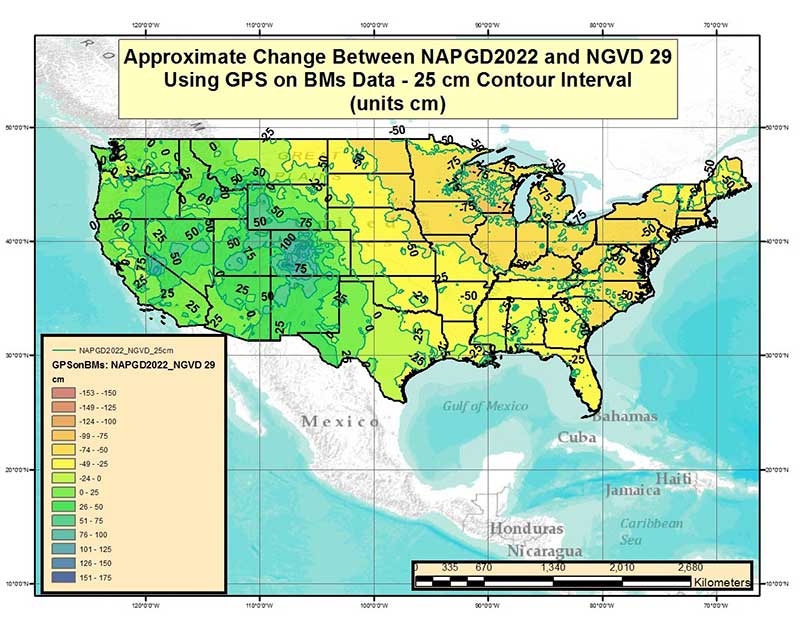
    Figure 2 – Approximate Change Between NAPGD2022 and NGVD 29 Using GPS on BMs Data (units = cm). (Image: National Geodetic Survey)
    Figure 2 – Approximate Change Between NAPGD2022 and NGVD 29 Using GPS on BMs Data (units = cm). (Image: National Geodetic Survey)

    As shown in figure 2, the absolute differences between the new vertical reference frame, NAPGD2022, and NGVD 29 are also going to be large but, once again, in most regions of the country, the relative differences over small areal extents will be small.

    What does this look like in a local area? Figure 3 is a plot of the approximate change between NAPGD2022 and NAVD 88 in North Carolina and surrounding states, and figure 4 is plot of the approximate change between NAPGD2022 and NGVD 29 in North Carolina and surrounding states.
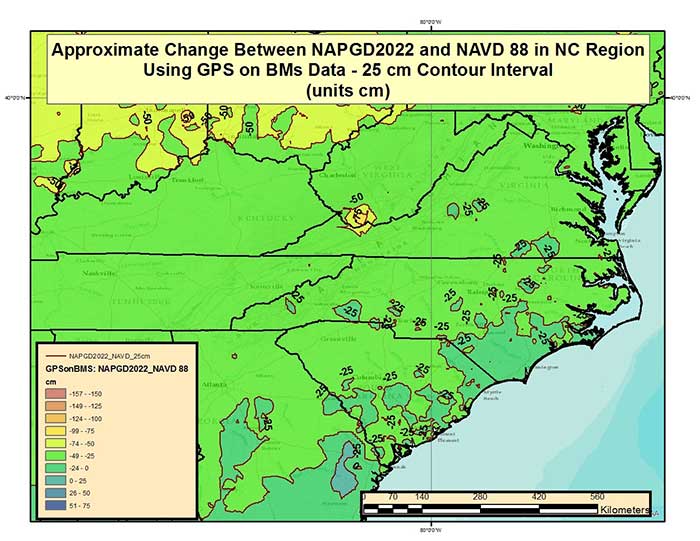
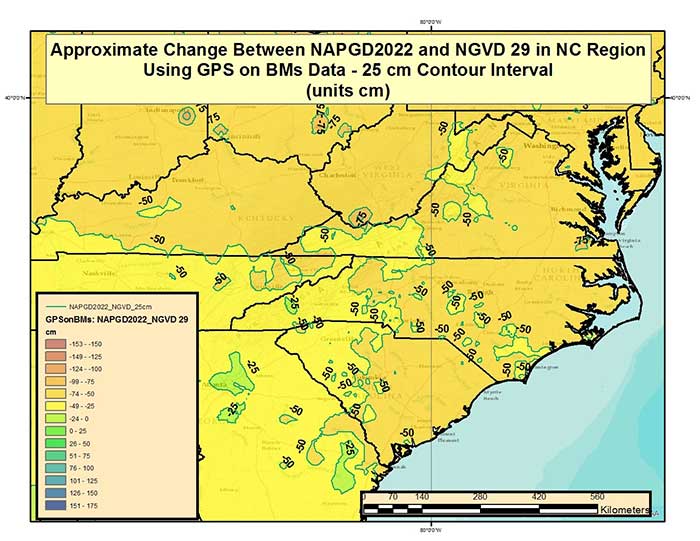
    Figure 3 – Approximate Change Between NAPGD2022 and NAVD 88 in North Carolina and Surrounding States Using GPS on BMs Data (units = cm). (Image: National Geodetic Survey)
    Figure 3 – Approximate Change Between NAPGD2022 and NAVD 88 in North Carolina and Surrounding States Using GPS on BMs Data (units = cm). (Image: National Geodetic Survey)
    Figure 4 – Approximate Change Between NAPGD2022 and NGVD 29 in North Carolina and Surrounding States Using GPS on BMs Data (units = cm). (Image: National Geodetic Survey)
    Figure 4 – Approximate Change Between NAPGD2022 and NGVD 29 in North Carolina and Surrounding States Using GPS on BMs Data (units = cm). (Image: National Geodetic Survey)

    Figure 5 provides a more detailed depiction of the change between NAPGD2022 and NAVD 88 along the North Carolina Atlantic Coast. The differences appear to vary by several centimeters but some of these differences are due to errors in published heights (both ellipsoid and orthometric). These differences can be used to develop a transformation model but the user will need to know the accuracy of the model, globally and locally.
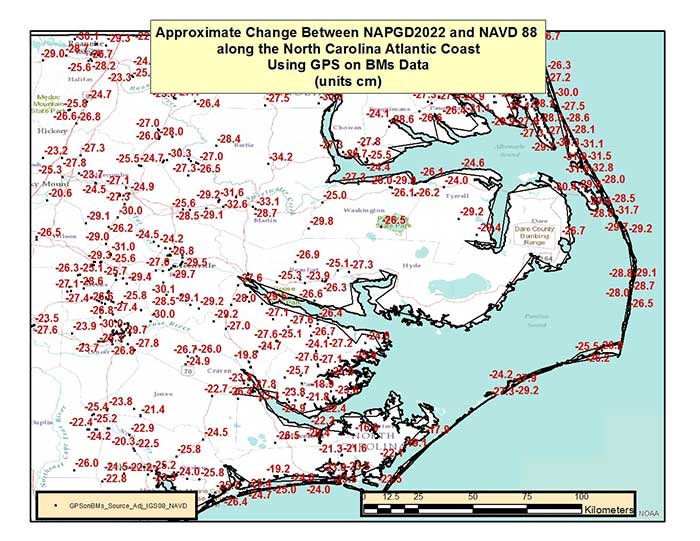
    Figure 5 – Approximate Change Between NAPGD2022 and NAVD 88 along North Carolina Atlantic Coast Using GPS on BMs Data (units = cm). (Image: National Geodetic Survey)
    Figure 5 – Approximate Change Between NAPGD2022 and NAVD 88 along North Carolina Atlantic Coast Using GPS on BMs Data (units = cm). (Image: National Geodetic Survey)

    Figure 6 is a detailed depiction of the change between NAPGD2022 and NGVD 29 in the same area as shown in figure 5. Comparing figures 5 and 6, the reader should notice that the differences between NAPGD2022 and NGVD 29 are about 30 cm larger (more negative) than the differences between NAPGD2022 and NAVD 88.
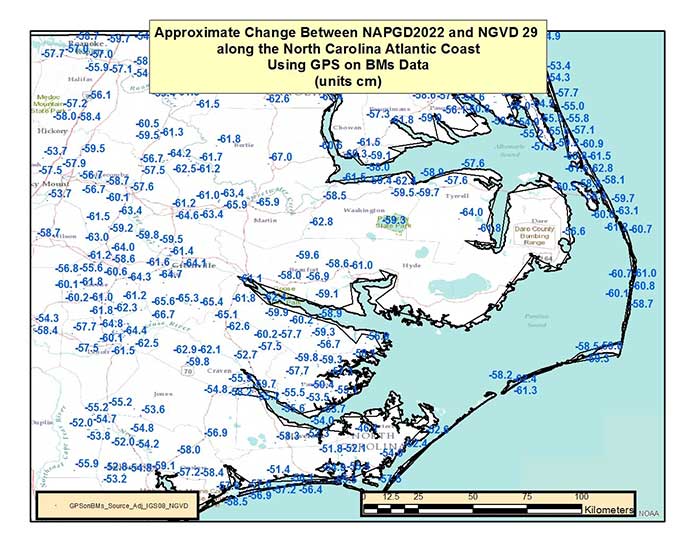
    Figure 6 – Approximate Change Between NAPGD2022 and NAVD 29 along North Carolina Atlantic Coast Using GPS on BMs Data (units = cm). (Image: National Geodetic Survey)
    Figure 6 – Approximate Change Between NAPGD2022 and NAVD 29 along North Carolina Atlantic Coast Using GPS on BMs Data (units = cm). (Image: National Geodetic Survey)

    Figure 7 is the difference between NAPGD2022 and NAVD 88 in western North Carolina. The local difference in the NC mountains is around -35 cm which is about 10 cm different from the NC Atlantic Coast. Questions that users need to address include: What is the accuracy of the transformation model? And What is the accuracy of the product or service being transformed? The transformation model will not replace the original survey results but may be useful for transforming some products and services.
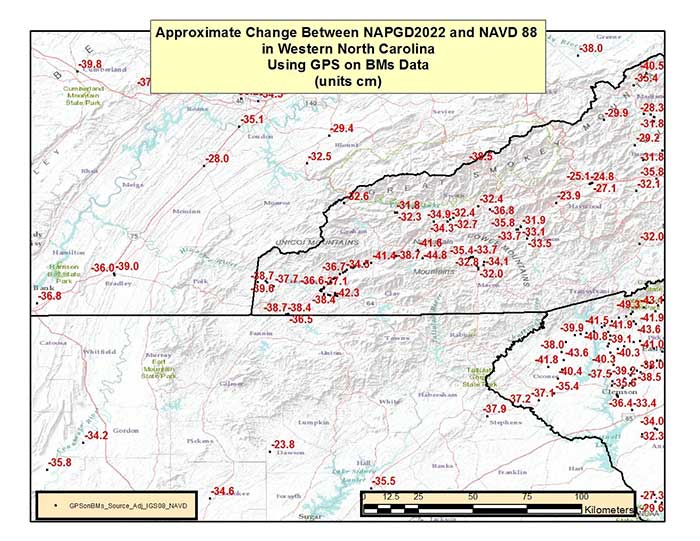
    Figure 7 – Approximate Change Between NAPGD2022 and NAVD 88 in the Western North Carolina Using GPS on BMs Data (units = cm). (Image: National Geodetic Survey)
    Figure 7 – Approximate Change Between NAPGD2022 and NAVD 88 in the Western North Carolina Using GPS on BMs Data (units = cm). (Image: National Geodetic Survey)

    Table 1 provides the average difference between NAPGD2022 and NAVD 88 (and NGVD 29) by State using the GPS on BMs dataset. This table shows that there are large differences between NAPGD2022 and both NGVD 29 and NAVD 88. No matter which datum the product or service is referenced to, it will probably need to be transformed to NAPGD2022.
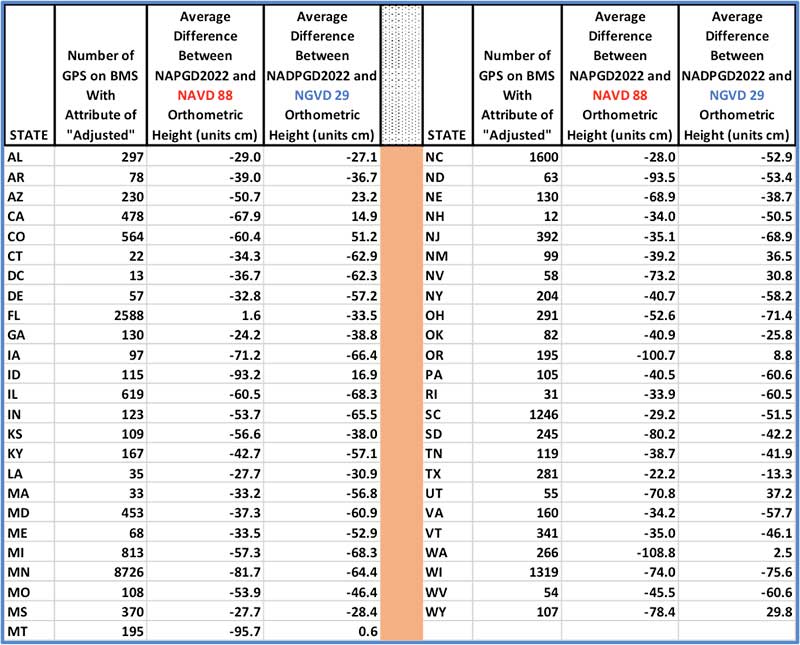
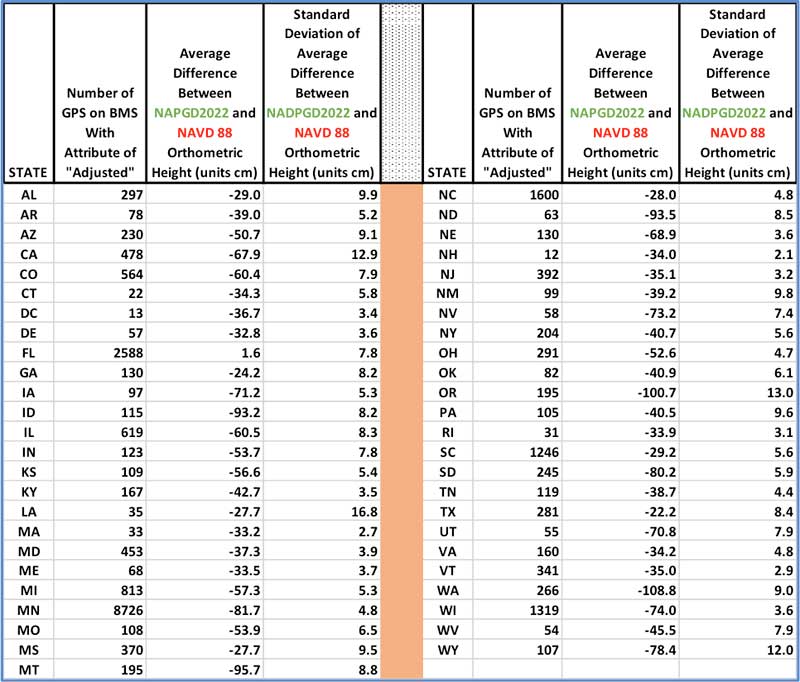
    Table 1 – Average Difference Between NAPGD2022 and NAVD 88 (and NGVD 29) by State Using GPS on BMs Dataset (units = cm). Click to enlarge. (Date: National Geodetic Survey)
    Table 1 – Average Difference Between NAPGD2022 and NAVD 88 (and NGVD 29) by State Using GPS on BMs Dataset (units = cm). Click to enlarge. (Date: National Geodetic Survey)
    Average Difference Between NAPGD2022 and NAVD 88 by State Using GPS on BMs Dataset (units = cm). Click to enlarge. (Date: National Geodetic Survey)
    Average Difference Between NAPGD2022 and NAVD 88 by State Using GPS on BMs Dataset (units = cm). Click to enlarge. (Date: National Geodetic Survey)

    Table 2 provides the standard deviation of the average difference between NAPGD2022 and NAVD 88 by State. For example, North Carolina has a sample size of 1600 stations and its average difference is -28 cm with a standard deviation of 4.8 cm. Looking at figures 5 and 7, there appears to be a difference of 10 cm across the State. The States in the northwestern region of the United States have a larger difference between NAPGD2022 and NAVD 88 as well as a larger standard deviation. Oregon has a sample size of 195 stations and its average difference is -100.7 cm with a standard deviation of 13.0 cm, and Washington has a sample size of 266 stations and its average difference is -108.8 cm with a standard deviation of 9.0 cm. Figure 8 is a plot of the approximate change between NAPGD2022 and NAVD 88 in the northwest region of the United States.

    As mentioned previously, these differences will vary from station to station because of a bias and trend between the two datums and due to remaining errors in published heights (both ellipsoid and orthometric). As I have noted in previous columns, many of the large relative differences between stations in a local area could be due to an invalid NAVD 88 published height because the bench mark moved since the last time the height of the bench mark was adjusted and published, and/or an undetected error in an ellipsoid height due to a weak GNSS project design. Either way, in my opinion, most of these stations with large relative differences don’t accurately represent the current NAVD 88. NGS’ modernization of the NSRS will provide a more accurate and consistent reference frame, and improve the user’s ability to obtain a current and accurate orthometric height.
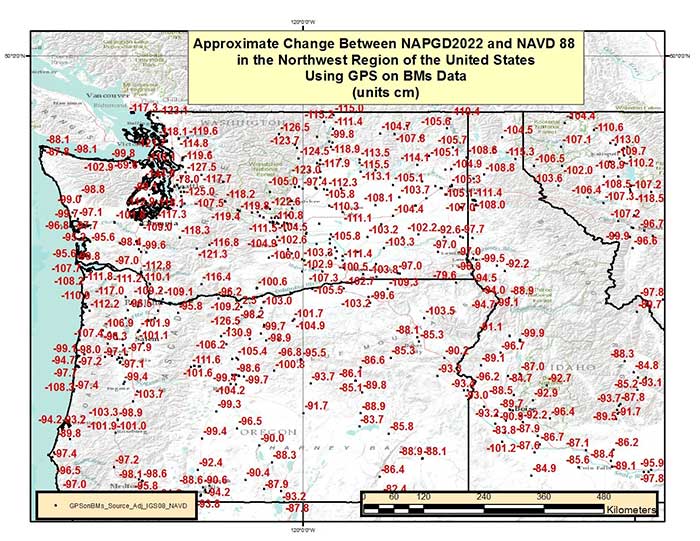
    Figure 8 – Approximate Change Between NAPGD2022 and NAVD 88 in the Northwest Region of the United States Using GPS on BMs Data (units = cm). (Image: National Geodetic Survey)
    Figure 8 – Approximate Change Between NAPGD2022 and NAVD 88 in the Northwest Region of the United States Using GPS on BMs Data (units = cm). (Image: National Geodetic Survey)

    This column highlighted some of the feedback provided by guest presenters at the NGS’ 2017 Geospatial Summit held on April 24-25, 2017, in Silver Spring, Maryland. The column also provided a discussion on the approximate differences between NAPGD2022 and NAVD 88 (and NGVD 29) at a national and local level. To prepare for the new datums and develop implementation plans, users should obtain an understanding of the differences between NAPGD2022 and NAVD 88. This column is the first in a new series of columns addressing topics associated with transitioning to the new North American -Pacific Geopotential Datum of 2022 (NAPGD2022).

  • NGS to replace NAVD 88 in 2022: What GNSS users need to know — Part 10

    NGS to replace NAVD 88 in 2022: What GNSS users need to know — Part 10

    Understanding the differences between the North American Vertical Datum of 1988 and the new 2022 Vertical Reference Datum

    My Survey Scene columns have focused on procedures and routines for establishing GNSS-derived orthometric heights. My last column focused on analyzing NGS’ GPS on BM data set that is used to make National Geodetic Survey’s (NGS) hybrid geoid models. It provided procedures that users could employ when analyzing the differences between the modeled geoid values and the computed geoid values using GPS/Leveling data. This GPSBM data set or one similar will be used to make the next hybrid geoid model, as well as provide input to the transformation model between the North American Vertical Datum of 1988 (NAVD 88) and the new 2022 Vertical Reference Datum. As I emphasized, all geospatial users should help develop this GPS on BMS data set to help improve the National Spatial Reference System and future hybrid geoid models.

    Large relative differences in residuals between neighboring stations provided examples of stations that should investigated based on different reasons: No. 1, a weak NAVD 88 is leveling network design in the region; No. 2, the station’s published height attribute code implies that the station was not rigorously adjusted into the NAVD 88; and No. 3, station pairs have different adjustment dates indicating a possible adjustment distribution correction issue or movement.

    It was mentioned that NGS has a program called “GPS on Bench Mark” to support users that occupy bench marks with GNSS equipment. It was also mentioned that in addition to participating in the NGS’ GPS on Bench Mark program, all geospatial users should participate in the NGS 2017 Geospatial Summit, which will be held in April 2017 in Silver Spring, Maryland. This summit is an opportunity for all users of the National Spatial Reference System (NSRS) to obtain a better understanding of NGS’ plans to modernize the NSRS. Users will be able to provide feedback directly to NGS leadership.

    This column will briefly address NGS’ plans to replace the North American Vertical Datum of 1988 in 2022; and, in my opinion, why GNSS users need to obtain a better understanding of the differences between the NAVD 88 and the new 2022 Vertical Reference Datum.

    First, NGS has a very nice website that discusses their new datums of 2022.

    The frequently asked question section provides information on the expected changes in coordinates.

    I have highlighted three FAQs that I believe users should learn more about. (See box titled “Excerpts from NGS’ New Datums FAQs, below.) Under the FAQ “Why is NGS replacing the North America of 1983 and the North America Vertical Datum of 1988 (NAVD 88)” it states that the NAVD 88 is both biased (by about one-half meter) and tilted (about 1 meter coast to coast) relative to the best global geoid models available today.

    Excerpts from NGS’ New Datums FAQs Web Page

    Why is NGS replacing the North American Datum of 1983 (NAD 83) and the North American Vertical Datum of 1988 (NAVD 88)? NAD 83 and NAVD 88, although still the official horizontal and vertical datums of the National Spatial Reference System (NSRS), have been identified as having shortcomings that are best addressed through defining new horizontal and vertical datums. Specifically, NAD 83 is non-geocentric by about 2.2 meters. Secondly, NAVD 88 is both biased (by about 0.5 meters) and tilted (about 1 meter coast to coast) relative to the best global geoid models available today. Both of these issues derive from the fact that both datums were defined primarily using terrestrial surveying techniques at passive geodetic survey marks. This network of survey marks deteriorates over time (both through unchecked physical movement and simple removal), and resources are not available to maintain them. The new reference frames (geometric and geopotential) will rely primarily Global Navigation Satellite Systems (GNSS) such as the Global Positioning System (GPS) as well as an updated and time-tracked geoid model. This paradigm will be easier and more cost-effective to maintain.

    How will accessing the National Spatial Reference System (NSRS) change with the release of the new datums? The NSRS will be accessed using Global Positioning System (GPS) technology that references Continuously Operating Reference Stations (CORS) and relies on a time-dependent gravimetric geoid model. This method of accessing the NSRS is a paradigm shift from accessing NAD 83 and NAVD 88 through the use of geodetic survey marks.

    How can I learn more about the new reference frames? NGS will participate in and host meetings to discuss the transition from NAD 83 and NAVD 88 to the new reference frames. We will continue to update our website with events, announcements and new outreach materials, as they become available.

    The “Get Prepared” section on the New Datum website explains how users can get a ready for the new datums. In this section, NGS provides a figure that depicts the approximate orthometric height change between the NAVD 88 and the 2022 Vertical Reference Datum (Figure 1).

    [FIGURE 1] New Datums: Approximate Orthometric Height Change
    [FIGURE 1] New Datums: Approximate Orthometric Height Change
    This figure may look familiar to many of you. The difference between the NAVD 88 and the National Geodetic Vertical Datum of 1929 (NGVD 29) was more than a meter from the east coast to the west coast. This difference was documented in a 1992 report titled “Special Report – Results of the General Adjustment of the North American Vertical Datum of 1988.” Figure 2 shows a plot of the differences between NAVD 88 and NGVD 29.

    [FIGURE 2]
    [FIGURE 2] NAVD 88 minus NGVD 29 Datum Shift Contours
    A similar difference was detected in 1929 when the NGVD 29 general adjustment was performed. Figures 3 and 4 depict the adjusted height differences between the NGVD 29 fully-constrained adjustment and a minimally-constrained adjustment. The heights of 26 tide stations were constrained in the fully-constrained NGVD 29 general adjustment. Four of the constrained tide stations have been labeled to show the differences between the east coast and the west coast of the U.S.

    [FIGURE 3] Coast-to-Coast Height Differences in the National Geodetic Vertical Datum of 1929 General Adjustment – Plot A
    [FIGURE 3] Coast-to-Coast Height Differences in the National Geodetic Vertical Datum of 1929 General Adjustment – Plot A
    As indicated in the plots depicting the results of the NGVD 29 General Adjustment, the difference between stations at St. Augustine, Florida, and Fort Stevens, Oregon, was 86.3 centimeters. This is similar to the trend between the NAVD 88 and NGVD 29. It should be noted that most of the original NGVD 29 leveling data were revealed, so the leveling data observed prior to 1929 were not included in the general adjustment of the NAVD 88. In 1929, the Coast and Geodetic Survey (the predecessor of the NGS) decided to constrain the heights of the 26 tide gauges and force the differences between the constraints.

    [FIGURE 4] Coast-to-Coast Height Differences in the National Geodetic Vertical Datum of 1929 General Adjustment – Plot B
    [FIGURE 4] Coast-to-Coast Height Differences in the National Geodetic Vertical Datum of 1929 General Adjustment – Plot B
    Prior to performing the NAVD 88 general adjustment a special project was performed to evaluate possible constraints including constraining heights of various tide gauges. Regardless of which datum definition scenario was chosen, i.e., the height of one tide gauge or heights of multiple tide gauges on the east and west coasts of the U.S., the results showed that large differences between NAVD 88 and NGVD 29 heights would exist. These differences were due to many factors, such as large distribution corrections (residuals) from the NGVD 29 adjustment, better estimates of corrections applied to account for systematic errors, crustal movement, and estimating geopotential differences using real gravity values instead of normal orthometric height differences. Based on the results from the special study, NGS decided to constrain the height of one tide gauge and not force the differences between constraints. This was mainly because of the uncertainty of the heights of the tide gauges representing the same equipotential surface. The new 1988 heights are much better estimates of orthometric heights than are the NGVD 29 heights.

    As part of the NAVD 88 datum definition study, NGS also compared Satellite-Derived Orthometric heights computed using the best available geoid model and ellipsoid heights with NAVD 88 leveling-derived heights. See box titled “Excerpt from 1992 report titled “Special Report – Results of the General Adjustment of the North American Vertical Datum of 1988.” As stated in the report, based on the comparison, combining VLBI-derived orthometric height difference data with leveling data in NAVD 88 would not have helped to control remaining errors in the leveling data, or significantly improved the estimates of adjusted heights in the network adjustment. The results were consistent with the accuracy statements of GEOID90. VLBI-derived orthometric heights did not show the same 1.5 m difference indicated by the LMSL (epoch 1960-78) tidal heights. Therefore, if the coast-to-coast leveling does indeed contain long-wave-length systematic errors, the errors probably are not as large as 1.5 m.

    Corrections to account for known systematic errors were applied to the leveling data involved in the NAVD 88 but it is recognized that the leveling data could still have a small systematic error remaining in the data. The leveling distance from the east coast to the west coast is over 5,000 kilometers. If we assume that the leveling crew performed a setup every 150 meters, then the number of setup across the country would be over 30,000 setups. If we assume a systematic error of 0.02 millimeters, then the accumulated error could be at least 600 millimeters (60 centimeters). Although, there also could be a small systematic error in the scientific geoid model due to an undetected and/or unmodeled long wavelength error. (Of course, this statement is from the NAVD 88 Project Manager, me, and may be a little bias). At this moment, it really doesn’t matter why the systematic difference exists, just that it does and that the new 2022 Vertical Reference Datum will be established using the same process used to generate the scientific geoid models. Therefore, it is important for all users of geospatial data to prepare for the changes.

    Excerpt from 1992 report titled “Special Report – Results of the General Adjustment of the North American Vertical Datum of 1988

    Comparison of NAVD 88 Adjusted Heights from the General Adjustment with Satellite-Derived Orthometric Heights

    In a report by Despotakis (1987), discussed in the datum definition study by Zilkoski, Balazs, and Bengston (1989), numerical computations of geoid heights using several methods were compared with satellite-derived geoid heights (ellipsoid heights minus orthometric heights) at laser tracking stations around the world. Despotakis’s report states:

    The numerical computations of the geoid undulations using all the four methods resulted in agreement with the “ellipsoidal minus orthometric” value of the undulations on the order of 60 cm or better for most of the laser stations in the eastern United States, Australia, Japan, Bermuda, and Europe. A systematic discrepancy of about 2 m for most of the western United States stations was detected and verified by using two relatively independent data sets. The cause of this discrepancy was not found.

    The results of the 1989 datum definition report provided a possible explanation for this systematic discrepancy of 2 m in the western U.S. stations (i.e., the difference between NGVD 29 and NAVD 88 in western United States was about 1.5 m). Applying NAVD 88 heights to Despotakis’s study reduced the 2 m bias to 60 cm.

    The problem with adjusting space-derived orthometric height data with leveling data is similar to the problem of using LMSL tidal heights as weighted observations in a leveling network adjustment: The uncertainties in space-derived orthometric height differences are too large to help control remaining errors in the leveling data. Space-derived ellipsoid height differences over long lines are probably more precise than leveling-derived orthometric height differences over the same distance. The uncertainties of geoid height differences used to convert ellipsoid height differences to orthometric height differences are large compared with the formal errors of leveling height differences. Several Very Long Baseline Interferometry (VLBI) stations, which were tied into NAVD 88, were included as special junction stations. The results of the final adjustment comparing NAVD 88 adjusted heights with VLBI-derived orthometric heights derived using the best available estimates of ellipsoid heights (Strange 1991) and geoid heights (Milbert 1991) are given in Figure 11.

    Figure 11 indicates that the results are consistent with the accuracy statements of GEOID90. In coast-to-coast geoid height differences, the accuracy of the underlying geopotential model OSU89B (Rapp and Pavlis 1990) dictates the accuracy of GEOID90. OSU89B is believed to have a standard error of approximately 60 cm. VLBI-derived orthometric heights do not show the same 1.5 m difference indicated by the LMSL (epoch 1960-78) tidal heights. Therefore, if the coast-to-coast leveling does indeed contain long-wave-length systematic errors, the errors probably are not as large as 1.5 m. Combining VLBI-derived orthometric height difference data with leveling data in NAVD 88 would not have helped to control remaining errors in the leveling data, or significantly improved the estimates of adjusted heights in the network adjustment. As the accuracies of geoid models continue to improve, space-derived orthometric height data will be incorporated into NAVD 88 and future adjustments.

    The “Get Prepared” section on the New Datum website has a “GPS on Bench Marks” option. This is where NGS recommends that you obtain accurate GNSS-derived ellipsoid heights on NAVD 88 bench marks. We discussed this program in my last column. In Addition to improving the transformation model from NAVD 88 to the new 2022 Vertical Reference Datum, occupying more NAVD 88 bench marks with GNSS will help to identify regions of the country where the GNSS-derived orthometric heights obtained using the 2022 Vertical Reference Datum will be more accurate than the current NAVD 88 leveling-derived orthometric heights.

    My last column used the GPS on BMs dataset to identify potential issues in the published NAVD 88 heights. Figure 5, below, shows two stations (FA1337 and FA1560) are about 20 kilometers apart, and the difference in residuals is -18.6 centimeters (-12.4 centimeters minus 6.2 centimeters). This is a large difference for only 20 kilometers. What is even more significant is that the group of stations near FA1337 are all negative residuals (around -10 centimeters) and the group of stations near FA1560 are all positive residuals (around 6 centimeters). When the two stations are only 13 kilometers apart the GPS on BMs residual is 13.6 centimeters (Figure 6). These are two examples where the 2022 Vertical Reference Datum will provide a more accurate orthometric height difference between stations less than 20 kilometers apart. These differences are significant and could easily effect the results of many construction, transportation and flood plain mapping projects.

    [FIGURE 5] Large GPS on BMS Residuals Between Stations 20 km Apart at the NC/SC Border (Note: rejections by geoid team have been removed)
    [FIGURE 5] Large GPS on BMS Residuals Between Stations 20 km Apart at the NC/SC Border (Note: rejections by geoid team have been removed)
    [FIGURE 6] Large GPS on BMS Residuals Between Stations 13 kilometers Apart in South Carolina
    [FIGURE 6] Large GPS on BMS Residuals Between Stations 13 kilometers Apart in South Carolina
    In this column, we highlighted NGS plans for the 2022 Vertical Reference Datum and provided approximate height differences that users can expect to see. We also provided a little history behind the differences between the NGVD 29 and NAVD 88, and how each replacement of the vertical reference datum is improving the user’s ability to obtain the most accurate orthometric height.