Tag: OCXO

  • Microchip TimeProvider 4100 Grandmaster now more redundant, resilient

    Microchip TimeProvider 4100 Grandmaster now more redundant, resilient

    IEEE 1588 precise timing grandmaster with gateway clock now offers software-based redundancy
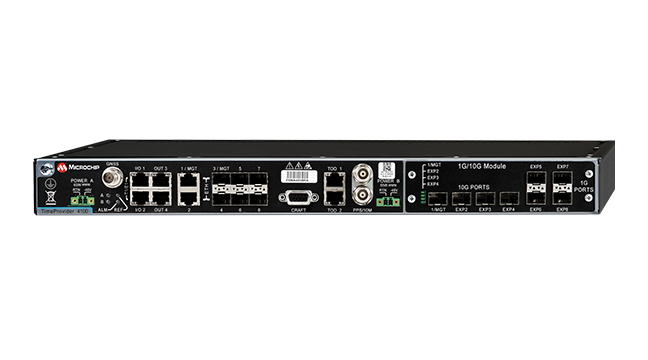
    Photo: Microchip
    Photo: Microchip

    For today’s critical infrastructure providers — 5G wireless networks, smart grids, data centers, cable and transportation services — a fundamental need exists for a redundant, resilient and secure precise timing and synchronization solution.

    Microchip Technology Inc.’s TimeProvider 4100 Release 2.2 grandmaster provides a new level of resiliency with the introduction of an innovative redundancy architecture in addition to support for a multi-band GNSS receiver and enhanced security to ensure always-on precise timing and synchronization.

    Redundancy is key for infrastructure providers to ensure uninterrupted services. Infrastructure deployments previously relied on hardware redundancy to avoid service disruption despite costly modular architectures. Microchip’s TimeProvider 4100 Release 2.2 grandmaster provides redundancy via software implementation, enabling flexible deployment and lower hardware costs without sacrificing ports.

    In addition, the TimeProvider 4100 Release 2.2 grandmaster introduces an increased level of resiliency by supporting a new GNSS multi-band, multi-constellation receiver to protect against time delay resulting from space weather, solar events and other disruptions that may impact critical infrastructure services.

    Multi-band GNSS is particularly important for the highest levels of accuracy, including primary reference time clock class B (PRTC-B, 40 ns) and enhanced primary reference time clock (ePRTC, 30 ns).

    With a focus on security solutions across its technology portfolio, Microchip’s new TimeProvider 4100 Release 2.2 grandmaster adds support for RADIUS and TACACS+ as well as new anti-jamming and anti-spoofing capabilities.

    “Resilient, redundant and secure precise timing and synchronization solutions are necessary to mitigate security risks to critical infrastructure,” said Randy Brudzinski, vice president and general manager of Microchip’s frequency and time business unit. “This latest release brings an innovative software redundancy that enables always-on technology as well as support for multi-band GNSS to eliminate ionospheric time error delays. It provides new key security, anti-jamming and anti-spoofing so critical infrastructure services can be accessed only by authorized, authenticated personnel.”

    In addition, the TimeProvider 4100 Release 2.2 grandmaster provides a super oven controlled crystal oscillator (OCXO) option for enhanced holdover capabilities in case of GNSS disruption.

    The TimeProvider 4100 Release 2.2 grandmaster is a family of products with hardware expansion modules for legacy fan-out or Ethernet fan-out with 10 Gigabit Ethernet support. It can be configured in specific operation modes to act either as a gateway clock, a high-performance boundary clock or an ePRTC.

    The TimeProvider 4100 Release 2.2 grandmaster embeds additional Microchip technology including its OCXO, super OCXO, rubidium atomic clock, field-programmable gate arrays (FPGAs), Ethernet switch, synthesizers and cleaning oscillators.

    The TimeProvider 4100 is part of Microchip’s Virtual Primary Reference Time Clock (vPRTC) product portfolio, offering end-to-end precise time and synchronization solutions. These include Cesium atomic clocks for source of frequency and time, the BlueSky GNSS Firewall for security, TimeProvider 4100 high-performance boundary clock and TimeProvider 4100 Gateway clocks, as well as the TimePictra software suite, which manages the end-to-end precise time architecture across all Microchip timing products.

    Microchip’s TimeProvider 4100 Release 2.2 grandmaster offers several options for software and hardware support including installation, sync audits, network engineering and 24/7 worldwide support. It is available now for both new and already-deployed systems.
  • Microchip offers phase noise analyzer for precision oscillator characterization

    Microchip offers phase noise analyzer for precision oscillator characterization

    Next-generation phase noise instrument combines timing technologies in a smaller, higher performance measurement instrument

    Photo: Microchip Technology
    Photo: Microchip Technology

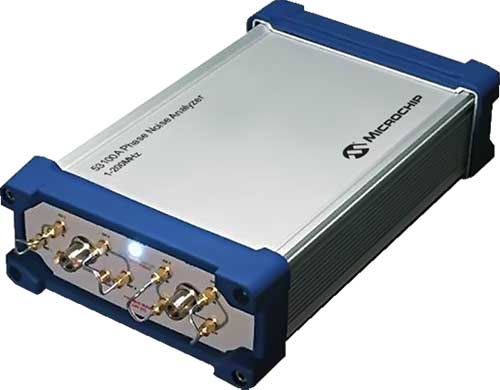
    To help research and manufacturing engineers make precise and accurate measurement of frequency signals, including those generated by atomic clocks and other high-performance frequency reference modules and subsystems, Microchip Technology Inc. has announced the availability of the new 53100A Phase Noise Analyzer, a next-generation phase noise test instrument.

    The 53100A Phase Noise Analyzer is designed for engineers and scientists who rely on precise and accurate measurement of frequency signals generated for 5G networks, data centers, commercial and military aircraft systems, space vehicles, communication satellites and metrology applications.

    Capable of measuring radio frequency (RF) signals up to 200 MHz, the new test instrument rapidly acquires frequency signals and characterizes the phase noise, jitter, Allan deviation (ADEV) and time deviation (TDEV) quickly and precisely. All attributes of a frequency reference can be completely characterized with a single instrument within minutes.

    The 53100A Phase Noise Analyzer enables a variety of configurations by allowing up to three separate devices to be tested simultaneously using a single reference, enabling higher capacity for stability measurements. At 344 x 215 x 91mm (13.5 x 8.5 x 3.6 inches), the phase noise test instrument is small enough for integration into manufacturing automated test equipment (ATE) systems, yet powerful enough for laboratory-grade metrology. Its interface provides backward compatibility with Microchip’s 51xxA test sets’ command and data stream, reducing the need to redesign existing ATE infrastructure.

    The 53100A Phase Noise Analyzer provides flexibility by allowing an input reference device to be connected through the front panel at a different nominal frequency than the device under test — allowing a single reference to characterize a variety of oscillator products. Rubidium frequency standards such as Microchip’s 8040C-LN or a quartz oscillator such as Microchip’s 1000C Ovenized Crystal Oscillator (OCXO) could be used as a reference as well as other manufacturers’ precise oscillators.

    The 53100A Phase Noise Analyzer is available now. Microchip supports the 53100A Phase Noise Analyzer with technical support services as well as an extended warranty.

  • IQD launches a new GNSS-disciplined crystal oscillator

    IQD launches a new GNSS-disciplined crystal oscillator

    Photo: IQD
    Photo: IQD

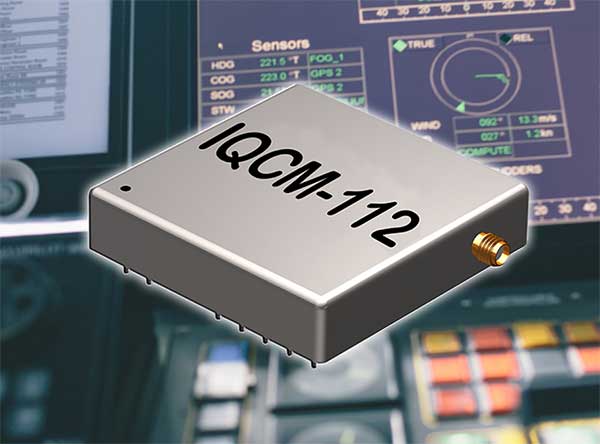
    IQD has launched a new series of GNSS-disciplined oven controlled crystal oscillators (OCXOs), the IQCM-112 series.

    The new design incorporates an internal GNSS receiver with a 1PPS output, which is compatible with an external GPS, GLONASS, BeiDou and Galileo source. It is housed in a 14-pin 60-millimeter-square package.

    When coupled to an external aerial antenna via the incorporated SMA connector, in the event of the loss of the GNSS signal the highly specified 10-MHz OCXO will switch-in with a holdover capability of 1.5 µSeconds for a 24-hour period, thereby maintaining lock until restoration of the reference signal.

    The standard operating temperature range of the module is -20° to 75° C but is also available with a -40° to 85° C operating temperature range. Other holdover specifications can be considered upon request.

    The required power supply is 5V with a standard HCMOS output. Current consumption is 2A maximum during warm-up with this reducing to 1A once the steady-state condition is reached.

    The design incorporates an internal adaptive algorithm that enables the module to “learn” the parameters of the GNSS signal after a period of three days of lock, so that the holdover function can start in the event of signal failure.

    A built-in internal alarm indicates lock failure and subsequent restoration of signal. The unit incorporates a serial connection for more detailed interrogation of the device’s performance.

    The IQCM-112 series is intended for a range of applications including land-based telecommunications systems and marine-based navigation systems.

    The IQCM-112 forms part of a range of highly specified modules and Oven Controlled Crystal Oscillators available from IQD.

  • PNT Roundup: Scaling down GPS-reliant devices

    By Ramki Ramakrishnan

    In many respects, the story of innovation in electronics has been about miniaturization: designers pack more features, functionality and performance into electronics that are smaller, lighter and more power-efficient. However, this has traditionally been applied only to a limited extent to atomic clocks, which electronic devices employ to maintain correct time if their GPS signal is lost.

    Atomic clocks have significant limitations in terms of scalability and portability, so until recently the best designers could use were ovenized crystal oscillators (OCXOs), which were smaller, lighter and consumed less power than atomic clocks.

    However, they were also less accurate and precise. Now, micro-atomic clocks enable addressing an entirely new range of use cases. A miniature atomic clock (MAC) is not the same clock made smaller; it’s a different clock.

    Timing Quality Measurements. A clock is accurate if its time agrees with a standard such as cesium reference or GPS. A clock is precise if its interval between ticks — its frequency of oscillation — is the same as a reference clock’s interval, even if the reference clock is inaccurate.

    A stern measure of precision is syntonicity, which is a measure of consistency in the occurrence of ticks within the environment. Radar requires syntonicity. To obtain a clear image of a scanned object, the receiver of the signal bounced off the object needs to know the exact instant the associated pulse was sent from the transmitter.

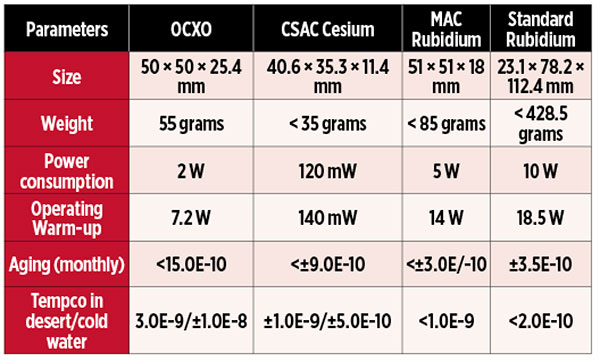
    It’s All About SWaP. One challenge of any timing miniaturization is whether the clock’s size, weight and power (SWaP) meet the needs of a given application. For example, a cesium chip-scale atomic clock (CSAC) is the smallest sized atomic clock in the current market; see the table below. By contrast, the rubidium MAChas the lowest power consumption after the CSAC (that is, 40 times more than CSAC). Before the introduction of the MAC, the standard rubidium clock was the clock with the lowest power consumption and with similar performance.

    Performance metrics of clock technologies.

    Benefits of small SWaP values are easily seen. Devices that required an external power source can now operate on batteries, without a heat sink. A person or a drone can now carry devices that were stationary or required a truck.

    Improvements in SWaP only matters if application requirements for accuracy and precision are also met. What happens if an application’s GPS access is lost? All clocks tend to drift once they no longer reference an external time source. This is known as aging. A key factor that affects aging is temperature. While operating in extreme environments (such as, deserts, high altitudes or under sea), the rate of timing error increases due to temperature variation; the amount of temperature-related error is called tempco.

    The availability of clocks with tight specifications signifies that designers can now employ accurate and precise timing in many ways and places. However, one must specify, analyze and select the clock carefully to meet the requirements of the application. For example, replacing the OCXO with a standard rubidium clock is typically not an option because the standard rubidium clock does not fit in to the OCXO form factor. Designers may consider replacing an OCXO with a CSAC or MAC if greater portabiity and better timing accuracy and precision are the key requirements.

    The choice often comes to one between the CSAC’s lower power consumption and weight versus the MAC’s superior aging performance in the event of GPS loss. The difference between the two clocks lies in how gas atoms trapped into resonance by a microwave synthesizer are excited and then interrogated, a concept known as coherent population trapping.

    Applications suitable for rubidium atomic clocks (MAC) include the following.

    Cellular Base Stations. Rubidium atomic clocks can meet the tight timing requirements for 4G-/LTE-base stations up to 24 hours (even longer for 3G and 4G). Moreover, rubidium’s superior aging ensures longer holdover, meaning the network can remain operational for longer even if the sync reference is lost. The MAC’s lower power consumption compared to a standard rubidium clock also contributes to a lower power and heat density overall, potentially reducing the need for external cooling while increasing the electronic reliability and reducing its size. Low tempco is also critical, considering the environments in which these stations often operate.

    Radar Base Stations. Radars require highly precise synchronization between transmitter and receiver signals. MACs are increasingly replace OCXO in these applications, which also benefit from the technology’s lower power.

    Applications suitable for CSACs include these.

    IED Jammers. Low-power consumption is critical in dismounted intelligent electronic devices (IED) jammers, which must be small, light and battery-powered. Yet they must be precise enough to tightly synchronize and allow pre-defined time slots in the signals (known as look windows) to allow friendly communications through.

    Dismounted Military Radios. Portability and precise synchronization are critical, especially given the higher bandwidth waveforms required to handle encoded video and other data-rich signals.

    Tactical Unmanned Aerial Vehicles (UAVs). In addition to relying on GPS (or clock holdover) for navigation, unmanned aircraft drones also require precise timing for their encoded data-rich and video communications. They also present challenges in terms of the size, weight and power consumption of payloads.

    Undersea Seismic Sensing. Differences in time measurements of acoustic pulses across sensor nodes are used to map subterranean formations such as oil deposits. In the absence of GPS under water, precise synchronization and very good aging performance are critical to harvesting reliable data during the duration of a survey deep under the ocean.

    More innovation lies ahead! Low-powered SWaP-friendly atomic clocks are revolutionizing the world without compromising clock performance, enabling many mission-critical applications.


    RAMKI RAMAKRISHNAN is director of product line management and business development, Clocks Business Unit, Microsemi Corporation.

  • Jackson Labs Delivers Low Phase-Noise Frequency and Timing Reference

    Jackson Labs Delivers Low Phase-Noise Frequency and Timing Reference

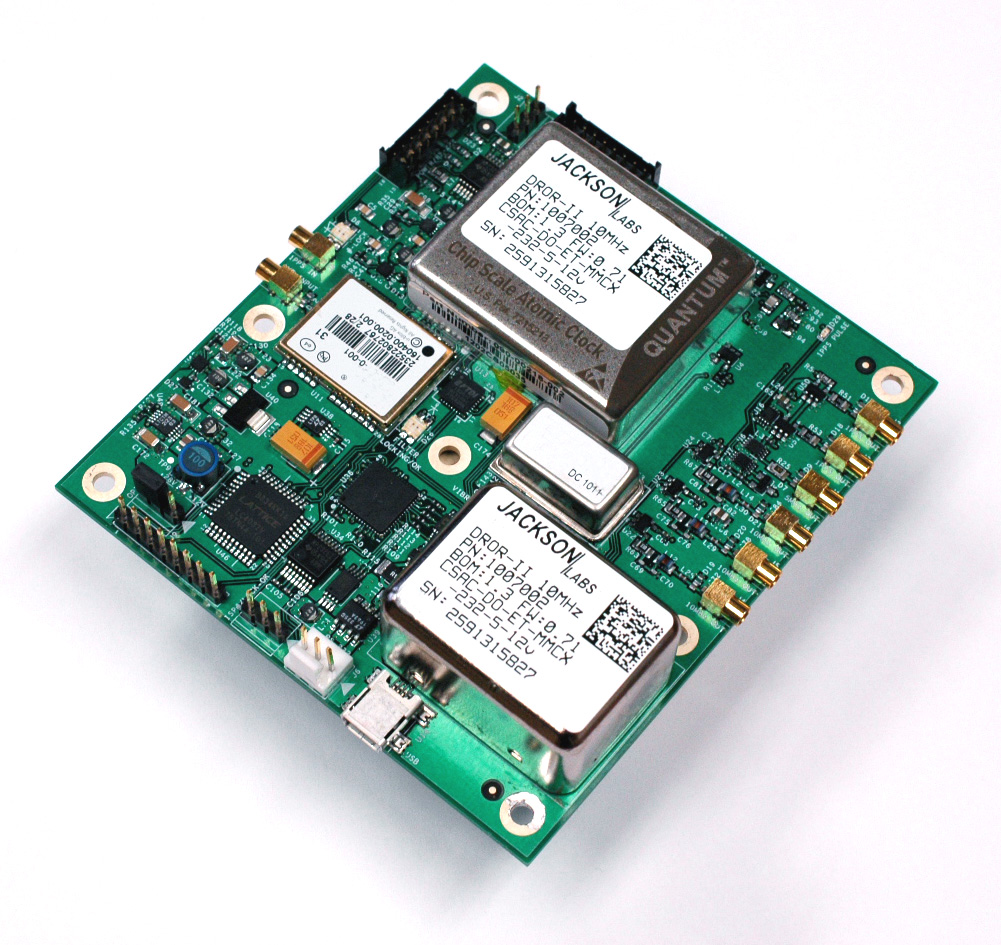
    The DROR-II by Jackson Labs.
    The DROR-II by Jackson Labs.

    Jackson Labs Technologies, Inc., a designer and manufacturer of GPS, timing and frequency equipment, is offering the DROR-II, a 10-MHz/5-MHz/1-PPS GPS-Disciplined Atomic Frequency and Timing Reference (GPSDO).

    The DROR-II is a ruggedized frequency and timing reference with a Cesium Vapor Atomic Oscillator followed by a precision SC-cut Crystal Double-Oven Oscillator and an actively vibration-compensated VCXO oscillator, with specific emphasis on ultra low phase noise performance under extreme vibration and acceleration such as could be encountered in aircraft, tracked vehicles, and wheeled vehicles.

    The DROR-II unit is optimized for operation in high-vibration and high-acceleration environments that require ultra-low phase noise performance and high frequency stability under extreme conditions. The DROR-II combines the strengths of three different on-board oscillators to provide an overall performance that has not been achievable with legacy products, at a steady-state power consumption of less than 3.85W, the company said.

    The DROR-II uses a GPS receiver to provide long-term phase and frequency accuracy of the built-in CSAC atomic oscillator which is followed by an SC-cut, Double Oven OCXO (DOCXO) for very high short-term stability and low phase noise, which is itself followed by a three-axis electronically vibration-compensated crystal oscillator for ultra-low-noise under high vibration. Using these four signal sources cascaded to each other allows unmatched Phase Noise and Short Term Stability (ADEV) while also providing long-term atomic holdover, very fast warmup, and long-term phase-lock to UTC. Short term stability of 1E-012 (1ppt), and phase noise floors of -162dBc/Hz are achieved. Frequency stability over 24 hours is better than 5E-013 (0.5ppt) typically when locked to GPS.

    The DROR-II supplies three isolated 10-MHz Sine Wave outputs, two CMOS 1PPS, and one 5-MHz output that is phase-synchronized to UTC via the internal GPS receiver. DROR-II contains a 50-channel WAAS/EGNOS/MSAS-enabled GPS receiver that provides support for avionics systems through integrated three-axis gyro-accelerometers and a -160-dBm GPS tracking capability. DROR-II power requirements are less than 3.85W steady-state, and only a single supply of between 11.0V to 32V is required. Support for an external LCD display is standard.

    The unit can be monitored and controlled by an RS-232 port or a USB port via industry standard SCPI-99 Commands (GPIB commands), and is capable of generating numerous NMEA-0183 output sentences for easy integration into existing infrastructure. The DROR-II can be ordered with various OCXO options and with different temperature ranges.

  • Bliley Offers Oven-Controlled Crystal Oscillators

    Bliley Offers Oven-Controlled Crystal Oscillators

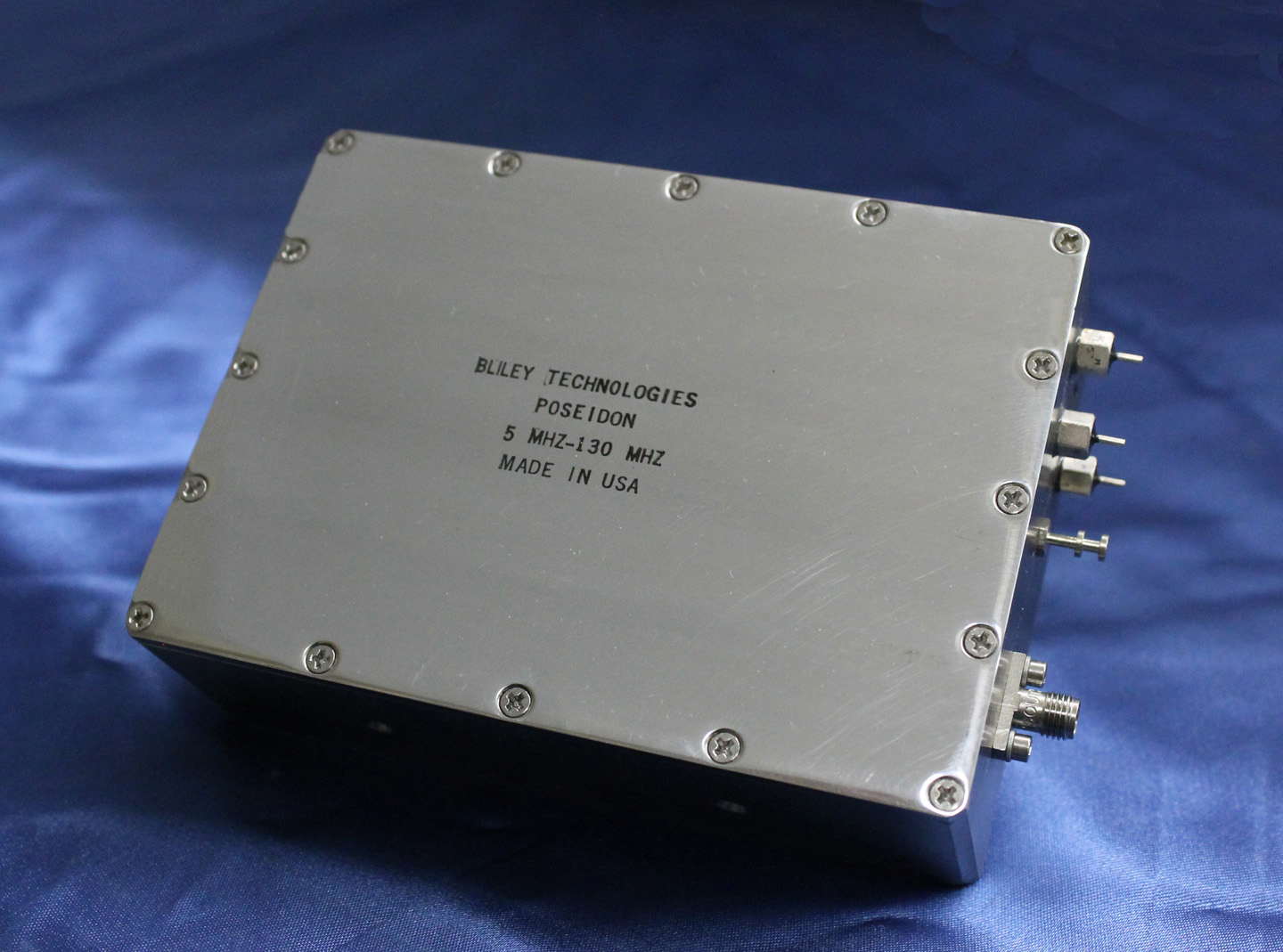
    Photo: Bliley

    The rugged Poseidon Series of OCXOs by Bliley features unparalleled phase noise performance in a modular type sealed package. It is a customizable frequency range product specifically designed for vibration-prone environments where dynamic phase noise performance is paramount. Applications include ground mobile, airborne, and shipboard environments.

    Features include typical acceleration sensitivity of <2e-11/g, excellent FvT performance, frequency range of 5 MHz to 130 MHz, ultra-low static and dynamic phase noise, and excellent long-term aging.