Tag: orthophotos

  • V6 of Virtual Surveyor provides streamlined workflows with drones

    V6 of Virtual Surveyor provides streamlined workflows with drones

    Image: Virtual Surveyor
    Image: Virtual Surveyor

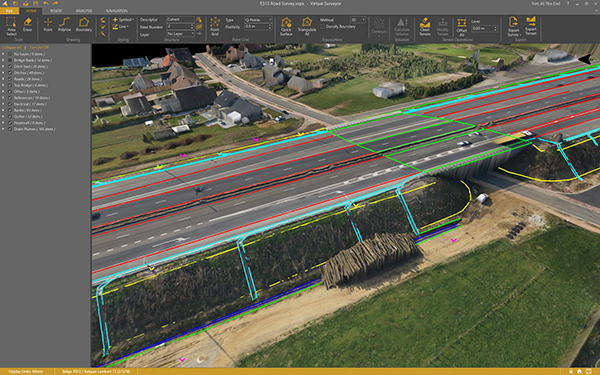
    The newly released version 6 of the Virtual Surveyor drone surveying software offers a faster, more efficient workflow and better overall user experience in a more stable platform, according to the software maker.

    Version 6 offers new capabilities, an improved licensing system and an extended free application.

    “Surveyors who have used the Virtual Surveyor package in the past will be amazed at how easily they can manipulate data and how quickly the software renders results of even the most complex topographies,” said Tom Op ‘t Eyndt, managing director of Virtual Surveyor nv in Belgium.

    Virtual Surveyor leverages the expertise and interpretation skill of a land surveyor and combines it with the computing power of the computer, the company said.The software generates an interactive onscreen environment through orthophotos and digital surface models, generated from the unmanned aerial vehicle (UAV), where the surveyor selects survey points and breaklines to define the topography.
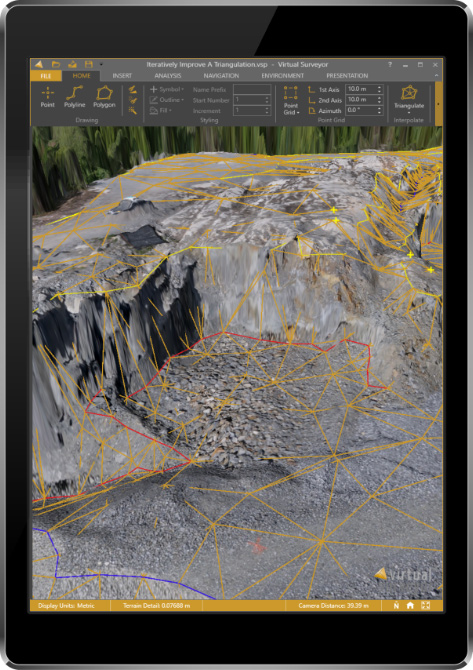
    Image: Virtual Surveyor
    Image: Virtual Surveyor

    Virtual Surveyor enables land surveyors to complement traditional fieldwork with UAV imagery to generate highly accurate topographic products up to five times faster than otherwise possible. It bridges the gap between UAV photogrammetric processing software and engineering computer-aided design (CAD) packages.

    “The focus of Version 6 development has been to streamline the workflow — from the importing of drone data to exporting topo information into CAD — to make the surveyor more productive,” Op ‘t Eyndt said.

    Key enhancements in Virtual Surveyor 6 include the following:

    • Easier editing – The new editing functions allows users to quickly select, delete or move individual point and lines placed by the computer during the automated creation of elevation points. The associated Undo/Redo function allows reversing all edit operations.
    • Better CAD integration – The addition of Descriptor functionality means that point descriptions remain with the point during export to CAD, working the same way as the land surveyor collects data in the field.
    • 3D geometry retained – All points, lines and other data imported into the software, either from a UAV or field surveyed data, retain elevation values and integrate seamlessly into the merged scene. This allows a surveyor, for example, to collect point values from a ditch bottom that may be obscured by vegetation in the drone image and have the bottom points accurately represented in the topography.
    • Improved drawing tools – Users can now densify (drape) lines and boundaries to map current surface conditions. Individual vertices are now adjustable in all directions and exact X, Y and Z locations can be specified as well. Sub-surface modeling is now possible with these new improvements. Created features can then be exported to CAD for profile or alignment creation.
    • Extended free plan – Referred to as the Valley version, the free Virtual Surveyor suite has added functionality, including the ability to import photogrammetric data.
    • Improved licensing – We better honor our principle: “The license follows the user”. With an improved licensing system based on a Virtual Surveyor Identity (email) the user will be able to work where he or she wants.

    “The enhanced user experience will continue to appeal to professional land surveyors, who are our core client base,” said Op ‘t Eyndt. “And the seamless integration with CAD and advanced drawing tools will make Virtual Surveyor more attractive to design engineers.”

    Virtual Surveyor is available in a free 14-day trial.

  • SimActive introduces new technology for true orthophotos

    SimActive Inc., a developer of photogrammetry software, has released Correlator3D version 7.1 with new technology for true orthophotos.

    Users can now automatically generate enhanced true orthomosaics through a technological breakthrough that significantly minimizes artifacts, the company said.

    This major release successfully addresses the industry-wide challenges of generating true orthophotos without artifacts, such as distortions around buildings and vertical structures. Along with the enhanced output quality, the overall mosaicking speed of the software has increased five-fold, furthering the gap with competing tools.

    “While DTM-based orthophoto generation has been the norm for decades, we observe a shift toward true orthos,” said Louis Simard, CTO of SimActive. “The advancement provides consistent quality of results without any manual intervention.”

    For a live demonstration at the Geospatial World Forum (Jan. 17-19, Hyderabad, India), send an email to [email protected].

    To register for an online training session on how to generate high-quality orthomosaics with Correlator3D (Nov. 30, 10 a.m. Eastern Time, sign up at the website.

  • Black Swift summits extreme altitude mapping test with small UAV

    Crisp orthophotos map 300 acres with sUAS flying over 14,000 feet

    Overcoming the challenges of mapping terrain in difficult conditions at altitudes exceeding 14,000 feet using a small unmanned aircraft system (sUAS), Black Swift Technologies demonstrated that a sUAS can successfully be deployed at extreme altitudes.

    Black Swift Technologies (BST), a specialized engineering firm based in Boulder, Colorado, was able to obtain geo-referenced digital aerial images with detailed actionable information, obtained cost-effectively without concern for a surveyor’s well being or equipment malfunctions.

    Using BST’s SwiftTrainer, a turnkey sUAS flight system designed specifically for GIS mapping applications, BST captured millions of data points in a fully autonomous flight over Colorado’s Mount Evans. The geotagged images were easily integrated into processing software, resulting in an accurate 3D orthomosaic (a highly detailed map in true scale).

    “Surveyors have been using sUAS in place of more expensive manned aerial missions for quite some time now,” said Jack Elston, Ph.D., CEO of Black Swift Technologies. “Being able to demonstrate that a sUAS can be an effective and accurate mapping platform in areas inaccessible to vehicles or at extreme altitudes solidifies the added value surveyors can offer their clients.”

    Using BST’s own Mission Planning Software, surveyors can program the SwiftTrainer in minutes to calculate the area under review and then begin collecting data for immediate analysis and decision making. Leveraging an intuitive tab-driven interface, flight planning is simple and easy to accomplish. Mission monitoring and mapping is all done from a handheld Android Tablet loaded with BST’s SwiftTab software. Intuitive gesture-based controls enable users to confidently deploy their SwiftTrainer with minimal training while being able to collect data over geography that is topically diverse with confidence.

    Unlike other sUAS offerings that cobble together hardware and software from a variety of sources to assemble their solutions, BST’s aerospace and software engineers designed the hardware, flight management system, and essential software from the ground up. This unified, fully integrated approach ensures that users have the right airframe and sensor suite to address their specific application requirements without compromise.

  • Avenza Releases Geographic Imager 5.0 for Adobe Photoshop

    Avenza Systems Inc., producers of MAPublisher cartographic software for Adobe Illustrator and the PDF Maps mobile app, has released Geographic Imager 5.0 for Adobe Photoshop. This latest release is compatible with Adobe Photoshop Creative Cloud 2015 for both Windows and Mac.

    Among the new features, the Georeference tool has been redesigned to provide more flexibility and interactivity when referencing and rectifying images. This release also introduces map package export compatible with the PDF Maps mobile app and the upload of map packages directly to the PDF Maps digital map store.

    “We’ve been working diligently on this release of Geographic Imager to allow users to work with their spatial imagery and data in Adobe Photoshop Creative Cloud 2015,” said Ted Florence, president of Avenza. “Geographic Imager is an excellent add-on to Photoshop and proves to be a competitive geospatial image editing platform for many GIS professionals in the industry. We’re looking forward to continuing to develop new tools for the Creative Cloud platform to improve productivity and to streamline workflows.”

    Additional Geographic Imager 5.0 Features

    • Fully compatible with Adobe Photoshop CC 2015
    • Redesigned Georeference tool: reference with online maps, coordinate system detection, and improved rectification process
    • New export DEM formats: ArcInfo ASCII Grid and BIL
    • New online help and help integrated into dialogs
    • New ability to export a PDF Maps package and upload it directly to the PDF Maps digital map store
    • New ability to record operations, errors, and messages to event log
    • New mosaic options including ability to apply blending mode and place mosaic layers above destination layer
    • Optimized Export to Web Tiles and now includes image interpolation methods and support for OpenStreetMap and TileMill
    • Enhanced scripting support now includes WMS import
    • New Preferences interface and options
    • Various other bug fixes and user experience enhancements

    Geographic Imager software for Adobe Photoshop leverages the superior image editing capabilities of the world’s premier raster-based image editing software and transforms it into a powerful geospatial production tool. Work with satellite imagery, aerial photography, orthophotos, and DEMs in GeoTIFF and other major GIS image formats using Adobe Photoshop features such as transparencies, filters, and image adjustments while maintaining georeferencing and support for hundreds of coordinate systems and projections.

    Geographic Imager 5.0 is immediately available and free of charge to all current Geographic Imager Maintenance Program members and at US$319 for non-maintenance upgrades. New fixed licenses start at US$699. Geographic Imager Basic licenses start at US$99. Academic, floating and volume license pricing are also available. Geographic Imager 5.0 is compatible with Adobe Photoshop CS6, CC 2014 and CC 2015. Adobe Photoshop CS5 and CC are supported but deprecated in this release.