Tag: oscilloquartz

  • Oscilloquartz series provides timing for mission-critical harsh environments

    Oscilloquartz series provides timing for mission-critical harsh environments

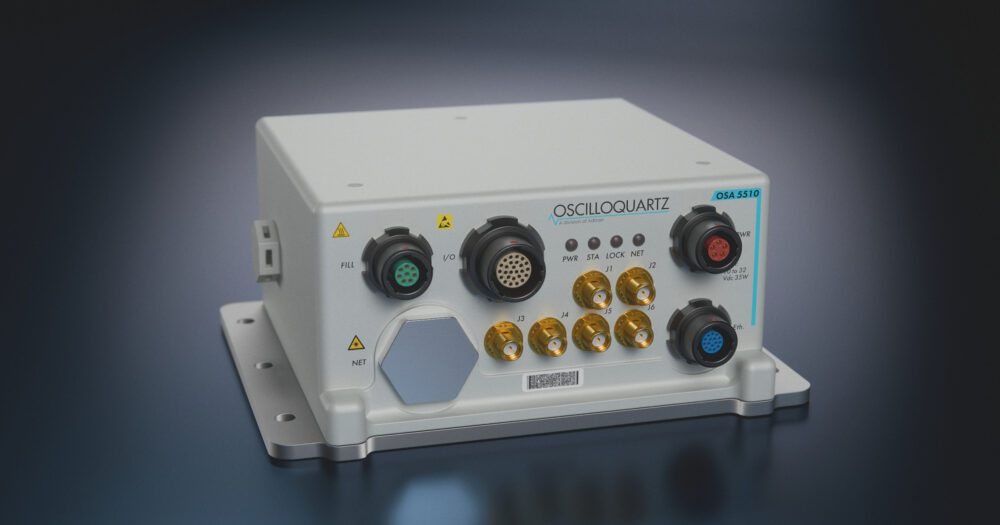
    Oscilloquartz has launched its ruggedSync Series OSA 5510, a ruggedized timing and synchronization platform engineered for defense and other harsh, mission-critical environments.

    The OSA 5510 is designed for deployment in tactical communications networks, mobile command centers, aviation systems and other highly demanding operational environments. It combines PTP grandmaster and NTP server functionality with synchronization assurance and resilient holdover in a compact military (MIL)-qualified platform.

    Multi-band GNSS support, encrypted and authenticated timing options, and environmental protection enable operation in contested and GNSS-denied environments where trusted synchronization must be maintained.

    Built to support resilient defense timing architectures, the OSA 5510 integrates advanced synchronization technologies and flexible mission-critical interfaces within a hardened platform compliant with MIL-STD-810H and MIL-STD-461G. The solution supports IEEE 1588v2 PTP, SyncE and secure NTP services, while programmable I/O and timecode interfaces, including STANAG, Have Quick, IRIG and PPS/CLK distribution, support diverse defense payloads and operational requirements. Optical and copper SFP/SFP+ 1G/10G interfaces and dual power feeds further enable deployment across modern high-bandwidth defense networks.

    The ruggedSync Series OSA 5510 strengthens multi-source resilience through zero-trust architecture, with support for M-code, Galileo PRS and Iridium STL. Extended holdover, low phase-noise outputs, and jamming and spoofing detection and mitigation help maintain continuity during GNSS degradation or disruption, while White Rabbit readiness supports advanced timing distribution use cases.

    The launch also builds on Oscilloquartz’s expanding global aerospace, defense and government partnerships, including regional representative and VAR relationships supporting resilient timing and assured PNT deployments across the Americas, EMEA and Asia-Pacific.


  • Adtran launches Galileo OSNMA authentication for Oscilloquartz

    Adtran launches Galileo OSNMA authentication for Oscilloquartz

    Adtran‘s Oscilloquartz synchronization platforms now support Galileo’s Open Service Navigation Message Authentication (OSNMA). OSNMA is a GNSS authentication service designed for civilian use.

    By verifying that timing data originates from genuine Galileo satellites, OSNMA ensures authenticity and integrity at the point of reception. The new feature, available via firmware update for supported multi-band GNSS receivers, adds an extra layer of protection against spoofing and manipulation, empowering existing deployments to strengthen security without hardware changes or service disruption.

    OSNMA support from Adtran brings a new level of GNSS security to critical infrastructure. Available for multi-band GNSS receivers in the OSA 5412, OSA 5422, OSA 5430 and OSA 5440 product lines, the feature integrates with Galileo’s Open Service, using digital signatures and TESLA chain keys to authenticate navigation data. This ensures that timing and positioning information is verified as authentic and protected against spoofing or manipulation.

    Adtran’s Oscilloquartz Syncjack probing adds a second layer of defense, detecting record-and-replay attacks – also known as meaconing – by comparing GNSS signals against trusted PTP sources. This dual-layer approach helps identify subtle timing manipulations and delay attacks that traditional receivers may miss.

    “From 5G and smart power grids to financial networks and data centers, bringing authentication to GNSS is a game changer for critical infrastructure,” said Gil Biran, GM of Oscilloquartz, Adtran. “By enabling our customers to defend against sophisticated threats, including meaconing, we’re helping them achieve greater timing integrity for their networks. Existing customers can access this new GNSS security feature with a simple firmware update, helping them stay protected as threats continue to evolve.”

  • Adtran launches Oscilloquartz SFP grandmaster clock for precise edge timing in 10G networks

    Adtran launches Oscilloquartz SFP grandmaster clock for precise edge timing in 10G networks

    Adtran has launched the OSA 5401XG SyncPlug, an SFP-based grandmaster clock that delivers precise PTP and NTP synchronization for 10Gbit/s edge and access networks. The new Oscilloquartz device enables timing distribution through a compact, plug-in form factor that requires no rack space or complex installation, empowering network operators to extend synchronization into space- and power-limited deployments.

    With multi-band GNSS support, compliance with PRTC‑B and compatibility with 10Gbit/s-only host platforms, it offers an efficient way to upgrade timing capabilities across sectors, including telecom, energy, defense, enterprise and more, according to Adtran.

    “As networks evolve, precise timing has to reach further, faster and into more constrained environments. That’s exactly what the 5401XG SyncPlug is built for. It’s a no-compromise solution that fits directly into existing infrastructure, requires almost no space or power and delivers the performance needed for next-generation services,” said Gil Biran, GM of Oscilloquartz, Adtran. “By integrating advanced GNSS capabilities in a 10Gbit/s-ready SFP module, we’re giving our customers an easier, smarter way to deploy resilient timing, whether modernizing legacy sites, extending coverage at the edge or rolling out new, timing-critical applications.”

    The OSA 5401XG SyncPlug is a fully featured SFP-based synchronization device that supports PTP grandmaster, boundary and slave clock modes, Stratum 1 NTP server functionality, and SyncE for frequency synchronization. It plugs directly into standard 1Gbit/s or 10Gbit/s ports and consumes less than 2.5W, making it ideal for space- and power-sensitive locations. With multi-band GNSS (L1 and L5), the device enables compliance with enhanced timing standards such as PRTC-B and supports regional systems, including India’s IRNSS. It also offers advanced spoofing and jamming detection, extended holdover and up to 500,000 NTP transactions per second, ensuring performance and security at scale.

    “Demand for precise synchronization is growing rapidly across edge and access networks, and it has to be delivered with minimal footprint and maximum resilience,” commented Igal Pinhasov, VP of product line management at Oscilloquartz, Adtran. “From mobile backhaul and energy grids to secure government and business networks, the OSA 5401XG SyncPlug fits directly into existing infrastructure to deliver full grandmaster functionality over 10Gbit/s. There’s no need for extra cabling, appliances or rack space. It’s an ideal solution for operators looking to modernize timing in challenging environments while simplifying deployment and strengthening performance.”

  • Australian Defence selects Adtran optical cesium clock for PNT research

    Australian Defence selects Adtran optical cesium clock for PNT research

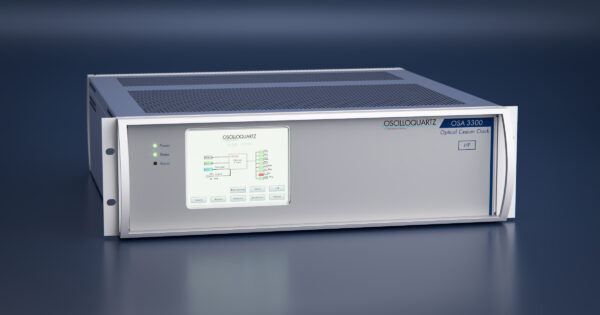
    Australia’s Defence Science and Technology Group (DSTG), part of the Australian government’s Department of Defence, has selected Adtran’s Oscilloquartz high-performance optically pumped cesium clock to support research at its Adelaide facility.

    The OSA 3300 HP will serve as a time and frequency reference for positioning, navigation and timing (PNT) research. Delivered in collaboration with local partner CoverTel, the deployment marks the first integration of optical cesium technology within Australian defense research.

    “DSTG’s selection of our optical cesium reflects a broader shift toward autonomous, long-term synchronization solutions,” said Stuart Broome, GM of EMEA and APAC sales at Adtran. “Defense organizations around the world are reassessing how they ensure timing resilience, particularly as reliance on GNSS becomes more of a risk.”

    The OSA 3300 HP will give national infrastructure precision and adaptability, supporting DSTG’s research into new strategies for assured PNT. DSTG selected the OSA 3300 HP to support advanced PNT research within its Sensors and Effectors division.

    Using optical pumping technology that measures 100 times more atoms than traditional magnetic cesium clocks, the device delivers outstanding frequency stability and precision, Adtran said. Its all-digital design ensures consistent performance, while its 10-year operational lifespan offers long-term value.

    With its compact form factor, robust construction and advanced atomic technology, the OSA 3300 HP provides the reliability needed to support Australia’s evolving synchronization requirements and critical scientific initiatives.

    The clock will help DSTG explore new approaches to synchronization and build greater resilience into the Australian Defence Force’s long-term PNT capabilities, especially in contested environments where GNSS jamming and spoofing are prevalent. It will lay the groundwork for systems that rely on precise, dependable timing — from secure defense communications to advanced sensing and navigation.

  • NextNav, Oscilloquartz partner to bolster 5G-based timing solutions for critical infrastructure

    NextNav, Oscilloquartz partner to bolster 5G-based timing solutions for critical infrastructure

    New collaboration to demonstrate how terrestrial 5G-based timing can provide scalable solutions to complement and backup GPS.

    NextNav and Oscilloquartz, a division of Adtran, have partnered to demonstrate how 5G-powered terrestrial positioning, navigation, and timing (PNT) technology combined with Oscilloquartz’s established synchronization systems can serve as a scalable complement and backup to GPS. The initiative aims to maintain the operation of critical infrastructure, such as data centers, utilities, and emergency services, during GPS outages by distributing precise, coordinated universal time (UTC) over existing 5G networks for both indoor and outdoor environments.

    The collaboration integrates Oscilloquartz’s synchronization technology with NextNav’s terrestrial 5G PNT platforms to introduce an additional timing source, thereby reducing end-user dependence on GPS alone. This effort addresses increasing demand for secure and redundant timing solutions in light of threats to GPS reliability. The companies are aligning their technologies with ongoing Federal Communications Commission initiatives to encourage complementary PNT solutions.

    According to the companies, this approach responds to national security and public safety concerns by prioritizing the development of resilient infrastructure. The demonstration of these integrated terrestrial timing capabilities is intended to provide a practical example of how industry can build more robust timing networks and reduce the risks associated with relying solely on GPS.

  • Adtran and Satelles partner on GNSS timing alternative

    Adtran and Satelles partner on GNSS timing alternative

    Image: Business Wire
    Image: Business Wire

    Adtran and Satelles, a provider of secure time and location technology using low-Earth-orbit (LEO) satellites, have partnered to offer operators of critical infrastructure a timing network device with satellite, time and location (STL) technology. The partnership aims to provide an alternative to GNSS by integrating STL technology from Satelles into Adtran’s Oscilloquartz network synchronization products.

    Through its partnership with Satelles, Adtran’s Oscilloquartz division will incorporate STL into its end-to-end timing toolkit. The companies will also integrate STL into its grandmaster clocks to develop miniature M.2 form factor STL receiver modules for third-party product integration.

    With the ability to deliver precise position, navigation and timing (PNT) service in GNSS-denied applications, STL is suitable for mobile operators, power utility companies, government, scientific research and more. STL technology also offers accurate, secure and augmented Iridium LEO-based PNT services for indoor applications and as backup for GNSS outdoors.

  • ADVA unveils high-performance optical cesium clock

    ADVA unveils high-performance optical cesium clock

    Service providers harnessing the solution can now offer GNSS/GPS- backup-as-a-service (GBaaS) with enhanced precision and availability

    OSA 3300-HP. (Photo: ADVA)
    OSA 3300-HP. (Photo: ADVA)

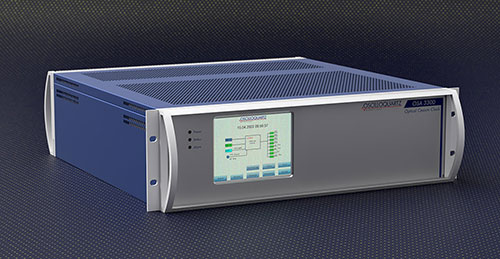
    ADVA has introduced its Oscilloquartz high-performance optical cesium atomic clock. The coreSync OSA 3300-HP is ADVA’s latest innovation in assured positioning, navigation and timing (PNT).

    Following ADVA’s launch of an optical pumping timing solution two years ago, the OSA 3350 ePRC+, the OSA 3300-HP takes the technology to new levels. It has a 10-year lifetime compared to the five years offered by currently available high-performance magnetic clocks.

    As a high-performance optical cesium clock, the OSA 3300-HP sets a new benchmark for precision and availability, ADVA claimed, providing the resilience required for PNT assurance in critical infrastructure and empowering service providers to deliver differentiated service-level-agreement timing offerings with integrated GNSS backup.

    The feature-rich device has embedded Ethernet- and IP-based management as well as a user-friendly touchscreen graphical user interface.

    “The launch of our coreSync OSA 3300-HP marks a key milestone in the design of atomic frequency and phase standards,” said Gil Biran, GM of Oscilloquartz, ADVA. “After many years of extensive work in our Swiss laboratories supported by the European Space Agency, we now have a mature, state-of-the-art technology that enables a major leap in the accuracy and stability of network timing while providing a substantially longer lifetime.”

    Atomic clocks offer synchronization backup for networks that rely on GNSS-based timing, combining high accuracy with outstanding availability. The OSA 3300-HP commercial high-performance optical cesium atomic clock features an all-digital design and leverages optical-pumping techniques using laser diodes. This enables it to measure 100 times the number of atoms, making it more efficient compared to existing primary reference clock (PRC) technologies.

  • ADVA launches GPS backup service to help combat cyberattacks

    ADVA launches GPS backup service to help combat cyberattacks

    ADVA logoADVA is enabling service providers to offer GPS/GNSS-backup-as-a-service (GBaaS) to answer the need for operators to safeguard services that rely on positioning, navigation and timing (PNT) information.

    Along with spoofing and jamming of GNSS, in-network timing based on network time protocols (NTP) and precision time protocols (PTP) are also increasingly vulnerable to cyber threats.

    As a response, ADVA is now empowering service providers to offer GBaaS and enable end users to address new guidelines and standards for redundant PNT architectures. GBaaS meets the latest recommendations for PNT homeland security, including U.S Executive Order 13905. Leveraging ADVA’s aPNT+ technology, GBaaS eliminates the risks and costs associated with GNSS dependence.

    “Threats to hamper PNT capabilities are growing, and much of the world’s critical infrastructure is still without adequate protection from GNSS vulnerabilities,” said Gil Biran, general manager of Oscilloquartz, ADVA. “All of that can change when service providers are able to offer GBaaS.”

    GBaas is based on ADVA’s aPNT+ platform, which leverages a suite of technologies, including multi-band GNSS receivers and management software based on artificial intelligence and machine-learning.

    Service providers can offer ADVA’s aPNT+ protection as a subscription-based service as part of their service-level agreements.

    ADVA’s GBaaS solution employs a combination of multi-layer detection, multi-source backup and fault-tolerant mitigation to render timing networks more secure. Embedded in all timing devices, ADVA’s Syncjack technology provides comprehensive and precise synchronization performance monitoring and analytics, enabling the Ensemble Sync Director network management suite to intelligently operate and prioritize multi-source timing feeds across the network.

    Onboard multi-band GNSS receivers boost timing accuracy and also protect against attacks like jamming and spoofing. When GNSS is either unavailable or compromised, a dispersed network of autonomous cesium atomic clocks and network backup timing feeds is ready to deliver highly accurate network timing over long periods of GNSS unavailability.

  • ADVA releases software to boost timing resiliency

    ADVA releases software to boost timing resiliency

    Screenshot: ADVA
    Screenshot: ADVA

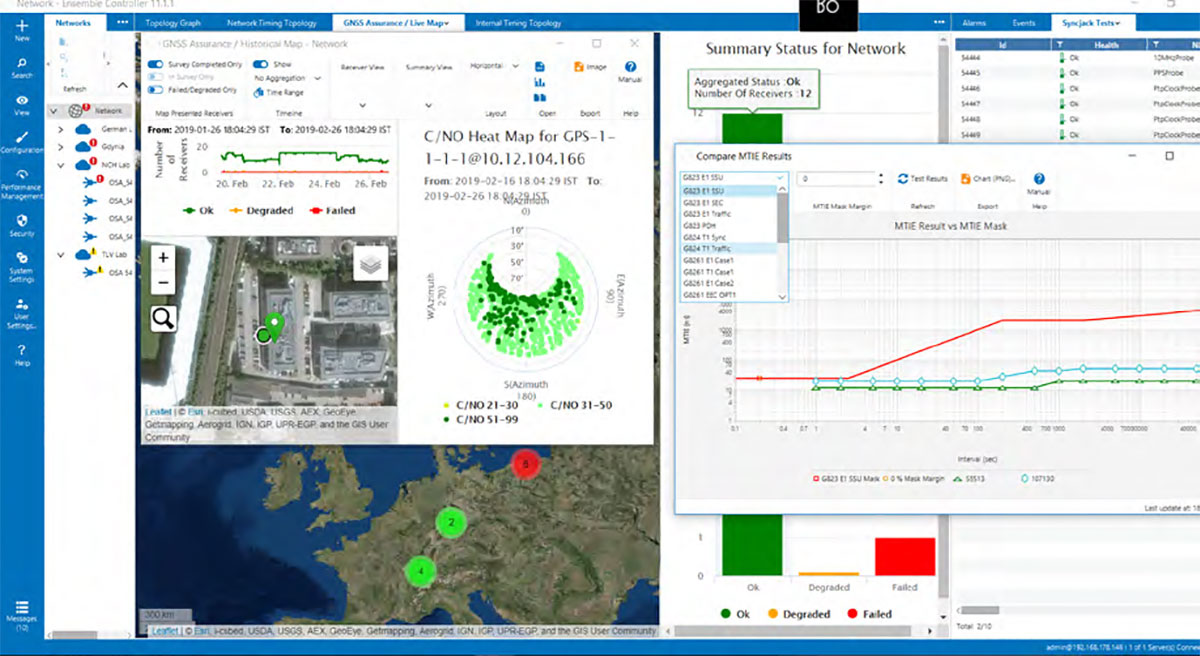
    ADVA has released new software that extends its Oscilloquartz timing assurance technology to synchronization networks using Network Time Protocol (NTP).

    ADVA’s Ensemble Sync Director management system provides assurance control, helping mission-critical services across many industries that depend on reliable and accurate NTP timing.

    The new NTP capabilities are extended from ADVA’s robust Oscilloquartz Precision Time Protocol (PTP) product range and supported by Syncjack GNSS monitoring. They also leverage multiple form factors with redundant synchronization devices, multiple holdover options and versatile multi-technology gateways between GNSS, PTP and NTP, ensuring robust, scalable and highly resilient NTP timing architectures.

    “Despite the availability of PTP, NTP remains the most widely used time synchronization protocol,” said Gil Biran, GM of Oscilloquartz, ADVA. “It’s applied in many legacy networks as well as new IoT (internet of things) applications. What’s more, the sophistication of NTP timing is increasing, while the NTP protocol itself remains unchanged. Now we’re enabling our customer to deploy robust, reliable and secure NTP implementations built on our unique expertise and experience in delivering assured synchronization.”

    ADVA uses a combination of NTP architecture and highly accurate GNSS timing backed up with PTP timing domains.

    Because ADVA’s products now support assured NTP technology, they offer customers virtually unlimited scale, Biran said. “With hardware-implemented NTP functionality, even the smallest SFP (small-form factor pluggable) NTP server can support up to 500,000 transactions per second.”

    To ensure NTP delivery is able to withstand a broad range of risk scenarios, ADVA’s resilient synchronization solution is engineered for both device and network redundancy. It features multiple backup options such as PTP- and GNSS-delivered time, as well as a variety of oscillator solutions that allow different levels of holdover.

    Comprehensive monitoring by ADVA’s Ensemble Sync Director management system helps guarantee the levels of performance required for time-critical network applications. Designed from the bottom up to support continuous assessment and assured timing precision, it automatically responds to any issues before applications can be disturbed by timing inaccuracies.

    ADVA’s solutions also offer centralized GNSS monitoring and assurance, protecting timing networks from vulnerabilities, including jamming and spoofing attacks.

    Customers can build NTP-based networks today and switch to PTP with one click, commented Nir Laufer, vice president of product line management at Oscilloquartz, ADVA. “Our customers no longer need to hope for the best from their NTP servers,” Laufer said. “With real-time GNSS monitoring and comprehensive probing and analysis of timing quality, they can rest assured that their synchronization services have the highest levels of accuracy, integrity, availability and scale.”

  • ADVA offers embedded timing for third-party hardware

    ADVA offers embedded timing for third-party hardware

    ADVA has introduced its OSA 5400 SyncModule embedded timing solution, designed to enable technology suppliers to integrate precise synchronization into their hardware. Its M.2 form factor can add crucial timing capabilities to switches, routers, open compute servers and other IT devices.

    The OSA 5400 SyncModule provides GNSS, precision time protocol (PTP) and network time protocol (NTP) engines as well as comprehensive PTP and GNSS monitoring and assurance functionality. According to ADVA, the module can enable assured sub-microsecond timing in public and private networks as well as critical infrastructure.

    “Our OSA 5400 SyncModule brings something completely new and very valuable to the market,” said Gil Biran, general manager, Oscilloquartz, ADVA. “For the first time, third-party technology manufacturers will be able to embed the most advanced synchronization capabilities into their designs and easily control them with our Ensemble Sync Director or their own management system.”

    Featuring multiple interface options for easy integration, the OSA 5400 SyncModule comes with an open API. It can also be managed by ADVA’s proven Ensemble Sync Director management system.

    Image: ADVA
    Image: ADVA

  • PGE selects assured PNT clocks for smart-grid infrastructure

    PGE selects assured PNT clocks for smart-grid infrastructure

    ADVA’s aPNT platform is key for the development of PGE’s critical network infrastructure (Photo: Business Wire)
    ADVA’s aPNT platform is key for the development of PGE’s critical network infrastructure (Photo: Business Wire)

    Portland General Electric (PGE) is deploying Oscilloquartz PTP grandmaster clock technology as it upgrades to packet-based synchronization and protects its network against GNSS vulnerabilities and cyberattacks. The upgrades also conform to PNT Executive Order 13905.

    PGE, one of the largest power utilities in the Western United States, is using the ADVA scalable timing solution to enable a smooth transition from legacy synchronization and ensure new levels of accuracy, reliability and resiliency. The new system will  timestamp data and control grid substations at the edge.

    With multi-band GNSS receivers and artificial-intelligence (AI) threat detection, ADVA’s assured PNT (A-PNT) platform helps maintain resilient timing, even in challenging circumstances such as deliberate jamming and spoofing attacks. It also provides multi-source backup, including PTP network timing and in-device holdover oscillators for when GNSS signals are unavailable or disrupted.

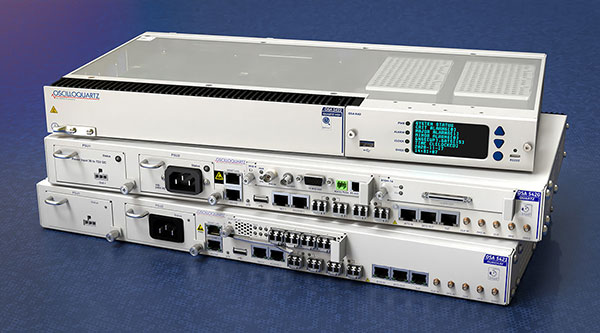
    The solution is built on the OSA 5410 and OSA OSA 5420 series of edgeSync+ grandmaster clocks. It features multi-band, multi-constellation GNSS receivers and supports multiple PTP profiles, including substation power and core telecom backup sync, while also allowing conversion between them and supporting legacy interfaces.

    The products are part of ADVA’s new aPNT platform, integrating threat detection, multi-source backup and ADVA’s intelligent Ensemble Sync Director.

  • UrsaNav trials eLoran as GNSS backup with ADVA grandmaster clock

    UrsaNav trials eLoran as GNSS backup with ADVA grandmaster clock

    Successful eLoran field trial using ADVA’s OSA 5420 Series demonstrates same accuracy and stability as GPS with much-improved resilience

    UrsaNav and ADVA have conducted an enhanced long-range navigation (eLoran) field trial using UrsaNav’s eLoran receiver and ADVA’s Oscilloquartz grandmaster clock technology. The successful demonstration shows that eLoran offers a robust and reliable backup for GPS and other GNSS, and could be used to provide an assured position, navigation and timing (PNT) service.

    The trial follows U.S. PNT Executive Order 13905 aimed at strengthening national resilience through PNT services, including protecting critical infrastructure such as electrical power grid and communication networks from rising cyber threats. By harnessing ADVA’s flexible OSA 5420 series, designed with assured PNT (A-PNT) technology, UrsaNav has shown that eLoran can provide a new layer of protection and significantly boost timing resilience and security.

    “The success of this field trial demonstrates how eLoran, as part of ADVA’s assured PNT solution, can serve as a crucial backup for GPS,” said Charles Schue, CEO, UrsaNav. “We have shown how our technology enables ADVA’s grandmaster clock to receive UTC timing from the eLoran system for a period of several days with the same accuracy and stability as GPS. Of course, this capability is extensible to other GNSS as well. eLoran is far less vulnerable to unintentional jamming and spoofing disruptions or intentional attacks, thereby delivering nanosecond precision with even more resilience.”

    “By partnering with ADVA, we’ve been able to show that our eLoran receiver interoperates with the best network timing toolkit available,” Schue said. “The OSA 5420 Series is a great product — highly efficient and easy to operate. Together with ADVA, we’re paving the way for tomorrow’s more robust assured PNT synchronization architecture. Now that UrsaNav has demonstrated the power of our OSA 5420 Series to utilize eLoran in the event of outages, we have another very important tool to ensure the quality and availability of time-sensitive services.”

    UrsaNav’s latest trial used the OSA 5420 series grandmaster clock with built-in GNSS receiver. Timing stability from GPS was measured for several days. This was then replaced with eLoran for the same period with no loss of stability.

    The test was conducted indoors where GNSS signals are not usually available, potentially extending the availability of precise UTC timing to many more environments.

    “Commercially available GNSS jammers and spoofers are easy and cheap for attackers to acquire,” explained Nir Laufer, VP, product line management, Oscilloquartz, ADVA. “That’s part of the reason why we’re seeing a growing number of incidents across the world of blocked or misleading signals. If power utilities, enterprises, service providers and governments continue to rely on GNSS alone, it’s only a matter of time before the consequences become very serious. That’s why we’re committed to tackling GNSS vulnerabilities with advanced technologies like our ePRTC offering, cesium atomic clocks and our optical timing channel solution. Now that UrsaNav has demonstrated the power of our OSA 5420 series to utilize eLoran in the event of outages, we have another very important tool to ensure the quality and availability of time-sensitive services.”

    A demo showed how ADVA’s synchronization technology enables protection for critical infrastructure that needs ultra-reliable aPNT solutions. (Photo: Business Wire)
    The demo showed how ADVA’s synchronization technology enables protection for critical infrastructure that needs ultra-reliable aPNT solutions. (Photo: Business Wire)