Tag: product development

  • U-blox to offer explorer kits for cm-level positioning designs

    U-blox to offer explorer kits for cm-level positioning designs

    The development kits will bring together u-blox’s centimeter-level positioning and wireless communications expertise and services to support faster time-to-market for new products
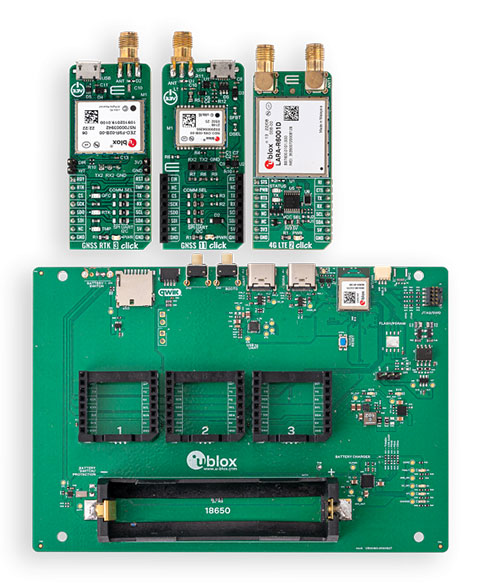
    The XPLR-HPG-1 high-precision GNSS explorer kit. (Photo: u-blox)
    The XPLR-HPG-1 high-precision GNSS explorer kit. (Photo: u-blox)

    U-blox has announced new explorer kits to make it quicker and easier for engineers to design and evaluate products requiring centimeter-level positioning capabilities.

    Set to launch in early 2023, the ready-to-use XPLR-HPG-1 and XPLR-HPG-2 solutions will combine u-blox’s unique offering across the key technologies required to achieve highly precise positioning.

    As well as an open microcontroller unit (MCU), the kits will include high-precision GNSS positioning with real-time kinematic (RTK), dead-reckoning, cellular, Wi-Fi and Bluetooth communications, along with the necessary antennas.

    The kits are designed to integrate seamlessly with complementary u-blox services, such as PointPerfect GNSS augmentation service and the ubxlib software component.
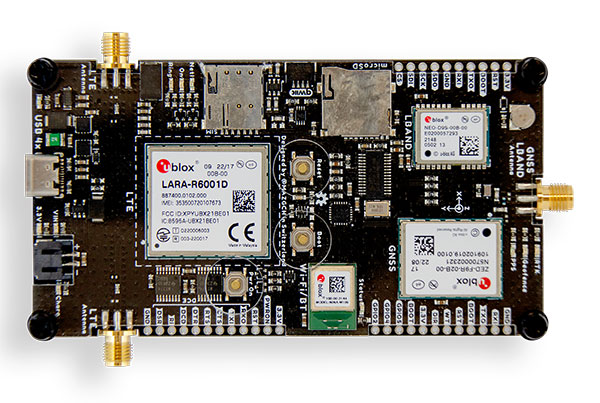
    The XPLR-HPG-2 High precision GNSS explorer kit. (Photo: u-blox)
    The XPLR-HPG-2
    High precision GNSS explorer kit. (Photo: u-blox)

    The kits will assist engineers working in areas such as micro-mobility and low-speed robotics, helping them build, test and demonstrate early-stage proofs of concept more quickly, supporting faster overall time-to-market.

    Both explorer kits will include the full gamut of u-blox technology and software required.

    • The modular XPLR-HPG-1 kit will be based around the wireless MCU in the u-blox NORA-W106 , with its Wi-Fi and Bluetooth LE capabilities, and will give engineers flexibility to adjust their solutions to their precise needs, using MIKROE Click boards featuring a variety of u-blox modules. The kit will include three Click boards, which respectively incorporate the ZED-F9R high-precision RTK GNSS module, the LARA-R6001D LTE Cat 1 module (global coverage and with built-in MQTT client), and the NEO-D9S L-band correction data receiver module. Engineers can purchase others based on their application’s needs. The kit’s source code will include example software for the Espressif IoT Development Framework (ESP-IDF), based on ubxlib software components.
    • The compact XPLR-HPG-2 will deliver an integrated solution, incorporating the ZED-F9R high-precision RTK GNSS, LARA-R6001D LTE Cat 1 (with global coverage and built-in MQTT client) and NEO-D9S L-band correction data receiver modules, as well as the NINA-W106 with its MCU, Bluetooth LE and Wi-Fi capabilities.
  • Companies discuss navigation solutions at NAVISP Industry Days

    Companies discuss navigation solutions at NAVISP Industry Days

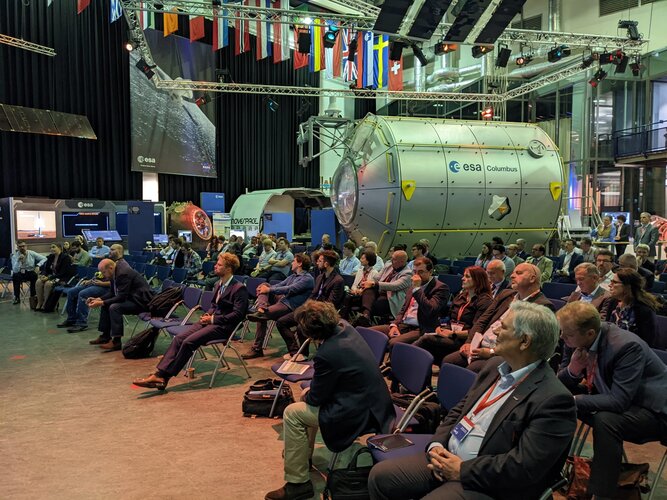
    Europe’s leading companies and research institutes working on positioning, navigation and timing (PNT) technologies met in the Netherlands in mid-June for this year’s NAVISP Industry Days. The event is devoted to the latest developments in the Navigation Innovation and Support Program (NAVISP), sponsored by the European Space Agency (ESA).

    NAVISP is focused on navigation technologies beyond Galileo and EGNOS, with many of the same engineers that led the development of Europe’s own satnav constellation working with European industry and academia on exciting new concepts.

    Photo: ESA
    Photo: ESA

    About 130 people participated in the two-day event, which took place June 16-17 at the ESA-ESTEC center in Noordwijk aan Zee, The Netherlands.

    As well as attending presentations on NAVISP projects, participants had the opportunity to meet and talk shop in the exhibition area, which displayed products and hardware such as an improved-accuracy smartphone board and drones for data gathering.


    The PNT sector accounts for 10% of the European economy.


    Throughout Industry Days, the importance of innovation for competitiveness was highlighted, to enable companies to adapt to rapid technological change in the fast-growing PNT sector, which today accounts for 10% of the European economy.

    “NAVISP’s strength lies in supporting all types of actors, from start-ups and SMEs to large enterprises, and space companies to companies in other sectors that have recognized the added value of PNT solutions,” said Pierluigi Mancini, NAVISP program manager. “That means playing a part in advancing research and product development, as well as commercialization to broadly foster and support European industry in addressing technology, market and regulatory risks.”

    At the Industry Days, many different projects across varying market areas along different points in the value chain were highlighted such as air mobility testbeds, new technologies for roads and other infrastructure, support for maritime navigation, development of novel PNT satellites, studies for quantum-based PNT, and weather monitoring based on collaborative crowdsourcing.

    The innovation potential of NAVISP activities was underlined by the fact that two new Navigation Directorate programs set to be proposed to ESA’s Council of Ministers this November — the in-orbit demonstration of low-Earth orbit PNT services and the GENESIS mission for precision Earth measurement — originated in NAVISP projects.

    The entire set of the NAVISP Industry Days presentations can be found here.