Siemens has unveiled its latest innovation for energy infrastructure: the Siprotec 5 Precision Time Protocol (PTP) Grandmaster Clocks (GMC).
Built to secure the backbone of modern power grids, the GMC ensures resilient, fail-safe time synchronization for digital substations, safeguarding critical protection functions from disruption, shielding against external disturbances, and strengthening cybersecurity to boost overall grid reliability.
Avoiding GNSS disruptions. Conventional digital substation architectures often rely on redundant GNSS-based grandmaster clocks. However, even with redundancy, they remain vulnerable: disturbances to GNSS signals, whether from natural phenomena like solar storms or intentional interference such as jamming and spoofing, can cause disruptive “‘jumps” in the time base. Such disruptions force merging units to resynchronize, temporarily disabling critical protection functions and can lead to unnecessary removal of equipment from service or even cause false tripping events, impacting grid stability and increasing operational costs. Siemens’ new solution mitigates these risks, ensuring uninterrupted, secure operation.
Siemens’ solution separates sample synchronization from global time synchronization using specialized internal time sources. The Siprotec 5 devices, equipped with integrated PTP Grandmaster Clocks compliant with IEEE 1588v2/PTP standard, operate independently from external GNSS signals, using internal oscillators as time references for precise synchronization.
Changeover technology. A key feature of this approach is Siemens’ patent-pending Seamless PTP grandmaster changeover technology, built into Siprotec 5 devices. This ensures that when primary clocks return, they first align with active backup clocks before resuming their role. In doing so, disruptive time base jumps during switchovers are prevented, keeping protection functions continuously available.
The specialized synchronization enables process bus networks in digital switchgears to operate autonomously without external access points, significantly strengthening cybersecurity by isolating the process bus from the station bus network.
The open-source collaboration features Orolia Atomic Reference Time Cards powered by its Spectratime micro-atomic clock
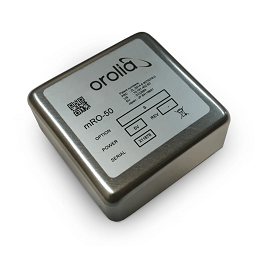
Orolia is providing Atomic Reference Time (ART) Cards to support Meta’s implementation of high-precision timing protocols within its distributed timing infrastructure. The architecture of Orolia ART Cards is powered by the company’s Spectratime mRO-50 mini rubidium atomic-clock technology.
The Spectratime mRO-50. (Photo: Orolia)
“We are honored to have this opportunity to collaborate with Meta’s incredibly talented team of engineers to develop a unique open-source solution using our mRO-50 technology,” said Jean-Yves Courtois, Orolia CEO. “We look forward to a continuing partnership with Meta and other global network leaders working to advance solutions to ensure ongoing timing accuracy and resilience.”
Orolia developed the ART Card solution in collaboration with the Meta engineering team to fulfill a new specification that Meta published for the Time Appliances Project Initiative of the Open Compute Project. This new collaborative community is focused on designing from scratch new hardware and software to efficiently support the critical timing accuracy and resilience demands on computer network infrastructure. This project is fully open-sourced and available on Orolia’s GitHub.
In 2020, Meta began converting its data-center servers to a new time-distribution service based on network time protocol (NTP) and precision time protocol (PTP). The new service, built in-house and later open-sourced, was more scalable and improved the accuracy of timekeeping within the Meta infrastructure from 10 milliseconds to 100 microseconds. Orolia ART Cards will further increase the accuracy, resiliency and adoption of Meta’s new timing platform.
Developed with long-term support in mind, Orolia’s ART Cards deliver management, disciplining and monitoring functions that can be integrated into any computer with a PCIe port and bring accurate and resilient timing for the most demanding applications such as NTP/PTP time reference, time stamping and latency calculation.
ADVA has introduced its OSA 5400 SyncModule embedded timing solution, designed to enable technology suppliers to integrate precise synchronization into their hardware. Its M.2 form factor can add crucial timing capabilities to switches, routers, open compute servers and other IT devices.
The OSA 5400 SyncModule provides GNSS, precision time protocol (PTP) and network time protocol (NTP) engines as well as comprehensive PTP and GNSS monitoring and assurance functionality. According to ADVA, the module can enable assured sub-microsecond timing in public and private networks as well as critical infrastructure.
“Our OSA 5400 SyncModule brings something completely new and very valuable to the market,” said Gil Biran, general manager, Oscilloquartz, ADVA. “For the first time, third-party technology manufacturers will be able to embed the most advanced synchronization capabilities into their designs and easily control them with our Ensemble Sync Director or their own management system.”
Featuring multiple interface options for easy integration, the OSA 5400 SyncModule comes with an open API. It can also be managed by ADVA’s proven Ensemble Sync Director management system.
Chronos Technology Ltd., a UK-based resilient synchronization and timing company, has transitioned to employee ownership through the Chronos Technology Employee Ownership Trust (EOT) Ltd.
Charles Curry who established Chronos Technology in September 1986 and was co-owner alongside his wife, Angela Curry, had been deliberating succession planning and their exit from the business. Various options such as a third-party sale or a management buyout were considered but quickly dismissed.
“I am aware of business owners who had exited through third-party sales and had not enjoyed the experience of working under new management for the agreed handover period,” Curry said. “New owners generally change the dynamic of the business, often introducing new staff and work practice without giving opportunity to existing staff and process, and we did not want this for Chronos.”
“Over the years we have established a work ethic that puts the customer first,” Curry continued. “The EOT protects the loyal Chronos family and ensures the customer-facing continuity of the business and, most importantly, safeguards jobs. Going forward, in the hands of the employees, the company will benefit from increased customer engagement and the commitment to a team approach to steer the business on the next phase of its journey.”
Chronos Technology specializes in resilient synchronization and timing systems, smart technologies, GNSS and cybersecurity solutions for critical national infrastructure, with industry experience gathered over 35 years in specialist technologies such as GNSS, PTP, NTP and SyncE.
The company provides GPS coverage solutions in hangars, manufacturing areas and underground, as well as smart technology solutions and GNSS jamming detection and location solutions for law enforcement. Customers include telecom, finance, energy, data centers, broadcast, aerospace, defence and security, enterprise/IT, emergency services, transport and manufacturing.
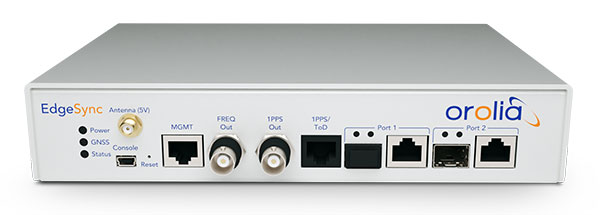
The new cost-effective small form factor is designed for NTP and PTP functionality
Photo: EdgeSync
Orolia has introduced EdgeSync, a new cost-effective network timing platform that provides Network Time Protocol (NTP) and Precision Time Protocol (PTP) Grandmaster and Boundary Clock functionality for real-time edge applications.
High performance, scalability, ease of use and manageability make EdgeSync particularly suitable for a wide range of applications, including data centers, finance, mobile edge computing, enterprise, smart grid, industrial internet of things (IoT), process control or telecommunications.
“EdgeSync is a great addition to Orolia’s timing product line because it’s ideally suited to meet the demanding requirements of today’s modern networks, including 5G infrastructure,” said Jeremy Onyan, director of Time Sensitive Networks at Orolia. “It delivers NTP and PTP capability to industries like process control, broadcast and telecom in a cost-efficient form factor that doesn’t sacrifice performance while taking advantage of the growing demand for edge applications.”
EdgeSync uses a multi-GNSS receiver (GPS, Galileo, GLONASS, Beidou and QZSS), PTP and Synchronous Ethernet (SyncE) as input references and generates PTP, SyncE, NTP and timing signals (10 MHz, 1 PPS and Time of Day message) as outputs. It features dual 1 GbE ports for both copper RJ45 and optical network timing connections.
EdgeSync also can provide IEEE 1588-2008 (PTP) Grandmaster and Boundary Clock functionality. The device leverages unique PTP algorithms to deliver stringent timing for demanding, precise applications and supports multiple industry PTP profiles for interoperability. An enhanced oscillator and PTP slave capacity option allow users to choose the EdgeSync performance level to meet their specific needs.
EdgeSync is available both in the Orolia Online Store (shipping to U.S. addresses only) and directly from Orolia technical sales representatives.
Oxford Technical Services (OxTS) has launched precision time protocol (PTP) master functionality on all of its next-generation inertial navigation systems (INS).
PTP is a network-based time synchronization protocol used to synchronize all clocks throughout a computer network. It is used in many industries, but most notably in finance to synchronize transactions, mobile-phone tower transmissions and subsea acoustic arrays.
Time synchronization
In many commercial organizations, millisecond-level device synchronization as offered with network time protocol (NTP) is sufficient. However, in surveying and automotive testing environments where there is more than one clock source (lidar and inertial navigation systems, or INS, for example), final results can suffer from time drift if millisecond — and not microsecond — synchronization is used.
Time drift becomes relevant as soon as you introduce more than one data acquisition system working in parallel. This is because each system will have its own timing error, and over time this error will grow and create drift.
For surveyors, time drift can negatively impact point clouds by making object recognition difficult, subsequently leading to blurring and double vision.
For automotive engineers, when running campaigns, analysis of events within your data may be misaligned, making the analysis more difficult and/or less efficient.
Stamp out time drift
To stamp out time drift, it is important to use the most accurate clock source available.
A key component of an INS is the GNSS receiver. The GNSS receiver acquires data, including timing information, directly from multiple GNSS constellations (GPS, GLONASS, BeiDou and Galileo). The GNSS receiver, coupled with the inertial measurement unit within the INS, allows users to benefit from the centimeter-level position accuracy that is so important in surveying and automotive testing environments.
These satellite systems house the most accurate time source possible — atomic clocks — meaning that devices connected to a network that includes an INS can take advantage of this time source owing to the GNSS receiver within the INS.
Simpler setup for lidar use
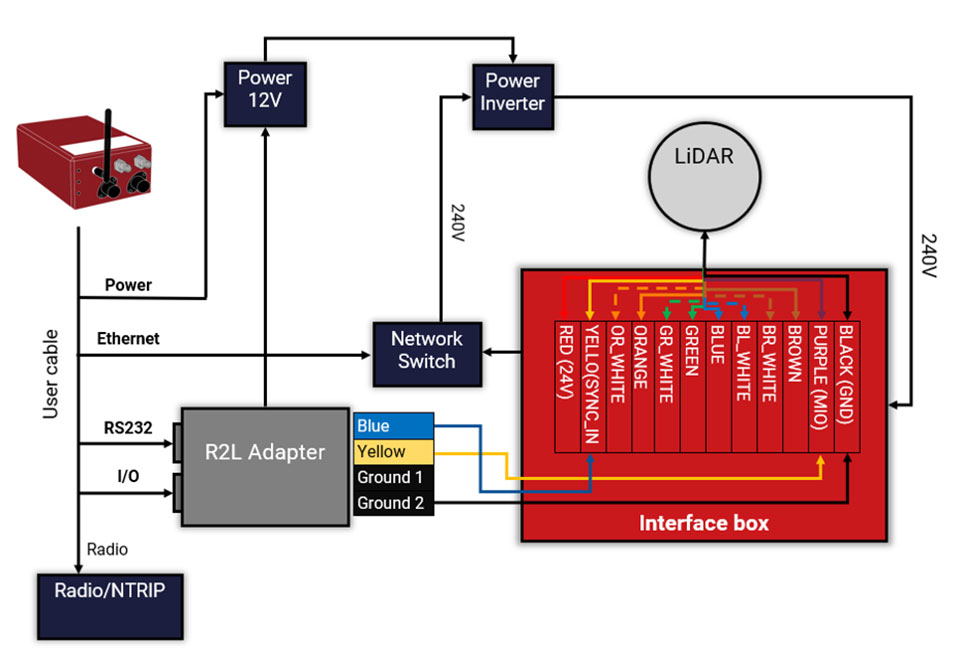
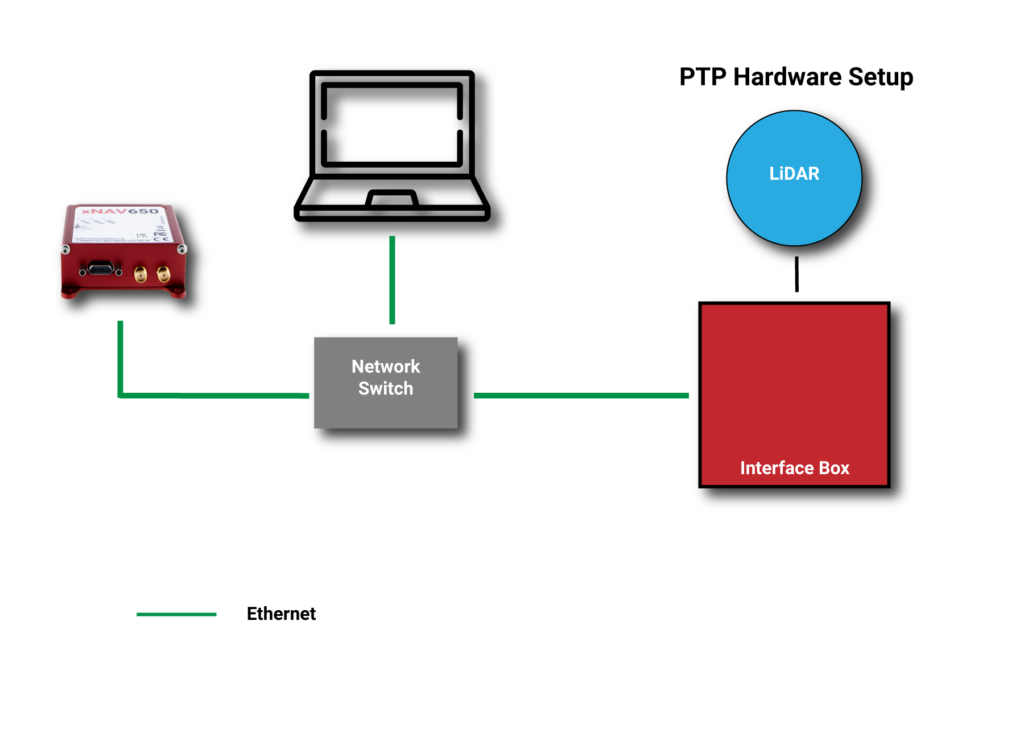
By migrating from a traditional PPS hardware set-up, which involves connecting and wiring multiple cables, to a PTP setup, which is essentially an Ethernet “plug-and-play” solution, users can also make day-to-day use of the equipment simpler and more efficient.
Without PTP – using PPS setup. (Image: OxTS)
An example PPS hardware setup with a PTP-enabled network. (Image: OxTS)
This much-improved hardware setup allows surveyors and automotive test engineers to be up and running in a much shorter time frame than previously possible.
Adding value to the automotive industry
The addition of PTP also adds value for automotive users. With cars-under-test incorporating multiple sensors (lidars, cameras, etc.), synchronizing all that data can help support accurate analysis after the test is complete.
OxTS is continuing to develop its PTP solution by working on PTP slave functionality and improving the configuration process, which will provide greater flexibility in typical automotive setups that use data acquisition (DAQ) for larger sensor networks.
Summary
PTP as a time synchronization method is becoming more popular, particularly in the lidar industry, with manufacturers such as Ouster and Hesai enabling PTP on their sensors.
The shorter “time to survey” gives customers a much-enhanced user experience, and the higher quality final output on offer means that many users will demand their sensors are PTP-compatible before considering them for their projects.
Manufacturers of complimentary sensors, such as INS, need to build the capability into their product sets to allow them to be fit for the future.
Various OxTS INS are available to use PTP, including the new xNAV650, the company’s new small, lightweight and affordable INS for applications where payload size and weight matter. Learn more about the xNAV650 INS.
Users can also find out more about OxTS and its range of PTP-enabled devices by visiting its dedicated landing page, OxTS PTP-enabled INS devices.
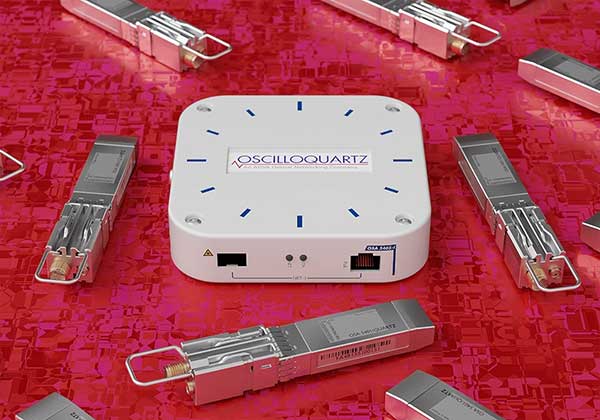
Enhanced Oscilloquartz portfolio enables seamless transition to PTP timing from the core to the substation
Photo: Business Wire/Oscilloquartz
ADVA has upgraded its portfolio of Oscilloquartz PTP grandmaster clocks, enabling power utilities to smoothly transition to packet network synchronization.
The enhanced technology will empower electricity providers to evolve their infrastructure into smart grids based on precision time protocol (PTP) power profiles, while at the same time supporting all legacy timing signals.
Updates to ADVA’s Oscilloquartz pluggable solution, its compact small cell device, its mid-size PTP grandmasters and its fully redundant core timing technology ensure ultra-precise timing throughout a utility network.
The technology also removes the risk of relying purely on satellite-based time sources through continuous monitoring, jamming and spoofing detection and AI-assisted analytics.
ADVA’s entire range of Oscilloquartz grandmaster clocks has been upgraded to meet the latest PTP profiles for time, frequency and phase synchronization in power utility networks. This includes:
OSA 5401 small form-factor pluggable,
OSA 5405 for indoor and outdoor substation deployments,
OSA 5420 Series,
Highly scalable OSA 5430 and 5440 with 10Gbit/s interfaces and fully redundant hardware.
The technologies enable an easy migration to an Ethernet-based timing network with support for PTP, Network Time Protocol and SyncE, as well as IRIG-B, PPS and BITS legacy interfaces.
PTP-based backup combined with multi-band GNSS receivers and advanced monitoring capabilities ensure that the upgraded solutions provide highly reliable delivery of precise timing information even during long GNSS outages.
To create an ePRTC solution, ADVA’s Oscilloquartz cesium clocks can also be combined with the OSA 5420, 5430 or 5440. This delivers extended holdover of up to 70 nanoseconds for 14 days, even when GNSS signals are unavailable.
Image: ChakisAtelier / iStock /Getty Images Plus /Getty Images
By Eric Colard
Head of Emerging Products, Frequency & Time Systems
Microchip Technology
Mobile operators are investing heavily in the deployment of LTE-Advanced and 5G networks that will transform cellular communications and connectivity.
They face big risks, though: the high-performance mobile services delivered over these networks are extremely dependent on precise time from GPS and other similar regional constellations broadly known as GNSS so they can synchronize radios, enable new applications and minimize interference.
If GPS/GNSS becomes unavailable due to jamming, spoofing, failures or other events, the resulting service disruption would have a catastrophic impact on system performance.
Just like the energy grid is extremely vulnerable to climate, heat, winds and dry vegetation that can lead to fires on a large scale as seen in California recently, 5G networks are vulnerable to disruptions in the distribution of precise time that can lead to total systems outage.
New technologies enable mobile operators to protect their networks from these threats. These technologies make use of existing deployments while creating new architectures for distributing very high-precision time over long distances. They minimize additional costs while offering the necessary performance to meet the demanding requirements of 5G.
Technology landscape
The latest LTE-Advanced and 5G mobile networks bring tremendous capacity and bandwidth gains that are being used to deliver new services to consumers, industries, cities and specific market segments. From high-bandwidth video delivery for smartphones to autonomous vehicles, smart cities and the internet of things (IoT) for smart factories, these new services all rely on the synchronization of numerous sensors, base stations and other devices.
Accomplishing this requires the delivery of very precise time over long distances. Without it, mobile operators cannot maximize deployment investments by minimizing disruptions and risk.
They also must devise plans they can leverage in case of GPS/GNSS malfunction. At the same time, they need to take advantage of optical networks and other existing infrastructure so that they don’t require expensive new investment in dark fiber.
Photo: iStock.com/NicoElNino
Meeting stringent requirements
Standards bodies have defined stringent requirements for precise time and synchronization such as Prime Reference Time Clock (PRTC), which includes 100-nanosecond (ns) PRTC Class A (PRTC-A), 40-ns PRTC Class B (PRTC-B) and 30-ns enhanced PRTC (ePRTC) performance specifications.
To meet these requirements, a high-quality source of time is an absolute must and a very resilient, efficient and performant distribution mechanism is required to transport time from the source to the various devices consuming time (for example, base stations, sensors and vehicles).
The problem with relying on GPS/GNSS for meeting these requirements is that its deployment can be expensive given the increasing densification of endpoints. There is also a technical vulnerability associated with GNSS receivers located at cell sites.
If the GNSS receiver cannot track satellites properly for whatever reason, the radio must be removed from service quickly to avoid interference issues due to the short holdover period of the oscillator technologies used in the radios. Because of these technical and financial considerations, operators are very motivated to find solutions where GNSS dependency is reduced or even eliminated at many locations.
Another set of considerations for operators includes:
the distribution of time from the source to the endpoints using the network;
the network nodes; and
the various synchronization capabilities these network nodes can support.
Typically, a precision time protocol (PTP) grandmaster is located at the beginning of the timing chain and complies with 100ns PRTC-A or 40-ns PRTC-B so it can deliver precise time to the end of the chain within +/-1.5 microseconds. The network nodes on the path typically embed a Time Boundary Clock (T-BC) capability that meets either Class A (50-ns) or Class B (25-ns).
A new type of time-distribution architecture is needed to address these requirements and considerations so operators can protect their mobile network against GNSS disruption and distribute precise time over long distances for national coverage. This architecture must also deliver the necessary performance to meet end-to-end budgets for 5G needs.
A different time-distribution architecture
There are multiple capabilities a high-precision time-distribution architecture should feature so that operators can most effectively mitigate GPS/GNSS vulnerabilities and solve other challenges in their 5G networks. The architecture should:
leverage the existing optical network (thus avoiding high cost dark fiber expenses)
use a dedicated lambda in order to transport time in the most rapid manner
protect, to the utmost level, a redundant source of time that meets the highest, 30ns ePRTC performance and uses a combination of Cesium and GNSS as the source of time
have two directions for the flow of time (East and West) so that a redundant path can be leveraged in case of any issues along the way from source to endpoint
have a chain of high-precision boundary clocks (HP BCs) that can meet the highest level of performance defined by today’s standards (T-BC Class D 5ns)
A multi-domain architecture of this type offers the redundant, sub-microsecond end-to-end timing capabilities that are required to affordably deliver the high performance, 5-nanosecond per node distribution of precise time over hundreds of miles.
An example of this type of solution is Microchip’s TimeProvider 4100, which can be configured as either an ePRTC at the source of the timing chain with PRTC-A and PRTC-B time-delivery capabilities to various end nodes, or an HP BC on the optical network path.
This type of product can also be configured for application-specific requirements, end to end, with up to nanosecond precision time-delivery capabilities over long distance.
Assuring precise timing
The success of a coming generation of high-performance mobile services will depend on how well operators address today’s critical GPS/GNSS vulnerabilities. Jamming, spoofing, failures or other events can disrupt the precise GPS/GNSS timing that 5G networks need for synchronizing radios, enabling applications and minimizing interference.
The latest high-precision time-distribution architectures mitigate these risks with minimal additional cost and give operators the performance they need to support demanding new 5G services ranging from IoT-based applications to receiving high-bandwidth video on smartphones.
Microchip has released version 2.1 for its TimeProvider 4100 timing grandmaster.
Eric Colard leads product line management for Microchip’s TimeProvider 4100 and Integrated GNSS Master solutions for the telecom, utility and other industries. Colard’s leadership includes product definition, customer interaction, outbound promotions and business development.
He has held successive technical and leadership roles at technology companies in the U.S. and Europe. He began his career as an engineer in the networking arena on X.25, frame relay and other protocols at companies including Alcatel and Cap Sesa Telecom. He later held successive product management and business development leadership roles in networking, security, and other areas at Novell, Tumbleweed, FaceTime and Vernier Networks.
As the industry rapidly progressed, Colard increasingly became involved in wireless data compression and TCP/IP optimization. In 2007 he joined Symmetricom and architected and built the SyncWorld ecosystem with partners Alcatel-Lucent, Ericsson, Nokia Siemens and Cisco. Through acquisition Symmetricom became part of Microsemi, which today is part of Microchip.
Colard holds bachelor of science and master of science degrees in computer science, both from Ecole Nationale Superieure des Telecommunications (now Telecom ParisTech) in Paris, France. He is a member of the Metro Ethernet Forum (MEF), Open Compute, Telecom Infra Project and Small Cell Forum. He has received an award for his industry contributions from the Small Cell Forum.
The OSA 5401 and OSA 5405 now enable power utility and broadcast networks to achieve sub-microsecond synchronization. (Photo: Business Wire)
Upgraded PTP grandmaster clocks deliver precise, robust timing in compact form factor
Adva has extended the capabilities of its compact Oscilloquartz PTP timing technology to enable power utility and broadcast networks to achieve sub-microsecond synchronization.
Now electricity companies can harness the accuracy needed for smart power grids, and media enterprises can meet key timing challenges, the company said.
The two upgraded solutions are the pluggable OSA 5401, a small PTP grandmaster clock, and the versatile OSA 5405, an integrated PTP grandmaster with dual GNSS antenna and receiver.
Both technologies have proved critical in the telecommunications industry, where they have been widely deployed across the globe. They offer outstanding precision and design density. Thanks to unique spoofing and jamming detection capabilities, they also provide high availability.
“This upgrade is big news for utility and media network operators looking to harness the most advanced innovation in their field. With our OSA 5401 and 5405 bringing new levels of accuracy and resilience to their infrastructure, they can reap the benefits of emerging bandwidth-intensive, latency-sensitive applications”
“This upgrade is big news for utility and media network operators looking to harness the most advanced innovation in their field. With our OSA 5401 and 5405 bringing new levels of accuracy and resilience to their infrastructure, they can reap the benefits of emerging bandwidth-intensive, latency-sensitive applications,” said Nir Laufer, senior director, product line management, Oscilloquartz, Adva.
“These devices are feature rich and incredibly efficient. But as well as their versatility, what really sets them apart is their extremely small footprint and low power consumption. This is key to bringing packet time distribution to the edge of network. With our technology ensuring sub-microsecond synchronization, smart grids can perform flexible, real-time decision making, as well as monitoring and automated maintenance. And for media companies, the possibilities for high-quality, interactive broadcasting from any location are enormous.”
The OSA 5401 and OSA 5405 now comply with the latest PTP profiles for time, frequency and phase synchronization in both power utility and broadcast networks. These include the IEC/IEEE 61850-9-3 Power Utility Profile for precise time distribution and clock synchronization in electrical grids with an accuracy of 1μs, and SMPTE 2059 for synchronizing video and audio equipment over packet networks.
By supporting NTP, both solutions also enable enterprises to run an on-premises NTP server for high levels of accuracy and uncompromised availability. What’s more, the OSA 5401 and OSA 5405 include advanced GNSS jamming and spoofing detection mechanisms, which are integrated in a centralized AI-based GNSS assurance toolkit.
Taking up zero real estate and using very little power, the OSA 5401 can be deployed in the most space-restrictive locations. Its capabilities include multi-constellation GNSS (GPS/GLONASS/BEIDOU) and accurate time and frequency recovery, even in challenging environments such as urban canyons.
Available in both indoor and outdoor variants, the OSA 5405 radically simplifies and extends the reach of GNSS antenna installation by allowing operators to forget about archaic and expensive RF cables and instead use simple Ethernet over copper cables or optical fiber.
With the OSA 5405, highly precise GNSS-sourced synchronization is supported by network-based SyncE and PTP backups for highly stable sub-microsecond timing accuracy.
“Our mission is to make precise, resilient and affordable timing available in every industry. Both our OSA 5401 and OSA 5405 have had a significant impact on communication service provider networks, supporting mass small cell rollout and the transition to 5G connectivity. Now we’re ready to bring accurate, reliable and cost-efficient PTP timing to the edge of power and broadcast networks,” commented Ulrich Kohn, director, technical marketing, Adva.
“One feature of these devices that will prove key to network operators in these industries is their unique spoofing and jamming detection capabilities. These work on two layers. Firstly, network elements identify disruption autonomously. Then, on top of that, a layer powered by AI analyzes information from multiple devices. Using machine learning, this delivers the highly sophisticated and extremely robust protection needed for machine type communication applications in energy grid protection and control,” Kohn said.
Qulsar announces precision time protocol (PTP) software availability for Qualcomm FSM platform.
The QNgine-S precision time protocol (PTP) software by Qulsar is now available on the Qualcomm FSM9xxx platform, which is used in small-cell designs worldwide.
With QNgine-S, products based on the FSM9xxx platform have access to a precision timing solution that will enable indoor and urban canyon deployments of small cells, where GNSS signals are rather weak.
As operators continue to upgrade and modernize their networks, there is an increasing demand for a packet-based timing solution (such as 1588 PTP) to support LTE-TDD and LTE-A deployments.
The QNgine–S made available by Qulsar to use with the FSM9xxx platform is designed to enable operators to deploy small cells cost effectively and without a hardware upgrade to existing networks (such as on an existing timing unaware network), especially in locations where GNSS signals are unavailable or impeded.
Qulsar’s 1588 PTP slave technology already powers many eNodeBs and mobile backhaul infrastructure.
QNgine-S is a software-only solution that integrates with the baseband software of the FSM9xxx platform to provide an IEEE 1588-2008 PTP solution capable of recovering both time and frequency from a remote PTP grandmaster.
According to Minoo Mehta, Qulsar’s VP of Sales and Strategic Partnerships, “QNgine-S is optimized to operate in networks that haven’t implemented full on path PTP support. Qulsar’s advanced time recovery servo uses adaptive algorithms to allow time recovery to better than the required 1.1 μs for TDD applications, coupled with frequency alignment better than 15 ppb to meet the air interface requirements — a level of performance that typically cannot be achieved with unsophisticated servos and/or open source PTP solutions.”
“QNgine-S provides an increasingly important solution for synchronization of small cells and remote radio heads,” said Puneet Sethi, senior director, product management, Qualcomm Atheros, Inc. “We applaud Qulsar’s approach to delivering precise timing performance to customers using the FSM9xxx platform without new specialized hardware requirements, as this will help accelerate the global adoption of these platforms.”
Qulsar also provides design engineering services to tailor QNgine-S to variant architectures and platforms as needed and offers lab testing services to validate PTP performance.
Microsemi Corporation has updated the hardware on its TimeProvider 5000IEEE 1588 Precision Time Protocol (PTP) grandmaster clock. The update enables the clock to support Internet Protocol version 6 (IPv6) and multi-GNSS constellations to ensure better reception and higher security in a wide variety of telecommunications network applications.
“As our global wireless customers drive mobile infrastructure forward with LTE-Advanced (LTE-A) and 5G services, support for IPv6 and alternate GNSS constellations is rising in importance for deploying a robust, secure and future-proof synchronization network,” said Barry Dropping, senior director of product line management for Microsemi.
“The addition of GLONASS and Galileo support on the TimeProvider 5000 system greatly enhances the robustness and security of this widely adopted synchronization platform for global carriers,” Dropping said. “We will continue to invest in this technology to ensure reliable long-term roadmap support is provided for telecommunications customers.”
An increasing number of global operators are now looking at solutions such as Microsemi’s enhanced TimeProvider 5000, because the device offers multiple constellations in accordance with the directives in certain countries to remove their sole dependency on GPS. Having support for GLONASS and Galileo constellations also makes systems more robust and secure to certain GNSS vulnerabilities.
Microsemi’s TimeProvider family has been installed in more than 350 networks across the globe, enabling communications service providers to build stable, high performance and reliable network infrastructures.
Along with new support for IPv6 and multi-GNSS constellations, the recently enhanced TimeProvider 5000 provides redundant hardware, user configurable PTP profiles and Synchronous Ethernet (SyncE) support with optical small form-factor pluggable (SFP) modules.
The TimeProvider 5000 is a carrier-grade IEEE 1588 PTP grandmaster clock with a Network Time Protocol (NTP) server option and expansion shelf capabilities that include SyncE and an advanced PTP profiles, making the timing and synchronization system capable of supporting network needs today and in the future. Its flexible design is vital to enable circuit to packet network migration for high-speed data services and wireless backhaul, and to deliver 3G, 4G/LTE, LTE-A and 5G wireless services.
Microsemi’s TimeProvider family is a part of the carrier routing and switching equipment market, which was approximately $43 billion in 2016 according to market research firm IHS Infonetics. The firm also expects this market to see sales growth as more carriers start and expand their 4G services along with the introduction of 5G deployments toward the end of 2019.
Broadcast Date: March 31, 2016 On-Demand Available Until: March 31, 2017 Sponsor:Microsemi Summary: You’ll hear from our expert speaker panel about real-life timing challenges in mission-critical applications, such as satellite and military communications, test ranges and radar; time transfer accuracy and stability via GPS or PTP; and what technologies to look for in your next-generation instrument class clock to cost-effectively deliver accurate and stable time and frequency signal types, signal output flexibility and robust security. Speakers: Paul Skoog, Microsemi Corporation; Scott Williams, G.L. Williams Associates; and James L. Wright, Range Generation Next









 The QNgine-S precision time protocol (PTP) software by