Tag: Research Online

  • Research Online: A way to monitor LTE signals for autonomous vehicles

    Integrity Monitoring of LTE Signals of Opportunity-Based Navigation for Autonomous Ground Vehicles

    By Mahdi Maaref, Joe Khalife and Zak M. Kassas/University of California, Riverside

    FIGURE 1. RAIM framework for LTE-based navigation without GNSS signals. (Images: Authors)
    FIGURE 1. RAIM framework for LTE-based navigation without GNSS signals. (Images: Authors)

    Proprietary receivers and navigation frameworks for autonomous ground vehicle (AGV) navigation with long-term evolution (LTE) cellular signals demonstrate meter-level accuracy with standalone LTE signals and lane-level accuracy with LTE signals coupled with other sensors (inertial and lidar).

    As the number of systems that rely on cellular signals for navigation grows, the need for monitoring the integrity of their navigation solution becomes essential.

    This paper proposes a receiver autonomous integrity monitoring (RAIM) framework for AGV navigation with LTE signals of opportunity. Experimental results evaluate the efficacy and accuracy of the proposed RAIM-based fault detection and exclusion technique, demonstrating a reduction of 22% in the position root-mean-squared error (RMSE).

    FIGURE 1 demonstrates the RAIM framework: (a) When GNSS signals are unusable, LTE signals are used for navigation and integrity measures are calculated; (b) simulation results of downtown Riverside, California, where the black regions represent areas where multipath is expected to exceed 0.5 meters; (c) experimental setup; (d) environment and location of LTE towers; and (e) experimental results showing severe multipath being autonomously detected and excluded.

    The estimation error represents the difference between the ground truth from an RTK GNSS-IMU system and our LTE-IMU system.

    More information available via www.aspin.ucr.edu and www.ion.org/publications/browse.cfm.
  • Enhanced navigation, robustness, safety for autonomous vehicles

    By Sam Pullen, Stanford University; Jim Kilfeather, Jim Goddard, Tom Nowitzky, Brinda Shah, Wen Doong, David Kagan, and Kerry Greer, Globalstar. To be presented at ION-GNSS+ 2018.

    Globalstar is developing a connected car program for continuous, worldwide service to vehicles via satellite and terrestrial communications links.

    This combines PPP corrections provided globally by the second-generation Globalstar low-Earth orbit (LEO) constellation with local-area corrections via LTE cellular signals in urban areas for connectivity anytime, anywhere. Both signals are broadcast at 2.4 GHz and include pilot channels used for ranging, augmenting GNSS ranging and providing robustness against jamming and spoofing.

    The program provides enhanced navigation via continuous augmentation of GNSS with data derived from ground-based reference networks for sub-meter accuracy and integrity bounds on navigation errors to probabilities as low as 10-9 per operation. When this is combined with other on-board sensors and data such as lidar, radar, optics and IMUs, it will be possible to operate autonomously under almost all conditions with a very high degree of safety.

    The key is combined use of PPP corrections globally and local-area CDGNSS/RTK corrections in high-density urban regions where it is economically beneficial. Both sets of augmentations are made available to vehicles. The global approach on the left side of the figure is primary, given its near-worldwide coverage based on the LEO satellite network broadcasting corrections within its licensed communications spectrum at 2.4 GHz. The P/N-modulated pilot component of the Globalstar satellite signals will be used for ranging to augment GNSS and provide additional robustness to RF interference or spoofing at GNSS frequencies.

    The paper will be given at ION GNSS+ 2018 and later be available here.

    For more ION GNSS+ news, see our page here.

  • Research Online: Sensor-based collision warning systems

    By Gustavo Lee and Mathieu Joerger, Aerospace and Mechanical Department, The University of Arizona Presented at ION/IEEE/PLANS 2018

    This paper describes the design and implementation of a new safety risk evaluation method for a sensor-based automotive collision warning system using vehicle-to-vehicle (V2V) communication. It provides an overview of the V2V basic safety message (BSM) format and of surrogate measures of safety (SMS) used to parameterize a vehicle encounter. BSM and SMS are then employed to quantify risk of collision and risk of false alerts. Preliminary simulations illustrate the methodology in an example multi-sensor intersection movement assist system.

    The U.S. Federal Communications Commission has allocated 75 MHz of licensed spectrum in the 5.9-GHz band for use by Intelligent Transportation Systems vehicle safety and mobility applications. In addition, in the Society of Automotive Engineers (SAE) J2735 Standard, the DSRC committee specifies a set of messages and their formats to support vehicle-based applications. Of particular relevance to this work is the BSM, which conveys critical vehicle-state information that includes vehicle position, positional accuracy, speed, heading, braking status and size.

    V2V communications using DSRC have an operational range of about 300 meters. Within this range, V2V applications have the potential to significantly reduce occurrences of crashes through real-time advisories, alerting drivers to imminent hazards. GPS and GPS/INS-based relative positioning using V2V is subject to alteration and loss of GPS signal. But unlike vehicle-resident sensors (such as cameras and lidars), GPS/INS/V2V is not affected by weather, light or dust, and can sense out-of-sight vehicles occluded behind other vehicles or around building corners. This capability addresses scenarios where an oncoming vehicle emerges from behind a truck or from a blind alley. In those situations, GPS/INS /V2V can sense threats that a radar or camera cannot.

    Available online via www.ion.org/publications/browse.cfm.

    Image: Lee and Joerger

  • Research Online: A way to authenticate Galileo Open Service

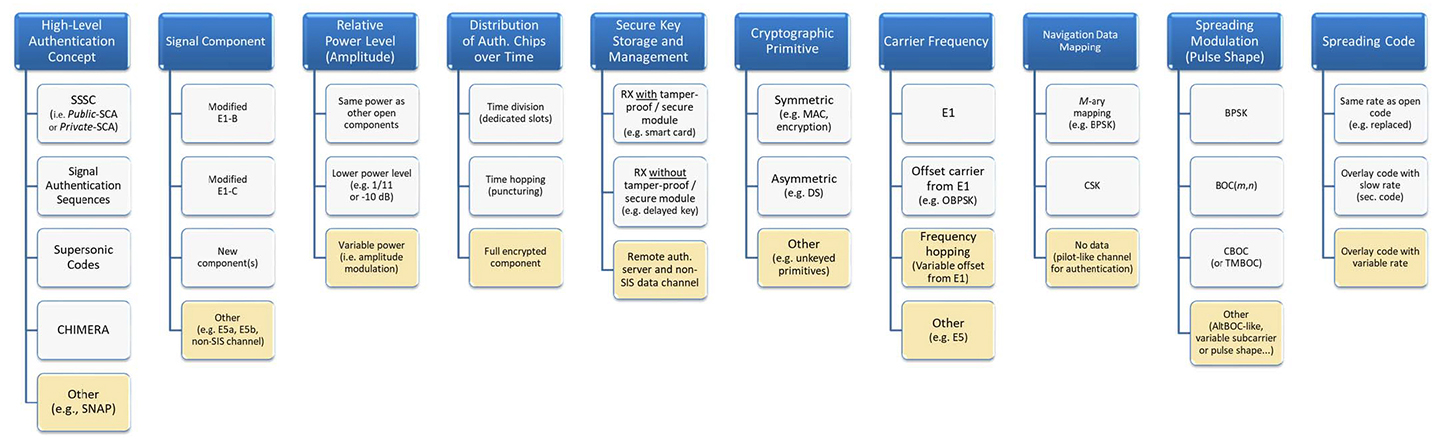
    Overview of the main signal design aspects relevant for authentication at the spreading code level. (Image: Authors)
    Overview of the main signal design aspects relevant for authentication at the spreading code level. (Image: Authors)

    SNAP: An Authentication Concept for the Galileo Open Service

    By Beatrice Motella and Davide Margaria, Istituto Superiore Mario Boella
    and Matteo Paonni/European Commission
    Presented at ION/IEEE/PLANS 2018

    The design of a solution for the authentication of both navigation data bits and spreading code chips — Spreading Code and Navigation data-based Authentication Proposal (SNAP) — and suitable for the evolution of the Galileo E1 Open Service (OS) signal is presented in this paper. Though the technique is innovative and able to achieve predefined authentication performance, it exploits the structure of the legacy Galileo signal and the characteristics of the OS Navigation Message Authentication (NMA) that will be transmitted starting in 2018. A detailed overview of the open choices for the design of signal components dedicated to authentication is provided, together with an analysis of signal parameters definition. A possible implementation option of the SNAP solution is also presented.

    After investigating the performance of the solution under different families of spoofing attacks, a trade-off analysis addressed to the definition of the solution parameters is presented, followed by a possible implementation of the SNAP concept, referred to as working point.

    Available online via www.ion.org/publications/browse.cfm.

  • Research Online: Positioning integrity parameters for vehicle safety

    By Yanming Feng and Charles Wang,
    Queensland University of Technology, Australia,
    and
    Charles Karl, Australia Road Research Board, Australia /
    Presented at ION International Technical Meeting 2018

    Connected vehicle safety and traffic applications depend on communication, position and velocity information to function. However, road users may have different vehicle communicating and positioning capabilities. Further, the performance of communicating and positioning could vary from time to time and location to location.

    The vehicle safety system must be fully aware of the performance of vehicle positioning outputs and warn drivers when the positioning system cannot be used for the intended level of safety applications. Minimum operational performance standards about positioning have not been established in the road community.

    This paper reviews and develops the required navigation performance parameters for vehicle positioning capability in terms of accuracy, integrity, timeliness and interrogability of positioning solutions.

    It attempts to adjust the integrity performance parameters for vehicle safety positioning and provide the analysis for integrity risk, protection level and different alert limits. It introduces the error ellipse representation to visualize the protection bubble area of each vehicle on the road. Experimental results demonstrate how different capability levels meet different integrity alarm limits.

    Available online via www.ion.org/publications/browse.cfm.

  • Research Online: Monitoring of wide-area oscillations in presence of GPS spoofing attacks

    By Yongqiang Wang and Aranya Chakrabortty, Clemson University /
    IEEE Power and Energy Society General Meeting, September 2017

    Phasor Measurement Units (PMU) are playing an increasingly important role in wide-area monitoring and control of power systems. PMUs allow synchronous real-time measurements of voltage, phase angle and frequency from multiple remote locations in the grid, enabled by their ability to align to GPS clocks. Given that this ability is vulnerable to GPS spoofing attacks, which have been confirmed easy to launch, this paper proposes a distributed real-time wide-area oscillation estimation approach that is robust to GPS spoofing on PMUs and their associated Phasor Data Concentrators (PDCs). The approach employs the idea of checking update consistency across distributed nodes and can tolerate up to one third of compromised nodes. Numerical simulations confirmed the effectiveness of the proposed approach.

    The lead author, an assistant professor of electrical and computer engineering at Clemson, leads a team that received $1 million from the National Science Foundation to fortify computers and devices against cyberattacks associated with timekeeping. “We want to provide secure timing solutions by securing the two most commonly used time distribution approaches,GPS receivers and NTP.”

  • Research Online: Urban positioning accuracy enhancement using 3D buildings model

    Research Online: Urban positioning accuracy enhancement using 3D buildings model

    By Nesreen I. Ziedan, Zagazig University, Egypt / Presented at ION GNSS+ 2017, September 2017

    Above: The constructed 3D model for 26 buildings; below: illustration of the direction of recording of surfaces. (Images: Authors)
    Above: The constructed 3D model for 26 buildings; below: illustration of the direction of recording of surfaces. (Images: Authors)

    Multipath is a major source of positioning accuracy degradation in urban areas. Advances in 3D mapping and the availability of 3D city models have encouraged a set of new techniques for multipath mitigation.

    This paper presents three algorithms to enhance the accuracy of urban positioning using all the available line-of-sight, multipath and non-line-of-sight signals:

    • An accelerated ray tracing technique that first eliminates the 3D surfaces that are invisible with respect to a position, and then analyzes the visible surfaces to predict the existence and path lengths of reflected signals. The ray tracing algorithm is applied on the possible range of positions.
    • A Markov Chain Monte Carlo-based algorithm that applies both the Gibbs sampler and the Metropolis-Hastings technique to analyze the received correlated signals to estimate the delays of reflected signals for all the received signals.
    • A Van Rossum-based technique that measures the discrepancy between the estimated delays and the predicted ones at a range of possible positions, where the position that generates the minimum discrepancy is taken as the estimated position. Test results indicate the ability of the algorithms to successfully utilize reflected signals to enhance urban positioning accuracy.
  • Research Online: Tight integration algorithms designed for cars

    Research Online: Tight integration algorithms designed for cars

    Image: Authors
    Image: Authors

    By Gianluca Falco, Gianluca Marucco, Mario Nicola and Marco Pini, Istituto Superiore Mario Boella (ISMB) / Presented at ION ITM, January 2017

    The authors of this paper deal with the development of a Robust Position Unit (RPU) based on the real-time implementation of an advanced positioning algorithm. The RPU uses a tightly coupled technique between a mass-market single-frequency GNSS chipset with a low-cost inertial measurement unit (IMU) based on micro-electro-mechanical systems (MEMS) and an odometer.

    The tight integration algorithm has been obtained through the design of a complex extended Kalman filter (EKF). Its performance has been verified running the designed real-time algorithm in different challenging environments. One is an urban scenario characterized by narrow streets, few satellites in view and tree-lined avenues. A second harsh environment is represented by a mountain area where the vehicle has driven through long tunnels, overpasses and sharp road bends.

    The tests showed how a tight integration algorithm, designed by using raw data from only low-cost sensors, can provide real advantages at a price of careful customizations and adaptations that take into account the particular use and environment.

    In the designed tight algorithm, additional features and constraints were added with respect to a common tight strategy in order to provide a navigation solution targeted for land applications. Results show a significant decrement of the positioning errors compared to those obtained with other commercial devices. In particular, the tightly-coupled algorithm provides better estimates of the vehicle position and attitude in case of an urban scenario. The improvement was measured following a standardized testing method, considering the horizontal position error and the yaw angle, as the main performance metrics.

    Moreover, the advantages of the embedded system based on an ad-hoc tightly-coupled strategy become even more evident in case of a mountain road that is characterized by frequent tunnels and steep slopes. The experimental results demonstrate the possibility to employ tightly-coupled architectures in low-cost mass-market devices. In the future, the improvement of MEMS technology and the evolution of GNSS, with enhanced signal formats, different frequency bands and more satellites in view, are expected to further increase the positioning performance of mass-marked devices, enabling a variety of new services for road users.

  • Research Online: GPS UTC anomaly, spatial reference system access

    Research Online: GPS UTC anomaly, spatial reference system access

    Click to enlarge.
    Click to enlarge.
    Click to enlarge.
    Click to enlarge.

    Impact of January 2016 GPS UTC Anomaly

    By Charles Curry / Presented at ION ITM, January 2017

    On Jan. 26, 2016 alarms occurred on GPS timing receivers around the globe. This article tells the story as experienced by the Chronos support team over a four-day period, dealing with nearly 5,000 alarm events from many different GPS timing receivers worldwide. It examines whether the alarms were service-affecting or if the equipment switched to a resilient fallback status. This event was not without precedent. The last time such an event happened to the GPS transmission was Jan. 1, 2004, and coincidentally SVN23 was also to blame then. A major network event happened to GLONASS on April 1, 2014. These qualify as “Black Swan Events” first proposed by Nassim Nicholas Taleb in his 2001 book, Fooled by Randomness. This was a unique event with unique impact across the globe. Chronos supports many thousands of GPS-based timing receivers for more than 100 clients in more than 50 countries. This article also reviews more recent work to understand what caused the event and how it manifested itself.

    National Spatial Reference System Access in 2022

    By Daniel Roman, NOAA / Presented at ION ITM, Jan 2017

    In 2022, the National Geodetic Survey will implement a new datum to replace both the North American Datum of 1983 (NAD 83) and the North American Vertical Datum of 1988 (NAVD 88). This datum will provide the primary access to the National Spatial Reference System (NSRS) through GNSS and a geopotential model. Foundation CORS sites will provide a backbone network to ensure that the U.S. contributions to the ITRF solutions remain robust. In turn, these sites will also provide the connection to the densified network of CORS stations to provide local access. RTN and RTK surveys will provide an additional layer of access for improved local resolution. Velocities will be taken into account to provide tie back to survey points. Passive control (benchmarks) will become secondary access to the NSRS with conversion models being provided to ensure backward compatibility to NAD 83 and NAVD 88.

  • Research Online: Positioning with LTE signals

    Research Online: Positioning with LTE signals

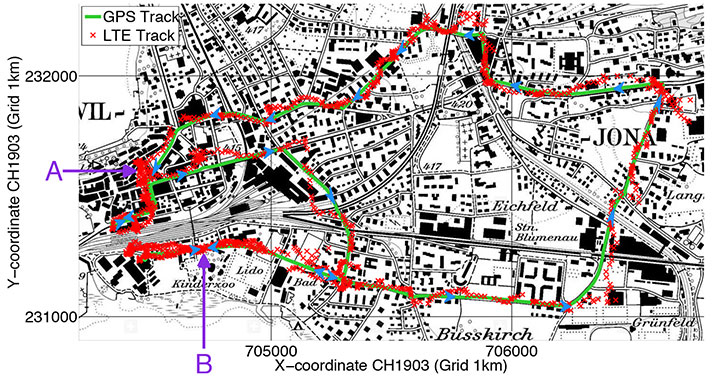
    Rover positions obtained with 2D LTE versus GPS track.
    Rover positions obtained with 2D LTE versus GPS track.

    Positioning with LTE Signals

    An alternative to GNSS in urban canyons can be provided by signals from cellular base stations, particularly new signals from long-term evolution (LTE) networks, since LTE coverage will be high in cities. Wide LTE downlink bandwidth provides good resolution of multipath components, which also assists positioning.

    A test used a universal software radio peripheral N210 synchronized to a GPS-locked Rubidium frequency standard. A personal computer stored LTE data samples together with GNSS sentences from a u-blox LEA-6T module. A Matlab-algorithm did the complete post-processing, extracting pseudoranges for the LTE base station and calculating the position solution.

    Results of a car driven on an urban route show root-mean-square value of the absolute error using LTE compared to GPS position is 43 meters.

    Positioning Using LTE Signals, by Fabian Knutti, Mischa Sabathy, Marco Driusso, Heinz Mathis, and Chris Marshall. Presented at the European Navigation Conference 2015.

    Seamless Indoors

    Sensor Augmented Indoor Navigation and Positioning, by M. Gemelli and Keith Nicholson, Bosch Sensortec. An overview of technologies that guide us indoors in a seamless and reliable manner, highlighting key requirements for motion and pressure sensing, low-power processing, efficient code design, wireless beaconing and map matching. Fusion software needs new data sources: Bluetooth low-energy, Wi-Fi fingerprinting, magnetic fingerprinting, ultrasound. Presented at ION GNSS+ 2015.

    Disturbed Ionosphere

    Mitigating satellite motion in GPS monitoring of traveling ionospheric disturbances (TIDs), by R.W. Penney and N.K. Jackson-Booth. Discusses the impact of satellite motion on the use of compact arrays of GPS receivers for estimating the velocity of travelling ionospheric disturbances (TIDs). It is shown that satellite motion has subtle effects upon standard techniques of waveform cross-correlation, or time-difference of arrival (TDOA), which can easily lead to spurious TID velocity estimates. In Radio Science, an AGU journal.