Tag: satnav

  • UK government issues highest level study of SatNav vulnerabilities

    A U.K. government report issued on Jan. 30 looks at the vulnerability of all satellite-based positioning systems: GPS, Galileo, GLONASS, BeiDou, QZSS and more. Issued by the Office of the Government Chief Scientific Adviser, Sir Mark Walport, and informally called the Blackett Report, designating the highest level of government scientific studies, named after a UK physicist who won the 1948 Nobel Prize, the review aims to “lay out the breadth, scale and implications of our reliance on ‘the invisible utility’ mainly in terms of existing critical national infrastructure (CNI).”

    “Satellite-derived Time and Position: A Study of Critical Dependencies” states in the forward that it “represents a vital step in understanding the UK’s dependency on GNSS and recommends measures to improve our resilience. Importantly, it also recognises that innovation will be key to realising, fully and safely, the economic and societal benefits offered by GNSS.”

    The report points to the fragility of satellite positioning signals which can be affected by cheap jammers, spoofers, weather and interference from other radio signals — among other vulnerabilities. The 86-page PDF document is downloadable here.

    The review incorporates the results of a separate but related study, issued in April 2017, looking at the fiscal consequences of a GNSS disruption in. “Economic Impact to the U.K. of a Disruption in GNSS” was briefly summarized in a June 2017 column from this magazine (scroll down to “At What Cost Ignorance?”). The report attempted to quantify the cost of a GNSS disruption, should one occur. The authors came up a figure of 5.2 billion pounds ($6 billion) for a 5-day disruption.

    David Last, a UK consultant engineer specializing in radio navigation and communications systems, professor emeritus at the University of Bangor, Wales and past president of the Royal Institute of Navigation, consulted on the June 2017 economic impact report, and was a member of the expert panel and co-author of the January 2018 Blackett Report. He was to have given a presentation on them at the ION International Technical Meeting in Reston, Virginia on January, but could not make the trip. The following materials are drawn from his prepared presentation.

    Some of the conclusions from the June 2017 economic impact study are:

    • There are alternatives to GNSS, specific to each application
    • However, there is no universally-applicable single alternative for positioning and navigation
    • Among the most salient needs: higher quality (more expensive) oscillators for timing
    • “The most applicable mitigation strategies for the largest number of applications are eLoran and Satelles.”
    • “Omnisense and Locata may be preferred for localised applications that require high levels of accuracy.”
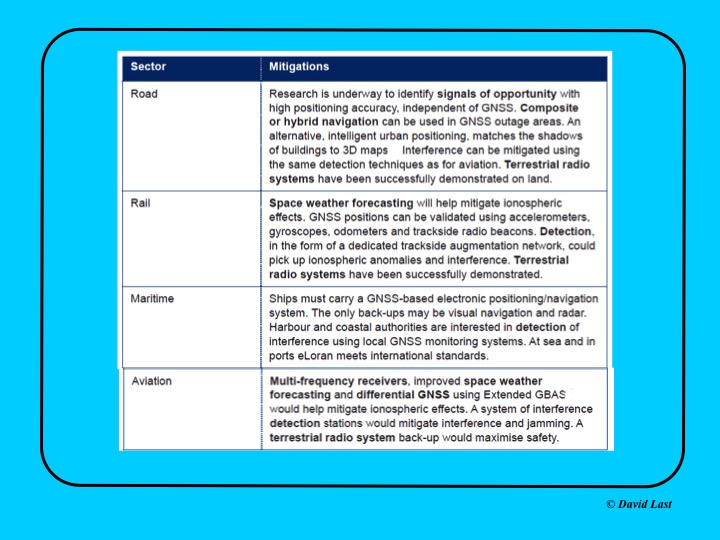
    From the just-issued Blackett Report, the first figure displayed above presents recommended mitigations to impacts on GNSS applications in road, rail, maritime and aviation. Alternative options include composite or hybrid navigation, terrestrial radio systems, space weather forecasting, eLoran, various methods of interference detection, multi-frequency receivers and differential GNSS.
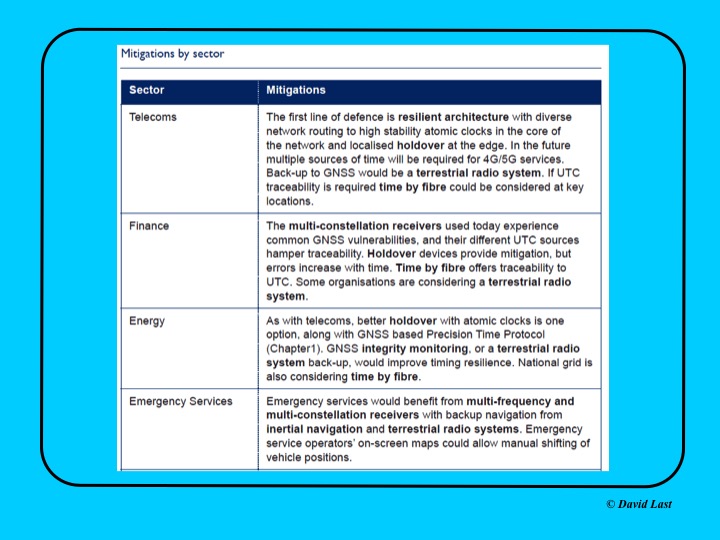
    A second figure from Last’s presentation, shown above, covers the mitigations recommended for telecoms, finance, energy, and emergency services sectors. Mitigations for these applications include a resilient architecture with diverse network routing to high-stability atomic clocks, terrestrial radio systems, time-by-fiberoptics, multiconstellation receivers, holdover devices, GNSS integrity monitoring, and inertial navigation.

    Concluding recommendations of the Blackett Report:

    1. CNI operators to review and report on their reliance on GNSS. Cabinet Office to assess overall dependence of CNI on GNSS.
    2. Add loss or compromise of GNSS-derived PNT to National Risk Assessment, not just as a dimension of space weather.
    3. In allocating radio spectrum to new services and applications, address the risk of interference to GNSS-dependent users, including CNI.
    4. Review the legality of the sale, ownership and use of devices and software to cause deliberate interference to GNSS receivers or signals.
    5. Assess the need to monitor interference of GNSS at key sites such as ports and share the data with government
    6. Employ GNSS-independent back-up systems.
    7. Cross-government PNT Working Group to report to Cabinet Office on ways to improve national resilience.
    8. Government to facilitate as those procuring GNSS equipment for CNI specify performance standards.
    9. Map PNT testing facilities and explore how industry and critical services can better access them.
    10. Leverage UK academic and industrial expertise in time and geo-location, increasing coordination among existing centres of excellence.

  • January issue: All the news that fits…

    We have a finite number of pages to bring you each month, one might say a tightly controlled number. That number has never easily accommodated the quantity of fresh, relevant GNSS and PNT news and technical material that emerges each month. The pace of your developments is too fast with which to keep up!

    2017 GPS World Receiver Survey (PDF).
    2017 GPS World Receiver Survey (PDF).

    This month, a case in point. Most importantly, driving the whole issue is the latest, greatest version of that long-running industry resource and guide, the GNSS Receiver Survey: 24 data-packed pages of it!

    There is a major GNSS milestone to report, one which I have personally awaited since the year 2000 — and I know many others have also. When I signed on at this publication, my first assignment was getting its little sister magazine out the door: the summer 2000 issue of Galileo’s World. For four years we published that optimistic quarterly. There was plenty of content for it, but the constellation itself, and the market to support it, were slower in developing. No longer. With the Declaration of Initial Services, reported in the System of Systems section, Galileo is truly and fully open for business.

    This month, we also report a momentous satnav development that is not GNSS in the traditional sense, but does come from a globally orbiting constellation. Adding signals from ranging satellites in low-Earth orbit to those from GNSS satellites in medium-Earth orbit provides just the kind of augmentation and backup that many applications critically need. The advantages come primarily in the timing realm, but there is potential for significant positioning benefits, especially once you many innovators out there get your hands on it and combine it with inertial. A true PNT powerhouse.

    nytimes-logo-newsI haven’t even gotten to this month’s cover story yet: a technical advance in multipath mitigation that has the potential to amp the power, so to speak, of GNSS receivers in many applications. Correlator beamforming is an intriguing new development. Scientists at the Air Force Institute of Technology put it through its paces, and report good results.

    At the risk of giving short shrift to any of these essential stories, not to mention the multiple new products, partnerships, application advances and technology updates that appear in smaller bites, we have opted not to omit any, but to cram them all into the one knowledge-laden issue.

    We may not be the New York Times, nor can we approach that venerable publication’s mission, reproduced here. But we have our own — All the News That Fits!

    Letter to the Editor

    My November column began with Jimi Hendrix, drifted into GPS jamming, touched on a mock presidential plebiscite conducted during ION GNSS+, and concluded by reverting to Hendrix’s Purple Haze: “The real [election] results may already be known by the time you read this … Is it tomorrow, or just the end of time?”

    Brian in Oklahoma sent me a four-word email in response. “The end of time,” he wrote.

  • SatNav engineering by the book

    Betz-book-coverEngineering Satellite-Based Navigation and Timing: Global Navigation Satellite Systems, Signals, and Receivers

    John W. Betz

    ISBN: 978-1-118-61597-3; 672 pages

    December 2015, Wiley-IEEE Press

    Hardcover print or ebook available


    A new book by a recognized authority in signal design and processing, structured as a textbook for an upper-level undergraduate course or a graduate course in satnav engineering, will also admirably serve anyone seeking to enhance his or her skills in satnav engineering, or as a reference and indicator of future paths for a practicing satnav engineer.

    Author John Betz contributed to the international interoperability and compatibility efforts leading to the design of the GPS L1C civil signal. His binary offset carrier (BOC) technique is used for the GPS M-code signal, and has been adopted by satellite navigation systems developed by Russia, Europe, China, Japan and India.

    He played an active role in the United States/European Union negotiations that established compatibility and interoperability between GPS and Galileo. More recently, he provided critical analysis related to GPS modernization, recommending affordable enhancements to address increasing threats and to shape the architecture of military GPS for decades to come.

    The book comprises four large sections:

    • System and Signal Engineering. Describes principles and practices, including the basic calculations that describe system operation and performance: link budgets, signal-to-noise ratios, and error sources.
    • System Descriptions. All active or nascent global, regional and satellite-based augmentation systems, with detailed yet succinct signal characteristics.
    • Receiver Processing. Essential aspects of receiver design and means of evaluating performance from front end through tracking loops to position calculation.
    • Specialized Topics. Modern and future signal use increasingly involve more advanced techniques and capabilities to attain next level(s) of performance and enable ever-advancing applications. Interference, multipath, augmentations using differential satnav, assisted satnav, integrated receiver processing, and an appendix on theoretical foundations.

    Learn more about the book here.

  • Satnav Augmentation Systems Settle on Common Channels Post-2020

    Satnav Augmentation Systems Settle on Common Channels Post-2020

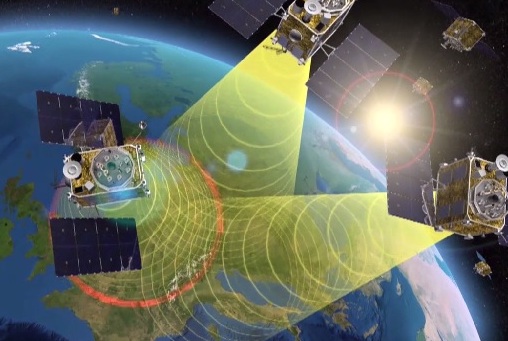
    EGNOS is Europe’s first venture into satellite navigation. EGNOS broadcasts augmented information through a trio of geostationary satellites linked to a network of monitoring ground stations, to sharpen the accuracy and reliability of GPS signals across the continent.
    EGNOS is Europe’s first venture into satellite navigation. EGNOS broadcasts augmented information through a trio of geostationary satellites linked to a network of monitoring ground stations, to sharpen the accuracy and reliability of GPS signals across the continent. (artist’s concept: ESA)

    News from the European Space Agency

    The next decade’s aircraft pilots will be able to rely on enhanced, reliable satellite navigation signals on a seamless basis across much of the world, thanks to decisions made at the latest gathering of worldwide satnav augmentation system providers and experts.

    The U.S. Wide Area Augmentation System (WAAS) and European Geostationary Navigation Overlay Service (EGNOS) are leading examples of satellite-based augmentation systems (SBAS) that apply additional ground stations and satellite transponders to sharpen the accuracy and reliability of existing satnav services across given geographical regions.

    These performance enhancements permit satnav to be employed for safety-of-life services, especially aviation. Such systems are based on the U.S. GPS for now, but plans are being laid to move to a multi-constellation design employing Europe’s Galileo, China’s Beidou and Russia’s GLONASS satnav systems beyond 2020.

    The 28th Satellite-based Augmentation Systems Interoperability Working Group (IWG), planning standardization of SBAS systems to come, was hosted at ESA’s ESTEC technical centre at Noordwijk, the Netherlands, on April 1-3.

    The ESTEC facility in Noordwijk, The Netherlands.
    The ESTEC facility in Noordwijk, The Netherlands. (Photo: ESA)

    All participants unanimously endorsed the “message definition” for a new secondary SBAS channel — to be known as L5, along with the current L1 — for the planned second-generation SBAS systems, which will utilize dual-frequency multi-constellation signals.

    Using dual frequencies greatly increases the accuracy of navigation systems, by allowing interference from the ionosphere — an electrically active outer layer of Earth’s atmosphere — to be largely subtracted from the final result.

    “This definition is presented in what is called the Dual Frequency Multi-Constellation Definition document,” explained Didier Flament, representing ESA. “It represents the outcome of a four-year activity, which started at IWG 19 in Japan, back in 2010, coordinated between all IWG members under the technical leadership of ESA and French space agency CNES on the European side, and the Federal Aviation Authority (FAA) and Stanford University on the U.S. side.

    “The formal IWG review loop for the document took six months to conclude, with this IWG 28 then allowing endorsements to be gathered by SBAS project managers, culminating in formal signatures to the document,” Flament said.

    Planned_SBAS_coverage_for_2020-W
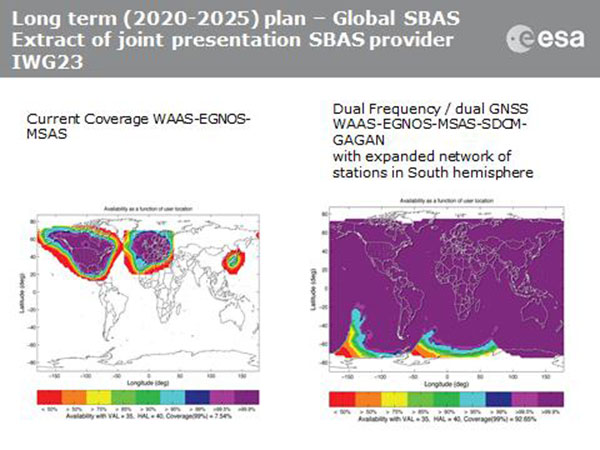
    SBAS coverage for 2020: Comparing current worldwide SBAS coverage — based on WAAS, EGNOS and MSAS — to the situation envisaged for 2020–25: near-global coverage based on WAAS, EGNOS, MAAS, SDCM and GAGAN, with an expanded network of stations in the southern hemisphere, all based on a common dual-frequency/dual satnav standard being finalized by the SBAS Interoperability Working Group. (Image: ESA)

    IWG members now intend to have this document accepted by the official international SBAS standardization bodies: the International Civil Aviation Organisation, the U.S. Radio Technical Commission for Aeronautics (RTCA) and the European Organisation for Civil Aviation Equipment.

    “This next step is very important,” added Didier. “Not only for the coming 2016-22 implementation of the European EGNOS v3 but for implementation of other second generation SBAS in other regions of the world.”

    The meeting also reported on the state of development of the other global SBAS systems. Along with the four operational systems — the U.S. WAAS, European EGNOS, Japan’s Multi-functional Satellite Augmentation System (MSAS) and India’s GPS-aided geo-augmented navigation or GPS and geo-augmented navigation system (GAGAN) — these comprise South Korea’s KASS, China’s Beidou SBAS, Russia’s System for Differential Corrections and Monitoring (SDCM) and the West African Agency for Aerial Navigation Safety in Africa and Madagascar (ASECNA) SBAS.

    The follow-up IWG meeting will take place in October, hosted by the FAA in Washington, D.C., in conjunction with the next RTCA meeting.

  • GNSS Constellations March On

    This week nearly all the global navigation satellite systems will push their spatial presence one or two steps further, or higher, if they perform as scheduled. Rarely if ever has there been such a concentrated period of activity in the catapult category. Are we witnessing the real dawn of the multi-GNSS era? GPS, Galileo, BeiDou, and IRNSS all have positioned loaded rockets on the launching pad, destined to heave satnav payloads aloft. Only GLONASS seems stuck in stasis.

    Leading the pack, as ever, GPS should send forth the ninth GPS Block IIF satellite (GPS IIF-9) on March 25 at 2:36 in the Eastern U.S. afternoon. Perhaps the event has already occurred by the time you read this.

    The seventh and eighth Galileo satellites, Adam and Anastasia, are destined for a double date in space on March 27. After a four-hour flight into orbit 22,300 kilometers high, the duo will spring away from their Fregat fourth stage in opposite directions.

    The launch of the fourth satellite for the Indian Regional Navigation Satellite System, scheduled for March 9 but postponed to replace a faulty onboard telemetry transmitter, will now take place on March 29. IRNSS-1D will pass the halfway point in India’s march to a seven-spacecraft regional constellation.

    HTXK4 Credit: BeiDou
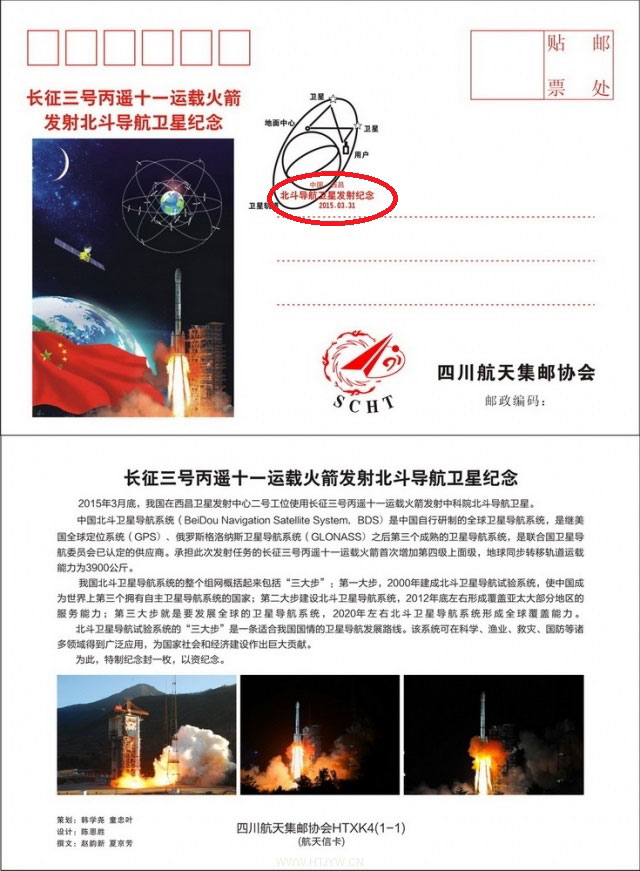
    This philatelic first-day cover to commemorate an upcoming BeiDou launch indicates a specific date of March 31, 2015 (circled in red). Credit: BeiDou

    There are indications that the first satellite in the BeiDou Phase 3 expansion may be launched by the end of March. Apparently, a BeiDou satellite has been shipped to the Xichang launch site, and tracking ships have left port for the open ocean. Also, a postal stamp first-day cover for the launch — a common Chinese practice — has been issued with a March 2015 inscription. The launch will likely be that of a medium Earth orbit satellite.

    A GLONASS-M single-satellite launch from Plesetsk had been expected in the first quarter of this year, but has not materialized. A GLONASS-M triple-satellite launch from Baikonur is expected in the April/May 2015 timeframe. The Russian constellation’s orbit count now stands at 26, fully sufficient for global coverage.

    As the Ides of March in 44 B.C. mark a turning point in Roman history, the transition from Republic to Empire, so might this week mark complete world domination. GPS is now ¾ down the last section of road that leads to the fully modernized Block III generation. Galileo will reach, numerically, 1/3 of the total number of satellites it needs for full operational capability, although there is some doubt about whether all satellites now in orbit can be counted as full integers. BeiDou will mark its 15th operational satellite, out of a planned total of 35, with the new philatelically commemorated rising. And, as mentioned, IRNSS will pass its halfway point this weekend.

    Ironically, just as GNSS begins to show signs of approaching its apogee (similar to the dawning of Empire in the Augustan Era that followed Caesar’s assassination on the Ides of March), the world is starting to turn away from, or turn beyond, GNSS.

    GNSS will remain at the core of our navigation and positioning technologies — as Roman values remain at the core of Western civilization. But we need to go now to multi-sensor approaches for several reasons:

    • some requisite positioning data, such as precise attitude, is not optimally derived solely from GNSS measurements;
    • despite their increasing numbers, GNSS satellites will never be ubiquitous enough to be visible in sufficient numbers everywhere;
    • threats such as jamming and interference will likely surmount all efforts at single-solution resilience to overcome GNSS vulnerability.

    ‘Twas ever thus. With rise come decline, with ripeness, decay. Sic transit Gloria.