Tag: SDK

  • Iridium hybrid IoT module now commercially available

    Iridium hybrid IoT module now commercially available

    The Iridium 9604 module and development kit streamline global IoT development with integrated satellite, cellular and GNSS connectivity

    Iridium Communications has announced commercial availability of the Iridium 9604 module and Development Kit, giving developers, OEMs and solution providers a faster path to build and scale connected IoT solutions worldwide.

    Combining GNSS positioning, Iridium short burst data satellite connectivity, and LTE-M cellular, the Iridium 9604 module delivers a compact, integrated solution for global IoT deployments.
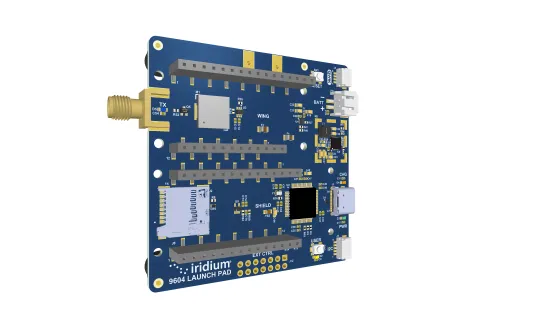
    The Iridium 9604 Development Kin, back side. (Credit: Iridium)
    The Iridium 9604 Development Kit, back side. (Credit: Iridium)

    Alongside the Iridium 9604 Development Kit, developers can rapidly prototype, test and validate hybrid satellite, cellular, and GNSS applications with resources that simplify integration and streamline deployment workflows.

    Built on the u-blox SARA-R5 platform, the Iridium 9604 is designed to reduce hardware complexity, lower integration costs, and accelerate time to market for connected solutions operating across industrial, infrastructure, transportation, mobility, utilities, maritime and remote-monitoring applications. The integrated design helps reduce board space requirements by 60 percent or more while simplifying RF routing, power architecture, and firmware development, Iridium said.

    Early developers and beta participants reported significant operational and economic benefits from the platform’s integrated architecture.

    “The Iridium 9604 has enabled us to develop a truly global asset tracking solution without relying on terrestrial network infrastructure. Its reliable coverage, compact form factor, and straightforward integration have significantly accelerated our development process and allowed us to focus on optimizing the end-user experience,” said Askar Gabit, CEO, GPSOne. “For applications in remote and challenging environments, the Iridium network provides the confidence that critical data can be delivered when it matters most.”

    The Iridium 9604 gives developers independent control over satellite, LTE-M and GNSS subsystems, enabling flexible implementation of failover logic, location-aware connectivity decisions, and application-specific routing strategies. A unified AT command set and comprehensive SDK resources further simplify development and integration.

    Built for scalable and power-sensitive IoT applications, the Iridium 9604 features a compact 16 x 26 x 2.4 mm form factor optimized for deployments where size, resiliency and efficiency are critical. The platform supports GPS, GLONASS, Galileo and BeiDou GNSS services alongside LTE-M (Cat-M1) and Iridium’s 100% global L-band satellite network.

    The Iridium 9604 represents the next evolution of Iridium’s broader IoT strategy, expanding beyond traditional satellite-only hardware to support unified, multi-mode connectivity architectures. The Iridium network now supports multiple IoT pathways, including dedicated Iridium SBD modules, Iridium NTN Direct standards-based direct-to-device capabilities, and larger payload connectivity through the Iridium Certus 9704 module.

    Operating on a global mobile satellite network, the Iridium 9604 delivers reliable connectivity across remote land areas, oceans, airways and polar regions where other networks are unavailable or unreliable.

  • Trimble introduces high-accuracy mapping solution for GIS field applications

    Trimble introduces high-accuracy mapping solution for GIS field applications

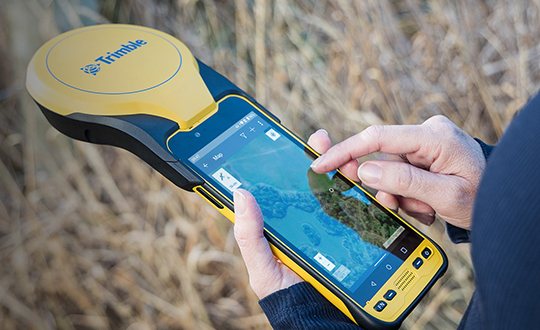
    Trimble has announced a new high-performance data collector for its Mapping and Geographic Information Systems (GIS) portfolio — the Trimble TDC650 handheld. Built for GIS data collection, inspection and asset management activities, the TDC650 provides users a rugged solution with scalable high-accuracy GNSS positioning for professional field workflows.

    The TDC650 is fully integrated with today’s demanding GIS data environment, powered by the Trimble Software Development Kit (SDK) that enables precision GNSS positioning for apps such as Esri ArcGIS Field Maps and Trimble TerraFlex software. The TDC650 is also a scalable solution that allows customers to choose their desired accuracy down to the centimeter-level to meet needs and budget requirements.

    “This is an ideal tool for customers tasked with modernizing critical utilities including electric, gas and telecommunications networks,” said Gareth Gibson, marketing director, Trimble Mapping and GIS. “The precision, quality and data integration workflows needed to map the physical world to a digital one in these projects requires a modern data-collection platform like the TDC650.”

    City, state and local governments and utilities will benefit from this solution, which is part of the larger Trimble Public Sector ecosystem that includes Cityworks software for stormwater inspections and Trimble Unity for monitoring municipal water pressure and hazards. As GIS data continues to grow more complex, Trimble helps simplify, visualize and make sense of the data so customers can make better decisions in managing their communities’ assets.

    Photo: Trimble
    Photo: Trimble

  • Parrot’s new ANAFI Ai UAV drone is 4G connected

    Parrot’s new ANAFI Ai UAV drone is 4G connected

    Photo: Parrot
    Photo: Parrot

    Drone-maker Parrot has released a new drone for professionals. The ANAFI Ai UAV uses 4G as its main data link between the drone and the operator, so that users will no longer experience transmission limitations.

    The 4G also enables precise control at any distance. For beyond-visual-line-of-sight (BVLOS) flights, it stays connected even behind obstacles.

    For the first time, ANAFI Ai embeds a secure element in the drone and in its Skycontroller 4. The 4G link between the drone and the user’s phone is encrypted. The secure element protects both the integrity of the software and the privacy of data transferred.

    Parrot’s piloting application is open source. Parrot offers developers a software development kit (SDK) to create custom code for the drone to execute during flight. The SDK gives access to all flight sensors, including obstacle-avoidance sensors, occupancy grid and internet access.

    ANAFI Ai’s obstacle-avoidance system detects obstacles in all directions, using stereo cameras to sense objects and automatically avoid them.

    ANAFI Ai incorporates a 48MP main camera and a powerfully stabilized 4K 60-fps/HDR 10 camera to capture finely detailed aerial images and smooth video footage.

    ANAFI Ai will be available in the second half of 2021 through Parrot Drone Enterprise Partners and Enterprise Drone Reseller Network.

  • Cohda Wireless launches advanced C-V2X software development kit

    Cohda Wireless launches advanced C-V2X software development kit

    Cohda Wireless has released an updated version of its C-V2X software development kit (SDK). According to the company, the SDK now features an extensive range of useful applications and tools, as well as a virtual simulation tool. The virtual simulation tool allows users to test their applications before real-life deployment, through high-quality, simulated drives that provide full playback capabilities for actual drive tests.

    The Cohda C-V2X SDK is a self-contained virtual machine that allows anyone with previous embedded Linux experience to quickly compile and run C-V2X applications in conjunction with C-V2X development platforms, such as those featuring the Qualcomm 9150 C-V2X chipset solution, the company said.

    The SDK includes source code for red light warning and road side alert to demonstrate the various APIs and enable quick application development. It also features binaries for forward collision warning, emergency electronic brake light, curve speed warning, RoadWorks warning, blind spot warning, hazard location warning for China, abnormal vehicle warning for China, speed limit warning for China, red light violation warning for China and green light optimal speed advisor for China. It includes tester control interfaces for performing conformance tests, as well.

    “The functional benefits of this SDK, especially the vsim component, have significant tangible value in the C-V2X ecosystem,” said Fabien Cure, chief engineer at Cohda Wireless.

    As they are radio agnostic, Cohda’s V2X solutions support C-V2X and dedicated short-range communication.


    Feature image: Cohda Wireless

  • TomTom expands mapping deal with Verizon, providing APIs and SDKs

    TomTom expands mapping deal with Verizon, providing APIs and SDKs

    Photo: TomTom
    Photo: TomTom

    Verizon will integrate TomTom’s Maps application programming interfaces (API) and software development kits (SDK) into its location-services offering, making it easier for the developer community to build upon and integrate the platform. The developers’ portal is available at developer.tomtom.com. More information from

    The agreement is an expansion of the existing TomTom and Verizon agreement, where TomTom provides location-based services to enhance Verizon’s current suite of location-based data, navigation, and intelligence.

    “We look forward to continuing to build upon and evolve our product suite with TomTom’s technology,” said Jeff Frantz, executive director, Verizon Location Services. “By expanding our agreement, we are furthering our commitment to providing best-in-breed location technology for Verizon and our customers.”

    “We’re determined to make it as easy as possible for developers to have access to our Maps APIs and SDKs so we’re delighted that Verizon is offering TomTom products to their location-services customers,” said Anders Truelsen, managing director, TomTom Enterprise.

    5G and HD Maps. In the last quarter of 2019, the companies also announced an innovation project using Verizon 5G Ultra Wideband and TomTom HD Maps to help make intersections safer for emergency vehicles.

  • New version of Global Mapper SDK supports S-52 marine chart symbology

    Photo: Blue Marble Geographics
    Photo: Blue Marble Geographics

    Blue Marble Geographics has released a new version of the Global Mapper software development kit (SDK), providing software engineers with the means to embed the latest geospatial technology into their custom applications.

    Version 20.1 incorporates many of the functional upgrades introduced in the recent release of the desktop version of the software.

    Blue Marble’s GIS software has been used by GIS professionals for 25 years. Users come from all industries including software, oil and gas, mining, civil engineering, surveying and technology companies, as well as government departments and academic institutions.

    Global Mapper’s GIS application is capable of displaying, converting and analyzing virtually any type of geospatial data. The Global Mapper SDK and accompanying Lidar Module SDK provide software developers with a toolkit for accessing much of this functionality from within an existing or custom-built application.

    The SDK also enables the creation of custom toolbars and extensions to enhance the data processing and analysis functionality of the standard version of Global Mapper. This capability allows in-house developers to create a unique version of the application to meet their specific needs or for software companies to build custom products for commercial distribution.

    Highlights of the latest version of the SDK include:

    • A new function to allow querying of elevation from a specific list of elevation layers
    • Significant speed improvements when working with vector data with attributes
    • Faster viewshed calculation on computers with multiple cores
    • Support for downloading vector features from Esri RESTful data sources
    • S-52 point symbols for S-57 and S-63 marine chart files
    • Updated SHIFT_LAYER script command to support shifting in the Z (elevation) direction.
    • Support for several new formats including, OpenFlight and HEC-RAS raster and vector files

    The supplementary Lidar Module SDK now offers:

    • The ability to select points based on their proximity to other lidar points and/or line features
    • A new option to update the return number/count when deleting multi-return points

    “Global Mapper’s reputation as a powerful geospatial data processing and analysis application is well known throughout the world and software engineers are increasingly integrating these tools into a wide variety of development projects,” said Patrick Cunningham, Blue Marble president. “The Global Mapper SDK is unrivaled in its ease of deployment, data format support, affordability, and in its adaptability, allowing it to meet the ever-changing needs of today’s geospatial software development sector.”

  • Peering behind the mapping curtain

    Peering behind the mapping curtain

    Photo: Mapbox
    Photo: Mapbox

    Location intelligence powers applications with data and “live maps” updated continuously.

    According to Forbes, 70 percent of telecommunications companies consider location intelligence critical to their success. The intelligence data is provided by specialists such as Google, Esri, Here and PlaceIQ.

    In January, Sprint and location intelligence startup Mapbox launched precision mapping technology with the Curiosity IoT network. The 5G network’s extreme bandwidth and low latency will allow Mapbox to collect higher volumes of richer data to create “live maps.” A live map is built not from traditional data surveys months or years before, but from data collected from hundreds of millions of location-enabled sensors that feed back information about the world in real time, including high-resolution video.

    Mapbox uses artificial intelligence (AI) to turn the massive data flows into a picture of real time transit paths that can be used for precise, up-to-date routing.

    Augmented Reality view from the Mapbox Vision SDK. (Image: Mapbox)
    Augmented Reality view from the Mapbox Vision SDK. (Image: Mapbox)

    According to Mapbox CEO Eric Gundersen, maps that constantly update are essential to the internet of things (IoT). “As maps guide new smart machines on IoT networks, you remove the human in the middle that used to compensate for differences between the map and the real world,” he said. “Precision mapping services need to reflect the world as it is, at that precise moment so that those smart machines can travel safely and efficiently.“

    According to Mapbox, smart machines such as drones and autonomous delivery carts will be able to make fast location and routing decisions using its detailed, updated maps.

    Other companies that use Mapbox’s location services include IBM, Lonely Planet, Square, Tableau and The Weather Channel.

  • Global Mapper SDK updated for greater geospatial intelligence

    Version 20 of the Global Mapper Software Development Kit (SDK) is now available, along with the accompanying Lidar Module SDK. Mirroring the most important capabilities of the desktop version of the software, the powerful developer’s toolkit provides software engineers with the means to embed the latest geospatial technology into their custom applications, according to software maker Blue Marble Geographics.

    An elevation contour image in Global Mapper SDK. (Screenshot: Blue Marble)
    An elevation contour image in Global Mapper SDK. (Screenshot: Blue Marble)

    Among the highlights of the version 20 release are dramatically improved vector data performance in both the 2D and 3D environments, updated 3D mesh rendering with colors now displayed in the 2D view, and faster display and export of online tiled datasets, the company said.

    For more than 25 years, Blue Marble’s affordable, user-friendly GIS software has been meeting the needs of users in industries including software, oil and gas, mining, civil engineering, surveying and technology companies, as well as government departments and academic institutions.

    The Global Mapper GIS application can display, convert and analyze virtually any type of geospatial data. The Global Mapper SDK and Lidar Module SDK provide software developers with a toolkit for accessing much of this functionality from within an existing or custom-built application.

    The SDK also enables the creation of custom toolbars and extensions to enhance the data processing and analysis functionality of the standard version of Global Mapper. This capability allows in-house developers to create a unique version of the application to meet their specific needs or for software companies to build custom products for commercial distribution.

    The functional highlights of the latest version of the SDK effectively illustrate the continued evolution of 3D GIS technology and Blue Marble’s commitment to providing a superior data processing engine for managing, visualizing and analyzing increasingly large 3D datasets. Such is the case with the improvements that have been made to the display performance of vector files with faster rendering in both 2D and 3D Views.

    The display of 3D meshes or models, such as those created in Global Mapper’s Pixels-to-Points tool, has been improved with the photo-realistic colors now displayed in the top-down view. Online data processing has also seen improvements with significant speed increases when loading and exporting tiled data sources.

    Additional upgrades to the SDK functionality include improved box resampling of color images, especially those with palettes; several new supported formats, including Cyclone PTX and Autodesk Recap (RCP and RCS) point clouds; new projections and datums, including GDA2020 (Australia) and TUREF (Turkey); and support for Intermap’s online NextMap worldwide elevation dataset.

    For users of the Global Mapper Lidar Module, the version 20 SDK release also introduces a wealth of new and updated functionality. Point clouds can now be thinned, from both a 2D and 3D perspective, reducing file size and improving efficiency; a gridded layer can now be created from the classification values associated with lidar points; and a new scripting option has been added to apply colors to a point cloud from underlying imagery.

    “The Global Mapper SDK has become one of the most important components of Blue Marble’s suite of geospatial products,” stated Patrick Cunningham, Blue Marble President. “Motivated by the rapid emergence of the desktop software as a major player in the GIS industry, developers are increasingly turning to the corresponding SDK to leverage the software’s powerful geoprocessing tools in a wide variety of third party applications. The improved data handling capability of the version 20 release demonstrates our commitment to providing tools that work efficiently with even the largest datasets.”

  • Trimble Catalyst brings high-accuracy positioning to Android devices

    The Trimble Catalyst software-defined GNSS receiver for Android devices is now available through Trimble’s global distribution network.

    Trimble Catalyst DA1 antenna attaches to a smartphone running a Catalyst-enabled app.

    Through Catalyst and a special antenna, customers can access positioning-as-a-service to collect geolocation data with Trimble or third-party apps on smartphones, tablets and mobile handhelds.

    When combined with a plug-and-play digital antenna and subscription to the Catalyst service, the receiver provides on-demand GNSS positioning capabilities to turn consumer Android devices into centimeter-accurate data-collection systems.

    Catalyst requires only a few components:

    • Any location-enabled mobile app.
    • A Catalyst subscription, with accuracy options ranging from one meter to centimeter level.
    • Trimble’s small, lightweight DA1 antenna that plugs directly into Android smartphones and tablets.

    “Our goal has always been to extend the accessibility of high-accuracy positioning to a broader base of geospatial and non-geospatial professionals,” said Ron Bisio, vice president of Trimble Geospatial. “Trimble Catalyst represents a new era of GNSS technology by making high-precision positioning a reality for new user segments around the world. With economical on-demand service, it puts high-accuracy in the palm of anyone’s hand — it’s revolutionary.”

    Both Trimble and third-party development teams have produced a range of Catalyst-enabled applications for geographic information system (GIS) data acquisition, cadastral land management, topographic mapping and ground control for unmanned aircraft systems (UAVs).

    Also, the Trimble Catalyst solution includes a software development kit (SDK) for building mobile applications with integrated professional workflows.

    “Trimble is enabling us to deliver better solutions for our customers thanks to the level of integration that the SDK provides,” said Paul Brodin of Korec Group. “It allows us to provide sophisticated solutions that are innovative, easy to use and remove the technical complexity associated with high-accuracy workflows.”

    Trimble Catalyst service subscriptions and the Catalyst DA1 antenna are now available through Trimble’s Authorized GIS Distribution Network. Catalyst availability, pricing, subscription and accuracy may vary by region. Catalyst-enabled apps for Android can be found in the Google Play Store.


  • Boundless Suite 4.10 streamlines mapping with open GIS

    Boundless has released Boundless Suite 4.10, designed to streamline the creation of maps and applications using open GIS.

    The company also released a new Boundless software development kit (SDK) and contributions to the community release of GeoServer 2.11.

    The company also entered a strategic partnership with geospatial intelligence firm Spatial Networks Inc. to bring software and data solutions to government and defense customers worldwide. SNI and Boundless are delivering the capability to quickly support users locked into proprietary software architectures with limited abilities to connect to third-party data sources.

    The SNI and Boundless teams will be at the GEOINT Symposium (Booths 731 and 961) June 3-6 to highlight this partnership.

    Boundless Suite 4.10 includes enhancements designed to make working with open GIS easier. Users now have all the necessary installation files, tools, extensions and premium support options needed to ensure a successful deployment of open GIS.

    Unlike proprietary solutions, Boundless Suite 4.10 offers flexibility and scalability, without complicated and costly licensing models, enabling organizations to scale up or out freely without being penalized.

    Features of the new release

    • Support on the CentOS 7 operating system, giving users outside of the Windows ecosystem access to the most comprehensive open GIS solution.
    • Leverage modern symbology styles with Mapbox Styles, a modern way to style data that is designed to work across the entire Boundless product platform. This update lets users style applications quickly and consistently across desktop, web and mobile.
    • Designed to work in modern IT architectures, including virtual machines, elastic DevOps architectures and the cloud, allowing customers to maximize their GIS investment and lower total ownership costs.

    “Boundless Suite 4.10 represents our continued commitment to releasing quality geospatial software on a regular basis,” said Anthony Calamito, VP of product at Boundless. “The new capabilities in Suite 4.10 make publishing spatial data easier, make it accessible on more operating systems and enable the simplified styling of data across the Boundless ecosystem.”

    Boundless SDK. Boundless’ new SDK ships with Boundless Suite 4.10. It enables users to easily create web mapping applications that leverage the OpenLayers 3 library, using the React framework.

    The SDK additionally powers the web application builder in Boundless Desktop, which allows users to quickly create quality applications without writing any code.

    GeoServer 2.11. Boundless Suite 4.10 ships with GeoServer 2.11, which has been updated to include improved loading and OGC request times for large installations, making it possible to manage tens of thousands of layers in GeoServer with minimum load times.

    GeoServer 2.11 comes with increased EPSG support and improved identification and handling of obscure .prj files and directories of shapefiles. These new updates greatly decrease the load time for shapefiles, and allow GeoServer to better support data from ArcGIS.

    The Boundless open GIS platform includes Connect, Desktop, Exchange and Suite.

  • LizardTech releases MrSID gen 4 decode SDK version 9.5.4

    Developers can add support for MG4 files created with LizardTech’s GeoExpress Version 9.5.3

    LizardTech, a division of Celartem Inc. and a provider of software solutions for image asset handling, has released MrSID Generation 4 Decode SDK Version 9.5.4 to compliment the release of LizardTech’s GeoExpress Version 9.5.3.

    This latest SDK release includes support to view MrSID compressed Harris Geiger-Mode LIDAR point clouds, paralleling previously incorporated tools for viewing MrSID compressed LAS and LAZ point clouds.

    LizardTech continues to enhance lidar and raster compression capacity across its image asset handling platform for image compression, management, distribution, integration and deployment. This includes updating compilers, refreshing target computing platforms and improving compression performance.

    Trusted as a raster format by geospatial professionals since 1992 and supported in a broad spectrum of GIS and CAD applications, MrSID is the highest quality file format with the most advanced compression technology available. A no cost download of the MrSID Generation 4 Decode SDK is available at http://developer.lizardtech.com, and enables application developers to add support for viewing and decoding multiple image files and most recently Geiger-mode, LAS and LAZ point clouds compressed into MrSID.

  • CartoDB acquires Nutiteq to bring location intelligence to mobile devices

    CartoDB is acquiring Nutiteq, a mobile mapping software development company with more than 15 million unique installations of its software development kit (SDK).

    CartoDB is a location intelligence, data analysis and visualization company. Nutiteq’s clients include SeatGeek, LonelyPlanet, iRobot and Accenture, among others.

    The acquisition will allow CartoDB to offer a cross-platform mobile mapping SDK, with a core rendering engine that complements its geo-analytics capabilities. The offline mapping and routing capabilities, along with an ability to work with a number of different sources of data, will enable enterprise customers to implement core location intelligence apps from a one-stop solution.

    “We believe there is a big opportunity to rethink how we interact with location data on mobile devices. Most geospatial innovation has been pushed to the consumer space. Now enterprises will be able to make use of location intelligence on mobile devices with CartoDB,” said Javier de la Torre, CEO of CartoDB.

    Nutiteq’s current SDK offering, including on-device analytics and vector rendering, will be augmented with CartoDB’s cloud location analytics and self-service products. This will provide a complete solution for companies building external facing apps or productivity tools on mobile.

    “We’re thrilled for the potential to unlock massive value for location intelligence in virtually every industry,” said Jaak Laineste, CEO of Nutiteq. “It’s no surprise that people are moving from laptops to smartphones, and it’s safe to say that enterprises will be quick to follow.”

    Laineste will lead the mobile division for CartoDB. The entire Nutiteq team will join CartoDB, with an office opening in Estonia, where Nutiteq is currently headquartered.