Tag: shipping

  • Automated shipping moves containers with Locata

    Automated shipping moves containers with Locata

    At ION GNSS+ in September, I met with Nunzio Gambale and Paul Benshoeff of Locata. They were excited to share their news about the timing tests conducted at White Sands Missile Range by the U.S. Air Force’s 746th Test Squadron.

    In the January issue, we share the results of the tests. The two also showed me and Matteo Luccio, our contributing editor, a YouTube video highlighting another Locata project: guiding 100-ton robots around the Ports of Auckland, New Zealand.

    The robots are straddle carriers, giant mechanisms that are usually driven by a human. The carriers move and sort the shipping containers as they arrive from ships and leave via truck or train.

    In the new setup, Locata has made possible the elimination of the human element with nanosecond-precision tracking.

    Tom Scott, a former Sky One television host and now host of a series of YouTube shows, highlighted the robotic system in April 2019 on his “Amazing Places” channel.

    Screenshot: Tom Scott video
    Screenshot: Tom Scott video

    Compared to manned straddle carriers, the automated straddle carriers (A-STRADs) are able to stack the containers closer, higher and work more steadily, increasing the capacity of the limited land space at the port. The A-STRADs can stack containers with the accuracy of a few centimeters.

    The automated system also allows stack shuffling, so that wear and tear on the asphalt is spread more evenly and requires fewer repairs.

    The Locata local positioning system uses synchronized transmitters installed around the port, with two antennas on each straddle carrier using the lightspeed delay from each transmitter to find exact position. “They don’t just look at the timing signal itself, they track the phase of each transmitter’s carrier signal,” Scott explained.

  • Research Roundup: Focus on maritime

    Research Roundup: Focus on maritime

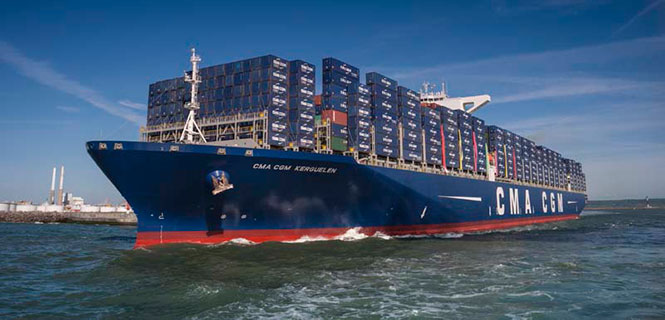
    The 18,000-container-capacity CMA CGM Kuergelen. (Photo: CMA CGM)
    The 18,000-container-capacity CMA CGM Kuergelen. (Photo: CMA CGM)

    Of the 273 papers researchers presented this year at the Institute of Navigation’s annual ION GNSS+ conference, which took place in Miami on Sept. 16–20, the following five focused on maritime issues. Papers are available at www.ion.org/publications/browse.cfm.

    Automating the Sharing of Ocean Weather Data

    The Automatic Identification System (AIS) — mandatory for large ships and used by many mid-sized ones — was designed to help avoid collisions, enable shore authorities to provide vessel traffic services, and allow coastal states to monitor their waters. It also may be used to transmit other information between AIS stations onboard and ashore.

    In the aftermath of the sinking of the container ship El Faro in 2015, the U.S. National Transportation Safety Board (NTSB) and U.S. Coast Guard found a contributing factor was lack of reliable weather forecasts. The NTSB then recommended to the National Oceanic and Atmospheric Administration (NOAA) that it determine whether AIS could be used to share weather data collected by ships, to supplement the Voluntary Observing Ship (VOS) program where ships voluntarily submit weather observations to NOAA. The paper describes a successful test of this concept.

    Citation. Gregory Johnson, Ken Dykstra, Gaurav Dhungana and Brian Tetreault, “Sharing Ships’ Weather Data via AIS.”

    EGNOS for Maritime Navigation

    The European Geostationary Navigation Overlay System (EGNOS), which has been providing guidance to civil aviation since 2011, also can support maritime, railway and road applications. This paper assesses its use for maritime navigation compliant with International Maritime Organization (IMO) requirements for harbor entrances, harbor approaches and coastal waters: 99.8% of signal availability, 99.8% of service availability, 99.97% of service continuity, and 10 meters of horizontal accuracy. A kinematic test campaign was conducted in the waters of the Canary Islands using a geodetic multi-frequency, multi-constellation receiver-antenna pair installed aboard two vessels. The EGNOS Maritime Service met all IMO requirements by achieving a signal availability of 99.999%, a service availability in 99.9% of a predefined rectangular region, and 1.06 meters of horizontal accuracy at the 95th percentile. The service continuity requirement, however, was met in only 62.50% of the predefined region. Therefore, the paper concludes that the continuity risk is the most limiting factor for expanding the EGNOS Maritime Service along the coastal waters of the Canary Islands.

    Citation. Deimos Ibáñez Segura, Adria Rovira Garcia, Jaume Sanz, José Miguel Juan, Guillermo González Casado, María Teresa Alonso, José A. López Salcedo, Huamin Jia, Francisco Javier Pancorbo Garcia, Carlos Garcia Daroca, Irene Martin Calle, Santos Rodrigo Abadía Heredia and Manuel López Martínez, “A Kinematic Campaign to Evaluate EGNOS 1046 Maritime Service.”

    Options for Integrity

    Many maritime authorities are considering how to maintain the integrity of navigation systems as their infrastructure ages, especially given that the need for integrity in the user position is expected to increase with e-navigation services and for autonomous vessels. In harbor entrances, harbor approaches and coastal waters, the International Association of Marine Aids to Navigation and Lighthouse Authorities (IALA) prescribes an absolute horizontal accuracy of ≤10 meters 95% of the time, with an integrity risk of 99.99999%. Today’s GNSS more than meets that accuracy requirement, so the driver is integrity. Options for integrity are marine radiobeacon DGPS/DGNSS, the primary augmentation system in use today; receiver autonomous integrity monitoring (RAIM); satellite-based augmentation systems (SBAS); and others (such as commercial services or inertial.). The European MarRINav project is investigating resilient PNT options to support UK Critical National Infrastructure. Part of this work is comparing EGNOS and marine radiobeacon DGPS performance to inform international discussions and receiver standardization.

    Citation. Alan Grant, George Shaw and Martin Bransby, “Considering SBAS and marine radiobeacon corrections to support safe maritime operations.”

    Evaluation of WAAS for Use in Canadian Waters

    Mariners navigating in Canadian waters use a ground-based augmentation system (GBAS) that provides differential corrections and integrity monitoring of GPS. This GBAS has been provided since 1994 by the Canadian Coast Guard (CCG) in the form of a differential GPS (DGPS) broadcast service. The service is only provided south of latitude 60°N in collaboration with the U.S. Coast Guard. Before embarking on a recapitalization program of its 24-year-old DGPS, and given that the U.S. Coast Guard is progressively shutting down its National Differential GPS sites, the CCG is evaluating options for its own DGPS network. Options include the wide-area augmentation system (WAAS), originally developed by the U.S. Federal Aviation Administration for civil aviation. This paper describes the authors’ evaluation for the CCG to determine the expected accuracy, integrity and availability of WAAS throughout Canadian waters, concluding that the current WAAS provides acceptable accuracy and integrity for most of Canada, excluding the higher latitudes.

    Citation. Gregory Johnson, Gaurav Dhungana and Jean Delisle, “An Evaluation of WAAS 2020+ to Meet Maritime Navigation Requirements in Canadian Waters.”

    GNSS + INS for Attitude Determination

    Attitude determination (AD) is an important navigation component for ships and spacecraft. GNSS enables resolving their orientation in a precise and absolute manner, by employing multiple antennas rigidly mounted on the vessel. This requires carrier-phase observations, with the consequent added complexity of resolving integer ambiguities. Inertial aiding has been extensively exploited for AD, because it enables tracking fast rotation variations and bridging short periods of GNSS outage. In this paper, the fusion of inertial and GNSS information is exploited within the recursive Bayesian estimation framework, applying an Error State Kalman Filter, which, unlike common Kalman filters, tracks the error or variations in the state estimate, posing meaningful advantages for AD. The results show that the inertial aiding, along with a constrained attitude model for the float estimation, significantly improve the performance of attitude determination compared to classical unaided baseline tracking.

    Citation. Daniel Medina, Vincenzo Centrone, Ralf Ziebold, and Jesús García, “Attitude Determination via GNSS Carrier Phase and Inertial Aiding.”

  • C-V2X module powers smart truck project at Shanghai Port

    Quectel Wireless Solutions has partnered with SAIC Motor, Shanghai International Port and China Mobile to install its C-V2X modules on trucks to conduct smart truck trials for the shipping industry.

    Developed by SAIC Motor, the heavy smart trucks are powered by advanced technologies, including 5G, V2X and AI, to achieve 5G L4-level intelligent driving at the port. Each truck has been equipped with “senses” to detect the external environment and cope with unexpected situations such as crosswinds, obstacles in the road or pedestrian traffic. After arriving at the destination, the vehicles can also dock in target locations.

    Photo: Quectel
    Photo: Quectel

    Quectel C-V2X modules AG15 were integrated in the trucks to help identify and communicate with roadside units such as gates and traffic lights, greatly improving driving safety and efficiency.

    According to McKinsey and Company, the automation of ports has proved safer, more cost-effective and efficient than conventional ones. However, the adoption of automation remains slow compared to other sectors. One reason is the high upfront costs associated with automation and difficulties in ensuring effective operations.

    The introduction of 5G provides port owners with an unprecedented opportunity to embrace automation to reduce costs by 25-55% and raise productivity by up to 10-35%, according to the same report.

    Modules, such as the Quectel C-V2X portfolio, offer even more significant cost-effectiveness and flexibility than conventional forms of investment in automation as they can be custom-installed to meet automakers’ or port authorities’ requirements.

    Additionally, Quectel’s AG520R module integrating LTE+C-V2X technologies has supported over 30 automotive customers in product design. The 5G+C-V2X module AG550Q is currently under development and compatible with AG520R in both HW/SW, ensuring a smoother migration from LTE to 5G, which means that the future of automation is now just a module away.

  • Iran jams GPS on ships in Strait of Hormuz

    Iran jams GPS on ships in Strait of Hormuz

    Ships sailing through the Strait of Hormuz and the Persian Gulf have been experiencing GPS interference that U.S. officials suspect is the work of the Iranians, according to CNN.

    The U.S. Department of Transportation’s Maritime Administration issued an advisory on Aug. 7 to ships traveling in the Persian Gulf, Strait of Hormuz, Gulf of Oman, Arabian Sea and Red Sea. Ships have reported GPS interference, bridge-to-bridge communications spoofing and jamming, and other problems.

    Iran’s goal is for ships and aircraft to wander into Iranian waters or airspace, justifying a seizure, a U.S. defense official told CNN. He said Iran has placed GPS jammers on Iran-controlled Abu Musa Island, which lies in the Persian Gulf close to the entrance of the Strait of Hormuz.

    “Heightened military activity and increased political tensions in this region continue to pose serious threats to commercial vessels,” reads the advisory. “Associated with these threats is a potential for miscalculation or misidentification that could lead to aggressive actions. Vessels operating in the Persian Gulf, Strait of Hormuz, and Gulf of Oman may also encounter GPS interference, bridge-to-bridge communications spoofing, and/or other communications jamming with little to no warning.”

    In at least two incidents, vessels reported GPS interference. One vessel reportedly shut off its Automatic Identification System (AIS) before it was seized, complicating response efforts.

    Vessels have also reported spoofed bridge-to-bridge communications from unknown entities falsely claiming to be U.S. or coalition warships.

    Since May 2019, the following maritime incidents have occurred in this region:

    • Six attacks against commercial vessels.
    • Shoot-down of U.S. Navy remotely piloted aircraft over international waters
    • Attempted at-sea interdiction of Isle of Man-flagged M/V British Heritage (oil tanker)
    • Seizure of ex-Panama-flagged M/V Riah (oil tanker)
    • Seizure of U.K.-flagged M/V Stena Impero (oil/chemical tanker)
    • Detention and subsequent release of Liberian-flagged M/V Mesdar (oil tanker).
    Photo: Igor Grochev/Shutterstock.com
    Photo: Igor Grochev/Shutterstock.com
  • AUVSI launches unmanned maritime systems advocacy committee

    The Association for Unmanned Vehicle Systems International (AUVSI) has formed an Unmanned Maritime Systems (UMS) Advocacy Committee to focus on the development of policy positions to support the advancement of the industry.

    “Unmanned maritime systems allow military and commercial operators alike to go farther and deeper than ever before,” said Brian Wynne, president and CEO of AUVSI. “The input provided by the UMS Advocacy Committee will help us speak with a unified voice and enable all our members to advocate for the growth of the industry.”

    The UMS Advocacy Committee will be chaired by Thomas Reynolds, vice president of business development for Hydroid Inc./Kongsberg Maritime. Reynolds, who leads all Kongsberg Maritime business with the U.S. government, previously served as a commissioned officer in the U.S. Navy, where he served as commander of the Explosive Ordinance Disposal Task Group, U.S. Fifth Fleet, among other roles.

    Reynolds holds a bachelor of science degree from the U.S. Naval Academy and an executive master of business administration from Benedictine College.

    Wayne Prender, vice president for Applied Technology and Advance Programs at Textron Systems, will be the committee’s vice chair. In his role at Textron, Prender is responsible for engineering development programs, advancing areas such as the Common Unmanned Surface Vehicle and Cased-Telescoped Weapons and Ammunition, as well as emerging capabilities and development programs.

    Prender is a former commissioned officer in the U.S. Army, where he was deployed to Iraq and awarded the Bronze Star. He holds a bachelor’s degree in mechanical engineering from St. Louis University, a master’s degree in technology management and a master of business administration from the University of Maryland University College.

    The committee also includes representatives from BAE Systems, L3 Technologies, Leidos, Lockheed Martin, Northrop Grumman and Seaborn Defense.

    The UMS Advocacy Committee formalized a set of policy priorities to help guide the committee’s legislative and regulatory actions. The priorities state that the committee shall:

    • Establish the UMS Advocacy Committee as the preeminent industry voice influencing acquisition and regulatory policies and processes.
    • Facilitate the growth of UMS through active engagement with the government and commercial sectors.
    • Collaborate with ship owners, operators, shipyards, ports, federal maritime agencies, technology developers, classification societies and academia to further integrate advanced automation for maritime platforms into the domestic market.
    • Develop the future of the UMS workforce through technology-focused education.
  • Hoopo to provide low-power geolocation for IoT

    A new company, hoopo, has launched to supply an innovative, accurate geolocation solution for low-power wide area (LPWA) networks. The solution would improve precision for low-power Internet of Things (IoT) asset tracking.

    Hoopo’s geolocation enables companies to locate their valuable assets without the significant cost or battery consumption that can be associated with GPS. hoopo’s IoT solutions help companies precisely track specific assets in areas such as shipping ports, airports, car dealer lots, cattle ranches and other asset-dense areas.

    Hoopo has received $1.5 million in funding to further grow its business from a group of investors, including the initial investors in Mobileye; Israeli investor Zohar Gilon; and Ben Marcus, CEO of AirMap.

    The need to understand and quantify asset location is quickly becoming a requirement for the enterprise and industrial IoT. However, the accuracy of today’s low-power geolocation isn’t precise enough to deliver on the full promise of the IoT.

    LPWA networks are becoming the driving force behind smart city and other IoT applications because of their low-cost, low-power consumption, and high-coverage capabilities in rural and urban environments. The long battery life of LPWA devices allows businesses to deploy a maintenance-free device in the field for several years.

    “Hoopo is addressing a real business need of companies around the world: cost-effective, yet precise, tracking of their valuable assets with longevity of battery life up to 10 years in the field,” said Ittay Hayut, CEO of hoopo. “LPWA checks off all of the boxes companies need in terms of cost and coverage, and hoopo’s solutions work alongside these LPWA networks to help businesses keep their assets safe, anytime and anywhere.”

    Hoopo’s solutions are based on a patent-pending triangulation method that uses LPWA data transmissions to generate a precise location. The solutions suite includes low-cost LPWA gateways and devices, as well as a platform for management and real-time notifications. Companies can receive on-demand geolocation, establish geofences, receive movement alerts, and more, ensuring the protection of their valuable assets.

    “Hoopo’s geolocation technology reveals new business verticals that were limited or impossible when using existing technologies because of their high-cost and significant power consumption,” said Menashe Terem, CEO at Tri-logical, a provider of tracking and management solutions.

    “Early applications such as asset tracking are just the beginning of what advances in geolocation will enable,” said Eli Fogel, former CTO at Intel and hoopo investor. “Just as the advent of GPS launched a wealth of applications that no one ever thought of before, such as location-based advertising, there are future applications that this next generation of geolocation technology will enable. We’re excited to see what new applications emerge as customers embrace these new precision location capabilities.”

    Hoopo is displaying at Mobile World Congress in Barcelona Feb. 26-March 1 in Hall 5, Stand 5D81.

  • IBM patents way to transfer packages between drones

    IBM’s inventors have been granted a patent for transferring packages between drones during flight.

    The invention, described in U.S. Patent No. 9,561,852: In flight transfer of packages between aerial drones, helps to extend the range of drones that are delivering packages from a warehouse to a customer’s home.

    IBM inventors developed this patented system using their supply chain expertise to enable precise delivery services to customers using drones.

    Drones are starting to be used to transport packages to customer locations, but there are still numerous challenges to this delivery method such as limited flight range, theft of unattended packages once delivered, and a lack of delivery network optimization.

    The invention can help to mitigate these challenges by providing in-flight drone-to-drone package transfers to extend package delivery range.

    For example, a customer expecting a package could dispatch a personal drone to receive and securely deliver the package to the customer’s home. Drone delivery network optimization could be provided to autonomous drones via the communications link described in the patent.

    “Drones have the potential to change the way businesses operate and by leveraging machine learning, drones could change ecommerce,” said Sarbajit Rakshit, IBM master inventor and co-inventor on the patent. “Our inventor team is focused on improving how the most valuable cargo is delivered globally. This could create opportunities such as managing drones to deliver postal packages and medicine in developing countries via the most direct route.”

    IBM inventors have patented other inventions related to drones and drone-enabling technologies. However, this is just one aspect of IBM’s Supply Chain and Logistics expertise. IBM manages supply chains for clients on a worldwide basis using IBM Watson Supply Chain. Learn more about IBM patents here.

  • Rolls-Royce joins partnership to develop autonomous ships

    Rolls-Royce joins partnership to develop autonomous ships

    Rolls-Royce and VTT's vision of  futuristic land-based control center, known as the Future Operator Experience Concept or oX. (Concept: Rolls-Royce)
    Rolls-Royce and VTT’s vision of  futuristic land-based control center, known as the Future Operator Experience Concept or oX. (Concept: Rolls-Royce)

    Rolls-Royce and VTT Technical Research Centre of Finland Ltd. have signed a strategic partnership to design, test and validate the first generation of remote and autonomous ships.

    The partnership, established in November 2016, combines and integrates the two company’s expertise to make such vessels a commercial reality.

    Rolls-Royce is pioneering the development of remote controlled and autonomous ships and believes a remote controlled ship will be in commercial use by the end of the decade. The company is applying technology, skills and experience from across its businesses to this development.

    VTT is an expert in ship simulation and the development and management of safety-critical and complex systems in demanding environments such as nuclear safety. It combines physical tests, such as model and tank testing, with digital technologies, such as data analytics and computer visualization.

    They will also use field research to incorporate human factors into safe ship design. As a result of working with the Finnish telecommunications sector, VTT has extensive experience of working with 5G mobile phone technology and wi-fi mesh networks. VTT has the first 5G test network in Finland.

    Working with VTT will allow Rolls-Royce to assess the performance of remote and autonomous designs through the use of both traditional model tank tests and digital simulation, allowing the company to develop functional, safe and reliable prototypes.

    Two remote -controlled ship prepare to pass. (Artist's concept: Rolls-Royce)
    Two remote-controlled ship prepare to pass. (Artist’s concept: Rolls-Royce)

    “Remotely operated ships are a key development project for Rolls-Royce Marine, and VTT is a reliable and innovative partner for the development of a smart ship concept,” says Karno Tenovuo, vice president of ship intelligence for Rolls-Royce. “This collaboration is a natural continuation of the earlier user experience for complex systems (UXUS) project, where we developed totally new bridge and remote control systems for shipping.”

    “Rolls-Royce is a pioneer in remotely controlled and autonomous shipping. Our collaboration strengthens the way we can integrate and leverage VTT’s expertise in simulation and safety validation, including the industrial Internet of Things, to develop new products and in the future, enable us to develop new solutions for new areas of application as well,” says Erja Turunen, executive vice president for VTT.

    Ship Intelligence will make greater use of ship systems and sensors to enhance both crew and vessel operating efficiency. (Rolls-Royce)
    Ship Intelligence will make greater use of ship systems and sensors to enhance both crew and vessel operating efficiency. (Rolls-Royce)
  • GPS Lite: Keeping tabs on cargo at the port

    GPS Lite: Keeping tabs on cargo at the port

    Cargo that comes into the Rotterdam, The Netherlands, shipping port could very well be guided by a new GPS system.

    APM Terminals Rotterdam operates at the important European gateway with a fleet of more than 70 straddle carriers. The straddle carriers have been equipped with GPS Lite, made by U.K.-based International Terminal Solutions (ITS).

    GPS Lite tracks the straddle carriers.(Photo: ITS)
    GPS Lite tracks the straddle carriers.(Photo: ITS)

    GPS Lite, the latest version of ITS’s G-POS GPS tracking system, provides real-time visibility so that valuable resources aren’t wasted hunting for or handling misplaced containers.

    Testing. To ensure the new system was rolled out smoothly and provided the required reliability and accuracy, extensive tests were done on two straddle carriers.

    Following the success of these tests, the system was rolled out in phases to the rest of the fleet.

    APM Terminals Rotterdam uses the COSMOS Terminal Operating System. For COSMOS users, G-POS connects to the radio data terminal on each straddle carrier in the same way as the legacy system it replaced.

    It is fully compliant with COSMOS interface specifications and uses the same cable connections to make the system swap compatible.

    Rotterdam port: A straddle carrier is in the foreground. (Photo: APM Terminals Rotterdam)
    Rotterdam port: A straddle carrier is in the foreground. (Photo: APM Terminals Rotterdam)

    ITS can provide a range of GPS accuracy options wih G-POS, depending on customer needs. Accuracy can range from 2 centimeters up to 0.7 meters, with various types of differential GPS correction methods used.

    G-POS provides automated, real-time, error-free data, enabling a live accurate database to improve storage and retrieval decisions, and to optimize equipment use.

  • Shipping container tracking on verge of big increase

    Shipping container tracking on verge of big increase

    Big Changes from a Tiny Tracker

    The container shipping industry uses between 20–25 million containers, only a small number of which are tracked. A company called Traxens is on the verge of changing that.

    In July, the Switzerland-based Mediterranean Shipping Company (MSC) joined worldwide container shipping company CMA CGM to invest in the French start-up. Under the deal, both CMA CGM and MSC will be represented on the board of directors of Traxens.

    Traxens cargo tracker. (Photo: Traxens)
    Traxens cargo tracker. (Photo: Traxens)

    CMA CGM and MSC transport about 25 percent of the world’s shipping containers.

    Established in 2012, Traxens has been developing solutions for the cargo logistics sector and has created a new multi-modal container monitoring and coordination system to provide real data for logistics.

    By the last quarter of 2016, CMA CGM and MSC will have installed Traxens devices across their fleets.

    “We see container monitoring as an important innovation in providing our customers with a high quality of service, while also being able to monitor our outputs accurately,” said MSC CEO Diego Aponte. “We believe that shipping lines should naturally compete on service, but should cooperate in the area of technology and innovation.”

    “This should be the start of deployment on a massive scale,” said Tim Baker, Traxens director of marketing and communications.

    CMA CGM, which has been backing Traxens since 2012, said that the investment is a part of its global digital strategy. Its 536 vessels call on more than 420 world ports. MSC operates an integrated network of road, rail and sea on more than 200 trade routes.

    Each Traxens device has GPS on board, but other methods can be used to save battery life, which affects the overall cost of ownership of the solution. “For instance, once we have determined that a container is on board a ship, we can use the AIS ship-positioning data rather than the GPS on the device — especially as the device may be under deck with no view of the sky,” Baker said.

    Also to save power, critical decisions on location are made by the devices locally rather than transmitting position up to the cloud and making decisions there. “It is much less power hungry to evaluate GPS position on the device, compare location with expected location, and then decide whether the information is worth transmitting than to send each position to the cloud just in case it happens to be interesting,” Baker explained.

  • Euroship Services Gets eLoran as Backup

    Euroship Services Gets eLoran as Backup

    Container ship in port.
    Container ship in port.

    Ship management company EuroShip Services Ltd. has installed eLoran as a backup to GPS to ensure the safety of its vessels operating off the coast of the United Kingdom.

    The trial installation may lead to implementation across the full fleet of 16 vessels managed by Euroship, working routes in Northern Europe. The land-based radio navigation system is intended to seamlessly take over in the event of a GPS outage. EuroShip plans to simulate GPS outages to test eLoran provision of position, navigation and timing data automatically.

    The General Lighthouse Authorities of the UK and Ireland announced the initial operational capability of UK maritime eLoran on Oct. 31, 2014 .

    Euroship Services is one of the first ship managers to trial eLoran as a back-up to its GNSS. The company manages vessels owned by Cobelfret. They are mostly shortsea vessels, operating in and out of port, frequently in congested waters and with bridge teams that rely heavily on bridge systems for situational awareness.

    Euroship managing director Frank Davies told Lloyd’s List that the company has so far been impressed with the first trial system on one of the company’s vessels. He said that with the company’s vessels entering and exiting large European ports, crews have even noticed distorted GPS signals while going under bridges.

  • Protecting Position in Critical Operations

    Jamming Signals Criminal Activity in Intermodal Ports

    By Logan Scott

    More than 25 million containers pass through U.S. intermodal ports every year, with port operations valued at more than $1 billion per day. Measured in 20-foot equivalent units (TEU), the World Bank reports that worldwide, more than 600 million TEU passed through intermodal ports in 2012: 155 million through Chinese ports, 95 million through the EU ports and 43 million through U.S. ports.

    The Port of Long Beach alone handled 6,820,806 TEU in 2014. GPS is a central component of automated port operations, but because GPS is widely used in asset tracking and monitoring, it has also become a target for denial-of-service attacks. If we look to the history of computer security, the initial attacks were mostly nuisances, but as criminals figured out how to monetize attacks, the attacks became more damaging, more sophisticated and more profitable.

    In January, the U.S. Coast Guard held a public meeting on Maritime Cybersecurity Standards at Department of Transportation headquarters in Washington, D.C. Brett Rouzer, chief of Maritime Critical Infrastructure and Key Resources Protection, Coast Guard Cyber Command, described how a major East Coast intermodal shipping facility was degraded by a GPS disruption for more than seven hours. Two ship-to-shore cranes ceased operation due to loss of position, and two others were degraded. Ports are highly automated; ship-to-shore cranes are just one of the container-handling systems critically reliant on GPS. Fully automated ports providing services for unmanned container ships, trucks and trains lie within the realm of feasibility in the near future.

    Rouzer did not specify the motivates for the disruption, how the attack was mounted, or if the shipping facility was even the intended target of the attack (I suspect it was not). Jamming is not a highly selective process, and it can affect numerous unintended targets.

    In June 2014, I reported to the PNT Advisory Board on how every third or fourth truck on Highway 30B near Portland (Oregon) International Airport was radiating at or near the GPS L1 frequency. This highway leads to several nearby Port of Portland intermodal terminals west of the airport. The Federal Bureau of Investigation recently reported that “In 46 reported incidents, the thieves placed one or more GPS jammers in cargo containers with stolen automobiles” (italics mine). High-end automobiles command premium prices in foreign markets and are stolen and shipped out of the country within hours, usually via intermodal container. Active jammers can affect not only the automobile’s GPS tracker, but also trackers on other containers, ship’s navigation systems, straddle carriers and ship-to-shore cranes. Again, jamming is not selective.

    Of particular note as cited above, criminals are beginning to use multiple jammers. Car theft rings are not unique in this. According to the Pharmaceutical Cargo Security Coalition in July 2014, “a tractor and trailer hauling $2 million worth of pharmaceutical products was stolen from a truck stop in Cartersville, Georgia, with the thieves deploying two separate GSM jammers.” The criminal’s motivation is that tracking devices can be hard to find and disable; just because you found one doesn’t mean that there isn’t another. The use of multiple jammers in criminal enterprise is indicative of a threat escalation where bad actors are seeking higher effect. This could lead to higher jamming powers and so on; and also more collateral damage.

    Response

    What is a correct and measured response to threats against navigation and timing? The key is to be on the lookout for emerging threats and to have a flexible response. Early detection usually yields a more effective and lower cost response; witness Ebola and ISIS. Following a public health model would seem to offer better prospects for protecting access to PNT. To this end, I would argue that situational awareness is the first important step.

    One of the most striking comments that Sarah Mahmood (DHS) made at last June’s PNT Advisory Board meeting was about how backup systems are often not activated or used because the GPS receiver fails to recognize that there is a problem. As we move towards resilient PNT architectures, one of the most critical needs is to be able to distinguish good signals from bad signals and act accordingly.

    Most GNSS receivers already have fairly advanced jamming detection capabilities by virtue of having an automatic gain control. Sudden changes in precorrelation input power levels are not normal and can indicate jamming or RF spoofing. Many GNSS receivers, particularly those that go into embedded mobile applications, also have sophisticated spectrum- and temporal-analysis capabilities, used mainly for diagnostic purposes in looking for interference sources from other components of the device. This same capability can be used in detecting and fingerprinting jammers. We already have the smoke alarms; we must amplify their use and visibility to the wider community of GNSS users and beyond.

    Detection

    One notable aspect of the port incident was the duration: more than seven hours. Rapidly finding and disabling the jammer was clearly a problem in this case. The old adage is that to find a stationary source (jammer) you need to be moving, and to find a moving source, you need to be stationary. Trucks and trains entering or leaving a port all pass through gates that can act as a simple chokepoint for detecting and finding active jammers. Properly hardened ship-to-shore cranes and straddle carriers can also act as a chokepoint. Straddle carriers used in moving containers around the yard and between modes could be very good at finding stationary jammers.

    There are numerous relatively low-cost approaches for finding jammers in support of enforcement actions. One additional point: law enforcement officials need to be better educated as to why they should be interested in jammers; jammers point towards a crime much like smoke points to a fire.

    Given the economic criticality of port operations and the concentration of assets (and asset trackers), we may see increased incidence of GPS disruptions. The situation is not critical yet, but it does bear watching. If jamming events increase or it takes too long to find and disable jammers, improved operational resilience will be needed.

    Inertial measurement units are already used in many critical applications, but they don’t offer long-duration capability. They drift. Using adaptive arrays in critical equipments is another possibility, but they are not a panacea. Adaptive arrays are physically large, and standard null-steering approaches are not compatible with RTK processing. Precise positioning systems based on GNSS require specialized antenna-receiver designs to achieve a high level of jam resistance.

    While I strongly believe eLoran is an urgently needed augmentation for resilient wide area navigation, it is not capable of the centimeter-level precision required for machine control, for example ship-to-shore cranes and straddle carriers.

    High-precision local-area positioning systems based on optical systems, RFID and/or Locata-style systems may be the best approach for creating a defense in depth.

    And then there is the cybersecurity question, which I will leave for another day.


    Note: A video of the Coast Guard meeting is on YouTube. Rouzer’s talk starts at 36:30, with the port jamming incident mentioned at 48:51.


    Logan Scott has 35 years of military and civil GPS systems engineering experience. He is a consultant specializing in radio frequency signal processing and waveform design. At Texas Instruments, he pioneered approaches for building high-performance, jamming-resistant digital receivers. He is a co-founder of Lonestar Aerospace, an advanced decision analytics company in Texas. Logan is a Fellow of the Institute of Navigation and holds 37 U.S. patents.