Tag: silicon sensing

  • Silicon Sensing, Psionic partner to advance GNSS-denied navigation

    Silicon Sensing, Psionic partner to advance GNSS-denied navigation

    Silicon Sensing gyro to support GNSS-denied navigation from Psionic SurePath system

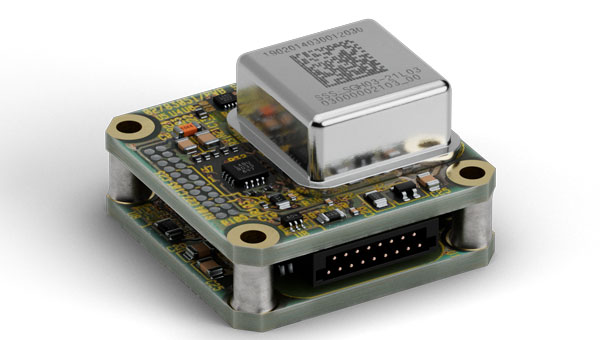
    Silicon Sensing Systems has been contracted by Psionic Inc. to supply the CRH03 tactical-grade gyroscope to equip its SurePath navigation system.

    SurePath is a completely self-contained navigation solution developed to solve the growing issue, across many platform types, of effective navigation over extended periods in GNSS-denied or contested environments. SurePath’s navigational capability is based on proprietary doppler laser technology, developed initially by NASA, to support autonomous lunar navigation and landing. Able to capture real-time 3D velocity to precisely determine location, SurePath’s unique, mission-critical operational capabilities render it RF invisible and undetectable – it cannot be jammed, spoofed, or defeated.
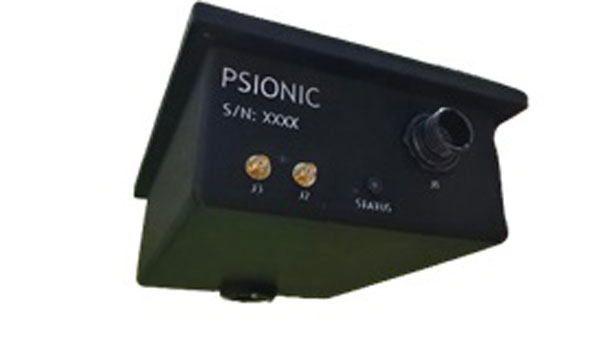
    Photo:
    The Surepath navigation solution

    The Silicon Sensing CRH03 gyro will serve as an ultra-precise heading sensor, providing constant azimuth data to the SurePath solution filter and bringing critical improvements to heading calculations over time. 

    “Precise azimuth control and sensor data are crucial for accurate navigation and overall system functionality in GNSS-denied and contested situations,” said Sean McCormack, senior vice president at Psionic. “SurePath will integrate the data from the CRH03 into our proprietary filtering techniques to deliver enhanced capability to our end user.”

    The CRH03 is a tactical-grade, stand-alone, micro electro-mechanical system (MEMS) gyroscope that delivers exceptional bias instability, angle random walk and low noise performance. Available in five rate ranges:  ±10°/s, ±25°/s, ±100°/s, ±200°/s, ±400°/s, this all-silicon unit has comparable bias characteristic to far larger and less rugged fibre-optic (FOG) and dynamically-tuned gyroscopes (DTG).
  • Inertial sensors vital to Mayflower autonomous voyage

    Inertial sensors vital to Mayflower autonomous voyage

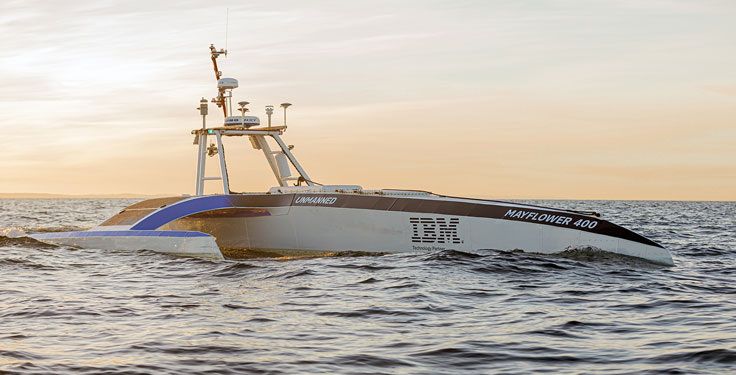
    Photo: IBM
    Photo: IBM

    The Mayflower Autonomous Ship (MAS) is set to re-embark on its three-week trans-Atlantic journey in April 2022 equipped with two of Silicon Sensing’s AMU30 inertial measurement units (IMUs). These devices send highly precise motion data to the new ‘AI captain’ that guides the vessel. They also assist in measuring sea surface height as part of detailed scientific analysis of ocean topography.

    AMU30 is a micro electro-mechanical system (MEMS) unit with excellent inertial performance, including very good bias stability and low noise characteristics, plus an embedded Kalman Filter-based AHRS (attitude and heading reference system) algorithm. It delivers precise 3-axis outputs of angular rate and acceleration, plus roll, pitch and heading angles, altitude and pressure, and temperature, at 200 Hz — all critical to precise maritime navigation.

    “The two AMU30 are used to make real-time, precision measurements of the movement of the Mayflower Autonomous Ship in 6 degrees of freedom (DOF) so that the AI Captain may make minute manoeuvring adjustments to optimise vessel performance in a complex wavefield, while also providing redundant general navigation capability at sea,” said Brett Phaneuf, co-director of the project. “Furthermore, when coupled with optical and RTK (real time kinematics) GPS data, the AMU30 assists the ship in making highly accurate measurements of sea surface height, which are important for studying ocean tides, circulation and the amount of heat the ocean holds.”

    The MAS journey across the Atlantic will celebrate the voyage of the original Mayflower some 400 years ago. It is just one element of an extensive scientific data gathering and research programme the vessel will complete in the coming years.  The ship is guided by its new AI Captain, built using IBM cloud, artificial intelligence (AI) and edge computing technologies, and uses a hybrid engine that draws on solar power. Working with scientists and other autonomous vessels it provides a flexible platform for deepening understanding of issues such as climate change, ocean plastic pollution and marine mammal conservation. In parallel, the development of marine autonomous systems such as this will transform ocean-related industries such as shipping, oil & gas, telecommunications, security & defence, fishing & aquaculture.

    Featured Photo: IBM