Wear Elite is a personal AI platform designed to unlock the next generation of truly personal, always-on, intelligent wearable computing devices. It works acrossWearOS by Google, Android and Linux with a neural processing unit (NPU) for on-device AI and advanced suite of ultra-low power connectivity solutions.
The Snapdragon Wear platform introduces a multi‑mode connectivity architecture integrating six advanced technologies: GNSS, 5G RedCap, Micro‑Power Wi‑Fi, Bluetooth 6.0, UWB and NB‑NTN. The company’s GNSS solution enables advanced processing for precise location context that helps AI better understand where users are and adapt interactions accordingly.
Snapdragon Wear Elite delivers key on‑device capabilities that support rich, real‑time agentic experiences. By integrating the Qualcomm Hexagon NPU to support up to billion‑parameter models at the edge, and pairing it with advanced sensor fusion, high-performance, low-power connectivity and computing, Snapdragon Wear Elite enables a new class of Personal AI experiences, including context‑aware recommendations, natural voice interactions, life logging and AI agents that can take actions and orchestrate tasks on users’ behalf.
Snapdragon Wear Elite delivers a massive leap in power efficiency backed by 5x improvement on single-core CPU performance and up to 7x faster GPU, for app launching, multitasking and smoother rendering.
The platform supports multi-day battery life, reducing charging sessions, while advanced power management enables 30% longer day of use compared to the previous generation. When recharging is needed, rapid charging powers a device up to 50% in approximately 10 minutes.
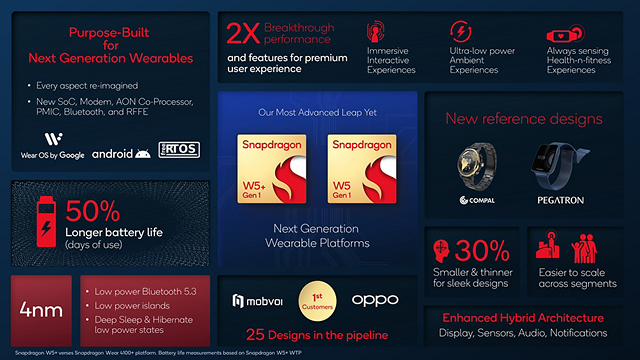
Qualcomm Technologies has unveiled new wearable platforms, the Snapdragon W5+ Gen 1 and Snapdragon W5 Gen 1.
The platforms are designed to advance ultra-low power and breakthrough performance for next-generation connected wearables with a focus on extended battery life and premium user experiences. They incorporate a series of innovations including low power islands for GNSS, Wi-Fi and audio; ultra-low power Bluetooth 5.3 architecture; and low power states such as Deep Sleep and Hibernate.
New enhancements to the flagship Snapdragon W5+ platform offer 50% lower power, 2X higher performance, 2X richer features, and 30% smaller size, compared to our previous generation, enabling wearable manufacturers to deliver the differentiated experiences consumers demand. Based on the hybrid architecture, the purpose-built platform is comprised of a 4 nm-based system-on-chip and 22 nm-based highly integrated always-on co-processor.
By using these platforms, manufacturers can scale, differentiate and develop products faster in the continuously growing and segmenting wearables industry, Qualcomm said.
Qualcomm also announced two reference designs from Compal and Pegatron, which showcase the capabilities of the platform and the company’s collaboration with ecosystem partners, helping customers develop products faster.
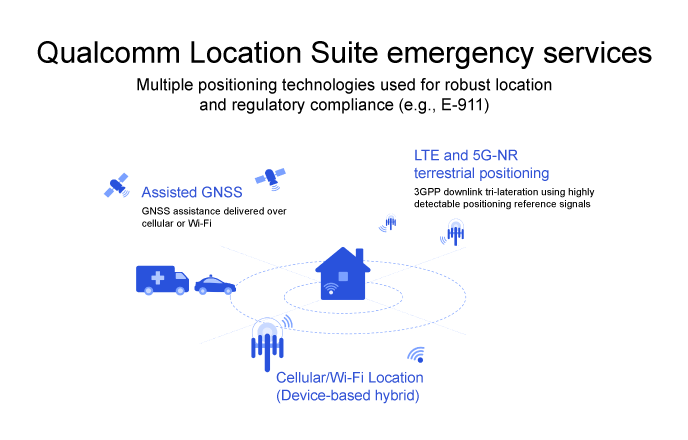
To comply with Federal Communications Commission (FCC) E-911 regulations, Qualcomm Technologies has enhanced its Qualcomm Location Suite to provide improved horizontal and vertical positioning information. The upgrade will help first responders better determine the floor within a multi-story building from which an emergency call was placed.
The Qualcomm Location Suite is deeply integrated with Qualcomm’s Snapdragon Mobile Platforms and Snapdragon Modem-RF Systems that power millions of mobile devices in the U.S. The suite has supported emergency location services in the U.S. and globally for two decades.
The change will help mobile service providers comply with new E-911 regulations requiring that the horizontal and vertical position of each wireless caller be determined with a certain level of precision.
The Qualcomm Location Suite uses GNSS with network-based positioning and dead reckoning to deliver accurate location with speed and efficiency. GNSS assistance is delivered over cellular or Wi-Fi, LTE and 5G-NR terrestrial positioning; cellular/Wi-Fi-based location is also provided.
When an emergency call comes in, operators rely on a combination of triangulation of wireless signals and device positioning technologies, such as GPS, to provide the position of the caller. The use of technologies in the Qualcomm Location Suite is designed to result in highly accurate positioning information and the ability to share this reliable information with first responders, allowing them to reach the precise emergency site more quickly.
Upgraded flagship mobile platform to power commercial smartphones from ASUS, Honor, Motorola, vivo and Xiaomi in second half of 2021
Photo: Qualcomm
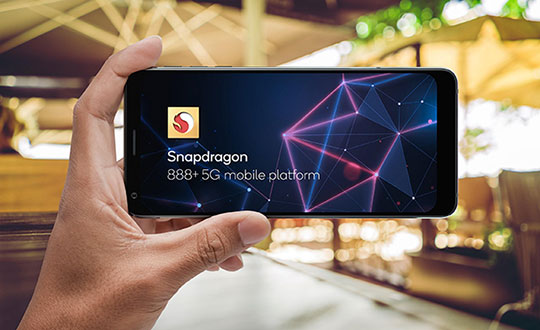
Qualcomm Technologies Inc. announced the Snapdragon 888 Plus 5G Mobile Platform, a follow-on to the flagship Snapdragon 888. These two platforms power more than 130 designs announced or in development. The product was introduced at Mobile World Congress, taking place this week in Barcelona, Spain.
Satellite systems supported include all four constellations (GPS, Beidou, Galileo, GLONASS) with dual-frequency GNSS. Additional systems supported include NavIC, QZSS and SBAS.
Snapdragon 888 Plus provides AI-enhanced gameplay, streaming, photography and premium connectivity. Compared to its predecessor, Snapdragon 888 Plus offers an increased Qualcomm Kryo 680 CPU Prime core clock speed at up to 3.0 GHz and the 6th generation Qualcomm AI Engine with up to 32 TOPS AI performance, which is more than 20% improvement.
“Snapdragon is synonymous with premium Android experiences. Our latest flagship Snapdragon 888 Plus 5G Mobile Platform will help deliver the premium entertainment, connectivity, and gaming experiences users deserve,” said Christopher Patrick, senior vice president and general manager, mobile handset business, Qualcomm. “We’re excited to see OEMs launch with products based on our highest performing platform.”
New modules enable entertainment, advanced connectivity features and next-generation artificial intelligence
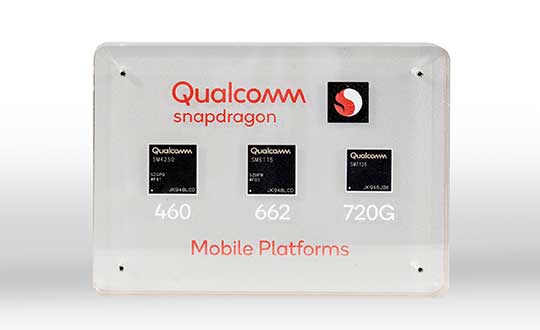
Qualcomm Technologies has launched three new mobile platforms — the Qualcomm Snapdragon 720G, 662 and 460 — to enable enhanced user experiences across connectivity, gaming and entertainment.
The new mobile platforms support dual-frequency (L1 and L5) GNSS to improve location positioning accuracy and robustness. The system-on-chip solutions also support the Indian NavIC (Navigation with Indian Constellation).
Seven constellations. For the first time supported on mobile, the Qualcomm Location Suite now supports up to seven satellite constellations concurrently, including the use of all of NavIC’s operating satellites for more accurate location performance, faster time-to-first-fix (TTFF) position acquisition, and improved robustness of location-based services.
“ISRO is satisfied with the efforts of Qualcomm Technologies Inc. towards incorporating NavIC and we urge OEMs to leverage it for future handset launches in India,” said K. Sivan, chairman, ISRO. “The availability of NavIC across multiple mobile platforms will help enhance the geolocation capabilities of smartphones in the region and bring the benefits of this indigenous solution to Indian consumers for their day-to-day use.”
The new modules also enable fast 4G connectivity speeds, deliver key Wi-Fi 6 features and integrated Bluetooth 5.1 with advanced audio via the Qualcomm FastConnect 6-series subsystems.
Artificial Intelligence. Designed to deliver new and improved AI user experiences across photography, voice assistants and virtually always-on scenarios for increased contextual awareness, the new platforms also feature the Qualcomm AI Engine and Qualcomm Sensing Hub.
“While we see a fast adoption of 5G across geographies globally, we do recognize the phenomenal boost that 4G has given towards enabling broadband connectivity for Indian consumers. 4G will continue to remain a focus area for Qualcomm Technologies for regions like India, where it will stay a key technology for connectivity,” said Rajen Vagadia, vice president and president, Qualcomm India Pvt. Ltd. “Our goal is to enable our partners to continue creating solutions that offer seamless connectivity access and exceptional mobile experiences, that consumers can count on.”
“Today’s smartphone users want fast, seamless connectivity, advanced features and long-lasting battery life,” said Kedar Kondap, vice president, product management, Qualcomm Technologies, Inc. “This expansion of our 4G lineup enables our partners to offer sophisticated solutions that meet global demand and enable a remarkable gaming experience across multiple tiers and price segments.”
Photo: Qualcomm
Snapdragon 720G
Snapdragon 720G reimagines extraordinary gaming and entertainment experiences with select Qualcomm Snapdragon Elite Gaming features, striking capture capabilities, and intelligent performance. Leveraging select Snapdragon Elite Gaming features from premium-tier mobile platforms, Snapdragon 720G delivers smooth HDR game play, dynamic color range and contrast, realistic and immersive in-game environments, and high-quality, synchronized sound with Qualcomm aptX Adaptive.
In addition to gaming, users will have a “home theater in their pocket” with HDR viewing and super-smooth video streaming with the Qualcomm Spectra 350L ISP, Qualcomm said. They can also capture 4K video or snap massive 192-megapixel photos.
Snapdragon 720G also features the latest fifth-generation Qualcomm AI Engine with the improved Qualcomm Hexagon Tensor Accelerator that will enable a host of new AI experiences for gaming, photography, voice assistants and virtually always-on contextual awareness.
The integrated Snapdragon X15 LTE modem supports 3-carrier aggregation, 4×4 MIMO on two carriers and 256-QAM modulation for fast download speeds up to 800 Mbps — allowing for quick app downloads and smooth video streaming and sharing.
In addition, Snapdragon 720G, with the FastConnect 6200 subsystem, virtually doubles Wi-Fi speed and range for online gaming and web browsing, compared to single antenna devices, while also delivering key Wi-Fi 6 features such as 8×8 sounding with multi-user MIMO for up to 2x improvement over competitive Wi-Fi 6 devices, Target Wake Time for up to 67% better power efficiency and the complete WPA3 security suite, as well as integrated Bluetooth 5.1 with advanced audio capabilities.
Finally, users will experience power savings and improved performance due to the Snapdragon 720G’s 8-nm process technology and upgraded CPU architecture.
Snapdragon 662
Snapdragon 662 brings astonishing camera and AI capabilities to the 6-series for the first time. It will feature the new Qualcomm Spectra 340T, which supports triple camera configurations and smooth switching between them — a first in the 6-series. A more robust ISP will enable support for photo capture in the HEIF file format for stunning image quality at half the file size.
The addition of the third-generation Qualcomm AI Engine with Hexagon Vector Extensions and the Qualcomm Spectra 340T will enable AI-based user experiences such as avatars, night photography, and face and voice authentication.
Snapdragon 662 also features the new Snapdragon X11 LTE modem with peak download speeds up to 390 Mbps thanks to 2-carrier aggregation, 2×2 MIMO and 256-QAM modulation, along with 150 Mbps peak uploads to support a snappy web browsing and social media experience.
Snapdragon 460
Snapdragon 460 boasts a gigantic leap in performance across the board in the 4-series, as well as significant boosts in connectivity, AI and camera improvements[1] for the next-generation of mass market smartphones. For the first time in the 4-series, Snapdragon 460 features performance CPU cores and an updated GPU architecture that translates into up to 70% and 60% increase in performance, respectively.
Overall system performance, meanwhile, delivers a 2x increase compared the previous generation. The Hexagon processor with Qualcomm Hexagon Vector eXtensions (HVX) is also introduced into the 4-series for the first time, thereby equipping it with a 3rd generation Qualcomm AI Engine and the Qualcomm Sensing Hub for new AI experiences for photography and voice assistance.
The Qualcomm Spectra 340 ISP is also among the many new additions to the 4-series, enabling the platform to capture stunning photographs and support for triple cameras. An integrated Snapdragon X11 LTE modem allows for download speeds up to 390 Mbps and uploads up to 150 Mbps.
To date, more than 85 commercial devices based on Snapdragon 7-series mobile platforms, more than 1600 commercial devices based on Snapdragon 6-series mobile platforms, and more than 2,500 commercial devices based on Snapdragon 4-series mobile platforms have been announced by global OEMs. Together, the 7-, 6- and 4-series amount to over 4,000 designs — an impressive feat for these segments.
Devices based on Snapdragon 720G are expected to be commercially available in Q1 2020 and devices based on Snapdragon 662 and 460 are expected to be commercially available by the end of 2020. For more information, please visit the product details pages for the Snapdragon 720G Mobile Platform, Snapdragon 662 Mobile Platform, and Snapdragon 460 Mobile Platform.
Companies aim to provide sub-lane-level accuracy to automotive OEMs and Tier 1 suppliers
Image: Trimble
Trimble and Qualcomm Technologies, a subsidiary of Qualcomm Inc., will be working together to produce precise-positioning solutions for select automotive applications.
Trimble will work with Qualcomm Technologies to integrate Trimble’s RTX technology with select Qualcomm Snapdragon Automotive 4G and 5G platforms to deliver a highly accurate positioning solution essential for maintaining absolute in-lane positioning.
The new solution will accelerate the adoption of road-level navigation and emergency services applications, as well as satisfy requirements for developing advanced driver-assistance systems (ADAS) and autonomous driving solutions.
The Snapdragon 4G and 5G automotive platforms feature integrated multi-frequency and multi-constellation high-precision GNSS technology. They also support all major global and regional GNSS satellite constellations including GPS, GLONASS, Galileo, BeiDou, and QZSS, operating concurrently on the L1, L2, and L5 frequency bands, including a precise positioning framework.
The framework ensures consistency in access and use of precise positioning information and incorporates the use of GNSS corrections technology.
Tight integration of GNSS functionality in conjunction with the modem reception of the corrections allows for minimum latencies and optimal performance of the precise-positioning solution from the telematics system and provides automakers with a global location platform to meet the requirements of next-generation vehicles.
Trimble RTX technology provides real-time, multi-constellation GNSS corrections and positioning capable of achieving 2-centimeter horizontal accuracy worldwide, compared to uncorrected GNSS positioning that can be accurate to several meters. The combined solution will provide reliable, consistent, high-accuracy positioning, in a broadcast format, to serve even the most precise requirements of the automotive and transportation industries.
“Trimble’s relationship with Qualcomm Technologies establishes a unique alliance between industry leaders, in which both companies are committed to advancing the development of safer, more capable ADAS,” said John Sprivulis, director of autonomous navigation solutions for Trimble’s advanced positioning division. “Together we will offer a solution to the automotive industry that can help accelerate the adoption of precise GNSS positioning in the connected car and transform the way the world drives.”
“Highly accurate positioning is quickly becoming an important element of connected vehicle solutions to support Vehicle-to-Everything (V2X) and other autonomy applications,” said Lars Boeryd, senior director, product marketing, Qualcomm Technologies. “For this very reason, we are working with Trimble to host the RTX precise positioning software library on our Snapdragon Automotive 4G and 5G platforms to offer a robust end-to-end highly accurate position solution for the automotive industry.”
Evaluation kit. An RTX-enabled Snapdragon evaluation kit (EVK) is expected to be available by early 2020, for use by automotive OEMs, Tier 1 suppliers or other stakeholders considering absolute positioning as part of their autonomy solution.
Trimble has also made Trimble RTX Auto an ASIL and ASPICE compliant RTX software library, available to any OEM or supplier who requires a functional safety certified solution.
Qualcomm Technologies’ Snapdragon automotive platforms were selected to power the next-generation of infotainment systems in the Geely Auto Group vehicles.
According to Qualcomm, these systems include the world’s first-announced infotainment offering with an integrated 4G LTE modem using the Snapdragon 820Am automotive platform.
Geely also expects to use Snapdragon automotive platforms on upcoming generations of its iNTEC technology package, which includes G-Netlink, a system that allows drivers to interface with their vehicles in a number of ways, as well as G-Pilot, an intelligent drive technology designed to support a high degree of driving comfort, assistance and autonomy.
“China is emerging as a source of automotive innovation, not only benefiting Chinese customers but also the rest of the world, by quickly adopting and commercializing leading-edge car attechnology,” said Patrick Little, senior vice president and general manager for automotive at Qualcomm Technologies. “We are pleased to work with Geely and the Chinese automotive ecosystem to help define the future of connected car experiences and use our industry-leading technologies to accelerate its realization.”
According to the company, select Geely models are expected to use the Snapdragon 820Am variant of the platform with an integrated X12 LTE modem, supporting up to 600 Mbps downlink and 150 Mbps uplink speeds.
In addition, Geely vehicles featuring Snapdragon automotive platforms are expected to be available from 2020 onward, the company reported. Geely’s connected cars featuring telematics applications are already available using Snapdragon LTE modems.
Qualcomm Technologies Inc. has introduced a new variant of its connected car reference platform using its flagship gigabit class Snapdragon X16 LTE modem to help car manufacturers deliver the high-speed, high-quality and reliable connectivity required for advanced telematics and connected vehicle services — supporting peak download speeds up to 1 Gbps.
Qualcomm is showcasing the variant at CES 2017, which is being held Jan. 5-8 in Las Vegas, Nevada.
Building on the Company’s leadership supplying 3G/4G LTE modems for automotive, the reference platform is designed to allow carmakers to quickly and easily integrate the broad range of additional wireless and networking technologies required in today’s vehicles, including Wi-Fi, Bluetooth, Bluetooth Low Energy and GNSS, with optional support for DSRC and Cellular-V2X.
The platform also includes a module reference design for the Snapdragon X16 LTE modem to help automotive suppliers accelerate development and improve time-to-commercialization.
Highlights of the new connected car reference platform include:
Gigabit Class LTE cloud connectivity: The Snapdragon X16 LTE modem supports Gigabit-class download speeds, up to 10x as fast as first generation 4G LTE devices. The modem is designed to employ sophisticated digital signal processing to pack more bits per transmission with 256-QAM, receives data on four antennas through 4×4 MIMO, and supports for up to 4x Carrier Aggregation. All of this comes together to support peak download speeds up to 1 Gbps, helping satisfy the connectivity needs and use cases of the next generation of connected vehicles including high-definition map updates, connected navigation with real-time traffic and road condition information, software upgrades, Wi-Fi hotspot and multimedia streaming.
In-car networking and satellite navigation: The connected car reference platform also integrates Wi-Fi 802.11ac, Bluetooth 4.2, Bluetooth Low Energy 4.2, sensor support for stolen vehicle tracking and recovery, quad-constellation GNSS and 3D Dead Reckoning (DR) location solutions, with optional support for vehicle-to-everything communications using DSRC/802.11p or Cellular-V2X. The solution is designed to manage concurrent operation of multiple wireless technologies using the same spectrum frequencies. In addition, the reference platform features in-vehicle networking technologies such as Gigabit Ethernet with Automotive Audio Bus (A2B), Controller Area Network (CAN) and Local Interconnect Network (LIN) interfaces.
OEM and third-party applications support: Qualcomm Technologies also provides a security-rich framework for the execution of custom OEM and third-party telematics applications. The simplified access to tightly-integrated apps processing functionality is designed to help automakers and service providers handle the increasing number of use cases requiring connectivity — simultaneously in many cases — and quickly prototype, develop and deliver unique and differentiated experiences to their customers.
Qualcomm Technologies has also developed a reference hardware module in two different band configurations, North America and Rest of World (including Europe). The module design is engineered to support up to four antennas to utilize the 4×4 MIMO capabilities of the Snapdragon X16 modem and reach the peak download speeds of up to 1 Gbps. This can help accelerate the time-to-commercialization of this flagship device and the Company is working with module manufacturers and Tier 1 suppliers to further optimize 2-antenna and 4-antenna configurations aiming to meet cost-effectiveness and size requirements of specific automakers, specific segments and use cases.
“Connected cars are becoming intelligent sensors on the road, not only using data for consumer use cases such as Wi-Fi hotspots and video streaming, but also collecting and transmitting critical, rich real-time information about road conditions, map updates and driver status,” said Patrick Little, senior vice president and general manager, automotive, Qualcomm Technologies, Inc. “As a leader in car connectivity, Qualcomm Technologies is well positioned to address the tremendous data demand, helping automakers integrate the broad set of technologies required by a new generation of connected vehicles.”
The new connected car reference platform using Snapdragon X16 LTE modem, including its corresponding reference module, is expected to be available in the first half of 2017.
All major global automakers currently use products from Qualcomm Technologies’ broad portfolio of automotive solutions, including the Company’s flagship Snapdragon automotive processors and modems.
Across telematics, infotainment and connectivity, Qualcomm Technologies has achieved more than 150 automotive design wins, and car manufacturers across the globe have selected Snapdragon processors for their next generation infotainment solutions. To learn more, please visit Qualcomm Technologies’ automotive booth at CES, north hall, booth #5609, or visit qualcomm.com/automotive.
Qualcomm Technologies Inc. and AT&T will test unmanned aircraft systems (UAS) on commercial 4G LTE networks.
The trials will analyze how UAS can operate safely and more securely on commercial 4G LTE and networks of the future, including 5G. The research will look at elements that would impact future drone operations.
CTIA Super Mobility 2016 attendees can catch a video demonstration at Qualcomm’s booth in the 5G Zone. Matt Grob will showcase the benefits of LTE-based drone operation during his keynote at 9 a.m. PDT on Sept. 8.
The team will look at coverage, signal strength and mobility across network cells and how they function in flight. The goal of the trials and ongoing research is to help enable future drone operations, such as beyond visual line of sight (BVLOS), as regulations evolve to permit them.
The trials will begin later this month at Qualcomm Technologies’ San Diego Campus, with testing to take place at its FAA-authorized UAS Flight Center and test environment. The center contains real-world conditions including commercial, residential, uninhabited areas and FAA controlled airspace. The facility permits testing of the use of commercial cellular networks for drones without affecting AT&T’s everyday network operations.
In April, Qualcomm Technologies’ San Diego Campus received an FAA certificate of authorization to perform outdoor testing of drones.
The ability to fly beyond an operator’s visual range could enable successful delivery, remote inspection and exploration. Wireless technology can bring many advantages to drones such as ubiquitous coverage, high-speed mobile support, robust security, high reliability and quality of service (QoS), Qualcomm said in a press release.
“The trial with a carrier with the reach and technology of AT&T is a significant step in the development of connectivity technologies for small unmanned aircraft systems (SUAS), including optimization of LTE networks and advancement of 5G technology for drones,” said Matt Grob, executive vice president and chief technology officer, Qualcomm Technologies. “Not only do we aim to analyze wide-scalable LTE optimization for safe, legal commercial SUAS use cases with beyond line-of-sight connectivity, but the results can help inform positive developments in drone regulations and 5G specifications as they pertain to wide-scale deployment of numerous drone use cases.”
“Many of the anticipated benefits of drones, including delivery, inspections and search and rescue will require a highly secure and reliable connection,” said Chris Penrose, senior vice president, IoT Solutions, AT&T. “With a focus on both regulatory and commercial needs, LTE connectivity has the potential to deliver optimal flight plans, transmit flight clearances, track drone location and adjust flight routes in near real-time. Solving for the connectivity challenges of complex flight operations is an essential first step to enabling how drones will work in the future.”
The UAS trials will be based on the Qualcomm Snapdragon Flight drone development platform, which is designed to offer superior control and navigation capabilities. Already in use in some commercially available drones, the platform offers high fidelity sensor processing, precise localization, autonomous visual navigation and 4K videography all in an integrated, light-weight model suitable for consumers and enterprises.
Mercedes autonomous car on display at Mobile World Congress 2016. (Photo: Kevin Dennehy)
BARCELONA, Spain — Most attendees at the Mobile World Congress (MWC) wouldn’t mistake the huge mobile phone show to be a gathering of auto manufacturers and their suppliers. However, the show, which broke 100,000 participants this year, has seen a rise in auto companies who are outlining connected and autonomous vehicle strategies.
MWC was held Feb. 27 to March 2 in Barcelona.
At MWC, Ford CEO Mark Fields said the company is tripling its investment in new technologies over the next five years with the ultimate goal of fully autonomous vehicles.
Ford also rolled out the new Kuga SUV, which features the company’s new SYNC 3, which Fields says should be in 43 million vehicles by 2023 (SYNC 3 is upgraded to include improved voice commands and easier to get to applications on a driver’s smartphone).
Fields said Ford, which attended its fourth straight Mobile World Congress, was transitioning from an auto company to one that is a dual auto-mobility entity. In addition, just as with GM’s decision to invest $500 million in Lyft, Ford is getting into the sharing economy with its own car-sharing, ride-sharing and other mobility services.
This new mobility strategy includes GoPark, an app that directs drivers to parking spaces; FordPass, a platform that connects services and partners; and FordGuides, a problem-solving app. According to published reports, another Ford app is MyBoxMan, which allows drivers in Europe to make money delivering boxes.
At least one industry expert believes that car sharing and autonomy is the future for auto companies. “Full autonomy is coming. We will see fleets of driverless public transport vehicles on the roads due to their low overheads,” said Kevin Curran, senior member of IEEE and senior lecturer at the University of Ulster. “Regarding non-autonomy, we will see that cars ownership will change in a number of ways. We will start to see more ride sharing. Uber and other ride sharing models will rise to supersede existing traditional models. That is quite obvious even now, and a proper ride sharing model should also emerge, too.”
Ford displayed the Kuga in its main booth, and also had a booth featuring its Developer Program. One of its development partners, Magellan, showed off its SmartGPS in-vehicle technology.
The Magellan unit delivers local information to the car that is equipped with SmartGPS, including speed trap alerts, weather, traffic and lowest gas prices, said Matt Erstling, Magellan product manager, connected platform.
Magellan’s connected auto strategy was outlined, in part, by its new CEO, Pierre Parent, at CES in January. Parent said that the company will continue to put location capability in connected devices.
Large industry players make MWC auto announcements
At its press conference, Hans Vestberg, Ericsson president and CEO, said 5G will provide the latency needed for autonomous cars. The company is jointly developing a connected car with Geeley Automobile Holdings, the Chinese owners of Volvo. Besides Ericsson, Nokia, SK Telecom and others believe that 5G, which is expected to rollout in 2020, will be critical for mobile Internet applications — and, therefore, for better safety in connected vehicles.
Qualcomm announced its partnership with Audi to integrate the Snapdragon 602A into the automaker’s 2017 vehicles. The company showed off connected car technologies with Formula One Team Mercedes AMG Petronias.
One of the cooler pieces of equipment at MWC was the folding steering wheel developed by Harman and Rinspeed. The companies are also co-developing an autonomous car.
Harman showcased its new folding steering wheel at Mobile World Congress 2016. (Photo: Kevin Dennehy)
Besides rolling out Galaxy S7 phones, Samsung announced its Connect Auto dongle that adds LTE connectivity for older vehicles. The dongle plugs into a diagnostic port to let drivers monitor a vehicle’s performance. It also makes the vehicle a Wi-Fi hotspot. It should be available in the second quarter, with AT&T as the U.S. wireless partner.
Saying the partnership is a giant step toward driverless vehicles, Panasonic and Ficosa announced at MWC that they were developing a Smart Connectivity Module that enables passengers to be securely connected through a vehicle’s own internal connection. The system provides both inside and outside connections and works in V2V and V2X environments.
“A lot of people don’t know that 33 percent of our business is in auto and industrial systems. Consumer is only 14 percent,” said Tony O’Brien, deputy managing director, Panasonic Systems Solutions, Europe.
Inside the Mercedes autonomous vehicle. (Photo: Kevin Dennehy)
In other MWC news:
The Consumer Electronics Show (CES), which automakers and their suppliers are heading to in droves, now has 115 exhibiting companies. While far fewer in numbers, and with so many large wireless and device manufacturers involved, auto execs realize that MWC is an important stop before the Geneva Auto Show.
At MWC, I could actually talk to people, even see folks again at events and sometimes passing by in the huge exhibit halls at the Fira Grand Via. You can’t say that about CES. Unfortunately, MWC is getting huge…more than 100,000 people with the requisite traffic congestion, public transit strikes, expensive housing and airfares.
Join Lyft, BMW Group, HERE and 25 other speakers at Driverless, The Business of Autonomous Vehicles, which is March 22-23 at the Crowne Plaza Hotel, San Francisco Airport. Panels feature new technology, executive insights on the future, investments, legal and cyber security and mapping. For more information, go to www.driverlessmarket.com or [email protected].
Qualcomm Technologies, Inc., has introduced the Qualcomm Snapdragon 410 chipset with integrated 4G LTE World Mode. According to Qualcomm, the delivery of faster connections is important to the growth and adoption of smartphones in emerging regions, and Qualcomm Snapdragon chipsets are poised to address the needs of consumers as 4G LTE begins to ramp in China.
Snapdragon 410 chipsets support all major navigation constellations: GPS, GLONASS, and China’s new BeiDou, which helps deliver enhanced accuracy and speed of location data to Snapdragon-enabled handsets.
The new Snapdragon 410 chipsets are manufactured using 28-nm process technology. They feature processors that are 64-bit capable along with superior graphics performance with the Adreno 306 GPU, 1080p video playback and up to a 13 megapixel camera. Snapdragon 410 chipsets integrate 4G LTE and 3G cellular connectivity for all major modes and frequency bands across the globe and include support for dual and triple SIM. Together with Qualcomm RF360 front-end solution, Snapdragon 410 chipsets will have multiband and multimode support. Snapdragon 410 chipsets also feature Qualcomm’s Wi-Fi, Bluetooth, FM and NFC functionality.
The chipset supports all major operating systems, including the Android, Windows Phone and Firefox operating systems. Qualcomm Reference Design versions of the processor will be available to enable rapid development time and reduce OEM R&D, designed to provide a comprehensive mobile device platform. The Snapdragon 410 processor is anticipated to begin sampling in the first half of 2014 and expected to be in commercial devices in the second half of 2014.
Qualcomm Technologies also announced for the first time the intention to make 4G LTE available across all of the Snapdragon product tiers. The Snapdragon 410 processor gives the 400 product tier several 4G LTE options for high-volume mobile devices, as the third LTE-enabled solution in the product tier. By offering 4G LTE variants to its entry level smartphone lineup, Qualcomm Technologies ensures that emerging regions are equipped for this transition while also having every major 2G and 3G technology available to them. Qualcomm Technologies offers OEMs and operators differentiation through a rich feature set upon which to build innovative high-volume smartphones for budget-conscious consumers.
“We are excited to bring 4G LTE to highly affordable smartphones at a sub $150 ( ~1,000 RMB) price point with the introduction of the Qualcomm Snapdragon 410 processor,” said Jeff Lorbeck, senior vice president and chief operating officer, Qualcomm Technologies, China. “The Snapdragon 410 chipset will also be the first of many 64-bit capable processors as Qualcomm Technologies helps lead the transition of the mobile ecosystem to 64-bit processing.”
Qualcomm Technologies will release the Qualcomm Reference Design (QRD) version of the Snapdragon 410 processor with support for Qualcomm RF360 Front End Solution. The QRD program offers Qualcomm Technologies’ technical innovation; customization options; the QRD Global Enablement Solution, which features regional software packages, modem configurations, testing and acceptance readiness for regional operator requirements; and access to a broad ecosystem of hardware component vendors and software application developers. Under the QRD program, customers can rapidly deliver differentiated smartphones to value-conscious consumers. There have been more than 350 public QRD-based product launches to date in collaboration with more than 40 OEMs in 18 countries.