Sokkia announces the release of the CX-60 total station in the Americas with upgraded data transfer and storage options for the series. Featuring RED-tech reflectorless capabilities, the new CX-60 is designed to provide an entry-level solution with a fast and powerful EDM.
“The CX-60’s RED-tech technology reflectorless EDM offers a fast distance measurement of 0.9 seconds,” said Ray Kerwin, director of global surveying products. “The instrument also offers a new USB option for quick and easy data transfer, along with 2- and 5-arc second accuracies ideal for land surveying, topography, construction layout, foundations and exterior job sites as well as as-built projects.”
RED-tech technology allows the total stations to operate reflectorlessly with an EDM of up to 350 m or 4000 m with a prism.
The CX-60 instruments offer optional Bluetooth functionality, providing connectivity of up to 10 meters (32 ft.) with controllers.
Additional features include 10,000 points of memory, a battery life of up to 15 hours, dual axis compensation, a waterproof design, and a laser pointer.
BIM 360 Layout is designed to provide vertical construction contractors the ability to connect the coordinated model to the field layout process — helping to increase job site productivity, while improving the accuracy of staked or installed building components.
“We are committed to the interoperability between our products and Autodesk software making workflows increasingly simple for common customers,” said Ray Kerwin, director of global surveying products. “Now operators taking advantage of the iX series’ smoothest and most accurate prism tracking ability can also layout or QA/QC (quality assurance/quality control) with the BIM 360 Layout app.”
With the addition of the iX series, operators now have a choice of instruments in the Sokkia family with BIM 360 connectivity, including the SX total station series.
The iX series of robotic total stations uses ultrasonic technology.
Sokkia has introduced a new line of robotic total stations. Featuring ultrasonic technology, the iX series is designed to provide smooth, accurate prism-tracking and is “lighter and faster,” according to a Sokkia news release.
“Ultrasonic technology is the driving force for the iX series,” said Ray Kerwin, director of global surveying products. “The Ultrasonic motors are the thinnest, lightest and most reliable on the market. With a rotation speed of 150 degrees per second, the iX series offers the efficiency of a single-operator robotic system and the power of long-range reflectorless measurements of up to 800 meters and 6,000 meters with a reflector.
“Our new UltraTrac technology gives you increased prism-tracking strength in all conditions. Advanced instrument algorithms deliver the confidence you need to move ahead,” he said.
The system is designed to be a compact solution and is a third smaller and lighter than previous robotic Sokkia instruments.
Along with complementing Sokkia products, the instrument is designed with an open platform for additional compatibility with non-proprietary software and controllers. The iX series also features a five-year motor warranty.
Sokkia has introduced its new SHC500 field controller for construction and surveying applications. It is designed to provide operators a compact handheld option with numerous features and benefits, including a 4.3-inch touchscreen display and optional 5 MP camera with built-in LED flash.
The SHC500 is designed for the professional operating MAGNET Field, Site and Layout software. The data controller works with all Sokkia GNSS receivers and total stations, and meets or exceeds all field application requirements.
“With a sunlight-readable screen, even in bright conditions the controller is perfect for modern project sites,” said Ray Kerwin, director of global surveying products. “It is built rugged — waterproof up to one meter with an IP68 rating — securing the unit and optional built-in LED flash camera and 8GB flash storage.
“The SHC500’s optional internal cellular modem allows operators to send and receive data through the MAGNET suite of software solutions. Field crews can easily communicate when projects need to be changed or if important data is required back in the office,” Kerwin said.
Additional features include standard Bluetooth and Wi-Fi connectivity, 23 control buttons with numeric input, and a capacitive-touch interface.
Sokkia has introduced the latest addition to its line of field controllers for use with construction and surveying applications, the SHC5000. Operating MAGNET Field, Site and Layout software, the newest field controller is designed to provide a more versatile and faster handheld computer for GNSS receivers and total stations, with the largest screen size in the Sokkia line.
“The SHC5000 boasts a 7-inch sunlight-viewable screen, which makes it the largest in our line of field controllers,” said Ray Kerwin, director of global surveying products. “The display’s capacitive touch interface comes with finger, glove, small tip stylus and water capable options. Operators can change the screen from portrait to landscape when viewing maps or drawings, depending on which orientation is preferable.”
The SHC5000 comes with two built-in cameras. One uses an 8 MP camera with autofocus and LED flash that is designed for uses such as field photography. The second has a 2 MP camera on the front side of the unit for purposes such as video meetings.
Additional features include 64 GB of flash storage, an optional 4G LTE cellular modem, internal GPS navigation, Bluetooth and Wi-Fi, and a battery life of 10-plus hours.
Arne Musch of Topcon Positioning Group discusses Sokkia‘s GCX2 GNSS integrated receiver at INTERGEO 2015, which was held Sept. 15-17 in Stuttgart, Germany.
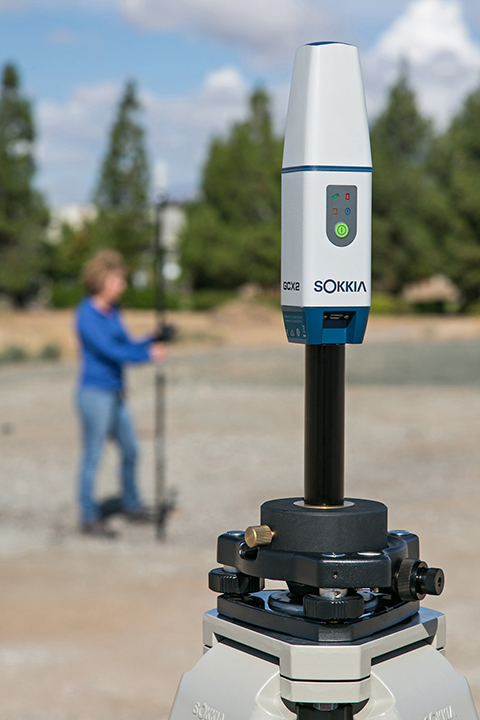
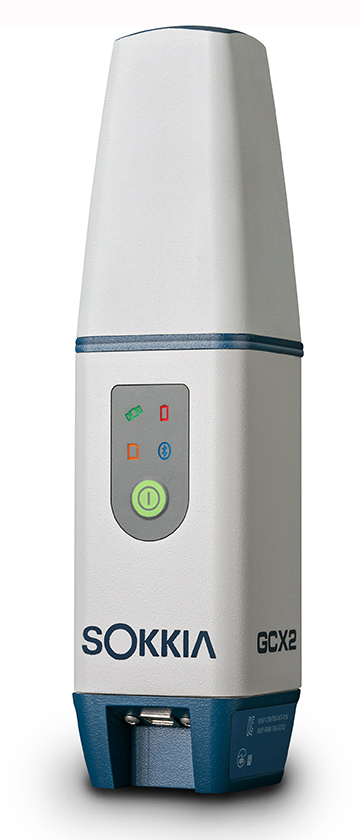
The GCX2, nicknamed “the bullet,” is a multi-constellation and dual frequency receiver. It is the smallest and lightest integrated receiver Sokkia has ever offered, the company says.
Sokkia has introduced a GNSS integrated receiver designed for lightweight and convenient field operation — the GCX2.
“Nicknamed ‘the bullet’, the GCX2 exemplifies a completely reimagined approach to receiver design that offers an ultra-lightweight and ergonomic solution at a low cost,” said Eduardo Falcon, executive vice president and general manager of the GeoPositioning Solutions Group.
The multi-constellation and dual-frequency receiver is designed to offer affordable high-quality results for traditional applications in the surveying and construction fields — as well as unconventional uses such as in landscape architecture, GIS, BIM and forensic mapping. The receiver connects via Bluetooth to the Sokkia S-10 or GHX2 field controller, enabling ease-of-operation within the MAGNET suite of software. The GXC2 uses 226 channels, each one optimized to constantly track any currently available satellite signals.
“This is the smallest and lightest integrated receiver Sokkia has ever offered,” said Falcon. “The innovative POST (Precision Orbital Satellite Technology) antenna element allows for a form that is both ergonomic and extremely lightweight, which fully differentiates it from existing receivers in the market. The unique ‘bullet’ shape appears as a small extension of the range pole — almost as if it’s not even there.”
The receiver features radio-free RTK operation via interference-free data communication technology, which eliminates licensing issues. When used as a base station, it can support up to three concurrent GCX2 rovers at a range of up to 300 meters. Each receiver can be used as a base or as a rover.
For network operation, the GCX2 may be paired with a cellular-enabled data-controller to provide RTK network corrections and connectivity with MAGNET Enterprise.
“The GCX2 delivers a high level of performance and efficient workflow, and it’s offered with a substantial pricing advantage over competitive systems,” said Falcon.
Additional features include a rechargeable battery and Sokkia receiver utility (SRU) software compatibility.
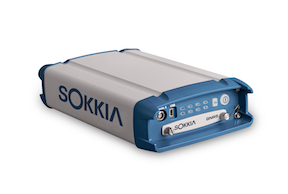
Sokkia announces the latest addition to its line of geodetic GNSS reference receivers — the GNR5. Making use of 452 channels optimized to track the full GNSS spectrum, the GNR5 is designed to assign any visible signal to any available receiver channel.
“The GNR5 is a comprehensive connectivity solution,” said Charles Rihner, vice president of the GeoPositioning Group. “Whether using the built-in Bluetooth and Wi-Fi wireless communication options, or standard Ethernet, serial and USB connections — the system provides a powerfully integrated reference station that is capable of tracking the GPS, GLONASS, Galileo, Beidou, QZSS and SBAS constellations.”
Additional features include high-precision code and carrier phase measurements up to 100 Hz, Power over Ethernet (PoE), and advanced receiver management features.
The new receiver is on display at InterGeo 2014, being held this week in Berlin.
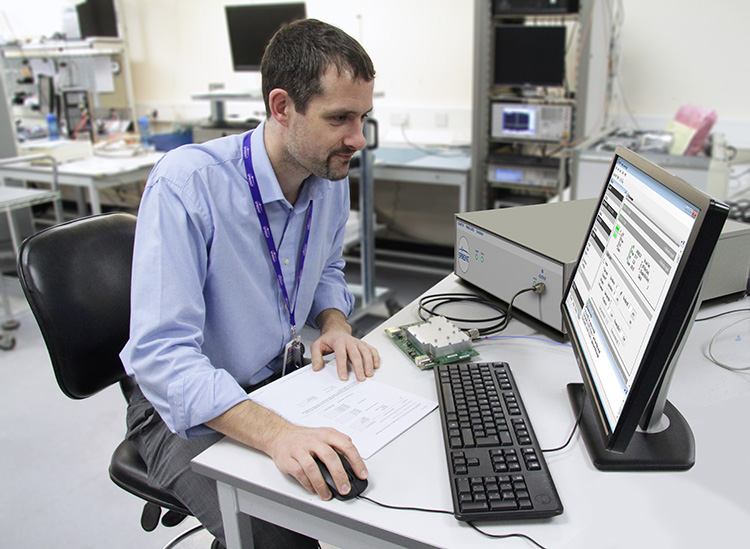
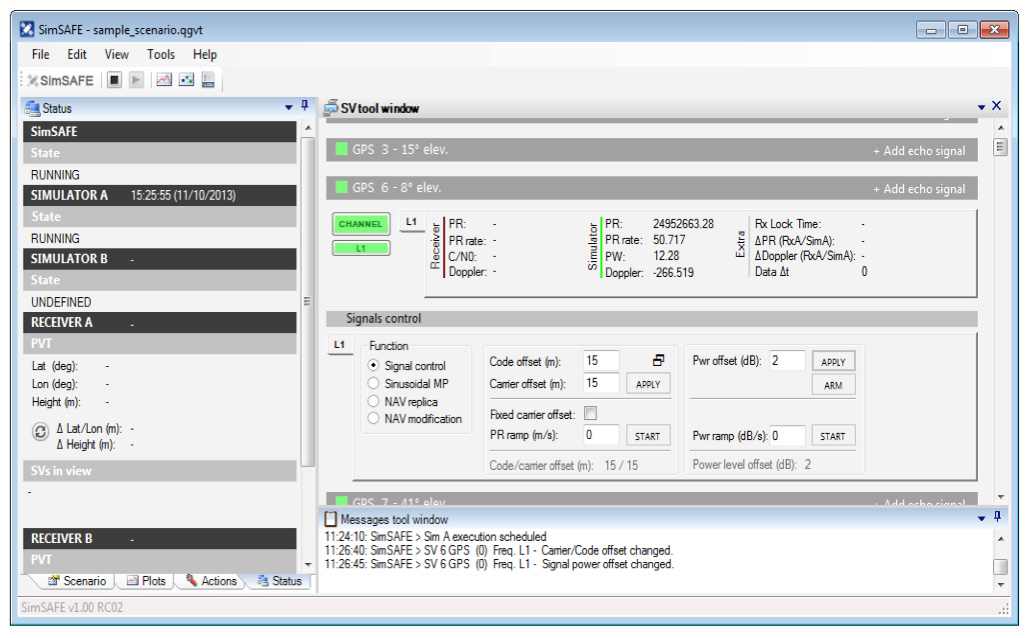
Spirent Communications now offers SimSAFE, a software solution that simulates legitimate GNSS constellations along with spoofed or hoax signals to evaluate receiver resilience and help develop counter measures.
Hoax or spoofing attacks work by mimicking genuine GNSS signals, which mislead GNSS receivers. The military and critical infrastructure — such as wireless networks, banking, and utilities — are especially interested in being able to detect and reject spoofing attacks.
“GNSS signal vulnerability is becoming a significant issue,” said John Pottle, marketing director of Spirent’s Positioning Division. “The industry is beginning to talk more about vulnerability and how we actually think about categorizing the threat — what approaches are there to evaluate performance in the presence of interference signals? If you’re a developer, what approaches are there to clean up your performance? You’ll see us at Spirent being quite a bit more vocal about these areas in the coming months.”
SimSAFE was developed in conjunction with Qascom, a small organization of half a dozen GNSS signal security and authentication experts headed by Oscar Pozzobon, who served as the chief solutions architect for SimSAFE. Pozzobon contributed his knowledge of GNSS security and vulnerabilities, which were then integrated into the SimSAFE system.
SimSAFE provides a means of emulating a spoofing attack, and then monitoring a receiver under attack to evaluate mitigation strategies and countermeasures.
“SimSAFE really gets into details on how a receiver reacts in the presence of the hoax signals,” Pottle said. “By really understanding that, really getting into how is the receiver is acting and reacting, you can understand better how your receiver is likely to behave, and tune it up.”
The SimSAFE laboratory-based test solution is fully controllable, so that users can evaluate a receiver’s response to a wide range of spoofing attacks. As Pottle put it, when fed both authentic and spoofed signals, “What’s the receiver going to see? It’s going to see the authentic signals, it’s going to see a couple of spoofed signals. And you can play around with the spoofed signals — that’s the controllable bit. While this is happening, the detector module within SimSAFE monitors and reports the receiver’s response to the attacks. At its most simple, that’s the power of SimSAFE.”
SimSAFE is aimed not only at receiver developers, a core audience of Spirent’s, but at anyone trying to build a system that may be subject to intentional interference, such as in the military or critical infrastructure. “Those people are starting to ask questions about what should I be worried about? What kind of an attack might I be open to? How can I be sure, if I’ve got a choice of three or four receivers, that I’m going to choose one that meets my needs in terms of resilience to intentional interference?” Pottle said. “Our belief is that SimSAFE will allow people to evaluate different receivers and strategies for mitigating spoofing attacks, and therefore help them to build the right level of resilience in their systems.”
SimSAFE is available in two variants. SimSAFE Simulated uses the simulator for all signals, both satellite and spoofed, using one or more channels for the spoofed signal.
Instead of a simulator, SimSAFE Live pulls authentic signals from sky with an antenna, so the user has the full power of the simulator to generate a much broader range of spoofing attacks. “The clever bit is aligning the spoofed signal with the real signal, getting the timing and frequency synced up,” Pottle said.
Spirent is also working on other technologies to mitigate spoofing, including work with interference signals from ground-based transmitters, adaptive antenna lab-based tests, and integration with inertial sensors, such as in military jets.
 Sokkia announces the release of the CX-60 total station in the Americas with upgraded data transfer and storage options for the series. Featuring RED-tech reflectorless capabilities, the new CX-60 is designed to provide an entry-level solution with a fast and powerful EDM.