Tag: Soyuz

  • Soyuz Takes Shape in French Guiana for Dual Galileo Launch

    Assembly process for the Soyuz launcher began with integration of the four first-stage strap-on boosters to the Block A core second stage (photos at left and center).  At right, the Block I third stage is seen after its mating to the launcher’s core.

    The launcher for Arianespace’s next Soyuz mission from the Spaceport in French Guiana is completing its initial checkout for a flight in the second half of 2012, which will carry another two spacecraft for Europe’s Galileo satellite navigation constellation, according to Arianespace.

    During activity at the Spaceport’s Soyuz Launcher Integration Building — known by its Russian “MIK” designation — the vehicle’s four first-stage strap-on boosters have been mated with the Block A core second stage, followed by integration of the Block I third stage.

    With its initial build-up concluded, the Soyuz is undergoing regular maintenance checks that are standard for the Russian-built vehicles that have been in storage prior to their mission. Such verifications include testing of the launcher’s pneumatic and electrical systems, Arianespace said.

    This Soyuz will carry Europe’s next two Galileo In-Orbit Validation (IOV) satellites, joining the first pair of spacecraft lofted on Arianespace’s historic maiden flight of the Russian-built launcher from French Guiana in October 2011. Once the four IOV satellites are in orbit, they will provide the minimum information needed for space-based navigation: latitude, longitude and altitude data, along with ranging accuracy, enabling assessment of the Galileo system’s performance, while also allowing suppliers to realistically check their receivers and services against actual signals.

    Arianespace has been chosen to deploy the entire Galileo constellation of 30 satellites. This began with the launch of the first two experimental satellites, GIOVE-A and GIOVE-B, orbited by Arianespace’s Starsem affiliate on Soyuz launchers from Baikonur Cosmodrome in 2005 and 2007. Subsequently, Arianespace lofted the initial pair of In-Orbit Validation spacecraft on Soyuz’ October 2011 inaugural mission from the Spaceport.

    The remaining 24 Galileo constellation satellites will be orbited through 2015, using six additional Soyuz vehicles carrying two spacecraft each, along with three Ariane 5s configured with four per launch.

    Initial phases of the Galileo program were carried out by the European Space Agency (ESA) in activity co-funded with the European Commission. Galileo’s Full Operational Capability phase is being managed and funded by the European Commission, with ESA and the Commission having signed a delegation agreement by which the space agency acts as design and procurement agent.

    The upcoming Galileo mission is designated VS03 in the numbering system for Arianespace’s launcher family — which is composed of the medium-lift Soyuz, heavy-lift Ariane 5 and light-lift Vega – all operated at the Spaceport. The “V” represents the French word for “flight” (Vol), while “S” signifies the use of a Soyuz launch vehicle. Its “3” denotes the third Arianespace mission of Soyuz from French Guiana.

  • Galileo IOV Satellites Succesfully Launched into Orbit

    21102011-_SCO3184-W

    The first pair of satellites for Europe’s Galileo global navigation satellite system has been lofted into orbit by the first Russian Soyuz vehicle ever launched from Europe’s Spaceport in French Guiana in a milestone mission, reports the European Space Agency.

    The launch occurred one day after initially scheduled to resolve a problem with the ground-support fueling system.

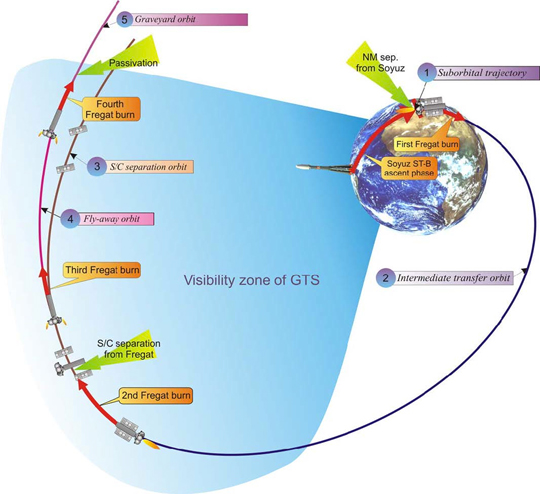
    The Soyuz VS01 flight, operated by Arianespace, started with liftoff from the new launch complex in French Guiana at 10:30 GMT on October 21. All of the Soyuz stages performed as expected and the Fregat-MT upper stage released the Galileo satellites into their target orbit at 23,222 km altitude, 3 hours 49 minutes after liftoff. A launch replay is available. A look inside the IOV satellite is available on the BBC website.

    The two Galileo satellites riding the Soyuz are part of the In-Orbit Validation (IOV) phase that will see the Galileo system’s space, ground and user segments extensively tested. The satellites are now being controlled by a joint ESA and CNES French space agency team in Toulouse, France. After these initial operations, they will be handed over to SpaceOpal, a joint company of the DLR German Aerospace Center and Italy’s Telespazio, to undergo 90 days of testing before being commissioned for the IOV phase.

    The next two Galileo satellites, completing the IOV quartet, are scheduled for launch in summer 2012.

    “This launch represents a lot for Europe: we have placed in orbit the first two satellites of Galileo, a system that will position our continent as a world-class player in the strategic domain of satellite navigation, a domain with huge economic perspectives,” said Jean-Jacques Dordain, director General of ESA.  “Moreover, this historic first launch of a genuine European system like Galileo was performed by the legendary Russian launcher that was used for Sputnik and Yuri Gagarin, a launcher that will, from now on, lift off from Europe’s Spaceport.

    “These two historical events are also symbols of cooperation: cooperation between ESA and Russia, with a strong essential contribution of France; and cooperation between ESA and the European Union, in a joint initiative with the EU. This launch consolidates Europe’s pivotal role in space cooperation at the global level. All that has been possible thanks to the vision and commitment of ESA member states.”

    This was also the first Soyuz to be launched from a site outside of Baikonur in Kazakhstan or Plesetsk in Russia. A new site for Soyuz in French Guiana, operated by Arianespace, adds to the flexibility and competitiveness of Europe’s fleet of launchers.

    Soyuz is a medium-size vehicle, complementing ESA’s launchers: Ariane 5 handles large payloads, and the new Vega, planned to debut in 2012, will lift smaller satellites.

    Launching from close to the equator allows the European Soyuz to offer improved performance. From French Guiana, Soyuz can carry up to 3 tonnes into the ‘geostationary transfer orbit’ typically required by commercial telecommunications satellites, compared to the 1.7 tonnes that can be delivered from Baikonur.

    Source: GPS world staff
    The launch profile of the Galileo IOV satellites.


  • Rocket to Carry First Galileo Satellites Moved to Launch Pad

    This unusual view from underneath the launch table at French Guiana highlights the nozzle clusters of Soyuz’ four first-stage boosters and its central-core second stage.


    The first Soyuz to take off from Europe’s Spaceport in French Guiana was moved to the launch pad October 14. The rocket that will carry the first two Galileo navigation satellites into orbit is on track for liftoff on October 20, reports the European Space Agency (ESA). Video of the transfer is available here.

    Launch of the first two Galileo IOV satellites is scheduled for October 20 at 10:34:28 UTC.
     
    The three-stage Soyuz ST-B was rolled out horizontally on its erector from the preparation building using the 600 m-long railway that leads to the pad. The vehicle was then raised into its launch position.
       
    Earlier this week, the two Galileo In-Orbit Validation satellites, attached to their dispenser, were mated to the Fregat-MT upper stage and then enclosed in the fairing. This ‘Upper Composite’ was also transferred October 14 and added onto the vehicle from above, completing the very first Soyuz on its launch pad at Europe’s Spaceport. The new mobile launch gantry, built specifically for the rocket’s operations in French Guiana, also protects the satellites and the vehicle from the humid tropical environment.

    The Soyuz and Upper Composite will undergo a full launch dress rehearsal in the next few days, including preparations for fuelling the vehicle, which will begin four and a half hours before liftoff.

    According to ESA, October’s launch will be doubly historic: the first Soyuz from a spaceport outside of Baikonur in Kazakhstan or Plesetsk in Russia and the start of building Europe’s Galileo satnav constellation.In 2012 the second pair of satellites will arrive in orbit, ready to prove the design of the Galileo system in advance of the other 26 satellites. This quartet of satellites, built by a consortium led by EADS Astrium Germany, will form the operational nucleus of the full Galileo constellation.

    More images and details are available at ESA’s website.

    To watch the launch live, visit one of these sites:

    European Space Agency

    European Parliament

    DLR German Aerospace Centre

    For more information:

    Special ESA IOV website

    Launch kit

    Arianespace website

  • Galileo IOV Satellites Fueled for October 20 Launch


    Dispenser check-out with upper stage.


    The first two Galileo navigation satellites are both now fueled and checked for their launch by Soyuz from French Guiana on October 20, reports the European Space Agency.
     
    The two Galileo In-Orbit Validation satellites reached Europe’s Spaceport in September. Galileo’s second flight model, FM2, touched down on September 7 on an Antonov-124, and the Galileo Protoflight Model followed it seven days later on an Ilyushin 76. Both satellites are now fueled and ready to be mated this week onto the dispenser that will hold them in place during launch before deploying them into their final 23 222 km orbit. 

    The combined payload stack — the dispenser and both satellites — will then be transported from the fueling facility to the Upper Composite Integration Facility S3B for integration with their Fregat-MT upper stage and subsequent encapsulation.

    ESA has set up a website dedicated to the launch.


    Encapsulated under fairing.

  • Countdown to Galileo Launch via Soyuz Rocket Under Way


    Assembly of the three-stage Soyuz takes place. The Soyuz will carry the first two Galileo satellites into orbit. (Photo courtesy of ESA.)


    The first Soyuz flight from Europe’s Spaceport in French Guiana will carry the first two satellites of Europe’s Galileo navigation system into orbit on October 20, and the European Space Agency is reporting on the preparations.

    On September 12, final assembly began on the three-stage Soyuz ST-B, consisting of four first-stage boosters clustered around the core second stage, topped off by the third stage. The Launcher Flight Readiness Review in July gave the green light to begin assembling the rocket.

    The campaign began on August 16 in the assembly and testing building — known by its original "MIK" Russian acronym — with electrical and mechanical tests of the upgraded, reignitable Fregat-MT upper stage. It will carry an additional 900 kg of propellants for its double-satellite load. Fregat was then moved to the Payload Preparation Building S3B to fill its four spherical propellant tanks.

    Soyuz will be rolled out horizontally to the launch pad on October 14 and raised into its vertical launch position. A new 45-meter-tall mobile gantry was built specifically for Soyuz operations in French Guiana. It protects the satellites and the launcher from the humid tropical environment and provides access to the Soyuz at various levels for checkout activities. The upper composite, comprising the Fregat upper stage, payload and fairing, is then hoisted on top of Soyuz.

    October’s launch will be doubly historic: the first Soyuz from a spaceport outside of Baikonur in Kazakhstan or Plesetsk in Russia and the start of building Europe’s Galileo satnav constellation. The two Galileo satellites have arrived from the Rome facility of Thales Alenia Space Italy — the first on September 7, the second on September 14 — and are undergoing initial preparations.
       
    The next step will be to attach the satellites to Fregat, followed by the fairing.

    Next year, the second pair of satellites will join them in orbit, proving the design of the Galileo system in advance of the other 26 satellites. These first four satellites, built by a consortium led by EADS Astrium Germany, will form the operational nucleus of the full Galileo satnav constellation. They combine the best atomic clock ever flown for navigation — accurate to one second in three million years — with a powerful transmitter to broadcast precise navigation data worldwide, ESA reports.

  • Galileo’s Soyuz Launchers Arrive at French Guiana

    The European Space Agency (ESA) announced that two Soyuz launchers which will fly the first four satellites of Europe’s Galileo navigation system into orbit have arrived at Kourou harbour in French Guiana, completing a journey that took them halfway round the world.

    The first two Galileo In Orbit Validation satellites are set to be launched from Europe’s Spaceport on 20 October, with two more following them into orbit by mid-2012. The October launch will be the first flight of a Soyuz rocket from French Guiana.

    The two Soyuz ST-B launchers and their Fregat-MT upper stages were carried across the Atlantic aboard Arianespace vessel MN Colibri, arriving on June 18. The rocket hardware left by train from the Soyuz manufacturing plant in Samara, Russia and the Fregat factory in Moscow to St. Petersburg harbour, where it was loaded for shipment, leaving on June 3 for French Guiana.

    Soyuz_ST-B_launchers_at_Kourou_harbour_node_full_image_2
    Soyuz ST-B launchers at Kourou harbor.

    According to the ESA, the next step will be the Launcher Flight Readiness Review, due to take place on 21 July. Authorisation will then be given to begin assembling the rocket hardware and deployingthe initial Soyuz ST-B launcher for the first Galileo campaign.

    The first two Galileo satellites — known as PFM and FM2, for Protoflight Model and Flight Model 2 – are currently undergoing their final qualification and acceptance tests at Thales Alenia Space in Rome, Italy. Once Satellite Flight Readiness Review has given the green light, both satellites and their ground equipment and launch teams will arrive at the beginning of September for the launch campaign.

    Soyuz ST-B is the most powerful version of the famous Soyuz launcher, while the Fregat-MT is an upgraded version of the Fregat upper stage.

    Other Soyuz hardware is already in storage at Kourou but only the combination of Soyuz ST-B and Fregat-MT was up to the demanding task of conveying the Galileo satellites into their circular 23,222 km orbits. A European dispenser will hold the satellites in place as they share their ride to orbit, and then release them into their final orbits.

    Baseline versions of the reignitable Fregat were previously employed to deliver ESA’s GIOVE-A and -B experimental satellites in 2006 and 2008, which secured the rights to Galileo’s radio frequencies. Fregat-MT carries an additional 900 kg of propellants for its double-satellite load.

    The ESA says that October’s launch will be a historic occasion, the first time that a Soyuz launcher lifts off from a spaceport other than Baikonur in Kazakhstan or Plesetsk in Russia.

    Because French Guiana is so close to the equator each launch will benefit from Earth’s spin, increasing the maximum payload to geostationary transfer orbit from 1.7 tonnes to three tonnes, says the ESA. As a medium-class launcher, Soyuz will complement Ariane and Vega to enhance the flexibility and competitiveness of Europe’s launcher family. Each three-stage rocket will be assembled horizontally in the traditional Russian manner, transferred to the launch site and moved to the vertical so that its payload can be mated onto it from above. A new mobile launch gantry enables this process, while protecting the satellites and the launcher from the humid tropical environment.

    These first four Galileo satellites will form the operational nucleus of the full Galileo satnav constellation, according to the announcement. They are fully representative of the others that will follow them into orbit, combining the best atomic clock ever flown for navigation — accurate to one second in three million years.

  • European Space Agency Says Galileo Launch Site Ready

    ARIANE 5 V200 ATV-2
    Soyuz launch site.


    The ESA announced the Soyuz site at Europe’s Spaceport in French Guiana is now ready for its first launch. ESA yesterday handed over the complex to Arianespace, marking a major step towards this year’s inaugural flight.

    According to the announcement, construction of the Soyuz site began in February 2007, although initial excavation and ground infrastructure work began in 2005 and 2006, respectively. Russian staff arrived in French Guiana in mid-2008 to assemble the launch table, mobile gantry, fuelling systems and test benches. The first two Soyuz launchers arrived from Russia by sea in November 2009 to be assembled in the new preparation and integration building.

    Source: GPS world staff
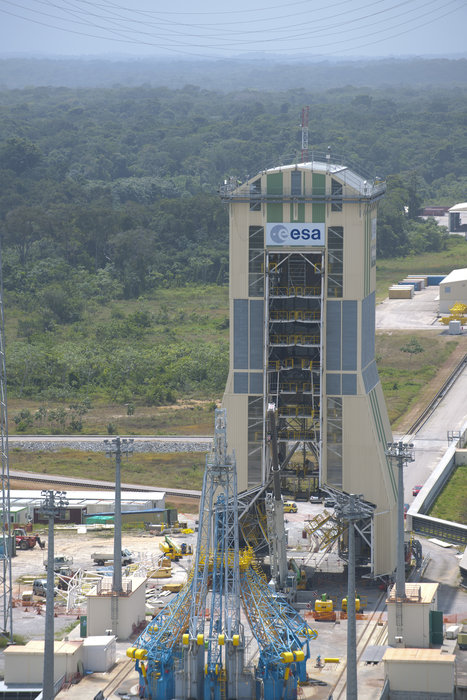
    Soyuz mobile gantry.

    The French space agency, CNES, as prime contractor for the building work, along with its European and Russian partners, has spent recent months qualifying the site – known as Ensemble de Lancement Soyuz, or ELS for short. The tests covered all the mechanical, fluid and electrical elements, such as the pad’s umbilical arms and fuelling vehicles, and all the buildings, including the launch control centre that will house the combined European and Russianteams.The ‘acceptance review’ this week declared that the site is ready for its first rocket. At the same time CNES handed over the facilities to ESA.

    The last step this week was ESA’s hand-over to Arianespace.

    According to the announcement, the launch site is almost identical to the other Soyuz sites in Kazakhstan and Russia, although adapted to conform to European safety regulations. The most visible difference is the 45 m-tall mobile gantry, which provides a protected environment as payloads are installed on the vertical launcher. Its internal movable work platforms provide access to the Soyuz at various levels.

    The ESA reports that from now on Arianespace is responsible for the Soyuz launch site and will begin the campaign this month to qualify its launch operations. A launch rehearsal will ensure that the Soyuz and the new facilities work together perfectly, while allowing the teams to train under realistic launch conditions. This simulated launch campaign will include the vehicle’s transfer to the launch zone, its erection into the vertical position, its installation on the pad, and the testing of ground and launcher interfaces. These final tests will give the green light for the first Soyuz flight from French Guiana in the third quarter of 2011.