Tag: SSTL

  • New GNSS weather datasets available from TechDemoSat-1

    New GNSS weather datasets available from TechDemoSat-1

    GNSS-R Data collections. The measured reflection tracks are shown in yellow over the Globe. A sequence of Delay Doppler Maps from one track is shown below — the spread of each is related to the sea surface roughness and surface wind speed.
    GNSS-R Data collections. The measured reflection tracks are shown in yellow over the Globe. A sequence of Delay Doppler Maps from one track is shown below — the spread of each is related to the sea surface roughness and surface wind speed.

    New weather datasets, which could prove highly valuable for weather forecasting and for longer term climate monitoring, have just been made available from the Space GNSS Receiver-Remote Sensing Instrument (SGR-ReSI) instrument on board TechDemoSat-1, a small technology demonstration satellite launched by Surrey Satellite Technology Ltd (SSTL) in 2014.

    With support from the European Space Agency, SSTL and the National Oceanography Centre (NOC) are continuing to work on the data received from TechDemoSat-1 and have been steadily improving the calibration of the measurements and researching new techniques and applications.

    New data, including delay Doppler maps and wind speed analysis over oceans, has been released on the MERRYBS website (Measurement of Earth Reflected Radio-navigation Signals By Satellite).

    Looking to the future, the NASA CYGNSS mission due to launch later this year will fly eight satellites carrying SSTL’s SGR-ReSI instrument to measure the winds within cyclones, hurricanes and typhoons.

    The SGR-ReSI instrument was developed by SSTL and is able to calculate TechDemoSat-1’s position and speed in much the same way as does a car-based SatNav, by measuring ranges and triangulating its position from high-altitude GNSS satellites orbiting 20,000 km above the satellite itself. The SGR-ReSI also carries a high-gain nadir (downward-pointing) antenna to utilize GNSS reflectometry, a technique where the GNSS signals scattered off the Earth’s surface are collected and measured.

    A calm ocean will give a clean reflection, while a rough, wind-driven ocean will spread the signal out. SSTL’s partner, the National Oceanography Centre in Southampton, has developed an algorithm that calculates from the signals the ocean roughness and in turn estimates the wind speed at the surface of the ocean.

    To validate the algorithm, NOC has compared the wind speed measurements from the SGR-ReSI against radar measurements from EUMETSAT’s MetOp satellite. These wind speed measurements are valuable for weather forecasting, and could also prove to be of significant benefit to the scientific community for climate monitoring.

    The GNSS reflections off ice are much stronger than reflections off the ocean, and it has been possible to demonstrate from the results a new method for measuring the changing location of ice edges over time, and the potential for a new method of measuring ice height and thickness.

    GPS reflections are not only collected by the SGR-ReSI over the ocean, but over land, where measurements to date show strong variations that could contain valuable geophysical information about the land surface. For instance, healthy vegetation will absorb more of the signal while damp soil can cause stronger reflections. Soil moisture is considered an essential parameter for climate monitoring, and is not currently measured with sufficient coverage over the globe.

    TechDemoSat-1 was in part funded by Innovate UK and is jointly operated by SSTL in Guildford and by the Satellite Applications Catapult in Harwell.

    SSTL received funding to support the development of the SGR-ReSI and ground processing from the UK CEOI, SEEDA, Innovate UK and the European Space Agency.

    The below videos show processing and application of the SGR-ReSI data.

    Video 1: This video shows in about 20 times real-time speed the motion of the TechDemoSat-1 satellite over an orbit, indicated by a white cross on the world map. The specular reflections targeted by the SGR-ReSI are shown by yellow spots, and the measurement tracks are shown in yellow.

    The four Delay Doppler Map channels from measurement tracks are shown in yellow. The four Delay Doppler Map channels from the SGR-ReSI are shown at the top right.

    The spreading horseshoe shape is caused by reflections being received away from the specular point, and a rougher ocean causes more spreading. When reflections are received from over land and over ice, there is much less spreading.

    The red band on the map indicates the collection of “raw” unprocessed data, which takes a few minutes to transfer before the processed Delay Doppler Maps resume.

    Video 2: This video shows reflections over the Northwest Passage, with and without ice.

  • SSTL delivers 22nd — and final — Galileo FOC payload

    SSTL delivers 22nd — and final — Galileo FOC payload

    Surrey Satellite Technology Ltd (SSTL) has delivered the 22nd Galileo navigation payload to prime contractor OHB System in Bremen, Germany. This is SSTL’s final payload under Galileo Full Operational Capability (FOC) Works Orders 1 and 2.

    SSTL’s FOC payload is based on European-sourced atomic clocks, navigation signal generators, and high-power traveling wave-tube amplifiers and antennas. It will provide Galileo’s navigation, positioning and timing services.

    As payload prime contractor, SSTL is responsible for the development, assembly, integration and test of 22 navigation payloads. The first Galileo FOC payload was delivered to OHB in 2012, and since then payloads have continued to roll off the production line at SSTL, with a delivery schedule of approximately one every six weeks.

    On May 12, SSTL held an event to mark the occasion, and to celebrate the achievement with the contributors and supporters of the FOC payloads work. Katherine Courtney, chief executive of the UK Space Agency, attended the event and remarked ,“Satellite navigation is an important part of the UK space industry success story and we are at the forefront of innovation in technology and services. Every FOC payload for the Galileo constellation — the beating heart of each satellite — has been built here in Guildford and the completion of this 22nd payload is a significant milestone which should be celebrated. We remain fully committed to the success of the Galileo programme, and look forward to the start of initial services later this year.”

    SSTL’s FOC payload comprises different units that have been manufactured by a European supply chain. The modular design of the satellite enables SSTL to assemble the payload units onto three panels for delivery, fully tested, to OHB in Bremen.

    The last of the payloads in these two batches has now completed its journey through production and test at SSTL and has been delivered to Germany, where a team of SSTL engineers will assist OHB engineers with integration to the spacecraft platform.

    SSTL's Galileo FOC payload under production. (Photo: SSTL)
    SSTL’s Galileo FOC payload under production. (Photo: SSTL)

    “The completion and delivery of the 22nd payload for FOC marks another milestone for SSTL, and I must pay tribute to the talented and dedicated FOC team here who have worked tirelessly to keep the production line rolling for the past four years,” said John Paffett, director of Telecommunications and Navigation at SSTL. “We are extremely proud of our contribution to Europe’s new navigation system, and we are all looking forward to the day that the new service comes on stream, and we can start using it in our daily lives.”

    “SSTL has been a reliable partner of the Galileo venture since GIOVE-A,” said aul Verhoef, director of Galileo Programme and Navigation at the European Space Agency. “I wish to thank all SSTL staff for their extremely valuable contribution.”

    The subcontractors for SSTL’s Galileo FOC navigation payload are Airbus Defence and Space, Finmeccanica, Spectratime, Kongsberg Norspace, Rymsa, TAS-I, Tesat, Ruag, Mier, ComDev (Honeywell), and Siemens. Testing facilities were provided at Airbus Defence and Space and RAL Space.

    The next launch of a pair of Galileo FOC spacecraft is scheduled for May 24 on board a Soyuz launcher from Kourou in French Guiana. Twelve Galileo satellites are already in orbit, and a second launch of four spacecraft is planned for later this year, bringing the total of 18 Galileo satellites in orbit by the end of this year.

  • Soyuz in the Launch Zone for March 27 Galileo Launch

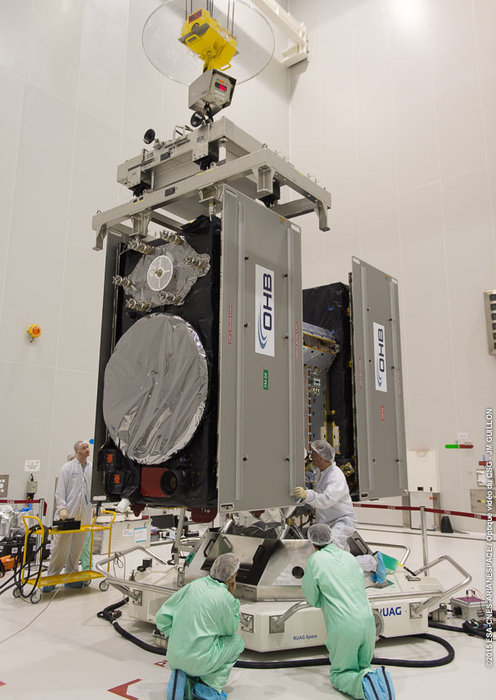
    The seventh and eighth Galileo satellites being fitted together onto the dispenser, March 16-17. (Photo courtesy of ESA)
    The seventh and eighth Galileo satellites being fitted together onto the dispenser, March 16-17. (Photo courtesy of ESA)

    The Soyuz for Arianespace’s next medium-lift mission is in the launch zone at French Guiana, where it stands ready to receive the two spacecraft passengers that will join Europe’s Galileo global navigation satellite system.

    Applying procedures that have been followed since the workhorse Soyuz launcher inaugurated the Space Age, the basic three-stage vehicle for Arianespace’s March 27 flight emerged today from its MIK integration building in the Spaceport’s northwestern sector.

    Riding horizontally on a transporter/erector rail car, Soyuz was transferred to the ELS launch zone — which was followed by its erection to the vertical orientation and positioning over the launch pad, suspended in place by four large support arms.

    With this step completed, all was ready for the purpose-built 53-meter-tall mobile gantry to be moved into position around the launcher — a phase of the processing in French Guiana that differs from Soyuz operations at Baikonur Cosmodrome in Kazakhstan and Plesetsk Cosmodrome in Russia.  The gantry provides a protected environment for installation of the “upper composite,” which consists of the two Galileo spacecraft, the Soyuz’ Fregat upper stage and a two-piece protective payload fairing.

    The March 27 launch — designed VS11 in Arianespace’s numbering system — is scheduled to lift off at precisely 6:46:18 p.m. local time in French Guiana, with its Galileo satellite passengers to be deployed during a flight lasting approximately 3 hrs., 47 min. Total payload lift performance is estimated at 1,597 kg., which includes a combined mass of some 1,428 kg. for the two spacecraft.

    Flight VS11’s passengers — built by OHB System, with Surrey Satellite Technology Ltd. supplying their navigation payloads — are the third and fourth Full Operational Capability (FOC) satellites in the Galileo program, which is creating a European-operated space-based navigation system.

    The European Commission is managing and funding Galileo’s FOC phase, during which the network’s complete operational and ground infrastructure will be deployed. The European Space Agency has been delegated as the design and procurement agent on the Commission’s behalf.

    Follow Arianespace’s launch activity at: www.arianespace.com.

  • Retired GIOVE-A Helps SSTL Demo High-Altitude GPS Fix

    An experimental GPS receiver, built by Surrey Satellite Technology Limited (SSTL), has successfully achieved a GPS position fix at 23,300 kilometers altitude – the first position fix above the GPS constellation on a civilian satellite. The SGR-GEO receiver is collecting data that could help SSTL to develop a receiver to navigate spacecraft in geostationary orbit (GEO) or even in deep space.

    GPS is routinely used on Low Earth Orbit (LEO) satellites to provide the orbital position and offer a source of time to the satellite. Spacecraft in orbits higher than the 20,000 km of the GPS constellation, however, can only receive a few of the signals that “spill over” from the far side of the Earth, meaning that the signals are much weaker and a position fix cannot always be secured.

    With the support of the European Space Agency (ESA) and the ARTES 4 program, SSTL included the SGR-GEO receiver on the GIOVE-A satellite to prove that a receiver could achieve a position fix from a higher orbit. The SGR-GEO is adapted from SSTL’s SGR range of receivers and incorporates a high-gain antenna and a precise oven-controlled clock. It will demonstrate special algorithms to allow reception of weak signals and an orbit estimator intended to allow a near continuous position fix throughout orbit.

    “The results from the SGR-GEO receiver are really encouraging,” said Martin Unwin, principal GNSS engineer at SSTL. “We’re getting higher signal strengths than anticipated and also acquiring side lobes from the GPS transmit antennas, which improves the availability of the usable signals for navigation. With the success of the SGR-GEO receiver, GPS, in combination with Galileo and GLONASS, could soon be helping navigate spacecraft much further away from Earth.”

    The experimental GPS receiver onboard GIOVE-A has been inactive for six years while the satellite has been used for its primary purpose of transmitting prototype Galileo signals. GIOVE-A’s retirement in June 2012 has allowed the commissioning of the experiment and is now providing valuable data to SSTL and ESA in support of the future use of spaceborne GNSS receivers at GEO altitudes. Engineers at SSTL will continue operations, testing out, tuning and improving the receiver software onboard GIOVE-A to achieve the best possible performance.

  • SSTL Signs €80M Contract with OHB for Second Batch of Galileo Payloads

    Surrey Satellite Technology Ltd (SSTL) Director of Telecommunications & Navigation, John Paffett, has today signed a contract with Ingo Engeln, member of the Executive Board of OHB System AG at the Farnborough International Airshow, for the construction of a further eight navigation payloads for the European Galileo programme.

    Under the contract, worth approximately €80 million, SSTL will construct the navigation payloads for the second batch of Full Operational Capability satellites (Work Order No. 2), continuing a successful cooperation between the two companies to build the first 14 satellites (Work Order No. 1) under the supervision of the European Space Agency (ESA).

    Matt Perkins, CEO of SSTL, commented, “We value our role in the Galileo programme greatly. SSTL is committed to the FOC programme and together with OHB we are making great strides towards the completion of the first satellites — a momentum which we will carry forward with these next eight payloads.”

    "It is a pleasure to witness this signature, it shows OHB and SSTL are preparing at full speed the building of the additional eight satellites ordered at the beginning of 2012 for the GALILEO constellation. These will complement the order of 14 satellites initiated in 2010," said Giuliano Gatti, head of the ESA Galileo Space Segment Procurement Office.

    Today’s contract formalizes arrangements between the two companies following the award of Work Order No. 2 to the OHB-SSTL team by Antonio Tajani, European Commission vice president in February of this year. Work has already begun on the new batch of payloads and the first is due for delivery in early 2014.

    SSTL is responsible for the navigation payloads that will provide all of Galileo’s services. Assembled and tested at SSTL’s Kepler Technical Facility in the UK, the sophisticated payloads are based on European-sourced equipment, including highly accurate atomic clocks, navigation signal generator, high-power traveling wave tube amplifiers, and antennas.

    The SSTL-OHB team is currently integrating the first of the FOC Work Order No. 1 satellites in at OHB’s facilities in Bremen, Germany, which are scheduled for launch next year.

    The Full Operational Capability phase of the Galileo program is managed and fully funded by the European Union. The Commission and ESA have signed a delegation agreement by which ESA acts as design and procurement agent on behalf of the commission.

  • SSTL-OHB System Consortium to Build Eight More Galileo FOC Satellites

    European Commission Vice President Antonio Tajani announced in London that the consortium led by OHB System AG and Surrey Satellite Technology Ltd. (SSTL) will build a further eight satellites for the European Union’s Galileo satellite navigation program under the supervision of the European Space Agency.

    The new contract will see SSTL continuing its role as payload prime, assembling, integrating and testing the navigation payloads in the UK, whilst OHB System, as the prime contractor, builds the eight satellite platforms and executes the final integration of all the satellites in Germany. The SSTL-OHB partnership is already building fourteen satellites for the Galileo program and will draw on its heritage and experience to produce the additional satellites to demanding schedules.  

    Matt Perkins, SSTL Group CEO commented “SSTL has played a key role in the development of the Galileo program for nine years and we have the commitment, experience and track record to deliver this substantial contract.  We are delighted to have been selected with our partner, OHB, to continue to play our part in building Europe’s operational navigation system.”

    SSTL is assembling the Galileo program payloads at its recently opened purpose-built Kepler technical facility in Guildford, UK. Under the contract, SSTL is fully responsible for the construction and test of the navigation payloads. SSTL will manufacture the electrical harnesses and the electronics to interface the navigation payload with the satellite platform. The remaining payload equipment will be externally procured by SSTL from European and other suppliers. SSTL's payload solution is based on European-sourced atomic clocks, navigation signal generators, high power travelling wave tube amplifiers and antennas and will provide all of Galileo’s services.

    Galileo is Europe’s own Global Navigation Satellite System (GNSS), providing real-time positioning, navigation and timing services with unrivalled accuracy and integrity. It will be interoperable with the American GPS system and Russia’s GLONASS system.

    The Full Operational Capability phase of the Galileo program is managed and fully funded by the European Union. The Commission and ESA have signed a delegation agreement by which ESA acts as design and procurement agent on behalf of the Commission. The views expressed in this Press Release can in no way be taken to reflect the official opinion of the European Union and/or ESA. “Galileo” is a trademark subject to OHIM application number 002742237 by EU and ESA.

  • SSTL-OHB System Consortium to Build Eight More Galileo FOC Satellites

    European Commission Vice President Antonio Tajani announced in London that the consortium led by OHB System AG and Surrey Satellite Technology Ltd. (SSTL) will build a further eight satellites for the European Union’s Galileo satellite navigation program under the supervision of the European Space Agency.

    The new contract will see SSTL continuing its role as payload prime, assembling, integrating and testing the navigation payloads in the UK, whilst OHB System, as the prime contractor, builds the eight satellite platforms and executes the final integration of all the satellites in Germany. The SSTL-OHB partnership is already building fourteen satellites for the Galileo program and will draw on its heritage and experience to produce the additional satellites to demanding schedules.

    Matt Perkins, SSTL Group CEO commented “SSTL has played a key role in the development of the Galileo program for nine years and we have the commitment, experience and track record to deliver this substantial contract.  We are delighted to have been selected with our partner, OHB, to continue to play our part in building Europe’s operational navigation system.”

    SSTL is assembling the Galileo program payloads at its recently opened purpose-built Kepler technical facility in Guildford, UK. Under the contract, SSTL is fully responsible for the construction and test of the navigation payloads. SSTL will manufacture the electrical harnesses and the electronics to interface the navigation payload with the satellite platform. The remaining payload equipment will be externally procured by SSTL from European and other suppliers. SSTL’s payload solution is based on European-sourced atomic clocks, navigation signal generators, high power travelling wave tube amplifiers and antennas and will provide all of Galileo’s services.

    Galileo is Europe’s own Global Navigation Satellite System (GNSS), providing real-time positioning, navigation and timing services with unrivalled accuracy and integrity. It will be interoperable with the American GPS system and Russia’s GLONASS system.

    The Full Operational Capability phase of the Galileo program is managed and fully funded by the European Union. The Commission and ESA have signed a delegation agreement by which ESA acts as design and procurement agent on behalf of the Commission. The views expressed in this Press Release can in no way be taken to reflect the official opinion of the European Union and/or ESA. “Galileo” is a trademark subject to OHIM application number 002742237 by EU and ESA.