Microchip Technology has released the TimePictra 12 platform, a major software upgrade to its synchronization management software to help critical-infrastructure operators manage advanced timing architectures with greater visibility, automation and control. The new version delivers a redesigned graphical user interface (GUI), expanded automation capabilities and enhanced support for the latest high‑accuracy timing technologies.
As telecom, power, transportation, data center and other critical infrastructure networks evolve, operators are increasingly deploying more sophisticated synchronization architectures to improve resilience, reduce dependence on GNSS and maintain precise clock alignment across distributed environments. The TimePictra 12 platform addresses these requirements with enhanced capabilities for managing high-accuracy time transfer connections, monitoring GNSS observables using Microchip’s BlueSky technology, and maintaining clock alignment using SkyWire technology.
The platform is also designed to strengthen GNSS visibility and resiliency by monitoring using BlueSky technology. By enabling centralized monitoring of GNSS-observables, the TimePictra 12 platform helps operators better understand GNSS conditions, identify anomalies, and manage timing infrastructure in environments where GNSS availability, integrity and security are critical.
In addition, the TimePictra 12 platform supports the maintenance of clock alignment using SkyWire technology, helping operators preserve synchronization accuracy across distributed network elements. This capability is especially important as networks become more distributed, automated and dependent on precise phase and frequency alignment.
The TimePictra 12 software suite introduces a refreshed user experience designed to simplify how operators interact with large, meshed synchronization environments. The modernized GUI makes it easier to view network relationships, identify issues and streamline ongoing management, helping reduce operational overhead for telecom, power, data center and other timing‑dependent sectors such as telecom, power, transportation, data centers and AI infrastructure.
To help minimize deployment challenges, the software is designed to accelerate network rollouts, upgrades and configuration activities. The TimePictra 12 platform supports up to 5,000 elements, more than double the network size of earlier versions, providing increased capacity for large-scale synchronization deployments.
The TimePictra 12 platform supports a broad range of Microchip’s synchronization products, including the TimeProvider 4100, 4500 and 5000 grandmaster clocks, SSU-2000, TimeCesium 4400 and 5071 products, Skywire technology and BlueSky GNSS Firewall. It enables centralized monitoring, configuration and management of these devices across critical infrastructure networks such as 5G, utilities, transportation, power substations, AI and datacenters.
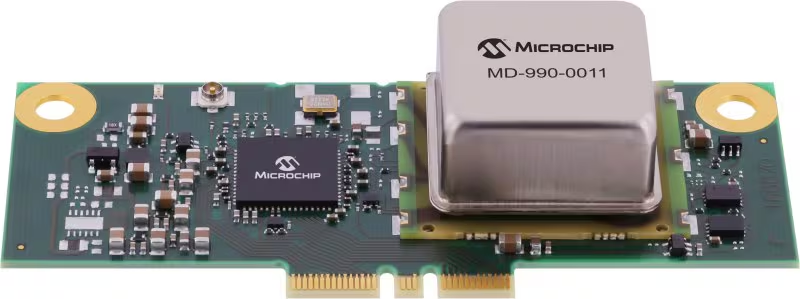
Microchip Technology has released its MD-990-0011-B family of plug-in timing modules, delivering turnkey, high-precision synchronization for data center servers and 5G virtualized radio access networks (vRAN).
Developed in collaboration with Intel, the MD-990-0011-B timing module is designed for seamless compatibility with Intel Xeon 6 SoC-powered server platforms, supporting both OEMs and ODMs in building future-ready systems. By leveraging Intel’s foundational vRAN architecture, the module enables robust, low-latency time synchronization, which is essential for distributed AI workloads and real-time applications.
Engineered for the reliability and scalability required by cloud infrastructure, virtualization and high-availability deployments, the MD-990-0011-B supports automatic source selection and locking across GNSS, synchronous Ethernet (SyncE) and precision time protocol (PTP). This flexibility supports continuous, accurate timing even as network demands evolve.
The MD-990-0011-B timing modules are available in two variants. MD-990-0011-BC01 offers eight hours of holdover performance; MD-990-0011-BA01 offers four hours of holdover performance. These timing modules consolidate several of Microchip’s advanced technologies into a single, highly integrated solution. Key components include:
Synchronous Ethernet (SyncE) synthesizer (ZL80132B). Two independent digital phase-locked loop (DPLL) channels for flexible and resilient synchronization
Oven controlled crystal oscillators (OCXOs, OX-22x). Provide up to eight hours of holdover, ensuring stable timing during GNSS outages or network disruptions
MCP9808 temperature sensor. Supports enhanced, environmental monitor 24LC024 EEPROM implementing board configuration and VC-820for low jitter performance
By unifying these critical timing components into a single plug-in module, the MD-990-0011-B streamlines server architecture, reduces design complexity and simplifies the supply chain. Its modular design enables rapid installation and simplified maintenance, minimizing downtime and facilitating effortless upgrades, key advantages for dynamic data center and 5G network environments.
How the atom went from data’s worst enemy to its best friend
By David Chandler, product marketing manager, Frequency and Timing Systems business unit, Microchip Technology
GNSS constellations are precise timing systems. (Image: Microchip Technology)
Timing from atomic clocks is now an integral part of data-center operations. The atomic clock time transmitted via Global Position System (GPS) and other Global Navigation Satellite System (GNSS) networks is synchronizing servers across the globe, and atomic clocks are deployed in individual data centers to preserve synchronization when the transmitted time is not available.
This high level of synchronization is vital to ensure the zettabytes of data collected around the globe every year can be meaningfully stored and used in many applications, whether due to system requirements or to ensure regulatory compliance. The quantum nature of an atom enables the precision time and is a critical part of ensuring that more data at faster speeds will be processed in the future — ironic, as just a few years ago the quantum nature of the atom was seen as the ultimate death of this increase in data processing and speed.
In 1965, Gordon Moore predicted the transistor count on an integrated circuit would double every year. This was eventually revised to doubling every two years. Along with this increase in transistor density came an important increase in speed as well as decreases in cost and power consumption.
It may have been hard in 1965 to imagine there would be any real-world need to have a semiconductor with 50 billion transistors on it in 2021, but as semiconductor technologies kept up with the law, so did application demands. Cell phones, financial trading and DNA mapping are all applications that rely heavily on the number of operations per second a microprocessor can execute, which is closely tied to the transistor count on a chip.
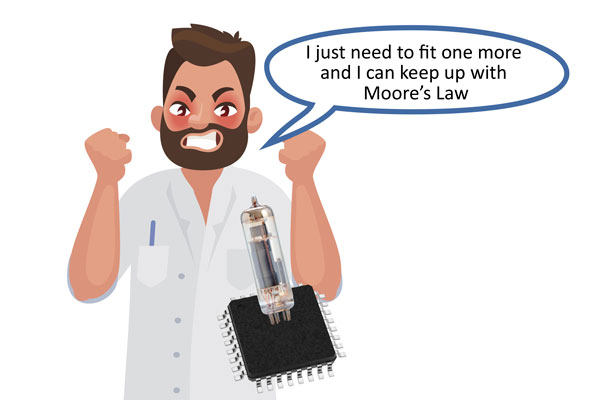
Satirical image of an engineer trying to keep up with Moore’s Law. (Image: Microchip Technology)
The Demise of Moore’s Law
Unfortunately, Moore’s Law is rapidly coming to an end due to a limit imposed by physics. With wafer fabrication now in the sub-10-nm technology nodes, the transistor sizes are only about 10 to 50 times that of a silicon atom. At this scale, the size and quantum properties of atoms and free electrons significantly prohibit further size reduction. In essence, you could think of the atom as the ultimate court that struck down the law.
But while Moore’s Law will come to an end, the thirst for increased processing power will continue to grow. With the advent of the internet of things (IoT), streaming services, social media posts and autonomous self-driving cars, the amount of data generated every day continues to increase exponentially.
In 2021, every day an estimated 2.5 exabytes (2,882,303,761,517,120,000 bytes) was generated. Exabyte databases managing more than 100,000 transactions per second (a transaction consists of multiple operations) are currently in use, and the size of the databases and the transactions per second will continue to grow for the foreseeable future.
Synchronizing the Machines
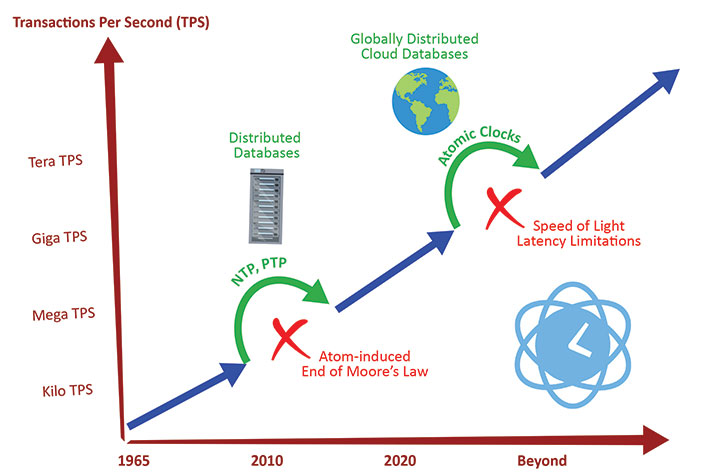
This explosive growth in the volume of data — coupled with the speed at which the data must be written, read, copied, analyzed, manipulated and backed up — required data-center architects to find a way around the end of Moore’s Law. The architects employed horizontal scaling in a data center with distributed databases, where instead of an entire database residing on one server, the database is distributed over multiple servers in a cluster.
In this configuration, the cluster essentially functions as one giant machine, hence the size and speed of the system now becomes limited by the physical size of a data center rather than by the size of an atom. (Take that, atom!)
Software engineers now make careers writing code that enables horizontal scaling. For all the software to work, however, all the machines must be synchronized. Otherwise it violates a concept called causality.
What is causality? It is easiest to explain through an example. Suppose you have two cameras to record images for a 100-meter dash, each with its own internal clock. The first camera is at the starting blocks. The second camera is at the finish line. Both sensors are continually firing and timestamping each image with the time from their respective clocks.
Clock uncertainty causes issues with causality. In this case, a race officially finished before it started. (Image: Microchip Technology)
To determine the official time of the winning sprinter in the race, the first camera’s images are reviewed for the point in time when the first runner left the block and this time-stamp is subtracted from the time-stamp on the last camera’s image for that runner crossing the finish line.
For this to work, both cameras must be synchronized to an acceptable level of uncertainty. If the synchronization of the clocks is only ±0.05 seconds, you would be unable to determine if someone who was recorded as running 9.6 seconds actually broke the world record of 9.58 seconds. What if they were only synchronized to ±5 seconds from the stadium clock?
Imagine this scenario: Observed from the main stadium clock, a race starts at exactly 12:00:00:00 p.m. The first runner crosses the finish line at 12:00:09:60 p.m. From the perspective of the main stadium clock, the official race time was 9.6 seconds.
But what if the first camera’s clock was exactly 5 seconds fast and the second camera’s clock was exactly 5 seconds slow? The race would officially start at 12:00:05:00 p.m and finish at 12:00:04:60 p.m. The race would officially finish 0.4 seconds before it started, the world record would be shattered, the laws of physics would be broken, and the current record holder would most likely be wrongfully dropped by all his sponsors.
Applying Causality to a Database
The same principle of causality is important in a database. Transactional record updates must appear in the database in the sequential order in which they occurred. If you count on the direct deposit of your paycheck arriving prior to having a direct withdrawal to pay your monthly mortgage, and the bank’s database did not record these in the correct sequence, you will be charged an overdraft fee. On one machine, causality errors are easy to prevent, but on multiple servers, each with its own internal clock, the servers must be synchronized and timestamp every transaction.
To achieve this, one server must act as a reference clock, much like the stadium clock, and it must distribute time to each server in a way that minimizes the time error of each server clock. The uncertainty of each timestamp (±5 seconds in the race) forms a time envelope that is twice the uncertainty of the clock (10 seconds for the race). For a distributed database, the number of nonoverlapping time-envelopes that can fit into a second should be at least on the order of the number of transactions per second expected for the system.
Probability, criticality of causality, and cost of implementation will ultimately all play a role in the final solution, but this relationship is a good starting point. A system with time-stamp uncertainties of ±1 millisecond would have time-envelopes of 2 milliseconds, and a maximum of 500 non-overlapping time-envelopes would fit in one second. This system could support approximately 500 transactions per second.
Where NTP and PTP Fall Short
Time-over-Ethernet technologies known as Network Time Protocol (NTP) and Precision Time Protocol (PTP) are used to synchronize all the servers in a distributed database in a data center. These protocols can ensure a local area network can distribute time with sub-millisecond (NTP) or sub-microsecond (PTP) uncertainties, enabling thousands (NTP) or millions (PTP) of transactions per second.
Unfortunately, even with these solutions that enabled a detour around the atom-imposed demise of Moore’s Law, physics has thrown another roadblock in the path of distributed databases in the form of the speed of light.
Imagine a well-synchronized distributed database operating with PTP in San Jose, California, happily executing 100,000 transactions per second with no causality issues. One of the database architects is sitting in his office in New York and his boss asks him to update a large series of records.
The architect wants to be able to exploit his new database to its full extent and show off the system capabilities. He plans on executing 100,000 transactions per second.
To update records per the request, he creates a simple transaction that adds the value of one record to a second record only if the value of the first record is greater than the second record. To accomplish this, he must issue a read to both records. His local machine in New York will then compare the values, then send a write command to the second record when needed.
After completing this, he then wants to execute the next transaction that compares a third value to the new sum. If the new sum is greater than the third record, then the third record is replaced with the sum. He wants to repeat this for 6 million records. Because the database is capable of 100,000 transactions per second, he thinks it will be done in roughly a minute. He tells his boss he will have the records updated in five minutes, then leaves to get a cup of coffee.
While drinking his coffee, he reads a story about how the new 100-meter dash record is negative 0.4 seconds which defies the laws of physics, and that the previous record holder is suing the stadium officials because he has lost all his endorsement money. The architect laughs to himself and thinks that the stadium should have hired him as the synchronization expert.
He comes back to his desk five minutes later and is dismayed to see that his database update has completed fewer than 1,500 transactions. He sadly realizes his mistake and prepares his résumé to send it over to the stadium, where he hopes his PTP deployment won’t have the same problem.
What went wrong? The speed of light limits the theoretical fastest possible transmission of data between New York and San Jose to 13.7 milliseconds.
The speed of light imposes a theoretical limit to the speed at which data can be transferred between two points. (Image: Microchip Technology)
The Distance Problem
Unfortunately, real world transactions are even slower. Even with a dedicated fiber-optic link between the two locations, the refractive index of the fiber, the real-world path of the fiber and other system issues make this transit time even slower. So just one transmission from New York will take 40 to 50 milliseconds to arrive in San Jose.
However, in this transaction there are four unique operations. There are two read operations, which could happen in parallel, which then have to be sent back to New York. The round trip takes 80 to 100 milliseconds. Then, once both values are compared, a write operation is issued and a write acknowledgement must be sent back indicating the write operation completed before the next transaction can start.
Suddenly, it doesn’t matter that the database can perform 100,000 transaction per second, because the distance is limiting the system to 5 transactions per second. To complete the 6 million transactions, this system would take 13 days, more than enough time for several more cups of coffee and to update a résumé. This delay is referred to as communications latency.
Circumventing Latency
But just like with Moore’s Law, database architects figured out how to circumvent latency. Database replications are created near the users, so they can work with the data without having to send signals across the country.
Periodically, the replications are compared and reconciled to ensure consistency. During the reconciliation process, the transaction time-stamps are used to determine the actual sequence of transactions, and records are sometimes rolled back when there is an irreconcilable difference such as when the transaction time-envelopes overlap. Reducing clock uncertainty reduces the number of irreconcilable differences in replicated instances, as more time-envelopes reduce the probability of overlaps. This results in higher efficiencies and lower probabilities of data corruptions.
But now the timestamping has to be accurate not only within each data center, but also between the data centers, which can be separated by thousands of miles and connected via the cloud. This is a much more difficult task, as it requires an external reference with very low uncertainly that is readily available in both locations.
Down to the Atomic Level
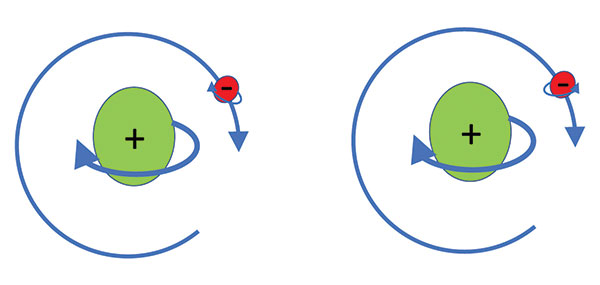
Enter the previous foe of the database architect, the atom. While the atom was busy repealing Moore’s Law, its subatomic particles were busy spinning. The neutrons and protons in the nucleus were rotating, while at the same time the electrons were busy orbiting about the nucleus, while also spinning on their own axes. This is analogous to Earth orbiting around the sun while simultaneously spinning on its axis.
The electrons can spin around their axes clockwise or counterclockwise. Considering there are roughly 7 octillion (7 with 27 zeros after it) atoms in a human, with all the subatomic particles spinning in our bodies, it is amazing we aren’t permanently dizzy. (Note: The subatomic particles aren’t really busy spinning and orbiting, they are really busy giving us probability wave functions and magnetic interactions that would give us results similar to what would happen if they were spinning and orbiting. But if the thought of all the spinning makes you dizzy, trying to comprehend the reality of quantum mechanics will make you positively nauseous.)
Conceptual atoms with nucleus and valence electron with nuclear spin, electron spin and orbital spin. (Image: Microchip Technology)
When microwave radiation at a very specific precise frequency is absorbed by an electron, the direction of spin about the electron axis can be changed. If this happened to Earth, the Sun would suddenly set in the east and rise in the west!
Atomic clocks are machines designed to detect the state of the electron spin, and then change that direction through microwave radiation. The frequency varies depending on the element, the isotope, and the excitation state of the electrons.
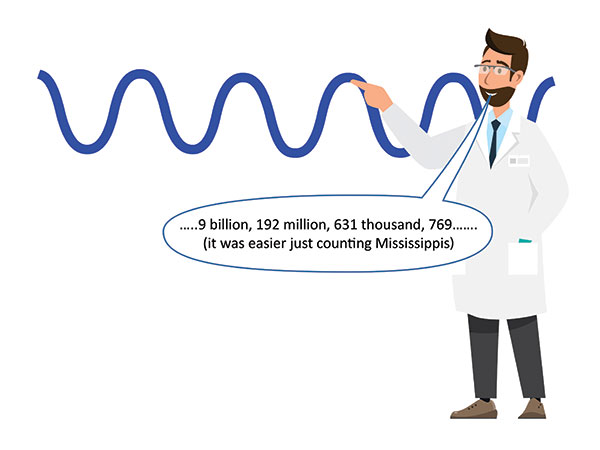
Once the machine determines the frequency, known as the hyperfine transition frequency, the period can be determined as the inverse of the frequency, and the number of periods can be counted to determine the elapsed time. The international definition of the second is 9,192,631,770 periods of the radiation required to induce the hyperfine transition of an electron in the outer orbital shell of a cesium atom.
Atomic clocks are the most stable commercially available clocks in the world. An atomic clock the size of a deck of cards called the chip-scale atomic clock (CSAC) will drift 1 millionth of a second in 24 hours, whereas an atomic clock the size of a refrigerator called a hydrogen maser will only drift 10 trillionths of a second in 24 hours. (Coincidentally, 10 trillionths is also about the ratio of the radius of the hydrogen atom to the height of the sprinters in the 100-meter dash and of the now-unemployed data-center architect in New York.)
With the accuracy provided by these atomic clocks, approximately 500,000 to ~50 billion non-overlapping time-envelopes can be provided for a distributed database running in data centers in Tokyo, London, New York, Timbuktu or anywhere else in the world.
The unit second is defined by counting 9,192,631,770 cycles of the cesium hyperfine transmission radiation frequency. (Image: Microchip Technology)
Time for Distribution
How does time get to all the data centers from these atomic clocks? Universal Coordinated Time (UTC) is a global time distributed by satellites, fiber optic networks, and even the internet. UTC itself is derived from a collection of high precision atomic clocks located in national laboratories and timing stations around the world. Contributors to UTC receive a report that provides the UTC time from these clocks and their individual offset from calculated UTC. The labs and other facilities then transmit the time to the world.
The UTC report is published monthly and tells the national labs their miniscule timing offset from UTC during the previous month. Technically, we don’t know precisely what time it was up until a month after the fact. And to make things worse, extra seconds are periodically added to UTC, called leap seconds, which are inserted due to variations in the Earth’s rotation and our relative position to observable stars. While this aligns Earth to the universe, it causes havoc in data centers and 100-meter dashes.
The hyperfine transition frequency produced in a hydrogen maser, 1.420405751 GHz, will cause spin reversal in an electron. (Image: Microchip Technology)
Enter GNSS
Two common methods used by data centers to acquire UTC are via the internet using publicly available NTP time servers and via satellite using GPS or other GNSS networks. While timing through public NTP timeservers over the internet was common during early deployment of distributed databases, inherent performance, traceability and security issues have created the push to move away from this solution.
Even though GPS and other GNSS are typically thought of as positioning and navigation systems, they really are precision timing systems. Position and time at a receiver are determined by the transit time of signals traveling at the speed of light from multiple satellites to the receiver. Ironically, this is another case of a physics principle causing a problem — in this case the speed of light instead of the atom — but also contributing to the solution.
The satellites have their own onboard atomic clocks, which are synchronized to UTC that was transmitted to the satellites from ground stations. Acquiring UTC with this method can provide time uncertainties in the 5-nanosecond range, enabling 100 million time-envelopes per second.
This method is far more reliable and accurate than public NTP servers, and while these signals can be interrupted by such events as solar storms or intentional signal jamming, backup clocks that have been synchronized to the satellite signals when present can be placed in each individual data center to provide the desired uncertainty levels during these interruptions.
The evolution of database transaction rates and the enabling and disabling technologies. (Image: Microchip Technology)
Next Up: Jumping Electrons
As our quest to acquire, store and transact data in the future continues to grow, novel atomic-clock technologies and time transmission systems with lower uncertainties will be needed. Currently, national timing labs are developing atomic clocks that work on the optical transitions that occur when an electron jumps orbital shells. These offer frequency stabilities to a quintillionth of a Hertz and will eventually be used to redefine the unit second.
Signal transmission through dedicated fiber-optic links or airborne lasers are already yielding improved transmission accuracy. With these continued innovations data, the atom and light will continue their complex love-hate relationship to enable ever larger quantities of data processed at ever increasing rates without consistency issues or causality casualties.
Upgraded range of synchronization solutions now includes enhanced PNT resiliency against jamming and spoofing attacks and cyberthreats
ADVA has announced a new software release of its core and edge timing technology, to provide higher levels of positioning, navigation and timing (PNT) security and resilience to synchronization networks. The new release follows the Resilient PNT Conformance Framework issued by the U.S. Department of Homeland Security (DHS).
The upgraded series of PTP grandmaster clock solutions now enables operators to automatically harness public key infrastructure. Along with enhanced certificate management, this delivers more robust security and removes complexity, the company said.
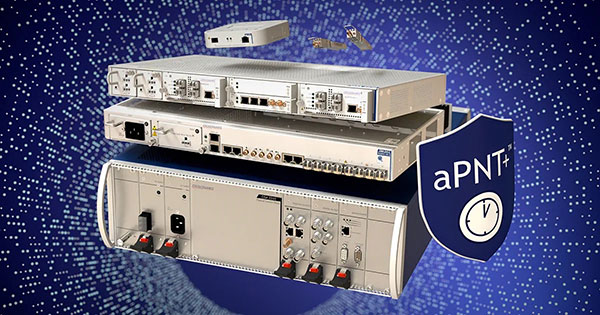
ADVA’s core and mid-sized PTP grandmaster devices now also integrate enhanced aPNT+ technology, providing advanced jamming and spoofing detection as well as mitigation with automatic switchover in the event of cyberattacks.
The software replaces costly hardware devices previously used for PNT protection and achieves enhanced DHS Level 4 Resiliency in PNT self-survivability, the highest in the industry. The new software release also supports 100 Mbit/s over fiber for interconnectivity with optical timing channels from third-party vendors as well as support for PTP profiles for a wide range of industries.
“Today’s timing networks require greater accuracy than ever before. But mission-critical national networks need improved resilience and security as defined by the latest standards. With our trusted PNT assurance solutions, we’re providing the GNSS protection and cybersecurity that today’s operators need to meet current and future challenges,” said Gil Biran, GM of Oscilloquartz, ADVA. “From phase synchronization in critical national infrastructure to traceable timestamping in financial networks, highly precise and protected timing is key to successful operations. This upgrade sets a new standard for secure synchronization and delivers it to more networks than ever before.”
The new 11.1.1 software release features upgrades to ADVA’s comprehensive range of Oscilloquartz edge timing products, the OSA 5412/22 series, as well as its core synchronization devices, the OSA 5430/40 series. The solutions now provide multi-layered security for synchronization infrastructure through improved certification management and PKI.
As part of ADVA’s intelligent and scalable assured PNT platform, the ADVA aPNT+, the solutions also feature innovation for detection of spoofing and jamming as well as countermeasures to prevent service disruption. With PTP capabilities for new verticals, including the PTP broadcast profiles (SMPTE ST-2059-2/AES67), the new release will bring precise, reliable synchronization to many new customers.
Chronos Technology Ltd., a UK-based resilient synchronization and timing company, has transitioned to employee ownership through the Chronos Technology Employee Ownership Trust (EOT) Ltd.
Charles Curry who established Chronos Technology in September 1986 and was co-owner alongside his wife, Angela Curry, had been deliberating succession planning and their exit from the business. Various options such as a third-party sale or a management buyout were considered but quickly dismissed.
“I am aware of business owners who had exited through third-party sales and had not enjoyed the experience of working under new management for the agreed handover period,” Curry said. “New owners generally change the dynamic of the business, often introducing new staff and work practice without giving opportunity to existing staff and process, and we did not want this for Chronos.”
“Over the years we have established a work ethic that puts the customer first,” Curry continued. “The EOT protects the loyal Chronos family and ensures the customer-facing continuity of the business and, most importantly, safeguards jobs. Going forward, in the hands of the employees, the company will benefit from increased customer engagement and the commitment to a team approach to steer the business on the next phase of its journey.”
Chronos Technology specializes in resilient synchronization and timing systems, smart technologies, GNSS and cybersecurity solutions for critical national infrastructure, with industry experience gathered over 35 years in specialist technologies such as GNSS, PTP, NTP and SyncE.
The company provides GPS coverage solutions in hangars, manufacturing areas and underground, as well as smart technology solutions and GNSS jamming detection and location solutions for law enforcement. Customers include telecom, finance, energy, data centers, broadcast, aerospace, defence and security, enterprise/IT, emergency services, transport and manufacturing.
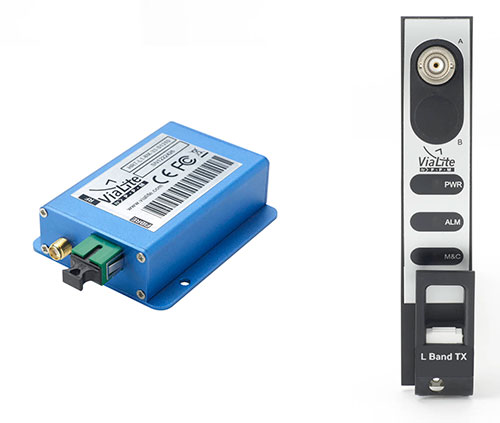
ViaLite GPS Link: Blue OEM module and rack chassis card hardware formats shown. (Photos: ViaLite)
ViaLite is supplying Raytheon Technologies with its GPS over Fiber Extension Kit for Microchip GPS servers. The kit provides mission-critical GPS timing and synchronization for systems requiring extremely accurate clock signals.
Standard transmission distances for the extension kit can be up to 10 km, while solutions are available for distances as long as 50 km.
“The ViaLite kit was chosen for its unique performance with Microsemi’s S650 timing server, along with our best-in-class quality, reliability and support,” said Craig Somach, ViaLite director of Sales North America.
The ViaLite GPS link is designed to provide a remote GPS/GNSS signal or derived timing reference to equipment located where no signal is available, such as inside buildings or tunnels. By using optical fiber instead of traditional coaxial cable, extreme distances are possible with no radio frequency loss and zero introduction of noise.
Adva’s OSA 5405-MB provides nanosecond timing at a network’s edge. (Photo: Business Wire)
Adva has launched the OSA 5405-MB, a compact outdoor precision time protocol (PTP) grandmaster clock with multi-band GNSS receiver and integrated antenna.
Part of the OSA 5405 series of smart synchronization devices for indoor or outdoor deployment, the OSA 5405-MB ensures timing accuracy by eliminating the impact of ionospheric delay variation. This empowers communication service providers and enterprises to deliver the nanosecond precision needed for 5G fronthaul and other emerging time-sensitive applications.
The GNSS receiver and antenna enable the OSA 5405-MB to meet PRTC-B accuracy requirements (+/-40 nanosec0nds) even in challenging conditions. For the first time, the technology is available in an edge timing device with minimal footprint, helping operators achieve unprecedented accuracy and reliability as they roll out wide-spread small cell networks.
“Our multi-band, multi-constellation GNSS receiver provides an extremely cost-efficient way to achieve PRTC-B UTC-traceable network timing with the levels of accuracy needed for next-generation use cases,” said Gil Biran, general manager, Oscilloquartz, Adva. “By adding this technology to our versatile, small-form-factor OSA 5405 series, we’re offering a route to precision synchronization at the network access without significant investment.”
“A ruggedized design and minimal visibility make our OSA 5405-MB easy to install in almost any outdoor location,” Biran said. “With the power to compensate for ionospheric delay variations and resilience against jamming and spoofing, our compact edge solution really is the key to 5G synchronization.”
The OSA 5405 series is a versatile timing solution for deployment deep in urban canyons, where advanced end applications require stringent synchronization. With its small form factor, the OSA 5405-I indoor variant can be positioned on windows to avoid multipath signal interference.
Offering both electrical and optical interfaces and with cost-effective Ethernet cabling, the OSA 5405 series avoids RF feeds of traditional GNSS installations by integrating an antenna, receiver and PTP grandmaster in a single device.
Ionospheric Delays. With multi-band GNSS technology, the OSA 5405-MB also protects against timing inaccuracies caused by ionospheric disturbance. By receiving GNSS signals in two frequency bands and using the differences between them to calculate and compensate for delay variation, the OSA 5405-MB eliminates inaccuracy and ensures ultra-precise synchronization whatever the space weather conditions.
It can work with up to four GNSS constellations concurrently (GPS, Galileo, GLONASS and BeiDou), increasing the number of observable satellites in urban canyons. A comprehensive set of Syncjack PTP and GNSS jamming and spoofing monitoring features in combination with Adva’s Ensemble Controller and Sync Director assures high synchronization quality and provides transparency for simple operation of large synchronization networks.
The OSA 5405-MB also offers network-delivered timing backup to further mitigate GNSS vulnerabilities and make synchronization more robust and resilient.
The United Kingdom’s National Timing Centre will conduct a two-phase series of funded studies and demonstrations focusing on “innovation in the dissemination and application of resilient time, frequency and synchronisation.”
The first round now being advertised is for feasibility studies of projects costing between £50,000 and £250,000. Total funding for the round is £2M. A briefing for interested parties will be held on April 20.
The second round and remaining funding will be devoted to technology demonstrations.
The UK’s National Timing Centre was established in response to several national studies and concerns about the vulnerability of space-based timing services.
Severe solar storms, called coronal mass ejections, were listed on the UK National Risk Register in 2012. While rare, these events can damage assets in space and on the ground.
Next month marks the 100th anniversary of the New York Railroad Storm. It was so powerful, telegraph offices were set on fire in the U.S. and Europe, fuses were blown, and equipment damaged. Even underwater telegraph cable traffic was affected.
Experts say if such a storm were to strike the Earth today, it would likely damage GPS and other GNSS satellites. At a minimum, it would charge the atmosphere and prevent signals from getting through for days.
Projects that will be considered for the UK competition must be technologies and application areas providing trust, assurance, security and resilience for time distribution.
While supported by Innovate UK, the National Physical Laboratory (NPL), which operates the virtual National Timing Centre, appears to be the primary agent for execution. NPL will offer applicants who are selected to participate in the feasibility study phase free technical consultation up to 12 hours, and free access to highly precise and accurate time signals from four NPL locations in the southeast of England.
Since its inception, the National Timing Centre seems to have concentrated on establishing distributed suites of atomic clocks, probably linked by fiber, as a first step to improving the nation’s timing resilience.
Industry observers have opined that future efforts are likely to focus on wireless distribution.
“Wireless requires less infrastructure and has no user limit,” said one. “It only makes sense they would go there once they feel they have a solid clock foundation.”
The competition is open to UK entities. Applications will be accepted April 19-June 9, with accepted participants notified on July 30.
Oxford Technical Services (OxTS) has launched precision time protocol (PTP) master functionality on all of its next-generation inertial navigation systems (INS).
PTP is a network-based time synchronization protocol used to synchronize all clocks throughout a computer network. It is used in many industries, but most notably in finance to synchronize transactions, mobile-phone tower transmissions and subsea acoustic arrays.
Time synchronization
In many commercial organizations, millisecond-level device synchronization as offered with network time protocol (NTP) is sufficient. However, in surveying and automotive testing environments where there is more than one clock source (lidar and inertial navigation systems, or INS, for example), final results can suffer from time drift if millisecond — and not microsecond — synchronization is used.
Time drift becomes relevant as soon as you introduce more than one data acquisition system working in parallel. This is because each system will have its own timing error, and over time this error will grow and create drift.
For surveyors, time drift can negatively impact point clouds by making object recognition difficult, subsequently leading to blurring and double vision.
For automotive engineers, when running campaigns, analysis of events within your data may be misaligned, making the analysis more difficult and/or less efficient.
Stamp out time drift
To stamp out time drift, it is important to use the most accurate clock source available.
A key component of an INS is the GNSS receiver. The GNSS receiver acquires data, including timing information, directly from multiple GNSS constellations (GPS, GLONASS, BeiDou and Galileo). The GNSS receiver, coupled with the inertial measurement unit within the INS, allows users to benefit from the centimeter-level position accuracy that is so important in surveying and automotive testing environments.
These satellite systems house the most accurate time source possible — atomic clocks — meaning that devices connected to a network that includes an INS can take advantage of this time source owing to the GNSS receiver within the INS.
Simpler setup for lidar use
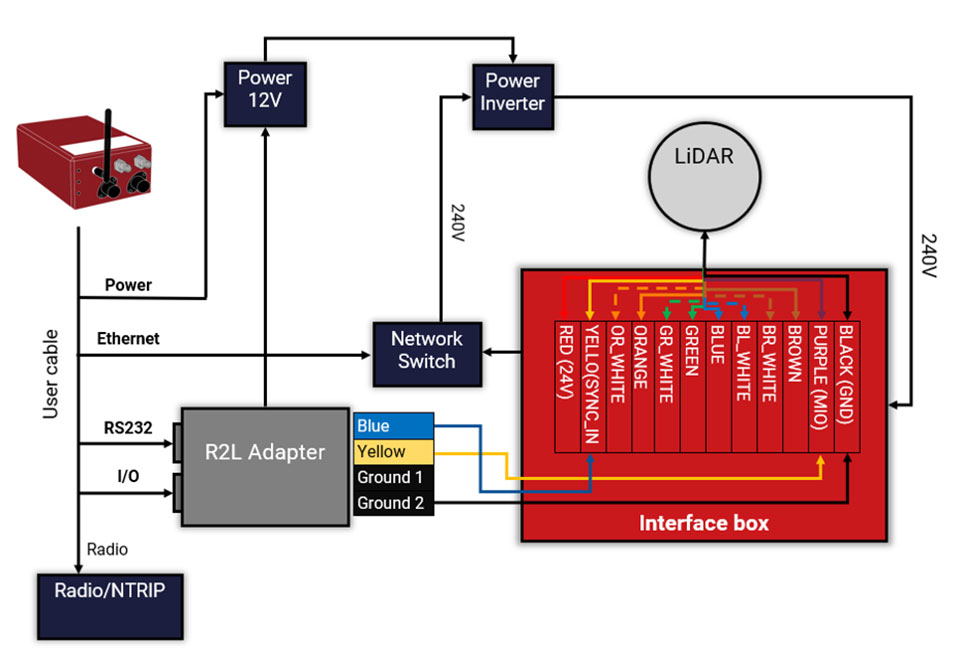
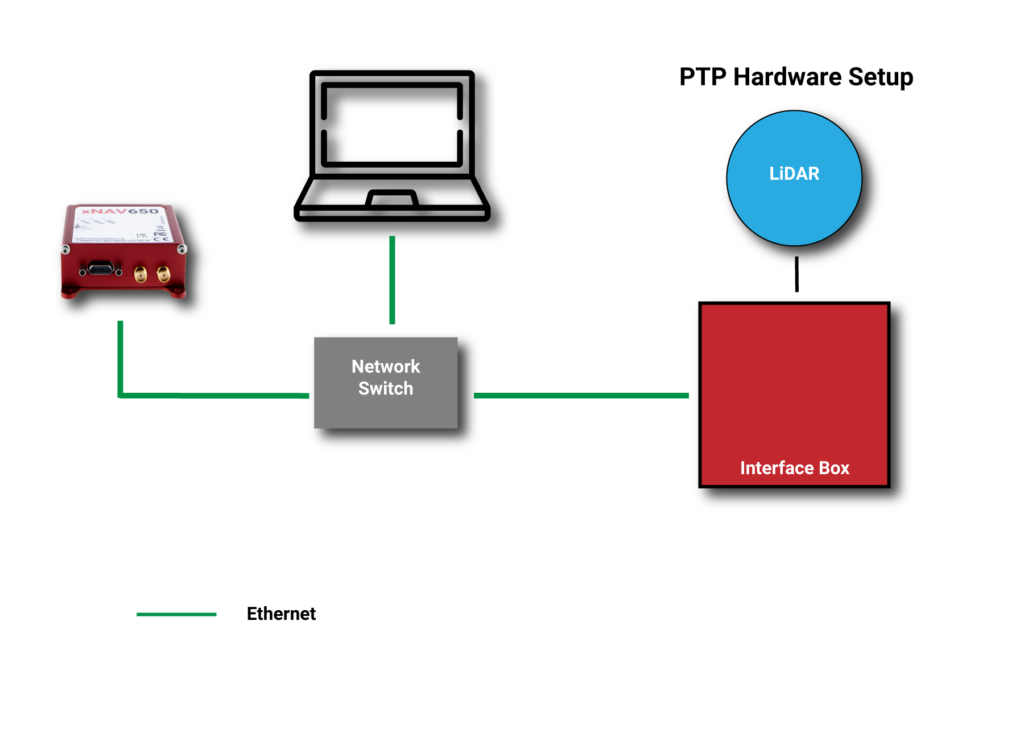
By migrating from a traditional PPS hardware set-up, which involves connecting and wiring multiple cables, to a PTP setup, which is essentially an Ethernet “plug-and-play” solution, users can also make day-to-day use of the equipment simpler and more efficient.
Without PTP – using PPS setup. (Image: OxTS)
An example PPS hardware setup with a PTP-enabled network. (Image: OxTS)
This much-improved hardware setup allows surveyors and automotive test engineers to be up and running in a much shorter time frame than previously possible.
Adding value to the automotive industry
The addition of PTP also adds value for automotive users. With cars-under-test incorporating multiple sensors (lidars, cameras, etc.), synchronizing all that data can help support accurate analysis after the test is complete.
OxTS is continuing to develop its PTP solution by working on PTP slave functionality and improving the configuration process, which will provide greater flexibility in typical automotive setups that use data acquisition (DAQ) for larger sensor networks.
Summary
PTP as a time synchronization method is becoming more popular, particularly in the lidar industry, with manufacturers such as Ouster and Hesai enabling PTP on their sensors.
The shorter “time to survey” gives customers a much-enhanced user experience, and the higher quality final output on offer means that many users will demand their sensors are PTP-compatible before considering them for their projects.
Manufacturers of complimentary sensors, such as INS, need to build the capability into their product sets to allow them to be fit for the future.
Various OxTS INS are available to use PTP, including the new xNAV650, the company’s new small, lightweight and affordable INS for applications where payload size and weight matter. Learn more about the xNAV650 INS.
Users can also find out more about OxTS and its range of PTP-enabled devices by visiting its dedicated landing page, OxTS PTP-enabled INS devices.
Orolia, a provider of resilient positioning, navigation and timing (PNT) solutions, announced that its SecureSync time and synchronization servers have been selected to support enroute radar systems across the U.S.
The selection comes as part of the Federal Aviation Administration’s (FAA) move towards a Next Generation Air Transportation System (NextGen). NextGen is about halfway through a multi-year investment and implementation plan.
The FAA plans to keep rolling out NextGen technologies, procedures and policies through 2025/2030 and beyond.
While NextGen will rely heavily upon GNSS to increase capacity, efficiency, and safety in the National Air Space (NAS), many technologies including legacies such as radar will be integrated into the system for maximum robustness to error and disruption.
The FAA employs a variety of radar types for short-, medium- and long-range air traffic control requirements. These diverse radars require different types of timing signals and outputs to suit their operations.
SecureSync. Orolia’s SecureSync provides the necessary timing outputs and signals to meet these requirements. The time server’s ability to provide resilient, accurate and reliable timestamps for the data that it receives from radars is used to quickly organize the data for the aircraft control user interface.
The only time and synchronization device approved by the Defense Information Systems Agency (DISA) for use in U.S. Government networks, Orolia’s SecureSync provides reliability, security and flexibility to synchronize critical aviation operations. SecureSync combines multi-GPS/GNSS signal synchronization, options for alternative signals and BroadShield GPS anti-jamming/spoofing protection for transportation systems. SecureSync combines Orolia’s precision master clock technology and secure network-centric approach with a compact modular hardware design.
The FAA selected Orolia for the competitive program based on its proven timing and synchronization technology and its ability to offer multiple output options as commercial off-the-shelf (COTS) products that do not require additional research and development time or investment.
“Consistently accurate timestamps and the synchronization of thousands of real-time flight data points are essential for safe and efficient enroute air traffic operations,” said Jean-Yves Courtois, CEO of Orolia. “Orolia is proud to support the FAA’s radar data and aircraft control user interface requirements to improve air travel services nationwide.”
More About the SecureSync COTS Product. Built-in time and frequency functions are extended with up to 6 input/output modules. Included with the base unit is a 1PPS timing signal aligned to a 10 MHz frequency signal without any 10 MHz phase discontinuity.
A variety of internal oscillators are available, depending on requirements for holdover and phase noise. On-board clocks synchronize to a variety of external references as standard, factory-installed or upgradable options.
Users may add alternate signals of opportunity to GPS or GNSS input references to improve resilience, or use them for indoor applications and choose from a variety of option cards to add to configuration of timing signals, including additional 1PPS, 10 MHz, time code (IRIG, ASCII, HaveQuick), other frequencies (5 MHz, 2.048 MHz, 1.544 MHz), telecom T1/E1 data rates, multi-network NTP and PTP. Modules can be customized for exact requirements.
To support network time synchronization, SecureSync supports the latest features of network time protocol (NTP) and precision time protocol (PTP, IEEE-1588v2). An optional multi-port NTP configuration allows for operation across 4 isolated LAN segments. Up to 6 PTP ports can be added to operate in various PTP deployments.
SecureSync is a security-hardened network appliance designed to meet rigorous network security standards and best practices. It ensures accurate timing through multiple references, tamper-proof management and extensive logging. Robust network protocols are used to allow for easy but secure configuration.
Features can be enabled or disabled based on network policies. Installation is aided by DHCP (IPv4), AUTOCONF (IPv6), and a front-panel keypad and display. The 1 RU chassis supports multi-GNSS (GPS/ Galileo/GLONASS/BeiDou/QZSS) input.
Options include SAASM, supporting L1/ L2, available for authorized users and required for the US DoD, and BroadShield GPS jamming and spoofing detection. The unit is powered by AC on an IEC60320 connector. DC as back-up, or primary, is available.
Microsemi Corporation has launched a new IEEE 1588 timing synchronization module, offering a complete self-contained platform for customers to implement IEEE 1588 network timing client protocols.
The solution, which consists of hardware, firmware and software, combines capabilities from Microsemi’s broad product portfolios by leveraging the company’s SmartFusion2 system-on-chip (SoC) field programmable gate array (FPGA), ZL30363 IEEE 1588 phase-locked loop (PLL) and VSC8575 Ethernet PHY devices.
Microsemi’s new IEEE 1588 timing synchronization module streamlines customers’ developments to add synchronization network timing to their designs, simplifies the sourcing process and reduces development time while providing an easy integration.
The module also includes drivers, servos/algorithm firmware, IEEE 1588 Precision Time Protocol (PTP) stack software, a user guide and reference board schematics to deliver a fully tested chip-set solution from a trusted tier-one vendor.
The IEEE 1588 timing synchronization module blends Microsemi’s expertise in nanosecond-level accurate timestamping for IEEE 1588 via the VSC8575 Ethernet PHY; embedded IEEE 1588 protocol engine and servo via its SmartFusion2 SoC FPGA host processor; and high precision clock generation, holdover and reference switching via its ZL30363 system synchronizer.
The solution is addressed via a command line interface to minimize software integration efforts.
The combination of these capabilities makes the new solution suitable for applications within the industrial networking, smart grids, communications, defense and data center markets.
Depending on the applications holdover and reliability requirements, either an XO, TCXO or OCXO can be used to provide holdover supported by the IEEE 1588 timing synchronization module.
According to a 2017 GNSS Market Report, issue 5, the timing capability offered by satellite navigation systems is at the core of most vital infrastructures; telecom networks operation, energy distribution, financial transactions and TV broadcast are some examples of areas where a GNSS is used for timing or synchronization purposes.
The annual shipments of GNSS devices used in the timing and synchronization market will exceed 300,000 units in 2017 and are expected to grow at a compound annual growth rate (CAGR) of 5.3 percent over 2017-2025.
Catering to this growth opportunity, Microsemi’s new IEEE 1588 timing synchronization module is designed specifically for such applications, which require much more precise timing, including base stations and small cell markets for 5G, 4G, 4G LTE, LTE-Advanced, microwave and millimeter wave based fixed wireless networks, smart grids and secure edge networks.
Other key features of Microsemi’s new IEEE 1588 timing synchronization module include:
High accuracy timestamping of less than 4 nanoseconds
Frequency and phase synchronization
Holdover with initial accuracy of <1ppb and long-term holdover of 1.5µs over 24 hours using the appropriate performance OCXO
Hitless reference switching
Precision frequency and phase control
Multiple profiles, including IEEE 1588-2008 Annex J.3 End-to-End
Microsemi Corporation’s new SyncServer S650 SAASM server incorporates a Selective Availability Anti-Spoofing Module (SAASM).
The SAASM capability provides a highly secure, accurate and flexible time and frequency platform for synchronizing mission-critical electronics systems and instrumentation applications in the defense market, such as satellite communications and defense operational infrastructure, the company said.
Military Grade. The new SyncServer S650 SAASM, designed for use by the U.S. Department of Defense (DOD) and other government agencies as well as their approved suppliers, received the GPS Directorate Security Approval to incorporate a military-grade, GPS SAASM receiver module.
Microsemi SyncServer S650 SAASM Time and Frequency Server.
This enables U.S. armed forces to confidently deploy features of Microsemi’s popular commercial SyncServer S650 in a military-grade configuration. In addition, the integrated SAASM module adheres to industry standards allowing for a migration path to GPS Military Code (M-code) support.
“Our key military and DOD-related customers require flexible, secure and extremely reliable time and frequency technology for their most critical applications, which they have come to rely upon from Microsemi. Enabling support for SAASM provides the extra security and reliability necessary for this market,” said Randy Brudzinski, vice president and business unit manager of the Frequency and Timing Division at Microsemi. “The addition of the SyncServer S650 SAASM to our product line further demonstrates Microsemi’s commitment to providing the highest quality time and frequency technology in support of vital government programs.”
The SyncServer S650 SAASM is a highly versatile time and frequency system with the company’s FlexPort technology for multiport, user-definable output signal configurations for time codes, pulses and a variety of signal types essential for system synchronization.
This makes the SyncServer S650 SAASM ideal for DoD electronics system engineers synchronizing mission-critical, system-level instruments. This is coupled with Microsemi’s NTP Reflector technology for robust security, accuracy and reliability of network-based time services such as Network Time Protocol (NTP) and Precision Time Protocol (PTP).
Resilience to Threats. According to a 2017 GNSS Market Report, global navigation satellite system (GNSS) jamming and spoofing are specifically identified as increasing and notable cybersecurity threats to critical infrastructure.
Furthermore, resilience to these threats has become mandatory by critical infrastructure policy makers and GNSS receiver manufacturers. Without the use of SAASM technology in the presence of these threats, deliberate or unintentional, the most mission-critical systems operated by the DOD may be subject to the side effects of degraded time and frequency performance.
Microsemi’s new SyncServer S650 SAASM is designed to generate precise time and frequency signals to synchronize high bandwidth mission-critical communications systems and critical infrastructure requiring the highest levels of security support.
In addition to offering superior low phase noise performance, the device is compliant with the Joint Chiefs of Staff SAASM GPS mandate and developed for authorized military users only.