Tag: test flights

  • UAVOS successfully completes ApusDuo solar HAPS test flight

    UAVOS successfully completes ApusDuo solar HAPS test flight

    Photo: UAVOS
    Photo: UAVOS

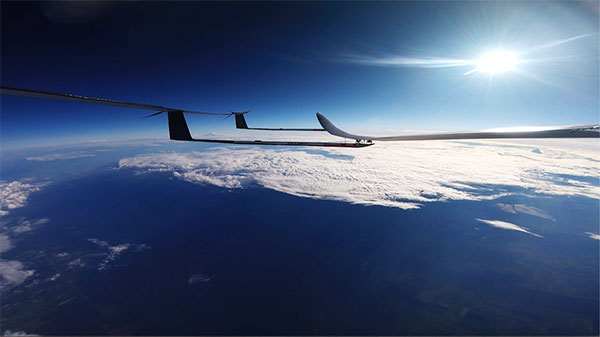
    UAVOS has completed a successful test flight of the ApusDuo solar-powered high-altitude platform system (HAPS).  The test flight, at a European Flight Center, was conducted continuously for 11 hours and reached altitudes of 15,000 meters.

    The ApusDuo successfully achieved more than two dozen test points, including energy balance validation, power and propulsion performance, and propeller revolutions per minute evaluation. The team also tested aircraft motor control efficiency, which was refined following previous test flights.

    After operations in Europe, UAVOS plans to transport ApusDuo to Argentina. The company is accelerating preparations to perform the next phase of test flights in the stratosphere.

    ApusDuo is a stratospheric UAV running on solar power, and is meant to provide persistent local satellite-like services. Built with carbon-fiber composites, it can be landed, re-equipped with multitask payloads and re-deployed. It is also capable of flying autonomously from takeoff to landing and can be remotely operated from its ground-control station.
  • SPH Engineering’s UgCS software now supports Velos UAV helicopter

    SPH Engineering’s UgCS software now supports Velos UAV helicopter

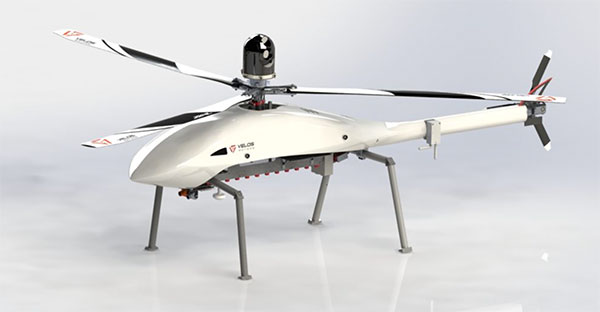
    The Velos UAV helicopter has passed field tests to become the first single-rotor helicopter supported by UgCS software, according to UgCS maker SPH Engineering. UgCS now enables Velos helicopter professionals to use Velos for photogrammetry and lidar drone surveying missions.

    UgCS is now able to support the twin-engine telemetry providing input for a UAV. Its newly created Telemetry Viewer can handle extensive telemetry from such complex drones. This allows for optimal flying of the Velos helicopter with a fully redundant twin-motor design and double key components.

    UgCS allows for the control and monitoring of one or multiple Velos helicopters on a single mission in both single and multi-operator modes.

    Photo: Velos UAV
    Photo: Velos UAV

    The field tests were initiated and conducted by GeoInspect, the first company to use c with its Velos helicopter. The new solution allows professionals to fine-tune projects, resulting in maximum performance and very high usability. One of the projects was a fully autonomous test flight with UgCS.

    “GeoInspect has been performing lidar surveys successfully with UgCS for many years,” explained Bart Zondag, GeoInspect founder. “Having started with the M600 model, UgCS is now used to support single-rotor UAVs. We have already delivered a Velos V2 with UgCS to one of our customers to the EU Nordics to perform lidar forestry surveys.”

    Learn more about the solution by joining a free Zoom webinar on March 4, 2021.

  • UAVOS control system for HAPS takes on unstable air

    UAVOS control system for HAPS takes on unstable air

    Photo: UAVOS
    Photo: UAVOS

    UAVOS Inc. has performed a series of successful flight trials with High Altitude Pseudo Satellite (HAPS) ApusDuo, testing its unique control system.

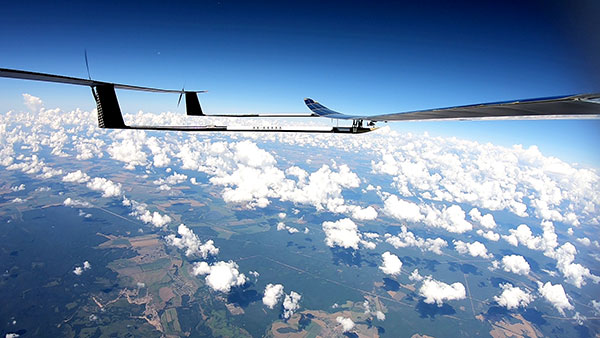
    The test flights confirmed that UAVOS’s control system allows aircraft with a large-wing elongation to fly in unstable atmospheric conditions. The ApusDuo aircraft successfully copes with turbulence, actively changing the bend of the wings.

    The total flight time of UAVOS solar-powered test aircraft is more than 1,000 hours. Test flights took place at an altitude of up to 62,000 feet (19,000 meters).

    UAVOS’s control system does not require the installation of wing mechanization. This reduces the aircraft’s weight by 30% or more, improves reliability and simplifies wing production for lower manufacturing costs.
    The ApusDuo drone weighs about 95 lbs (43 kg) and has a wingspan of 49.2 ft. It is launched by a winch. The aircraft is built on the tandem principle, where two of the wings are located one after another with a small elevation difference.

    ApusDuo is controlled by changing the geometry of the aircraft. It is designed to linger at an altitude of about 60,000 feet (18,000 m) for months at a time for surveillance or to provide a temporary boost to communications.

    Additional test flights are planned for this year, said Aliaksei Stratsilatau, UAVOS CEO and lead developer.

    In July, UAVOS became a member of the HAPS Alliance, which aims to accelerate commercial adoption of HAPS technologies.