Tag: The Business

  • The Business: Location-Driven Coupons on iPhone

    >> LOCATION-BASED SERVICES

    Location-Driven Coupons on iPhone

    By Gwen Cameron

    Yowza!!, an application designed for the latest GPS-enabled iPhone 3G and 3GS models and iPod Touch, brings relevant coupon offers to customers based on their location.

    “Any time you insert a concept such as location into a marketing program, you end up with a far more compelling value proposition,” states Mike Wehrs, president of the Mobile Marketing Association.

    Sales and discount offers via Yowza!! can be updated in real-time and targeted by region or store location. “The phone will deliver a list of stores within one mile that have offers on Yowza!!,” said August Trometer, co-founder of the recent startup. Users show the barcode and digital mobile coupon on their handset at checkout to redeem the discount on their purchase.Bus-2

    “We work directly with merchants; they provide us with their latitude and longitude, we get the GPS coordinates, do a database search with a proprietary algorithm,” said Trometer. “The phone constantly goes back and forth between our app, touching data from our database. When the person touches their location, it touches a new set of data in the database. The phone will work with them to keep delivering the closest store. There’s a lot of work on the database end of things.”

    One drawback of the app is that it has to be turned on to work — it does not sit in the background, waiting to be activated by incoming offers. “Users have to give the application access to their GPS coordinates,” explained Trometer. “But the power of the device and all the applications it brings make it silly to turn off the location capability.”

    Retailers that have signed with Yowza!! include Sears, McDonald’s, The Container Store, and more. Unlike traditional forms of couponing such as newspaper ads, Yowza!! offers can be updated in real time and targeted by region or store location.

    Trometer expects to announce Yowza!! capability through other GPS-equipped phones: Blackberry Storm, Google’s Android-based phone, and the Palm Pre. “All three makers allow developer access to the GPS and this is very important, it’s crucial, obviously. They also have a high-res screen, which is a requirement for our scannable barcode that the user shows to the merchant.”

    Referring to GPS handsets that lack a high-res screen, he claims “The other phone manufacturers really have an uphill battle right now.”

    Whose GPS? The source of the GPS chip within Apple’s iPhone remains a mystery. “Even people who have done teardowns of the devices, the chips are completely blank,” says Trometer.

    “There are so many possibilities, we’re just scratching the surface right now with what can be done,” Trometer said. “The mind reels with the things that can be done with that.”

    >> SURVEY & CONSTRUCTION

    Hemisphere, Juniper Jointly Offer DGPS Receiver for Demanding Environments

    Juniper Systems and Hemisphere GPS offer the XF101 DGPS receiver for the Archer Field PC, designed to deliver sub-meter DGPS to location-based applications in demanding environments.

    According to the companies, the Hemisphere GPS XF101 DGPS receiver provides: Crescent GPS technology for sub-meter accuracy; COAST technology to maintain accuracy during temporary loss of differential signal; optional external antenna for centimeter-level accuracy; low power consumption; modular connection for rapid field use; real-time or post-processed DGPS data collection; and multipath minimization.

    The XF101 with the Archer is priced at less than $2,500. It fully supports mobile GIS applications such as ESRI ArcPad and OnPoz GNSS Driver.

    >> AVIONICS

    NovAtel Receiver for Next-Gen WAAS

    NovAtel announced receipt of a contract from the U.S. Federal Aviation Administration (FAA) to develop the next generation Wide Area Augmentation System (WAAS) reference receiver, the GIII. Total contract value can go up to $9.7 million.

    NovAtel has worked with the FAA WAAS program since 1995, providing and supporting two previous generations of reference receivers for the WAAS ground network. The technology refresh will add support for new L1C, L2C, and L5 signal capabilities, on a qualified RTCA DO-178B software and DO-254 hardware platform. The WAAS GIII receiver program is scheduled to be completed over the next three years, and will include growth provision for further signal capability such as Galileo. As many as 14 receivers will be produced in the GIII development and qualification program.

    >> FLEET TRACKING

    AT&T, Trimble Fleet Management

    AT&T has broadened its fleet and mobile asset management portfolio with the latest version of Trimble’s GeoManager solution, which helps reduce fuel and maintenance costs by enabling operators to manage their vehicle assets more efficiently.

    Trimble GeoManager enables transportation and field-service fleet operators to track their mobile workers and assets through software and GPS modems running on AT&T’s wireless network. GeoManager integrates GPS, wireless data communications, and a browser interface to help manage mobile workers, the mobile worker’s work, and the mobile worker’s assets.

    AT&T and Trimble have jointly offered fleet-tracking solutions for several years. The GeoManager update features improved map and status, new landmark uploads, WLAN usage, schedule report enhancements, driver logs, and organizational hierarchy modifications.

    >> TIMING

    Timing Vulnerability Concern Grows

    Industrial and enterprise users in telecommunications and utilities privately express concern over revelations from the April Government Accounting Office (GAO) report, “Global Positioning System: Significant Challenges in Sustaining and Upgrading Widely Used Capabilities.” The GPS signal is used for synchronizing almost all global computer networks belonging to the military, utilities, banks, telecomms, television companies, and many more.

    Backup? What Backup? These same companies point to a continued lack of commitment on the part of the U.S. government to stable and reliable backup for GPS. As long ago as 2007, in comments before the Department of Transportation, wireless carrier Sprint Nextel stated: “Sprint Nextel Corporation respectfully requests that the U.S. government continue to operate and invest in the LORAN-C and eLORAN systems. Should the DOT and DHS decide to decommission the LORAN-C system, Sprint Nextel recommends that the agencies delay doing so until the eLORAN system is fully operational. Sprint Nextel and other communications providers use the frequency signals of the Global Positioning System, LORAN, and atomic clocks for multiple levels of redundancy and diversity in their networks. Therefore, Sprint Nextel urges the DOT and DHS to carefully weigh decisions which might impact LORAN’s availability to the nation’s voice and data communications networks.

    “The loss of a primary reference source (PRS) can negatively impact a telecommunications network, and those impacts can vary from minor short-term noise impairments to long-term network-wide outages. Both traditional wireline services and newer wireless services require a precise frequency reference for basic service delivery . . . . The continental U.S. portion of the Sprint Nextel network requires a PRS at thousands of switch sites, interconnection sites
    , and cell tower sites to ensure reliable service delivery.”

    Deadlock on Capitol Hill. Competing resolutions to either discontinue or adequately fund LORAN and eLORAN continue fencing in Congressional subcommittees in both chambers. Nothing has changed since Sprint commented two years ago — aside from a potential rise in the susceptibility of GPS to jamming, unintentional interference, and decreased availability.
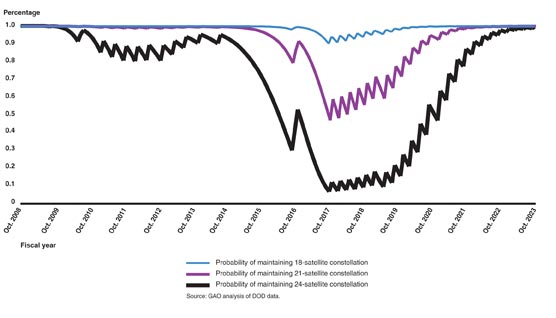
    GAO REPORT, FIGURE 5. Probability of maintaining constellation of at least 18, 21, and 24 GPS satellites based on reliability data as of March 2009 and a two-year GPS III launch delay.
    GAO REPORT, FIGURE 5. Probability of maintaining constellation of at least 18, 21, and 24 GPS satellites based on reliability data as of March 2009 and a two-year GPS III launch delay.

    >> TIMING

    Telecom Clock from EndRun

    EndRun Technologies announced a Telecom Clock Option for its Meridian Precision GPS Timebase, which provides accurate and stable GPS-synchronized outputs for military communications, aerospace, broadcast, engineering and calibration laboratories, telecommunications, and more.

    The option was designed as a plug-and-play module that can supply any combination of E1, T1, J1 and/or composite clock outputs. An alarm output is also available and single-satellite mode (SSM) is supported. The Telecom Clock Option can be installed in EndRun’s GPS or CDMA-based Meridian and Tycho product lines.

  • The Business — January 2007

    » AVIONICS & TRANSPORTATION

    Pay As You Drive Insurance Gets Brit Road Test

    Under a plan offered by British insurer Norwich Union, GPS helps determine how much drivers pay for their auto insurance.

    The company’s Pay As You Drive plan uses GPS to calculate monthly insurance premiums based on how often, when, and where a person drives, basing the premium on the individual’s driving habits — rather than everyone else’s — and potentially saving the customer some money.

    A black-box GPS unit provided by Trafficmaster is installed in the trunk or under the dashboard so it cannot be disturbed or tampered with. Once the unit is fitted on the car, the insured motorist’s journeys are monitored to see what types of road they drive on, and whether they drive at peak or off-peak times. This generates a price per mile that is totaled on their monthly bill.

    The objective is to help drivers control insurance costs by making informed choices about when to use the car. Examples of pricing might be 1 penny per mile for off-peak motorway driving for 24 to 65 year olds, and as much as £1 per mile for an under 24-year-old driver at night.

    Norwich Union has been piloting the project since 2004, with 5,000 customers recording data on 100 million miles from more than 10 million trips.

    The program especially targets young motorists. “We tested young drivers because they have an issue with high insurance charges so we wanted to find ways to help them,” said Norwich Union’s product development manager Sue Rowland. “On average, they saved 30 percent on their premium.”

    The Pay As You Drive bill looks similar to a mobile phone bill, with premiums for each journey calculated and totaled. According to Iain Napier, director of Pay As You Drive insurance, this transparent approach to motor insurance will help customers control insurance costs.

    “We’re confident that Pay As You Drive insurance is simply a fairer way of calculating premiums and gives customers greater control, flexibility, and choice,” Napier said. “That is why we expect this unique UK proposition to be a huge success with motorists.”

    The Association of British Drivers (ABD) is not fond of the plan. “Aside from the obvious implications for privacy and civil liberties, the ABD warns drivers that this information can also be used for the government’s planned road charging scheme.” In that proposal, aimed at cutting congestion, “pay-as-you-go” road charges would replace road and gas taxes. Every vehicle would be equipped with a GPS black box to track its journey. Costs would range from as little as 2 cents per mile in rural areas to £1.34 per mile for peak time in city areas.

    An ABD spokesman who participated in the initial 5,000-vehicle trial said, “Insurance premiums are already based on a driver’s accident/ conviction history, age, the number of miles traveled annually, and the vehicle’s insurance group. Why do we need to attempt a micro-managed premium calculation? We don’t. The government’s own research shows that they are not trusted with an individual’s personal journey details by the majority of the British public. The use of service providers, such as insurance companies, is seen as a way around the problem.”

    Norwich Union is the UK’s largest general insurer with a market share of around 14 percent, and a focus on insurance for individuals and small businesses.


    » LOCATION-BASED SERVICES

    Philips Exits PND Market Before Entry

    Philips Electronics, the Netherlands-based electronics giant that is Europe’s largest consumer electronics company, said in June, 2006, that it would enter the personal navigation device (PND) market in the fall, to compete with Garmin, TomTom, Magellan, and other PND makers. But it abruptly pulled the plug on that effort in early December, stating that it was no longer interested. A spokesperson confided that the company had watched the market closely and decided it was too crowded.

    This marks the second time Philips has retreated in this sector. Although its Carin system was an early dedicated in-vehicle nav system (circa 1990), and the company was an early investor in NavTeq, it later abandoned that market.

    The booming European PND market, which analysts say could double to about 5 million units, has attracted Japanese consumer-electronics giants as well as many smaller Taiwanese manufacturers. Hardly a day goes by without a trumpeting of a new PND, often from a company heretofore unheard of in GPS and nav circles.

    “It’s a very competitive market and it puts a lot of pressure on profit margins,” stated the Philips spokeperson. “We decided we need some focus, and navigation devices like these don’t fit within this focus.”

    The company remains interested in GPS in general, but not for stand-alone products. “We don’t want to go further with GPS as a single device, but it’s an interesting technology to implement in other products,” she added. Mobile phones or digital music players remain as possible candidates for GPS capabilities.


    » TRANSPORTATION & AVIONICS

    Trimble Acquires @Road, Spacient

    Trimble will acquire @Road, Inc. of Fremont, California for $496 million. This expands Trimble’s role in mobile resource management (MRM), formerly known as fleet tracking. Trimble acquired Spacient Technologies, an MRM software supplier, in November.

    An early sector pioneer, @Road has a scalable software infrastructure, relationships with telecom carrier partners, system integrators, and a strong field presence in transportation, distribution, telecommunications, utilities, facilities management, and public works. This complements Trimble Mobile Solutions division’s business in construction supply, store delivery, and public safety.

    Frost and Sullivan forecasts MRM growth to $2.6 billion by 2010, from $1.2 billion in 2006.


    Carnegie Mellon’s Sandstorm racer, veteran of both Mojave and
    Grand Challenges

    » MILITARY & GOVERNMENT

    Driving for Dollars: Urban Challenge Purse Put at $3.5 Million

    The Defense Advanced Research Projects Agency (DARPA) will award $2 million, $1 million and $500,000 awards to the top three robotic finishers who complete its new Urban Challenge course in November 2007.

    Under Secretary of Defense for Acquisition, Technology and Logistics Kenneth J. Krieg approved the cash prizes, evidencing the Department’s interest in making one-third of all combat vehicles — principally supply vehicles — driver-less by 2015.

    DARPA has staged two desert Grand Challenges, in 2004 and 2005 in the Mojave, with significant difficulties posed by geography and terrain. The 2007 Urban Challenge will feature fully autonomous ground vehicles conducting simulated military supply missions in a mock urban area. The race will take place on November 3, 2007, at a location to be announced later, in the western United States.

    Robotic vehicles will attempt to complete a 60-mile course through traffic in less than six hours, operating under their own computer-based control. Vehicles must obey traffic laws while merging into moving traffic, navigating traffic circles, negotiating busy intersections, and avoiding obstacles.

    Learning Curve. Participants in past Grand Challenges have truly risen to the occasion, learning and innovating as they go. The number of sensors and software applications integrated into most of the experimental vehicles increased dramatically between the first and second races. Inertial sensors proliferated, with cost, size, and power consumption going down, while performance went up. Inertial systems, along with various camera/vision apparati, function as the workhorses covering the ground in most of the vehicles. GPS generally teams with a central processing unit (CPU) to act as the brain guiding the process.

    William “Red” Whittaker of Carnegie Mellon University’s Robotics Institute and Louis Nastro of Applanix Corporation co-authored a detailed technical article in September 2006 GPS World on their experience with the students of Carnegie Mellon’s Red Team Racing effort, designing and outfitting two vehicles that competed and placed in the 2005 race.

    To qualify for the race or simply watch, see the Grand Challenge website for additional information and rules for the Urban Challenge.


    » AGRICULTURE & NATURAL RESOURCES

    Accuracy on the Move

    The American Society of Agricultural and Biological Engineers (ASABE) announced an effort to develop a standard on the dynamic accuracy of GPS equipment used in precision agriculture. In unveiling Project X587, Assessment and Reporting of GPS Receiver Dynamic Accuracy, in its October 2006 newsletter, the Society states: “GPS receivers are used in many agricultural field operations. There are standards in place to guide assessment of the static accuracy of GPS receivers, but static performance is not always indicative of the performance when the receiver is used dynamically.”

    The ASABE seeks to develop such dynamic accuracy standards to enable evaluation of moving GPS units. Farmers spend thousands of dollars on mobile, high-precision GPS units that are components of tractor guidance systems, variable-rate application equipment, and crop- yield monitoring equipment. The proposed standards will provide prospective purchasers with a benchmark to compare the specifications of units for accuracy.

    Current specifications assume that GPS units that monitor satellite signals five times per second deliver greater positional accuracy than units that monitor the signals one time per second. The proposed ASABE standards will provide a more definitive measurement on the way GPS units must function on moving vehicles.


    » LOCATION-BASED SERVICES

    Cingular TeleNavs Mobiles

    Cingular Wireless has launched its first generally available, location-based service with TeleNav Inc’s GPS Navigator. Cingular business and government customers can get turn-by-turn voice and onscreen GPS directions, while driving or walking, on Cingular business devices including the HP iPAQ hw6920 and hw6500 Mobile Communicators, the Cingular 8125 Pocket PC, and the Palm Treo 650. The latter two devices require a Bluetooth GPS receiver. A GPS receiver is built into the Mobile Communicators. Features include:

    • full-color moving maps
    • a “Biz Finder” for locating nearby businesses such as cash machines, restaurants, hotels, and gas stations
    • a spot marker for locating a parked car
    • a fuel finder for finding low gas prices
    • pedestrian mode.

    Pricing is $5.99 per month for up to 10 trips, or $9.99 per month for unlimited trips.

    “Location-based services on wireless phones have disrupted the navigation market and created a more versatile solution for both businesses and consumers,” said Ken Hyers, principal mobile wireless analyst at ABI Research, of the launch of TeleNav GPS Navigator.