Tag: Tier 1 automakers

  • Ambarella to acquire imaging radar company Oculii

    Ambarella to acquire imaging radar company Oculii

    An Oculii sensor placed at the front corner of a vehicle. (Photo: Oculii)
    An Oculii sensor placed at the front corner of a vehicle. (Photo: Oculii)

    Oculii’s patented adaptive AI software increases resolution of existing RF radar silicon up to 100X

    Ambarella Inc. has entered into a definitive agreement to acquire Ohio-based Oculii Corp. Oculii’s adaptive artificial intelligence (AI) software algorithms are designed to enable radar perception using current production radar chips to achieve significantly higher (up to 100x) resolution, longer range and greater accuracy.

    The fusion of Ambarella’s camera technology and Oculii’s radar software stack provides an all-weather, low-cost and scalable perception solution, enabling higher levels of autonomy for Tier 1 automakers and OEMs globally.

    Oculii’s technology eliminates the need for specialized high-resolution radar chips, which have significantly higher power consumption and cost than conventional radar solutions. Oculii’s software can be deployed on Ambarella’s existing CVflow systems-on-chip (SoCs), operating in conjunction with radar RF solutions to increase safety and reliability.

    The acquisition expands Ambarella’s addressable market into radar perception and fusion with its existing SoCs for automotive and other internet of things endpoint applications, including mobile robotics and security.


    Oculii’s superior resolution and sensitivity can unlock the potential of everything from advanced driver-assistance systems (ADAS) and autonomous vehicles to robotics and security, by providing radar with a dynamic waveform that uses AI to learn from and adapt to the environment. The result is an extended operating range of up to 400 meters with a wide field of view.


    See also

    Why radar is the future of autonomous transportation


    To date, Oculii is engaged with 10 of the top 15 Tier 1s on software licensing, and has commercial development contracts with other OEM and AV companies. Oculii is generating pre-production revenue today, with production programs expected to commence in CY2023.

    The boards of directors at both companies have approved the transaction, which is subject to customary closing conditions and expected to close during Ambarella’s Q4 FY2022 (ending January 31, 2022). Wilson Sonsini Goodrich & Rosati served as legal advisor to Ambarella, and Goodwin Procter served as legal advisor to Oculii. Greenhill & Co. served as financial advisor to Ambarella.

  • Trimble joins VSI Labs in autonomous vehicle research

    Trimble joins VSI Labs in autonomous vehicle research

    Photo: Trimble
    Photo: Trimble

    Trimble to provide reliable in-lane positioning for the year-long research program

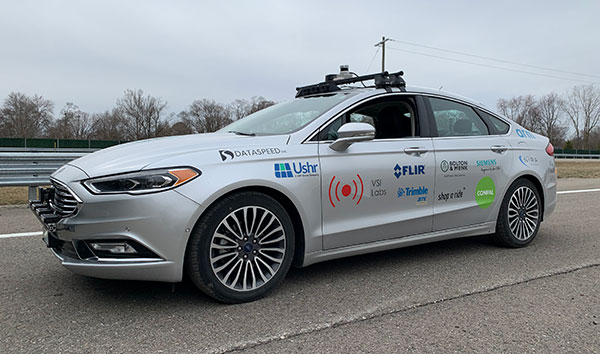
    Trimble and VSI Labs have formed an alliance, with Trimble serving as the GNSS precise positioning supplier for VSI’s autonomous research vehicle program. The alliance officially kicked off in March at Destination ACM, a long-distance driving event for VSI’s research vehicle that continues with additional events throughout the year.

    The collaboration provides the opportunity to showcase Trimble RTX technology as the trusted precise-positioning correction source for car manufacturers and their suppliers. Coupled with Trimble’s inertial positioning, Trimble RTX plays a pivotal role in a vehicle’s ability to maintain accurate and reliable lane-discipline during autonomous driving.

    Destination ACM launched from VSI’s Minneapolis headquarters en route to the American Center for Mobility’s (ACM) test center in southeast Michigan where a day of testing and demonstration took place March 26.

    “The integration of Trimble’s precise RTX positioning is a key element of VSI’s technology stack for advanced driver assistance systems (ADAS) and autonomous vehicle (AV) applications,” said Stephen Ruff, general manager of Trimble’s On-Road Autonomy Division. “VSI Labs is a leading researcher of best-in-class technologies critical to autonomous vehicle development.”

    Suitable for on-road driving applications, Trimble RTX corrections operate on a single, global network. Drivers are not subject to the coverage outages that can exist when relying on local positioning systems — requiring line-of-sight to a positioning source or radio/cellular/internet connections.

    When occasional obstructions are present, such as a bridge, tunnel or deep urban or rural canyon, Trimble augments its precise GNSS positioning with inertial technology to maintain continuous positioning and orientation while on the road.

    Trimble’s innovative GNSS positioning is being used on the road today by a number of automotive OEMs and Tier 1 suppliers to improve the functional safety and performance of ADAS for passenger vehicles. Consumers have logged more than 7 million miles using Trimble RTX for lane-level positioning to date.

    “VSI Labs is thrilled to have Trimble’s RTX technology on board,” said Phil Magney, founder and president of VSI. “Trimble’s positioning capabilities allow us to really expand our applied research on the safety and performance of autonomous and ADAS driving solutions.”

    Trimble GNSS positioning technology will be used in the VSI research vehicle during each of the quarterly Destination ACM events, the Drive World Conference in Silicon Valley in August, the VSI 2021 “Drive South,” and other events this year.

    For more about autonomous vehicles, see our June issue.

  • Qualcomm teams with Veoneer on ADAS and autonomous driving systems

    Qualcomm teams with Veoneer on ADAS and autonomous driving systems

    Automotive technology company Veoneer Inc. and Qualcomm Technologies Inc. are working together to deliver scalable advanced driver-assistance systems (ADAS) and collaborative and autonomous driving (AD) solutions.

    The platform will integrate Veoneer’s fifth-generation perception software and driving policy software with the current and future Snapdragon Ride portfolio.

    Qualcomm Technologies intends to make this integrated SoC and software stack platform available to global automakers and Tier-1 suppliers.

    Designed for Tier-1 automakers

    The solutions will be powered by Veoneer’s next-generation perception and driving policy software stack and the Qualcomm Snapdragon Ride ADAS/AD scalable portfolio of systems on a chip (SoC) and accelerators. They solutions range from L1 to L4 systems, designed to create an open platform for Tier-1 suppliers and automakers.

    Designed to address the growing complexities associated with developing ADAS, including safety compliance, the integrated software and SoC platform aims to address the growing needs of the automotive ecosystem for scalable and upgradable solutions, which require highly advanced and power-efficient compute, connectivity and cloud service capabilities across all vehicle tiers.

    Veoneer will serve as a Tier-1 system integrator for the new solution, while continuing its current strategies, which include developing, selling and launching its full line of ADAS and collaborative driving products and systems.

    2024 model vehicles

    The open and programmable platform that both companies intend to develop will be designed to create alternatives for automakers and Tier-1s for more customization opportunities while also charting a course for next-generation automotive architecture evolution. The companies expect the integrated platform to be available through automotive Tier-1 suppliers or directly to OEMs for 2024 vehicle production.

    Veoneer’s software stacks are automotive grade solutions designed to meet the requirements of automakers, regulators and rating agencies globally. It has received top performance ratings and enabled automakers to achieve 5-star safety ratings for European New Car Assessment Program (Euro NCAP) in 2018 and 2020.

    The companies plan to launch a state-of-the-art automotive-grade, functional safety compliant and optimized platform, which will include a full range of optimized NCAP features and up to hands-free driving on highways and slow-moving traffic. The platform will be continuously upgradeable through over-the-air updates.

    The next-generation software stack will be developed in a dedicated organization within Veoneer.

    In January, Qualcomm Technologies announced its latest addition to the company’s growing portfolio of automotive products with the new Qualcomm Snapdragon Ride platform.

    Image: adamkaz/E+/Getty Images
    Image: adamkaz/E+/Getty Images
  • U-blox L-band receiver enables cm-level positioning for mass market

    U-blox L-band receiver enables cm-level positioning for mass market

    Photo: u-blox
    Photo: u-blox

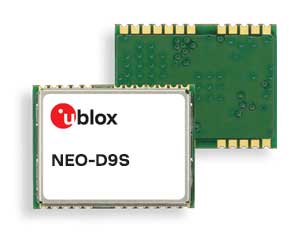
    U-blox said its new NEO-D9S GNSS correction data receiver module provides an affordable approach to bringing centimeter-level accuracy to GNSS receivers.

    The NEO-D9S receives from correction service providers broadcast on the L-band (1525-1559 MHz). A host processor can then decrypt this correction data and provide it to a high-precision GNSS receiver, combining corrections directly with readings from the satellite constellations to enable much more accurate position readings than those offered by GNSS signals alone.

    Use of the NEO-D9S will also increase the availability of high-precision GNSS positioning data in areas with limited connectivity and reduce the amount of cellular data consumed by positioning receivers.

    Customers are expected to include carmakers, both Tier 1 and OEMs, industrial system integrators that offer position-correction services, and any other applications that rely on very accurate positioning at low cost.

    The NEO-D9S module is a correction-only receiver, based on the latest u-blox ninth-generation (D9) platform. This means that it will integrate easily with the u-blox F9 RTK GNSS receivers from u-blox, or can be used as part of a modular product roadmap. The module also integrates a TCXO and SAW filter to ensure good RF sensitivity and resilience to interference from adjacent channels.

    The module includes the algorithms necessary to decode satellite data broadcasts. It is configured to work initially with whichever correction service has been set as default, but can be configured for any L-band data broadcast. It stores its configuration settings in non-volatile memory.

  • Quectel releases high-precision positioning module for auto industry

    Quectel releases high-precision positioning module for auto industry

    Photo: Quectel
    Photo: Quectel

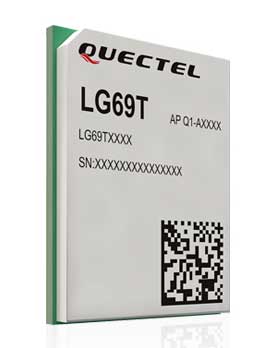
    Quectel Wireless Solutions Co. Ltd., in association with STMicroelectronics, has released the LG69T module, an automotive-grade dual-band high-precision GNSS module that integrates dead-reckoning (DR) and real-time kinematic (RTK) technologies.

    The new Quectel module, announced at 2019 Apsara Conference in Hangzhou, is designed to facilitate open-sky positioning performance with an accuracy of up to 10 centimeters, which is currently the industry’s most advanced positioning technology for the automotive market. LG69T will support next-generation precision positioning capabilities for smart vehicles and autonomous driving scenarios.

    The Quectel LG69T GNSS module is based on ST’s STA8100GA, the latest Automotive-grade dual frequency positioning chip with 80 tracking channels and four rapid-acquisition channels that are compatible with many constellations: GPS, BeiDou, Galileo, NAVIC/IRNSS and QZSS.

    It is an AEC-Q100-qualified dual-band (L1 + L5) GNSS module that integrates multi-band RTK technology for centimeter-level accuracy.

    The LG69T module’s dead-reckoning capabilities feature an integrated inertial measurement unit (IMU) that provides continuous high-precision positioning. The LG69T supports corrections input for standard Radio Technical Commission for Maritime Services (RTCM) and centimeter-level navigation by using RTCM data from a third — local base stations. The module performs well under the highly challenging conditions of urban canyon environments.

    “We are thrilled to collaborate with STMicroelectronics on our newest generation of high-precision positioning module,” said Min Wang, Quectel’s automotive product line general manager. “With this highly-integrated LG69T module, automakers and Tier 1 suppliers will no longer have to spend time selecting components, integrating hardware, adapting interfaces and conducting tests and verifications, which will greatly cut their time-to-market and costs, and help them accelerate the deployment of autonomous driving to seize early opportunities.”

    “ST has strong experience and is the Global Automotive High Precise Positioning Technology and Market Leader. We are very proud to cooperate with leading Chinese smart driving high technology company,” said MH TEY, Greater China, South Asia and Korea automotive marketing and application head of department, STMicroelectronics. “Today, there is growing dependency on high-performance GNSS in automotive applications such as navigation, safety and autonomous driving. With this cooperation, we are very confident to become the market leader by providing cost-effective and unique best-in-class solution for autonomous vehicle.”

    Engineering samples of Quectel’s LG69T module will be offered to automakers and Tier 1 suppliers by the end of 2019, and the product will be commercially available around mid-2020 and is expected to be deployed in mass produced models as early as 2021.

  • Trimble, Qualcomm partner on connected vehicle positioning

    Trimble, Qualcomm partner on connected vehicle positioning

    Companies aim to provide sub-lane-level accuracy to automotive OEMs and Tier 1 suppliers

    Image: Trimble
    Image: Trimble

    Trimble and Qualcomm Technologies, a subsidiary of Qualcomm Inc., will be working together to produce precise-positioning solutions for select automotive applications.

    Trimble will work with Qualcomm Technologies to integrate Trimble’s RTX technology with select Qualcomm Snapdragon Automotive 4G and 5G platforms to deliver a highly accurate positioning solution essential for maintaining absolute in-lane positioning.

    The new solution will accelerate the adoption of road-level navigation and emergency services applications, as well as satisfy requirements for developing advanced driver-assistance systems (ADAS) and autonomous driving solutions.

    The Snapdragon 4G and 5G automotive platforms feature integrated multi-frequency and multi-constellation high-precision GNSS technology. They also support all major global and regional GNSS satellite constellations including GPS, GLONASS, Galileo, BeiDou, and QZSS, operating concurrently on the L1, L2, and L5 frequency bands, including a precise positioning framework.

    The framework ensures consistency in access and use of precise positioning information and incorporates the use of GNSS corrections technology.

    Tight integration of GNSS functionality in conjunction with the modem reception of the corrections allows for minimum latencies and optimal performance of the precise-positioning solution from the telematics system and provides automakers with a global location platform to meet the requirements of next-generation vehicles.

    Trimble RTX technology provides real-time, multi-constellation GNSS corrections and positioning capable of achieving 2-centimeter horizontal accuracy worldwide, compared to uncorrected GNSS positioning that can be accurate to several meters. The combined solution will provide reliable, consistent, high-accuracy positioning, in a broadcast format, to serve even the most precise requirements of the automotive and transportation industries.

    “Trimble’s relationship with Qualcomm Technologies establishes a unique alliance between industry leaders, in which both companies are committed to advancing the development of safer, more capable ADAS,” said John Sprivulis, director of autonomous navigation solutions for Trimble’s advanced positioning division. “Together we will offer a solution to the automotive industry that can help accelerate the adoption of precise GNSS positioning in the connected car and transform the way the world drives.”

    “Highly accurate positioning is quickly becoming an important element of connected vehicle solutions to support Vehicle-to-Everything (V2X) and other autonomy applications,” said Lars Boeryd, senior director, product marketing, Qualcomm Technologies. “For this very reason, we are working with Trimble to host the RTX precise positioning software library on our Snapdragon Automotive 4G and 5G platforms to offer a robust end-to-end highly accurate position solution for the automotive industry.”

    Evaluation kit. An RTX-enabled Snapdragon evaluation kit (EVK) is expected to be available by early 2020, for use by automotive OEMs, Tier 1 suppliers or other stakeholders considering absolute positioning as part of their autonomy solution.

    Trimble has also made Trimble RTX Auto an ASIL and ASPICE compliant RTX software library, available to any OEM or supplier who requires a functional safety certified solution.