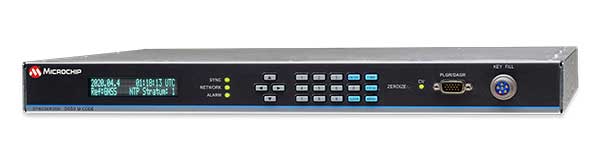
The GridTime 3000 GNSS time server meets rugged international environmental standards for power plants and substations
The GridTime 3000 GNSS time server. (Photo: Microchip)
Microchip Technology Inc. has announced its GridTime 3000 GNSS time server, a software-configurable solution providing power plants and substations with a new level of redundancy, security and resiliency to protect against surges, adverse weather and cyberattacks targeting critical infrastructure.
Meeting the Need
Power plants and substations rely on high-speed communications networks to transmit critical data including operability metrics, network health, fault monitoring, power measurement and usage trends. To synchronize communications and ensure continuity across these networks, substations require secure, precise timing and synchronization to avoid false tripping and to provide accurate time-stamping of substation data including system faults, power-measurement data and substation status information.
The launch of the Microchip GridTime 3000 GNSS Time Server assists power-grid operators to meet these requirements.
The GridTime 3000 system generates precise time and frequency signals to synchronize analog and digital communication systems. This resilient timing platform incorporates multiple timing inputs for protection in the event of a GNSS signal disruption caused by severe weather, environmental disturbances or signal jamming or spoofing.
New SyncServer S650 M-Code secures military communication systems, radar and networks reliant on GPS signals
Photo: Microchip
Threats from intentional jamming and spoofing of GPS signals, as well as cybersecurity risks to critical infrastructure, demonstrate the need for powerful and secure time and frequency systems that ensure continuing operability and performance.
Microchip Technology’s SyncServer S650 M-Code time server has received approval from the U.S. Air Force GPS Directorate of the Los Angeles Air Force Base for use in support of military communication systems, radars and networks.
M-code, an encrypted military signal broadcasted in GPS frequency bands, is required by congressional mandate for mission critical Department of Defense (DOD) applications in hostile environments. Microchip’s SyncServer S650 M-Code equipped time and frequency server provides a secure, accurate, flexible platform for synchronizing mission-critical electronic systems and instrumentation.
For DOD programs requiring jam-resistant, encrypted time and frequency signals from the GPS military M-code Precise Positioning Service (PPS), the SyncServer S650 M-Code is a secure time and frequency instrument with a fully integrated M-code GPS receiver.
“As the first time and frequency instrument enabling DOD compliance for M-code-based GPS systems, this technology demonstrates Microchip’s continuing commitment and investment in the security of time and frequency systems,” said Randy Brudzinski, vice president, Frequency and Timing Solutions business unit. “This time server represents a new level of security hardening built on Microchip’s proven commercial SyncServer S650 time server that provides extreme timing accuracy, security and flexibility.”
The SyncServer S650 M-code equipped time and frequency instrument is a rack mounted server device that synchronizes to the atomic clocks aboard GPS satellites via M-code. The S650 M-code leverages new technology to provide enhanced anti-jamming protection and further hardening against spoofing, providing greater accuracy, and improving operator ease-of-use for key loading.
Harder to jam than commercial CA-Code GPS, M-code provides a more secure signal than the commercial CA-Code or SAASM P(Y) signal, with greater accuracy. The instrument also is easier for operators to load crypto keys.
Staff Sgt. Daniel Pennington, a flight engineer assigned to B Co “Big Windy,” 1-214th General Support Aviation Battalion, takes in his ‘office’ view from the ramp of his CH-47 Chinook while flying over the island of Cyprus on Jan. 14, 2020. (Photo: U.S. Army/Maj. Robert Fellingham)
The SyncServer S650 M-Code can utilize Microchip’s FlexPort technology for multiport, user definable output signal configurations for Inter-Range Instrumentation Group (IRIG) timecodes, pulses and a variety of signal types essential for military communication, radars and network system synchronization. This is coupled with Microchip’s NTP Reflector technology for robust security, accuracy and reliability of network-based time services such as Network Time Protocol (NTP) and Precision Time Protocol (PTP). Other features include:
Four standard GbE ports, all with patented NTP hardware time stamping, with two additional 10 GbE ports optional
Contains most popular timing signal inputs/outputs standard in the base timing I/O module (IRIG B, 10 MHz, 1PPS)
Web-based management with high security cipher suite
Rubidium atomic clock or OCXO oscillator upgrades
Superior 10 MHz low phase noise options
Microchip has been delivering the SyncServer S650 to synchronize business critical and mission critical operations, across all industry segments, since its commercial introduction in 2016.
Microsemi Corporation is offering new hardware and software options for its SyncServer S600 series of time servers and instruments. The enhancements improve time synchronization over enterprise Ethernet networks and supply timing signals for improved military radar operations and satellite uplink communications.
“The SyncServer S600 series provides highly accurate, reliable and secure time for a variety of applications, not the least of which are the extremely precise low phase noise 10-MHz signals used in military radars and satellite uplinks,” said Paul Skoog, senior product line manager at Microsemi. “We’re committed to helping our customers improve the performance of their systems by improving the performance of ours. These high-quality timing signals enable radars to track difficult targets as well as to improve the quality and data throughput of satellite communications systems.”
Enterprise and financial customers also look to the SyncServer S600 series to meet the timing and synchronization needs of their rapidly evolving networks, particularly for compliance purposes such as the European MiFID II directive, which specifies highly stringent time accuracy requirements for stock trading systems.
Also applicable for laboratories and test and measurement companies, this latest release of Microsemi’s S600 hardware and software includes support for the IEEE 1588 multiport, multi-profile Precision Time Protocol (PTP), which allows the S600 to operate as an independent grandmaster clock on each Ethernet port — delivering cost savings and network deployment flexibility to customers. This is coupled with a new 10GbE interface to easily interoperate with a wider variety of network and stock trading topologies.
The newly enhanced SyncServer S600 and S650 can be equipped with two 10 GbE Ethernet small form-factor pluggable (SFP+) ports for customers needing to maximize PTP grandmaster performance in a cost-effective 1 rack unit (1U) chassis.
In addition, the S650 can measure the accuracy of PTP hardware slaves that are synchronized to the S650 grandmaster by way of a new external 1 pulse per second measurement option.
The combination of these devices’ new hardware and software features support Microsemi’s expanding leadership position as a cost-effective enterprise PTP grandmaster provider delivering accurate and reliable time to critical systems.
Microsemi’s SyncServer S600 series meets the time and frequency requirements of multiple vertical markets, particularly the global military radar market, which is estimated to reach $10 billion by 2024 with a compound annual growth rate of 2.6 percent between 2016 and 2024 according to market research firm Variant Market Research.
The firm also identifies how radar in military applications is widely used for air traffic control, early warning detection of missiles, navigation at sea and surveillance of air and ground. The versatile SyncServer S600 series meets the needs of today’s demanding timing requirements and scales to meet the needs of the future.
Microsemi Corporation’s new SyncServer S650 SAASM server incorporates a Selective Availability Anti-Spoofing Module (SAASM).
The SAASM capability provides a highly secure, accurate and flexible time and frequency platform for synchronizing mission-critical electronics systems and instrumentation applications in the defense market, such as satellite communications and defense operational infrastructure, the company said.
Military Grade. The new SyncServer S650 SAASM, designed for use by the U.S. Department of Defense (DOD) and other government agencies as well as their approved suppliers, received the GPS Directorate Security Approval to incorporate a military-grade, GPS SAASM receiver module.
Microsemi SyncServer S650 SAASM Time and Frequency Server.
This enables U.S. armed forces to confidently deploy features of Microsemi’s popular commercial SyncServer S650 in a military-grade configuration. In addition, the integrated SAASM module adheres to industry standards allowing for a migration path to GPS Military Code (M-code) support.
“Our key military and DOD-related customers require flexible, secure and extremely reliable time and frequency technology for their most critical applications, which they have come to rely upon from Microsemi. Enabling support for SAASM provides the extra security and reliability necessary for this market,” said Randy Brudzinski, vice president and business unit manager of the Frequency and Timing Division at Microsemi. “The addition of the SyncServer S650 SAASM to our product line further demonstrates Microsemi’s commitment to providing the highest quality time and frequency technology in support of vital government programs.”
The SyncServer S650 SAASM is a highly versatile time and frequency system with the company’s FlexPort technology for multiport, user-definable output signal configurations for time codes, pulses and a variety of signal types essential for system synchronization.
This makes the SyncServer S650 SAASM ideal for DoD electronics system engineers synchronizing mission-critical, system-level instruments. This is coupled with Microsemi’s NTP Reflector technology for robust security, accuracy and reliability of network-based time services such as Network Time Protocol (NTP) and Precision Time Protocol (PTP).
Resilience to Threats. According to a 2017 GNSS Market Report, global navigation satellite system (GNSS) jamming and spoofing are specifically identified as increasing and notable cybersecurity threats to critical infrastructure.
Furthermore, resilience to these threats has become mandatory by critical infrastructure policy makers and GNSS receiver manufacturers. Without the use of SAASM technology in the presence of these threats, deliberate or unintentional, the most mission-critical systems operated by the DOD may be subject to the side effects of degraded time and frequency performance.
Microsemi’s new SyncServer S650 SAASM is designed to generate precise time and frequency signals to synchronize high bandwidth mission-critical communications systems and critical infrastructure requiring the highest levels of security support.
In addition to offering superior low phase noise performance, the device is compliant with the Joint Chiefs of Staff SAASM GPS mandate and developed for authorized military users only.
The NTP (Network Time Protocol) Reflector is a fast, accurate NTP server. It features denial of service resilience, monitoring and notification functions.
Characteristics include 100 percent hardware NTP time-stamping for accuracy and high performance; NTP packet monitoring for DoS detection; bandwidth limiting and packet filtering for CPU protection; and alarming if NTP loading is above expected levels.
To help users better understand the advantages of Microsemi’s NTP Reflector and packet limiting/monitoring technology, the company explains the underlying technology and its security benefits in the new application note, available for download.
Key Characteristics
100 percent hardware NTP timestamping for accuracy and high performance
NTP Packet monitoring for DoS detection
Bandwidth limiting and packet filtering for CPU protection
Alarming if NTP loading is above expected levels.
The NTP Reflector is one of the many differentiating features of Microsemi’s new SyncServer S600 series network time servers.
The reflector is a real-time, hardware-based NTP packet identification and time-stamping engine uniquely designed to protect the SyncServer CPU from excessive network traffic denial of service attacks and notify the operator if NTP traffic is above expected levels.
The innovative technology enables extremely high-bandwidth, high-accuracy, high-reliability and security-hardened NTP operations.
Microsemi Corporation has announced its TimeSource Enhanced Primary Reference Time Clock (TimeSource Enhanced PRTC), a new system protecting against serious threats associated with GNSS vulnerabilities.
It also enables telecommunications and mobile operators to meet the new G.8272.1 recommendation from the International Telecommunication Union (ITU). The stringent new ITU-T Recommendation G.8272.1 requires accuracy to within 30 nanoseconds (ns) or better when verified against a time standard such as UTC.
Microsemi’s new TimeSource Enhanced Primary Reference Time Clock protects against serious threats associated with GNSS vulnerabilities.
The TimeSource Enhanced PRTC “generates time” by producing its own independent time scale aligned with GNSS, while its phase, time and frequency signal outputs remain autonomous. This provides customers within the communications, power, public safety, data center and government network markets with a secure infrastructure, reducing dependency on GNSS and enabling network operators to retake control of the timing source used for network synchronization.
“Worldwide telecommunications, power utilities and other infrastructure customers are in critical need of protection against GNSS vulnerability, and Microsemi’s new TimeSource Enhanced PRTC provides a powerful, high performance solution to address this need,” said Randy Brudzinski, vice president and business unit manager of Microsemi’s Frequency and Time division. “In addition, maintaining less than 30 ns performance is important to mobile operators who require a high level of accuracy to support LTE/4G and the upcoming deployment of 5G.”
Massive deployment of GNSS as a timing source for synchronizing telecommunications networks (both wired and wireless) has created security risks to a point where governments, major telecommunications/mobile operators and enterprises are now urgently looking to protect their networks against both regional GNSS issues as well as the potential of a global GNSS outage. Microsemi’s TimeSource Enhanced PRTC works with the company’s cesium clocks to ensure time is generated in an autonomous manner. Specifically, the TimeSource Enhanced PRTC’s “source of time” aligns accurately with GNSS time without being dependent upon it—avoiding any vulnerability to threats caused by jamming and spoofing.
According to Research and Markets’ report from market research firm Markets and Markets titled, “Anti-Jamming Market for GPS by Technique (Nulling System, Beam Steering System, Civilian System), Receiver Type (Military & Government Grade, Commercial Transportation Grade), Application, End User, and Geography – Global Forecast to 2022,” the anti-jamming market for GPS is expected to reach $4.8 billion and more than 309,000 units by 2022, at a compound annual growth rate (CAGR) of 7 percent and 10 percent, respectively, between 2016-2022. Demand for secured weapons guided systems and increasing vulnerability of GPS signals due to development of low-cost GPS jammers are the major growth drivers of the market.
Microsemi’s technical experts will be showcasing the new TimeSource Enhanced PRTC, along with its integrated GNSS Grandmaster (IGM) 1100 series, SyncServerS600 series, TimeProvider 2700 and TimeProvider 5000, in booth #17 at the International Timing & Sync Forum (ITSF), taking place Nov. 1-3 in Prague, Czech Republic.
Symmetricom, Inc., has introduced new RoHS compliant versions of its existing SyncServer S200 and SyncServer S250 GPS Network Time Servers. Designed for large or expanding IT enterprises, the cost-effective SyncServer S200 and S250 with optional rubidium-based atomic clocks will reliably continue operational service for extended periods when primary time sources are impaired.
Accurate network time-keeping is essential for modern data networks to support a number of key functions — including precision time stamping, scheduled data backups, network management and security. These functions all rely on networked clocks to stay synchronized with each other. By using enterprise owned servers, companies are better poised to ensure accurate, reliable and more simplified network timing and synchronization, Symmetricom said.
The European Union’s Restriction of Hazardous Substances directive (or RoHS) assures environmental responsibility for the materials used in electrical and electronic equipment. The SyncServer S200 and S250 now offer network managers and engineers RoHS certified, entry-level time servers that still allow them to take advantage of rubidium-based clock technology. Unlike the more commonly deployed time servers that leverage temperature-compensated crystal oscillator (TCXO) and oven-controlled crystal oscillator (OCXO) technologies, the rubidium-based SyncServers provide superior holdover — technology that allows the network to continue to operate with accurate timing when the primary reference (usually GPS) is temporarily impaired due to events such as GPS jamming, antenna breakage, or solar interferences.
Communications and information technology managers can now take control of their network timing and synchronization and be assured of very accurate timing in their network that will not degrade or disrupt services during long periods where holdover is necessary, Symmetricom said.