Tag: University of Otago

  • Researchers demonstrate centimeter-level positioning using smartwatches

    Researchers demonstrate centimeter-level positioning using smartwatches

    University of Otago – Ōtākou Whakaihu Waka researchers have developed algorithms that improve the precision of location tracking in smartwatches.

    Led by Associate Professor Robert Odolinski, a visiting researcher with Google from Otago’s School of Surveying, the research team demonstrated that a smartwatch determined its location with centimeter-level precision over four hours with a stationary setup. The result was achieved by using the Google GnssLogger app and combining precise signals from several GNSSs.

    The research was done in collaboration with Google’s Android Context group and the Chinese Academy of Sciences. Results are published in the scientific journal GPS Solutions.

    For decades, achieving centimeter-level positioning has required industries such as surveying, construction and engineering to invest in expensive GPS equipment.

    “While the use of the so-called carrier-phase signals has long been known to improve the positioning performance, the specialized antenna and receivers needed for this have traditionally come at a cost far beyond the reach of many who would benefit from the technology. This is just the beginning of what wearable high-precision positioning can potentially achieve.”

    GPS was introduced in a wearable watch in 1999, but hardware and power consumption limitations prevented it from tracking the carrier-phase signals needed for high-precision results. Recent advances in smartwatches now make this possible.

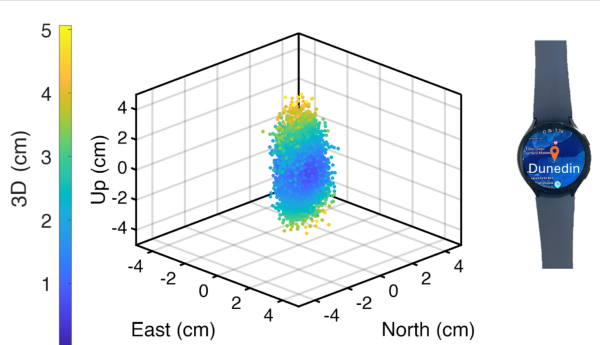
    Precise centimeter-level positioning on a smartwatch during 4 hours of data in Dunedin, New Zealand. The dots show the repeatability of one second of data in comparison to precise benchmark coordinates. The repeatability of the positioning is about 8 cm, at most twice as large as the smartwatch diameter of 4 cm (displayed to scale).

  • University research uses smartphones for precision GNSS

    New research conducted at the University of Otago, New Zealand, and published in the August issue of Journal of Geodesy demonstrate that it is possible to achieve centimeter(cm)-level precise positioning on a smartphone.

    The research, conducted in collaboration with Curtin University, Australia, combined signals from four different GNSS, according to Otago’s Dr. Robert Odolinski and Curtin University colleague Prof. Peter Teunissen.

    “It’s all down to the mathematics we applied to make the most of the relatively low-cost technology smartphones use to receive GNSS signals, combining data from American, Chinese, Japanese and European GNSS. We believe this new capability will revolutionize applications that require cm-level positioning,” Odolinski says.

    He said to understand the new technology, a look back at the historical scientific context is needed.

    Precise centimeter-level positioning on a smartphone during 24 hours in Dunedin, New Zealand. Blue dots show repeatability of one epoch data in comparison to precise benchmark coordinates. The repeatability is more or less the size of a one-dollar New Zealand coin (diameter of 2.3 cm) in all three dimensions. (Image: University of Otago)
    Precise centimeter-level positioning on a smartphone during 24 hours in Dunedin, New Zealand. Blue dots show repeatability of one epoch data in comparison to precise benchmark coordinates. The repeatability is more or less the size of a one-dollar New Zealand coin (diameter of 2.3 cm) in all three dimensions. (Image: University of Otago)

    “For decades, construction, engineering, cadastral surveying and earthquake monitoring have relied on high-cost, dual-frequency GPS positioning to obtain centimeter-level location information. The challenge is that GPS signals, traveling from Earth-orbiting satellites to receivers on the ground, are disrupted along the way, and this generates errors and limiting precision.

    “The traditional solution is to combine GPS signals sent at two different frequencies to improve the positions, but the antennas and receivers required have been expensive, far beyond the reach of many who would benefit from the technology,” Odolinski said.

    The new approach uses only one of two frequencies but collects data from more satellites for a multi-constellation GNSS solution. The extra data and algorithms are used to improve the positions without adding cost.

    Odolinski and Teunissen have shown that this approach can work in smartphones, producing competitive results compared to dual-frequency GPS solutions (see figure).

    Odolinski believes that countries and industries of all sizes can benefit from using smartphones as GNSS receivers, and is confident commercial application and development will spring from this research.

    “This significant reduction in costs when using smartphones can increase the number of receivers that can be deployed, which will revolutionize a range of disciplines requiring centimeter-level positioning, including precise car navigation, surveying and geophysics (deformation monitoring), to name a few.”

    Read the full research paper.

    Robert Odolinski configuries a smartphone to collect multi-GNSS data. (Photo: University of Otago)
    Robert Odolinski configuries a smartphone to collect multi-GNSS data. (Photo: University of Otago)

  • Hexagon Geospatial Tech Measures Tallest Mountain in New Zealand

    Topography of Mount Cook, New Zealand's tallest peak, changed following a rock avalanche. (Photo Wikipedia Commons, C.M. Lynch)
    Topography of Mount Cook, New Zealand’s tallest peak, changed following a rock avalanche. (Photo Wikipedia Commons, C.M. Lynch)

    The National School of Surveying, University of Otago, implemented Hexagon Geospatial technologies provided by Intergraph in its quest to measure the summit of Mount Cook, the tallest mountain in New Zealand and a UNESCO World Heritage Site. The University of Otago is New Zealand’s oldest university.

    The university turned to Hexagon Geospatial’s ERDAS IMAGINE and IMAGINE Photogrammetry (formerly LPS) to help measure the height of Mount Cook, also called Aoraki, following a large rock avalanche that changed the peak’s topography and height in 1991. For many years, the university has benefited from Hexagon Geospatial’s education licenses through Intergraph, and chose these technologies for the project because of  their image processing and photogrammetric capabilities, as well as integrated workflows.

    “ERDAS IMAGINE is the cornerstone of the project. It started from there,” said Pascal Sirguey, senior lecturer at National School of Surveying and project leader. “Using the photogrammetric capability, we were led to look more closely at what the model was telling us. The software gave us the right answer in the end.”

    Following the avalanche, a resurvey found the mountain to be 3,754 meters high — down from the surveying estimate of 3,764 meters in 1881. The university undertook the unique challenge of validating the new elevation. Photogrammetry and remote sensing were the only viable methods for measuring the summit as it is considered sacred by the Maori tribe of Ngāi Tahu and standing on it is prohibited.

    Using Hexagon Geospatial’s software, along with Global Navigation Satellite System receivers, the university determined the actual height of Mount Cook is 3,724 meters. For the university’s remarkable efforts, Sirguey received the top award from the New Zealand Institute of Surveyors in 2014 for teaching and education and the New Zealand Spatial Excellence Award 2014 in the Education and Professional Development category.

    The University of Otago was founded in 1869 by an ordinance of the Otago Provincial Council. Its School of Surveying offers the only academic qualification leading to professional recognition as a professional land surveyor in New Zealand, following a period of post-graduation training and examination by the New Zealand Institute of Surveyors. The courses offer a broad range of disciplines — surveying, land planning and development, survey measurement and Geographic Information Systems — that equip graduates for a professional career.

    Provided through Intergraph, Hexagon Geospatial’s education program provides the university with a complete geospatial software portfolio that offers support and tools for academic research projects and teaching.