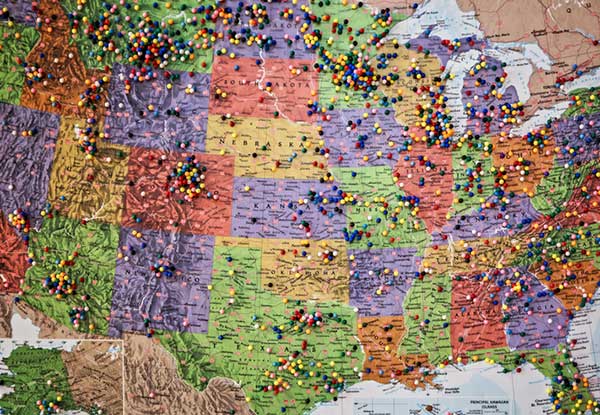
The survey is designed to gather information from organizations using GIS technology, to learn about how they organize and GIS, and provide services to their users.
All respondents will receive a report of survey results.
The Urban and Regional Information Systems Association (URISA) will be hosting GIS-Pro 2020, the association’s 58th Annual Conference, Sept. 29 to Oct. 2 in a virtual format. The event was originally scheduled to take place in Baltimore, but URISA chose to hold it virtually because of the COVID-19 pandemic.
“With the serious COVID-19 health and physical distancing concerns, hosting an in-person conference this year and putting members, presenters, and staff at risk was a non-starter,” the organization said.
Keynote speakers for the event include Martin O’Malley, the former governor of Maryland; Chris Vaughan, geographic information officer at the Federal Emergency Management Agency; and Juliana Blackwell, director of the National Geodetic Survey.
According to URISA, the program also will highlight a number of relevant topics, including public health, community resilience, equality and social justice, GIS leadership and ethics.
Here’s an overview of the program:
Wednesday, Sept. 23
• Best Practices for GIS Project Planning and Management
• NG911 & the GIS Workflow
• GIS in Emergency Management
• Microsoft Project Software Tutorial
Thursday, Sept. 24
• Experimental Learning Techniques to be More Effective
• Introduction to GIS for Equity and Social Justice
• Navigating a Virtual Landscape for your GIS Career
Tuesday, Oct. 6
• Building Community Using Geospatial Tools
• Unpacking the NENA NG911 GIS Data Model
• Changes Afoot After 2022: State Plane and the Death of the U.S. Survey Foot
Wednesday, Oct. 7
• Preparing for GISP Certification
• Coordinate Systems and Projections
Sessions also will be available on demand for GIS-Pro 2020 registrants after the conference, URISA said. Register for the event here.
The Vanguard Cabinet is an advisory board made up of passionate, young geospatial professionals who strive to engage young practitioners, increase their numbers in the organization and better understand the concerns facing these future leaders of the geospatial community. The board consists of members that are 35 years of age or younger.
The cabinet’s mission is to collaborate with URISA’s board of directors and URISA committees in creating and promoting programs and policies that will benefit young professionals, as well as enhance overall innovation, collaboration, networking and professional development opportunities.
Cabinet members are selected through an application process, with a review by the URISA Leadership Development Committee. Those who apply must submit a letter of reference from a colleague, supervisor, mentor or instructor; a resumé; and a completed online application form.
The National States Geographic Information Council (NSGIC) has released a joint statement on the value of GIS during the COVID-19 pandemic, alongside its partners the MidAmerica GIS Consortium (MAGIC), Open Geospatial Consortium (OGC), Urban and Regional Information Systems Association (URISA), and American Association of Geographers (AAG).
Joint Statement on the Value of GIS in the Pandemic
The spread and effects of COVID-19 can be best understood considering space and time.
As governments are responding to COVID-19, more leaders are recognizing the value of “knowing the where.” The importance of knowing where the outbreak is growing, where high risk populations are, where the hospital beds and important medical resources are, and where to deploy resources is essential. “Knowing the where” informs better decision-making.
In an effort to better understand the where, governments are recognizing the value of geospatial information and technologies and are engaging geospatial professionals to help them better understand the where to help them in their decision-making and response.
Geospatial professionals bring unique analytical and visualization skills to the table that help responders and decision-makers visualize where the pandemic is spreading more quickly and can make the important decisions regarding where response and resource needs need to be focused. The value of telling the story through a map coupled with a geospatial dashboard provides a view of the event not readily seen in a table such as a spreadsheet.
Beyond visualizing existing data, we can connect data from a location perspective, which enhances the value of the data sources being integrated. Equally important in this event is data on COVID-19 cases and testing packaged and shared in a way useful to scientists.
GIS (geographic information systems) is experiencing an unprecedented level of use. Historically, GIS was deployed following a disaster to help respond and recover. Today, GIS is used as a disaster is unfolding. The COVID-19 event is an outstanding example of how effective GIS is when robust data is available. Governments are realizing the value of investing in these systems and the people who run them.
The information necessary to empower all partners already exists.
Current nationwide models and response efforts may not benefit from the details of local geographic parameters. Local or statewide models and response efforts may not fully take advantage of the data from other areas of the country. Hospitals are surveyed by both federal and state agencies, and the results of those surveys are not readily available to the hospitals working together to care for patients. Nationwide geospatial data will empower a coalition of participants with a better understanding of the spread and impacts of COVID-19 and improve mitigation actions.
The same data can be made available in different forms to empower people playing different roles in the response. Researchers — epidemiologists — will benefit from nationwide COVID-19 testing data and data describing factors impacting the spread. This data needs to be as disaggregated as permissible under HIPAA and in a form readily digestible in models.
The case data could be aggregated to the same units of geography as a wealth of existing demographic data (Census tracts), which could explain and quantify local variances in the spread. Policy makers and those in emergency management can benefit from map and tabular dashboards, harnessing the power of the where by integrating data for analytics.
The emergency response, public health and geospatial communities must come together to understand COVID-19 in the U.S. and mitigate its spread and overall impact.
By geo-enabling public health and emergency response data, we can better:
understand the spread — with COVID case data, movements of people, and symptoms
understand the impact on individuals — with data including age, disease, obesity, and medical treatments
understand how to tailor outreach — by age, language, engagement with government, and lifestyle choices
understand the needs of the healthcare industry — by facility, day, bed capacity, type of care, ventilators, and PPE
understand the impact on the local economy — by county, day, unemployment, and bankruptcies
understand the societal impacts — by census tract, domestic violence, alcohol consumption, child abuse, animal abuse, elder abuse, mental health crises, 3-1-1 calls and firearm sales
We are committed to beginning the national conversation about leveraging the best available data to better understand the spread and impacts of COVID-19.
The National States Geographic Information Council (NSGIC) has released a joint statement on the value of GIS in the pandemic, alongside its partners the MidAmerica GIS Consortium (MAGIC), Open Geospatial Consortium (OGC), Urban and Regional Information Systems Association (URISA), and American Association of Geographers (AAG).
Joint Statement on the Value of GIS in the Pandemic
The spread and effects of COVID-19 can be best understood considering space and time.
As governments are responding to COVID-19, more leaders are recognizing the value of “knowing the where.” The importance of knowing where the outbreak is growing, where high risk populations are, where the hospital beds and important medical resources are, and where to deploy resources is essential. “Knowing the where” informs better decision-making.
In an effort to better understand the where, governments are recognizing the value of geospatial information and technologies and are engaging geospatial professionals to help them better understand the where to help them in their decision-making and response.
Geospatial professionals bring unique analytical and visualization skills to the table that help responders and decision-makers visualize where the pandemic is spreading more quickly and can make the important decisions regarding where response and resource needs need to be focused. The value of telling the story through a map coupled with a geospatial dashboard provides a view of the event not readily seen in a table such as a spreadsheet.
Beyond visualizing existing data, we can connect data from a location perspective, which enhances the value of the data sources being integrated. Equally important in this event is data on COVID-19 cases and testing packaged and shared in a way useful to scientists.
GIS (geographic information systems) is experiencing an unprecedented level of use. Historically, GIS was deployed following a disaster to help respond and recover. Today, GIS is used as a disaster is unfolding. The COVID-19 event is an outstanding example of how effective GIS is when robust data is available. Governments are realizing the value of investing in these systems and the people who run them.
The information necessary to empower all partners already exists.
Current nationwide models and response efforts may not benefit from the details of local geographic parameters. Local or statewide models and response efforts may not fully take advantage of the data from other areas of the country. Hospitals are surveyed by both federal and state agencies, and the results of those surveys are not readily available to the hospitals working together to care for patients. Nationwide geospatial data will empower a coalition of participants with a better understanding of the spread and impacts of COVID-19 and improve mitigation actions.
The same data can be made available in different forms to empower people playing different roles in the response. Researchers — epidemiologists — will benefit from nationwide COVID-19 testing data and data describing factors impacting the spread. This data needs to be as disaggregated as permissible under HIPAA and in a form readily digestible in models.
The case data could be aggregated to the same units of geography as a wealth of existing demographic data (Census tracts), which could explain and quantify local variances in the spread. Policy makers and those in emergency management can benefit from map and tabular dashboards, harnessing the power of the where by integrating data for analytics.
The emergency response, public health and geospatial communities must come together to understand COVID-19 in the U.S. and mitigate its spread and overall impact.
By geo-enabling public health and emergency response data, we can better:
understand the spread — with COVID case data, movements of people, and symptoms
understand the impact on individuals — with data including age, disease, obesity, and medical treatments
understand how to tailor outreach — by age, language, engagement with government, and lifestyle choices
understand the needs of the healthcare industry — by facility, day, bed capacity, type of care, ventilators, and PPE
understand the impact on the local economy — by county, day, unemployment, and bankruptcies
understand the societal impacts — by census tract, domestic violence, alcohol consumption, child abuse, animal abuse, elder abuse, mental health crises, 3-1-1 calls and firearm sales
We are committed to beginning the national conversation about leveraging the best available data to better understand the spread and impacts of COVID-19.
URISA’s GIS Hall of Fame honors persons and organizations that have made significant and original contributions to the development and application of GIS concepts, tools or resources, or to the GIS profession.
URISA is inviting nominations for 2020 inductees.
Anyone may nominate a person or organization for induction to URISA’s GIS Hall of Fame. To make a nomination, submit a written statement to URISA describing:
The nominee’s achievements, emphasizing significant and original contributions to the development or application of GIS concepts, tools, or resources, or to the GIS profession; and
The significance of the nominee’s contributions, in terms of their enduring impact on the GIS field or profession, and their social benefit.
Hall of Fame laureates are expected to exemplify vision, leadership, perseverance, community-mindedness, professional involvement, and ethical behavior.
Nominations are due on or before May 11. The 2020 URISA GIS Hall of Fame celebration will take place during GIS-Pro 2020 in Baltimore, Maryland.
Visit the URISA website for details about the nominations criteria and process, and to review the path-breaking accomplishments of previous inductees.
URISA (Urban and Regional Information Systems Association) announced their 2012 GIS Hall of Fame inductees. URISA established the GIS Hall of Fame in 2005 to recognize and honor the most esteemed leaders of the geospatial community. To be considered for the GIS Hall of Fame, an individual’s or an organization’s record of contribution to the advancement of the industry demonstrates creative thinking and actions, vision and innovation, inspiring leadership, perseverance, and community mindedness. Hall of Fame inductees are individuals or organizations whose contributions and accomplishments have moved the geospatial industry and user community in a better, stronger direction.
This year, the GIS Hall of Fame Nomination Committee, composed of URISA Past Presidents, proposed five federal agencies that have made substantial contributions to the GIS community and profession. The URISA Board of Directors unanimously approved each nominee. URISA is pleased to announce the 2012 GIS Hall of Fame inductees:
National Aeronautics and Space Administration
Natural Resources Canada
Statistics Canada
United States Census Bureau
United States Geological Survey
Representatives from each agency will be in attendance at URISA’s 50th Annual Conference in Portland, Oregon, where each will be inducted into the URISA GIS Hall of Fame during the Awards Ceremony on Wednesday, October 3, 2012.
“The United States Geological Survey (USGS) is thrilled to be receiving this award from URISA and is immensely proud of the many USGS employees who have pioneered the application of GIS in the programs we carry out on behalf of the U.S. Department of the Interior and the citizens of our Nation”. — Mark DeMulder, Director, USGS National Geospatial Program
“NASA is honored by this recognition from a leader in the use of geospatial data and tools across sectors. This honor is truly a tribute to the many people who design and operate the Earth-observing satellite missions, process and deliver the data, and analyze the measurements to benefit all humankind.” — Michael H. Freilich, Director of the NASA Earth Science Division
“Statistics Canada is honored to be recognized by the URISA GIS Hall of Fame for its leadership role in advancing GIS technology for the production and dissemination of statistical data in Canada. The Agency is most proud of its staff who have partnered with organizations in Canada and internationally to develop and adopt innovative GIS solutions to meet increasing and evolving user needs.” — Rosemary Bender, Assistant Chief Statistician, Informatics and Methodology, Statistics Canada
“The U.S. Census Bureau is honored to be inducted into the URISA GIS Hall of Fame, which recognizes the achievements of Census Bureau staff for its technological innovations for making GIS data available to the nation.” — Thomas L. Mesenbourg, Acting Director, Census Bureau
“Natural Resources Canada is proud to be recognized for its scientific and technological accomplishments in geomatics. This honour is a reflection of the dedication and professionalism of our staff and partners who have advanced geomatics innovation in Canada and beyond.” — The Honourable Joe Oliver, P.C., M.P., Minister, Natural Resources Canada