Tag: Waze

  • 2013: A Positive Year for Location Industry


    2013 was an up-and-down roller coaster of a year for the location industry…and 2014 appears to be more of the same. What was the big story? Google buying Waze? While it is easy to predict what will happen, the harder thing to do is to predict when it will happen. With that in mind, LBS Insider reached out to industry veterans to discuss the big buzz in 2013 in the industry — and what the future holds, next year and beyond.

    It’s that time of year — to assess the big deals and trends — good, bad and ugly — in the worldwide location industry. Some of the stories seem obvious, such as the Google acquisition of Waze for more than $1 billion.

    “The valuation remains a mystery to many in the mapping community, but it is always nice to see a truly great exit in this business.  There haven’t been enough for an industry that is both foundational in mobile and online, and really hard to do well,” said Marc Prioleau, president of Prioleau Advisors.

    Prioleau says one of the big stories of 2013 was the reemergence of Apple Maps.  “For all the flak they took, they’ve worked hard to make them better.  Their default position in iOS has given them traffic, as has the extension to OSX in the Maverick’s release,” he said.  “Last year you saw Apple start to buy companies that could extend the features (like HopStop), a sign that they think they’ve fixed the major problems and are working on moving forward. They are also hiring aggressively and have brought in some very good people.”

    Last year, Prioleau predicted that the combination of data with location to derive better location-based context would be a big thing.  “I think a lot has happened in that area with much more to come.  It’s happening in apps (see Foursquare recommendations), advertising (PlaceIQ and others), CRM (SAP Precision retailing as an example),” he said. “There is a lot more to come here, and we should expect many new applications, most of which will do things badly, but some — likely the ones with the most targeted data — will do things that really change the model.”

    Prioleau says MapBox is making mapping cool again (and Prioleau is a director at the company).  “Just when all was going to be subsumed by the Google Maps juggernaut, MapBox is doing new interesting data visualization work,” he said.

    Crowdsourcing being embraced by the wider mapping community is another big trend Prioleau has identified.  “Everyone knows about OSm, but then you add Waze for crowdsourcing real-time traffic plus map corrections. Google is in deep with MapMaker, and even Nokia is pushing crowdsourced input,” he said.  “It’s no longer the battle between crowdsourced maps and professional maps. It’s how to make the two work together.”

    Prioleau sees the location industry having a few benchmarks in 2014.  “I’ll stick with the same prediction as last year:  Data + location for better location context. Google Now is a great benchmark,” he said. “Break out in location-based ad targeting. The technology is better, and the providers really understand the advertising market now. Complementary ad technologies like Real Time Bidding are maturing, and these will fit in to a model that really works. And if for no other reason, if we keep predicting it, it will be right one year, right?”

    Prioleau believes Google Map domination will begin to show cracks. “Google has a great platform, but as they monetize it more aggressively, more companies will look for alternatives,” he said. “Apple maps will be one. HERE will be another. But solutions from MapBox and others will grow as well.”

    In terms of connected car and other automotive technology, Prioleau says new and interesting applications will come from local search, driver services, and diagnostics — rather than just basic navigation.

    Another industry insider, Mike Dobson, president of TeleMapis, said 2013 was a quiet year for location-based services.  “Even the biggest deal, Google’s acquisition of Waze, does not look as if it will have much impact, other than as a defensive strategy. Perhaps the most interesting aspect of the year was the stream of patents covering LBS and GIS-like applications from both Apple and Google, not to mention those of several start-ups,” he said.

    From his perspective, Dobson said 2013 was yet another year in waiting, but 2014 looks like it might actually be exciting. “It appears that Google will finally make its move into the in-car navigation market. Apple is beginning to play with the idea of allowing its users access to a more GIS-like parsing of its map database,” he said. “Perhaps the biggest change will be a new focus on thematic maps that aim not to be navigation aids, but to perform the function of information devices for travelers and others using directed search technology. I suspect that 2014 will be another slow year for indoor positioning, but maybe it will flourish as a subset of BIM.”

    Indoor Mapping Still Considered Trend for Location Industry

    While many in the location industry have seen new companies and products coming to the indoor positioning market, at least one analyst says that Wi-Fi positioning has been weak.

    “The biggest trend in 2013 was indoor mapping, the beginning of the hockey stick adoption curve in my opinion. Major retailers like Home Depot, Lowes, etc., launched indoor maps with product search/locator,” said industry veteran Kris Kolodziej. “What was overblown was indoor Wi-Fi positioning. The latency and accuracy is not good enough for micro location. It’s good enough to know what store/venue you’re in, but that’s about it.”

    Kolodziej said that the big deal in 2014 will be ibeacons or Bluetooth low energy (BLE) for micro location and proximity services. “BLE solves the many shortcomings Wi-Fi has,” he said.

    Prioleau says that in-door location will be big, but it is where outdoor location was in the early 1990s:  many technologies and technology providers all pushing different solutions — and most will not succeed.

    “Beyond the location technology, the market needs to figure out how the money will flow from beneficiaries of the market (retailers, brands) to the providers of indoor location technology (mostly semiconductor companies and tech companies).  There is no natural connection,” he said.

  • Expert Advice: Cooperative Updates with Maps 2.0

    Oliver Kuhn, Skobbler
    Oliver Kuhn, Skobbler

    By Oliver Kühn, Skobbler

    Not so long ago, paper maps were a necessity in many walks of life. Today, they are increasingly a nostalgic novelty, to coin a term.

    It’s not difficult to understand why digital maps replaced their paper brethren. Digital maps are more accurate, more adaptable, and most importantly, in an increasingly real-time environment, much faster at making the appropriate updates and amends.

    Now, however, digital mapping finds itself at a crossroads. Crowdsourced navigation platforms like OpenStreetMap — affectionately referred to as the “Wikipedia of maps” — are forcing digital maps and the map-building process to evolve significantly. As a result, the future of mapping is now in the hands of location enthusiasts and everyday map users. These people are redefining what a map is, how data is sourced and utilized, and how much it can cost to harness that information both efficiently and effectively. Those of us who have been in this space for years can see the writing on the wall.

    Some, however, are eager to write off crowdsourced mapping. Corporate digital map providers, for instance, often refer dismissively to these mapping platforms as “hobby maps.” Nevertheless, they recognize the potential for change such innovation brings and are vulnerable to it.

    What potential? Consider the benefits attainable through a crowdsourced approach, in the following sections.

    Scalability

    As with any process, cost is critical. It is particularly core to building a digital map. Truth be told, the fewer dollars ultimately spent on a map’s construction, the more its long-term operational preservation and, through that, scalability can be ensured. Despite massive innovation in our field, collecting data and creating a usable international digital map is far from cost-effective or efficient today. Candidly, it is one of the clunkier processes in technology, perhaps because it appears compulsory.

    Look no further than Google, which spends billions of dollars a year to maintain its platform, yet we marvel at the huge scope of its operation. In truth, it is an effort in dire need of real streamlining. Google, via its recent acquisition of Waze, along with Navteq, TeleAtlas, and the like, leverage laser-enabled cars and high-tech backpacks that are astoundingly inefficient from a pricing standpoint, costing hundreds of thousands of dollars. Nokia’s Map Mobiles, for example, are each outfitted with more than $25,000 of computing equipment.

    To think this is sustainable in the long term, on an international level, is wrong. It will inevitably cripple a map’s quality and viability, with corporate providers choosing to limit global detail and upkeep to balance costs.

    For crowdsourced map platforms, this problem does not exist. They can and are scaling rapidly, without the exorbitant costs corporate players are used to — and tired of. These costs secondarily manifest in mapping service usage fees for third parties, as well as subscription costs for consumer navigaton products. For either use case (business-to-business or business-to-consumer) crowdsourcing delivers cost benefits traditional players cannot match. Again, this leads directly to scalability, with crowdsourcing the most enduring maps option.

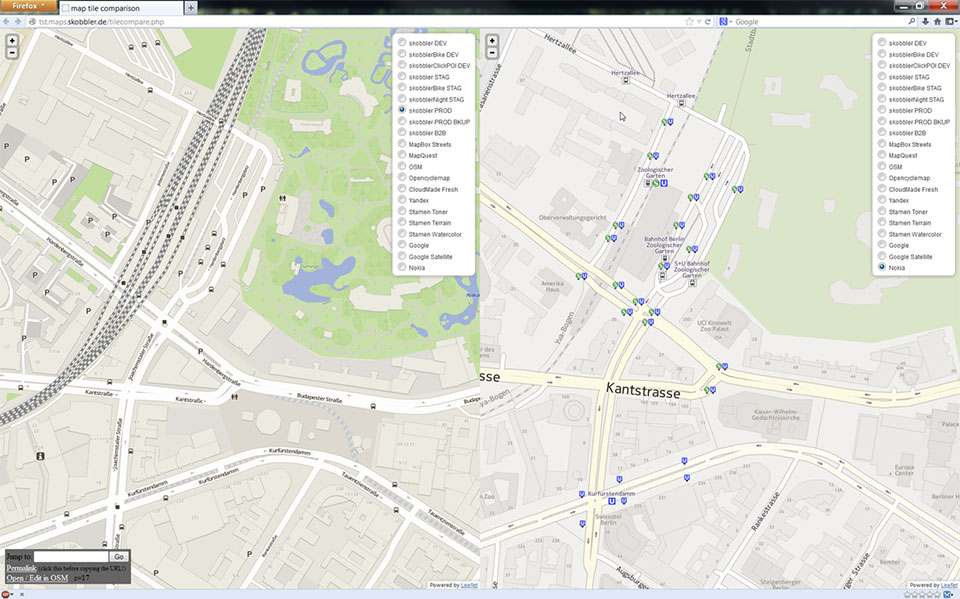
     Same time, same place — different look. Crowdsourced OpenStreetMap (left) and Nokia map (right) of central Berlin, Germany. Photo: Oliver Kühn
    Same time, same place — different look. Crowdsourced OpenStreetMap (left) and Nokia map (right) of central Berlin, Germany. Photo: Oliver Kühn

    Detail

    Crowdsourced mapping services and platforms like OpenStreetMap are more than just cost-efficienct tools to coax scale. As a crowdsourced dataset built using more than a million dedicated mappers, OpenStreetMap inherently delivers benefits above and beyond those obtained from corporate map providers like TeleAtlas and Navteq.

    The most visible benefit is the unrivaled map quality. With an army of contributors, the data dynamically and constantly evolves — just as places do. Locations are rarely fixed or stable. They change and progress over time. No other service or platform can immediately provide developers with the real-time, on-the-ground granularity of a crowdsourced map. Google and the others are trying, but the costs they incur will ultimately be too taxing to maintain detail.

    Firsthand influence carries equal weight. Mappers who edit an open-source map have often had personal interactions with a place or locale. They know places intimately, and this makes their contributions detailed, rich, and hyperlocal. More companies and developers are looking to OpenStreetMap for this reason: they want to future-proof their services and products, making sure that they always have the best and most up-to-date data. Only a platform like OpenStreetMap can do this. Corporate map providers are painfully aware of it, too.

    Flexibility

    Google owns Google Maps, and TeleAtlas owns its TomTom platform. Not surprisingly, this affects what a third party, whether an automotive company or a travel brand, can and cannot do with the service. It is essentially a copyrighted product like an MP3, an audio digital file. So, Google can limit the way you visually render and showcase its platform. Needless to say, this can be suffocating for those interested in building their own unique services. This is what makes crowdsourced mapping such a significant development for those interested in integrating additional data with a digital map. Do with OpenStreetMap what you will, visually or design-wise; there are absolutely no limitations. Every map can be made unique and rendered differently. This also speaks to the flexibility of crowdsourcing more generally.

    Beyond design, crowdsourced maps can harness the data to build completely new maps that cater to a specific concept, creating thematic maps for different uses, such as walking, hiking, bicycling, routes for those with disabilities, and more. More traditional digital maps lack this flexibility; it affords possibilities to source non-traditional location data to build even more accurate maps.

    The Future — Through Cars

    Despite the fact that crowdsourced maps are forcing digital mapping to adopt a more scalable, cost-efficient, detailed, flexible andaltogether long-term approach, digital mapping definitely has room to grow.

    One of the most exciting opportunities for crowdsourced maps specifically, and digital maps generally, lies in car user data, which is just coming into its own. Cars are obviously one of the largest travel tools utilized by individuals on a daily basis, and, with the advent of the connected car, the data that they collect via internal/external sensors has grown more nuanced, granular, and specific over the years.

    Cars are simply getting smarter, with sensors capable of providing everything from weather conditions to speed-zone information.

    Making this information available in the cloud and combining it with data available via crowdsourced mapping platforms produces remarkable possibilities for innovation.

    Imagine adding road-condition data, as just one example, to crowdsourced mapping services. By marrying a crowdsourced map with crowdsourced car-sensor data, the map’s overall utility multiplies immeasurably.

    To avoid missteps that have positioned companies like Google to spend billions on building a digital mapping service — unsustainable long-term figures — we must always look to embrace that which is cutting-edge. We find that today in crowdsourced mapping platforms, as they enable us to maintain, update, and enrich maps as never before. We must also consider the limitations of the cutting edge and understand how to improve the latest innovation (car-sensor data, and more) before the once cutting edge becomes the next paper map, so to speak. This is key to evolving maps for the better and for the future.


    Oliver Kühn has an MBA from the University of Cologne, Germany. He has 10 years of location-based service experience and was Head of Product Management Special Projects at navigation systems specialist Navigon AG (acquired by Garmin). In late 2008, he co-founded skobbler GmbH, being responsible for business development and legal matters. He is also a board member of the OpenStreetMap Foundation.

  • Google’s $1.1 Billion Purchase of Waze Under FTC Scrutiny

    Google’s $1.1 Billion Purchase of Waze Under FTC Scrutiny

    Kevin Dennehy
    Kevin Dennehy

    In a year of ho-hum location deals, or the lack of any, the recent Google purchase of Waze for more than $1 billion is a big one. In fact, readers of GPS World magazine’s LBS Insider would have to go back to the summer of 2007, when TomTom purchased Tele Atlas and Nokia bought Navteq, to find an industry acquisition as big as this one.

    The Federal Trade Commission is reviewing Google’s $1.1 billion acquisition of Israel-based mapping startup Waze, according to published reports.  The big issue is that while Waze’s revenue was too low to trigger automatic review by the FTC, it may have hundreds of millions of users worldwide.

    The fact that Google’s acquisition of Waze has caught the FTC’s attention is not unusual, said Mike Dobson, TeleMapics president, who authors a location industry blog at www.telemapics.com. “Google, in an attempt to speed the acquisition, declared that the assets of Waze based in the United States are worth less than the $70.9 million that requires an antitrust review. Google maintains, and I agree, that the majority of the [intellectual property] for which they were willing to pay $1 billion was created in Israel, where it is currently located, and in that location it continues to be revised and enhanced,” he said.

    One of the supposed reasons, which were publicized in media reports, is that the deal with Facebook fell through because the social media giant wanted to relocate the Waze development activities to the U.S. and the Israel-based company declined.

    Google’s purchase of Waze ends months of rumors and stops other suitors, including Facebook, Apple and Microsoft, from moving in on the mapping startup. Google has said that its mapping technology will be incorporated into Waze.

    The Waze deal may strengthen Google, but won’t be the deciding factor on whether it has an unfair advantage in the [location] market, said Marc Prioleau, president of Prioleau Advisors. “They will have that regardless of Waze. I am not sure the criteria for the FTC, but I think Waze is just a spark to trigger a look at Google’s mapping position overall,” he said. “The FTC will have a hard time making the case that Google dominates the industry when Google can point to market share for Apple Maps, Nokia/Here [through its own sites as well as Bing, Amazon, Facebook and others] and even MapQuest, which stubbornly hangs on to a high market share with the over-50 demographic.”

    When it comes down to it, it is all about money. “It appears that the FTC’s preliminary interest in the Google acquisition of Waze is in determining if the U.S.-based assets are worth more than $70.9 million, and whether or not Google’s position regarding the Waze IP being located in Israel is justified,” Dobson said. “Many would argue that a considerable portion of the value of the Waze IP affects consumers in the United States, resides on cell phones of users in the United States, and has a functional impact in the United States beyond the $70.9 million that Google is claiming. Functional impact is a difficult issue, but since Waze generates little income, Google is probably in a good position here.”

    Dobson said that other pundits are commenting that the problem here is that Noam Bardin, Waze CEO, described Google as its only competition during a recent press conference. “Oh, how unusual, someone selling their company trying to increase the value of the company,” he said. “Has everyone forgotten about Nokia and TomTom? Does anyone really think they are incapable of competing with Google, Waze or the combination of both companies?”

    Google Made Strategic Decision Not to Buy Tele Atlas and Navteq                          

    Dobson said that, more troubling for the FTC and other antitrust interests, is this:  If Google wanted to monopolize the mapping world, why did it not choose to bid (or counterbid) when Navteq and Tele Atlas were sold in 2007?

    “I think the answer to this question is quite plain. Google did not participate in either acquisition because it had tried both companies’ data and found that the content quality and spatial coverage was not quite what Google had set as goals when developing its strategy for mapping. Instead, Google built its own ‘map machine’ and has managed to out-innovate either of these companies over the last several years,” Dobson said. “In addition, both Nokia and TomTom have fallen on hard times, not because of Google’s success, but because both companies overpaid for the assets they acquired, just before a worldwide economic downturn. Reduced budgets (for research and compilation) at TomTom and Nokia have had a lot to do with Google’s success in the mapping world.”

    The big deal in Google’s interest in Waze lies in the success that the mapping startup has had in capturing traffic information, as well as how it has attracted a large user community willing to contribute traffic data, Dobson said.

    “I doubt that Google will find that the map coverage provided by Waze has data they have not already mapped and mapped more exhaustively than Waze. However, it is somewhat camp to be an ‘anybody but Google’ fan boy and I suspect conspiracy theories about the acquisition will abound,” Dobson said. “I doubt that the FTC will find anything actionable. If Google were to announce next week that it was acquiring Inrix, I suspect that the FTC might have a real case with real antitrust issues.”

    While Waze hasn’t generated much revenue, its real-time maps and traffic information are valuable. This value was magnified last year when Apple tried to replace Google Maps on the iPhone with a not-so-good alternative.

    Analysts are looking around at what other companies are out there as potential acquisition targets — particularly as the smartphone industry becomes even more competitive. The apps on the smartphones will need to be distinguishable, particularly the mapping systems and capability, say several analysts.

    One company that stands out as a potential acquisition target is TomTom, which is the last independent provider of digital maps, now that Navteq was gobbled up by Nokia.

    Send all of your LBS stories to [email protected].

  • The Race to Own Mapping

    Mapping turned up the heat in June, becoming a hot topic across the board. Apple ended negotiations to buy Waze, a provider of crowd sourced mapping and traffic, reportedly because the company did not want to relocate from Israel. Google quickly took Apple’s place as Waze’s buyer. With almost 50 million drivers using Waze, many via Apple Maps, Google would get another leg up in the race to own mapping. The connected car industry, gathered in Detroit last week, discussed the need for intelligibility in the market, particularly more organized categories of offerings.  Also of interest this month is the backpack-mounted Google Trekker used to map the world where cars don’t go, as well as the LocationTech working group.

    Surprisingly, reaction to Google’s sweeping design of new personalized maps, now in limited release, has been muted.  The maps show landmarks, restaurants, and other details tailored to the user’s plans, habits, and interests that will become increasingly individualized with usage. One person’s map may include bars and public pools, another’s may include book stores and playgrounds. Google also introduced other map features like blending of Google’s place images, 360 degree views within retail shops, and 3-D satellite images of earth without a plug-in or download needed.

    Connected Car Gathering. At Telematics Detroit last week, the connected car industry tried to reach much-needed clarity on the state of the connected car, with attention to standardization, consolidation, increased collaboration, and partnership. Many are trying to build a smartphone experience in the car but, “compared to a mobile phone, you’re always going to lose,” said Robert Acker of Harman. “The car is another device on the ‘Internet of Things,’ and we need to optimize that thing for consuming content while driving. Don’t make it a bigger smartphone device. That’s all Google or Apple can do. Rather, completely change the paradigm. Make it totally seamless; introduce gesture, head-up displays, steering controls. Make it truly revolutionized for the customer.”

    Auto OEMs Are Changing Really. Smartphone-like capability in the vehicle is revitalizing the staid OEM industry and has encouraged car manufacturers to take more risk and speed up development time. It used to be de rigueur that a car maker would first pick a supplier like Denso to build a component, like a radio. “Now the automotive companies are first choosing a platform and layering on companies to build the solution. Tech companies are specialists,” says David Jumpa of Airbiquity. “We stand in the middle of the platform that makes it all work together.”  Jumpa expects connected car services to get bundled and consumers to pay a subscription fee.

    Freedom to Choose. To the unhappiness of wireless carriers, the automotive industry is planning on building cars with embedded subscriber identity module (SIM). Unlike current SIM cards that are carrier-specific, these are universal SIM cards that would enable customers to pick their vehicle’s wireless carrier and then change it at will. For OEMs, embedding SIM cards creates great efficiency. SIM cards can’t be easily replaced, as they must be soldered into vehicles because of vibration and shock. With OEMs shipping vehicles to multiple countries that have different carriers, a universal SIM card provides great flexibility and cost savings. Apple once tried to pursue an embedded SIM card and the carriers rose against it, but let’s see how the OEMs fare.

    Mapping the World on Your Back. You’ve probably seen cars loaded with GPS and cameras for mapping streets. It is less likely you’ve seen mapping trikes, carts, or new photo-mapping backpack. Google uses the Trekker, a 42-pound backpack equipped with GPS and 15 cameras. Every 2.5 seconds it takes a picture as a person lugs it along trails, narrow streets, alleys, and mountains. Photos are stitched together to create panoramic images for StreetView.

    Location Collaboration. A new initiative, LocationTech, has arrived on the location scene and is dedicated to individual and company collaboration on open-source software with an emphasis on location. The non-profit Eclipse Foundation, has created the working group LocationTech, led by Oracle, IBM, OpenGeo, and Actuate. LocationTech will allow companies to jointly develop and deploy components that bring location awareness to enterprise IT. “No single vendor can address the range of issues our LocationTech working group members are going to solve,” said Mike Milinkovich of Eclipse. “By creating a multi-vendor, open platform for location technologies, we intend to spur even broader adoption of location aware products, devices and services.” LocationTech might sound similar to the Open Geospatial Consortium (OGC) and the Open Source Geospatial Foundation (OSGeo); however, LocationTech offers full-service support and staffing for open-source location-aware technologies.


  • Google and Facebook Eye Waze as Potential Purchase

    waze_logoSince the recent CTIA conference wasn’t the buffet of location news, one potential deal could really set the industry on fire going into the summer months. Google and Facebook both are rumored to be in talks to purchase Waze. Some say this would mean Facebook would transform into a mobile advertising company, with local ads, if it were the winning bidder. Google’s rumored interest would block the social media giant’s momentum in that marketplace.

    by Kevin Dennehy

    In what could be one of biggest deals in the location industry, both Google and Facebook have been rumored to be interested in buying Israel-based mapping and navigation company Waze. Published reports indicate the deal could be worth $1 billion.

    Some industry analysts are skeptical that a deal could be valued that high, which would place it in the same realm as Facebook’s $1 billion purchase of photo-sharing service Instagram.

    “We really do not know if Facebook is willing to spend a billion dollars on Waze, but if the deal happens, (Facebook) must have considered its options. How could this be? First, I suspect that Facebook is certain it will grow beyond its current boundaries to become the world’s most valuable company,” said Mike Dobson, Telemapics president. “Operating under this mindset, a billion dollars is peanuts, and they will not care if everyone else thinks they overpaid. In other words, Facebook might not be basing its calculation on the same ‘time-value of money’ that the rest of us are using. Second, if the economics do not really matter to Facebook, the more important question is ‘What advantages would Facebook accrue by acquiring Waze?’”

    Dobson believes that Waze map databases are not competitive with Google or such commercial providers as Nokia or TomTom. “In essence, Waze does not offer competitive map coverage, competitive data quality, competitive data attributing, or a useful source of POI data. More importantly, I suspect that the Waze database will be a major league headache if Facebook plans to use it as the basis for its mapping activities supporting local search,” he said. “Further, I doubt that Waze understands enough about local advertising to help Facebook realize its most important goal of becoming a powerhouse ad agency capable of creating its own captive local search market, comparable or exceeding that enjoyed by Google.”

    Another industry insider, Marc Prioleau of Prioleau Advisors, said that quality and coverage of the maps would make the deal successful — if it really is going to happen. “The rumor mill on Waze seems to be quite active so it is hard to know if there is substance there. Waze has built a very innovative traffic application, and they use the user data to build a digital map data set,” he said. “The value of the company would be tied largely to the quality and coverage of that data set and the perceived ability of a big platform like Facebook to build that out into a truly serviceable worldwide map.”

    Waze is a mapping company built through crowdsourcing map and traffic data over mobile phones, which is the “magic” Dobson believes Facebook finds beguiling about the company.  While Waze claims 45 million users, its active base is more likely around 10-15 million, Dobson said. “Conversely, if you stop to consider the amount of data you could generate if all of Facebook’s mobile users were gathering mapping data through an app built on Waze, then the company might be willing to gamble on the acquisition,” he said. “Providing analytics on the behavior and location of its mobile users to advertisers and other interested parties could be a huge opportunity. On the other hand, there are numerous paths to this endpoint, not just Waze.”

    Dobson said if he were to advise Facebook on the acquisition, a suggested course of action would be that the company write their own crowdsourcing application and build a good quality map database through licensing and direct and indirect map compilation techniques.  “My off-the-cuff estimate is that this could be done for less than the cost of the Waze acquisition. Beating Waze into a quality map database is going to be an expensive — well beyond the acquisition cost — and time consuming effort. Perhaps the most glaring lack in the potential Waze acquisition is the absence of a suitable POI database, which, in my opinion, is the most critical need that Facebook will have in local search.”

    Dobson said he suspects that Facebook’s competitors are not concerned about the company’s potential acquisition of Waze. “Those who already in the mapping business — Google and Apple — will anticipate that it is likely that Waze could become a significant distraction for Facebook and delay the company effectively competing in the local search market. As far as the competitors are concerned, the longer it takes Facebook to mobilize its efforts in local search, the better,” he said. “In business, as in life, strange choices are made. Perhaps Facebook sees a future in Waze that depends on strategies being implemented by the company that we know nothing about. I hope so, as a good dose of innovation is just what the local search market needs.”

    Distinguishing itself is another reason Facebook may be interested in Waze. Providing mapping and traffic capabilities may bring more consumers to its mobile users.

    The company is also is redesigning its mobile pages platform to enable local merchant information, according to published reports. These new improvements may even challenge Foursquare and Yelp.

    There were questions whether the deal with Facebook will go through as published reports indicated that Waze’s research and development activities would remain in Israel rather than go to California, where Facebook’s headquarters are based.

    Google Interested in Waze to Cut off Facebook at the Location Pass?

    The rumor mill is heating up as Internet giant Google and Apple are said to also be interested in Waze.  “I saw a report indicating that Google was interested. If so, it would seem that this would be a move to deny Facebook access to Waze,” Dobson said.  “Google already derives a significant amount of information from passive crowdsourcing — recording the GPS traces of the devices of their users — and I am not sure that the acquisition would provide them any opportunities that they are not already exploiting. Of course, we might remember that Garmin, who had no intention of buying TeleAtlas, made a bid and significantly raised the price that TomTom paid for the mapping company.”

    Other analysts say while there have been several news articles on why Google should buy Waze, it all could be poorly informed speculation. Others say that the Israel tech press is quick to spread rumors. One analyst said, “I hear that the talks are legit, but my guess is that the deal in discussion is not $1 billion.”

  • Waze to Offer Location-Based Ads

    Kevin Dennehy

    The month of October and now into November was filled with several conferences, but not a lot of location news. A few news snippets, while not blockbusters, were important. One was Waze’s decision to offer its own location-based advertising. Another was a milestone for Ford, which said its Sync information system is now in five million vehicles.  On an end-of-an-era note, of which there have been quite a few in the last two years, Sprint has decided to drop the Nextel name. Nextel was one of the innovative companies in the late 1990s and early 2000s, placing location capability into mobile phones and jump-starting an industry.

    Waze recently said it is offering a global location-based advertising platform that will be directed to its 30 million users. Waze, founded in 2009 in Israel, says smartphone users can try the service for free — the profit for them is ad revenue from local and large brands.

    GPS World’s LBS Insider recently reported that Tim Cook, Apple’s chief executive, actually endorsed Waze as an alternative to its own mapping service after users were experiencing problems with it. Waze, which is offering the advertisements in the United States, said it saw a jump in downloads after the announcement.

    Some industry analysts say it may be a mistake for Waze to swim in the deep end of the pool to compete with such mobile advertising giants as Google.

    Waze raised a total of $67 million from investor Kleiner Perkins and Hong Kong investor Li Ka-shing.  They cite big partners such as Circle K, Dunkin’ Donuts, MACS, Kum & Go, Wyndham Hotels, Jamba Juice, and P&G.

    Palo Alto-based Waze is probably best known for its driving directions based on user input.  The company says that its users spend an average of more than 7 hours in their vehicles a month.

    The company, in order not to annoy users, is minimizing the number of pins on a map advertisement. According to published reports, the company said its advertisements will include coupons.

    From the Waze blog:  “We don’t want to bombard you, so you’ll never see too many businesses crowded on the map at once. Instead, the algorithm that powers Waze Ads aims to bring you a helpful selection of the various retailers around you on your daily drive.”

    Waze is also making advertising inroads in Europe. It recently announced a partnership with Lumata, an Italy-based mobile marketing company. The deal allows Lumata to have a an exclusive right for advertising on Waze’s app in Italy, according to published reports.

    Waze announced in June that car models will soon integrate the company’s mapping software. The company’s iOS and Android app’s users contribute road data while they drive, share accident reports, police speed traps, traffic jams and other data.

    Five Million Sync Units in Five Years…

    Ford and Microsoft’s Sync infotainment system has been installed in five million Ford and Lincoln vehicles. The unit, which was rolled out at the 2007 Consumer Electronics Show in Las Vegas, was one of the first products to allow smartphones to work with car components.

    Sync was innovative in that it bundled turn-by-turn navigation, hands-free calling, text message reading, and other features.  Earlier aftermarket products, such as Clarion’s AutoPC, were busts — but perhaps five-to-seven years too early for the market.

    Ford jazzed up Sync with touchscreens and voice recognition since it rolled out its first model, which only used push buttons. It integrated other features such as audio, air conditioning/climate control, and navigation. Soon the newer version, MyFord Touch, offered video streaming, music, and a voice-activated climate control system.

    Ford announced earlier this year that it was working with State Farm to add all Sync-equipped vehicles to the insurance giant’s Drive Safe & Save approved vehicles. A customer, through a voluntary sign up, can run a Vehicle Health Report that sends information to State Farm. Potential insurance savings for a customer could be 40 percent.

    Ford is working with several industry companies, including Pandora and TeleNav Scout, through its AppLink program, which was globally offered earlier this year.

    In other LBS news:

    • Sprint’s recent decision to drop the Nextel name was the end of an era, but not a surprise. It was Nextel, before its 2005 merger with Sprint, that truly innovated consumer and enterprise applications and markets on the mobile handset. In the wake of Japan’s Softbank purchase of 70 percent of Sprint, the Nextel part of the Sprint name will go away in mid-2013. The new name will be Sprint Corp.  The Nextel brand was known for its iDEN technology and network, which is gradually being shut down by Sprint.
    • The recent U.S. presidential election had an LBS story. Foursquare had an app that had the goal of encouraging users to vote. The “I Voted” app allowed users to find their local polling station on Election Day and check in to show they cast a vote. Foursquare, trying to show that it offers more than “check-in” capability, recently announced a rating system for businesses. It is not clear whether the service, with 25 million users, is going after companies such as TripAdvisor and Yelp for a share of the evaluation/services market.
    • Samsung Electronics’ Galaxy S III managed to knock Apple’s iPhone 4S off the pedestal as the world’s most popular smartphone, in terms of sales, in the third quarter, said Strategy Analytics. Samsung sold around 18 million S III phones during the quarter, compared to Apple’s 16.2 million iPhone 4S units. The Galaxy S features a large touchscreen and GPS for location-based services.


  • Have Apple and Google Killed Personal Nav Devices?

    Two prominent tech magazines are tolling the death knell for portable GPS devices today, spurred in large part by Apple’s announcement of Maps, its own mapping and GPS navigation service.

    “Apple made a number of significant announcements at its Worldwide Developer Conference (WWDC) yesterday, but one of the most insidious was its widely expected move to launch Maps, the company’s homespun mapping and GPS navigation service,” reads PC World’s article “Apple Moves to Kill GPS Devices, Reduce Dependence on Google.

    “The updated app marks the first time the iPhone will have free, voice-enabled GPS navigation. It also includes real-time traffic, Yelp integration, crowd-sourced traffic data (hello Waze), Siri support, and the ability to work in the lock screen. In a move to match Google, Apple is also working on 3D modeling for buildings and terrain data, which it will acquire by flying planes over U.S. cities.

    Wired Magazine was even more dire; its article titled “Apple, Google Just Killed Portable GPS Devices,” begins, “If it wasn’t obvious before, it’s crystal clear today. The dedicated portable GPS device is dead, with Apple and Google playing pallbearer to Garmin, Magellan and TomTom’s hardware businesses.

    “Between last week’s hastily organized Google Maps event, where the search giant showed off a new interface, new features and — most importantly for Android users — offline map downloading, and Apple’s new Maps app announcement at WWDC, a dedicated device for mapping and navigation comes across as superfluous. Or even worse, incredibly low-tech.

    Meanwhile, Apple signed TomTom for mapping services over Google Maps for its new operating system. Also read LBS Insider editor Kevin Dennehy’s latest column on Google’s plans to enhance its maps on Android.