
The World Geospatial Industry Council (WGIC) is supporting the launch of a professional doctorate in geospatial leadership — the Executive Doctor of Geospatial Leadership (DGEO) — offered by Clark University and the University of Southern California (USC). The announcement was made at WGIC’s flagship annual event, Horizons 2026, in London.
Designed in collaboration with WGIC and its 50+ member organizations, including companies such as Esri, Oracle, Amazon Web Services, TomTom, Trimble and Hexagon, the low-residency, cohort-based doctorate for mid-career professionals is set to begin in Summer 2027 at both Clark University and USC.
These strategic partnerships aim to address the significant workforce gap in the industry and to build a much-needed pipeline of geospatial leaders. DGEO graduates will possess the precise technical and executive skills required to lead organizations that deploy geospatial technology – a critical infrastructure cutting across numerous sectors of the economy, from insurance and logistics to urban planning, agriculture, and environmental monitoring.
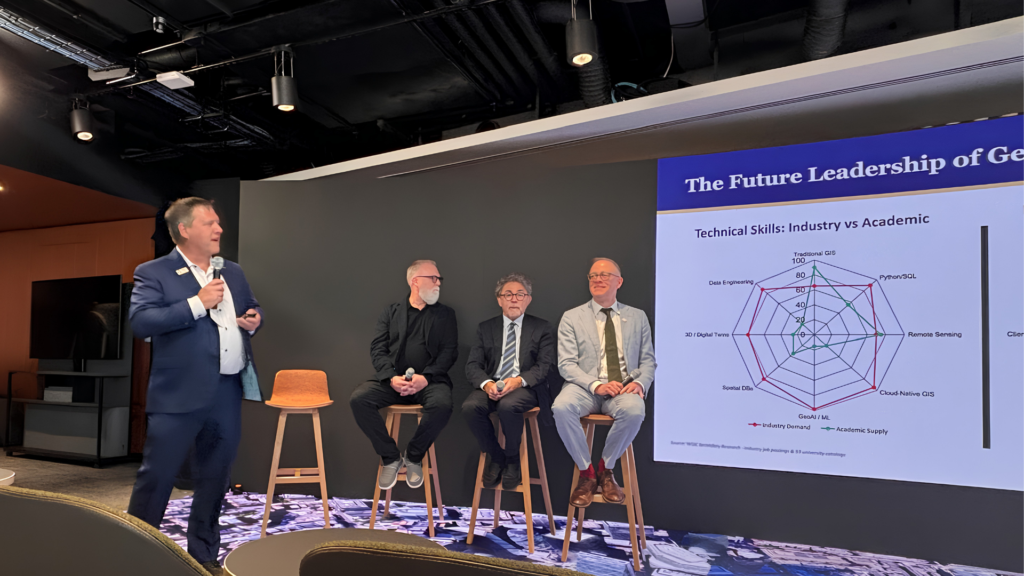
Mark Coates, vice president of Infrastructure Policy Advancement, Bentley Systems;
John Wilson, professor of Spatial Sciences and Sociology, University of Southern California; and
Lou Leonard, dean, School of Climate, Environment & Society, Clark University.
The initiative reflects WGIC’s ongoing commitment to geospatial workforce development. Accordingly, WGIC invites its member organizations to help establish the DGEO programs, participate in the doctoral capstone and classroom experience to bring real-world practices to the curriculum, and drive recognition and demand for the degree worldwide.
“Leaders emerging from this first-of-its-kind program will be equipped and empowered to approach problems with heightened understanding, an expansive set of skills, and the ability to find meaningful solutions,” said Aaron Addison, executive director of WGIC. “We are living in a time of incredible climate and societal disruption, when the demand for leaders in this space is acute — and the DGEO program will be critical in meeting that demand.”
“We are at the point where the scale and impact of the geospatial industry has expanded greatly, moving beyond traditional GIS and remote sensing to integrate AI, machine learning, and data engineering,” said Lou Leonard, the D.J.A. Spencer Dean of the School of Climate, Environment, and Society at Clark University. “However, with this growth have come workforce gaps for the industry, particularly at management levels, where integrating technological competence, particularly GeoAI, with executive skills is vital to leading organizations in a changing future.”
“The DGEO program will offer working professionals the opportunity to strengthen their communication, financial, and management skills as they step into leadership roles across the geospatial sector,” said John Wilson, professor and founding director of the Spatial Sciences Institute at the University of Southern California.
The DGEO Program delivers
Offered primarily online and built around a cohort model, the DGEO coursework spans strategic leadership, organizational management, finance, sales and marketing, and product management, governance, and policy, equipping graduates to lead a GeoAI-first enterprise and to remain fluent in geospatial technology from sensors and data to cloud-native workflows and analytics. The programs target mid-career managers, industry-sponsored candidates, and technical leaders bridging into business.
Two Pathways to the Degree
Executive Doctor of Geospatial Leadership, Clark University
Program Length: 6 semesters (2 years)
Units/Courses: 12 courses (48 credits) – 2 courses per semester
Delivery Model: Online/asynchronous + 2 annual 1-week in-person intensive sessions
Doctoral Capstone: Individual project/white paper/business model
Executive Doctor of Geospatial Leadership, University of Southern California
Program length: 10 semesters (3+ years)
Units/Courses: 10 courses (40 units) – 1 course per semester
Delivery Model: Online/asynchronous + three 4-day in-person intensive experiences
Doctoral Capstone: Thought leadership, business models, innovation, and new opportunities
Both programs start in Summer 2027.
For more information, visit www.wgicouncil.org.