Tag: what3words

  • What to expect from the Consumer Electronics Show

    What to expect from the Consumer Electronics Show

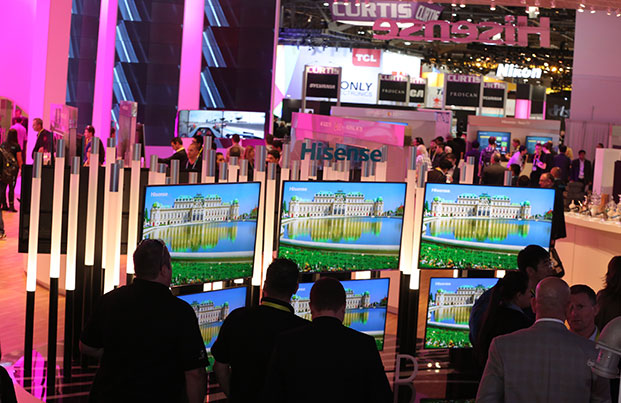
    A scene from the hectic and high-tech show floor of CES 2015.
    A scene from the hectic and high-tech show floor of CES 2015. (Photo: CES)

    It won’t be long until the January Consumer Electronics Show (CES) overwhelms us, so I want to ensure that we don’t overlook innovation occurring now, both in mapping and in automated vehicle technology. And if you are attending the show or following its news, I will provide you with a heads-up that will help orient you.

    what3words. GPS has revolutionized mapping and burst open a host of technologies. We have lived through a transformative age, but today, new features are mostly iterative, just a bit better than last year. A UK startup, what3words, is providing an intriguing perspective on geolocation, mapping the world by words instead of long number strings of location coordinates.

    what3words has divided the world into 57 trillion nine-meter square tiles, each randomly assigned a unique string of three words and, yes, that’s a big vocabulary. For instance, Strawberry-Cart-Walk might be the name for a patch of soil in Africa, and Flower-Hay-Pen might designate a square on the sidewalk in Manhattan. The words have no context, but provide the advantage of being easier to remember, communicate (particularly vocally) and may be less prone to error.

    The advantage of worded geolocations is more apparent in places that are mapped poorly, and have inadequate addressing or limited technology. This describes most of the world, where water wells in remote places can’t be found and aid has trouble reaching people that lack a way to communicate their location. Even in well-mapped areas, worded geo-location can be helpful by identifying specific locations at a traditional address, such as goods and vehicle entrances as well as front doors. How many times are we told by a nav system that we have arrived at our destination when the entrance or driveway isn’t in sight? what3words has recently signed a deal with Esri and has received a Series A investment round.

    Google’s Latest Patents. The race to owning the connected car has been a marathon, and the smartest companies have focused on developing intellectual property that can be patented. Google is in the lead, and most recently the company was granted a patent regarding the interaction between a vehicle and a pedestrian. Self-driving vehicles by necessity are overly cautious or may overreact to road “obstacles.” They are disadvantaged by not being able to interact like a human driver, who might nod or frown or gesture to a pedestrian to indicate intent. Google was recently granted a patent for automated vehicles to communicate intent with a pedestrian, via a physical signaling device, an electronic sign or lights, or a speaker for providing audible notifications. Signage on the vehicle might illuminate to indicate that the vehicle will stop at a crosswalk and that it is safe for the walker to proceed.

    Innovations Unveiled. The CES Innovation Awards are given prior to the show. Bosch is a 2016 winner for a new in-vehicle touch screen that provides haptic control. The screen recognizes the pressure applied by fingers and activates functions accordingly. Having recently announced that it is entering the auto component market, expect different offerings from Samsung. Anticipation is growing that Faraday Future, a new automaker planning to go head-to-head with Tesla, will unveil a concept car.

    Innovation will abound at the Consumer Electronic Show in Las Vegas. Look for the most exciting technology announcements in automotive and virtual reality technology. CES in expanding automotive exhibit space by 25 percent to fit 100 automotive technology companies and nine automakers. Virtual reality and robotics will both have a much stronger presence this year. In addition, the evolution of smart homes, wearables, drones and mobile health technology will be interesting to watch. And if you want see the next trendsetters, check out the curated area of 500 startups. That is the real barometer of the future.

    If you are interested in the connected vehicle, attend the conference Driverless, the Business of Autonomous Vehicles, which will be held March 22-23, 2016, near the San Francisco Airport.

    This is the last issue of Wireless LBS Insider. For six years I have been the editor of GPS World’s newsletters Wireless Pulse and then Wireless LBS Insider, to provide perspective on location-based trends. My coverage started with the beginnings of E-911, telematics and location-based services (LBS) and expanded into connected vehicles, location-based advertising, and M2M.

    As an industry insider, I have a consulting practice devoted to helping companies shape new offerings, research new markets, take the temperature of customers, develop new business and communicate the value of their offerings. Let’s keep in touch. Email me at [email protected]. And if you happen to be at CES, we can meet and talk technology.

  • what3words: The geospatial advancement of the year?

    In this screen capture of the what3words app, the pointer is on mouse's head at the Magic Kingdom. That grid cell is named "perform.heckle.comfortable" and will not change.
    In this screen capture of the what3words app, the pointer is on mouse’s head at the Magic Kingdom. That grid cell is named “perform.heckle.comfortable” and will not change.

    Early this year, I wrote a short column about what3words, one of the exhibitors at the Esri Federal GIS Conference. Since then, I’ve run into a fair number of geospatial professionals who hadn’t heard about what3words. This month,  I’m doing a deeper dive on it because I believe it will become part of our daily lives in just a few short years.

    What is what3words?

    what3words is a global location system using tessellated grid squares of the entire Earth. Each grid cell is roughly 3 meters by 3 meters, and each cell is uniquely named using a simple three-word combination such as “fork.lamp.book.” On initial consideration, one would think, “So what?” — until you understand the ramifications.

    First, this has already been done. More than 57 trillion 3-meter squares have been named using only 40,000 words.

    Second, the system is non-hierarchal, and the cells have no adjacent relationship, so minor errors are dramatically obvious.

    Third, unlike GPS lat/long, the United States National Grid (USNG), the Military Grid Reference System (MGRS) or even street addresses, the three-word combinations are easy to remember and not easily misunderstood.

    Fourth, the system is not just a 57-trillion record database; it’s a compact app (10 mb) that accurately generates the same unique name for each unique location with identifiers that are locked in concrete.

    The what3words website has more information and a well-done video overview.

    How did it come to be?

    Surprisingly, what3words was developed not by a geospatial analyst, but by a musician who got tired of driving around trying to find the correct hotel loading dock or concert venue entrance using an address or verbal directions. Even GPS coordinates didn’t help, since it was easy to miskey numbers or misunderstand voice-relayed numbers. As a result, he and his team built an app that is easy to use, memorable and not error prone.

    Early radio analogy

    The system is so easy to understand that non-technical users can quickly adopt it. I believe that it will greatly speed communications, minimize mistakes, and reduce wasted time and mileage. To me, a good analogy is the World War I development of the phonetic alphabet.

    In the early days of radio, voice communications were difficult and error-prone because of static, noise and garbled transmissions. To prevent mistakes, the military adopted a fixed list of words to help with aural identification of individual letters. The words were used for transmission of critical information such as map coordinates or to spell out words. (Alpha, Bravo, Charlie, Delta, etc.) A similar mind/ear relationship occurs with what3words. Here is a well-written technical appraisal and amplification by Prof. Robert Barr.

    Possible uses


    Military

    The implications for the military could be significant. When I served on a destroyer, one of my duties was Gunnery Liaison Officer, providing naval gunfire support for troops in battle locations. The 5-inch gunfire was called in by concealed spotters in the battle space. The coordination and conversion between the spotter location, the spotter’s point of view, and our offshore position and line of fire required significant calculations and diligence, because friendly fire was always a concern. Current developments in GPS and laser technology have helped significantly, but friendly fire mistakes from guns, missiles and bombing are still a constant concern. The use of what3words could be a simple and quick way to double check and prevent targeting friendly locations.

    Another issue that was a problem for some military bases was addressing, or E911. Some bases had buildings identified by numbers corresponding to the sequence of construction rather than street addresses, so building 245 might be next to building 1842 and next to building 38 (I’m not sure if this is still an issue). With what3words, help could be directed to exact building entrances or to exact locations in remote parts of a base.

    Disaster response would also benefit. In many disasters such as tornados or hurricanes, street signs and building were obliterated. What3words would provide “addressing” for relief supply drops and other needs.

    The location of the helo deck on the battleship Wisconsin in Norfolk, Virginia, is identified as "chew.sketch.hardly".
    The location of the helo deck on the battleship Wisconsin in Norfolk, Virginia, is identified as “chew.sketch.hardly”.

    First Responders

    Whether it be an air crash needing remote mountain rescue, a farm accident in a rural area, a capsized boat at sea, or a heart-attack victim in a shopping mall or home, response could be significantly faster with less chance for error. Even in urban areas, there are frequent stories of delayed medical aid because E911 street databases were not correct or updated with new construction. what3words provides complete location coverage and would serve as an easy and effective double check for street addresses.

    Government and NGO activity

    Some of you may be familiar with U.S. Census Bureau TIGER files and LUCA (Local Update of Census Addresses). I still can’t wrap my head around why census workers have to keep posted house numbers and street names confidential. Perhaps using what3words could provide a simpler, unclassified way to direct census workers. Additionally, many actions that currently use GPS may be better served with 3m grid locations, such as agricultural or environmental data collection.

    Business

    Mundane activities such as materials delivery to unaddressed construction sites or package delivery to homes and businesses will be more efficient. (Rumor has it that a prominent package delivery service is testing what3words.) Utility companies could locate cut-off valves, meters and other assets within 7 feet of their actual location. Meeting friends, getting an Uber pick up, or even having a pizza delivered to a specific bleacher location at a Little League game would become easy.

    Second and third world

    There are complex issues regarding the World Bank and economic development. To qualify for major economic development loans, countries have to demonstrate that they have viable property ownership and taxation system in place so loans can ultimately be repaid. We take our tax parcel system for granted, but may third-world countries don’t even have consistent and comprehensive street names and addresses. what3words can provide “addresses,” which could lead to more comprehensive parcel identification.

    On an even more basic level, the majority of citizens in the world don’t have an address for simple deliveries. When I was in a rural part of Haiti, just getting some simple wood screws was an all-day trip and ordeal. I learned to really appreciate being able to take a quick run to Home Depot or get two-day deliveries at my front door from Amazon. Those “luxuries” don’t exist in many parts of the world, and their lack really cripples those trying to start or run a business. what3words gives everyone an “address.”

    Try it

    iphone-WDon’t take my word for it; try it yourself. Download the app on your smartphone (I’m using an iPhone, so others may be slightly different). Launching the app will display a map with your location and its what3words name. Click the “eye” to view an ortho image rather than a vector map.

    If the padlock is locked, unlock it and you can move the map to different locations showing different what3words names. If you are sent a what3words location, you can click on the magnifying glass and type in the three words. The app will prompt “Near Me” or “Anywhere.” If there is no match near you, it will show possible options that come close by looking at alternate spellings or words. If you click “Anywhere” it will search the entire world for a match.

    Once it takes you to the location, you can use Maps or Google Maps to get directions.

    Other points

    what3words has been adopted by many geospatial firms, including Esri. Available online or offline, anywhere in the world, the what3words locator can be available to the GIS team or customers across the entire ArcGIS platform. Since what3words is grid-cell layer, it may be possible to do map algebra operations on the cells in Spatial Analyst. I’m not sure there would be a benefit to that other than not needing to transform the list of affected cells.

    what3words is available in several languages. The words are not simple translations, but developed for each language. Although the what3words team carefully scrubbed the words used to avoid offensive terms, I hope what3words doesn’t have to deal with lawsuits from individuals unhappy with the three-word identifiers of their location.

    Conclusion

    I predict that within a few years, our business cards will also include a what3words address. Simply put, I believe that what3words may prove to be one of the most significant geospatial advancements since Jack Dangermond spatially linked points, lines and polygons to a relational database.

    what3words is going to save time, money and, most important, it’s going to save lives.

    P.S.  If you read my March column reviewing Peter Zeihan’s book The Accidental Superpower, you may remember the importance Peter placed on 3D printing affecting the geo-politics of shipping manufactured goods from China.  If you haven’t seen the new CLIP technology 3D printers, you need to view this TED video to see how far the technology has progressed.

  • what3words Uses 3 Words as Coordinates to Identify Location

    what3words explains its coordinates system based on words while at the 2015 Esri Federal GIS Conference, held Feb. 9-10 in Washington, D.C. what3words splits Earth’s surface into 57 trillion 3-meter by 3-meter squares, and gives each square a unique combination of three words — replicated in eight languages — that identifies the area.

  • what3words: A new way to identify any 3-meter location gains traction

    what3words

    what3words (w3w) is such a simple concept that I’m kicking myself for not think of it first. Developed in 2013, what3words is gaining traction with many non-GIS users as a more user-friendly way of identifying locations. It’s a system of 3-meter grid cells covering the Earth’s surface, with each cell identified with a unique three-word group.

    The three words don’t mean anything, but like the phonetic alphabet (Alpha, Bravo, Charlie, Delta…) used in radio communications, the words make it easy to communicate and easy to remember. By contrast, a long string of lat long degrees, minutes and seconds, or MGRS characters are tedious to copy, hard to remember and easy to screw up.

    Additionally, because the w3w cells are small, communicating an exact location is easy. So, if I wanted to meet someone at a large sporting event in the parking lot or particular gate, the unique 3-meter cell puts me face-to-face with my colleague. Since the words follow no particular hierarchy or grouping, an error in one word would be very obvious or show zero return.

    See the video at the what3words website for a full explanation. My guess is that very soon your business card will not only list your address, but the three word location of the right door to enter your building and perhaps even your cubical location, once indoor location technology is perfected.

    My column is short for now because I’ll be attending the Esri Federal GIS Conference in Washington next week.  I’ll be posting video clips from the conference and expo, so watch this space Monday and Tuesday for highlights.