Author: Kevin Dennehy

  • Use of autonomous vehicles in mining and farming touted at CES 2021

    Use of autonomous vehicles in mining and farming touted at CES 2021

    After years of testing and hype, not a lot of companies can say there are real applications for autonomous technology. However, at this year’s virtual CES 2021 trade show, both Caterpillar and John Deere, two companies known for their tractors and heavy equipment, showcased autonomous machines that are being used worldwide in farming and mining projects.
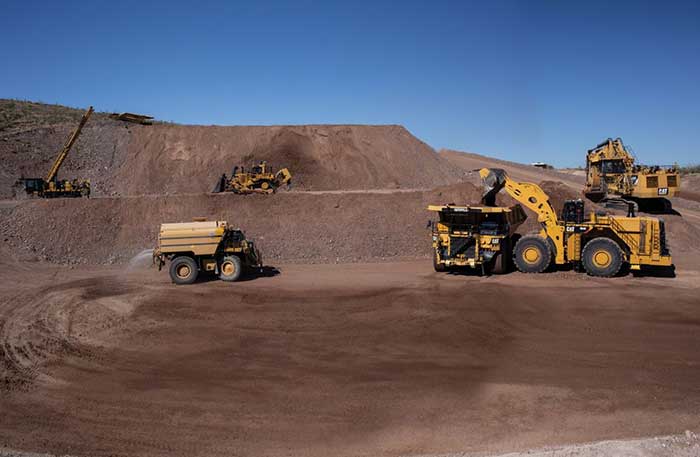
    Photo: Caterpillar
    Photo: Caterpillar

    Deerfield, Ill.-based Caterpillar, a first-time exhibitor at CES this year, said it has been involved in autonomy and use of GPS for more than two decades. “We were an early adopter of GPS when there were few satellites in the sky,” said Denise Johnson, company group president, resource industries. “We have 350 autonomous trucks operating 24-7 on three continents.”

    The company’s autonomous vehicles, in addition to other technology, are being used around the clock in the Kearl Oil Sands project in Alberta, Canada.

    “We are using autonomy primarily in mining operations in harsh environments. These [vehicles] are operating 24-7, with no loss time incidents,” said Bill Dears, Caterpillar worldwide sales and marketing manager. “We also track people underground with cameras and radar.”

    In addition to production enhancement, safety is a factor in mining operations because of operator fatigue — something that is precluded by autonomous mining equipment, Dears said.

    Agriculture uses variety of sensors, including GNSS

    To Moline, Ill.-based John Deere, exhibiting at the trade show for the third time, agriculture is a high-tech industry that uses GPS, self-driving tractors, artificial intelligence and a multitude of sensors. The company rolled out its first self-driving tractors nearly 20 years ago, said Jahmy Hindman, John Deere CTO.

    Photo: John Deere
    Photo: John Deere

    The company won the CES Innovation Award for one of its tractor and combine product lines. “Both our planter and tractor have GPS and antennas to know where to drive and where exactly fertilizer [is to be placed],” Hindman said. “These tractors are self-propelled, with accuracy augmented with [real-time kinematic] sub-inch accuracy for the planters in a field.”

    Among other requirements, Hindman said that tractors have to drive in a straight line, plant the required amount seeds and position them at the right depth. “When a tractor drives in a very straight line, the burden is off of the farmer. The yields increase—this is the way we see the progression of automation,” he said. “We are excited about 5G and its lower latency and high bandwidth. It opens up a lot of opportunity.”

    Organizers roll out Indy Autonomous Challenge race car

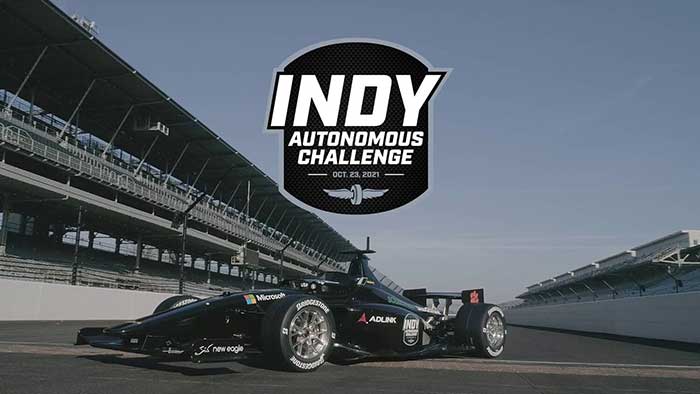
    At the virtual CES, representatives from the Indy Autonomous Challenge unveiled the Dallara IL-15 race car that will be used in a head-to-head race around the famous Indianapolis Motor Speedway on Oct. 23.

    The Indy Autonomous Challenge, organized by Energy Systems Network and Indianapolis Motor Speedway, pits 500 university students, developing autonomous vehicle technology, against each other for a $1.5 million prize.
    Logo: Indy Autonomous Challenge
    Logo: Indy Autonomous Challenge

    Organizers say the speeds are estimated to be as much as 200 mph around the 2.5-mile track, for 20 laps, which enables researchers to evaluate how autonomous vehicle technology works in extreme conditions. They say that the goal of the race is to advance the implementation of autonomous vehicles and advanced driver-assistance systems (ADAS), much like the 2005 Defense Advanced Research Projects Agency (DARPA) Grand Challenge.

    The race track has been the scene of much innovation throughout the years, said Doug Boles, Indianapolis Motor Speedway president. “Firestone tests tire technology there and that data transfers to our cars. One of the first conversations we had with Roger Penske [after Penske Entertainment bought the speedway] was about the autonomous challenge,” he said.

    IAC sponsors include ADLINK, Ansys, Aptiv, AutonomouStuff, Bridgestone, CU-ICAR, Dallara, Indiana Economic Development Corp., Microsoft, New Eagle, PWR, RTI, Schaeffler and Valvoline.

    Mobileye plans to test autonomous fleets in four cities

    Intel subsidiary Mobileye plans to launch autonomous vehicle fleet testing in Detroit, Paris, Shanghai and Toyko. The announcement, made at CES by CEO Amnon Shashua, said that the company also plans to test in New York City, pending regulatory approval.

    The company also plans to use in-house-built lidar sensors, while continuing to champion its camera-based testing. “We are using crowd-sourced data through the Cloud to build high-definition maps at scale,” Shashua said. “Thousands of product vehicles are sending us data.”

    Shashua addressed a moderator’s question that cameras alone cannot be the technology of choice for autonomous vehicles. “The camera first is crucial from a technology and business point of view. We have to find out what is acceptable failure for Level 4 autonomy. Camera-only is ideal, but pushing the envelope for driver-assistance systems,” he said. “Consumer AV will take place in the 2025 timeframe. [Eventually], we can build lidar and radar to the same performance levels as camera systems. Lidar and radar can be added later for redundancy, but only for Level 4.”

    Shashua said getting to Level 4 could take a decade, but that would be unsustainable unless there are government-funded projects to keep companies afloat. “By 2025, a subsystem will be good enough for consumers. Regulation is critical and sometimes it’s difficult to leap to a consumer level,” he said.

    Not everyone believes what Mobileye is testing constitutes “driverless” status. To Alain Kornhauser Princeton University professor and transportation program director, who was head of the university’s team during the 2005 DARPA Challenge, not many companies are capable of full driverless capability.

    “Unfortunately, I still see all of this as simply ‘eye candy’ to sell something that actually has no intention of delivering what it is implying. I still claim that the business case is zero, doesn’t exist, for personally-owned autonomous vehicles,” Kornhauser said in his Smart Driving Cars weekly newsletter. “Mobileye is nowhere close to being able to operate safely on most roads, let alone all roads. Thus, the consumer market has zero opportunity to scale.”

    Kornhauser said that driverless testing is being conducted only in one place, Phoenix, by Waymo. “Neither Tesla nor Mobileye are driverless anywhere. They both require on-board human driver supervision,” he said. “That’s why they are only self-driving [tests].”

    In other CES news:

    • GM CEO Mary Barra unveiled a single-seat electric vertical takeoff and landing (eVTOL) concept aircraft. The aircraft will be developed for future use as an air taxi. Barra briefly mentioned that the company’s Super Cruise self-driving technology will be integrated into 22 car models in a few years. The company also rolled out an electric vehicle for deliveries that can travel 250 miles on a charge and a motorized pallet for deliveries that can be tracked.
    • Photo: Mercedes-Benz
      Photo: Mercedes-Benz
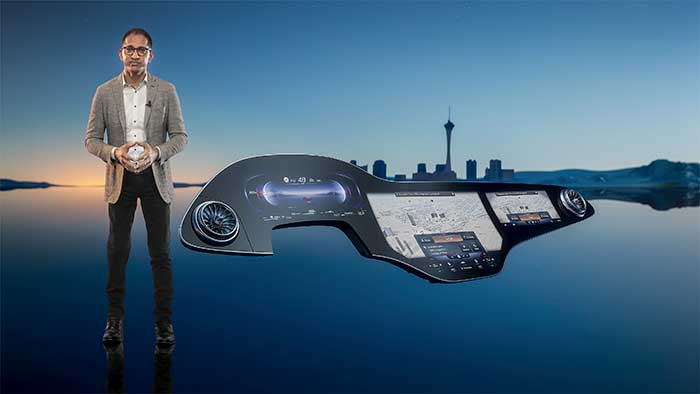
    • The Mercedes-Benz’ MBUX Hyperscreen, rolled out at CES, evaluates map data, surroundings and provides information about landmarks along a route, said Sajjad Khan, company CTO and member of the board of management. The new map feature, called Mercedes Travel Knowledge, allows a passenger or driver to ask a question as they drive by a landmark (“hey, Mercedes, what can you tell me about this building?”). The MBUX Hyperscreen is available in the new S-Class cars.
    • HERE Technologies introduced a mapping-as-a-service platform at CES. The platform is targeted to businesses wanting to create custom map datasets for advanced analytics and services, the company said. Some use cases include industrial yard mapping, leveraging probe data from private vehicle fleets in order to create or update a map.• A virtual CES is hard to get used to. After more than 20 years of covering the massive trade show in person, covering press conferences and conducting interviews online was sometimes a challenge. Sometimes the press conferences did not have question-and-answer sessions, or canned answers given to executives by public relations people. This doesn’t happen much during an in-person interview. In addition, trying to chat with “booth” personnel online was cumbersome and often those requests for information were ignored.
  • Universities compete in new autonomous race

    By Kevin Dennehy
    GPS World Contributor

    University teams will go head-to-head in a two-year autonomous race car competition to test new software and other self-driving technologies at Indianapolis Motor Speedway.

    The competition, called the Indy Autonomous Challenge, culminates in a high-speed autonomous vehicle race, scheduled for Oct. 23, 2021, on the speedway’s famed 2.5-mile oval track that is home to the annual Indianapolis 500.

    The competition was inspired by the 2005 Defense Advanced Research Projects Agency (DARPA) Grand Challenge, which pitted university teams against each other and spurred commercial development of autonomous vehicles.

    “The idea for the Indy Autonomous Challenge originated with DARPA’s winning team captain, [Stanford University’s] Sebastian Thrun. Sebastian joined us at the 2018 Indy 500, where he reflected on the inspiration and excitement that came from participating in the DARPA challenge, and how a high-speed automated vehicle race at the Indianapolis Motor Speedway had the potential to be on par with that experience with today’s teams,” said Matt Peak, Energy Systems Network director of mobility.

    Like the DARPA competition, the Indy Autonomous Challenge focuses on university participation. “I can’t speak for DARPA, but our focus on universities is deliberate,” Peak said. “It was advised by not only Thrun, but other original DARPA competitors such as [Aurora CEO] Chris Urmson, all of whom commented on how participation by universities — their students, faculty, departments, alumni — was a key to DARPA’s success.”

    The autonomous racing software developed through the competition could assist in developing commercial self-driving vehicles and enhance existing advanced driver-assistance systems (ADAS). Some of the cornerstone technologies include GNSS and digital maps, which provide the accurate location for fully autonomous vehicles.

    As was the case with the original DARPA challenge, spurring new innovations and socially beneficial products and services is a goal of the competition, Peak said. “In our case, we see inspiring teams’ creation of software that can solve for edge cases — those problems or situations that occur only at an extreme operating parameter, such as avoiding unanticipated obstacles at high speeds while maintaining vehicular control,” he said. “This applies not only for highly automated vehicles, but also for vehicles equipped with ADAS that aim to help human drivers avoid obstacles altogether. The notion is, if our university innovators can enable cars to outmaneuver others at 200 mph, they certainly can help enable you to avoid that piece of lumber that fell off the pickup in front of you on the 65-mph highway.”

    Peak said that a perfect place to demonstrate these technologies is the famous speedway, which for 100 years has tested automotive technology in a demanding environment. “Tackling automation at 200 mph in a race car is a bit more alluring than with a 20-mph people mover,” he said.

    In addition to ESN and Indianapolis Motor Speedway, other challenge partners include race-car manufacturer Dallara Automobili and the Clemson University International Center for Automotive Research (CU-ICAR).

    $1.45 Million in Prize Money

    During the final race at the speedway, teams will compete for $1 million as the first-place prize. Second- and third-place finishers receive $250,000 and $50,000, respectively.

    The five-round competition starts with the submission of a white paper to demonstrate vehicle automation with a video of an existing vehicle or participation in Purdue University’s self-driving go-kart competition at the speedway.

    During the initial rounds, teams will use sponsor ANSYS’ driving simulator to develop autonomous vehicle software. ANSYS, which will provide $150,000 in prizes to top finishers of a third-round race, will co-host a hackathon to let teams work with the simulator, the company said. The fourth round allows teams to test their vehicles at the speedway in advance of the final race.

    So far, five universities have registered:

    • Korea Advanced Institute of Science & Technology (KAIST)
    • Texas A&M Transportation Institute (TTI)
    • University of Florida
    • University of Illinois
    • University of Virginia.

    Not Everyone Has Championed Autonomous Vehicles…

    The new competition is commencing during a time when media reports show that the once-hot autonomous vehicle industry has vocal critics. Recently, Apple pioneer Steve Wozniak, who once headed a GPS-based fleet company called Wheels of Zeus, said he didn’t expect to see a fully autonomous vehicle operating on the streets in his lifetime.
    In addition, a few automakers have reined in autonomous vehicle development or have scaled back their technology expectations in recent months.

    “Not at all surprising. The traditional OEMs were never going to be disrupters that put driverless mobility-as-a-service cars out there. It isn’t their business model, and it won’t be,” said Alain Kornhauser, Princeton University professor and transportation program director, who was head of the university’s team during the DARPA Challenge, in his Smart Driving Cars weekly newsletter. “Self-driving, I dare say Level 2, is and has always been their sweet spot — it sells cars. Now watch these same companies throw monkey wrenches into those driverless mobility machines to protect their conventional business model.”

    Peak says the recent negative press on autonomous vehicles is what happens when any new technology is rolled out. “For any new technology, such as automation, we’re going to see euphoric coverage (automation will solve all of our problems) and pessimistic coverage (automation will never arrive and, if it does, it will make things worse),” he said. “It’s a cycle, it swings back and forth, and we happen to be touching upon the latter, pessimistic end of that cycle.”

    Taking a moderate and realistic position about the technology is what the Indy Autonomous Challenge is striving to do, Peak said. “Automated vehicle technologies have a role to play, both in helping humans drive better, and eventually in enabling new markets, such as first/last mile transit solutions. The technologies are light years ahead of where they were a decade ago, and low-level automated technologies are already making a difference and saving lives in today’s vehicles,” he said. “We have a bit of a ways to go before the full potential of automation will be realized, and the Indy Autonomous Challenge will help us address the concerns brought about by the media and others to reach this end goal much sooner than we otherwise would.”

    For more, go to www.indyautonomouschallenge.com.

  • TomTom highlights autonomous vehicle push

    TomTom highlights autonomous vehicle push

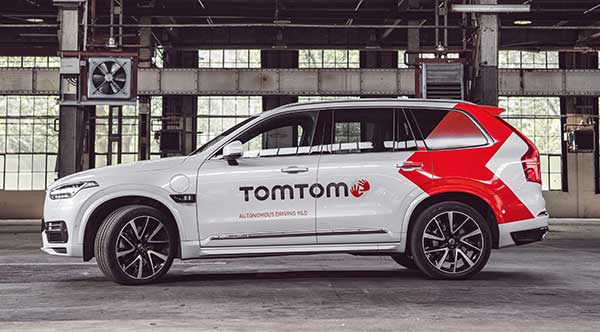
    The TomTom autonomous test vehicle. (Photo: TomTom)
    The TomTom autonomous test vehicle. (Photo: TomTom)

    To grab a larger piece of the burgeoning connected and autonomous vehicle markets, digital mapmaker TomTom launched its self-driving test vehicle and is integrating navigation and diagnostic capabilities in the Microsoft Connected Vehicle Platform.

    While the company has tested the technology for years, TomTom officially announced the availability of its own autonomous test vehicle, which Arnold Meijer, TomTom strategic manager, business development, said is a critical advantage to quickly develop maps and services for that industry.

    “We can continuously test our mapping technology on the roads, get insights and high-quality data on how it performs in a multitude of circumstances and, right away, feed this into our AI-driven mapmaking process,” he said.

    Currently, the vehicle is testing TomTom’s high-definition map; a crowd-sourced map update called Roadagrams; and a map-streaming service, AutoStream, which will deliver map data to vehicles on demand.

    The company announced in September at the International Motor Show (IAA 2019) in Frankfurt, Germany, that its digital maps have doubled to more than 1 million Level 1 and Level 2 autonomous vehicles from several automakers.

    Showcasing TomTom HD Maps

    At IAA 2019, TomTom also demonstrated proof-of-concept high-definition map features that can work through Microsoft Azure cloud services, Meijer said. “Some of the navigation intelligence, which also includes traffic information and HD map services, can also be used in vehicles for navigation apps, as well as context while driving autonomously,” he said.

    The demonstration allows TomTom to send telemetry data to Microsoft Azure. “[This includes] application usage data such as what menu items the end-user clicked on and what screens of the TomTom NavApp they opened for app analytics purposes,” he said.

    Other features include GPS location during a driving simulation, vehicle speed and heading for driver behavior, and usage of apps that are not navigation-related, such as for music. Other testing included road speed limit, the number of times users drive a planned route, destination details planned by a user, and travel time.

    TomTom navigation integrated into the Microsoft Connected Vehicle Platform allows automakers to quickly access precise navigation and driving behavior, “while of course adhering to TomTom’s privacy principles,” Meijer said. “This data could, for instance, be used to predict the range of an electric vehicle based on driving behavior and planned route more accurately. Or to work out, based on navigation behavior, what connectivity package for online navigation would be best suited for a driver.”

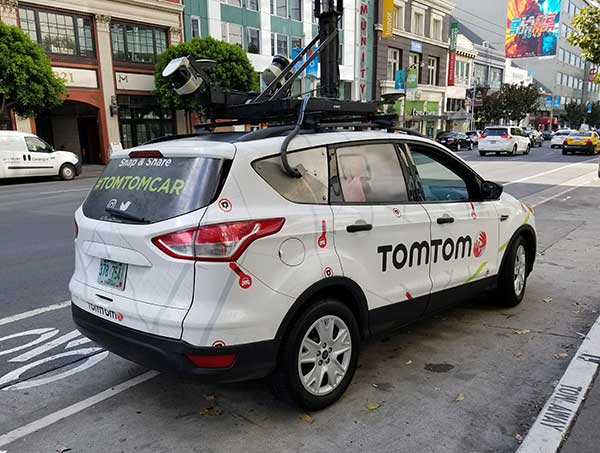
    The TomTom Moma test vehicle prototype hits the road in San Francisco. (Photo: Kevin Dennehy)
    The TomTom Moma test vehicle prototype hits the road in San Francisco. (Photo: Kevin Dennehy)

    Voyage Forges Ahead…

    While recent press reports have said autonomous vehicle development is slowing because of technology limitations and consumer doubt, Palo Alto, Calif.-based Voyage has raised millions of dollars and continues to test self-driving cars in retirement communities in California and Florida.

    The company recently raised $31 million in Series B funding from Franklin Templeton, Khosla Ventures, Jaguar Land-Rover’s InMotion Ventures and Chevron Technology Ventures. Voyage has raised a total of $52 million since its 2017 founding, said Oliver Cameron, company co-founder and CEO.

    With the new funding, Cameron said the company hopes to triple its workforce, increase its second-generation fleet of self-driving cars, invest more in the technology and roll out a third-generation vehicle.


    See the GPS World cover story about Voyage here.


    “We are taking a unique, focused approach to delivering truly driverless cars in communities where there are limited mobility options, customers who need an autonomous ride-hailing service, and lower speeds,” he said. “Many residents within our communities don’t have access to transportation options that work for them, so they’ve welcomed our fleet of self-driving vehicles. We’ve started with self-driving cars that can travel point-to-point within our communities at speeds of up to 25 mph.”

    Cameron said the community-based approach allows the company to quickly design and deploy autonomous technology. “For the past two years, because we are taking this focused, community-based approach to designing and deploying advanced self-driving car technology, progress has been rapid. Our vehicles intelligently and autonomously navigate the complex neighborhoods of our communities and safely transport our passengers door-to-door,” he said.

    The company said its engineers are transitioning software to a safety-critical middleware, shipping a new prediction engine with better capabilities and creating triple redundancy in the vehicle’s perception system.

    G3 Vehicle? Not Yet. Voyage, which began testing self-driving with a retrofitted Ford Fusion, doesn’t have a timetable planned for a third-generation system, Cameron said. Instead, the company plans to continue to use the self-driving Chrysler Pacifica hybrid minivan in its testing projects.

    “Before we launch our [third generation] self-driving car, we are going to build and scale more G2 self-driving cars to better serve the communities in which we operate. We haven’t announced a timeframe for the launch of our electric, truly driverless and highly scalable G3 self-driving car,” he said.

    The company is growing its ranks as it has hired its first chief operations officer, Nina Qi. She believes the biggest hurdle autonomous vehicles have is the basic challenge to deliver safe and cost-effective services to make the industry economically sustainable.

  • Sony sensors not just for robot puppy

    Sony sensors not just for robot puppy

    The importance of sensors, whether they be incorporated in cute dog robots or autonomous vehicles, is gaining more traction.

    At September’s Custom Electronic Design and Installation Association (CEDIA) Expo, Sony Electronics President and COO Mike Fasulo told GPS World that its foundation sensors are going into autonomous vehicles, drones, agricultural solutions and other platforms.

    “A lot of people also don’t know that more than half of the hardware in most smartphones is ours,” Fasulo said. “These sensors we are working on do things you and I can’t do. They can assess sunlight and darkness. They can put a safety cocoon around a vehicle.”

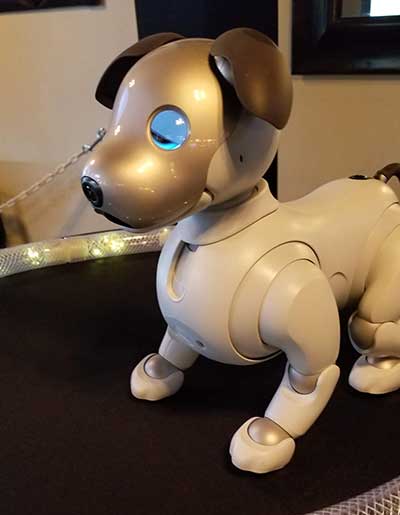
    The Aibo robot dog uses artificial intelligence to mimic a real puppy’s behavior. (Photo: Kevin Dennehy)
    The Aibo robot dog uses artificial intelligence to mimic a real puppy’s behavior. (Photo: Kevin Dennehy)

    At the conference, Sony displayed a nearly $3,000 Aibo dog robot, which has many of the same sensors that go into many of the company’s other products, including its venerable camera line. Aibo has facial recognition technology and uses artificial intelligence to mimic a real puppy’s behavior.

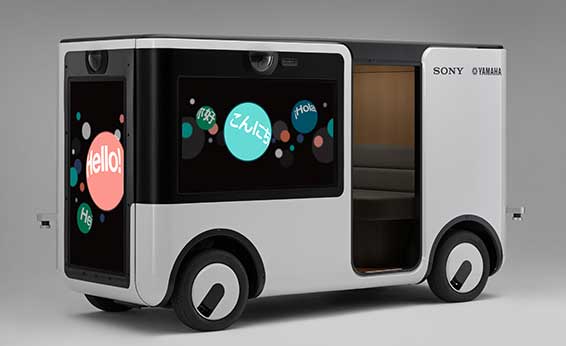
    Sony sensors seem to be a cornerstone in several new announcements. Less than two months ago, Sony and Yamaha Motor Co. announced the joint development of the SC-1 Sociable Cart, a small autonomous vehicle that will be deployed to golf courses, amusement parks and commercial facilities, the company said.

    The SC-1, which is not for sale, features five seats, replaceable batteries, front and rear scope of view thanks to image sensors, an innovative vehicle design, and other improvements over an original prototype vehicle.

    In addition to the image sensors, the vehicle has ultrasonic sensors and a two-dimensional laser detection and ranging (lidar) system, the company said. These sensors allow the vehicle to gather cloud travel data for safe-driving analysis.

    Sony is working with Japan’s NTT Docomo to test the vehicle’s 5G mobile technologies for remote-controlled functions, the company said.

    Geotab leverages sensor data

    Sony and Yamaha Motor plan to roll out the SC-1 later this year in Japan. (Photo: Sony/Yamaha Motor)
    Sony and Yamaha Motor plan to roll out the SC-1 later this year in Japan. (Photo: Sony/Yamaha Motor)

    Canada-based Geotab has made big announcements this year, although the huge one is from the U.S. government to equip more than 200,000 vehicles with its telematics systems.

    While that contract itself is massive, the company believes the more than 2 billion data points gathered each day, from millions of Geotab-equipped vehicles on the road, is the real valuable commodity.

    The data gathered with the company’s connected-car technology can help companies and governments assess how their fleets are operating, said Mike Branch, Geotab vice president of data and analytics.

    Branch, who leads a team of 40 employees, said the company uses the data to help cities assess road impediments — not only road quality. This includes analyzing ABS activation to look at black ice or other hazards. “While weather companies can only estimate conditions, we have sensors in vehicles that can give hyperlocal reports and ground truth,” he said. “People consistently slamming on their brakes in one area is an example [of aggregative data].”

    Back in the day, which is less than 10 years ago, all that many companies expected from their fleet management systems was to let them know where their drivers were, by using GNSS and mapping technology. Today, the sensors — and data provided by them — allow managers to assess dangerous driving areas, save on fuel costs by rerouting trucks and compare routes throughout the United States, not just in big cities, Branch said.

    In the smart cities space, Branch said that Geotab is working with municipalities for fuel intersection insight mapping. “This means if 20 vehicles, or even just two, are stopped at an intersection, our sensors can detect the wait times,” he said. “The big thing for us is looking at this smart-city deployment to leverage organic data in a private manner.”

    Because of the nature of data procurement, privacy is big topic for the company, Branch said. “We treat it with high importance. Our view is that the data is owned by the customer,” he said. “They have full access to it. We will go through it, aggregately, so we can improve our customer’s experience.”

    Keeping OBD port secure

    The future of open on-board diagnostic (OBD) vehicles — and procuring secured and open data from them — is a concern for Geotab, Branch said.
    “We have a full port safety committee with the goal of security and access to the port,” he said. “We believe in open access to this port. This gets to be a concern with mixed-fleet Fords, Mercedes, BMW and others as the data can slow down the port at any time.”

    Branch said the company does not want to remove the entrepreneur, who is interested in working with the port in a safe manner. “We work with the OEMs on the future of telematics not just by pulling the data from our device, but pulling it from their feed,” he said.

    Branch said that technology may make the port dongle obsolete in five to 10 years, but until then, the company has created an ecosystem to enable the use of the data. “There is going to be an aftermarket as cars are lasting an average of 11 years,” he said.

  • Indoor location, data see growth at MWC

    Indoor location, data see growth at MWC

    Barcelona’s Fira center hosted Mobile World Congress, a gathering of 105,000 industry participants.
    Barcelona’s Fira center hosted Mobile World Congress, a gathering of 105,000 industry participants.

    By Kevin Dennehy
    Contributing Editor for LBS

    The big takeaway from this year’s Mobile World Congress was the interest in location data from a growing number of vendors. Although still a small footprint in the cavernous halls of Barcelona’s Fira center, at least 33 companies displayed products and services related to indoor location, which was more than past years, said Bruce Krulwich, Grizzly Analytics founder and chief analyst.

    “There are also more major multinational companies that are exhibiting indoor location, including Phillips, Panasonic and Cisco,” he said. “The growth in the area is clear.”

    This year’s MWC also featured four different applications of indoor technology, Krulwich said.

    “The MWC app included mapping and navigation based on Pole Star’s technology and also proximity marketing and notifications based on MOCA [customer engagement software],” he said. “The security staff had a security management system based on Situm technology,” he said. “The smart badges at the entrances used [Bluetooth low energy] to detect the phone moving through the turnstile.”

    Rise of Ultrasonic

    Ultrasonic sound was prominent, Krulwich said. “In the past there was a single company, MTI, using ultrasonic sound for positioning, but this year three new players are using ultrasonic: Marvelmind for highly accurate positioning, Yap for proximity and Prontoly for selective content and communication,” he said. “If the technology is effective in real-world deployments, it may be a big step forward in increasing accuracy using existing phone technologies.”

    Modulated LED lighting, also known as visible light communication, is receiving more interest. “Phillips was demonstrating a solution in that space this year,” Krulwich said. “I2Cat also returned with an LED solution, and Oledcomm is a new entrant in that space.”

    Although beacon prices have gone down, the key is indoor positioning’s scalability and solution maturity. “Many of the solutions shown at MWC addressed scalability, including Estimote with self-mapping beacons, indoo.rs with SLAM-based automated configuration and Situm with infrastructure-free positioning,” Krulwich said. “The solution maturity is evident from the number of full commercial deployments (not trials) by companies like Pole Star and indoo.rs,” he said.

    Another trend is the increasing numbers of high-accuracy systems.

    Quuppa has shown highly accurate positioning at MWC for several years,” Krulwich said. “But this year they were joined by powerhouse Phillips and by newcomer Marvelmind. All three showed centimeter-level accuracy with very fast response, each with a very different technology.”

    Samsung press conference had hundreds of journalists in attendance at MWC.
    Samsung press conference had hundreds of journalists in attendance at MWC.

    Indoor Location

    The lack of indoor location vendor participation at January’s National Retail Federation BIG Show in New York is a cause for concern, Krulwich said.

    “Indoor location has been expected to cross the chasm for years, and it’s still stuck among early adopters,” he said. “But recent improvements in accuracy and in the maturity of the solutions, with easier configuration and integration into back-end systems, should lead to more full commercial deployments and then larger adoption in retail. It is also important to note that retail is not the only application of indoor location. Asset tracking and customer analytics are both growing. We also see a growth in the number of companies developing practical solutions on top of existing technologies, such as MOCA, Qualigon and xAd.”

    Quest for Data

    Companies that aggregate location data found increased interest at MWC.

    Teralytics, which processes data points using predictive algorithms, provides human behavior information based on location. The company is working with not only wireless carriers, but governments and others on smart-city initiatives worldwide, said Luciano Franceschina, Teralytics co-founder and CTO. “We are already working with different verticals, and not just the telco verticals themselves, who are using the location analytics. A top transportation planner in Germany scrutinized our system for a year and now uses it to plan and decide what infrastructure investments to make.”

    The company is collecting billions of data points, and aggregating geolocation and demographics to assess human behavior globally. This allows a retailer to assess where to build the next store, or how much capacity a train line should handle. For municipal planners, the data shows what transit system stops are being used more than others, Franceschina said.

    Virtual reality goggles were big again at MWC.
    Virtual reality goggles were big again at MWC.

    Other markets for Teralytics’ data are tourism, retail, hedge funds and automotive, said Lisa Peterson, Teralytics vice president.

    “That could be location data that allows auto[makers] to use to see driver behavior,” she said. “A company like Marriott could see why their silver members aren’t upgrading to gold, because they can see their hotel usage patterns. The can see these consumer traits and target their members with better offers.”

    The acquisition of location data is more reliable that research methods used by such companies as Gallup, which still uses phone surveys and other antiquated methods, Peterson said.

    IoT Growing

    Comtech Telecommunications showed off its Location Studio platform that allows customers to build or enhance cloud-based embedded and hybrid LBS applications. The platform includes modular suites with indoor and outdoor positioning, geolocation, fraud detection, maps, search, routing, navigation, real-time messaging and analytics, the company said.

    The rise of Internet of Things (IoT) and location hasn’t surprised Comtech.

    “My team moved into IoT because it’s impacting a lot of new areas,” said Keith Bhatia, Comtech senior vice president. “IoT objects come down to how cheap you can make the connection and make the device available during the early stages. The momentum is there.

    However, the hype that every device will be connected is just not price feasible.”

    Comtech is looking for that location price sweet spot when it comes to IoT, Bhatia said. “We are seeing a pull for cheap location. We are seeing significant strides from last year to this year.”

    Location company PoLTE partnered with ACS at MWC. ACS will use PoLTE’s LTE-based location tracking to allow business in the manufacturing, industrial and transportation industries to track assets, goods, workers and devices.

    PoLTE, which delivers location services both indoors and outdoors, said that while Wi-Fi, Bluetooth and GPS have deficiencies when tracking LTE devices, its system leverages native cellular signals to geolocate 4G and 5G devices. PoLTE uses an advanced radar location technique to transform reference signals in LTE transmissions into precise location.

    The company started focusing on LTE positioning nearly seven years ago, said Russ Markhovsky, PoLTE founder.

    “Customers are going to be able to embed the available service into platforms and devices next year,” Markhovsky said. “We are undergoing trials and proofs of concepts and are connected to wireless operator’s network test platforms.”

    The location information derived from PoLTE’s network is valuable to retailers and others who track a consumer’s spending habits, said John Dow, PoLTE president and chief operating officer

    “LTE works everywhere,” he said. “You can track a user’s behavior when they went to Walmart, then went home,” he said. “It’s not a Swiss-cheese approach, as there is persistent location information. Retailers can receive decision-making data that is valuable compared to what’s out there today.”

    Other Tech Finds IoT Location Niche

    Another technology that is gaining traction with IoT companies is low power, wide area (LoRa) that leverages time difference of arrival (TDOA) triangulation to calculate the position of a device. One company, France-based Actility, says the system works with three gateways that receive data from a device, timestamps it and forwards it to a geolocation solver.

    The Actility network geolocation solver collects the timestamps to estimate the device’s position using triangulation. However, a precise time-synchronization mechanism, usually using GPS, is necessary to achieve nanosecond precision time measurement.

    “The number of agriculture and tracking applications are growing [for LoRa technology]. We are showing its applicability around Barcelona with a geofence, without GPS, through TDOA time stamping through different gateways,” said Christophe Francois, Actility senior vice president, marketing and digital. “Actility provides a different type of location services in that companies sometimes don’t need to know when the asset is not moving. This might mean to see if an asset like valuable copper in a yard is still there. You don’t need GPS to do that.”

    Data Playing Large Role in Fleet Market

    Geotab sees continued growth in 5G rollouts and data as key drivers to its European fleet transport market strategy, said Colin Sutherland, Geotab executive vice president, sales and marketing.

    Telefónica has been a great partner here [in Europe]. We continue to try to keep a pulse on the market over here and evangelize our data-centric telematics and 5G enablement,” he said. “We are also very focused on cyber security to keep cars and trucks safe on the road.”

    Sutherland says he believes 2019–22 will see continued growth in the fleet market, with focus on data.

    “Back in the day, companies focused on either a diagnostic bundle, or a GPS-based [fleet management] bundle,” he said. “What will happen in our industry is a growth of bundled software. There will be a lot of data play with the new business models and suite-specific applications, including data sharing.”

    Observations from MWC

    • Conference organizers estimated more than 105,000 attendees went to MWC this year. Last year, I said Barcelona was getting too small for the conference, which is has turned into a mini-CES. This year was slightly larger, with the requisite traffic jams, high taxi cab prices, crazy high hotel room prices, unreal crowds and lines. One organizer took offense to my criticism of this huge growth, saying that I had no solutions. Well, yeah, though I love Barcelona as a venue, maybe it’s time to move it to a larger city?
    • MWC touts itself as the mobile event of the year. Barcelona crows that it is the most tech-savvy town in Europe. How can that be if Uber and Lyft aren’t even allowed and the alternative is long lines with price-gouging taxis? As a reporter with Asian heritage, I get the business, literally, when I get into a cab (read: inflated prices).
    • The high cost of hotel rooms has forced companies to use Airbnb and other sites to get lodging. Sad thing is that lodging may be in Badalona or Sitges, which require long train rides and eat up precious conference time. Again, maybe it’s time to either move it, or talk to city officials about getting more rooms in town.
    • Despite all of my criticism about the show, it still is one where you can meet people, network and manage the huge halls, which are positioned in one large building. You can’t do that at CES anymore as meetings and exhibits are spread over the convention center and various hotels. You may never see an executive or contact again after one meeting at CES, but MWC still has the feel that you can still rub elbows with some of the bigwigs at either the Fira or offsite meetings and receptions.
  • GNSS plays prominent role at Mobile World Congress

    Global navigation satellite system (GNSS) technology found its way into products ranging from autonomous vehicles to wearables at this year’s Mobile World Congress in Barcelona, Spain.

    One company says it is tailoring a GNSS receiver chip to meet the demands of mobile devices that require high levels of speed and position accuracy. Thalwil, Switzerland-based u-blox said its new low-power UBX-M8230-CT GNSS receiver chip can not only be used for smartwatch development, but for tracking people, animals and assets.

    “The highlight of the chip is that it has much better balance, while maintaining the accuracy of a traditional, full-power receiver,” said Florian Bousquet, u-blox market development manager. “It can work in the most difficult urban canyon environments. It works well in sports watches, smartwatches, activity trackers and other wearables — and just about anything portable that has a battery.”

    Bousquet said the chip, in what the company calls a Super-E mode, uses GPS with either GLONASS or BeiDou. This mode allows batching location data on the chip, which reduces power consumption, he said.

    Bousquet said the chip is available now, in an evaluation kit, for around $120. He said the chip will be manufactured in volume this summer.

    It took u-blox a year-and-a-half to develop the GNSS chip, Bousquet said. “It took time for our development team to optimize the system and field test the infrastructure to make sure the product performed in different scenarios and environments.”

    Another company, Racelogic, exhibited its LabSat 3 Wideband GNSS simulator, which is used by u-blox and others to help test and develop products. Some applications include drones, autonomous vehicles, survey equipment, personal monitoring devices, aerospace and end-of-the-line product testing, the company said.

    The newer L2C, L5 and L1C signals give companies the opportunity to develop products that are compatible with new receivers as they come to market, said Mark Sampson, LabSat product/sales manager.

    The company also showed off its SatGen v3 simulator software that allows users to create a data file to be replayed on the LabSat GNSS simulator. The software allows companies to define a complicated route, and then import it into the software.

    Company tests eCall and ERA-GLONASS modules

    Both the European Union (EU) and Russian Federation are requiring governments to have intelligent telematics-based safety systems. In case of a serious accident, these systems automatically call for local medical services.

    Technology to meet the requirements of eCall and ERA-GLONASS include an antenna, GNSS receiver, crash sensors and other components.

    To reproduce end-to-end and standard-compliant testing of the eCall and ERA-GLONASS modules, Rohde & Schwarz offers two products. One is the CMW-KA094 eCall application software. The other is the CMW-KA095 extension for ERA-GLONASS to simulate a public safety answering point (PSAP) to emulate a cellular network in a lab.

    “It’s pretty important testing because of the safety of life. We have set up implementation of it in our labs,” said Christian Hof, Rohde & Schwarz senior product manager for mobile radio testers.

    CMW_ERA-Glonass_eCall_T
    CMW500 simulator by Rohde & Schwarz. Photo: Rohde & Schwarz

    During testing, governments and companies can use the CMW500 platform, which identifies Internet of Things (IoT) and mobile communications devices’ IP connection security issues, Hof said.

    The company believes, since many IoT platforms are proprietary as standardization is still in progress, security gaps are frequently reported.

    Spirent rolls out new simulator

    Spirent Communications displayed its Elevate IoT Device Test Solution, a new cellular test designed to support IoT applications. These applications include end-to-end cloud server connectivity, security-vulnerability assessment and battery-life measurement.

    The new unit is available through the company’s Spirent Elevate platform, which addresses areas affected when designing 3G, LTE and new narrowband wireless technologies for IoT devices.

    Overall, Spirent is finding many use cases and applications in the IoT and mobile industry.

    “We are finding that smaller companies developing software and services want to test GNSS, but don’t have the capabilities to do so. These could include small projects such as people and pet trackers,” said Simon Loe, Spirent’s head of marketing solutions and services. “We are trying to democratize the technology. Another trend we are seeing is growing importance on GNSS in network timing.”

    Not everything is about drab simulation. Far from it. Spirent last year teamed with Aston Martin Racing to evaluate automotive technologies on the 2016 V8 Vantage GTE race cars.

    This includes the accuracy and performance of GPS receivers and interference monitoring, said Julian Kemp, Spirent product manager, custom solutions.

    Antenna market for IoT, autonomous vehicles robust

    Taoglas is offering GNSS antennas that support IoT products, unmanned aerial vehicles (UAVs) and future autonomous vehicles, said Ronan Quinlan, company co-founder.

    The company is offering lightweight antennas for mass-market unmanned UAVs, which had a growing presence at Mobile World Congress this year.

    The future markets for Taoglas will be in connected and autonomous vehicles, Quinlan said. “We found out years ago that we missed out on the rise of 2G, but we did not miss the rise of 4G. The advent of 5G and GNSS will lead to the development of the autonomous vehicle,” he said.

    Antenna costs associated with the rise of autonomous vehicles will have to be reduced, Quinlan said. “Some antennas that were $100 solutions have to go down to $20 solutions once they get into a car,” he said.

    In other Mobile World Congress news:

    • Fraunhofer IIS displayed its Enhanced Voice Services (EVS), the Third Generation Partnership Project (3GPP) communication protocol designed specifically for voice over LTE (VoLTE) services.
    • Telit said it is expanding its relationship with Tele2 on Pan-European long-term evolution (LTE) IoT connectivity services. Telit and Tele2 now offer custom data plans with predictable pricing, no hidden fees or roaming charges for high bandwidth IoT applications, the company said. Services include video monitoring, digital signage or real-time asset tracking.
  • Location technologies prominently featured at MWC

    Location technologies prominently featured at MWC

    Virtual reality was huge at MWC, such as this demonstration at the ST Telecom booth. (Photo: Kevin Dennehy)
    Virtual reality was huge at MWC, such as this demonstration at the ST Telecom booth. (Photo: Kevin Dennehy)

    When more than 50 companies ask for interviews during the Mobile World Congress, which has grown to more than 100,000 attendees, you have to jot down what the product, service or strategy is — and then move on. So, here’s a wrap up of my four days in Barcelona.

    BARCELONA, Spain — Location technologies are playing a prominent role in the development of Internet of Things (IoT)-enabled products and services, particularly for connected vehicles, at Mobile World Congress here, held Feb. 28-March 2.

    One location company, Glympse, partnered with two major companies, Google and Samsung, for their location sharing products. With Google, Glympse is part of the company’s Project Tango, which provides a mobile device with 3-D motion tracking and depth sensing.

    Samsung launched its Galaxy S7 and S7 Edge phones to a packed auditorium of guests and press members. While the phone has an improved camera and battery life, the S7 and S7 Edge also have Glympse’s location-sharing capability for both an installed Car Mode and an app called My Place. “The Google Tango [product] allows a mobile device to know where it is, and our location-aware product allows people to see where their friends are. It’s been a great partnership,” said Bryan Trussell, Glympse founder and CEO.

    Indoor location and mobile advertising

    The number of mobile advertising and indoor positioning companies at MWC seems to be increasing each year. Most companies involved say the market, which has such big players as Google, Intel and ST Telecom involved, is finally arriving.

    Polestar’s Jean Chenebault, COO, said the company has its Bluetooth beacons in hospitals, airports and shopping centers. “We are at Schiphol Airport, Yale Hospital and many others. We have 600 beacons installed at the Mobile World Congress,” he said. “The market for indoor location has really grown.”

    At MWC, indoor positioning vendor Indoor Atlas signed a deal with Yahoo! Japan, which is the leading Internet portal in the country with 63 billion page views a month. The company, founded in 2012 with seven employees, uses geomagnetic positions based on the magnetic sensor in a smartphone. The company’s biggest customer, Baidu, is using the magnetic positioning in its maps product, said Indoor Atlas CEO Janne Haverinen.

    Another company says its system is complimentary to GPS to deliver latitude, longitude and floor-level altitude in areas the satellite-based system doesn’t work, or works poorly. “We determine positioning, again, where GPS doesn’t work well,” said Christian Gates, NextNav vice president, strategy and development. A bonus point for NextNav is that it doesn’t burn up wireless spectrum, which is expensive, unlike cellular positioning, said Tom Wrappe, NextNav vice president, ecosystem development.

    Industry veteran Wrappe was with SnapTrack and went to Qualcomm when that company purchased the assisted-GPS company that helped spur location in cell phones. Gary Parsons, former XM Satellite Radio CEO, heads the company’s board of directors.

    A mobile advertising company, xAd, rolled out its MarketPlace Campaign builder that allows companies to control location campaigns. Using real-time location data, MarketPlace shows marketers available visitors and brand location. “Instead of showing an advertiser just impressions and clicks to a website, with the location capability we can show them that a customer went to the store to buy Kentucky Fried Chicken,” said Dipanshu Sharma, xAd co-founder and CEO.

    Kevin Dennehy in VR goggles at Samsung press conference.
    Kevin Dennehy in VR goggles at Samsung press conference.

    TCS has new name, showcases products and services at MWC

    The acquisition of TeleCommunications Systems by Comtech Telecommunications for an estimated $431 million was completed during MWC. The company will not see personnel reductions, and its operations in Annapolis, Maryland, will continue, said Jay Whitehurst, Comtech president of commercial software group.

    The company had several location services at MWC, including its Trusted Location application that provides such organizations as online gaming companies and financial entities a system to identify and prevent fraud using location algorithms. The company, which launched its VirtuMedix product at the 2015 MWC, said it has signed up several doctors for the patient monitoring system.

    European fleet market growing

    After a slow initial period, the European market for fleet tracking products has seen phenomenal growth, said Edward Kulperger, Geotab vice president, Europe. “We have nearly 500,000 units worldwide, and sell our products through an authorized reseller network,” he said. Geotab, which has a European partnership with Telefonica, offers MyGeotab software for in-vehicle driver coaching, engine diagnostics, real-time GPS vehicle tracing and other functions for the continent’s trucking companies.

    Another company, Aeris, has had ups and downs in the past eight years, but has been seeing steady growth recently, said Dan McBride, Aeris senior director of marketing. “We have 7 million connected users through a MVNO-style service provider strategy,” he said. McBride said the company’s IoT products aren’t cookie-cutter in that they are tailored for each project. Currently, the company is pursuing most IoT markets in Europe: fleet, payment, healthcare and network security, to name a few.

    Skyhook offers wearables location context

    Unlike the Consumer Electronics show (CES), outside of a few new products from Garmin and Mio there wasn’t a big splash at MWC for wearables. However, companies are incorporating location technology on fitness child safety and personal security wearables, said David Bairstow, vice president of product at Skyhook Wireless, which uses GPS, Wi-Fi and cell towers for hybrid positioning.

    “Without location you are blind to the user’s surroundings and will be reliant on a paired smartphone to complete your solution,” he said. “The use cases are endless when you pair these devices with location, varying from the ability to save a life, to keeping tabs on your kids, to capturing and adding context to photographic memories in real time. When accuracy is of the utmost importance, precise location can fill the void. The need for location on wearable devices is obvious and opens up a new world of capabilities for the wearable industry that they haven’t had historically.”

    Waze finding success in Europe

    Another company with a sluggish European start, Waze, is seeing big growth in central Europe, particularly in Italy and France, said Carlos Gomez of Waze. “We are improving the product to tailor it to European driving in city centers,” he said. Part of Google, Waze doesn’t sell any data it collects from users of the crowd-sourced map product. “We don’t sell it and are concerned with companies who sell data to third parties,” Gomez said.

    Saying it is the only pure-play navigation company now that HERE is owned by a German automaker consortium, Navmii says its app has been downloaded more than 26 million times in 187 countries. “Many people do not know that Navmii builds its own maps, which it sells to companies around the world,” said Peter Atalla, Navmii founder and CEO. Navmii is also very much in the connected car and autonomous driving space. We are releasing a new version of the app called Navmii AI, which uses computer vision systems to provide ADAS features to drivers.”

    Like Waze, Navmii enlists its users, and the data they provide, to contribute to the map to warn the community of upcoming disruptions. “This intelligence enables Navmii to generate high-quality traffic and map data,” Atalla said. “We believe that navigation should be free to users. We make money from the data collected (traffic and mapping) and white-labeling our technologies to power other devices and apps.”

    Location critical for connected car payments

    Accenture, Intel and Visa collaborated on a product to demonstrate the potential for next-generation connected vehicles. The demonstration showed how it can be securely and temporarily connected to personalized profiles for car sharing services, take advantage of biometric identification technologies and use location-based services (LBS) ecosystems, said Marcello Tamietti, Accenture Mobility Connected Transport lead.

    “The proof of concept is integrated with easy-to-use, safe and secure contextual commerce services to transform the car-sharing and driving experience through IoT technologies, whether the vehicle is owned by the driver or not,” he said.

    Contextual commerce relies on a payments system being situationally aware, and removing friction from the payments process, Tamietti said. “In this scenario, by applying analytics to data collected from a car on the behavior of a particular driver, services can then be offered through an LBS ecosystem that match a driver’s preference, and then make paying for it [seamless],” he said.

    Security issues not going away

    As companies roll out products, and differentiation is important, security and data privacy will become a top priority. “Even consumers with little interest or understanding of technology will see news stories about hacked devices and companies, and as a result will look to be reassured about how secure their personal data is, but also how far that data will be ‘legally’ shared with other companies,” Tamietti said. “Recent [Accenture] research found that for nearly half of respondents, security concerns and privacy risks rank among the top three barriers to buying an IoT device or service.”

    Creating a secure connected vehicle will involve cooperation among all members of the ecosystem, at every step of the manufacturing process, and throughout the vehicle’s lifecycle, Tamietti said.

    Every device connected to a network is a potential source of weakness in a targeted hacking attack, said Kevin Curran, senior member of IEEE and senior lecturer at the University of Ulster. “We might also find, however, that some of the features we are adding to cars, which use a connection such as dialing 911 when a car crashes and an airbag is deployed, with the GPS coordinates leads to lives being saved. We really have to consider the benefits that come from more connected features versus the dangers that may arise to a car vulnerable to remote attacks — which will, of course, happen,” he said.

    Timing important for IoT netwoks

    LBS and timing information are key enablers for IoT networks and applications. The time, location and velocity accuracy provided by multi-constellation systems provides the fundamental building blocks for numerous IoT applications, said Stephen Douglas, Spirent Communications Solutions and Technical Strategy, IoT. These applications range from simple consumer monitoring devices such as pet trackers through smart-city transportation management solutions to the future of connected cars with autonomous driving controls, he said.

    Because of the time-consuming and resource-intensive testing process, sometimes test conditions are unreliable, Douglas said. “With a GNSS signal simulator, you can test your device in any combination of conditions, and repeat the same test conditions over and over again to assess the impact of your modifications,” he said. “Then, when you are confident your device works well in simulated test conditions, you can significantly speed up and lower the cost of field testing by recording the RF signal environment at a test site, and playing it back to the device in the lab.”

    In other Mobile World Congress news:

    • This year’s MWC topped 100,000 attendees for the first time. A show getting that big loses its ability to have people network, which was always the big draw for me over CES. The show had 2,200 exhibits/booths.
    • The big deal this year at both CES and MWC was virtual reality. Having VR goggles on most of the time at Samsung, and seeing Mark Zuckerberg walk up to announce a partnership with the Korean giant and his giant Facebook social media platform, was surreal. One company, AirPush, is leaning forward to start its own advertising on VR platforms called VirtualSky, said Cameron Peeples, Airpush CMO.
    • Join Lyft, BMW Group, HERE and 25 other speakers at Driverless, The Business of Autonomous Vehicles, which is March 22-23 at the Crowne Plaza Hotel, San Francisco Airport. Panels feature new technology, executive insights on the future, investments, legal and cyber security and mapping. For more information, go to www.driverlessmarket.com or [email protected].
  • MWC not an auto show, but gaining importance

    MWC not an auto show, but gaining importance

    Mercedes autonomous car on display at Mobile World Congress 2016.
    Mercedes autonomous car on display at Mobile World Congress 2016. (Photo: Kevin Dennehy)

    BARCELONA, Spain — Most attendees at the Mobile World Congress (MWC) wouldn’t mistake the huge mobile phone show to be a gathering of auto manufacturers and their suppliers. However, the show, which broke 100,000 participants this year, has seen a rise in auto companies who are outlining connected and autonomous vehicle strategies.

    MWC was held Feb. 27 to March 2 in Barcelona.

    At MWC, Ford CEO Mark Fields said the company is tripling its investment in new technologies over the next five years with the ultimate goal of fully autonomous vehicles.

    Ford also rolled out the new Kuga SUV, which features the company’s new SYNC 3, which Fields says should be in 43 million vehicles by 2023 (SYNC 3 is upgraded to include improved voice commands and easier to get to applications on a driver’s smartphone).

    Fields said Ford, which attended its fourth straight Mobile World Congress, was transitioning from an auto company to one that is a dual auto-mobility entity. In addition, just as with GM’s decision to invest $500 million in Lyft, Ford is getting into the sharing economy with its own car-sharing, ride-sharing and other mobility services.

    This new mobility strategy includes GoPark, an app that directs drivers to parking spaces; FordPass, a platform that connects services and partners; and FordGuides, a problem-solving app. According to published reports, another Ford app is MyBoxMan, which allows drivers in Europe to make money delivering boxes.

    At least one industry expert believes that car sharing and autonomy is the future for auto companies. “Full autonomy is coming. We will see fleets of driverless public transport vehicles on the roads due to their low overheads,” said Kevin Curran, senior member of IEEE and senior lecturer at the University of Ulster. “Regarding non-autonomy, we will see that cars ownership will change in a number of ways. We will start to see more ride sharing. Uber and other ride sharing models will rise to supersede existing traditional models. That is quite obvious even now, and a proper ride sharing model should also emerge, too.”

    Ford displayed the Kuga in its main booth, and also had a booth featuring its Developer Program. One of its development partners, Magellan, showed off its SmartGPS in-vehicle technology.

    The Magellan unit delivers local information to the car that is equipped with SmartGPS, including speed trap alerts, weather, traffic and lowest gas prices, said Matt Erstling, Magellan product manager, connected platform.

    Magellan’s connected auto strategy was outlined, in part, by its new CEO, Pierre Parent, at CES in January. Parent said that the company will continue to put location capability in connected devices.

    Large industry players make MWC auto announcements

    At its press conference, Hans Vestberg, Ericsson president and CEO, said 5G will provide the latency needed for autonomous cars. The company is jointly developing a connected car with Geeley Automobile Holdings, the Chinese owners of Volvo. Besides Ericsson, Nokia, SK Telecom and others believe that 5G, which is expected to rollout in 2020, will be critical for mobile Internet applications — and, therefore, for better safety in connected vehicles.

    Qualcomm announced its partnership with Audi to integrate the Snapdragon 602A into the automaker’s 2017 vehicles. The company showed off connected car technologies with Formula One Team Mercedes AMG Petronias.

    One of the cooler pieces of equipment at MWC was the folding steering wheel developed by Harman and Rinspeed. The companies are also co-developing an autonomous car.

    Harman showcased its new folding steering wheel at Mobile World Congress 2016.
    Harman showcased its new folding steering wheel at Mobile World Congress 2016. (Photo: Kevin Dennehy)

    Besides rolling out Galaxy S7 phones, Samsung announced its Connect Auto dongle that adds LTE connectivity for older vehicles. The dongle plugs into a diagnostic port to let drivers monitor a vehicle’s performance. It also makes the vehicle a Wi-Fi hotspot. It should be available in the second quarter, with AT&T as the U.S. wireless partner.

    Saying the partnership is a giant step toward driverless vehicles, Panasonic and Ficosa announced at MWC that they were developing a Smart Connectivity Module that enables passengers to be securely connected through a vehicle’s own internal connection. The system provides both inside and outside connections and works in V2V and V2X environments.

    “A lot of people don’t know that 33 percent of our business is in auto and industrial systems. Consumer is only 14 percent,” said Tony O’Brien, deputy managing director, Panasonic Systems Solutions, Europe.

    Inside the Mercedes autonomous vehicle. (Photo: Kevin Dennehy)
    Inside the Mercedes autonomous vehicle. (Photo: Kevin Dennehy)

    In other MWC news:

    • The Consumer Electronics Show (CES), which automakers and their suppliers are heading to in droves, now has 115 exhibiting companies. While far fewer in numbers, and with so many large wireless and device manufacturers involved, auto execs realize that MWC is an important stop before the Geneva Auto Show.
    • At MWC, I could actually talk to people, even see folks again at events and sometimes passing by in the huge exhibit halls at the Fira Grand Via. You can’t say that about CES. Unfortunately, MWC is getting huge…more than 100,000 people with the requisite traffic congestion, public transit strikes, expensive housing and airfares.
    • Join Lyft, BMW Group, HERE and 25 other speakers at Driverless, The Business of Autonomous Vehicles, which is March 22-23 at the Crowne Plaza Hotel, San Francisco Airport. Panels feature new technology, executive insights on the future, investments, legal and cyber security and mapping. For more information, go to www.driverlessmarket.com or [email protected].
  • German automakers complete HERE acquisition

    Kevin Dennehy
    Kevin Dennehy

    In what was 2015’s largest location-industry deal, three German luxury auto manufacturers completed the purchase of HERE. But that wasn’t the only recent acquisition as location-based services provider TeleCommunication Systems, or TCS, was bought by Comtech Telecommunication Corp. Both deals indicate the growing, and continued growth, of location services going forward into 2016.

    Three German automakers are now in the location business following the finalization of a $2.8 billion deal to buy Nokia’s HERE digital mapping company last week. Audi, BMW and Daimler are now equal owners of HERE following quick regulatory approval.

    While some say there was much Nokia-driven hype about who was bidding on HERE, including Uber and Baidu, ultimately others breathed a sigh of relief that automotive companies, not Google, bought the digital mapping pioneer.

    The deal, which was originally announced in early August, shows the continued value of accurate maps to the automotive industry as it transitions for connected to autonomous vehicles. In addition, the number of big suitors interested in HERE shows the rise in the potential and real market for location-based services in both smartphones and connected vehicles.

    Many of the early suitors balked at HERE’s early price tag, estimated to be more than $4 billion. Uber, which some felt would be a good match for HERE because of their autonomous vehicle intentions, decided to go in another direction, buying mapping company deCarta.

    While it’s too early to analyze the consequences of the deal, some analysts say it will be interesting to see if the new owners keep the mapping giant neutral to not alienate future clients.

    It remains to be seen whether its competitor, TomTom, which also has been talked about as an acquisition target, should stay as an independent company or form its own consortium.

    Nokia purchased HERE, the former Navteq, for $8 billion in 2007. The sale of HERE is part of Nokia’s transformation as it completes its $16.6 billion acquisition of Alcatel-Lucent, which is expected to close early next year.

    In another big deal since our last column, Annapolis, Md.-based TeleCommunication Systems was acquired by Comtech Telecommunication Corp. for $430.8 million deal. The deal is expected to close in March 2016.

    TCS was one of the first companies to do it all in the consumer location space, buying entities in automotive navigation and also making inroads in the fleet management and indoor positioning/9-1-1 space. The company most recently was developing location technology for mobile, or m-health markets.

    Cyber Security Big Connected Vehicle Concern in 2015

    As we review the past year, one of the biggest connected vehicle trends in 2015 was when cyber security became real for the automakers, said Jon Allen, Booz Allen Commercial Solutions principal.

    “Just as automakers are increasingly demonstrating the power of automation, their momentum is challenged by researchers showing they really can hack into vehicles. While there are engineering challenges ahead to realize the full potential of autonomy, the priority in automotive is to protect the trust of customers and regulators as autonomous capabilities are further developed,” he said. “That puts cyber at the top of the agenda.”

    2016, OEMs will need to further embrace a security mindset, Allen said. “These [cyber risk] issues are solved by designing, engineering and testing your vehicle to meet defined standards. But cyber risk has an outside variable you can’t control: cyber threat actors. This means you’re not just engineering a solution — you’re fighting an adversary,” he said.

    Allen said that automakers need to identify a single leader to champion vehicle cyber security, supporting them up with an integrated, cross-functional team. “That includes experts from safety, privacy, IT, legal, engineering, manufacturing, customer service and supply chain,” he said.

    Autonomous vehicles tout a safety record that far surpasses today’s cars, but a cyber incident has potential to reverse that claim, Allen said. The “doomsday” scenario is attacking multiple vehicles over the air to “brick” multiple platforms, but this may be an unlikely near-term scenario, he said.

    “The near-term attacks will be motivated by money. That’s why many of the largest hacks were designed to exploit personal and financial information,” Allen said.

    At a Colorado Space Roundup meeting in Denver last week, Thad Allen, former Coast Guard commandant and now executive vice president at Booz Allen Hamilton, said that there won’t be a “cyber Pearl Harbor” as the government and civilian entities should have had plenty of warning it was coming. Allen, who was in Denver working on the GPS Operational Control System, or OCX, also said that it would be catastrophic if the GPS infrastructure was compromised.

    “If someone does something to disrupt GPS, it will affect everyone,” said Allen, who oversaw the Hurricane Katrina and Deepwater Horizon oil spill operations.

    Indoor Positioning’s Big Story in 2015: Consumer Appliances?

    While there were several significant tests and infrastructure rollouts, at least one analyst says the rise of indoor positioning in consumer appliances was huge. Bruce Krulwich, Grizzly Analytics founder, said that such companies as Move ‘n See are putting location chips into electronic devices.

    Move ‘n See also has a camera robot, called Pixio, which follows a person moving around a sports field or other indoor site. “What’s huge about this is not the product itself — it’s hard to tell whether it will appeal to the masses or only a niche market–but I believe that it’s the first in a new trend of electronic products that enhance their capabilities by incorporating indoor location technology,” he said.

    In other location news:

    • CalAmp Corp. said it made a $113 million offer for LoJack Corp., which is a pioneer in car theft-recovery using location technology. According to published reports, CalAmp has made three cash offers for Lojack in the past 14 months. LoJack’s car recovery systems use location technology, which seems to be a great fit for CalAmp, which offers fleet tracking software.

    It’s been a good run. After eight-and-a-half years, this is my last Wireless LBS Insider column. Many thanks to Alan Cameron and Tracy Cozzens, both seasoned journalists, who steered me on the right course over the years. I will be at CES in a freelance role next month and will continue to operate my autonomous vehicle conference, Driverless.

  • Uber’s recent deals expand its autonomous vehicle strategy

    Uber’s recent deals expand its autonomous vehicle strategy

    Uber has made big moves implementing location technology by signing a deal with TomTom, buying Microsoft’s mapping technology, and outright purchasing deCarta this year. The company is working with Carnegie Mellon University in Pittsburg to develop autonomous vehicle technology. In other location news, distinct technology is cropping up in the indoor location market to make widespread implementation possible.

    Kevin Dennehy
    Kevin Dennehy

    Uber is becoming a big player in the location industry with its announcement this month that it will use TomTom’s maps and traffic data for its ride-hailing service. The deal’s financial terms were not disclosed.

    While Uber unsuccessfully made a $3 billion bid for Nokia’s mapping business, it also acquired Microsoft’s mapping technology and the key personnel that came with it. The San Francisco-based company, currently operating in 300 cities worldwide, also acquired veteran location industry deCarta earlier this year.

    The mapping data will be key in Uber’s strategy to be a major force in autonomous vehicle development. To research driverless cars, Uber has leased a 53,000-square-foot facility in Pittsburgh.

    The question is, what market segment will be first for major autonomous vehicle rollout? At least one executive believes such technology companies as Uber have the advantage. “Because the continued success of [Uber’s] business depends on it, and they have the money to spend on it to gain a competitive advantage,” explained Scott Frank, Airbiquity vice president of marketing. “If ride share companies can reduce the variability and expense of physical drivers, they can reduce the cost of their services — even while improving their margins, and compete more effectively for market share versus private ride services, like taxis/limousines and public transportation, which is more limiting in terms of availability and comfort.”

    Frank says his company sees the market differently than others when it comes to autonomous vehicle development and rollout. “Google has been clear since the beginning about their automotive end goal, which takes a very long-range view — produce fully autonomous vehicles connected to public infrastructure with everything connected by Android and enabled by Google computing, data management, service delivery and advertising capability,” he said.

    Apple and Tesla’s ambitions are more in close and short-term, in that they want to produce electric vehicles that are better than what the traditional automakers are able to churn out, Frank said.

    “Uber is a recent entry into the fray, so it’s a bit premature to put them in the ‘build a vehicle platform’ class, although it’s becoming evident that they are very interested in developing underlying technologies that autonomous cars will certainly rely on,” he said. “In the last couple of months we’ve seen public statements from large traditional automakers referencing their autonomous vehicle ambitions, so they are definitely going to step up and not simply concede the autonomous opportunity to Google — or any another automotive industry newcomers.”

    Frank believes there are distinct areas in the United States where autonomous vehicle rollouts make sense. “[Companies are looking at] transportation pain points that autonomous will solve like urban traffic and lack of easy and affordable parking, public transportation infrastructure that can more easily accommodate the necessary changes to integrate and support autonomous, and metro sizes that aren’t so large that it would impossible and/or too costly to get anything done,” he said. “So cities like Portland, Minneapolis, Austin, Raleigh and [such areas as] Silicon Valley come to mind, to name just a few.”

    Either way, autonomous vehicles will present huge societal and business changes and such questions as will the public trust the new technology and get them where they need to go, safely and reliably, Frank said. “As with all new technologies there will be an adoption curve at play here with early adaptors taking the lead ahead of the mainstream,” he said. “We saw the same thing with horseless carriages, by the way. People placed more trust in their horses before they began to understand and allow themselves to realize the benefits of motorized transportation.”

    In other autonomous vehicle news, Ford said last week it was ramping up its driverless car efforts by being the first automaker to test its self-driving cars at Mcity, a 32-acre prototype town with private roads in Ann Arbor, Mich.

    Indoor Location Market Finds Low-Cost Technology

    Recent advancements in chip-based indoor location position technology are allowing developers to find a low-cost way to get the capability into multiple devices, said Bruce Krulwich, Grizzly Analytics founder.

    “The most exciting aspect of recent advances in chip-based indoor location positioning technologies is that indoor positioning is being added to the next generations of chipsets already being used in today’s smartphones,” said Krulwich, who recently released a new study, Chip-Based Indoor Location Technologies, which profiles GPS, Wi-Fi and sensor processing chips. “This means that the chips that device makers already include in their designs will soon include indoor location capabilities.”

    The biggest advantage of chip-based approaches is that they can integrate data from GPS, Wi-Fi and MEMS motion sensors at a very low level, using data direct from the chips, without requiring work by the CPU to enable more efficient and continuous location positioning, Krulwich said.

    “While there are many approaches being taken by the chip makers, the one that I’m most excited about is the combination of motion sensing with GPS. In this approach, the same chips that process GPS signals also use data from MEMS sensors, such as accelerometers, gyroscopes and magnetometers, to track locations when GPS signals are unavailable,” he said. “Motion-sensing approaches don’t work forever, since errors in the sensors accumulate over time, but should be able to give reasonable location estimates for 10-15 minutes after a person walks inside. This should be long enough to be a very valuable source of location positioning in between GPS or Wi-Fi signals.

    Krulwich said this positioning approach can work anywhere, without Wi-Fi hotspots, BLE beacons or even maps of the site. “This is the closest to ubiquitous location positioning that I’ve seen,” he said.

    Krulwich believes the new chip technology will allow the first large-scale incorporation of location technologies into electronic devices, appliances, wearables, Internet of Things (IoT) and others. “A cool example is a camera that tracks an athlete’s location automatically as they run around the basketball court.”

    In other location news:

    A new agenda is out for Driverless, which will be March 22-23, 2016, at the Crowne Plaza Hotel, San Francisco Airport. The autonomous vehicle conference will feature more than 30 speakers and 15 exhibitors. Go to www.driverlessmarket.com for more information.


  • Will Military Take the Autonomous Vehicle Lead?

    Will Military Take the Autonomous Vehicle Lead?

    At Unmanned Systems Defense, warfighters had the opportunity to learn about new technologies from government contractors and see demos in the exhibition hall. (PRNewsFoto/AUVSI)
    At Unmanned Systems Defense, warfighters had the opportunity to learn about new technologies from government contractors and see demos in the exhibition hall. (PRNewsFoto/AUVSI)

    ARLINGTON, Va. — Despite shrinking defense budgets, existing and emerging worldwide threats will make robotic and autonomous systems’ development important for decades, said officials at the Unmanned Systems Defense 2015 conference held here Oct. 27-29.

    Because America has been at war for more than 14 years, unmanned technology has been developing at a rapid rate, perhaps even faster than emerging autonomous commercial systems. The replacement of even manned aircraft has some in the military establishment wary, but others know it’s only a matter of time before most vehicles, surface ships and aircraft are unmanned.

    Navy Secretary Ray Mabus said that the F-35, which has been controversial because of its cost and capabilities, may be the last manned fighter aircraft.

    Mabus acknowledged the rise in autonomous vehicles not only in the military, but in the civilian world. “Our grandchildren may never have to drive a car. I can’t wait for driverless cars,” he said.

    The Navy is so high on unmanned systems that it recently named retired Marine Brig. Gen. Frank Kelley as deputy assistant secretary of the Navy for unmanned systems.

    Like the other services, the Navy is experimenting with aviation systems that are inexpensive and small. It is developing swarming drones that are designed to overwhelm a target. Mabus said one of the cool drones that the Navy is developing is called Kraken, which operates underwater, then explodes past the surface to operate in the air.

    A V-Bat UAV from Martin UAV. Applications include aerial mapping, border patrol, shipboard operations and others.
    A V-Bat UAV from Martin UAV. Applications include aerial mapping, border patrol, shipboard operations and others.

    The Air Force also is developing small drones that can be launched and recovered by a larger aircraft after a mission is complete.

    While the meeting was filled with government bureaucrats with the requisite PowerPoint slides detailing how long programs will take, they did say that the services are plowing ahead with autonomous technology that many of their civilian counterparts say are decades away.

    Convoy Operations

    An Army initiative called Leader Follower includes rudimentary autonomous convoy operations capability with GPS and base mapping systems, autonomous steering and braking. Army program managers say the program is in staffing, but should be approved in a few months.

    The follow on to Leader Follower is a full-blown Automated Convoy Operations capability that would allow any manned system, including tanks and mobile artillery, to operate autonomously. Automated Convoy Operations are at least two-to-three years behind the Leader Follower program, Army officials said.

    Other Army programs include route clearance systems to defeat underground improvised explosive devices and caches and mine rollers.

    With all the new autonomous technology, at least one speaker said the first question should be why an unmanned system is needed at all, given its high cost and long lead times for rollout. “Does the technology enable a [service member] to fight better, or does it just get in the way?” said Lt. Col. Hank Lutz, U.S. Marine Corps joint staff.

    Plans to Replace Aging Unmanned Systems

    Lt. Gen. Michael Williamson, U.S. Army deputy to the assistant secretary of defense for acquisition, said the service is divesting its aging robotics and drone systems, which means future contracts for defense companies. “In 14 years of war, we have rode this equipment pretty hard,” he said. “We believe in modernization, but also looking to buy new systems, which is a new shift in order to gain a competitive advantage over our enemies, who are leveraging unmanned systems.”

    Jeff Smith, president and CEO of Riptide Autonomous Solutions, holds an unmanned undersea vehicle that has GPS sensors and antenna.
    Jeff Smith, president and CEO of Riptide Autonomous Solutions, holds an unmanned undersea vehicle that has GPS sensors and antenna.

    The big mantra from the military program managers and senior officials is having an “open architecture” that includes a control segment that works with both manned and unmanned systems. Williamson also echoed the need for standardization, but went further by saying the services should have a list of standards and one place, a facility, to ensure components actually work together.

    While the “we want an open architecture” theme was in virtually every speaker’s presentation, one said that there needs to be a balance between the time a product is ready and its interoperability. “The Taliban’s [Program Objective Memorandum] cycle is a lot shorter. Don’t tell me that [your product] is plug and play,” said John Coglianese, U.S. Special Operations Command director, unmanned aerial systems.

    DoD Reaches Out to Smaller Businesses, Silicon Valley

    Realizing a need to assess new technologies and partner with innovative companies, the Defense Department recently established the Defense Innovation Unit, which is based in the San Francisco Bay area. The office is small with only a few personnel, said George Duchak, who was recently named director.

    Duchak acknowledged that some companies suffer from government fatigue in that they see the same presentations over and over.  By being out in the Silicon Valley, Duchak’s personnel can be more receptive and listen, rather than talk at companies. His office is made up of people who seek out new technology and vendors, serve as a conduit to local labs and assess companies who want work with the government, among other activities.

    “We are kind of in a honeymoon period [with private companies]. It has been interesting finding companies where their patriotism aligns with whether or not they are going to make money,” Duchak said. “Google has been pretty receptive, not so much with Apple.”

    Another group, the National Advanced Mobility Consortium, looks to match technology to defense needs for smaller companies looking to do business with the government. “We are trying to show how to engage nontraditional companies,” said Bill Thomasmeyer, National Advanced Mobility Consortium consultant. Thomasmeyer said it’s tough for a small company or individual entrepreneur to go through the complex government procurement cycle. “They are used to Silicon Valley, which has a 90-day cycle. The Federal Acquisition Regulation is 4,000 pages,” he said.

    Currently, NAMC has 274 members, a third of which are not defense companies, Thomasmeyer said.

    Future of GPS and Location Technology for Unmanned Systems

    Virtually all unmanned systems, from drones to autonomous vehicles, use GPS location technology and advanced mapping. As systems evolve, and enemy threats become more sophisticated, new requirements are emerging.

    “All of our systems use GPS, but we need to operate in a GPS-denied environment,” said Capt. Aaron Peters, U.S. Navy program manager for expeditionary missions.

    Other program managers said what’s also needed is GPS units that feature 3-D navigation for autonomous systems.

    In addition to basic positioning and navigation of drones and autonomous vehicles, the Air Force is using location technology to geo-locate damage from shell holes at airfields they use in war zones.

  • Opinions Vary on Autonomous Vehicle Rollout

    Opinions Vary on Autonomous Vehicle Rollout

    Wireless LBS Contributing Editor Kevin Dennehy sits in Delorean connected vehicle on "Back to the Future Day" sponsored by ITS America.
    Wireless LBS Contributing Editor Kevin Dennehy sits in Delorean connected vehicle on “Back to the Future Day” Oct. 21 sponsored by ITS America.

    The battle over when autonomous vehicles will be on the road for consumers seems to be divided along government/big auto companies/academic institutions vs. such technology companies as Google, Uber, Tesla and others. Two recent Washington events highlighted the gulf in expectations for full autonomous vehicle rollout. The question is, why are the two groups so far apart? Funding? Safety? Cyber Security?

    WASHINGTON — A panel of business and auto experts discussed the quick rollout of autonomous vehicles and the implications on business and consumer mobility at an Oct. 14 National Press Club meeting here. In terms of the time for consumer rollout, Google founders Larry Page and Sergey Brin attended a DARPA autonomous vehicle challenge in 2007 and determined they didn’t want to wait 15-20 years to roll out a business, said Larry Burns, Univ. of Michigan professor and Google consultant.

    Burns said that when he was the vice president of research and development at GM, it would have been hard to convince company execs and lawyers to go ahead with full-blown autonomous technology, while such technology companies as Google are forging ahead.

    Burns acknowledged the technology has to work as the automobile is a complicated and sophisticated machine. “Google has driven over a million miles. They have engineers and technicians capture any real-time incidents and take them back to a lab to create computer programs. I can tell you the technology is very close,” he said. “I think we need to get a small fleet on the road in one place, because the technology has to be proven on real roads, to see what human drivers have to deal with. We have the tendency to rush to large volumes because we think it is the answer, but we need to learn on a small scale — and share the data between regulators and legislators.”

    While Burns concentrated on the usual story — autonomous vehicles will dramatically decrease worldwide highway fatalities — he said that a new automotive DNA will shape a new market that will focus on the rise of electric vehicles and a sharing economy. “There will be more shared vehicles and the opportunity to created tailored vehicles. Average speeds are 25 miles per hour and most trips are less than eight miles,” he said. “It will change our dependency on oil, land use, parking and access.”

    With automated technologies, a car will be able to decrease in size to 1,000 pounds, which allows an electric car’s battery to work more efficiently, Burns said.

    Although they do not have an autonomous vehicle strategy, one Domino’s Pizza executive said that the technology would be important for their own fleets, but the franchisees would have to see a return on investment to purchase their own fleet.

    “We own supply chain centers and drive 22 million miles delivering food to thousands of stores,” said Lynn Liddle, Domino’s executive vice president of communications, investor relations and legislative affairs. “The pizza industry has not been on the forefront of transportation. When we were founded, the goal was to get pizza to a dorm in 30 minutes. We are now into tech — quick ordering and texting through Ford Sync. Our Australian franchisees are using GPS-enabled systems that allow [customers] to know when their pizza is coming.”

    Burns said he could see a two-person pod swinging by a Domino’s, hitting the post office and Fedex as part of the same trip. “The challenge of bringing goods to my door that weigh less than a pound in the last mile is formidable,” he said. “This is an exciting opportunity for the trucking industry. We may see this Class A trucks shortage of truck drivers [go away]. There is a great early opportunity for goods movement with a very good payback.”

    One panel member from Securing America’s Future Energy, or SAFE, said the organization is establishing an Autonomous Vehicle Task Force, a group of industry experts that will assess the social, political, market and regulatory challenges of the new technology.

    “It’s important to not be dependent on one fuel source, which is run by very high-priced cartels and national oil companies,” said Robbie Diamond, SAFE president and CEO. “This is the first time we have seen the convergence of technology and business models, not just the safety concerns. This is a once-in-a-century opportunity to have a better mobility system.”

    Not Everyone Believes Autonomous Vehicles Will Be Ubiquitous By 2020…

    Delorean connected vehicle at "Back to the Future Day" sponsored by ITS America.
    Delorean connected vehicle at “Back to the Future Day” sponsored by ITS America.

    Some transportation industry veterans don’t buy that the autonomous vehicle will have a quick rollout. While autonomous vehicles are great for short trips, they may not be the solution for families who live in rural areas, said Thomas Dingus, Virginia Tech Transportation Research Institute, at a Capitol Hill panel sponsored by ITS America Oct. 21.

    “The bestselling car today is a pickup. Why would you want an automated vehicle if you live in the country?” Dingus said. “Some [autonomous vehicle] adoption will be at a lower rate, some not at all. We will still have drivers on the road. There is no doubt that automated vehicles are coming, but it will be slower than people think.”

    Dingus’ Virginia Tech entity is part of the Virginia Connected Corridor Project, which tested autonomous vehicles on two interstate highways in the Washington, D.C., area recently.

    One panel topic is the need for better highway infrastructure in order for automated systems to work. Case in point was the problems Tesla has been having with its new lane-control feature because it cannot read the on-the-road markings. “Automated vehicle technology doesn’t work when you don’t have good lane markings. People who said the technology is ready today are wrong,” said Hillary Cain, Toyota director of technology and innovation policy. “We really need to make better investment in our infrastructure.”

    Cain also said that the industry is far away from achieving National Highway Safety Testing Administration Level 4, or full self-driving automation. “We are much farther away than we think we are,” she said.

    Despite a nationwide shortage of drivers, one trucking industry executive on the panel didn’t seem sold on autonomous vehicles. “The [automated] solution has to be 99.9 percent safe. You have to prove you could have done better than with a human being driving,” said Alan Korn, Meritor WABCO director of advanced brake systems integration.

    Also at the panel, Sen. Gary Peters, D-Mich., gave his opinions of the Google car and the new Michigan Mobility Transformation Center, and said the new autonomous technologies will be disruptive to whole industries. “The number-one job at risk is drivers. But the most dangerous vehicle on the highway will be driven by humans,” he said. “I had the opportunity to ride in the Google car, it’s a bit freaky.”

    In other news:

    • Driverless, the Business of Autonomous Vehicles, will be held March 22-23, 2016, at the Crowne Plaza Hotel-San Francisco Airport. More than 30 speakers will discuss worldwide autonomous vehicle markets, safety and security, new technologies and other topics. Go to www.driverlessmarket.com for more information.