Tag: BeiDou-3

  • Global GNSS constellations: Why 2 + 2 equals more than 4

    Global GNSS constellations: Why 2 + 2 equals more than 4

    The tremendous benefits of having four complete GNSS constellations

    In 2020, with the completion of China’s BeiDou-3 (aka BDS) and Europe’s Galileo, the number of available global navigation satellite system (GNSS) constellations doubled. 

    Analogously to the addition of GLONASS to GPS a quarter century earlier, but much more so, this sharp increase in the number of available satellites and frequencies greatly improved the precision of satellite-based positioning, the speed of first fix, and the confidence in the results — especially in GNSS-challenged places, such as under thick canopy and in deep urban canyons. 

    Additionally, this new ability to track three or four GNSS constellations makes the overall positioning solution more resilient to malicious RF interference (jamming and spoofing), to accidental GNSS service disruptions such as Galileo’s one-week service outage in July 2019, and to deliberate withholding of service such as might occur in times of war.

    While all this may make little practical difference to a driver needing to know which highway exit to take or to a pedestrian looking for the nearest pharmacy, it is very valuable in high-end applications, such as surveying and construction. In fact, surveyors who have transitioned to using all the available constellations are ecstatic.

    This month’s cover story, on the benefits of having four complete GNSS constellations, is in two parts. First, Oliver Montenbruck and Peter Steigenberger discuss “the practical relevance and implications of having four GNSS in parallel for both mass-market and high-end users.” Next, I present the comments of three surveyors and a receiver manufacturer:

    • Gavin Schrock, PLS, is a practicing land surveyor, the operator of a cooperative real-time GNSS network in Washington state, and a technology writer
    • James Richards is the senior land and utility surveyor at Benchmark Surveys in Venny Bridge, UK
    • Choice Sterling is the survey manager at Kiewit Corporation in Federal Way, Washington
    • Xiaohua Wen is the CEO and founder of Tersus GNSS, a manufacturer of GNSS surveying receivers based in Australia.
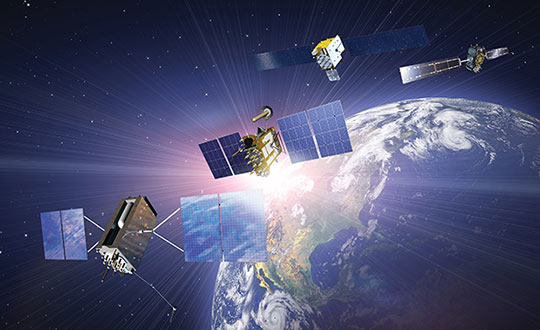
    (Satellites from left) GPS: In July 1995, GPS achieved full operational capability (FOC). GLONASS: In December 1995, the (then) Soviet system achieved FOC. BeiDou: On June 23, 2020, China launched the final satellite of the BeiDou-3 constellation. Galileo: The constellation has 21 usable satellites.(Credit: Satellites from public sources; background image: NASA/Chaykovsky Igor/Shutterstock.com)
    (Satellites from left) GPS: In July 1995, GPS achieved full operational capability (FOC). GLONASS: In December 1995, the (then) Soviet system achieved FOC. BeiDou: On June 23, 2020, China launched the final satellite of the BeiDou-3 constellation. Galileo: The constellation has 21 usable satellites.(Credit: Satellites from public sources; background image: NASA/Chaykovsky Igor/Shutterstock.com)

    See also

    GNSS today: A four-leaf clover, b and 

    How land surveyors grapple with rapid evolution, discussion with surveyor Gavin Schrock


    Thoughts from surveying experts

    James Richards
    Senior Land and Utility surveyor
    Benchmark Surveys, Venny Bridge, UK

    James Richards, Benchmark Surveys
    James Richards, Benchmark Surveys

    What kinds of surveying projects do you run?
    We run many different types of surveying projects. From small single-story bungalow extensions and redevelopment to development of new home sites of several hundred acres. We cover land, underground utility, and measured-building surveys of any size project, using the latest equipment in total stations, laser scanners, drones, GPS receivers, ground-penetrating radar (GPR) and electromagnetic location (EML).

    How have you transitioned to using multiple constellations?
    Ordnance Survey benchmarks in the UK are no longer maintained. Therefore, it has been a must to move forward with the surveying world and use multi-constellation GNSS equipment. We have stayed at the forefront of GNSS receivers, starting with a Topcon GRS1 then moving onto a Trimble R10 and a Topcon HiPer SR. Now, I feel we’ve taken another leap with the Trimble R12i, working in areas where we previously did not even consider using a GNSS receiver.

    How does the availability of four complete GNSS constellations, plus two regional ones, benefit your work?
    The availability of four complete GNSS constellations and two regional ones gives us more reliability as well as improved position and time accuracy in the data that we receive. It also gives us better coverage over the entire UK, including near buildings and under foliage. The Trimble R12i has 672 available channels, which makes it future-proof to new frequencies and additional space vehicles.


    Choice Sterling
    Survey manager, Kiewit Corporation
    Federal Way, Washington

    What kinds of surveying projects do you run?
    I am the survey manager on $1–3 billion mega projects, ranging from bridges and highways to tunnels and rail, including a couple of projects for the U.S. Department of Defense.

    How have you transitioned to using multiple constellations?
    The use of multiple constellations became available as we adopted technologies that could capitalize on their availability. Through the latest hardware and software, we have begun leveraging GNSS to a greater magnitude than we would have just a few years back.

    How does the availability of four complete GNSS constellations, plus two regional ones, benefit your work?
    Not long ago, the use of GPS for construction staking was an extremely risky proposition given its unreliability, primarily in the vertical component, and lack of confidence in its horizontal accuracy. With residuals exceeding most construction tolerances, GPS was primarily utilized for earthwork or to establish geodetic pairs that could then be traversed to establish control for more precise work. With the utilization of multiple GNSS constellations, we have gained confidence in the accuracy of our results and have started leveraging GPS for construction staking where we were once not willing to take the risk.

    Having the ability to leverage GPS under a canopy of trees or against structures or walls has proved invaluable when running traverses or levels, typically enabling us to use a single person rather than a two-person crew. Increased confidence in repeatability and accuracy while using GPS has been a game changer when working on projects where efficiency and cost management are of the greatest importance.


    Xiaohua Wen
    CEO and Founder, Tersus GNSS

    Xiaohua Wen, Tersus GNSS
    Xiaohua Wen, Tersus GNSS

    How have you transitioned to manufacturing multiple-constellation GNSS receivers?
    Early in 2016, we produced a GNSS receiver evolution road map to take advantage of GPS/GLONASS modernization, the continuing development of Galileo and QZSS, and the completion of BeiDou-3. In 2019, we released our current GNSS receiver, which has 576 tracking channels and supports all five major GNSS constellations (GPS, GLONASS, Galileo, BeiDou-3 and QZSS) and triple-band broadcasts (GPS L1+L2C+L2P+L5, GLO G1+G2+G3, GAL E1+E5a+E5b, BDS B1+B2a+B2b and QZSS L1+L2C+L5). We expect to release our next generation receiver, with 832 channels, in February 2022. It will support all available constellations (GPS, GLO, GAL, BDS, QZSS, IRNSS/NavIC, SBAS) and all civil signals, including the AltBoc and AceBoc.

    How does the availability of four complete GNSS constellations, plus two regional ones, benefit your end users?
    The most significant advantage of modern GNSS receivers is their robust high-accuracy performance with the aiding of the new constellations and signals, especially in harsh GNSS environments, such as deep canyons and heavy foliage. It greatly extended the RTK fix capability, and now reliable GNSS RTK fix solutions can be easily achieved in areas where it was impossible to do in the past.

    In the past, multipath always has been a problem for RTK GNSS receivers, as it might cause blunder errors. The improved RTK fix reliability based on robust RTK integrity monitoring takes advantage of the redundancy of observations to identify and isolate deteriorated observations and confirm the fixed result. Additionally, RTK achieves RTK fix solutions faster and maintains the RTK fix solutions easier with better accuracy than before.

    Compared to the dual-band (L1+L2) of GPS plus GLONASS, the triple-band (and multi-band) can allow long-range RTK capability, which can provide reliable RTK solutions with a remote GNSS base station far from the 20–30 km base and rover separation of the past. It also will provide more confidence in RTK positioning during the coming ionospheric disturbance peak in 2023.

  • U-blox technology platforms support BeiDou-3

    U-blox technology platforms support BeiDou-3

    logoCurrent u-blox GNSS platforms — from u-blox M8 and beyond — support the recently completed BeiDou navigation satellite system modernizations, improving the availability of GNSS positioning services.

    The opening ceremony of the BeiDou-3 global navigation satellite system (GNSS) was held in Beijing on July 31, officially celebrating the expansion of coverage offered by the critical Chinese space infrastructure to a global user base.

    As a global supplier of GNSS positioning and wireless communication technologies, u-blox has been driving technological innovation and deeply involved in the Chinese market for many years.

    Tests conducted across China and Europe have shown that including the BeiDou system can improve the positioning accuracy of GNSS receivers when multiple navigation satellite systems are tracked concurrently. When signals are partially obstructed, positioning accuracy can be significantly improved by incorporating the BeiDou system.

    Data shows that in 2019, the overall output value of the Chinese satellite navigation and location service industry reached nearly 345 billion yuan, an increase of 14.4% over 2018, with the output value expected to exceed 400 billion yuan in 2020.

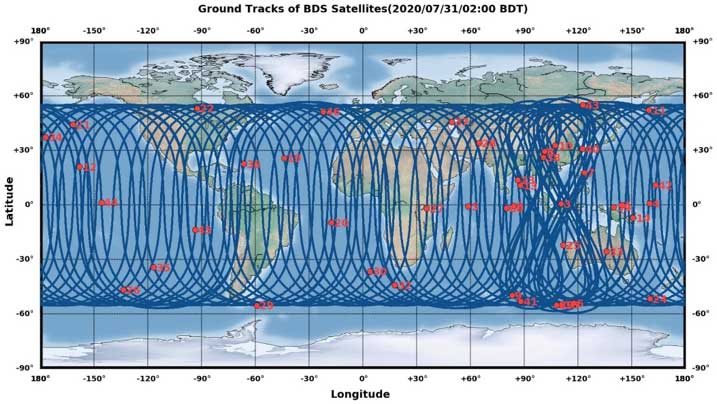
    Chart: China Satellite Navigation System Management Office Test Evaluation Research Center
    Graphic: China Satellite Navigation System Management Office Test Evaluation Research Center

    Additional Services Provided by BeiDou

    The BeiDou system provides a suite of additional services, including satellite and ground-based augmentation services, precise single-point positioning, precise timing and global short message services, laying a solid foundation for BeiDou’s ubiquitous navigation and tracking applications.

    Applications of GNSS technology continue to diversify, leveraging the all-weather, all-time, tracking, navigation and timing services it offers. GNSS technology is penetrating deeper into traditional industrial verticals, such as agriculture, forestry, animal husbandry and fishery, power and energy, as well as in railway and air transportation, including their infrastructure construction and management.

    At the same time, GNSS technology has become an indispensable and “smart” factor in emerging application fields such as the internet of things and the “internet of vehicles,” as well as in innovative applications such as autonomous driving, automatic parking and automatic logistics, and is now commonplace in many industrial and consumer use cases.

    “U-blox has been closely following the modernization of the BeiDou navigation system and is ready to work with partners in various industries to promote the expansion of industry applications, expand emerging markets and jointly create a green industry ecosystem,” said Hamilton Chen, China country manager at u-blox.

  • Two new BeiDou satellites complete BDS-3 constellation

    Two new BeiDou satellites complete BDS-3 constellation

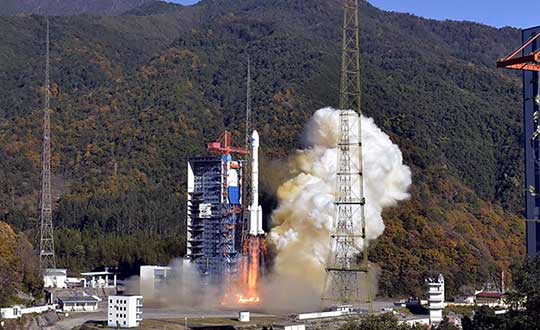
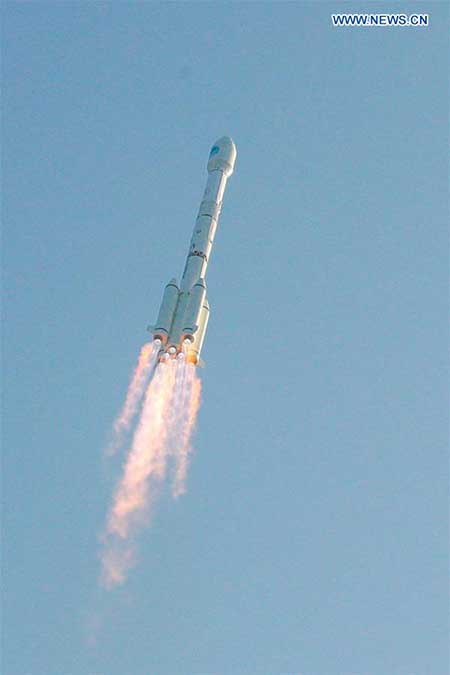
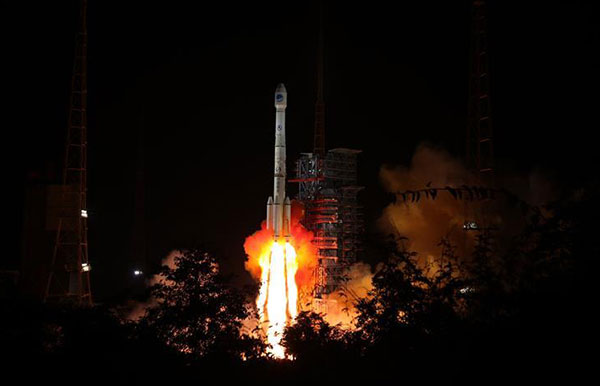
    China successfully sent two satellites of the BeiDou Navigation Satellite System (BDS) into space from Xichang Satellite Launch Center in Sichuan Province at 15:22 on Dec. 16.

    So far, 24 medium earth orbit (MEO) BDS-3 satellites have been successfully sent into space, and the deployment of the core BDS-3 constellation system has been completed, according to Yang Changfeng, chief designer of the BDS.

    Launched on a Long March-3A carrier rocket, the two satellites entered preset orbit after a more than three hours of flight, according to XinhuaNet, China’s official news service.

    The launch was the 321st mission for the Long March series carrier rockets and the 108th mission for the Long March-3A carrier rocket.

    In June, China stated its plan to complete the BDS-3 constellation by 2020.

    Photo: XinhuaNet
    Photo: XinhuaNet
  • China launches two MEO BeiDou-3 satellites

    China launches two MEO BeiDou-3 satellites

    China sends two BeiDou satellites into space a Nov. 23. (Photo: Guo Wenbin/Xinhua)
    China sends two BeiDou satellites into space a Nov. 23. (Photo: Guo Wenbin/Xinhua)

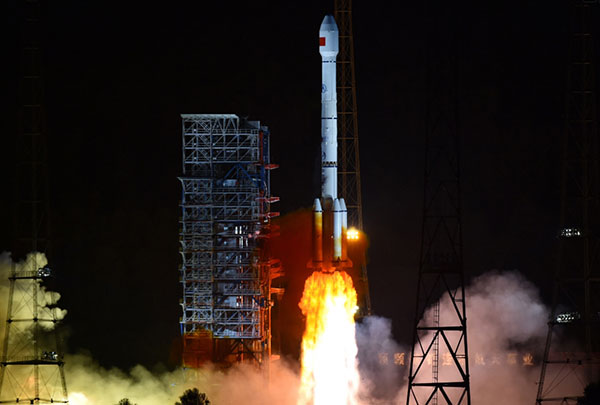
    China launched two satellites of the BeiDou Navigation Satellite System (BDS) into space from the Xichang Satellite Launch Center in Sichuan Province at 8:55 a.m. Saturday, Nov. 23.

    Launched on a Long March-3B carrier rocket and the Yuanzheng-1 (Expedition-1) upper stage attached to the carrier rocket, the two satellites have entered their planned orbits. They are the 50th and 51st satellites of the BDS satellite family.

    The two medium earth orbit (MEO) satellites are also network satellites of the BeiDou-3 system.

    The two new satellites, the carrier rocket and Yuanzheng-1 were all developed by the Innovation Academy for Microsatellites of the Chinese Academy of Sciences and the China Academy of Launch Vehicle Technology under the China Aerospace Science and Technology Corporation.

    The launch was the 319th mission for the Long March series carrier rockets.

  • Global BeiDou grows to 21 with latest launch

    Global BeiDou grows to 21 with latest launch

    Seven-ninths of the way there! The 21st satellite of the BeiDou-3 global constellation, destined to number 27 upon completion, successfully launched from Xichang on June 24. Once in final orbit and commissioned, it will become the second of three planned inclined geosynchronous orbit (IGSO) satellites, traipsing in figure-eight loops across the skies above China and neighbors in the Asia-Pacific region.

    The IGSO trio will play a key role in the expansion of BeiDou-3 from a regional to a global system, in that they may afford the Asia-Pacific region greater BeiDou-derived accuracy and availability — the so-called “optimized coverage” — than will be accessible to users of the constellation in other areas of the world.

    The new satellite, like others of its latest generation, will establish inter-satellite ranging links, and carries new-gun rubidium atomic clocks and passive hydrogen maser clocks. It weighs 450 kg, a gain over previous generations, with a phased array antenna for navigation signals, a laser retroreflector and deployable S/L-band and C-band antennas.

    While BeiDou-3 has widespread applications in construction, transportation, fishing, power grid, disaster response, public security, smart cities and more, it will also bring increased capability — and independence from GPS — to the People’s Liberation Army. At 2 million strong with modernizing equipment, this is a force to be reckoned with in an increasingly unsettled region, with China actively pursuing numerous territorial disputes.

    BeiDou-3 is migrating its civil or B1 signal from 1561.098 MHz to 1575.42 MHz, the same as the GPS L1 and Galileo E1, and changing from a quadrature phase shift keying modulation to a multiplexed binary offset carrier modulation similar to Galileos E1 and the pending GPS L1C.

  • China plans to complete BeiDou-3 by 2020

    China plans to complete BeiDou-3 by 2020

    Photo: Xinhuanet
    Photo: Xinhuanet

    China is planning to complete its updated navigation constellation by 2020, according to China’s news service Xinhuanet.

    With 35 satellites, the completed BeiDou-3 will provide better coverage inside buildings and in urban canyons, according to researcher Jin Shuanggen, Shanghai Astronomical Observatory. Shuanggen was addressing the second Beidou Summit Forum.

    China has deployed three systems, BDS-1, BDS-2 and BDS-3, to provide accurate positioning and navigation services to the world, said Jin Shuanggen, a researcher at the Chinese Academy of Sciences, at the second China (Nanjing) BeiDou Satellite Navigation Application Expo and Beidou Summit Forum.

    The BDS system currently has 38 in-orbit satellites including 18 BDS-2 and 20 BDS-3.

    “Traditional satellites navigation service is hardly available in the interior of buildings, underground, underwater and other locations. The BDS system provides better accuracy in these locations,” he said.

    “BDS will play a large role as it is used in different scenarios including smart city, agriculture and meteorology, autopilot, and intelligent transportation,” said Jing Guifei, dean of BeiDou Belt and Road School of Beihang University.

    Along with the summit, a three-day exposition displayed BeiDou applications with more than 400 exhibitors. Fields covered included drones, autonomous ships, surveying and mapping, and intelligent robots and vehicles.

  • BeiDou-guided ship completes first outbound trip; system eyes promotion in global markets

    A Chinese cargo ship, the Rongda Changsha, equipped with receivers downloading signals from the BeiDou Navigation Satellite System (BDS), arrived at Brunei, on the north coast of the island of Borneo in Southeast Asia, in February after embarking from Luojing Port in Shanghai. This marks the first public successful application of BeiDou terminal products in the South China Sea and unveils China’s ambition to promote BeiDou products in the international marketplace.

    The Shanghai-Brunei trip was a trial for not only examining BeiDou-3’s capacity, but for learning the users’ experience and needs. The data collected from the trip has been analyzed and applied for updating and prioritizing the marine navigation system, according to China Aerospace Science and Technology Corporation (CASC), manufacturer of the Beidou receivers on the ship.

    It is anticipated that more services will soon arrive, with Internet and voice calls facilitated by the messaging aspect of BDS, for further exploring industrial application scenarios and — importantly for government support of its GNSS — protecting Chinese outbound and inbound routes. The South China Sea is one of the world’s busiest waterways, and oil imports to China from the Middle East are a key strategic component of this traffic activity.

    Deployment of BeiDou-3 was completed in late 2018 (see http://stage.globalpositioningnews.com/directions-2019-beidou-accelerates-global-deployment/) with the aim of providing navigation services for countries and regions along the Belt and Road.

    BDS now covers more than 50 countries and more than 3 billion people. BDS-related products have gained access to the markets of more than 70 countries and regions, more than 30 of which are along the (land-based) Belt and (maritime) Road, in line with the Belt and Road Initiative. Through joint applications with other compatible navigation satellite systems, BDS provides global users with diversified choices for better application experience.

    “Chinese security interests encompass not only China itself and nearby areas, but also the sea lanes that enable the import of raw materials and export of finished goods,” wrote Scott Pace in GPS World, December 2010. “In recent years, China has shown an increasing interest in ‘maritime domain awareness,’ in which satellite navigation is used for monitoring the transit of ships in the Indian Ocean (for example, oil from the Middle East) and the South China Sea (minerals from Australia, fishing zones). Satellite navigation is a dual-use, commercial and military, interest for China, and this may have prompted support for the more advanced, independent GNSS that would become Beidou-2 or Compass.”

    Pace was chosen by the White House to serve as executive secretary of the National Space Council in July 2017. Pace is also director of the Space Policy Institute and Professor of Practice of International Affairs at George Washington University. He serves as a special counselor to the National Space-Based Positioning, Navigation and Timing (PNT) Advisory Board.

  • Javad GNSS tracks new BeiDou AltBoC signals

    Javad GNSS tracks new BeiDou AltBoC signals

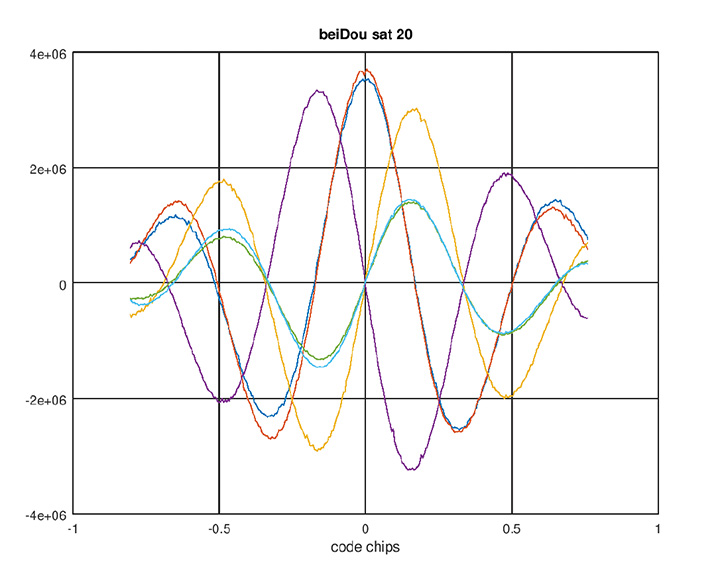
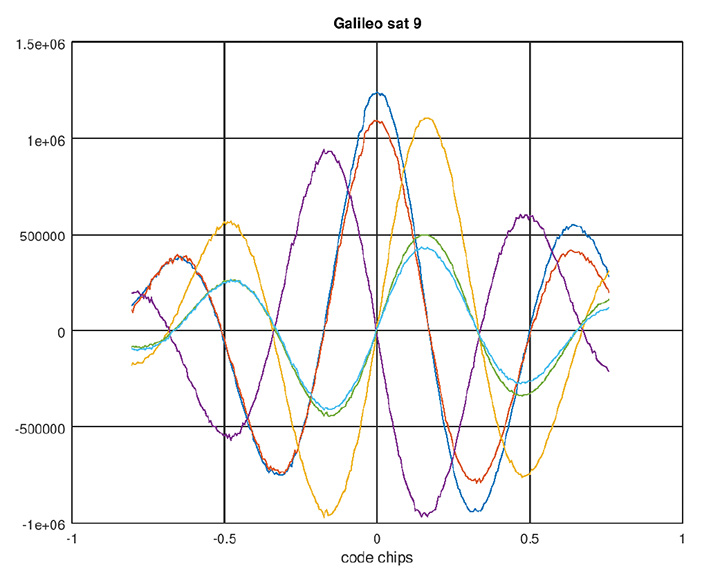
    Recently launched satellites of BeiDou Phase 3 program have started broadcasting new signals. Javad GNSS announced successful tracking of these signals and provided the adjacent figures.

    Interface control documents (ICDs) for B1C and B2A signals are available, while an ICD for the other signal, called B2B, has not yet been published. The company tracked the signal on the 1207.14 Mhz frequency on BeiDou’s satellites 32, 33 and 34, and subsequently saw that this signal is available on all recently launched BeiDou Phase 3 satellites, and tracked it successfully.

    This B2B signal plus B2A signal together form an AltBOC(10,15) signal on 1191.795 MHz — JAVAD GNSS calls it BaltBOC. Assuming that BOC parameters of this signal are similar to Galileo’s, the company tracked this. Figures 1 and 2 show BeiDou andGalileo (BaltBOC and altBOC) discriminator curves; they appear identical.

    Figure 1. BeiDou AltBoC signal. Red and blue: I of B2A(E5A) and B2B(E5b) sub-signals; purple and yellow: Q of B2A(E5A) and B2B(E5b) sub-signals (their sum is zero); green and aqua: I (early-minus-late) of B2A(E5A) and B2B(E5b) sub-signals.
    Figure 1. BeiDou AltBoC signal. Red and blue: I of B2A(E5A) and B2B(E5b) sub-signals; purple and yellow: Q of B2A(E5A) and B2B(E5b) sub-signals (their sum is zero); green and aqua: I (early-minus-late) of B2A(E5A) and B2B(E5b) sub-signals. (Chart: Javad GNSS)
    Figure 2. Galileo AltBoC signal. Colors same as Figure 1.
    Figure 2. Galileo AltBoC signal. Colors same as Figure 1. (Chart: Javad GNSS)

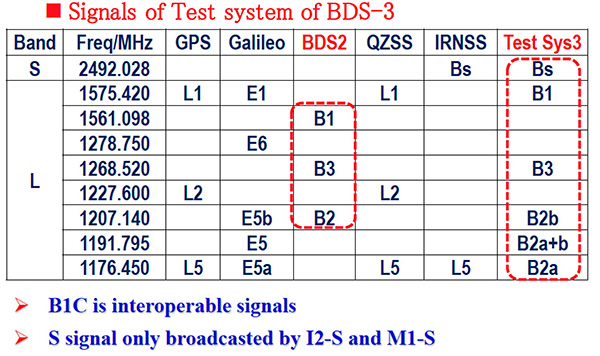
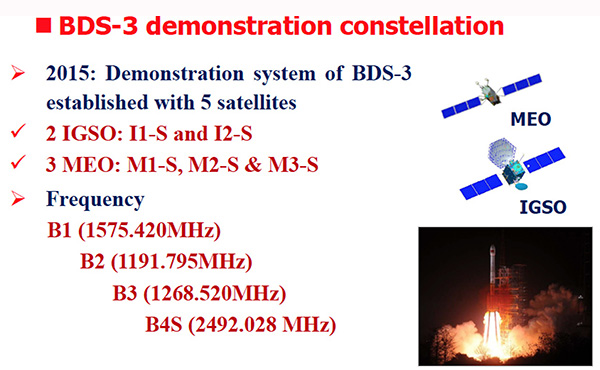
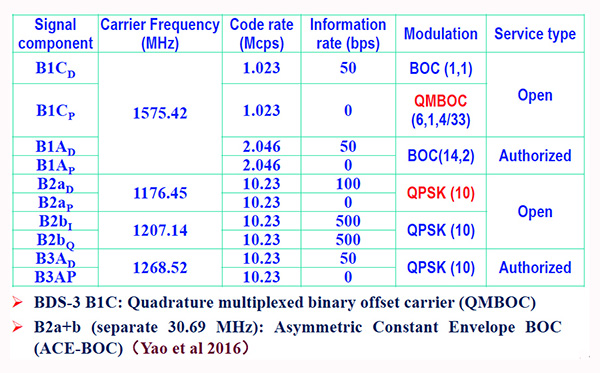
    According to another source, the signals are mentioned in some publications (Figure 3, 4 and 5 from an official Chinese government presentation at the International GNSS Service Workshop, Oct. 2018) and intended to be open signals, but an ICD is presently missing. However there appears to be some clarity now, that the modulation of B2a+b is an “ACE-BOC” modulation, which is similar to but formally different from “AltBOC.”

    Figure 3. BDS-3 demonstration constellation.
    Figure 3. BDS-3 demonstration constellation. (Chart: Javad GNSS)
    Figure 4. Signals of test system BDS-3.
    Figure 4. Signals of test system BDS-3. (Chart: Javad GNSS)
    Figure 5. BDS-3 signal modulations.
    Figure 5. BDS-3 signal modulations. (Chart: Javad GNSS)
  • China completes BeiDou-3 constellation with another launch

    China completes BeiDou-3 constellation with another launch

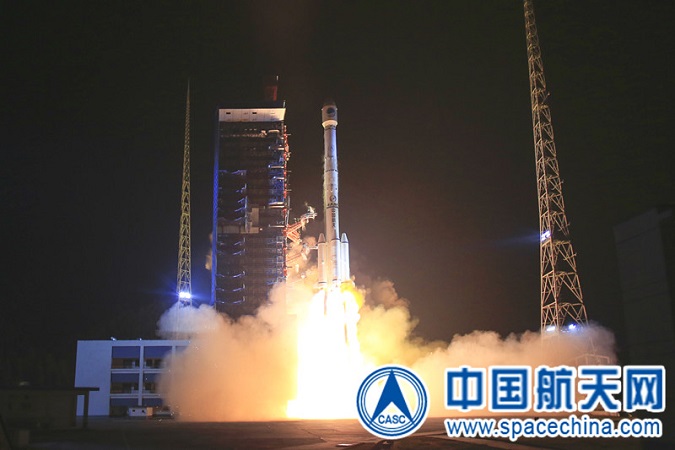
    The launch and deployment of the 42nd and 43rd BeiDou satellites complete the basic BDS-3 constellation.

    China has successfully sent twin BeiDou satellites into space by a Long March-3B launch vehicle (with an Expedition-1 upper stage) from the Xichang Satellite Launch Center, at 02:07 am, on Nov. 19. The twins, both medium Earth orbit (MEO) satellites, are the 42nd and 43rd of the BeiDou Navigation Satellite System (BDS), and the 18th and 19th of the BeiDou-3 family.

    Photo: CASC screenshot
    Photo: CASC screenshot

    The satellites successfully entered their designated orbit after more than three hours of the launch, and will join the constellation with the 17 previously launched BDS-3 satellites, after completing in-orbit test.

    The successful launch marks that the basic BDS-3 constellation has successfully been deployed. Networking of the constellation and assessment on its performances will be carried out in the near future.

    Plans are for the BeiDou-3 constellation to be put into operation before the end of this year, to provide basic navigation services to countries and regions participating the Belt and Road initiative, which will be a key milestone for BDS in expanding service areas from regional to global.

    The BDS-3 project was officially launched in 2009 with state approval, and a demonstration system was completed in 2016. Having verified the new-generation navigation signal system architecture, the BDS-3 development followed up with a three-step pattern, to construct its pilot, basic and nominal constellations respectively, according to the China Satellite Navigation Office,

    On Nov. 5, 2017, the first pair of satellites for the BDS-3 constellation was launched from Xichang Satellite Launch Center. By the end of March 2018, a pilot constellation consisting of 8 BeiDou satellites was built.

    At present, the project is progressing smoothly, and the basic constellation consisting of 19 BDS satellites will soon be operational. In the future, BDS with global coverage will be completed by the end of 2020.

    Since November 2017, the past year has witnessed a highly intensive launch of the China’s BDS constellation. With the joint efforts of the whole team participating in this project, 11 launches have been completed within one year, while 19 BDS-3 satellites and 1 BDS-2 satellite have been successfully sent into space.

    In particular, since July 2018, seven launches have been conducted to deliver 12 BDS satellites into orbit, with the shortest interval between launches being only 17 days. Both highly intensive and high success rate of launches set a new record in the history of the BDS constellation development.

    The satellites and the launch vehicle (with an Expedition-upper stage) for this mission were developed by the China Academy of Space Technology and the China Academy of Launch Vehicle Technology respectively, both are affiliated to the China Aerospace Science and Technology Co., Ltd. The launch was the 291st mission of the Long March rocket series.

    Currently, the BeiDou system comprises two families of operational navigation satellites; BeiDou-2, also known as Compass, presently consists of 15 operational satellites in Geostationary Orbit (GEO), Geosynchronous Orbit (GSO), Inclined Geosynchronous Orbit (IGSO) and Medium Earth Orbit (MEO).

    The new BeiDou-3 series, on the other hand, only has operational MEO satellites at the moment, although China is testing the first BeiDou-3 GEO satellite (BeiDou-3G1) and plans to launch at least four GEO and GSO satellites in 2019.

  • China launches first geostationary BeiDou-3 satellite

    China launches first geostationary BeiDou-3 satellite

    Photo: Xinhua News Agency
    Photo: Xinhua News Agency

    China has launched its first geostationary satellite for the BeiDou constellation, according to press reports.

    The successful launch of satellite G1Q took place at 15:57 UTC on Nov. 1 from the LC2 Launch Complex of the Xichang Satellite Launch Center, Sichuan province, using a Long March-3B/G2 (Chang Zheng-3B/G2) launch vehicle.

    Beidou-3G satellites are the geostationary Earth orbit (GEO) component of the third phase of the Chinese Beidou satellite navigation system. The GEO satellites will be in high orbit, about 36,000 kilometers above the Earth, following the Earth’s rotation to view the same point on Earth continuously.

    In addition to navigation services, the satellite will serve as a satellite-based augmentation system (SBAS) and provide short message services (Research Data Shared Service, RDSS).

    The G1Q satellite is the 17th BeiDou-3 satellite and the 41st overall BeiDou satellite. Another pair of BeiDou-3 medium Earth orbit (MEO) satellites, M17 and M18, will be launched in mid-November.

    The recent BeiDou launches will expand the system to global navigation coverage.

    The G1Q satellite is based on the DFH-3B bus that features a phased array antenna for navigation signals and a laser retroreflector, and also is equipped with an apogee propulsion system for final orbit insertion. The satellite has a launch mass of about 4,600 kg.


  • China launches pair of BeiDou-3 satellites into orbit

    China launches pair of BeiDou-3 satellites into orbit

    China successfully launched a pair of BeiDou-3 navigation satellites into medium Earth orbits on Oct. 15, according to GB Times.

    Four hours after the launch, the two satellites were inserted into their intended orbits, according to the China Aerospace Science and Technology Corporation (CASC).  The satellites, numbered M15 and M16, are the 39th and 40th launched as part of China’s Beidou system, following the launch of the first in 2000.

    Another pair of BeiDou satellites is expected to be launched in November, according to Richard Langley’s Upcoming Satellite Launches.

    Liftoff of the Long March 3B rocket sending the Beidou-3 M15 and M15 satellites into orbit. (Photo: CALT)
    Liftoff of the Long March 3B rocket sending the Beidou-3 M15 and M16 satellites into orbit. (Photo: CALT)

    For the Oct. 15 launch, a Long March 3B rocket with a Yuanzheng-1 upper stage lifted off from the Xichang Satellite Launch Centre in southwest China at 04:23 universal time (12:23 local, 00:23 Eastern).

    The China Academy of Launch Vehicle Technology (CALT), which developed the Long March 3B rocket, reported that data logging and active tracking equipment was placed aboard for tests to determine to altitude and timing for future parachute landings for boosters.

    Expended rocket boosters frequently land in or near populated areas downrange of Xichang. The trial phase of parachute booster landings is expected in 2019.


  • China launches yet more BeiDou navigation satellites

    China launches yet more BeiDou navigation satellites

    China sends twin BeiDou-3 navigation satellites into space on a single carrier rocket from Xichang Satellite Launch Center in Xichang, southwest China's Sichuan Province, Sept. 19, 2018. (Photo: Xinhua/Liang Keyan)
    China sends twin BeiDou-3 navigation satellites into space on a single carrier rocket from Xichang Satellite Launch Center in Xichang, southwest China’s Sichuan Province, Sept. 19, 2018. (Photo: Xinhua/Liang Keyan)

    On Sept. 19, China successfully sent twin BeiDou-3 navigation satellites into space on a single carrier rocket, according to state news agency Xinhuanet.

    This is the third launch of twin BeiDou-3 satellites in less than eight weeks. China launched two more pairs of BeiDou navigation satellites into space on July 29 and Aug. 25.

    The Long March-3B carrier rocket lifted off from the Xichang Satellite Launch Center at 10:07 p.m. It was the 285th mission of the Long March rocket series.

    The twin satellites are the 37th and 38th editions of the BeiDou navigation system. After a series of tests and evaluations, they will work together with 12 BeiDou-3 satellites already in orbit.

    The twin satellites will provide danger alerts and navigation services for global users. A basic system with 18 orbiting BeiDou-3 satellites will be in place by the end of the year, which will serve countries participating in the Belt and Road Initiative.

    The satellites and the rocket for Wednesday’s launch were developed by the China Academy of Space Technology and the China Academy of Launch Vehicle Technology, respectively.