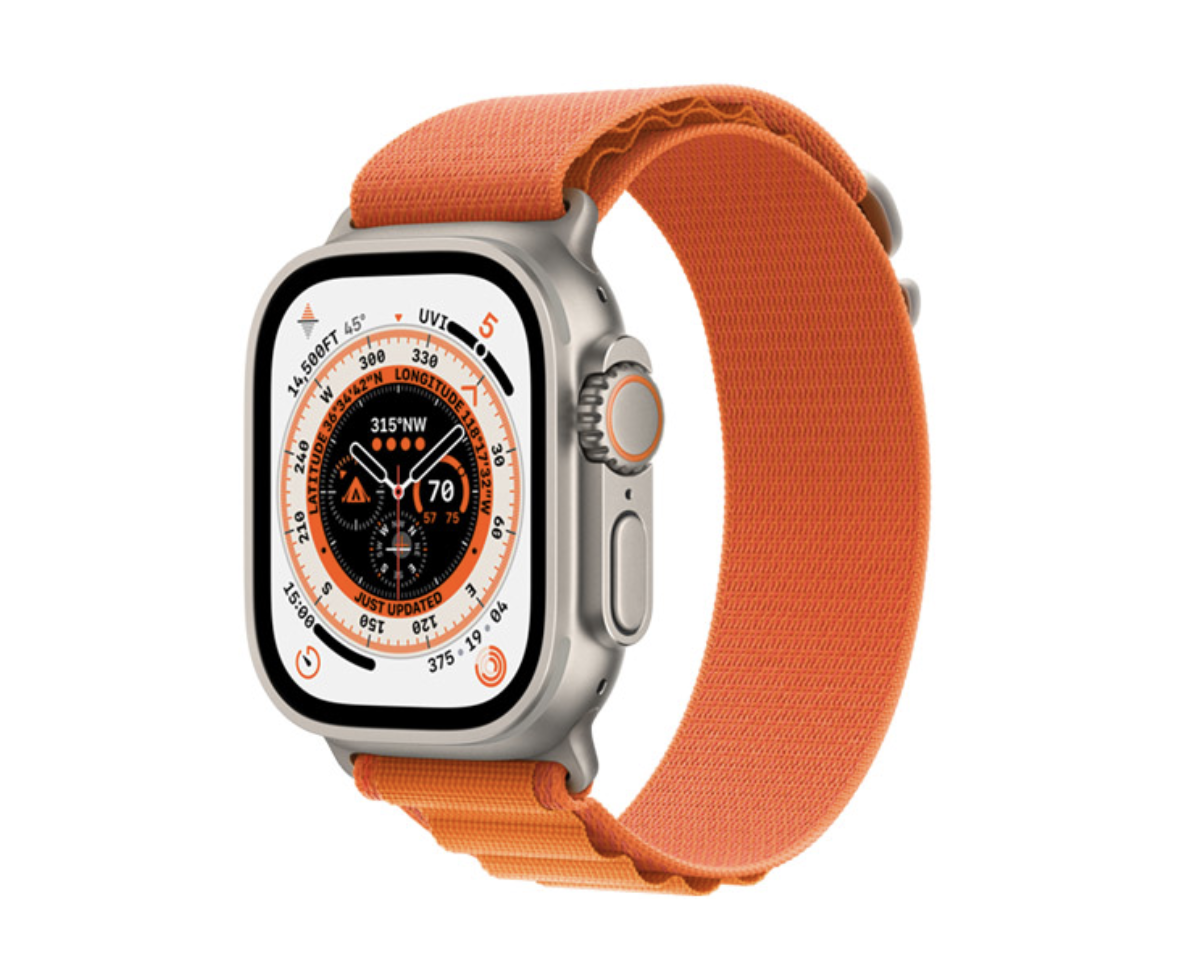
“Seen & Heard” is a monthly feature of GPS World magazine, traveling the world to capture interesting and unusual news stories involving the GNSS/PNT industry.
Image: Apple
Apple Products Meet Accuracy with GPS
Apple launched the Ultra Watch, which contains a dual-frequency GPS antenna that can receive L5 signals, as well as the iPhone 14, which features a dual-band GPS receiver combining the L1 and L5 signals. The company is also harnessing signals from more than 70 satellites to boost the accuracy of its services such as SOS alerts and alerting emergency responders, per The National News. The dual-frequency abilities of the new products provide accurate location for calculating distance, pace and routes. The L5 signals also are a critical component of Apple’s health and safety features, providing more accuracy than in previous products.
Wildlife researchers in Key Largo, Florida, accidently discovered a way to locate and eradicate invasive Burmese pythons, per WFLA News Channel 8. The team of researchers were observing racoons and possums that were fitted with tracking collars to note their behavior. After months of observation, a possum collar sent a mortality signal due to lack of movement. To the researchers’ surprise, the collar then started moving again. They later discovered the possum had been eaten by a python. While this was not the intent of the team’s research, they proved this could be an effective way to lower the increasing population of the invasive python species.
Scientist Liu Shaochuang and his team have used satellite remote-sensing technology to study and track wild camels. Shaochuang studies the interrelationship between endangered animals and their environments, which may help protect the species against climate change. To track a camel, Shaochuang attaches a GNSS-enabled collar, which transmits the camel’s location every day. The short message function is provided by China’s BeiDou satellite system, which transmits and receives signals in real time. Based on the data, Shaochuang and his team can observe migratory paths, living environments and possible threats.
Image: Screenshot of CNN video
Former South Carolina Attorney Convicted with Location Data
On March 3, Alex Murdaugh was convicted of killing his son Paul Murdaugh and wife Maggie Murdaugh. With limited evidence, the prosecution used a phone video and vehicle navigation data to prove Alex’s guilt. During the trial, Alex claimed he was visiting his mother during the time the murders took place. However, General Motors OnStar data accessed by investigators from his Chevrolet Suburban contradicted the alibi, putting Alex at the scene of the crime during the time of the murders. Plus, in a smartphone video taken by Paul that night, Alex’s voice could be heard, placing him at the scene.
On Friday, March 3, Alex Murdaugh was convicted of killing his son Paul Murdaugh and wife Maggie Murdaugh on June 7, 2021. With limited evidence, the prosecution used a phone video and vehicle navigation data to prove Alex’s guilt.
During the trial, Alex claimed he was visiting his mother during the time the murders took place. However, General Motors OnStar data accessed by investigators from his Chevrolet Suburban contradicted the alibi, putting Alex at the scene of the crime during the time of the murders.
In addition to the navigation data, in a phone video taken by Paul on the night of the murders near the Murdaugh’s dog kennels at their Moselle property, Alex’s voice could be heard in the background. That video also placed Alex at the scene around the time Paul and Maggie were shot and killed.
After deliberating for less than three hours, the jury found Alex guilty of the double murders. The judge then sentenced him to life in prison without the possibility of parole.
Since the trial began, the South Carolina Law Enforcement Division has reopened several investigations connected to the Murdaugh family. This includes the case of Stephen Smith who was found dead on the side of the road in 2015 allegedly from a hit-and-run.
Alex Murdaugh (Image: Pool reporter photo from trial)
Cellphone and vehicle location data is at center stage as former South Carolina attorney, Alex Murdaugh, takes the stand in the trial for the murder of his wife, Maggie Murdaugh, and son, Paul Murdaugh. Troves of data including call logs, text messages, steps recorded, app information, coordinates determined by GPS and more from Alex, Paul and Maggie, are being retrieved for the ongoing trial.
Records retrieved from Murdaugh’s cellphone show that after the murders occurred, he proceeded to Google an area restaurant, check group messages, and made other calls that night, which he testified were accidental, according to CNN reports. Vehicle location data was also pulled and presented at trial to identify a timeline of events for the court, according to reports from AP.
Location data retrieved from Murdaugh’s cellphone on the night of the double murders is not the only time this type of data comes into play for the Murdaugh family.
In February 2019, Paul Murdaugh and his friends were involved in a boating accident, which killed one of the boaters, Mallory Beach. In the new Netflix documentary regarding the Murdaugh family, Murdaugh Murders: A Southern Scandal, a relative of one of the boaters mentions in Episode 2 that Beach always wore an Apple Watch, and asked why investigators failed to look into location data to find her sooner.
Law enforcement agencies have been quick to adopt GPS monitoring of offenders on parole or awaiting trial. An estimated 300,000 people in the U.S. are wearing ankle bracelets. Proponents say the systems enhance public safety, reduce prison costs and provide social benefits.
However, technology is only as good as the people who use it, as a tragic case from Ohio illustrates. In February 2017, 21-year-old Reagan Tokes was kidnapped and murdered after leaving work in Columbus. The man convicted of killing her had been recently released from prison. Yes, he was wearing a GPS monitor, but no one was tracking his movements until after he robbed six people and killed Tokes.
In response, Ohio lawmakers introduced a bill to improve real-time monitoring of parolees by shrinking the workload for parole officers, who now are responsible for 90 to 100 offenders at one time.
In cases in Florida and New York, the system worked as intended and alerts were sent, but authorities took no action. In the Florida case, no one was on duty, despite the suspect having triggered more than 100 alarms.
An offender in Syracuse, New York, was able to remove and reassemble his ankle bracelet in less than a minute, using techniques he learned when he watched the officers put the bracelet on him. Because of numerous false alarms, the monitoring company had set a five-minute limit before officers were notified, at the police department’s request. Having beat the monitoring system, the offender committed a murder.
A nationwide investigation by ABC’s “20/20” news magazine program found at least 50 murders allegedly committed since 2012 by people ordered to wear monitored ankle bracelets.
“Public safety is only as good as the supervising entity we provide our products to,” Jennifer White of monitoring company BI Analytics commented on “20/20.” Criminal justice experts say the monitoring system should not be used for anyone who is a risk to the public.
While policymakers and law-enforcement authorities determine the most effective use of such systems —and how to address issues of monitoring response, overtaxed officers and tight budgets — the monitoring industry continues to improve the “tamper-resistant” devices as well as the services offered.
After all, no one wants to live with a false sense of security.
June’s Geointelligence Insider article on Jack Maple was the human interest article. One of the readers of June’s article had the opportunity to meet Jack Maple. I appreciate the feedback. This month’s article is based upon the recommendation of Geospatial Solutions Managing Editor Tracy Cozzens to cover the technical side of GIS and crime fighting.
Recap
Fighting crime with GIS sounds simple enough — map where the crimes are happening and where the bad guys are and send in the cops. That would be a gross over simplification. As always, there’s more to the case.
The first CompStat was founded in the pre-internet days of 1994 on a Commodore 64, harkening back to the days of 128-MB floppy disks and MS-DOS, a Jurassic period of computer evolution that marked some of the first steps into crime fighting’s digital era. The graph above is the current CompStat 2.0 from the NYPD. It is a GIS-based system, interactive, user-friendly and available to the public. Take note of the highlighted number.
Since CompStat was introduced, crime has fallen precipitously. As of this writing (Aug. 25, 2018) New York City has 183 reported murders year to date. By comparison, in 1990, prior to CompStat, there were 217 murders per month on average. More murders were committed per month in 1990 in New York City than what it will experience in all of 2018. Murders have dropped nearly 90 percent. In other words, nine out of 10 who would otherwise have been killed are alive to return to their families, parents, classmates and colleagues, and friends. The difference is staggering, providing tangible proof geospatial science is a benefit to humanity.
The arsenal of geospatial applications available for the crime fighter is enough to make any superhero envious. The list of these high-tech, integrated intelligence systems push the limits of science fiction.
The underlying strength of these systems is the robust GIS/GPS platform they are built on. Security cameras are geospatially connected to the network with dynamic mapping capabilities. This allows the surveillance video to be overlaid on GIS software in order to interact with more information and create actionable intelligence.
Cameras use a host of software algorithms that are able to recognize aggressive behavior, patterns, anomalies, change detection, biometric features, objects and text. Systems can integrate real-time information like social media feeds as well as live video, including facial recognition software scans for wanted individuals in real time. This information is shared with police officers in the field.
Police cars are becoming mobile command centers outfitted with a suite of sensors, and will eventually include drones. Police officers wear smart glasses augmenting information about who they are looking at in an intelligence and location-based context.
The police officer’s belt is Bluetooth enabled, connecting all these devices, as well as monitoring the officer’s vital signs. The officer’s gun is also Bluetooth enabled, reporting when it is drawn, the direction it is pointed and if it fired. The gun also comes with a chip for tracking purposes and to ensure only the officer it belongs to can fire the weapon.
The vest-worn camera is woven into the seamless geospatial network of sensors and records the officer’s experience from a first-person perspective.
Imagine this scenario. A crowd gathers at an intersection triggering an anomaly detection sensor due to the number of people gathering in that location at that time. Out of the thousands of security cameras being monitored at the Command and Control Center (C3), this video scrolls around and flashes yellow, bringing attention to the possible situation. Other mounted cameras that have that intersection in the field of view automatically align along the edge of the main security video projecting their imagery onto a 3D data model of the area. Police officers in the field nearest to that location are simultaneously alerted. No action is taken at this point except the police begin heading in that direction. Facial recognition software scans the video images for faces of known suspects. Social media and texts scroll next to the video and geospatially link to those in each frame of the video. Colored sentiment indicators showed levels of concern. Boxes outlining people in various colors correspond to threat levels determined by datamining multiple databases. Semi-persistent motion trails lag behind each box showing the speed and direction of people in the video. Pattern identification looks for convergence, divergence and synchronous movements.
Video analytics identify several people converging on a car that just pulled up. The license plate reader linked to the security camera reports the car as stolen with two traffic violations. Based on this preliminary information, the situation is elevated. A police officer is dispatched but before arriving, a drone launches from the police car outfitted with a true color camera and a stereographic infrared camera. The stereographic imagery pair is streamed live to the police officers entering the area of interest through their smart glasses and to a team of imagery specialists at the C3. The video analytics of the police drone are seamlessly integrated with the security camera videos focusing on the car and the individuals as it arrives on scene and surveils the area. Object recognition identifies three possible weapons on the persons of interest. The boxes around those individuals turn red. They are tagged for persistent surveillance by all security cameras in the area. The order is given to apprehend them for probable cause. More police officers are called in and before they arrive they know who they are looking for, where the person is located, and that they may be armed and dangerous. In less than a minute, the police arrive. The suspects flee. The drone follows one of them up the street into an alley. Two of the officers pursue him. The other two suspects jump into the car and drive away. License plate readers and security cameras track the car on a map showing the vehicle’s route and speed with corresponding real-time video as the vehicle passes into view of each camera. As the vehicle travels south a police officer steps out from a cross street and shoots an electromagnetic dart into the speeding vehicle, disabling it. The police officers approaching the car shine a disorienting laser light weapon called a dazzler at the suspects, preventing their eyes from focusing. The occupants are apprehended without incident. They are searched for probable cause and arrested for carrying handguns without a permit.
The other suspect fled on foot. The drone followed him relaying live imagery to the police officers’ smart glasses. Their smart glasses showed a real-time map of their locations and the suspect’s. They cornered him in a fenced area. Guns drawn, the smoky red light of the laser cutting through the air pointed at the suspect. He surrendered. No gun was found on the suspect but the drone video the gun being thrown into a dumpster. One of the officers went back and retrieved the gun.
Gun traces were run on the three confiscated weapons and one was identified as stolen, matching a description of a gun used in a recent homicide. One of the suspect’s fingerprints match those found on shell casings at a nearby location reported by gunshot acoustic sensors. Based on this information, there is probable cause and a tap and trace is approved electronically by a special task force judge. The phone records of the three suspects are searched linking them to the el Diablo gang. Several unknown numbers are also in the call logs. Those numbers are added to the case file to be investigated later.
Only one of the suspects has a known address. The other two have no known location. Activity extracted from phone records show their whereabouts over the preceding days pin pointing their main locus of operation. Search warrants are issued. Within hours of arresting the suspects, the locations are raided and searched. Officers discover a cache of weapons, drugs, laptops and other useful information.
Everything described above is already available — it is only a matter of time and money. And, if Dubai is any indication of things to come, police could soon be arriving on hoverbikes.
The police arriving within minutes is key to the success of preventive policing. Time saves lives. The goal is to intervene before crime happens. But how is it possible? Before answering, let’s look at some numbers.
By the numbers
In 2017 almost 84 percent of the population of the United States was considered urban residing within 106,400 square miles. The Bureau of Justice Statistics reports there are only 758,854 sworn officers in the United States. Maintaining the same 84 percent ratio as the population means only 634,847 officers cover those urban areas. Specifically, it breaks down to six police officers per square mile. It is one police officer for every 431 residents except that police, like all of us, work 40 hours a week, have days off, take vacations, etc., so, only one out of every six police officers is on duty at any given time. That is one police officer for every 2,153 residents; however, police often operate in pairs, so 4,306 residents depend upon two brave souls to protect them from danger.
Victims of violent crime are 2.1 percent of the population. In a sampling of 4,306 residents that equals 90 victims of violent crime every year. In the top 10 cities it is far worse. Police officers have an incredible responsibility placed on them and they rightly deserve our praise, support and respect for the dangers they face every day.
Why not more officers you ask? Police protection comes at a cost of $100 billion annually. Our relative safety is not cheap. Crime is a huge expense. Jails, trials, public defenders, prosecutors, judges and incarceration all cost money. Safety is expensive. Budgets are stretched thin. The answer for increased safety and security isn’t more police. The answer is integrated and intelligent technology systems leading to increased efficiency. Technology has benefitted most other professions. Now, the field of law enforcement and crime prevention are benefitting. Cost is the driving need. These efficiencies are being realized on a grand scale. Making matters more urgent is the worldwide mass migration as populations move towards cities. It is imperative to manage crime now rather than later.
Enter predictive policing — putting the power of open data, cloud computing, machine learning, geoscience and artificial intelligence in support of law enforcement and prevention. Basically, cities are broken up into grid patterns, typically 500×500 feet. Within each grid, crime data is compiled using multiple factors and resources, such as historical data, 9-1-1 calls, recent crime reports, and residences of known offenders and parolees. Even considerations such as the time, day of week, celebrations and cyclical events are taken into account. Information derived from security cameras, license plate readers, social media and financial transactions help the algorithm. The algorithms take into account information collected by authorized wire taps, call logs and other confidential sources. The goal of the algorithms are to include all available resources to develop the most complete and reliable dataset upon which the heatmaps base their probabilities. This helps police departments allocate their resources, know what to prepare for and, most importantly, know where to be to protect the public at large.
University of Montana, Research and Training Center (Data: U.S. Census Bureau)
Police tighten their patrols around the hotspots. Throughout their shifts those hotspots are subject to change depending upon new data. Mobile units simply focus their patrol efforts accordingly. Once a threat is reported, automated navigation routing systems show police the fastest route to the incident and their expected time of arrival. Officers continue to receive intelligence about the incident while en route to anticipate the situation prior to arriving. Knowing where the areas of highest probability are expected to occur focuses non-human assets too, such as geofencing the areas of interest and monitoring more closely for key indicators. This technology is not too different than numerical weather forecasting models predicting what and where weather events will occur in the next hour, three hours, six hours and so on. Numerical models continue to evolve making forecasting more and more reliable. And, although the past does not predict the future, it is a strong indicator. The disclaimer would be similar to the ones most have seen before, “Past performance does not guarantee future returns.” Sometimes preventing a crime is saving a life, sometimes it’s protecting property and almost always it is stopping someone from doing something they will later regret. All crime cannot be prevented but for every crime that is prevented there is a family spared from tragedy.
Preventive policing does more than help keep communities safer. It improves economic viability. Crime has an inverse relationship with a community’s vibrancy. As crime increases, prosperity decreases. Real estate values go down, the tax revenue goes down, employment opportunities go down, and safety, happiness and well-being go down. Crime is a societal disease. Reducing crime reverses those affects. Home values, employment, affluence and the quality of life all go up, which correlates to increased tax revenues. Thus, reduce crime and the city’s revenues increase. That means politicians can divert money into other programs to benefit the citizens. For these reasons there is bi-partisan support for computer based policing.
If you do the research you will see opposition efforts against artificially intelligent systems to fight crime, but those opponents are not well supported. Communities want to feel safer. Politicians want to be able to say they are using the latest technologies to keep the community safe. Companies want to prove their systems work in decreasing crime and capturing criminals. Crime prediction causes the greatest concern because it borders on Minority Report, but it is the echo of Jack Maple and William Bratton putting police where they need to be to support the people they need to protect. It is the essence of community based policing.
This article only touches on the front side of GIS and law enforcement, but there is another world on the back side piecing crime scenes together with forensics in artificially replicated environments. That too is a fascinating topic to explore.
Do yourself and your neighborhood a favor. Thank the police officers in your community for the job they do. They are foundational to the fabric of our society.
“The blockchain cannot be described just as a revolution. It is a tsunami-like phenomenon, slowly advancing and gradually enveloping everything along its way by the force of its progression.” — William Mougayar *
A kidnapping in Kiev
War-torn and ragged, the once glistening jewel on the Dnieper River adorned in Christmas lights bustled with Yuletide celebration. But further from the city center, the streets were quieter, more demure as the dark night settled in. A black Mercedes Benz pulled up and parked along a poorly lit street. In the car sat four men wearing facemasks and carrying Kalashnikovs. In the cold Kiev night, they waited.
Across the street a large, husky man pulled shut the security curtain, turned out the lights and locked the front door of his store. He turned, his briefcase hanging at his side, and walked a few steps toward his car.
The four men crossed the dim street, forming a semi-circle as they moved toward the man. He slowly raised his hands. He was Russian; his accent gave him away. One of the four men placed a thick black bag over the Russian’s head. With gun barrels pointed into his back, he followed their orders, climbing into the back of the Mercedes Benz.
The four men got into the car and sped away into the cold, dark Kiev night. The man was Pavel Lerner, a blockchain expert and owner of a digital currency exchange in the Ukrainian capital. His captors demanded a ransom of $1,000,000 paid in Bitcoins, the highest valued cryptocurrency.
Three days later, on Dec. 29, 2017, safe and unharmed, Pavel’s abductors released him along an unmarked road in the middle of nowhere.
Cryptocurrencies and crime. Crimes involving cryptocurrencies have been increasing; perhaps the most widespread is hackers using ransomware demanding payment in Bitcoins. The worldwide WannaCry virus is the most pernicious of these attacks, costing hundreds of billions of dollars.
Other crimes of the more traditional variety are also on the rise such as kidnapping, as in the case of Chloe Ayling, a British glamour model held for $500,000 payable in Bitcoin.
Blackmail and money laundering are also on the rise; all of them are using Bitcoin as the currency of choice, as are black markets lurking on the darknet.
The fall of the dark web marketplace Silk Road netted unexpected surprises, capturing two rogue FBI Agents and a DEA agent found to be peddling in the underworld’s vast enterprise. Silk Road’s net worth when it was shut down was 614,305 Bitcoins.
As December 2017 came to a close and Pavel Lerner paid his ransom, the value of one Bitcoin peaked at $19,843, making Silk Road worth $12.2 billion and the Dread Pirate Roberts the second wealthiest criminal in history. Ross Ulbricht, the creator of Silk Road, is serving a life sentence.
The 2015 documentary Deep Web describes the government’s takedown of Silk Road. View the trailer below.
When currencies fail
Governments have always been slow to act, or at least slow to comprehend. Such is the case with cryptocurrencies. The government sees the phenomenon as a mechanism supporting criminal enterprise, but the trending use in digital currencies represents a seismic shift in the way people think about money and where they are placing their trust.
There is a decline in the faith of fiat currencies as the countries backing them fall into mounting debt. Concern is fueled by the instability of national and international politics and the threat to the U.S. dollar by the unraveling of the petrodollar.
As well, the euro has been hit by wave after wave of bad news by the economies of Greece, Italy and Portugal and the so-called Brexit, as the United Kingdom withdraws from the European Union. What does that spell for the future of the euro?
Plus, with sanctions, Russia’s Ruble has lost 50% of its value since 2013. The farcical worthlessness of a Zimbabwe 50 trillion dollar note proves there is no limit to the loss in value a fiat currency can suffer when it implodes.
Photo: iStock
Venezuela’s currency collapse. And now, Venezuela is in a plummeting currency death spiral, officially falling in value from a par of 10 Bolivars to equal one U.S. dollar to 25,000 bolivars, all in the month of February. Unofficial reports are that the value has sunk to 230,000 bolivars to the U.S. dollar.
As of Tuesday, Feb. 27, in a desperate attempt to salvage itself, Venezuela announced an initial coin offering (ICO) for a national cryptocurrency called the petro. The irony in this is that the digital currency will probably survive because it’s on the blockchain, but Venezuela will not.
If anyone wants to learn about what happens when a nation’s currency collapses, Venezuela is a terrifying case study. It is no wonder people around the world seek refuge in an asset that promises freedom from government meddling. It is also no wonder governments are terrified of blockchain’s potential, yet fascinated at the same time, like so many other technologies holding great power for both good and evil.
There is a stalemate of sorts, a stand-off between those early adopters with the courage to invest and risk it all for the hope of great fortunes, and governments who hold the power to regulate, fine, confiscate and imprison. Tension separates both sides. Who will budge?
The United States and Europe have so far been measured in their response, while China and South Korea are cracking down on cryptocurrencies. Most people, curious and cautious, sit waiting it out. These stories represent the darker side of bitcoin, blockchain and the rise of cryptocurrencies, but there is another side, the more benevolent, useful and hopeful side.
What are cryptocurrencies?
Unlike gold, which has traditionally been considered a store of value, cryptocurrencies have no physical existence. They are digital assets held in a digital wallet. They are an asset with a finite number of tokens. They are driven purely by supply and demand. If there is a greater supply than there are traders, the value is next to nothing as there was in 2009 when Bitcoin first came into existence.
May 22, 2010, marks the milestone when a digital currency first purchased something in the physical world. Two pizzas sold for 10,000 Bitcoins. Now, there are more traders than tokens, and the demand has driven the value to unprecedented heights. One Bitcoin was worth $19,499 on Dec. 15, 2017.
Bitcoin is the most explosive financial instrument ever created. But Bitcoin is not the only digital currency. In all, there are more than 1,800 cryptocurrencies. The term “crypto” implies they are secretive and have a layer of anonymity, but there is an irony. Cryptocurrencies are based on blockchain technology.
Blockchains have an unalterable integrity system built into them, leading to the adage “What happens on the blockchain stays on the blockchain.” That creates a conundrum and begs the question, just how is it that what provides a veil of secrecy also holds the promise of open transparency?
Blockchains
Image: iStock
To answer that question, we need to explore blockchains. What exactly is a blockchain? A blockchain is a digital, decentralized, distributed, open and immutable ledger. Each transaction has a string of characters called a hash. Each hash includes a date/time stamp, a unique ID, a code linking it to the previous hash, and a private key identifying ownership, albeit anonymously.
Each transaction is another link in a chain that can be traced backwards to the previous link, all the way back to the origin of the entire chain, called the Genesis Block.
What makes the blockchain decentralized is no single computer or entity controls it. Hundreds and thousands of computers make up a blockchain network. Each computer is called a node. A blockchain is distributed because all the nodes work together in a peer-to-peer network. Nodes on a network record each transaction, and these transactions are mirrored on every other node throughout the network.
The transactions can be accessed and downloaded from any node on the network. This makes a blockchain an open and distributed ledger. When a node is out of sync with other nodes on the network, it is rejected until it is reset to match the other nodes. That makes it impossible to alter any records, making a blockchain immutable.
For these reasons integrity, is built into the blockchain. Anonymity is provided by a private key that ties it to a digital wallet that can only be accessed by the owner. The digital wallet connects to the owner, but not the blockchain itself. As a result, a blockchain identifies what, when and who about each transaction. A blockchain does not provide where the transaction occurred.
At this time, blockchains lack a geospatial capability.
“Anytime there’s some data that needs to maintain its integrity, blockchain is definitely there. Essentially, what you would do is get the hash and you would have a hash key and then any changes or alterations are made fully aware at all times.” — Reem El Seed **
Geospatial blockchain benefits
Image: FOAM
A company called FOAM is working to change that, creating a geospatially enabled blockchain using a crypto-spatial coordinate (CSC) system. Location in a FOAM blockchain doesn’t just record a specific time, it also validates proof of location and gives a spatial context that regular blockchains lack.
This functionality creates an immutable digital connection to the physical world. Kristoffer Josefsson, CTO of FOAM Inc., confirms this, saying, “We can securely connect offline spaces to online assets.”
If digital currencies based on blockchain technology are going to be considered a safe and viable medium for conducting business, they must include location. Blockchain’s abilities are what the world needs to curtail crime and corruption and be able to follow the money trail from whom and to where it flows.
“This is what we are working on at FOAM and believe that such a system is needed as a crucial infrastructure in our decentralized future and can open new marketplaces of privacy preserving location data.” — John Ryan King, CEO, FOAM Inc.
Adding a geotag to a blockchain is like adding ribonucleic acid to a cell bringing it to life. Something can’t exist until it exists in time and space. A blockchain with a geospatial tag makes that possible and allows mapping of events in a temporal sequence. This inhibits criminal activity.
If a crime were committed using a geotagged blockchain, the location of the crime would immediately be known. The hash code from the blockchain would be extracted with a date/time/location stamp and would be flagged on the network to all the nodes, making that hash code “hot.” A hot blockchain means that particular hash in the chain would be monitored. If it were involved in a transaction, an alert would be broadcast throughout the network, focusing on the location.
Security cameras and other assets would converge, putting eyes on the target, and the transaction would be rejected. Authorities would then be able to trace the digital wallet’s owner like running license-plate tags for a car, and, shortly thereafter, descend on and apprehend the offender.
Did George Orwell dream the dream we are now living, “Big Brother is watching you,” while he himself mocks us from his eternal sleep?
Empowerment with location. Mansour Raad, senior software engineer and Big Data advocate at Esri, sees location-enabled blockchain opening up opportunities for people to interact with their representatives. He is excited about the prospects saying, “We can envision dozens of potential use cases in geospatial contexts, from fine-grained citizen engagement in smart-city initiatives through to activity-based military intelligence applications.”
Certainly, this is a more empowering view. Some of the largest companies in the world are also exploring uses for blockchain and geospatially tagged ledgers. This mass effort and focus on innovation will have some magnificent results.
Mansour goes on to add, “The influx of companies like Boeing and Lockheed Martin and forward-thinking communities like Dubai are searching for blockchain-based solutions to their problems.” This will drive innovation. Both ends of the spectrum are there, from the frontline developers to the back-end buyers with large pockets.
Latitude and longitude has been the backbone of location and navigation for more than 2,000 years, when people navigated primarily by landmarks and the stars. That worked well for those not venturing beyond their familiar locales; but as knowledge of the world expanded and monarchs ruled larger and larger empires, and trade spread to further and further regions, and wars and conquest extended to unknown realms, maps were necessary. A grid system for maps was created by Hipparchus, another of those great Greeks upon whose shoulders the world still stands. That coordinate system, known as latitude and longitude, has served well for two millennia, but the digital age demands another solution.
And so it is with change. It happens over many years, but the transformation happens all at once. The change has been taking place for years with location-based formats such as the Military Grid Reference System (MGRS) and the more universal digital Degrees Minutes Seconds (DMS) supporting GPS-based systems, as well as the more novice friendly what3words (W3W), which is especially useful for disaster-relief operations. All of these serve their purpose, but fall short of providing a concise code that is critically important to make geotagging a blockchain possible. That is of great value considering blockchain’s potential in logistics and transportation, both of which are dependent upon precise location data.
Photo: Port of Rotterdam
Add the growth of IoT (the internet of things) and one gets a sense of the demand for a location-based blockchain and how enormous such a system would be. The Port of Rotterdam, Europe’s largest shipping facility, is testing blockchain for logistics. Companies like Ford, IBM and PwC also are looking at its potential.
Mansour Raad adds, “Some data scientists see a benefit to utilizing an addressed reference system such as the Open Geospatial Consortium Discrete Global Grid System (OGC DGGS), due to its holistic ability to fit into existing hashing algorithms. This also turns map algebra into map-set mathematics with drastic advantages to speed, computational resource usage and distribution.”
Get ready! Blockchain is a disruptive technology. It is so powerful that it is difficult to predict its impact, but it will touch everything.
“The old question ‘Is it in the database?’ will be replaced by ‘Is it on the blockchain?’” — William Mougaya
Governments will be more accountable to the people tracing where their expenses are actually going. The government could post an annual tax bill for each person online that could, in theory, show each taxpayer where each dollar was spent. This is an empowering new model for transparency.
A digital wallet is virtual, but it can be connected to the physical world through a smart key, like a SIM card. And, if the blockchain were geospatially enabled, it would create a layer of security preventing any use if the owner of the digital wallet were not nearby. That’s automatic two-step authentication.
A geospatially embedded blockchain could make that possible. Cash can transfer hands and no one is any wiser about where the money came from, but transfer a blockchain-based currency and the new owner is part of the permanent record.
Tough on crime. What would that do to crime? How would it affect blackmail, kidnapping, human trafficking? Perhaps the smart key is attached to the owner’s cellphone, or a smart watch, or a smart ring? Most likely it would be a smart chip implanted in the owner’s arm or thigh.
A smart chip implant. (Photo: Escape Alert, LLC)
The technology would also be useful for password tokens, building access security cards, passports, etc. It holds great promise for warding off theft and increasing security.
Uses for a blockchain extend beyond currency and are not necessarily associated with financial transactions. Transactions are events: a download is a transaction; clicks on a webpage are transactions; passing through a checkpoint is a transaction; an image capture is a transaction; IoT-triggered events are transactions; and electronically signing a document is a transaction. Blockchains can be coded into software to track downloads of digital copies such as songs, movies, audio, video, images, programs and documents. The obvious implications are copyright protection.
Blockchains can also provide information security for trade secrets, military secrets and even national secrets. Companies that contract to the government would be able to lock their trade secrets from hackers and spies by controlling digital copies with a blockchain. A geocoded blockchain could encrypt data outside of geospatially approved areas or if accessed by anyone other than approved private keys. The contents of secure packages could never fall into the wrong hands even if the package was intercepted. The encryption could not be unscrambled without being in the proximity of the smart key.
Additionally, every download would record what, when, who and where any attempts at access occurred. Blockchain technology also enables smart contracts such as medical records, land ownership records, shipping manifests and notaries. Blockchains can be made a part of physical inventory.
Geocoded-embedded blockchains make asset management more secure, restricting transactions to within specific locations. This would be beneficial in a store for controlling inventory, or at a facility for tracking movements of assets, whether the facility is a military installation, an industrial complex, a government facility, a school campus or a penitentiary. In the case of a penitentiary, the prisoners themselves can be tracked.
Closing Thoughts about Blockchain
“In a time of deceit, telling the truth is a revolutionary act.” ― George Orwell
Elections. In a free republic, the integrity of elections must be protected and made fully transparent. Geotagged blockchain election ballots would be an immutable record of the election. A little geospatial analysis could easily detect locations with multiple votes making it highly suspect for voter fraud. Add the requirement to have a private key associated with each voter and voter fraud would be eliminated.
One of the benefits would be eradicating the months of post-election bickering wasting time, tax dollars and sanity. It’s hard to argue with a transparent, decentralized, distributed and immutable ledger; so, no matter which side of the political divide someone is on, removing reasons for conflict should benefit everyone.
Immutable record. If you look at the non-stop news cycle about the government missing texts, missing emails, possible collusion, a dossier, possibly two, and who knew what, and when did they know it, all of that could be resolved with blockchain technology. An immutable record would make it nearly impossible for anything to come up missing, and a geospatially tagged blockchain would show exactly who knew, what they knew, and where they were when they learned it. Deception would be made much more difficult.
Blockchain has the potential to sterilize corruption in politics. The ideal for an open and transparent political system is worth holding on to.
Learn about blockchain, because it will become more and more prevalent in conversations, on television, in movies, and on the news. I hope this article helped shed some light on the technology and its future and the advantages of adding a geospatial component to a blockchain.
* William Mougayar is the Voltaire of the blockchain revolution. He applies his visionary intellect to the merits of a trust-based, information-sharing system prescribing it a cure against the ills of business, politics and society. Mougayar is stoking the coals of the digital transformation just as Voltaire helped light the torch of the French Revolution.
** Reem El Seed is the coordinator of the Blockchain Users Group for the Washington, DC Chapter. She is a prodigious and enthusiastic proponent of blockchain and cryptocurrencies and a well-known figure in the Washington, D.C., area.
Jamming Signals Criminal Activity in Intermodal Ports
By Logan Scott
More than 25 million containers pass through U.S. intermodal ports every year, with port operations valued at more than $1 billion per day. Measured in 20-foot equivalent units (TEU), the World Bank reports that worldwide, more than 600 million TEU passed through intermodal ports in 2012: 155 million through Chinese ports, 95 million through the EU ports and 43 million through U.S. ports.
The Port of Long Beach alone handled 6,820,806 TEU in 2014. GPS is a central component of automated port operations, but because GPS is widely used in asset tracking and monitoring, it has also become a target for denial-of-service attacks. If we look to the history of computer security, the initial attacks were mostly nuisances, but as criminals figured out how to monetize attacks, the attacks became more damaging, more sophisticated and more profitable.
In January, the U.S. Coast Guard held a public meeting on Maritime Cybersecurity Standards at Department of Transportation headquarters in Washington, D.C. Brett Rouzer, chief of Maritime Critical Infrastructure and Key Resources Protection, Coast Guard Cyber Command, described how a major East Coast intermodal shipping facility was degraded by a GPS disruption for more than seven hours. Two ship-to-shore cranes ceased operation due to loss of position, and two others were degraded. Ports are highly automated; ship-to-shore cranes are just one of the container-handling systems critically reliant on GPS. Fully automated ports providing services for unmanned container ships, trucks and trains lie within the realm of feasibility in the near future.
Rouzer did not specify the motivates for the disruption, how the attack was mounted, or if the shipping facility was even the intended target of the attack (I suspect it was not). Jamming is not a highly selective process, and it can affect numerous unintended targets.
In June 2014, I reported to the PNT Advisory Board on how every third or fourth truck on Highway 30B near Portland (Oregon) International Airport was radiating at or near the GPS L1 frequency. This highway leads to several nearby Port of Portland intermodal terminals west of the airport. The Federal Bureau of Investigation recently reported that “In 46 reported incidents, the thieves placed one or more GPS jammers in cargo containers with stolen automobiles” (italics mine). High-end automobiles command premium prices in foreign markets and are stolen and shipped out of the country within hours, usually via intermodal container. Active jammers can affect not only the automobile’s GPS tracker, but also trackers on other containers, ship’s navigation systems, straddle carriers and ship-to-shore cranes. Again, jamming is not selective.
Of particular note as cited above, criminals are beginning to use multiple jammers. Car theft rings are not unique in this. According to the Pharmaceutical Cargo Security Coalition in July 2014, “a tractor and trailer hauling $2 million worth of pharmaceutical products was stolen from a truck stop in Cartersville, Georgia, with the thieves deploying two separate GSM jammers.” The criminal’s motivation is that tracking devices can be hard to find and disable; just because you found one doesn’t mean that there isn’t another. The use of multiple jammers in criminal enterprise is indicative of a threat escalation where bad actors are seeking higher effect. This could lead to higher jamming powers and so on; and also more collateral damage.
Response
What is a correct and measured response to threats against navigation and timing? The key is to be on the lookout for emerging threats and to have a flexible response. Early detection usually yields a more effective and lower cost response; witness Ebola and ISIS. Following a public health model would seem to offer better prospects for protecting access to PNT. To this end, I would argue that situational awareness is the first important step.
One of the most striking comments that Sarah Mahmood (DHS) made at last June’s PNT Advisory Board meeting was about how backup systems are often not activated or used because the GPS receiver fails to recognize that there is a problem. As we move towards resilient PNT architectures, one of the most critical needs is to be able to distinguish good signals from bad signals and act accordingly.
Most GNSS receivers already have fairly advanced jamming detection capabilities by virtue of having an automatic gain control. Sudden changes in precorrelation input power levels are not normal and can indicate jamming or RF spoofing. Many GNSS receivers, particularly those that go into embedded mobile applications, also have sophisticated spectrum- and temporal-analysis capabilities, used mainly for diagnostic purposes in looking for interference sources from other components of the device. This same capability can be used in detecting and fingerprinting jammers. We already have the smoke alarms; we must amplify their use and visibility to the wider community of GNSS users and beyond.
Detection
One notable aspect of the port incident was the duration: more than seven hours. Rapidly finding and disabling the jammer was clearly a problem in this case. The old adage is that to find a stationary source (jammer) you need to be moving, and to find a moving source, you need to be stationary. Trucks and trains entering or leaving a port all pass through gates that can act as a simple chokepoint for detecting and finding active jammers. Properly hardened ship-to-shore cranes and straddle carriers can also act as a chokepoint. Straddle carriers used in moving containers around the yard and between modes could be very good at finding stationary jammers.
There are numerous relatively low-cost approaches for finding jammers in support of enforcement actions. One additional point: law enforcement officials need to be better educated as to why they should be interested in jammers; jammers point towards a crime much like smoke points to a fire.
Given the economic criticality of port operations and the concentration of assets (and asset trackers), we may see increased incidence of GPS disruptions. The situation is not critical yet, but it does bear watching. If jamming events increase or it takes too long to find and disable jammers, improved operational resilience will be needed.
Inertial measurement units are already used in many critical applications, but they don’t offer long-duration capability. They drift. Using adaptive arrays in critical equipments is another possibility, but they are not a panacea. Adaptive arrays are physically large, and standard null-steering approaches are not compatible with RTK processing. Precise positioning systems based on GNSS require specialized antenna-receiver designs to achieve a high level of jam resistance.
While I strongly believe eLoran is an urgently needed augmentation for resilient wide area navigation, it is not capable of the centimeter-level precision required for machine control, for example ship-to-shore cranes and straddle carriers.
High-precision local-area positioning systems based on optical systems, RFID and/or Locata-style systems may be the best approach for creating a defense in depth.
And then there is the cybersecurity question, which I will leave for another day.
Note: A video of the Coast Guard meeting is on YouTube. Rouzer’s talk starts at 36:30, with the port jamming incident mentioned at 48:51.
Logan Scott has 35 years of military and civil GPS systems engineering experience. He is a consultant specializing in radio frequency signal processing and waveform design. At Texas Instruments, he pioneered approaches for building high-performance, jamming-resistant digital receivers. He is a co-founder of Lonestar Aerospace, an advanced decision analytics company in Texas. Logan is a Fellow of the Institute of Navigation and holds 37 U.S. patents.