Tag: ESOC

  • Thanks Galileo: How the constellation can boost positioning accuracy for space missions

    Thanks Galileo: How the constellation can boost positioning accuracy for space missions

    Image: ESA
    Image: ESA

    The Navigation Support Office at the Mission Control Centre of the European Space Operations Center (ESOC) has been tasked with providing independent precise orbit determination for European space missions. ESOC, which is based in Darmstadt, Germany, is a part of the of the European Space Agency (ESA). ESA aims to use high-quality signals from Galileo alongside GPS to sharpen the orbital positioning levels for future space missions.

    The Navigation Support Office has used the positive results of the Copernicus Sentinel-6 mission — one of the first missions to fly a joint Galileo-GPS capable receiver, which improved positioning capabilities — to prove to ESA mission teams that future missions can harness the power of Galileo to improve positioning accuracy.

    Missions in the works 

    Proba-3 is a precision formation flying mission that aims to launch in 2024. The mission consists of two small satellites launched together that will separate to fly in tandem to prepare for future multi-satellite missions flying as one virtual structure. This mission will require millimeter-scale positioning precision and use a variety of positioning methods, including optical, radio and laser links and GNSS such as Galileo.

    The ESA-supported Lunar Pathfinder will be launched into lunar orbit in 2024 with the intent of using it as a communication satellite for future moon missions. The spacecraft will incorporate a specially designed GPS- and Galileo-capable receiver that aims to demonstrate the feasibility of positioning fixes from 400,000 km away.

    The future of Galileo

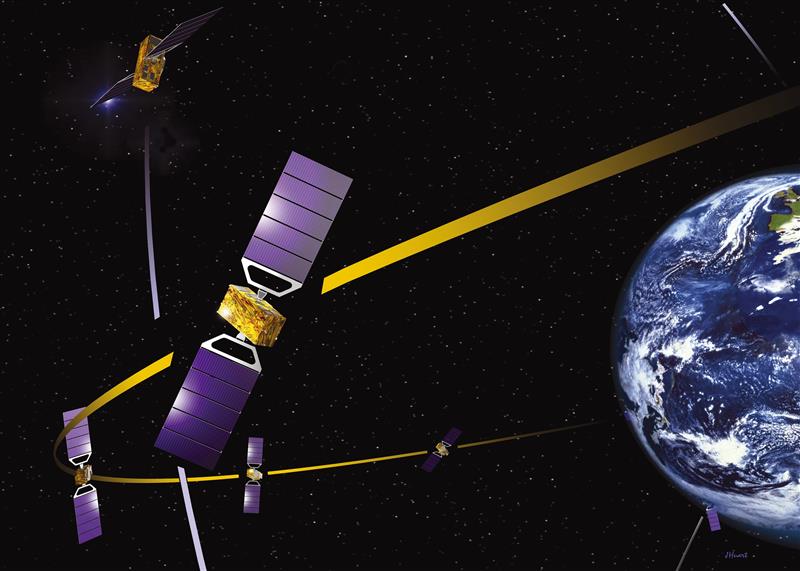
    Galileo serves Europe and the world with accurate and reliable navigation services as well as a catalyst for future space missions — making it a critical aspect of both everyday life and the enhancement of accurate navigation. The constellation will continue to grow with 10 more Galileo first-generation satellites planned for launch in the next few years. Second-generation Galileo satellites with enhanced capabilities are being built for testing and qualification at ESA’s European Space Technology and Research Centre as well.
  • New ESA facility puts satnav at the service of science

    New ESA facility puts satnav at the service of science

    News from the European Space Agency (ESA)

    Global satellite navigation systems are continuously bathing Earth in satnav signals. As well as helping in our daily lives, these signals are also tools for cutting-edge science. A new ESA facility, based at ESA’s astronomy centre near Madrid, is championing their use for everything from Earth monitoring to fundamental physics.

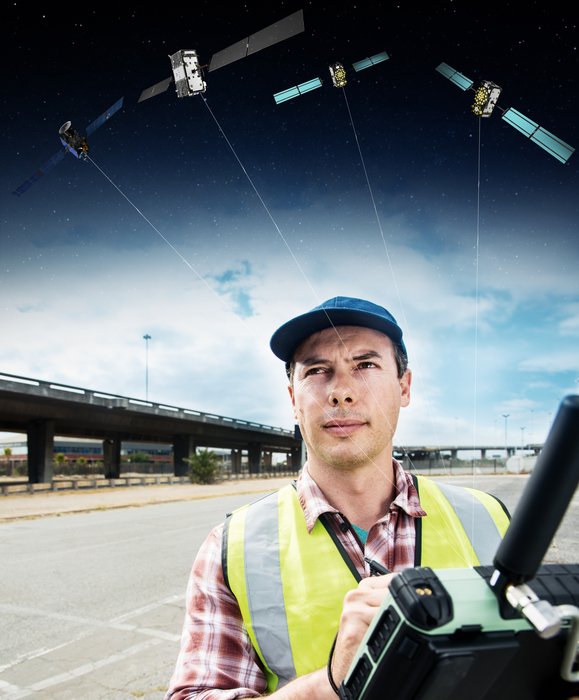
    A Surveyor uses a GNSS device to map urban assets with Galileo and EGNOS. (Image: ESA)
    A Surveyor uses a GNSS device to map urban assets with Galileo and EGNOS. (Image: ESA)

    The new ESA Global Navigation Satellite Systems (GNSS) Science Support Centre is based at ESA’s European Space Astronomy Centre, ESAC, near Madrid. Run by ESA’s Galileo Science Office, the GSSC integrates IT and satnav infrastructure to deliver advanced data processing services to the scientific community.

    Precisely timed to a few billionths of a second and highly stable, satnav signals can be used as a point of reference for many scientific sectors, including Earth and atmospheric sciences, astronomy, highly precise timing metrology as well as the study of relativity and other fundamental physics topics.

    Current satnav infrastructure plans worldwide should see more than 120 satnav satellites in orbit in coming years. This number includes Europe’s own Galileo constellation — offering unique features such as its highly stable passive hydrogen maser atomic clocks, multiple transmission frequencies, robust modulation, wide bandwidth and onboard laser retro-reflectors, which permit exact pinpointing of the satellites’ position in space down to a few tens of centimetres.

    “The potential of satnav for science has been recognised for a long time,” explains Javier Ventura-Traveset, Head of ESA’s Galileo Science Office. “The Galileo Science Office was set up in 2016 as a joint initiative between ESA’s Science and Navigation Directorates, coordinating scientific opportunities through interaction with the scientific community and the independent GNSS Science Advisory Committee.

    “The opening of the new centre is the next step. It is ESA’s concrete answer to the need expressed by the scientific community for a one-stop-shop to offer researchers long-term GNSS data, products information, results of scientific experiments, plus services to enhance GNSS scientific research and collaboration.

    “The future evolution of the centre will be driven by the interaction and feedback received from the scientific community, maximizing synergies with other GNSS data service providers from other institutions and research organization.”

    Among the activities to be supported by the new GSSC are big data processing of large amounts of satnav data, crowdsourcing as a means of weather monitoring and a scientific assessment of satnav performance in Antarctica.

    It also supports the continuing measurements of general relativity using Galileo satellites 5 and 6 and serves as a global data centre for the International GNSS Service. The long-established Navipedia website, giving technical information on satnav, is also hosted by the GSCC.

    One enthusiastic early adopter is ESA’s Navigation Support Office, based at ESA’s ESOC mission control centre in Darmstadt, Germany, lending support to mission teams making use of satnav to steer satellites.

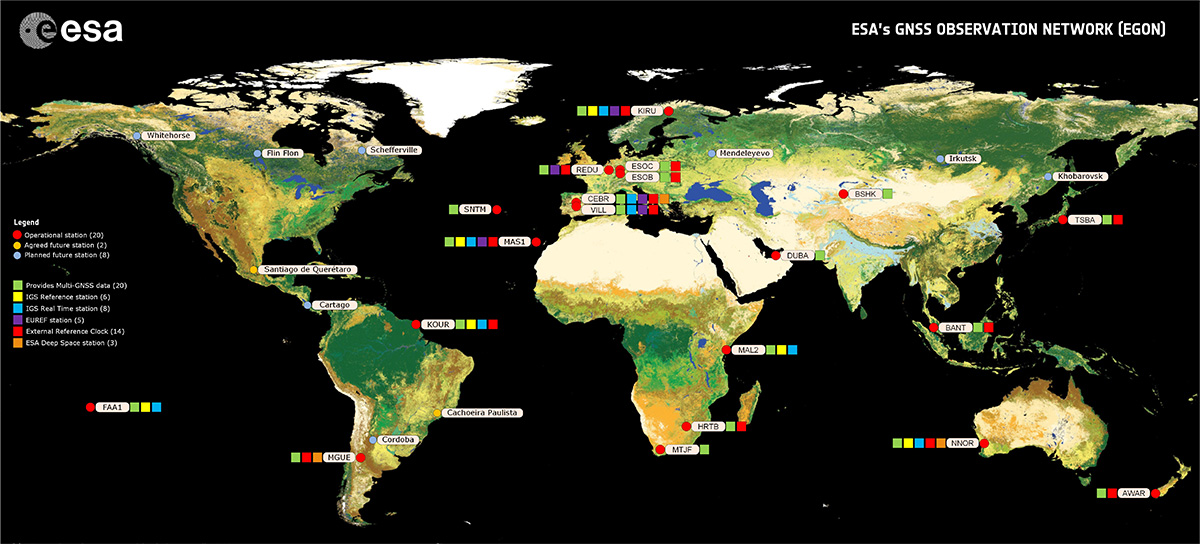
    ESA's GNSS Observation Network (EGON). (Image: ESA)
    ESA’s GNSS Observation Network (EGON). (Image: ESA)

    “The GSSC is a welcome addition to ESA’s activities in the science of satellite navigation,” says Werner Enderle, heading ESOC’s Navigation Support Office. “The GSSC already hosts GNSS products generated by the team at ESOC, including observations from our worldwide EGON GNSS Observation Network and precise satellite orbits generated by their state-of-the-art software. Our two teams look forward to this collaboration continuing for the benefit of ESA and the scientific community.”

    The GSSC will roll out access to data, products and services over the coming months.

  • Ground-based Galileo satellite joins post-launch dress rehearsal

    Ground-based Galileo satellite joins post-launch dress rehearsal

    News from the European Space Agency

    The navigation satellite set to become the 16th in the Galileo constellation has been taken through a Europe-wide rehearsal for its launch and early operations in space.

    Sitting in the cleanroom environment of ESA’s ESTEC technology centre in Noordwijk, the Netherlands, the satellite was last week linked to a trio of sites across the continent: the Galileo control centres in Fucino, Italy and Oberpfaffenhofen, Germany, as well as ESA’s ESOC operations centre in Darmstadt, Germany.

    Galileo's Ground Control Segment (GCS) in the Oberpfaffenhofen Control Centre in Germany is in charge of overseeing the performance of the Galileo satellites. (Photo: ESA)
    Galileo’s Ground Control Segment (GCS) in the Oberpfaffenhofen Control Centre in Germany is in charge of overseeing the performance of the Galileo satellites. (Photo: ESA)

    “These System Compatibility Test Campaigns (STSCs) occur on a regular basis,” explained Liviu Stefanov, lead Flight Operations Director for the next Galileo launch in May. “Last December saw a campaign using one of the two Galileo satellites due to be launched in May, while our February rehearsal used another satellite from the quadruplet being launched by Ariane 5 later this year. So with this most recent task, we have reached a frequency of three system tests in less than four months.”

    A joint team from ESA and France’s CNES space agency oversee Galileo’s Launch and Early Operations Phase (LEOP) – the initial switching on and checking and configuration of satellite systems. LEOP is run from either ESOC or CNES Toulouse, on an alternating basis.

    ESOC will host the LEOP team for the next launch of two Galileo satellites by Soyuz from French Guiana in May. Then the team will switch to Toulouse for the first launch of four Galileo satellites by Ariane 5, scheduled for this autumn.

    Members of the joint Galileo Launch and Early Operations Phase (LEOP) team at work in CNES Toulouse. A joint team from ESA and France’s CNES space agency oversee Galileo LEOPs – the initial switching on and checking and configuration of satellite systems. LEOP is run from either ESOC or CNES Toulouse, on an alternating basis. (Photo: ESA)
    Members of the joint Galileo Launch and Early Operations Phase (LEOP) team at work in CNES Toulouse. A joint team from ESA and France’s CNES space agency oversee Galileo LEOPs – the initial switching on and checking and configuration of satellite systems. LEOP is run from either ESOC or CNES Toulouse, on an alternating basis. (Photo: ESA)

    Liviu added: “From our point of view, this SCTC was a useful final opportunity to try out communications with a satellite that is actually due to fly, before our next Galileo LEOP takes place for real.
    “It is the last end-to-end test of the ground segment with a real satellite before the launch.”

    “Communicating with and controlling satellites still on the ground is one of the essential exercises the LEOP team has to perform before launch,” said Christelle Crozat, lead Spacecraft Operations Manager for the next LEOP.

    “It is an opportunity to test and validate the operational products with a satellite to identify and correct any issues of compatibility with the real hardware while the satellite is still ‘on Earth’. It is always a thrill for the operational engineers to interact with the satellite instead of the simulator.”

    Money spent by European taxpayers on spacecraft operations represents an excellent investment in infrastructure and in high-tech, value-added jobs, with strong benefits flowing back to ESA Member State citizens. (Photo: ESA)
    Money spent by European taxpayers on spacecraft operations represents an excellent investment in infrastructure and in high-tech, value-added jobs, with strong benefits flowing back to ESA Member State citizens. (Photo: ESA)

    In practice, LEOP encapsulates crucial activities such as separation from the rocket’s upper stage, deployment of solar wings and first attitude acquisition, followed by the gradual configuration of the platform system for orbit manoeuvres and the mission to follow.

    ESOC and CNES Toulouse both host their own functionally identical LEOP control centre. New Galileo satellites are launched on a regular basis: bringing them to life is demanding. Pooling this crucial responsibility between two agencies and two locations adds efficiency, delivering greater flexibility and redundancy.

    “This efficiency has been demonstrated by the three successful LEOPs conducted over the course of last year, in March, September and December,” stressed Hervé Côme, Galileo LEOP Service Manager.
    “It is also shown by the capability of CNES/ESOC to support the introduction of one additional Soyuz LEOP on a relatively short four-month notice, for this May.”

    Once each LEOP is completed, control of the satellite platform is passed to the Oberpfaffenhofen control centre, with Fucino overseeing the navigation payloads and the positioning services they enable.

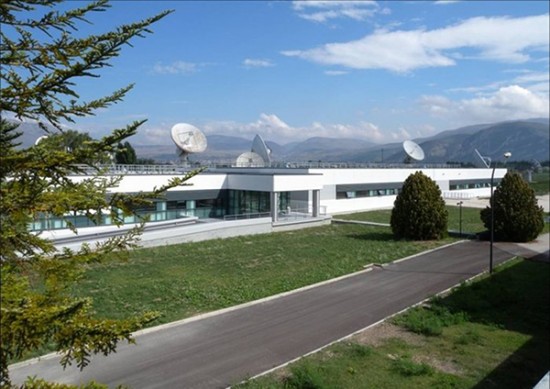
    Galileo’s Ground Mission Segment in the Fucino Control Centre in Italy oversees Galileo navigation services and satellite payload operations.
    Galileo’s Ground Mission Segment in the Fucino Control Centre in Italy oversees Galileo navigation services and satellite payload operations. (Photo: ESA)