Spaceopal has launched NAVCAST, a GNSS precise point positioning (PPP) service featuring high-accuracy positioning enhancement for end users worldwide. NAVCAST aims to actively support and to accelerate widespread adoption of Galileo.
NAVCAST provides Galileo and GPS real time orbit and clock corrections based on an algorithm RETICLE (REal-TIme CLock Estimation), developed by the German Aerospace Centre (DLR e.V.).
Galileo and GPS observations, from more than 100 receivers of the worldwide IGS network, are used to estimate the current corrections which are broadcast to registered users relaying on the standard NTRIP protocol.
NAVCAST corrections improve the user error down to the centimeter level, making it attractive for a large number of applications, the company said.
Users can appraise the accuracy levels and convergence times achievable using NAVCAST (Galileo + GPS) corrections combined with a precise point positioning (PPP) engine, on the Spaceopal website. The underlying PPP engine (dual-frequency, ionosphere-free observations) estimates the local troposphere delays and fixes the carrier-phase integer ambiguities.
NAVCAST can be considered as proof of concept and Spaceopal’s contribution to high-accuracy GNSS services. NAVCAST corrections, which are broadcast over the Internet, could be in future via satellite constellation (such as MEO satellites).
From November 2010 until end of June 2017, Spaceopal was the prime contractor responsible for Galileo operations under the Galileo Full Operational Capability (FOC) Operations Framework contract, the company said. Spaceopal GmbH will continue to operate the Galileo satellite fleet under the Galileo Service Operator (GSOp) contract. Spaceopal is actively supporting the completion of the system to expand the services up to full operational capability by 2020.
By Paul Verhoef
Director of the Galileo Programme and Navigation-related Activities,
European Space Agency
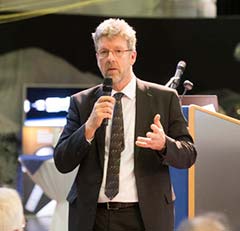
Paul Verhoef, director of the Galileo Programme. (Photo: ESA)
The European Space Agency (ESA) and the European GNSS Agency (GSA) are starting 2018 with the commissioning and In-Orbit Testing (IOT) of four new Galileo satellites.
This work is fairly routine for us as we have achieved the process successfully many times. But the impact of four new satellites for Galileo services is a different story.
This batch of satellites provided by OHB of Germany — 19, 20, 21 and 22 — will bring our constellation to 22 satellites. Together with the necessary ground segment delivered by Thales Alenia Space (TAS) and Airbus Defense and Space (ADS) and their many subcontractors throughout Europe, this will be providing availability to users anywhere in the world in order to achieve a high-quality position solution 99.8% of the time. “High quality” is hereby meant that the position dilution of precision (PDOP) will be smaller than 5, with our final accuracy for a full 24 FOC satellites operating at full potential being PDOP ~ 2.4.
This achievement will create a step change in the ability of service providers and equipment manufacturers to utilize the Galileo service. For all intents and purposes, it means the Galileo signal can always be relied upon to be there, and industry can sell products and design the power budget of devices based upon that fact.
Dual Frequency. The first mass-market GNSS receiver chip for smartphones and mobile devices that is able to utilize dual-frequency Galileo signals was released by Broadcom in September, able to employ both L1/E1 and L5/E5 signals. In 2018, dual-frequency technology like this will provide an order of magnitude increase in the performance of mobile device location-based services (LBS), especially in urban environments, and Broadcom advertises a 50% reduction in power consumption. The world of mobile-device LBS is going to change in 2018, and it will be due to the availability of Galileo.
It will not be the first time the partnership of ESA, the European Commission (EC) and the GSA has made a service available that has changed the nature of the marketplace. The GSA already has in service the ESA-designed EGNOS LPV200 aircraft approach service performing so well that countries like France have taken the decision to phase out the terrestrial Instrument Landing System that has burdened the capital expenditure budgets of airports in the past.
We have had discussions with several commercial organizations that are interested in building products around Galileo, and I am excited to see what they are going to come up with. With Galileo Initial Services the world had a new navigation signal to study and trial. In 2018 the world will have a new star to navigate by — well, a new constellation of 22 to 24 stars, I should say!
FOC. In the summer of 2018 we will launch the final part of the Galileo FOC constellation (geometrically speaking) with four more satellites taking us beyond the 24 needed for 100% coverage and minimum performance limitation from satellite geometry. The launch will also provide our first in-orbit spares, enabling us to plan for the end of life of our old validation phase satellites or otherwise supplement the constellation to improve performance.
What might we do with these in-orbit spares? Our first priority is to complete a constellation of 24 satellites in the correct orbits for minimum PDOP; as you know, a Fregat upper-stage malfunction left GSAT 0201 and 0202 in orbits too elliptical to correct fully, so the current plan is to complete the 24-satellite geometry. 0201 and 0202 are foreseen to be fully integrated in the Galileo operational system in 2018 following further testing and preparations, allowing us to have a 24+2 constellation with “hot back-up” from 0201 and 0202 contributing at around current GPS satellite levels of accuracy.
“It will not be the first — nor the last — time the partnership of ESA, the EC and the GSA has made a service available that has changed the nature of the marketplace.”
Of course, as is known to the community, the validation-phase satellite GSAT 0104 is down to single frequency, and we routinely monitor the health of all satellites. 0104 is the only satellite that has lost part of its function; designed-in redundancy has managed all other problems.
However, obviously we will be examining all options for deployment to ensure that the Galileo schedule is not impacted by in-orbit failures, and those we have experienced we have learned from and mitigated successfully without impacting the service.
The first two spares are not the end of our ability to maintain the constellation and our system performance. All four validation phase satellites will need to be replaced, and so the “Batch 3” satellite procurement will continue to regularly roll out satellites for replenishment of the constellation.
Enhancements. That won’t mean we will be resting on our laurels. In 2018 we also plan to release enhancements to the ground segment for Galileo, a process that will be a first as the system is already being operated by the GSA.
The process of managing an in-service upgrade program with the GSA is going to be new and challenging, but we have a strong engineering support team deployed as part of our working arrangement with the GSA to help ensure the process goes smoothly.
Of course, the need for GSA to be able to continue smooth operations imposes extra discipline and imposes on us a balance between stable operations and continued build-out of the infrastructure. We do not consider this to be a problem; on the contrary, the focus will be on robust operations and availability to the user.
Back at base (ESTEC in the Netherlands for Galileo and Toulouse, France, for EGNOS) we are full steam ahead on preparing the future. We are moving forward at considerable pace with our next-generation designs that develop new functionality for continuous service improvements.
Free PPP. Galileo was designed to broadcast a Commercial Service signal providing services such as precise point positioning to paying customers, but we are pleased to able to report that the EC has confirmed that this service will be provided for free by the European Union. In 2018/2019 the GSA will select the providers and get that unique, free service on the air.
In 2017 the EC confirmed the decision to implement the commercial service using E6-B with both encrypted and open components so all users could benefit for all frequency bands. Now, with the decision to make the service available free of charge, all users of Galileo, with the right type of receiver, will be able to achieve position fixes with an accuracy around 10 cm from Galileo’s first-generation constellation by 2020/2021.
The Galileo Public Regulated Service will also be a focus, with the EC soon to decide upon release dates for the first milestones on the service roadmap. The infrastructure and equipment to support a secure service is being put in place, and I can’t say more for security!
The next generation of European GNSS technology will include multi-constellation EGNOS, Galileo 2nd Generation (G2G) and a transition batch of satellites between the first and second generations to get the best technology proven in flight and working for Galileo users as soon as possible. G2G will reach its System Requirements Review stage in the first half of 2019. To be ready for that we are looking at:
clock technology and ensembles
inter satellite links
propulsion technology
flexible payloads and power allocation
5G telecoms networks standards and what we need to do ensure we provide the timing services those networks will need and new signals with time to first fix (TTFF) and power requirements for acquisition of signal that are compatible with 5G devices. Look out for a new pilot signal E1-D to move forward on this.
Open Service authentication and support for ARAIM (Advanced Receiver Autonomous Integrity Monitoring).
Finally, 2018 will see the first contract awards of the Navigation Innovation Support Programme. This is a programme specifically designed to encourage R&D, new concepts and new products and to ensure that 2018 is not the last time ESA with the EC and its industrial partners deploy a GNSS service for GSA to operate that changes the world.
Surrey Satellite Technology Ltd (SSTL) has delivered the 22nd Galileo navigation payload to prime contractor OHB System in Bremen, Germany. This is SSTL’s final payload under Galileo Full Operational Capability (FOC) Works Orders 1 and 2.
SSTL’s FOC payload is based on European-sourced atomic clocks, navigation signal generators, and high-power traveling wave-tube amplifiers and antennas. It will provide Galileo’s navigation, positioning and timing services.
As payload prime contractor, SSTL is responsible for the development, assembly, integration and test of 22 navigation payloads. The first Galileo FOC payload was delivered to OHB in 2012, and since then payloads have continued to roll off the production line at SSTL, with a delivery schedule of approximately one every six weeks.
On May 12, SSTL held an event to mark the occasion, and to celebrate the achievement with the contributors and supporters of the FOC payloads work. Katherine Courtney, chief executive of the UK Space Agency, attended the event and remarked ,“Satellite navigation is an important part of the UK space industry success story and we are at the forefront of innovation in technology and services. Every FOC payload for the Galileo constellation — the beating heart of each satellite — has been built here in Guildford and the completion of this 22nd payload is a significant milestone which should be celebrated. We remain fully committed to the success of the Galileo programme, and look forward to the start of initial services later this year.”
SSTL’s FOC payload comprises different units that have been manufactured by a European supply chain. The modular design of the satellite enables SSTL to assemble the payload units onto three panels for delivery, fully tested, to OHB in Bremen.
The last of the payloads in these two batches has now completed its journey through production and test at SSTL and has been delivered to Germany, where a team of SSTL engineers will assist OHB engineers with integration to the spacecraft platform.
SSTL’s Galileo FOC payload under production. (Photo: SSTL)
“The completion and delivery of the 22nd payload for FOC marks another milestone for SSTL, and I must pay tribute to the talented and dedicated FOC team here who have worked tirelessly to keep the production line rolling for the past four years,” said John Paffett, director of Telecommunications and Navigation at SSTL. “We are extremely proud of our contribution to Europe’s new navigation system, and we are all looking forward to the day that the new service comes on stream, and we can start using it in our daily lives.”
“SSTL has been a reliable partner of the Galileo venture since GIOVE-A,” said aul Verhoef, director of Galileo Programme and Navigation at the European Space Agency. “I wish to thank all SSTL staff for their extremely valuable contribution.”
The subcontractors for SSTL’s Galileo FOC navigation payload are Airbus Defence and Space, Finmeccanica, Spectratime, Kongsberg Norspace, Rymsa, TAS-I, Tesat, Ruag, Mier, ComDev (Honeywell), and Siemens. Testing facilities were provided at Airbus Defence and Space and RAL Space.
The next launch of a pair of Galileo FOC spacecraft is scheduled for May 24 on board a Soyuz launcher from Kourou in French Guiana. Twelve Galileo satellites are already in orbit, and a second launch of four spacecraft is planned for later this year, bringing the total of 18 Galileo satellites in orbit by the end of this year.
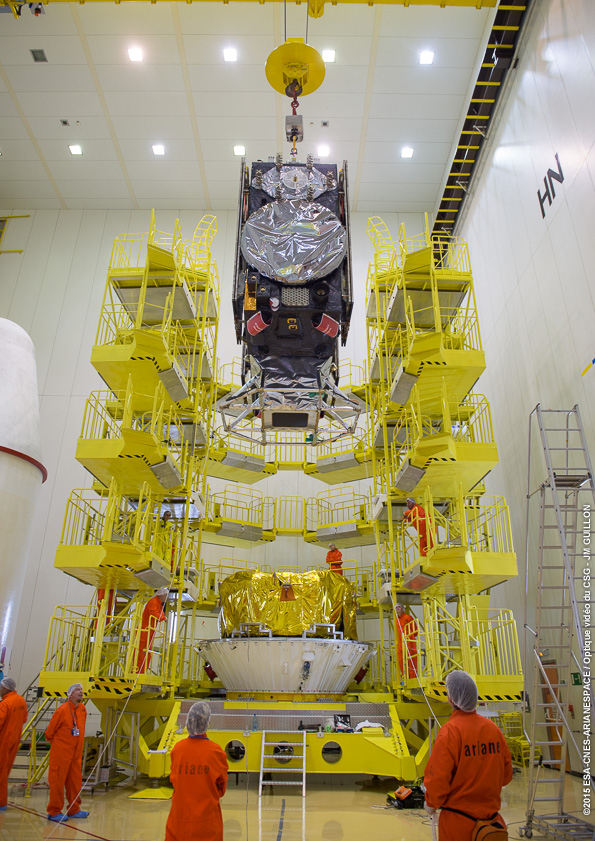
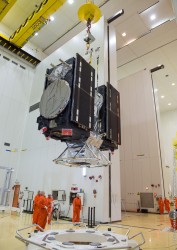
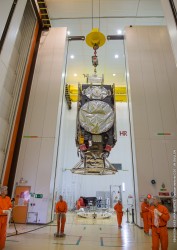
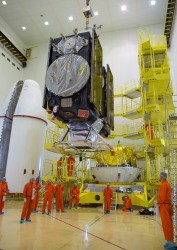
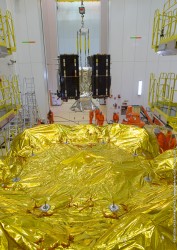
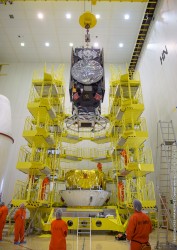
Galileos 9 and 10 are lowered onto the Fregat upper stage.
Galileo 9 and 10 are ready for launch atop a Soyuz rocket at 23:08 local time on Sept. 10 (02:08 GMT and 04:08 CEST on Sept. 11) from Europe’s Spaceport in French Guiana.
After being attached to their carrier last week, the pair of fully fueled satellites was carefully lowered onto the Fregat upper stage on Wednesday, Sept. 2, in the 3SB preparation building of the Guiana Space Centre. The following day was devoted to functional checks and inspections, preparing the Galileos plus Fregat to be encapsulated within the halves of their Soyuz rocket fairing, which took place on Sept. 4. This complete “upper composite” was then transported to the launch site and attached vertically to the first three stages of the Soyuz ST-B, the 12th Soyuz to be operated from the spaceport.
As much a spacecraft as a launcher stage, the re-ignitable Fregat will take the Galileos the bulk of the way to their designated medium-altitude orbit once the first three stages achieve low orbit, 9 minutes and 24 seconds after launch. A pair of Fregat firings will be separated by a 3-hour, 13-minute coast up to their target 23,222 km orbital altitude and 57.394° inclination.
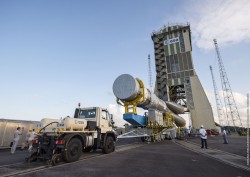
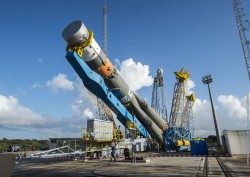
Soyuz in Launch Zone. The basic three-stage vehicle for Arianespace’s Sept. 10 Flight VS12 rolled out from its MiK integration building in the Spaceport’s northwestern sector this morning, and was transferred horizontally to the ELS launch zone by a transporter/erector rail car.
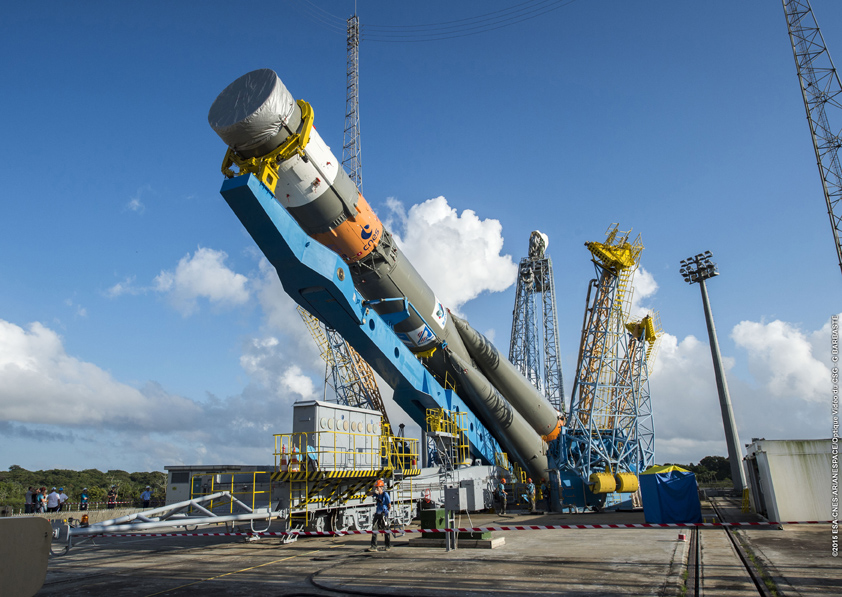
The Soyuz rocket is moved to the launch pad and lifted into a vertical position.
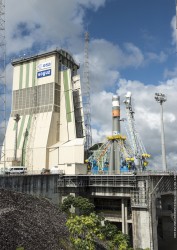
The Soyuz was then erected in a vertical position and suspended over the launch pad, held in place by four large support arms. This was followed by the 53-meter-tall mobile gantry’s move-in to protect the launcher, providing a safe environment for installation of the “upper composite” containing the Galileo satellites.
Galileo 9 and 10 are the fifth and sixth Galileo FOC (full operational capability) spacecraft, and have been designated “Alba” and “Oriana” — continuing the naming process after children who won a painting competition organized by the European Commission in 2011. The satellites were built by OHB System, with Surrey Satellite Technology Ltd. supplying their navigation payloads.
The European Commission is managing and funding Galileo’s FOC phase — during which the network’s complete operational and ground infrastructure is being deployed. The European Space Agency has been delegated as the design and procurement agent on the Commission’s behalf.
Two More this Year. Two further satellites are scheduled for launch by the end of this year. One is under test at ESA’s ESTEC technical centre in Noordwijk, the Netherlands, while the other has already completed its checks and is awaiting transportation to Kourou in the second half of October. In addition, the first satellite of the following batch (Galileo 13) has arrived at ESTEC and is undergoing its thermal-vacuum test. The next will arrive by mid-September.
Follow Arianespace’s launch activity on its website.
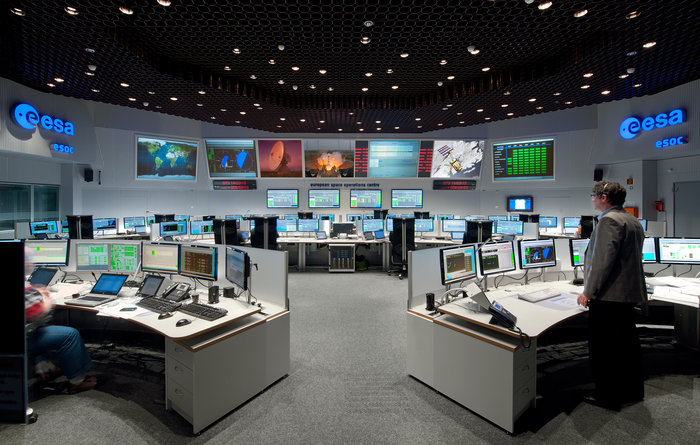
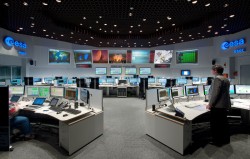
ESOC serves as the Operations Control Centre for ESA missions and hosts ESA’s Main Control Room (shown here), combined Dedicated Control Rooms for specific missions and the ESTRACK Control Centre, which manages ESA’s worldwide ground tracking stations.
Mission Control’s Mission. When the next pair of Galileo satellites is boosted into orbit on Friday, a team of mission control experts in Darmstadt, Germany, will spring into action, working around the clock to bring the duo through their critical first days in space. The fiery ascent to space will last just over nine minutes, after which the Fregat upper stage will fire twice to place the satellites into their release orbit.
Separation from Fregat, about 3 hours and 48 minutes into flight, marks the start of the critical early orbits for the team at ESA’s European Space Operation Centre in Darmstadt. Within the combined flight control team from ESA and France’s CNES space agency, each position is paired with its counterpart from the other agency and mixed “CNESOC” shifts will rotate to conduct operations around the clock. The same team conducts all the Galileo early operations alternately from ESOC and from the CNES control centre in Toulouse, France.
“Upon separation, the team will be very focused, and we’ll be watching for a number of critical events on the satellites to happen automatically at the right time and in the right order,” said ESA’s Liviu Stefanov, lead flight director for this phase. “The satellite must switch on, go into a basic flight configuration, deploy its solar wings for power, orient them towards the Sun and acquire Sun-pointing attitude. “As soon as we get communications, we’ll check its health and start sending commands to configure the satellite after completion of the automatic sequence and prepare it for the next major activity: pointing Galileo towards Earth.”
The intense activity will begin the 10-day early operations phase, during which the joint team will work 24 hours/day to oversee steps to prepare the satellites for handover to the Galileo Control Centre in Oberpfaffenhofen, for routine operations, and ESA’s Redu Centre in Belgium, for detailed payload testing.
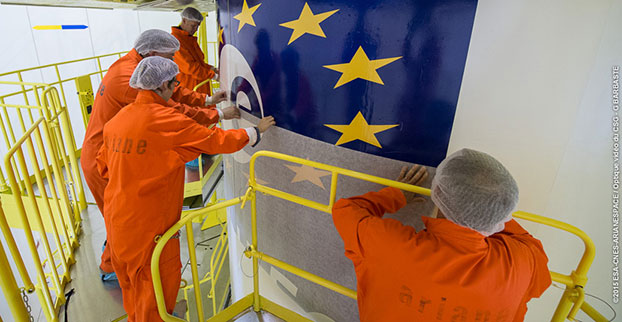
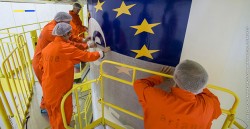
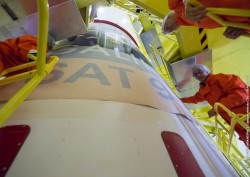
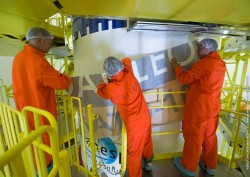
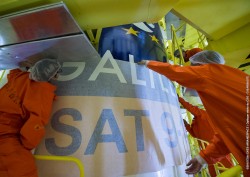
The logos of the two new satellites in the Galileo constellation are placed on the launcher fairing.
Photo Gallery
Galileos 9 and 10 are lowered onto the Fregat upper stage. (Credit: CNES/ESA)
Galileos 9 and 10 are lowered onto the Fregat upper stage.(Credit: CNES/ESA)
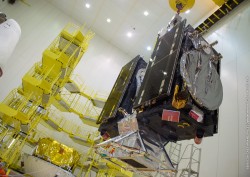
Galileo 9 and 10 on their dispenser being lifted towards the gold-insulation-covered Fregat upper stage. (Credit: CNES/ESA)
Galileos 9 and 10 are lowered onto the Fregat upper stage.(Credit: CNES/ESA)
Galileos 9 and 10 are lowered onto the Fregat upper stage. (Credit: CNES/ESA)
Galileos 9 and 10 are lowered onto the Fregat upper stage. (Credit: CNES/ESA)
The Soyuz launcher is transferred to the launch pad. (Credit: Arianespace)
The Soyuz rocket is moved to the launch pad and lifted into a vertical position. (Credit: Arianespace)
The Soyuz launcher is transferred to the launch pad. (Credit: Arianespace)
The logos of the two new satellites in the Galileo constellation are placed on the launcher fairing. (Credit: CNES)
The logos of the two new satellites in the Galileo constellation are placed on the launcher fairing. (Credit: CNES)
The logos of the two new satellites in the Galileo constellation are placed on the launcher fairing. (Credit: CNES)
The logos of the two new satellites in the Galileo constellation are placed on the launcher fairing. (Credit: CNES)
ESOC serves as the Operations Control Centre for ESA missions and hosts ESA’sMain Control Room (shown here), combined Dedicated Control Rooms for specificmissions and the ESTRACK Control Centre, which manages ESA’s worldwide groundtracking stations. (Credit: ESA)
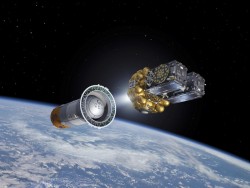
Artist’s view of Galileo satellites attached to their dispenser atop their Fregat upper stage separating from the Soyuz upper stage. The Fregat then flies them the rest of the way up to medium-Earth orbit. (Credit: ESA)
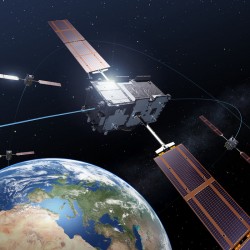
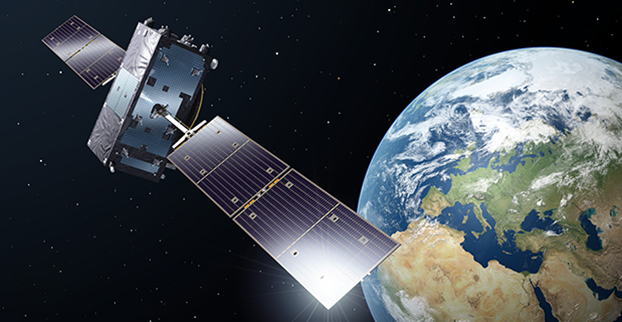
The Galileo GNSS. (artist’s rendering, courtesy ESA)
UPDATED 08/28/15 with information from the European Space Agency.
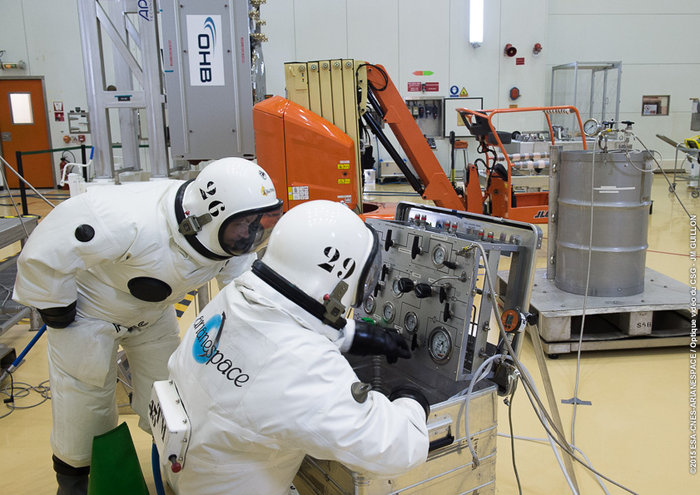
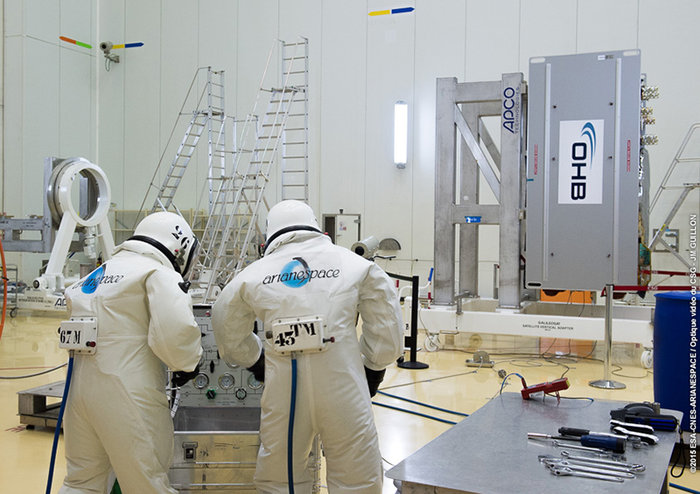
Europe’s ninth and tenth Galileo satellites were fueled Aug. 24 by technicians in protective SCAPE suits within the Guiana Space Centre’s 3SB preparation building. This left the satellites ready to be attached to their launcher upper stage in preparation for launch. (Photo:ESA)
The two European Galileo navigation satellites for Arianespace’s next mission from French Guiana have been fueled at the Spaceport, readying them for integration with their Soyuz launcher.
Galileo full operational capability (FOC) satellites 9 and 10 were “topped off” during activity this week at the Spaceport’s S3B payload preparation facility, further advancing preparations for the Sept. 10 mission — which is designated Flight VS12 in Arianespace’s launcher family numbering system, signifying the 12th liftoff of the medium-lift Soyuz vehicle from French Guiana. Lift-off is scheduled for 02:08:10 p.m. UTC.
Flight VS12’s satellites are the fifth and sixth in Galileo’s FOC phase. They were produced by OHB System, with Surrey Satellite Technology Ltd. supplying their navigation payloads that will generate precise positioning measurements and services around the world.
The Sept. 10 mission will be the fifth Soyuz flight with Galileo satellites performed by Arianespace from French Guiana — a series that began with the Russian-built launcher’s inaugural liftoff at the Spaceport in Oct. 2011.
At full deployment, the Galileo program will consist of 30 satellites — comprising operational spacecraft and reserves — situated on three circular medium Earth orbits at some 23,200 km. altitude inclined 56 degrees to the equator. The constellation — and associated ground infrastructure — will provide high-quality positioning, navigation and timing services under civilian control, and be interoperable with GPS and the Russian GLONASS.
Galileo’s FOC phase is managed and funded by the European Commission, with the European Space Agency delegated as the design and procurement agent on the commission’s behalf.
Arianespace Flight VS12 will be the company’s eighth mission this year, following the successful launches in 2015 of four heavy-lift Ariane 5s, two lightweight Vega vehicles, and one Soyuz.
Technicians donned spacesuit-like SCAPE (Self Contained Atmospheric Protective Ensemble) suits to fill each satellite with sufficient hydrazine fuel for their planned 12 years of operations in space, the European Space Agency describes in a news release. This fuel is needed for fine-tuning of their orbital paths following their launch, followed by routine orbital and attitude control over the course of their working lives.
Each Galileo satellite needs to keep its navigation antenna trained on Earth’s disc at all times, employing dedicated infrared Earth and Sun sensors for this purpose. This marked the first time Galileo had been fuelled within the Guiana Space Centre’s 3SB preparation building. Previously, the S5 fuelling building was dedicated to this purpose, but upgrades by Arianespace mean fuelling can now take place at the same location where they will subsequently be attached to their Fregat upper stage, streamlining the satellite preparation process. Completion of fuelling means the two satellites are essentially ready for launch — what needs to be accomplished now is to first attach the Galileos to their launch dispenser, then to fix this in turn to their Fregat.
The satellites plus Fregat will then be encapsulated within the launcher fairing, after which this ‘upper composite’ can then be attached to the other three stages of the Soyuz ST-B launcher. The latest Galileo launch campaign commenced at the end of July, with the arrival of the satellites in French Guiana on July 24. A “fit check” followed, to confirm the satellites as delivered in Kourou did indeed fit onto the dispenser that will first secure them in place during launch and then pyrotechnically eject them into their orbits once their target 23 222 km altitude medium-Earth orbit has been reached. This was followed by in-depth system checks and final settings of onboard navigation and data handling software parameters.
Two further Galileo satellites are still scheduled for launch by end of this year. One of these satellites is completing testing at ESA’s ESTEC technical centre in Noordwijk, the Netherlands, while the other one has already completed its testing and is awaiting transportation to Kourou in the second half of October.
In addition the first satellite of the following batch has arrived at ESTEC and is currently undergoing its thermal vacuum test. Another flight model will arrive at ESTEC by mid-September.
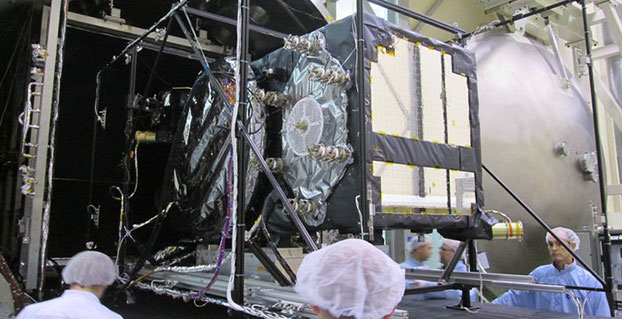
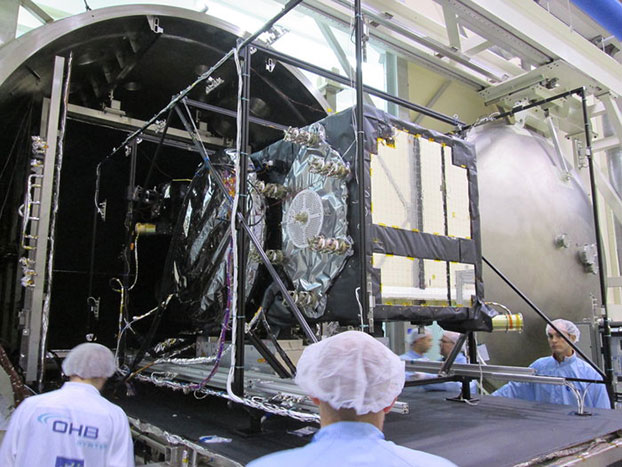
Weeks of testing simulated the airlessness and temperature extremes of orbital space, taking place at the ESTEC Test Centre in Noordwijk, the Netherlands during May 2015. (Photo: ESA)
News by the European Space Agency
Europe’s latest Galileo was unboxed at ESA’s technical centre in the Netherlands in May, bringing the total number of satellites at the site to four.
ESTEC in Noordwijk is the largest satellite test facility in Europe, with all the equipment needed to simulate every aspect of the launch and space environment under a single roof. It is an essential stop on the way to space for Europe’s Galileo satellites, built by OHB in Bremen, Germany, with navigation payloads from Surrey Satellite Technology Ltd. in Guildford, UK.
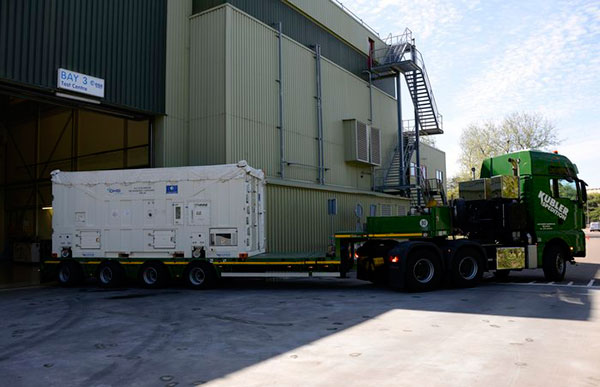
The 12th Galileo arrived by lorry from Bremen on May 13, in a custom-built environmentally controlled container. The satellite will begin with a thermal vacuum test in a 4.5-meter-diameter stainless steel chamber, subjected to about five weeks of hard vacuum and the temperature extremes of space.
Galileo-11 recently completed the same trial before moving on to final system testing, including a compatibility run with the ground network.
Meanwhile, the ninth and tenth satellites are in storage at ESTEC, having passed their own checks. They will be flown to Europe’s Spaceport in French Guiana in late July for launch by Soyuz in September, which will bring the total in orbit into double figures.
The 12th Galileo satellite, FOC FM-08, arrived at the ESTEC Test Centre on May 13. It was transported by lorry from Bremen in a protective air-conditioned container.
The first four Galileos, launched in 2011 and 2012, were in-orbit validation satellites, built by prime contractor Airbus Defence & Space. They confirmed that the overall system worked as planned, while also serving as the foundation of the full constellation to follow.
The follow-up Full Operational Capability satellites are now being launched regularly to increase the size of the constellation to the point where early Galileo services can begin next year.
European Partners. Galileo is a collaboration between ESA and the European Commission (EC). The validation phase was co-funded by ESA and the EC, while the full operational phase is funded by the EC. Under a delegation agreement, ESA acts as design and procurement agent on behalf of the commission.
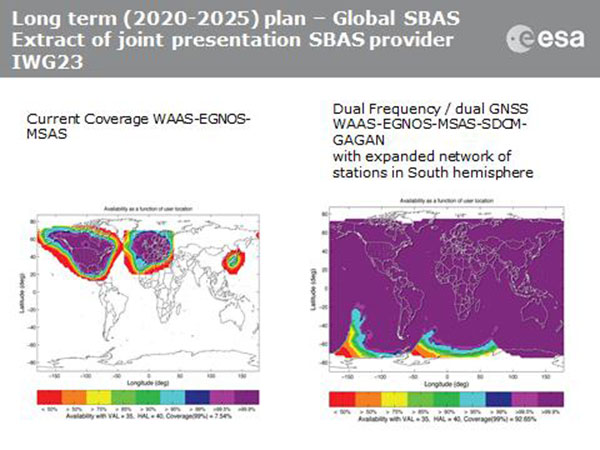
Current coverage (left) of WAAS, EGNOS and MSAS; long-term 2020–2025 (right) plan for dual-frequency, dual-GNSS WAAS-EGNOS-MSAS-SDCM-GAGAN.
SBAS Agree to Common Message
Aircraft navigation and safety will benefit from enhanced, reliable satellite navigation signals on a seamless basis across much of the world in the 2020–2025 timeframe. The 28th Satellite-based Augmentation Systems Interoperability Working Group (IWG) came to agreement on standardization of satellite-based augmentation systems (SBAS) in a meeting hosted by the European Space Agency in early April. The group planned a shift from reliance exclusively on GPS to a multi-constellation design employing Galileo, BeiDou and GLONASS after 2020.
The agreement centers around a message definition for a new secondary SBAS channel — to be known as L5, along with the current L1 — for second-generation SBAS systems, which will utilize dual-frequency multi-constellation signals, greatly increasing the accuracy of navigation systems available to airliners by largely eliminating ionospheric errors. Plans also call for an expanded network of stations in the Southern Hemisphere. The IWG document must now be accepted by the official international SBAS standardization bodies: the International Civil Aviation Organisation, the U.S. Radio Technical Commission for Aeronautics (RTCA) and the European Organisation for Civil Aviation Equipment.
The meeting also reported on the state of development of the other global SBAS systems. Along with the four operational systems — the U.S. WAAS, European EGNOS, Japan’s Multi-functional Satellite Augmentation System (MSAS) and India’s GAGAN (GPS and geo-augmented navigation system) — these comprise South Korea’s KASS, China’s Beidou SBAS, Russia’s System for Differential Corrections and Monitoring (SDCM) and the West African Agency for Aerial Navigation Safety in Africa and Madagascar (ASECNA) SBAS.
UAV Integration into Airspace
The Federal Aviation Administration (FAA) announced two new initiatives related to unmanned aircraft systems (UAS) at the Association for Unmanned Vehicle Systems International (AUVSI) Unmanned Systems 2015 conference in Atlanta, Ga., in early May.
FAA Administrator Michael Huertatold a large gathering of national journalists, “The unmanned aircraft industry is changing faster than any segment in the aircraft industry. A new project to harness that energy, the Pathfinder program, is partnering with three leading U.S. companies to expand unmanned aircraft operations in the United States.” The FAA is working with industry partners on three focus areas:
CNN will research visual line of sight (LOS) operations for newsgathering in urban areas. CNN will continue working with Georgia Tech University to improve newsgathering for all organizations.
PrecisionHawk will investigate agricultural operations for rural areas, flying outside LOS.
BNSF Railway, second-largest freight railroad network in North America, will undertake inspection of rail infrastructure, also beyond visual LOS.
Huerta said that the partners, collectively, “are trying to push the envelope, what can we accommodate safely and what can we learn from that.We’ll test a little, learn a little, then test some more. How do we see a staged implementation? To integrate unmanned aircraft, but to do it safely. We’re trying to push the edges of what we can allow, working with partners who have specific uses and resources.”
As to a timeframe to reach new UAV regulations, he replied, “I can’t comment a lot on the rule itself, but it’s fair to say that in the rulemaking comment process [closed on April 24], we received more than 4,500 comments. It’s too early to say how those comments will shape the final rulemaking.
“Assessment will be done in the coming months, perhaps by the end of the year, but that’s an aggressive timetable. That’s not accomplished in six months, nor should it take a million years.”
New Airbus EGNOS-Capable
The new Airbus A350 airliner, now entering service, comes fitted with EGNOS. The EGNOS system is being adopted by European airports to enable satellite-guided landing approaches. The A350’s Satellite Landing System allows pilots to perform precision-landing approaches guided by EGNOS or its U.S. equivalent, WAAS. The capability offers vertical landing guidance down to a minimum of 60 miles.
New Galileo Satellite on the Air
Monitoring by researchers at the German Aerospace Center (Deutsches Zentrum für Luft- und Raumfahrt, or DLR) indicates that one of the Galileo full-operational-capability (FOC) satellites launched on March 27 has begun transmitting standard L-band signals using pseudorandom-noise-code identifier 22.
The first E1 and E5 signals from GSAT0204, also known as FOC-FM4 and Galileo 8 and as NORAD object 40545, were received at an International GNSS Service Multi-GNSS Experiment tracking station in Windhoek, Namibia, at about 11:32 UTC May 21. The satellite’s signals were subsequently tracked by a station in Wettzell, Germany, and then by others.
The signals will be set unhealthy for use until satellite commissioning is completed.
News item courtesy of CANSPACE Listserv.
Euroship Gets eLoran as Backup
Container ship in port.
Ship management company EuroShip Services Ltd. has installed eLoran as a backup to GPS to ensure the safety of its vessels operating off the coast of the United Kingdom.
The trial installation may lead to implementation across the full fleet of16 vessels managed by Euroship, working routes in Northern Europe. The land-based radio navigation system is intended to seamlessly take over in the event of a GPS outage. EuroShip plans to simulate GPS outages to test eLoran provision of position, navigation and timing data automatically.
New GPS III RFP
The U.S. Air Force (USAF) has released a draft Request for Proposal for GPS III Launch Services, encompassing launch vehicle production, mission integration and launch operations.USAF reintroduces competition into the Evolved Expendable Launch Vehicle (EELV) program after more than a decade.
GPS III is the first of nine launches the Air Force intends to competebetween now and 2017, followed by 25 more from 2018 to 2022.
Signals from both Galileo satellites launched March 27 are now transmitting signals.
Researchers at Université de Liège and at the German Aerospace Center (Deutsches Zentrum für Luft- und Raumfahrt, or DLR) reported on May 21 that the first of the full-operational-capability (FOC) satellites had begun transmitting standard L-band signals. The satellite, designated Galileo 8, is using pseudorandom-noise-code identifier 22.
The first E1 and E5 signals from Galileo 8 were received at an International GNSS Service Multi-GNSS Experiment tracking station in Windhoek, Namibia, at about 11:32 UTC on May 21. The satellite’s signals were subsequently tracked by a station in Wettzell, Germany, and then by others.
The other satellite, Galileo 7, began transmitting standard L-band signals on May 25. The first E1 and E5 signals from Galileo 7 were received around 17:00 UTC. The satellite is using PRN code 26.
The signals will be set unhealthy for use until satellite commissioning is completed.
Galileo 7 is also known as GSAT0203, FOC-FM3 and as NORAD object 40544. Galileo 8 is also designated GSAT0204, FOC-FM4 and NORAD object 40545.
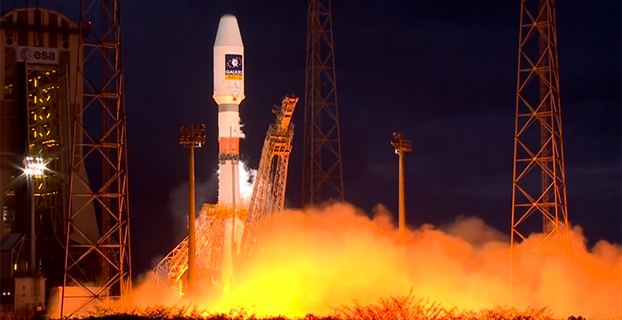
Galileo 7 and 8 were launched into orbit March 27. (Screenshot of ESA/Arianespace livestream feed.)
Europe’s two newest Galileo satellites — launched March 27 — have carried out maneuvers to take them down to their working positions in orbit. Both satellites are performing well. Galileo 7 and 8 were launched into a circular 23,522 km altitude orbit about 300 km above their final orbit.
Using their onboard thrusters, the two Galileo satellites have performed all their Launch and Early Operations Phase (LEOP) maneuvers, reports the European Space Agency (ESA). The maneuvers began as soon as the automatic initialization sequence was completed.
A joint team of ESA and CNES personnel oversaw the LEOP process from the French space agency CNES in Toulouse. On March 28, the team ensured that the two satellites’ solar arrays deployed correctly and oversaw the gradual switch-on of the satellites systems.
Once the two satellites passed inspection, control was passed to Galileo’s Oberpfaffenhofen-based Control Centre (run by SpaceOpal, a joint venture by DLR Gesellschaft für Raumfahrtanwendungen and Telespazio) to prepare for their final In-Orbit Testing (IOT) in two phases: commissioning for the host satellite platforms, and then their navigation and search and rescue payloads. Platform commissioning is now taking place.
The Galileo satellites’ navigation and the search and rescue payloads will be switched on in few weeks and will begin detailed in-orbit testing, overseen from ESA’s Redu centre in Belgium, which is equipped with a 20-meter antenna for high-resolution acquisition of the navigation signals.
The hosting of Galileo’s LEOP team alternates between CNES in Toulouse and ESA’s ESOC control centre in Darmstadt, Germany. Early operation of the next pair of Galileo satellites will be masterminded from ESOC — launch is scheduled for September.
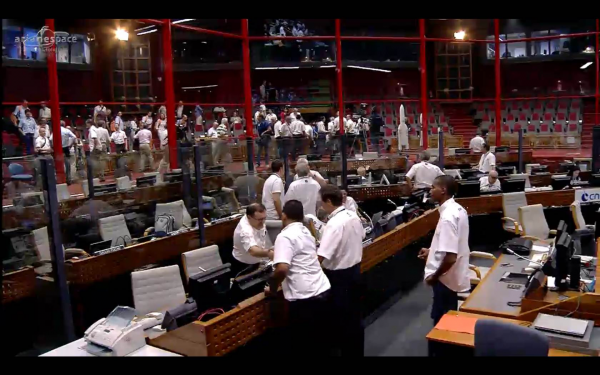
The Galileo launch team celebrates after a successful launch. (Screenshot of ESA/Arianespace live stream of lift-off.)
The two newest Galileo satellites — dubbed Adam and Anastasia — launched Friday are now being checked out by the European Space Agency (ESA) and France’s CNES space agency from the CNES Toulouse centre.
Following these initial checks, the two satellites will be handed over to the Galileo Control Centre in Oberpfaffenhofen, Germany, and the Galileo in-orbit testing facility in Redu, Belgium, for testing before they are commissioned for operational service. This is expected by mid-year.
Screenshot of ESA/Arianespace live stream following lift-off.
Adam and Anastasia are the third and fourth Full Operational Capability (FOC) spacecraft for Europe’s Galileo global navigation satellite system.
After an initial powered phase of Soyuz’ three lower stages, the launch included two burns of the Fregat upper stage — separated by a three-hour-plus ballistic phase — to place the two 700-kg.-class satellites at their targeted deployment point, according to launch contractor Arianespace. Total payload lift performance for the flight was estimated at 1,597 kg. on a mission to a circular medium-Earth orbit.
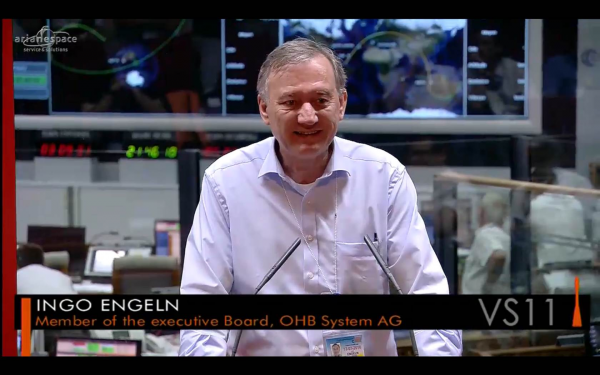
During post-launch comments from the Spaceport, Arianespace Chairman and CEO Stéphane Israël thanked and congratulated everyone involved with the Soyuz mission — designated VS11 in the company’s numbering system — but added that there is still much work to be done for the Galileo program moving forward.
He said there are six more Galileo launches to come following tonight’s success: three missions on Soyuz with six additional FOC satellites, and three launches on Ariane 5, with 12 more units.
Screenshot of ESA/Arianespace live stream following lift-off.
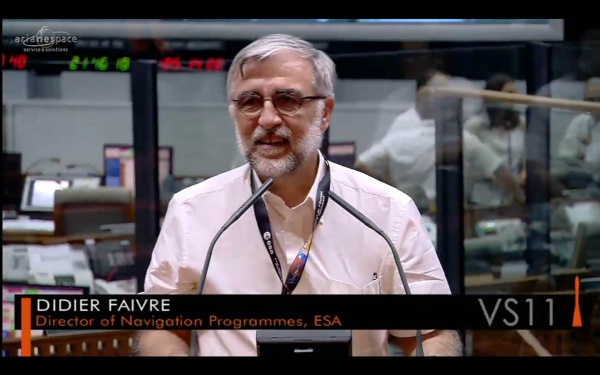
“The satellites are doing fine and are in good hands, managed by the Toulouse CNES [French space agency] operational center,” added Didier Faivre, director of Navigation Programs for ESA. “Let’s rejoice with this very good news. We will be back as soon as possible to continue deploying our satellites.”
The on-target Soyuz launch of Adam and Anastasia followed by one day the 35th anniversary of Arianespace’s creation in 1980. Adam and Anastasia were built by OHB System, with Surrey Satellite Technology Ltd. supplying their navigation payloads.
Galileo’s FOC phase — during which the network’s complete operational and ground infrastructure will be deployed — is being managed and funded by the European Commission, with ESA delegated as the design and procurement agent on the commission’s behalf.
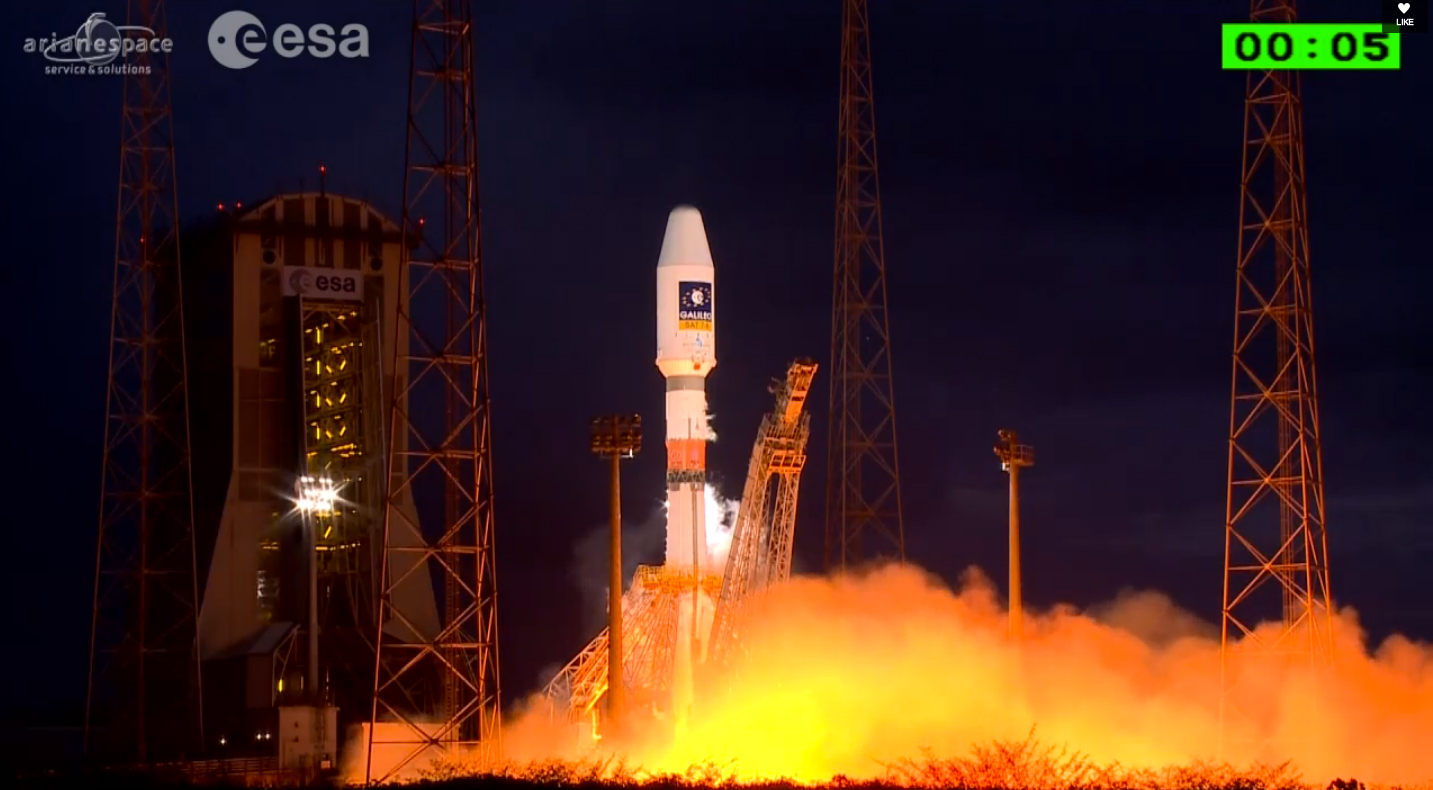
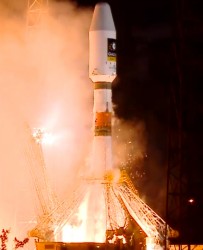
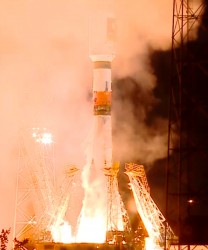
Galileo 7 and 8 were launched into orbit on time today. (Screenshot of ESA/Arianespace livestream feed.)
UPDATE: The two Galileo satellites are confirmed separated from their Soyuz Fregat upper stage into 22,522 altitude orbit right on schedule, according to ESA. Both are in their planned orbits.
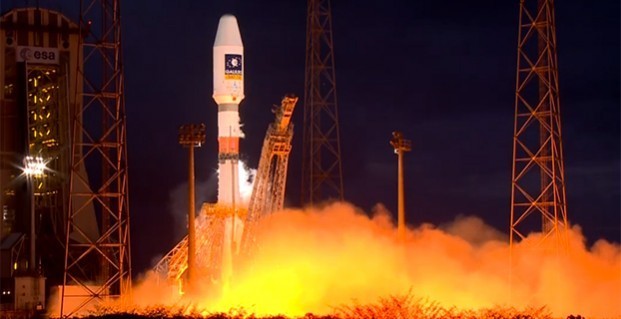
Two more Galileo satellites were successfully launched today from Europe’s Spaceport in French Guiana. The seventh and eighth Galileo satellites were lifted aloft on time at 21:46:18 GMT (22:46:18 CET) atop a Soyuz ST-B rocket.
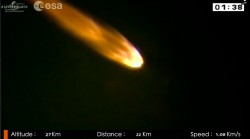
The first three stages of the Soyuz rocket are delivering the Galileo satellites and their Fregat upper stage into low orbit. Then the reignitable Fregat, as much a spacecraft as a rocket stage, will take over the task of hauling the satellites higher through a pair of burns. The satellites will be released in opposite directions by their dispenser once they reach their set 22,522 kilometer-altitude orbit 3 hours, 47 minutes, 57 seconds after launch.
The launch is designated VS11 in Arianespace’s numbering system. Flight VS11’s passengers — built by OHB System, with Surrey Satellite Technology Ltd. supplying the navigation payloads — are the third and fourth Full Operational Capability (FOC) satellites in the Galileo program, which is creating a European-operated space-based navigation system.
The European Commission is managing and funding Galileo’s FOC phase, during which the network’s complete operational and ground infrastructure will be deployed. The European Space Agency has been delegated as the design and procurement agent on the commission’s behalf.
Watch a replay of the launch here:
Screenshot of ESA/Arianespace live stream of lift-off.
Galileo 7 and 8 were launched into orbit on time today. (Screenshot of ESA/Arianespace livestream feed.)
Screenshot of ESA/Arianespace live stream of lift-off.
Screenshot of ESA/Arianespace live stream of lift-off.
Screenshot of ESA/Arianespace live stream of lift-off.
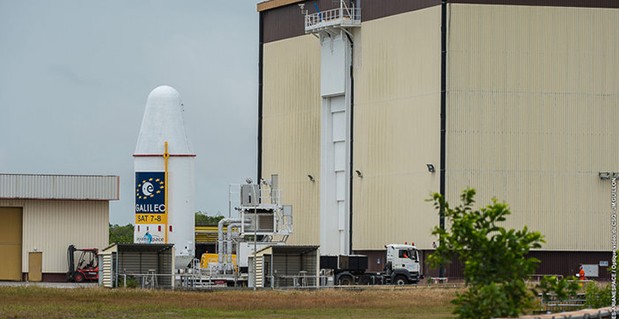
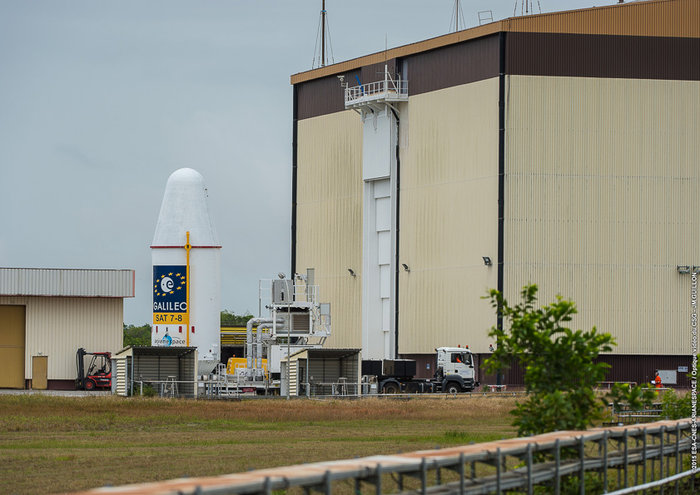
The upper composite, containing the seventh and eighth Galileo satellites attached to their dispenser atop the Fregat upper stage inside the launcher fairing, being moved from the S3B building to the Soyuz launch site of Europe’s Spaceport on March 24. Photo: European Space Agency
By the European Space Agency
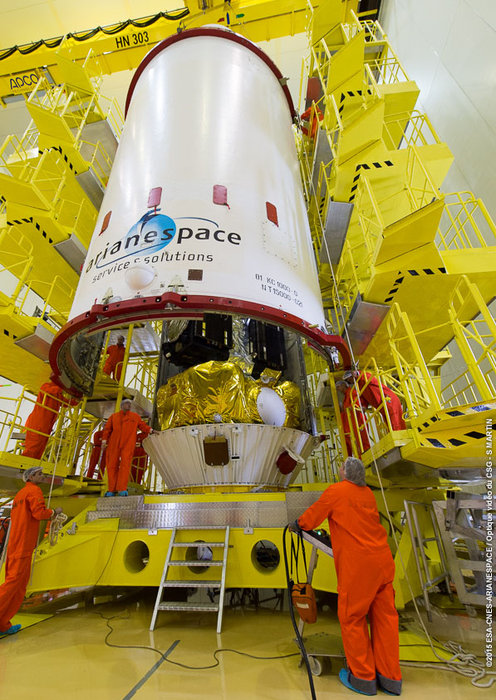
The seventh and eighth Galileo satellites attached to their dispenser atop the Fregat upper stage being enclosed within their Soyuz launcher fairing on March 20. Photo: European Space Agency
Thousands of engineers have worked on the seventh and eighth navigation satellites of Europe’s Galileo constellation in recent years, but last Friday marked the very last time the spacecraft were glimpsed by human eyes.
The team from ESA and builders OHB in the S3B building of Europe’s Spaceport in French Guiana looked on as the focus of their work disappeared from view.
The pair of satellites — already resting atop their Fregat upper stage and attached to their dispenser — was enclosed within the halves of the Soyuz rocket’s protective fairing.
This unit was moved yesterday to the launch site, where it will be lifted atop the first three stages of the Soyuz ST-B to complete the vehicle for Friday’s launch.
Last week saw the two satellites being fuelled in the Spaceport’s S5A preparation hall and then brought together atop the dispenser that will support them during the rigours of ascent.
The dispenser’s final task is to release them in opposite directions once their 22 522 km-altitude orbit is reached. The satellites themselves will then gradually lower themselves to their working 22 322 km orbit.
After fueling, the satellites plus dispenser were moved to the S3B processing building, where their Fregat was already fueled and waiting.
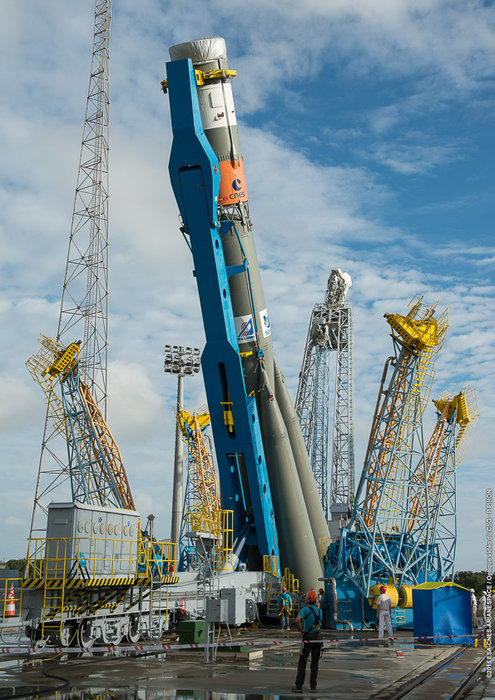
The first three stages of the seventh and eighth Galileo satellites’ Soyuz ST-B rocket being raised to the vertical on the launch pad at Europe’s Spaceport in French Guiana, awaiting the addition of the ‘upper composite’ containing the Galileo satellites plus the Fregat upper stage enclosed within the Soyuz fairing. Photo: European Space Agency
The reignitable Fregat is as much a spacecraft as a rocket stage. Once the Soyuz reaches low orbit, Fregat will take over the task of hauling the satellites higher through a pair of burns.
The two Galileos and their dispenser altogether weigh more than one and a half tonnes, so the attachment operation took place with great care and precision.
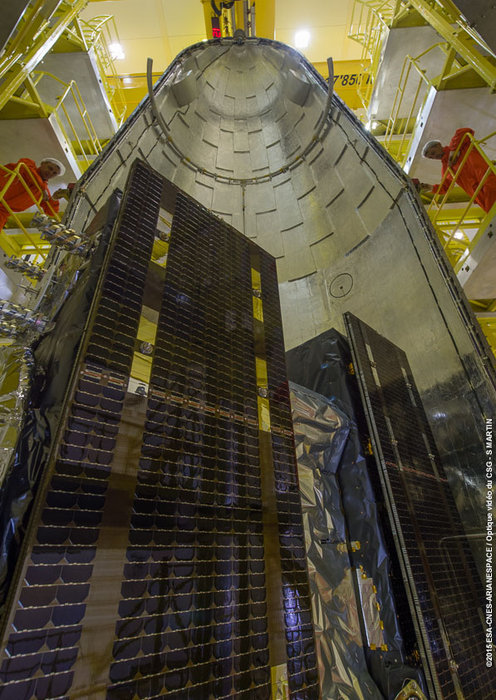
Then the fairing halves were slowly slid into place around them and closed. Enclosed in this way, the satellites will be protected from the harsh slipstream and vibration of the first few moments of launch, when the Soyuz is still travelling through the thickest layers of atmosphere.
The fairing is due to be ejected 3 min 29 sec after liftoff. Until liftoff, the satellites remain connected to the outside world via power and data links, allowing ESA’s Galileo team keep a check on their battery charging and the health of their atomic clocks.
The satellites stay switched off during launch, and will be activated automatically on separation from the dispenser.
Launch is due at 21:46:18 GMT (22:46:18 CET, 18:46:18 local time) on 27 March. The satellites are scheduled for release upon reaching their set orbit 3 h 47 min 57 sec after launch.
The seventh and eighth Galileo satellites were enclosed within their protective Soyuz fairing on Friday, 20 March 2015, ahead of their launch a week later. Photo: European Space Agency