Tag: INTERGEO 2024

  • Highlights from INTERGEO 2024

    Highlights from INTERGEO 2024

    Photo: GPS World Staff
    Photo: GPS World Staff

    The GPS World team touched down in Stuttgart, Germany, for INTERGEO 2024, held from Sept. 24-26.

    This year’s expo and conference, which attracted more than 17,000 visitors from 121 countries and featured 579 exhibitors, showcased solutions to address critical global issues such as climate change, urbanization and GNSS jamming and spoofing.

    Ray Weatherbee, CEO, Stonex USA, and Tim Carolin, Account Executive, GPS World. Photo: GPS World Staff
    Ray Weatherbee, CEO, Stonex USA, and Tim Carolin, Account Executive, GPS World. Photo: GPS World Staff

    GPS World Publisher Brian Kanaba and Account Manager Tim Carolin made their debut at the show, joining veteran Editor-in-Chief Matteo Luccio. The team had the opportunity to explore the expansive show floor, experiencing firsthand the latest innovations from around the world. With three floors of exhibits, Kanaba, Carolin and Luccio engaged with partners and established valuable connections with industry leaders. Their attendance highlights GPS World’s dedication to remaining at the forefront of geospatial technology and trends, emphasizing a strong commitment to collaboration and innovation within the industry.

    GPS World staff: Matteo Luccio, Editor-in-Chief, Brian Kanaba, Publisher, and Tim Carolin, Account Executive. (Photo: GPS World Staff)
    GPS World staff: Matteo Luccio, Editor-in-Chief, Brian Kanaba, Publisher, and Tim Carolin, Account Executive. (Photo: GPS World Staff)
  • Tronics developing north-seeking MEMS gyro, upgrades product line

    Tronics developing north-seeking MEMS gyro, upgrades product line

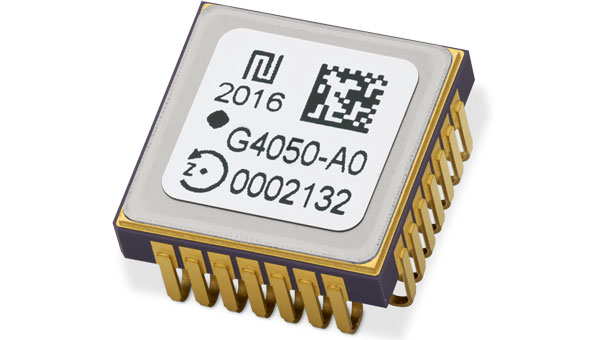
    Tronics Microsystems, a TDK company, has upgraded its GYPRO4000 product line, which consists of tactical-grade digital MEMS gyroscopes. As part of this product line, Tronics highlighted the GYPRO4300 and GYPRO4050 at INTERGEO 2024.

    The GYPRO4300 is a high-dynamics MEMS gyro designed for precision navigation applications. It features a ±300 °/s input range, 200 Hz bandwidth and 1 ms latency, making it ideal for dynamic environments. With a bias instability of 0.4 °/h and an Angular Random Walk of 0.07 °/√h, the GYPRO4300 offers high-performance sensing in a compact, digital and low size, weight and power (SWaP) package.

    Building on the GYPRO4300, the GYPRO4050 is a specialized North-seeking gyro for low-dynamics applications. This derivative offers 2° azimuth accuracy and is currently in the customer sampling stage. The GYPRO4050 maintains the same miniature package design as its predecessor, ensuring consistency across the product line.

    At INTERGEO 2024, TDK showcased a prototype based on an ongoing research and development project. This new development utilizes the same miniature package as the GYPRO4300 and GYPRO4050 but demonstrates ultra-low noise capabilities, achieving an azimuth accuracy of less than 1°. This product is slated for launch in 2025.

    The GYPRO4000 series offers a digital, cost-effective, low-SWaP alternative. The closed-loop architecture ensures strong vibration rejection, maintaining accuracy even in harsh conditions. The 24-bit digital SPI interface and miniature, hermetic ceramic package facilitate swift integration into various systems, including inertial navigation systems (INS) and inertial measurement units (IMU).

  • ComNav Technology advances surveying capabilities

    ComNav Technology advances surveying capabilities

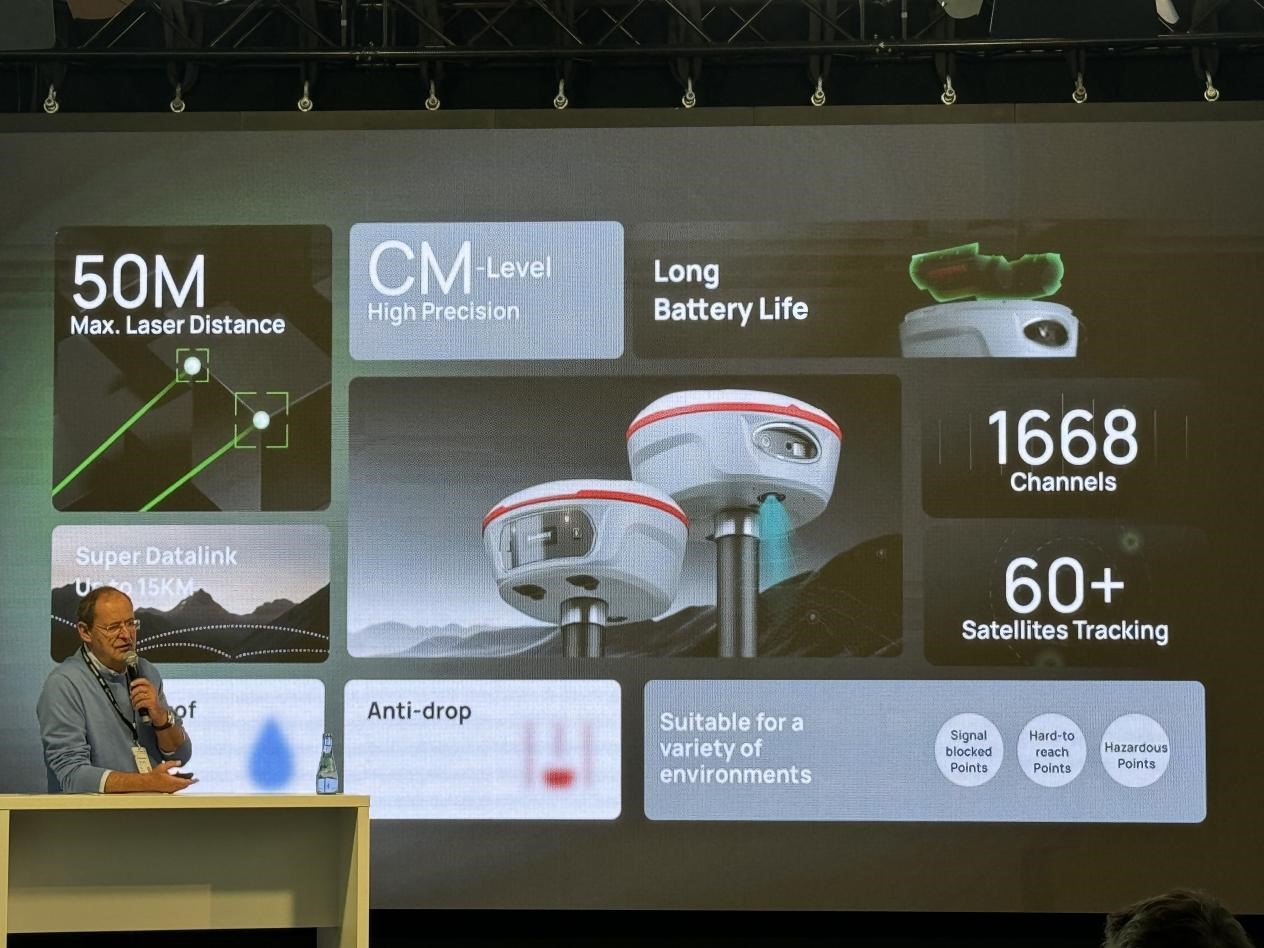
    At INTERGEO 2024, ComNav Technology previewed its Jupiter Laser RTK, designed for surveying applications. The Jupiter Laser RTK integrates GNSS, auto-IMU (inertial measurement unit), laser and dual-camera systems into a single unit. The system is set to be released in 2025.

    The system builds upon the laser technology featured in ComNav’s Universe series, incorporating a precise green laser that remains visible even in bright daylight conditions. This feature enables precise measurements of points in hard-to-reach, signal-blocked or potentially hazardous locations,, thereby pushing the boundaries of surveying accuracy and efficiency.

    The RTK system’s laser range is up to 50 m, substantially extending the measurement capabilities while maintaining high accuracy, making it suitable for challenging surveying environments.

    The Jupiter RTK system incorporates visual technology to offer surveyors an immersive experience during surveying and stakeout operations, improving working efficiency and productivity. Furthermore, Jupiter’s night vision camera allows users to clearly see feature points even in low-light conditions compared with competitive products. In very dark conditions, the feature points are unfeasible to recognize via camera, then the laser further makes up for this shortcoming. With Survey Master software’s intuitive guidance, even novice operators can stake out points seamlessly without the need for repositioning—provided the stakeout point is accurately marked on the ground.

    During an on-site demonstration at INTERGEO 2024, participants experienced firsthand the convenience offered by Jupiter integrating laser and visual technologies. ComNav’s integration of laser technology into traditional GNSS receivers has been fully applied and validated in their Universe Series Laser RTK. This series includes:

    Mars Pro Laser RTK: This device features a sunlight-readable OLED color display for easy operation. It tracks 1668 channels for all running and existing constellations and is compatible with mainstream brands of GNSS receivers.

    Mars Laser RTK: With 1590 channels full-constellation multi-frequency tracking capability, Mars ensures precision and minimizes user fatigue, crafting an impressive surveying experience. The built-in transceiver datalink module has a super long working distance of up to 15 km.

    Venus Laser RTK: This model offers a lightweight handheld design and rodless operation capability, simplifying surveying and stakeout processes while providing exceptional stability and accuracy. It is engineered to enhance user safety in challenging environments.


  • CHCNAV unveils GNSS receiver with IMU tilt compensation

    CHCNAV unveils GNSS receiver with IMU tilt compensation


    Photo: CHCNAV
    Photo: CHCNAV

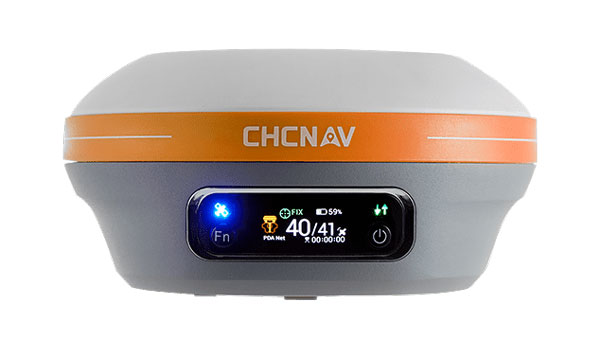
    CHC Navigation (CHCNAV) has unveiled the i83 Pro, an inertial measurement unit (IMU)-real-time kinematic (RTK) GNSS receiver. This receiver combines GNSS capabilities with extensive compatibility options to address the diverse needs of surveying, construction and mapping professionals.

    The i83 Pro incorporates CHCNAV’s third-generation GNSS antenna and the latest iStar algorithm, designed to boost GNSS signal tracking efficiency by 30%, according to the company. With 336 channels supporting GPS, GLONASS, BeiDou, Galileo and QZSS constellations, it can achieve centimeter-level precision rapidly, even in challenging environments.

    The receiver offers comprehensive connectivity options, including built-in Wi-Fi, Bluetooth, NFC, 4G modem and UHF modem. These technologies support various GNSS surveying modes, such as RTK Networks NTRIP and UHF base-rover configurations. The i83 Pro is compatible with VRS, FKP and MAC for Network RTK for precise positioning across diverse operational settings.

    Engineered for challenging environments, the i83 Pro features an IP68-rated enclosure for dust and water protection, a compact and lightweight design for enhanced portability, a high-resolution color display for clear status information and a 20-hour battery life for continuous operation in rover mode.

    The i83 Pro offers optional Trimble RTX and OmniSTAR support, providing RTK-level accuracy without relying on a base station or VRS network. Additionally, it can be equipped with the optional Trimble MAXPro Positioning Engine for extended performance.

    CHCNAV will showcase this receiver at INTERGEO 2024 in Hall  3, Booth B3.052.

  • Secure your spot at INTERGEO 2024

    Secure your spot at INTERGEO 2024

    Photo: INTERGEOINTERGEO 2024, the premier global event for geodesy, geoinformation and land management, will take place from Sept. 24 to 26, 2024, in Messe Stuttgart, Germany. This year’s theme focuses on the power of geoinformation technologies and their critical role in addressing global challenges.

    The event is expected to bring together more than 600 international brands, industry leaders and business professionals, providing a unique platform for networking, collaboration and knowledge exchange among geospatial professionals.

    The event will cover a variety of topics, including building information modeling (BIM), Earth observation, digital twins, maritime solutions and developments in the UAV industry. A significant emphasis will be placed on how geoinformation technologies can help tackle pressing issues such as climate change, urbanization and resource management. Earth observation will be a focal point, featuring sessions dedicated to managing the green transition and discussing strategies for climate adaptation. This comprehensive event aims to showcase the potential of advanced geospatial technologies in contributing to solutions across the globe.The conference will feature keynote speeches from industry leaders and government officials, including Walther Pelzer Ph.D., Head of the German Aerospace Center, who will deliver a keynote on “Earth observation for a world in transition”. Burkhard Boeckem, Ph.D., CTO of Hexagon AB, will discuss developments at the forefront of geospatial technology.

    Catch GPS World at INTERGEO 2024 from Sept. 24 to 26!

    Click here to register and learn more about the conference.