Tag: Magellan

  • GPS III ‘Magellan’ starts signal transmission

    By Peter Steigenberger, Steffen Thoelert, Oliver Montenbruck and Richard B. Langley

    The first GPS III satellite, “Vespucci,” was launched in December 2018, started signal transmission in January 2020, and was set healthy later that month. The second GPS III satellite, nicknamed “Magellan,” was launched on Aug. 22, 2019, on a Delta IV rocket from Cape Canaveral, Florida.

    Magellan, also identified by its space vehicle number (SVN) 75 (here referred to as GPS-75), started signal transmission with standard pseudorandom noise code (PRN) number 18 (here referred to as G18) on March 13. The L1 C/A, L1 P(Y), and L2 P(Y) signals were activated at 17:16:30 GPS Time (GPST), while the L1C, L2C and L5 signals followed less than two hours after Vespucci’s launch at 18:59:30 GPST. Transmission of navigation messages started at 19:00:00 GPST with GPS-75 (G18) marked as unhealthy.

    PRN G18 was previously used by the 27-year-old Block IIA satellite GPS-34 that had been already removed from the active GPS constellation on Oct. 7, 2019, but continued signal transmission until March 9, 2020. GPS-75 is already being tracked by a large number of tracking stations of the International GNSS Service (IGS). Based on the data collected by these stations, the Center for Orbit Determination in Europe (CODE), headquartered in Bern, Switzerland, has been providing precise orbit and clock products for this satellite since March 14.

    A comparison we performed with the CODE precise orbit products revealed initial broadcast ephemeris errors of up to 100 meters (3D) and an orbit-related signal-in-space range error (SISRE) of about 13 meters. Within four days, a SISRE (orbit component) of 24 centimeters was achieved, which closely matches the performance of the rest of the GPS constellation.

    Figure 1 shows the spectral flux density of GPS-75 in the L1, L2 and L5 frequency bands obtained with the 30-meter high-gain antenna of the German Aerospace Center (DLR) located in Weilheim, Germany. The civil L1 C/A, L1C and L2C signals can be identified as sharp peaks in the center of the respective frequency bands.
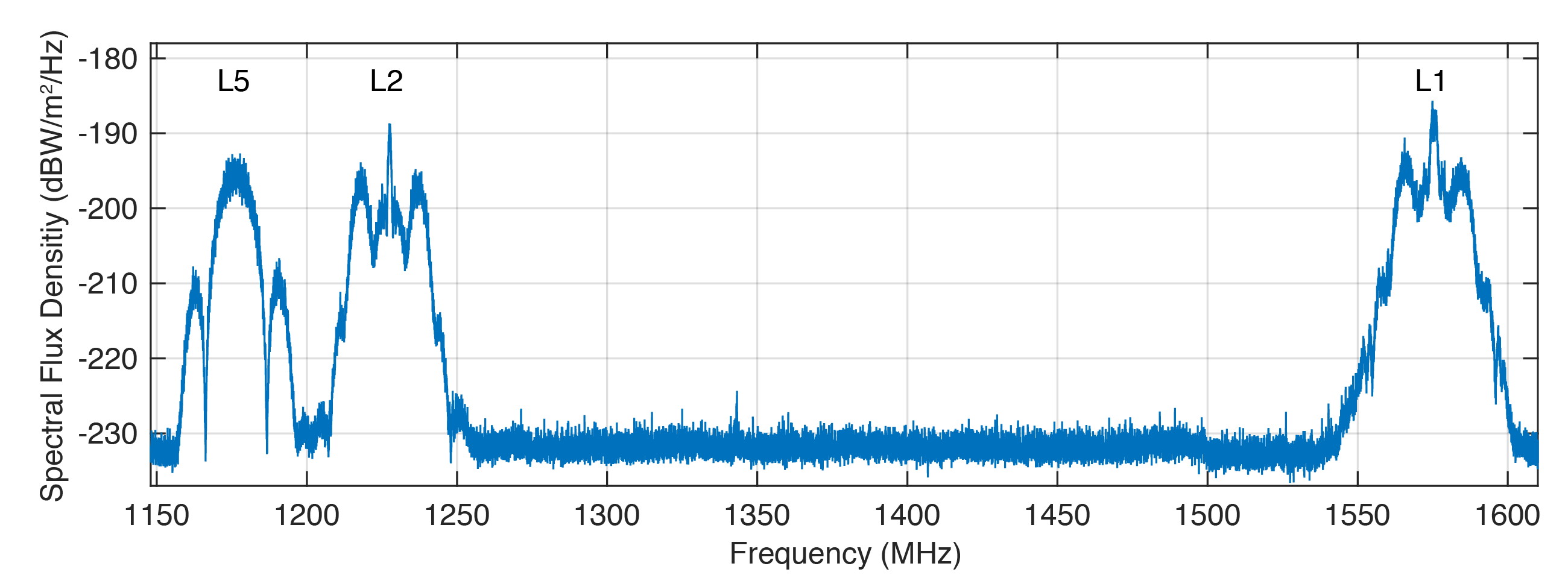
    FIGURE 1. Spectral flux density of GPS-75 measured with DLR’s 30-meter high-gain antenna. (Figure: Steigenberger, et al)
    FIGURE 1. Spectral flux density of GPS-75 measured with DLR’s 30-meter high-gain antenna. (Figure: Steigenberger, et al)

    The prominent side lobes in the L1 and L2 bands are associated with the military M-code. The wide main lobe of the L5 signal with two smaller and sharper side lobes is caused by the superposition of two in-phase and quadrature signals with a 10-MHz binary phase-shift keying (BPSK) modulation. We found that all signals are in good shape and have a quality similar to that of the first GPS III satellite.

    On March 16, 2020, we detected a significant change in the carrier-to-noise-density ratio of the L1 and L2 P(Y)-code signals. Figure 2 illustrates these changes for the IGS station located in Patumwan, Thailand (CUSV00THA). The L1 and L2 P-code signals are usually encrypted with the W-code to prevent spoofing (the generation of fake signals by adverse parties). The resulting encrypted signals are denoted by P(Y). Geodetic GNSS receivers are capable of tracking the P(Y) signals with a semi-codeless approach.
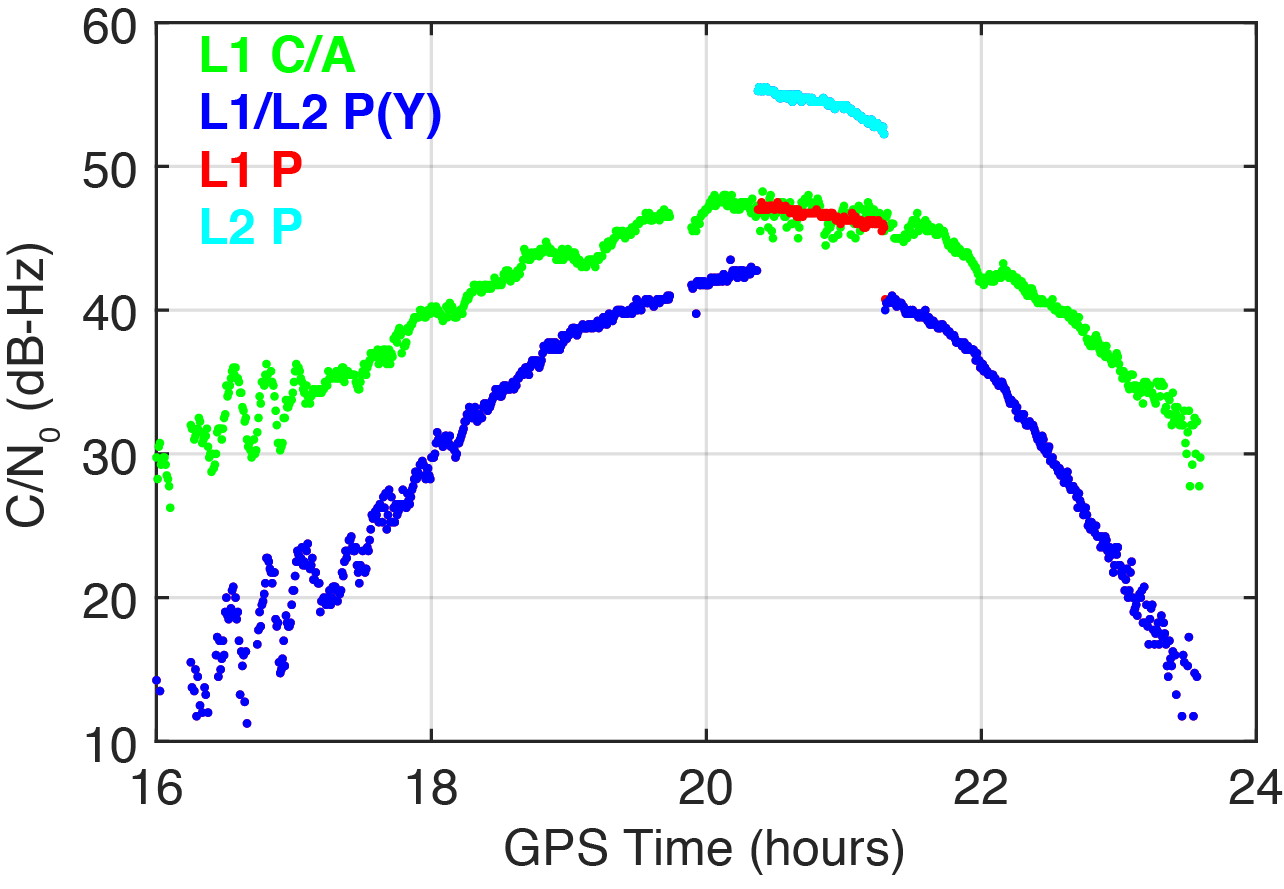
    FIGURE 2. Carrier-to-noise-density ratio (C/N<sub>0</sub>) of the second GPS III satellite, GPS-75, tracked by the IGS station CUSV00THA in Patumwan, Thailand, on March 16, 2020. Between 20:22 and 21:18 GPST, unencrypted P-code signals were tracked. (Figure: Steigenberger, et al)
    FIGURE 2. Carrier-to-noise-density ratio (C/N0) of the second GPS III satellite, GPS-75, tracked by the IGS station CUSV00THA in Patumwan, Thailand, on March 16, 2020. Between 20:22 and 21:18 GPST, unencrypted P-code signals were tracked. (Figure: Steigenberger, et al)

    As a result, C/N0 of L1 P(Y) and L2 P(Y) are virtually identical and significantly smaller than the C/N0 of the unencrypted signals due to losses of the semi-codeless tracking technique. This can be seen in the blue-colored plot of Figure 2, where the C/N0 values of L1 P(Y) and L2 P(Y) are identical and smaller by 4.5–16 dB compared to L1 C/A depending on the elevation angle of the satellite.

    However, between 20:22 and 21:18 GPST, an increase of the P-code C/N0 values was observed. The values changed by 4.5 and 12.5 dB for L1 and L2, respectively. This change is an indicator that unencrypted P-code signals were transmitted, rather than encrypted ones. This assumption can be verified by the “Anti-Spoof Flag” given as the 19th bit of the handover word (HOW) of the GPS LNAV navigation message.

    Indeed, decoding of the raw navigation data from the IGS station CHOF00JPN in Chofu, Japan, showed that the Anti-Spoof Flag indicated a deactivation of anti-spoofing between 20:22:00 and 21:17:48 GPST and verified our assumption that unencrypted P-code signals were transmitted during that time period.

    It has to be noted that only Javad receivers within the global multi-GNSS network of the IGS show this increase in C/N0. Other receiver types report continuous C/N0 values for the P-code signals, indicating that a semi-codeless tracking technique was continuously applied irrespective of the Anti-Spoof Flag.

    Figure 3 shows the two GPS III satellites’ Allan deviation, which measures the clock stability achieved in orbit; that is, the average frequency error over different time scales. In addition, the Block IIF satellite GPS-63 is shown, which is in the same orbital plane as GPS-75.
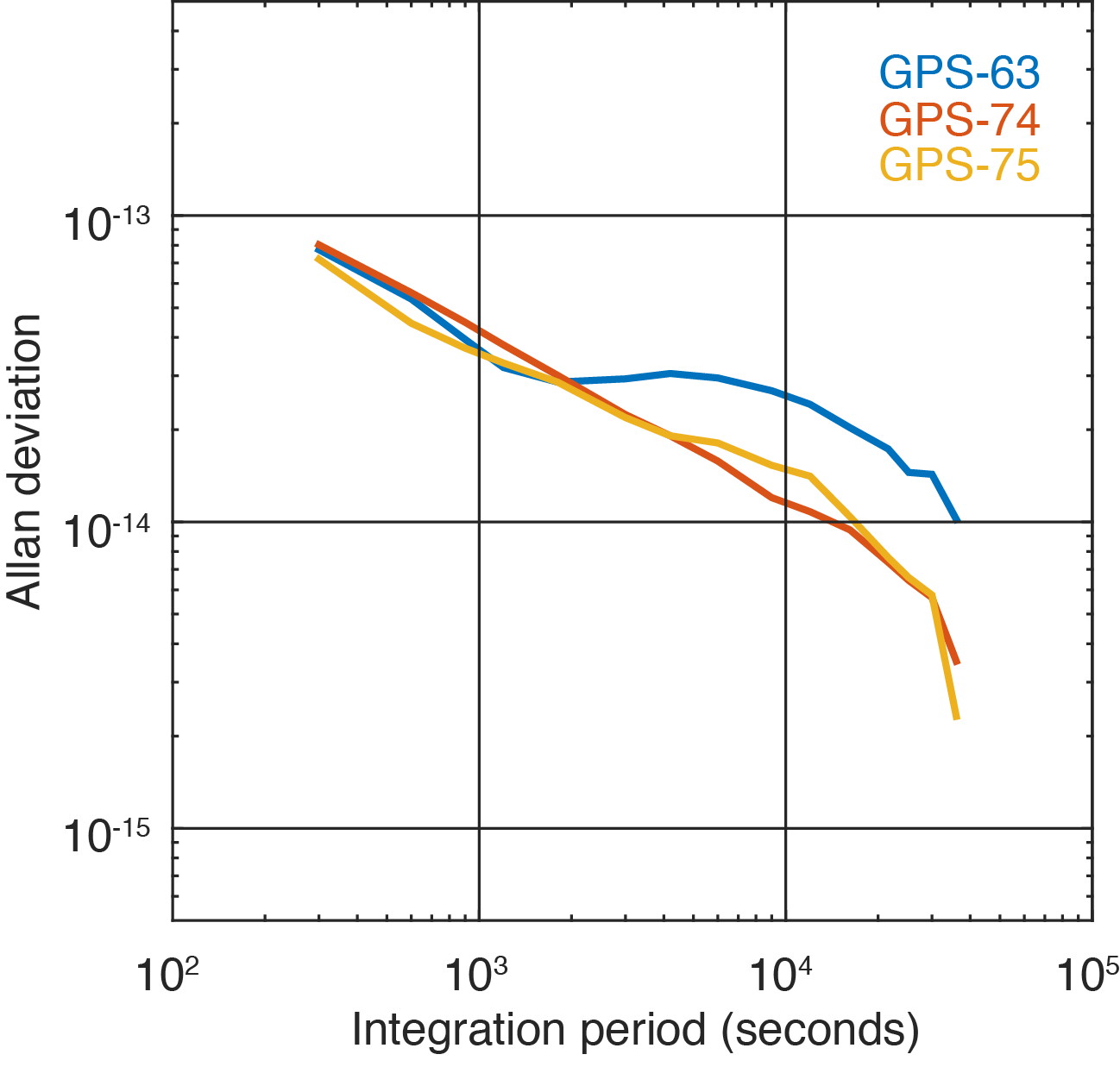
    FIGURE 3. Allan deviation of the Block IIF satellite GPS-63 and the GPS III satellites GPS-74 and GPS-75 computed from 5-minute clock solutions produced by DLR. (Figure: Steigenberger, et al)
    FIGURE 3. Allan deviation of the Block IIF satellite GPS-63 and the GPS III satellites GPS-74 and GPS-75 computed from 5-minute clock solutions produced by DLR. (Figure: Steigenberger, et al)

    For integration times up to 2,000 seconds, the clock stability of GPS-75 is slightly better compared to the first GPS III satellite, GPS-74, but the situation is opposite for integration times larger than 5,000 seconds. The latter finding might be caused by the fact that GPS-75, unhealthy at the time, was tracked by a smaller number of stations compared to the healthy GPS-74.

    As a consequence, the observed Allan deviation may partly be contaminated by orbit determination errors. In any case, both GPS III satellites clearly outperform the Block IIF satellite GPS-63 that suffers from thermal line bias variations visible as an increased Allan deviation starting at an integration time of about 2,000 seconds.

    The activation of the second GPS III satellite transmitting the new civil L1C signal enables the estimation of differential code biases (DCBs) between, for example, the L1 C/A signal (Receiver Independent Exchange [RINEX] format observation code C1C) and different tracking modes of the L1C signal. Septentrio receivers track only the pilot component of the L1C signal (C1L), whereas Javad and Trimble receivers perform a combined data+pilot tracking (C1X).

    DCBs are estimated from pseudorange (code) observations of a global tracking network and are corrected for ionospheric delays obtained from global ionosphere maps. The DCB estimates shown in Table 1 are based on eight days of data from 10 Javad, 21 Septentrio and 3 Trimble receivers.
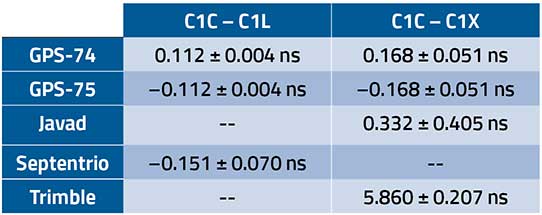
    TABLE 1. Differential code bias estimates in nanoseconds between L1 C/A and L1C for the GPS III satellites and average receiver DCBs. (Data: Steigenberger, et al)
    TABLE 1. Differential code bias estimates in nanoseconds between L1 C/A and L1C for the GPS III satellites and average receiver DCBs. (Data: Steigenberger, et al)

    As we have applied a zero-sum condition for the estimation of satellite DCBs of just two satellites, the values of GPS-74 and GPS-75 obtained from the same type of L1C observables differ only by the sign. The DCBs estimated from different L1C observables, namely C1L and C1X, differ by 56 picoseconds, corresponding to a range difference of 1.7 centimeters. The receiver DCBs are quite homogeneous for receivers from each manufacturer but differ by up to 6 nanoseconds between various manufacturers.

    On April 1, 2020, GPS-75 was set healthy and joined the constellation of operational GPS satellites. The third GPS III satellite, named “Columbus,” was shipped to the Cape Canaveral launch site in February 2020. Its launch is expected no earlier than June 30, 2020, and at least two GPS III launches per year are planned for the near future.

    Equipment. Measurements reported in this article were collected with JAVAD GNSS TRE_G3TH and TRE_3, Septentrio PolaRx5 and Trimble Alloy multi-GNSS, multi-frequency receivers. The spectral overview was captured with a Rohde & Schwarz EM100 digital compact receiver.


    PETER STEIGENBERGER and OLIVER MONTENBRUCK are scientists at the German Space Operations Center of the German Aerospace Center (DLR). STEFFEN THOELERT is an electrical engineer at DLR’s Institute of Communications and Navigation. RICHARD B. LANGLEY is a professor at the University of New Brunswick and editor of the “Innovation” column for GPS World magazine.

    Further Reading

    “Optimum Semicodeless Carrier-Phase Tracking of L2” by K.T. Woo in Navigation, Vol. 47, No. 2, 2000, pp. 82-99, doi: 10.1002/j.2161-4296.2000.tb00204.x.

    Interface Specification IS-GPS-200K: NAVSTAR GPS Space Segment/User Segment Interfaces by Global Positioning Systems Directorate Systems Engineering & Integration, Los Angeles Air Force Base, El Segundo, California, March 4, 2019. Available online: https://www.gps.gov/technical/icwg/IS-GPS-200K.pdf

    “Apparent Clock Variations of the Block IIF-1 (SVN62) GPS Satellite“ by O. Montenbruck, U. Hugentobler, E. Dach, P. Steigenberger and A. Hauschild in GPS Solutions, Vol. 16, No.3, 2012, pp. 303-313, doi: 10.1007/s10291-011-0232-x.

    “Differential Code Bias Estimation Using Multi-GNSS Observations and Global Ionosphere Maps” by O. Montenbruck, A. Hauschild and P. Steigenberger in Navigation, 2014, Vol. 61, No. 3, 2014, pp. 191-201, doi: 10.1002/navi.64
  • GPS III SV02 satellite control authority transferred to 2 SOPS

    GPS III SV02 satellite control authority transferred to 2 SOPS

    Image: USAF
    Image: USAF

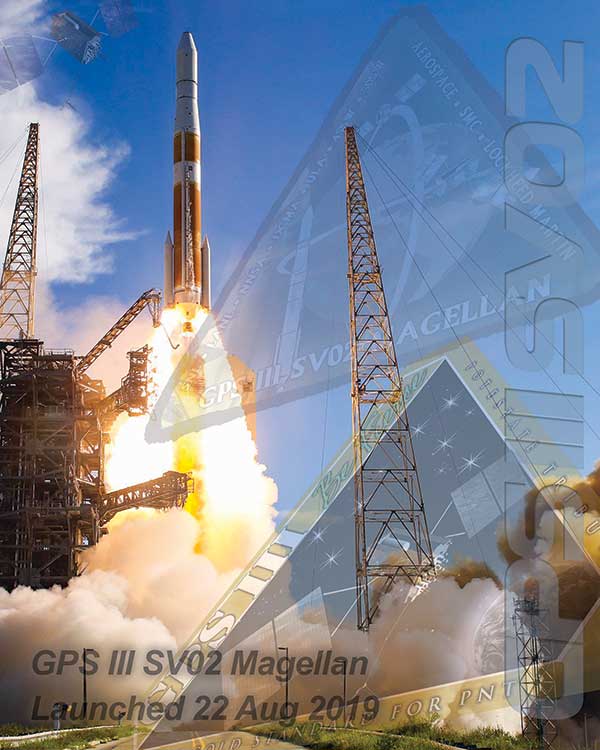
    On March 23, the U.S. Space Force’s Space and Missile Systems Center successfully transferred the second GPS III space vehicle (GPS III SV02) to Space Operations Command.

    GPS III SV02, dubbed “Magellan” in honor of Ferdinand Magellan, the Portuguese explorer who led the first expedition to circumnavigate the Earth, is now officially under the control of the Second Space Operations Squadron located at Schriever Air Force Base, Colorado.

    GPS III SV02 was launched on August 22, 2019, aboard a United Launch Alliance Delta IV Medium+ launch vehicle from Cape Canaveral Air Force Station, Florida.

    GPS III satellites deliver positioning, navigation and timing information with three times better accuracy, and up to eight times improved anti-jamming capability than its predecessor. This is crucial for the warfighter, who will benefit from the increased power, accuracy and protections provided by the newer GPS III systems.

    “This marks our second transfer of Satellite Control Authority for the GPS III program as we continue to modernize the GPS constellation with more capable and resilient systems,” said Col. Edward Byrne, chief of Production Corps’ Medium Earth Orbit Space Systems Division. “It’s only through the hard work, professionalism, and dedication of our entire government and industry partner team that we can successfully transition GPS III SV02 to operations.”

    The GPS III spacecraft has a 15-year design life, 25 percent longer than the last generation of GPS satellites currently on-orbit. Additionally, it delivers new capabilities, such as a fourth civilian signal (L1C), designed to enable interoperability between GPS and international satellite navigation systems, such as Galileo. GPS III satellites will also bring the full capability of the military code (M-code) signal, increasing anti-jam resiliency in support of the warfighter.

    These continued improvements and advancements to the GPS system make it the premier space-based provider of positioning, navigation, and timing services for more than four billion users around the globe.

    U.S. Space Force’s Space and Missile Systems Center, located at Los Angeles Air Force Base in El Segundo, California, is the U.S. Air Force’s Center of Excellence for acquiring and developing military space systems. Its portfolio includes the Global Positioning System, military satellite communications, defense meteorological satellites, space launch, range systems, satellite control networks, space-based infrared systems and space situational awareness capabilities.

  • Second GPS III satellite tops rocket at launchpad

    Second GPS III satellite tops rocket at launchpad

    The second GPS III satellite — nicknamed Magellan — is now at the launchpad at Cape Canaveral Air Force Station, Florida, in preparation for liftoff on Aug. 22.

    United Launch Alliance tweeted out an image of the encapsulated satellite on its way to the rocket.

    The Lockheed Martin-built satellite was originally scheduled for launch on July 25, but the launch was pushed to Aug. 22 because of “an anomaly during component testing at a supplier that created a cross-over concern. Upon further evaluation, additional time is needed to replace and retest the component on the launch vehicle,” ULA said.


    Launch Updates

    The launch window on Aug. 22 will open at 9 a.m. EDT (1300 UTC) and extend to 9:27 a.m. EDT (1327 UTC), a 27-minute duration. ULA’s live countdown blog begins at 11:45 p.m. EDT (0345 UTC) on Aug. 21. The launch webcast starts at 8:40 a.m. EDT (1240 UTC).

    Those interested can dial the ULA launch hotline at 1-877-852-4321 or join the conversation at www.facebook.com/ulalaunch, twitter.com/ulalaunch and instagram.com/ulalaunch; hashtags #DeltaIV #GPSIIISV02.


    GPS III SV02 will be the 29th and final flight of the Delta IV Medium rocket, the 73rd GPS launch by a ULA or heritage vehicle and marks ULA’s 135th mission.

    GPS III SV02 is named Magellan in honor of the Portuguese explorer who led the first expedition to circumnavigate the Earth.

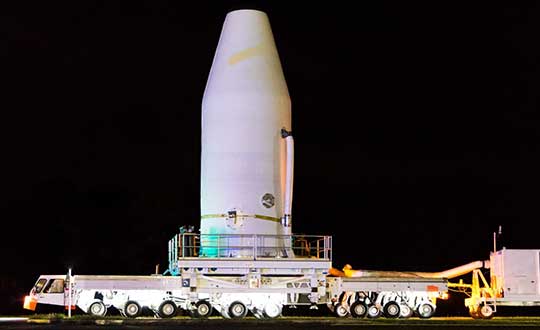
    The satellite, encapsulated in the 4-meter-diameter composite payload fairing, was moved overnight last week from its processing facility to the seaside launchpad at a top speed never exceeding 5 mph.

    The satellite was hauled by a motorized KAMAG Elevating Platform Transporter (EPT) that provided hydraulic leveling and precision positioning capabilities along the route. The EPT also towed a Portable Environmental Control System (PECS) trailer to supply conditioned air to the payload fairing during the trip.

    Once parked in the hoistway on the backside of the Mobile Service Tower (MST), technicians used the crane system in the gantry the next morning to carefully lift the satellite onto the Delta IV rocket’s second stage to complete a successful vertical integration of the launch vehicle and payload. The fully assembled rocket now stands 207 feet tall.

    A tip-to-tail electrical test of the combined payload and launch vehicle will occur next, an operation known as the Integrated Systems Test (IST). Once that is completed, the comprehensive process to verify flight readiness will begin in parallel to final vehicle closeouts for the launch targeted for Aug. 22 at 9 a.m. EDT (1300 UTC).

    ULA rockets have successfully launched 70 GPS satellites since 1978.

    ULA technicians transport the GPS III satellite to the Delta IV launchpad.( Photo: United Launch Alliance)
    ULA technicians transport the GPS III satellite to the Delta IV launchpad. (Photo: United Launch Alliance)
    The Delta IV rocket leaves the the Horizontal Integration Facility (HIF) aboard a 36-wheel, diesel-powered transporter on May 28 and traveled to Space Launch Complex-37. The trip took 40 minutes. (Photo: ULA)
    The Delta IV rocket leaves the the Horizontal Integration Facility (HIF) aboard a 36-wheel, diesel-powered transporter on May 28 and traveled to Space Launch Complex-37. The trip took 40 minutes. (Photo: ULA)


  • Second GPS III satellite encapsulated for July 25 launch

    Second GPS III satellite encapsulated for July 25 launch

    The second next-generation GPS III satellite — nicknamed “Magellan” by the U.S. Air Force — is encapsulated and ready for its planned July 25 launch.

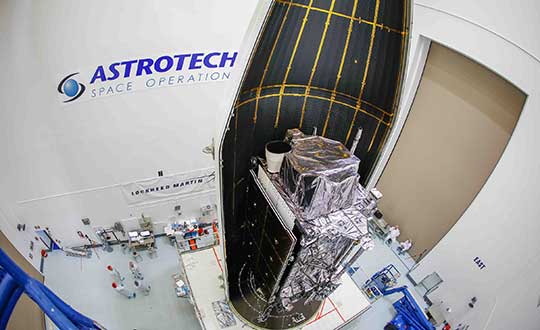
    On June 26, Lockheed Martin Space and United Launch Alliance (ULA) technicians completed encapsulating GPS III Space Vehicle 02 (GPS III SV02) in its launch fairings at the company’s Astrotech Space Operations facility, where the satellite has undergone pre-launch processing and fueling since its March 19 arrival in Florida. This final step enclosed GPS III SV02 in a protective, aerodynamic, nose-cone shell.

    In the coming days, the enclosed GPS III SV02 satellite will be mounted to a ULA Delta IV rocket for launch. The current window for launch on July 25 opens at 10:55 a.m. ET.

    “GPS III SV02 is launching just a brisk seven months after the nation’s first GPS III satellite lifted off back in December. The first satellite’s performance during on-orbit testing has exceeded expectations,” said Johnathon Caldwell, Lockheed Martin’s vice president for Navigation Systems. “We are excited to deploy more GPS III satellites so this new technology and capabilities can be distributed constellation-wide.”

    GPS III satellite production and launch cadence is picking up. On May 27, the Air Force declared the next GPS III satellite, GPS III SV03, available for launch, pending an official launch date.

    “More GPS III satellites are coming. If you looked at our production line back in Denver today you would see GPS III space vehicles 04, 05 and 06 already fully-assembled and in various stages of testing. And space vehicles 07 and 08 are being built up at the component assembly level now,” Caldwell added. “It is a smooth, efficient, methodical process.”

    Lockheed Martin is under contract to develop and build up to 32 GPS III/IIIF satellites for the Air Force. GPS III will deliver three times better accuracy and provide up to eight times improved anti-jamming capabilities. GPS III’s new L1C civil signal will make it the first GPS satellite to be interoperable with other international global navigation satellite systems, like Galileo.

    Additional GPS IIIF capabilities will begin being added with the 11th satellite. These will include a fully-digital navigation payload, a Regional Military Protection capability, an accuracy-enhancing laser retroreflector array, and a search-and-rescue payload.

    Photo: Lockheed Martin
    Photo: Lockheed Martin
  • 2016 TU-Automotive Awards winners announced

    2016 TU-Automotive Awards winners announced

    TU-AutomotiveTU-Automotive announced the 2016 winners of the TU-Automotive Awards at a reception in Novi, Michigan, held before the June 8-9 TU-Automotive Detroit trade show.  The 10 winners were selected by 30 expert judges in 10 categories.

    The award categories showcase specific aspects of the connected-car industry. The winners were selected by 30 top industry experts and judged based on the following criteria: innovation, industry engagement, user experience and market update.

    “We launched the TU-Automotive Awards in December of last year with the objective of recognizing innovation and success across the globe from companies established and new,” said Ruthana Foulkes, managing director at TU-Automotive. “We received a record number of nominations this year — over 400 in total. And we would like to thank and congratulate every company for taking part in this process. The quality of entries as always was incredibly high.”

    The 2016 TU-Automotive Awards winners are:

    • OEM of the year – Joint winners: Volvo Car Group and Ford Motor Company
    • Telematics Service Provider of the year – Wireless Car
    • Best Telematics Product/Service – Movimento for Movimento’s Over-The-Air platform
    • Best Insurance Telematics Product/Service – AXA Global Direct France for YouDrive
    • Best Active Safety or ADAS Product/Service – Volvo Car for Pilot Assist
    • Best Auto Mobility Product/Service – Veniam for Veniam
    • Best Auto Cybersecurity Product/Service – Security Innovation for Aerolink
    • Best Aftermarket Telematics Product/Service – MagellanGPS for Magellan eXplorist TRX7
    • Newcomer of the year – PolySync (previously Harbrick Technologies)
    • Influencer of the year – Julia Steyn, vice president of Urban Mobility Programs, General Motors


  • Magellan showcases eXplorist TRX7 off-road navigator at CES 2016


    Magellan is showcasing its new eXplorist TRX7 off-road vehicle navigation solution for the 4×4 and Powersports vehicle consumer market at CES 2016, a consumer electronics and technology trade show held Jan. 6–9 in Las Vegas. The OHV navigation solution delivers detailed 3D maps, more than 44,000 vehicle trails and community generated trails, improved driver safety and a superior user experience, the company said in a news release.

    The TRX7 will be displayed in the Magellan booth at CES, located in South Hall MP25441.

    “Magellan’s new eXplorist TRX7 is the only complete off-road navigator for adventuring,” said Stig Pedersen, associate vice president of product management for Magellan. “Pre-loaded trail maps and crowd-sourced trails provide a constantly updating platform, allowing users to plan adventures, navigate, and add pictures and comments to trails. Finally off-roaders have an all-in-one solution that will safely guide them through some of the most fun and exciting trails in the U.S. and Canada.”

    The device

    Built to withstand the harsh demands of off-roading, the Magellan eXplorist TRX7 features:

    • Weatherproof 7-inch LCD touchscreen display.
    • Water- and dust-proof IP67 ruggedized casing.
    • Powerful Dual Core Cortex-A9 processor running Android 4.2 OS.
    • Wi-Fi and Bluetooth connectivity.
    • 1G Mobile DDR2 memory.
    • 16GB onboard memory and a 64GB MicroSD card expansion slot.
    • Three different mounting options: Windshield Suction Cup Mount, Genuine Ram Handlebar Rail Mount or Genuine Ram Windshield Suction Cup Mount.

    The maps

    The Magellan off-road vehicle platform’s trail maps are cloud-based, dynamic, and will continue to grow and be improved by both Magellan and through crowd-sourced additions from the Magellan OHV user community, the company said. The off-road maps feature high-resolution 3D and 2D terrain and contour elevation lines; food, gas, lodging and general service POIs; third party trail guides; and more.

    The Magellan TRX7 allows users plan, track and save trail rides. Its OHV web portal lets users add pictures and comments to their trail rides and share them with friends, family, and off-road and outdoor communities. Members of Magellan’s off-road vehicle online community earn achievement badges for posting and sharing “dirt miles” traveled and total number of trails posted.

    The portal also is integrated to social media sites such as Twitter, Facebook and Instagram, users are able to post their greatest trail adventures.


  • Magellan to highlight DashCam navigators at CES 2016

    Magellan expands MiVue DashCam lineup

    Magellan has expanded its lineup of MiVue DashCam devices to be displayed at the Consumer Electronics Show, which will take place Jan. 6–9 in Las Vegas. The four new models include the MiVue 320, MiVue 420, MiVue 430 and MiVue 450D.

    “Magellan is excited to expand its award-winning line of MiVue DashCam models. Our four new models are designed with superior image quality, large storage capacity and extended battery life,” said Stig Pedersen, Magellan associate vice president of product management, in a news release. “Plus, select new models have new features such as lane departure and collision avoidance warnings, dual cameras and wide angle lenses that increase driver peace of mind and safety.”

    All MiVue DashCams include the MiVue Manager to record and manage videos that can be shared on social media. A parking mode for the MiVue DashCams allows an event to be recorded in case there is no impact. The impact sensor records the impact force and has a night view enhancement. A camera mode collects photos for evidence immediately, and it can be taken off out of the car for close-up photos. There also is a rotating mount design with a built-in GPS receiver that records location and time for playback of videos.

    Magellan to debut new RoadMate DashCams

    \Magellan is set to introduce its new family of three DashCam Navigators at CES 2016, according to a news release from the company. The flagship model for the family, the RoadMate 7670T-LM — project name: Hybrid 360Vue — is a CES 2016 Innovation Awards Honoree in the Vehicle Intelligence category.

    Magellan’s DashCam Navigator family is designed for safety-conscious drivers who want to record traffic incidents, as well as scenic and unusual events., the company says. It also includes a host of advanced navigation features and location-based content.

    “Our new DashCam Navigators give users flexibility, peace of mind and the confidence gained from using dependable Magellan engineering,” Pedersen said. “Plus, each model comes with well-known Magellan navigation features such as landmark guidance, junction view, parking mode and red light and speed camera warnings from PhantomALERT for improved driver safety.”

    The RoadMate 6630T-LM and RoadMate 7630T-LM devices include a fully integrated DVR and a software interface for recording, viewing and deleting videos and photos. The Lane Departure ­feature is an audio alert and icon that appears when departing to the left or right of the current lane. There also is an alert and icon that appears when a traffic-facing camera detects that the driver is getting too close to the car ahead.

    The devices will be displayed at in the Magellan booth in LVCC South Hall MP25441.

  • Magellan Integrates RoadMate with Position Logic Tracking Platform

    Magellan Integrates RoadMate with Position Logic Tracking Platform

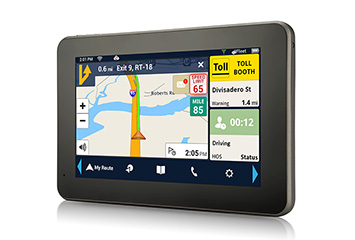
    The Magellan RoadMate RC9496T-LMB commercial navigator.
    The Magellan RoadMate RC9496T-LMB commercial navigator.

    Magellan is integrating its RoadMate RC9496T-LMB fleet navigation device with Position Logic’s advanced GPS tracking software solution. The partnership allows Position Logic service providers to leverage all Magellan RoadMate RC9496T-LMB devices.

    The RoadMate RC9496T-LMB, a 7-inch Android GPS fleet navigation device, is available now to current and prospective Magellan and Position Logic customers. Position Logic, a division of KORE, provides precision location-based services for business-to-business applications.

    The Magellan and Position Logic integration delivers a powerful and seamless end-to-end communication and navigation solution for fleets, the companies said. The solution includes the RC9496T-LMB, an active mobile terminal, allowing real-time two-way communication between driver and dispatch when paired with Position Logic’s GPS tracking software. Users can send and receive important information to immediately identify driver status including route-receipt, in-route or on-scene, and deliver real-time messages to improve driver productivity. The solution delivers critical information for field service fleets, emergency services, roadside assistance and many more applications.

    “Position Logic is an innovative technology leader in the location based services space. We are pleased to partner with them and offer the Magellan RC9496T-LMB to Position Logic customers,” said Stig Pedersen, associate vice president of product management for Magellan. “The combination of our two services delivers a highly efficient and flexible way for dispatchers to communicate with drivers in real-time, saving time, money and frustration.”

    The RC9496T-LMB is also connected to Magellan’s SmartGPS Eco cloud, providing drivers and fleet managers with customizable time and money saving content such as: real-time fuel price information, weather and truck speed limit warnings.

    “We are pleased to have the RoadMate RC9496T-LMB integrated. The Magellan integration further complements our Workflow/Dispatch module; improving communication between the dispatcher and driver and enhanced stop management,” said Felix Lluberes, executive vice president, advanced applications, KORE. “I am certain our service providers will be able to leverage the device and deliver more comprehensive services.”

    The Magellan RoadMate RC9496T-LMB is available now. It has an MSRP of $399.

  • Magellan Launches Off-Road Nav Platform for Auto OEMs

    Magellan has launched an Off Road Vehicle (ORV) Navigation platform for automotive OEMs and power sport vehicle OEMs. The new platform was showcased at the TU-Automotive Detroit trade show, held June 3-4.

    Designed specifically for the off-roading enthusiast, the Magellan ORV Navigation platform allows off-road enthusiasts to plan, track and save trail rides and dirt miles, and add pictures and comments to trails.

    The Magellan ORV platform includes an online user community, where riders can plan and save their trails, share trails with other riders, add pictures and comments to trails, and search for new trails. In addition, the Magellan ORV platform includes the most comprehensive outdoor trail maps available for off-road enthusiasts, covering all 50 states and Canada.

    Trail Maps

    The Magellan ORV platform’s trail maps are cloud based, dynamic and will continue to grow and be improved by both Magellan and the user community. Magellan’s detailed ORV maps include:

    • 3D Terrain & contour elevation lines
    • National, State & Provincial service roads and trails
    • National, State & Provincial Parks and Recreational Vehicle Areas
    • Scenic Byways
    • Crowd-sourced trails
    • Food, Gas, Lodging, and General Service POI
    • 3rd Party Trail Guides

    Online User Community

    Off-road enthusiasts have exciting stories to save and share. The Magellan ORV navigation platform gives off-roaders, campers, and anyone enjoying the outdoors on a vehicle the tools to plan, experience, and capture their activities in a story format, that they can keep or share with friends, family, or the larger off-road and outdoor communities.

    Users can add comments and pictures to their trail rides, and share with other members of the Magellan ORV community. Magellan ORV community users can also share posts and pictures to Facebook, Twitter and Instagram directly from the Magellan ORV app.

    As users share their trail rides, they garner community ranking and earn achievement badges.

    iOS and Android Companion Smartphone Apps

    To be a resource for the entire off-road community, Magellan’s standard iOS and Android ORV apps will be available in the iTunes and Google Play stores. This will enable any off-road enthusiast to find trails and record, save and share their own adventures.

    “The Magellan ORV navigation software is designed and targeted specifically to reach off-road and outdoor enthusiasts,” said Stig Pedersen, associate vice president of product management for Magellan. “It allows customers to use their technology to participate in and share their trail and outdoor experiences. It reflects the interests of technology savvy off-road enthusiasts, and makes off-roading achievable for aspiring off-road enthusiasts.”

    Designed for Auto OEMs

    Magellan’s smartphone driven ORV navigation platform is compatible with all major infotainment platforms, including Weblink, CarPlay and Android Auto. The ORV platform can be branded by automotive OEMs so their customers have a consistent brand experience while planning a trail ride, and in the vehicle.

    “Given the tremendous popularity of 4×4 SUVs in the US, and other major regions, Magellan’s ORV solution is a tremendous opportunity for auto OEMs to provide their customers with an integrated off-road solution that takes advantage of today’s in-dash and smartphone technology,” said Peggy Fong, president of MiTAC Digital Corporation, parent company of the Magellan brand. “With the new Magellan ORV navigation platform, auto OEMs can add to the fun and excitement enjoyed by both off-road enthusiasts and other outdoorsmen, such as hunters, fishermen, and campers.”

  • CES: Magellan Launches RoadMate Auto GPS Devices with 3D Landmarks

    CES: Magellan Launches RoadMate Auto GPS Devices with 3D Landmarks

    The Magellan RoadMate 5375T-LMB.
    The Magellan RoadMate 5375T-LMB.

    Magellan has introduced its newest lineup of 5-inch RoadMate auto navigators at the International Consumer Electronics Show, being held this week in Las Vegas. To provide a more realistic view of a user’s surroundings, each of the GPS models comes equipped with 3D renderings of buildings and landmarks.

    The new models are: RoadMate 5322-LM, RoadMate 5330T-LM with real-time traffic alerts, and RoadMate 5375T-LMB with real-time traffic alerts, Bluetooth connectivity and portrait viewing mode.

    The units will be displayed at CES in the Magellan booth, LVCC South Hall 2, MP25441.

    “Our new RoadMate 5-inch GPS devices for 2015 have large, vibrant displays and include a vast collection of renowned Magellan navigation features,” said Stig Pedersen, Magellan associate vice president of product management. “Plus, each model includes 3D renderings of buildings and landmarks to make it easier and quicker for users to identify where they are. Whether driving to work, across country, or going to grandma’s, drivers can count on these Magellan navigation units to safely guide them to wherever their destination is.”

    Below are a few of the features that the three RoadMate GPS devices share.

    • 3D Renderings – Selected buildings and landmarks are presented in 3D for a more realistic view.
    • Lifetime Map Updates – Owners of these three models can download the latest map information (up to four times a year) for all 50 states and Canada.
    • Landscape Viewing Mode – Provides improved peripheral view.
    • Traffic Camera Alerts – Sends audible and visual warnings of upcoming red lights, speed cameras, and more; provided by PhantomALERT.
    • 7,000 POIs – Includes branded and highway exit POIs to conveniently search for restaurants, hotels, gas stations, and more.
    • OneTouch Favorites Menu – Creates shortcuts to favorite destinations and searches.
    • Multi-Destination Routing – Users can plan their entire day or multi-day trip in one route.
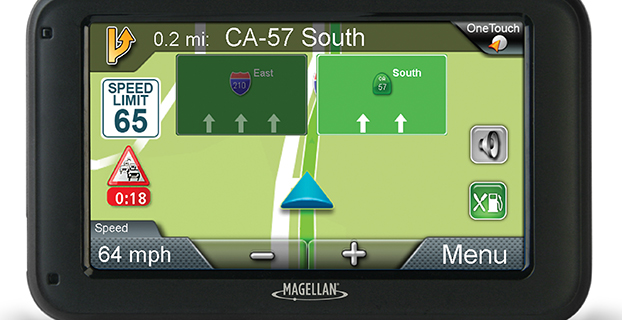
    • Junction View – Realistic images of freeway signs and arrows guide drivers to the correct lane.
    • SmartDetour – Provides immediate options when traffic suddenly comes to a halt.

    RoadMate 5330T-LM

    In addition to the features above, the 5330T-LM also includes:

    • Free Lifetime Traffic Alerts – Helps users avoid traffic jams and delays, suggests detours, provides travel times; no hidden fees or subscriptions.

    RoadMate 5375T-LMB

    In addition to the features above, the 5375T-LMB also includes:

    • Free Lifetime Traffic Alerts – Helps users avoid traffic jams and delays, suggests detours, provides travel times; no hidden fees or subscriptions.
    • Portrait Viewing Option – Provides extended view of the road ahead.
    • Bluetooth Compatibility – Turns this RoadMate model into a hands-free speakerphone, making drive time safer and more productive.

    The Magellan 5-inch RoadMate family of auto navigation devices will be available at retailers throughout the U.S. and Canada as well as online in March 2015. MSRPs are as follows: $149.99 (RM5322-LM); $159.99 (RM5330T-LM); and $199.99 (RM5375T-LMB).


  • $2.6 Billion GPS Fitness Device Market Overshadowed by Smart Devices and Wearables

    ​Despite major GPS fitness device OEMs announcing new fitness products at January’s International Consumer Electronics Show in Las Vegas, it looks like an increasingly difficult battle between smart devices and wearables, according to analysts at ABI Research.

    Garmin launched its Vivofit fitness band and Vivoki/Vivahub corporate wellness solution. Magallen is one of the few companies in the GPS device OEM space that continues to show flashes of innovation, opening up its Echo watch platform to a range of third-party smartphone application developers.

    At the high-end of the GPS fitness watch market, Polar has launched a new multi-sport watch, which features a barometric pressure sensor, support for new features such as a cycling power pedal. TomTom has launched an iOS application that links its current GPS watch range to an iPhone via Bluetooth.

    In ABI Research’s quarterly GPS/GNSS Device tracker, the impact of these new device categories on dedicated GPS fitness device growth can be fully seen. Senior analyst Patrick Connolly comments, “Our forecasts for the overall GPS-enabled fitness area remain strong, hitting $2.6 Billion in 2018, but as was the case with turn-by-turn navigation, converged devices and wearables will take an increasing part of the available market. The adage of keeping what we have is important here, retaining a firm eye on growth in professional users, with hardware and in particular eyewear, a major distinguisher.”

    Practice director Dominique Bonte adds, “Of the announcements, Garmin’s move into corporate wellness was the most striking. We are about to see a huge technological shift in the corporate/business sector, around BYOD, BYOW, wellness, security, and efficiency. What is interesting is that Garmin does not include a location element, which will be a core enabler in this sea change.”

    The findings are part of ABI Research’s Location Devices Research Service.

  • Hemisphere GNSS Names Chuck Joseph President and CEO

    Hemisphere GNSS, Inc. today announced that Chuck Joseph has been named president and chief executive officer, effective immediately, replacing Phil Gabriel. Joseph has also been appointed to the Hemisphere GNSS Board of Directors.

    Joseph has more than 30 years of executive leadership across multiple industries, serving in corporate officer and board of director capacities. He has extensive proven experience in GNSS OEM and direct sales market segments including survey and mapping, GIS, machine control, marine, avionics, personal (mobile) navigation, and tracking systems.

    Before joining Hemisphere GNSS, Joseph most recently served as president and chief operating officer of nusola, Inc., an energy technology company he co-founded and where he continues to serve as executive chairman of the Board. Previously, among other roles, Joseph was senior vice president and general manager of Immersion Corporation, a tactile feedback technology company focused on GPS-centric mobile and industrial applications, corporate vice president of marketing and sales for Magellan Corporation, and executive vice president and general manager of Trimble Navigation.

    “Chuck is a proven executive with the experience and expertise to lead Hemisphere GNSS as we enter our next phase of growth and development,” said Jonathan Ladd, chairman of the Hemisphere GNSS Board of Directors. “Over the course of his career, Chuck has repeatedly demonstrated the ability to develop critical corporate strategies to help innovative companies scale and grow globally. His understanding of our business, significant international experience, and deep OEM and GNSS industry experience make him ideally suited to lead Hemisphere as we seek to accelerate company growth.”

    “Hemisphere has long been recognized for its pioneering and trend setting high-precision GNSS technology, and I look forward to leading the company’s talented team as we make the strategic decisions necessary to expand our market share and OEM presence globally,” Joseph said. “Leveraging our deep GNSS experience and strong, core GNSS technologies, along with UniStrong’s high quality, low-cost product design and development resources, Hemisphere is poised for significant global growth.”

    In conjunction with the reported change in management, Hemisphere GNSS is also announcing the departure of Phil Gabriel, the company’s previous president, effective today. Ladd commented, “Phil was instrumental in getting our company off the ground after the acquisition from AgJunction Inc. in early 2013. We thank Phil for his contributions and dedication during the past year, and wish him good fortune and success on his next endeavor.”