Tag: Raytheon Company

  • United Technologies and Raytheon complete merger

    United Technologies and Raytheon complete merger

    logosRaytheon Technologies Corporation announced the successful completion of the all-stock merger of equals transaction between Raytheon Company and United Technologies Corporation on April 3, following the completion by United Technologies of its previously announced spin-offs of its Carrier and Otis businesses.

    Headquartered in Waltham, Massachusetts, Raytheon Technologies is one of the largest aerospace and defense companies in the world with approximately $74 billion in pro forma 2019 net sales and a global team of 195,000 employees, including 60,000 engineers and scientists.

    Raytheon Company shares ceased trading prior to the market open on April 3, and each share of Raytheon common stock has been converted in the merger into the right to receive 2.3348 shares of United Technologies common stock (previously traded on the NYSE under the ticker symbol “UTX”).

    Upon closing of the merger, United Technologies’ name has changed to “Raytheon Technologies Corporation,” and its shares of common stock will begin trading today on the NYSE under the ticker symbol “RTX.” United Technologies shareowners will continue to hold their shares of United Technologies common stock, which now constitute shares of common stock of Raytheon Technologies Corporation.

    Raytheon Technologies has a large, talented workforce to address the rapidly evolving needs of customers globally. The combined company expects to introduce breakthrough technologies at an accelerated pace across high-value areas such as hypersonics, directed energy, avionics and cybersecurity.

    In addition, Raytheon Technologies has a strong balance sheet and cash flows to support critical business initiatives, including company and customer-funded R&D.

    “Raytheon Technologies brings together two companies with combined strengths and capabilities that make us uniquely equipped to support our customers and partners during this unprecedented time. We will also play our part in the war on the COVID-19 pandemic, including doing everything we can to keep our employees around the globe safe and well,” said Greg Hayes, CEO of Raytheon Technologies. “As we move forward, Raytheon Technologies will define the future of aerospace and defense through our focus on innovation, our world-class people and our financial and operational strength to create long-term value for our customers and shareowners.”

    “Today, we introduce Raytheon Technologies as an innovation powerhouse that will deliver advanced technologies that push the boundaries of known science,” said Tom Kennedy, executive chairman of Raytheon Technologies. “Our platform-agnostic, diversified portfolio brings together the best of commercial and military technology, enabling the creation of new opportunities across aerospace and defense for decades to come.”

    Structure and Leadership

    Raytheon Technologies has four market-leading segments focused on high-priority areas for
    customers. (Note: 2019 net sales are prior to intercompany eliminations.)

    • Collins Aerospace Systems specializes in aerostructures, avionics, interiors, mechanical systems, mission systems and power controls that serve customers across the commercial, regional, business aviation and military sectors. The segment is led by President Stephen Timm, headquartered in Charlotte, North Carolina, with approximately $26 billion in 2019 net sales.
    • Pratt & Whitney designs, manufactures and services the world’s most advanced aircraft engines and auxiliary power systems for commercial, military and business aircraft. The segment is led by President Chris Calio, headquartered in East Hartford, Connecticut, with approximately $21 billion in 2019 net sales.
    • Raytheon Intelligence & Space specializes in developing advanced sensors, training, and cyber and software solutions — delivering the disruptive technologies its customers need to succeed in any domain, against any challenge. The segment is led by President Roy Azevedo, headquartered in Arlington, Virginia, with approximately $15 billion in pro forma 2019 net sales.
    • Raytheon Missiles & Defense provides the industry’s most advanced end-to-end solutions to detect, track and engage threats. The segment is led by President Wes Kremer, headquartered in Tucson, Arizona, with approximately $16 billion in pro forma 2019 net sales.

    Raytheon Technologies’ executive leadership team is comprised of Tom Kennedy, executive chairman, Greg Hayes, chief executive officer, and Toby O’Brien, chief financial officer. Additional leadership biographies are available on the company’s website.

    Raytheon Technologies Investor Call

    Raytheon Technologies will hold an investor call to discuss United Technologies and Raytheon Q1 results on May 7 at 8:30 a,m. The call details will be provided prior to the results announcement, and the call will be webcast on the Raytheon Technologies investor relations website.
  • Business presidents named for consolidated Raytheon businesses in Raytheon/United Technologies merger

    Business presidents named for consolidated Raytheon businesses in Raytheon/United Technologies merger

    logosRaytheon Company Chairman and CEO Thomas A. Kennedy announced leadership appointments for the Raytheon businesses that will be consolidated following the close of the merger of equals with United Technologies.

    Roy Azevedo will be president of the Intelligence, Space and Airborne Systems, which combines Space and Airborne Systems (SAS); Intelligence, Information and Services (IIS); and Forcepoint. The new business unit will have 2019 sales of approximately $15 billion.

    Wesley D. Kremer will be president of the Integrated Defense and Missile Systems, which combines Missile Systems (MS) and Integrated Defense Systems (IDS). The new business unit will have 2019 sales of approximately $16 billion.

    “Roy and Wes are defense industry veterans with proven track records developing and delivering advanced technologies,” said Thomas A. Kennedy. “Their global business acumen and strong customer focus will help ensure the new Raytheon Technologies Corporation is poised for success from day one.”

    Anthony “Toby” O’Brien was selected as chief financial officer for the new Raytheon Technologies Corp. O’Brien is the current CFO of Raytheon Company.

    The Raytheon business unit consolidation will be effective upon merger close, which is expected in the first half of 2020, subject to the satisfaction of customary closing conditions, including receipt of required regulatory approvals, as well as completion by United Technologies of the separation of its Otis and Carrier businesses.


    Roy Azevedo, President, Intelligence, Space and Airborne Systems

    Roy Azevedo was appointed president of Raytheon SAS in 2018. The business is a leader in the design, development and manufacture of integrated sensor and communication systems for advanced missions. These missions include intelligence, surveillance and reconnaissance; precision engagement; manned and unmanned aerial operations; electronic warfare; and space.

    With a workforce of 17,600 and 2018 sales of $6.7 billion, Space and Airborne Systems is headquartered in McKinney, Texas and operates across the United States and internationally, overseeing Raytheon UK.

    Before being named president of SAS, Azevedo was vice president and general manager of Raytheon’s Intelligence, Surveillance and Reconnaissance Systems, a mission area within SAS that focuses on electro-optical/infrared sensors, active electronically scanned array/scanning radars, and various special mission aircraft solutions to provide customers with actionable information for strike and persistent surveillance.

    The new Intelligence, Space and Airborne Systems business which Azevedo will lead, pairs his existing business unit with Raytheon’s Intelligence, Information and Services business, and the company’s commercial cybersecurity unit, Forcepoint™. The newly combined business will offer world-class airborne and space sensors, electronic warfare and communications systems, cybersecurity and cyber analytics capabilities, advanced air traffic control technologies, ground-based space logistics, training, and engineering services. It will also provide artificial intelligence and machine learning capabilities, and mission support.

    Azevedo, who joined Raytheon in 1989, also serves as a member of the Raytheon Saudi Arabia, Raytheon UK and Raytheon Australia Boards of Directors.


    Wesley D. Kremer, President, Integrated Defense and Missile Systems

    Wes Kremer currently serves as president of Raytheon Missile Systems, after being appointed to the role in March 2019. Missile Systems is the world’s leading producer of weapon systems for the United States military and the allied forces of more than 50 countries. It produces defensive and offensive weapons for air, land, sea and space, including interceptors for U.S. ballistic missile defense. The business continually develops and invests in new, innovative technologies such as hypersonic and counter-hypersonic weapons and directed energy systems to provide rapid, high-quality, affordable mission capability to its customers. It had 2018 sales of $8.3 billion and employs more than 16,000 people. Headquartered in Tucson, Arizona, Missile Systems also has locations in Alabama, Arkansas, Kentucky, New Mexico, Oklahoma and Texas, as well as oversight of Raytheon Emirates, where Kremer serves as board chair.

    Prior to leading MS, Kremer was president of Raytheon’s Integrated Defense Systems business, which is headquartered in Tewksbury, Massachusetts with 31 locations around the world and operational oversight of Raytheon Saudi Arabia. Its broad portfolio of weapons, sensors and integration systems supports its customer base across multiple mission areas, including air and missile defense systems; missile defense radars; early warning radars; naval ship radar systems; C5I® products and services; and other advanced technologies.

    Kremer also served 11 years in the U.S. Air Force as a weapon systems officer, flying the F-111 and F-15E, with more than 1,500 hours of flight time in fighter aircraft, including over 90 combat sorties. He joined Raytheon in 2003.


    Anthony “Toby” O’Brien, Chief Financial Officer

    Toby O’Brien was named chief financial officer for the future Raytheon Technologies Corporation on September 12, 2019. He currently serves as vice president and chief financial officer of Raytheon Company where he directs the company’s overall financial strategy. His responsibilities include financial reporting and controls, merger and acquisition activity, planning and analysis, investor relations, tax and treasury.

    Prior to his current position, O’Brien was vice president of finance and chief financial officer for Raytheon IDS. He has also served as Raytheon vice president of finance, CFO of Raytheon Aircraft Company and has held other senior finance positions across Raytheon.

    O’Brien joined Raytheon in 1986.

  • GPS-based portable JPALS landing system sets up fast

    GPS-based portable JPALS landing system sets up fast

    Raytheon’s F-35 precision landing system can be set up anywhere in less than 1.5 hours

    A Raytheon Company team has conducted a rapid set-up demonstration of a land-based expeditionary version of its Joint Precision Approach and Landing System (JPALS) to a group of global military officials at Naval Air Station Patuxent River, Maryland.

    JPALS is a GPS-based precision landing system that guides aircraft to precision landings in all weather and surfaces conditions.

    “The entire system was fully operational in 70 minutes on Day One and 50 minutes on Day Two,” said Matt Gilligan, vice president at Raytheon’s Intelligence, Information and Services business. “Raytheon is offering the U.S. and its allies fast and accurate precision landing systems that support operations from bare-base locations.”

    During the demonstration, military officials from all four services, as well as representatives from Japan, United Kingdom, The Netherlands and Italy, watched multiple F-35Cs land on the same designated runway landing point every time over the course of six different approaches.

    This was the second proof-of-concept event in 2019 showing how F-35s can use a reconfigured mobile version of JPALS to support landings in austere environments.

    JPALS is a differential, GPS-based precision landing system that guides aircraft onto carriers and amphibious assault ships in all weather and surface conditions up to the rough waters of Sea State 5. It uses an encrypted, jam-proof data link to connect to software and receiver hardware on the aircraft and an array of GPS sensors, mast-mounted antennas and shipboard equipment.

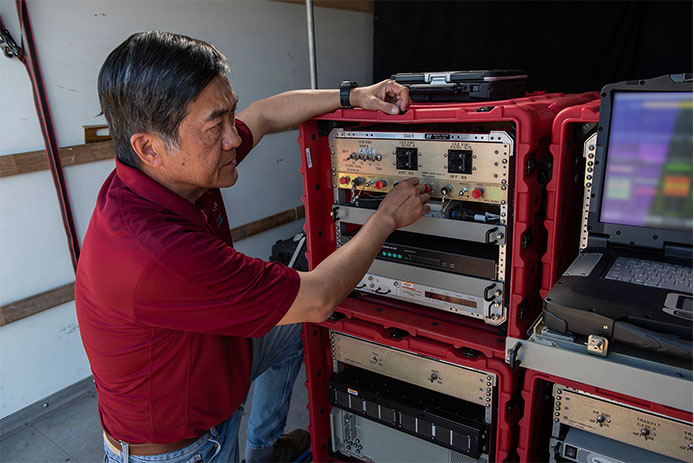
    A Raytheon technician operates the rapidly installed JPALS equipment during a demonstration at the Naval Air Station. (Photo: Raytheon)
    A Raytheon technician operates the rapidly installed JPALS equipment during a demonstration at the Naval Air Station. (Photo: Raytheon)
  • OCX supports second GPS III launch

    OCX supports second GPS III launch

    GPS OCX will maneuver satellite into final orbit over 10 days

    The U.S. Air Force used Raytheon Company’s GPS Next-Generation Operational Control System, known as GPS OCX, to support the launch of its second GPS III satellite into space. The ground system will now spend 10 days maneuvering the satellite into its final orbit, demonstrating GPS OCX’s ability to simultaneously support multiple GPS III spacecraft on-orbit throughout the checkout and calibration process.

    Raytheon’s GPS OCX has obtained the highest level of cybersecurity protections of any Department of Defense space system.

    “GPS OCX performed extremely well during the first launch and has exceeded performance requirements in the months since,” said Dave Wajsgras, president of Raytheon Intelligence, Information and Services. “The team was well-prepared for this launch, and we’re confident the system’s performance will continue to be positive.”

    GPS OCX, the enhanced ground control segment of America’s GPS system, has achieved the highest level of cybersecurity protections of any Department of Defense space system. Its open architecture design allows it to integrate advanced protections as they become available, and the system’s industry-leading cyber protections are why it will be used to support all future GPS III launches and GPS constellation operations upon operational acceptance.

    Earlier this year, the team completed final qualification testing of the system’s modernized monitor station receivers, which can receive and decrypt all GPS III military and civil signals. Global installation of the receivers starts next month and keeps the program on track for full system delivery by the program’s June 2021 contractual deadline.

    In addition to GPS OCX’s role, RGNext, a joint venture between Raytheon and General Dynamics Information Technology, provided operational launch support to ensure the safe launch of the United Launch Alliance’s Delta-IV rocket that was carrying the GPS III satellite. RGNext operates the launch range on behalf of the U.S. Air Force, providing maintenance, range safety, weather monitoring, communication and surveillance support for all launches conducted by defense, civil and commercial companies at the range.
    To access our press kit, which includes photos, videos and an animation, please visit us here. To learn more about the program’s progress and additional capabilities, visit us here.


    Featured photo: Raytheon

  • Raytheon to develop advanced laser systems for U.S. Air Force

    Raytheon to develop advanced laser systems for U.S. Air Force

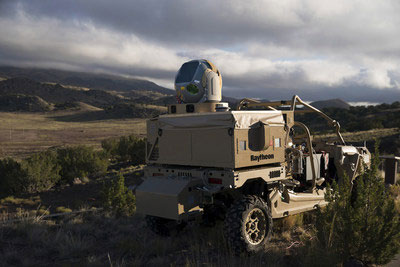
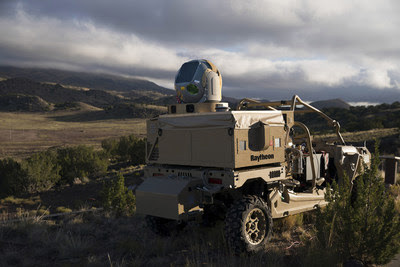
    According to Raytheon, its HELWS uses energy to detect, identify, track and take down drones. (Photo: Raytheon)
    According to Raytheon, its HELWS uses energy to detect, identify, track and take down drones. (Photo: Raytheon)

    Raytheon Company will deploy two prototype high-energy laser weapon systems (HELWS) to troops overseas under a $24 million U.S. Air Force contract. The U.S. Air Force’s experimentation includes 12 months of in-field operation against unmanned aerial systems and operator training.

    Raytheon’s HELWS uses energy to detect, identify, track and take down drones. According to the company, the system can target a single drone with precision. The HELWS is paired with Raytheon’s Raytheon’s Multi-spectral Targeting System. Raytheon’s HELWS, which comes mounted on a Polaris MRZR all-terrain vehicle, uses invisible beams of light to defeat hostile unmanned aerial systems.

    “Every day, there’s another story about a rogue drone incident,” said Stefan Baur, vice president of Raytheon Electronic Warfare Systems. “These threats aren’t going away, and in many instances, shooting them with a high energy laser weapon system is the most effective and safest way to bring them down.”

    Raytheon, headquartered in Waltham, Massachusetts, is a technology and innovation company that specializes in defense, civil government and cybersecurity solutions.

  • Raytheon, AirMap work on integrating drones into national airspace

    Raytheon Company has signed a strategic agreement with AirMap, an airspace intelligence platform for drones, to collaborate on projects to safely integrate unmanned aerial systems (UAS) into the national airspace system. This will help unlock the positive economic and social benefits of expanded commercial drone operations, the companies said.

    Unmanned air traffic control advances will unlock safe, efficient and scalable drone operations with a myriad of economic and social benefits.

    “AirMap is ushering in a new era in drone aviation,” said Matt Gilligan, vice president of Raytheon’s Intelligence, Information and Services business. “Drones must safely operate in an already complex ecosystem, which is where our experience matters.”

    The agreement combines the two companies’ expertise:

    • Raytheon’s Standard Terminal Automation Replacement System, or STARS, is used by air traffic controllers across the U.S. to provide safe and efficient aircraft spacing and sequencing guidance for more than 40,000 departing and arriving aircraft daily at both civilian and military airports.
    • AirMap is a global provider of airspace intelligence for UAS operations, with over 250,000 registered users. In 2018, U.S. registered commercial drone pilots used AirMap to request more than 45,000 automated authorizations to fly in controlled airspace.

    “Raytheon technology has helped safely and effectively manage airspace in the most complex, dense controlled airspace in the world for decades,” said Ben Marcus, AirMap co-founder and chairman. “They are an ideal partner to join AirMap on the path toward enabling safe, efficient, and scalable drone operations in U.S. low-altitude airspace between 0 and 400 feet.”

    The two companies are working toward an integrated demonstration that will showcase how AirMap’s unmanned aircraft traffic management platform can increase air traffic controllers’ awareness of potential conflict between drones and manned aircraft near airports to ensure overall safety of the airspace.

  • Raytheon merges with United Technologies aerospace business

    Raytheon merges with United Technologies aerospace business

    logosRaytheon Company and United Technologies Corp. have entered into an agreement to combine in an all-stock merger of equals.

    The transaction will create a systems provider with advanced technologies to address rapidly growing segments within aerospace and defense, the companies said. Raytheon is a defense contractor, while United Technologies is an aerospace company comprised of Collins Aerospace and Pratt & Whitney.

    The combined company, Raytheon Technologies Corporation, will offer a complementary portfolio of platform-agnostic aerospace and defense technologies, expanded technology and R&D capabilities to deliver innovative and cost-effective solutions aligned with customer priorities and the national defense strategies of the U.S. and its allies and friends.

    The merger is expected to close in the first half of 2020, following completion by United Technologies of the previously announced separation of its Otis and Carrier businesses, which are not part of the merger. The timing of the separation of Otis and Carrier is not expected to be affected by the proposed merger and remains on track for completion in the first half of 2020. The merger is intended to qualify as a tax-free reorganization for U.S. federal income tax purposes.

    The combined company will have approximately $74 billion in pro forma 2019 sales.

    Under the terms of the agreement, which was unanimously approved by the boards of directors of both companies, Raytheon shareowners will receive 2.3348 shares in the combined company for each Raytheon share. Upon completion of the merger, United Technologies shareowners will own approximately 57 percent and Raytheon shareowners will own approximately 43 percent of the combined company on a fully diluted basis.

    “Today is an exciting and transformational day for our companies, and one that brings with it tremendous opportunity for our future success. Raytheon Technologies will continue a legacy of innovation with an expanded aerospace and defense portfolio supported by the world’s most dedicated workforce,” said Tom Kennedy, Raytheon chairman and CEO. “With our enhanced capabilities, we will deliver value to our customers by anticipating and addressing their most complex challenges, while delivering significant value to shareowners.”

    “The combination of United Technologies and Raytheon will define the future of aerospace and defense,” said Greg Hayes, United Technologies chairman and CEO. “Our two companies have iconic brands that share a long history of innovation, customer focus and proven execution. By joining forces, we will have unsurpassed technology and expanded R&D capabilities that will allow us to invest through business cycles and address our customers’ highest priorities. Merging our portfolios will also deliver cost and revenue synergies that will create long-term value for our customers and shareowners.”

  • Raytheon to start global installation of GPS OCX receivers

    Raytheon to start global installation of GPS OCX receivers

    Raytheon Company’s GPS Next-Generation Operational Control System program, known as GPS OCX, completed final qualification testing of the system’s modernized monitor station receivers, which are now ready to be installed around the world starting in August.

    GPS OCX is the enhanced ground control segment of a U.S. Air Force-led effort to modernize America’s GPS system.

    “The modernized receivers give GPS OCX the ability to receive and decrypt all GPS III military and civil signals, a critical capability the current system doesn’t have,” said Dave Wajsgras, president of Raytheon Intelligence, Information and Services. “Monitor station receiver installation keeps us on track for full system delivery by our June 2021 contractual deadline.”

    The modernized receivers will measure and monitor legacy military and civilian signals sent by the current GPS satellite constellation plus the new signals sent by the next-generation GPS III.

    The receivers will also feed correction models at the master control station, giving U.S. Air Force satellite controllers the information necessary to make key adjustments to maximize accuracy.


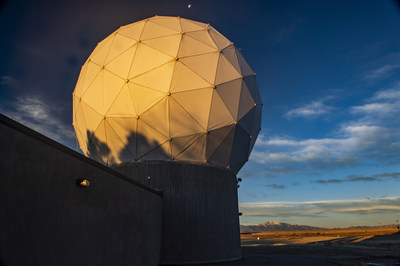
    Feature photo: GPS ground antenna at Schriever Air Force Base, home of the 50th Space Wing. (Photo: Raytheon)

  • System downs multiple drones in U.S. Air Force exercise

    System downs multiple drones in U.S. Air Force exercise

    Speed-of-light technologies will protect ground troops.

    Raytheon's high-energy laser (HEL). (iPhoto: Raytheon)
    Raytheon’s high-energy laser (HEL). (iPhoto: Raytheon)

    Raytheon Company‘s advanced high-power microwave and mobile high-energy laser systems engaged and defeated multiple unmanned aerial system targets during a U.S. Air Force demonstration. The mature HPM and HEL technologies offer an affordable solution to the growing UAS threat, the company said.

    Raytheon made the announcement at AUVSI Xponential, taking place this week in Chicago.

    Raytheon’s mobile high energy laser looks out into a wide-open sky. The company’s advanced high-power microwave and high-energy laser engaged and defeated dozens of unmanned aerial system targets in a recent U.S. Air Force demonstration.

    The HEL system, paired with Raytheon’s Multi-Spectral Targeting System, uses invisible beams of light to defeat hostile UASs. Mounted on a Polaris MRZR all-terrain vehicle, the system detects, identifies, tracks and engages drones.

    “Countering the drone threat requires diverse solutions,” said Stefan Baur, Raytheon Electronic Warfare Systems vice president. “HEL and HPM give frontline operators options for protecting critical infrastructure, convoys and personnel.”

    Raytheon’s HPM uses microwave energy to disrupt drone guidance systems. High-power microwave operators can focus the beam to target and instantly defeat drone swarms. With a consistent power supply, an HPM system can provide virtually unlimited protection.

    “After decades of research and investment, we believe these advanced directed energy applications will soon be ready for the battlefield to help protect people, assets and infrastructure,” said Thomas Bussing, Raytheon Advanced Missile Systems vice president.

    Raytheon’s HEL and HPM were the only directed energy systems that participated in this Air Force experimentation demonstration. The event expanded on previous directed energy demonstrations such as a U.S. Army directed energy exercise held in 2017.

  • Raytheon system downs multiple drones in U.S. Air Force exercise

    Raytheon Company’s advanced high-power microwave and mobile high-energy laser systems engaged and defeated multiple unmanned aerial system targets during a U.S. Air Force demonstration. The mature HPM and HEL technologies offer an affordable solution to the growing UAS threat, the company said.

    Raytheon made the announcement at AUVSI Xponential, which took place April 29-May 2 in Chicago.

    Raytheon’s mobile high energy laser looks out into a wide-open sky. The company’s advanced high-power microwave and high-energy laser engaged and defeated dozens of unmanned aerial system targets in a recent U.S. Air Force demonstration.

    The HEL system, paired with Raytheon’s Multi-Spectral Targeting System, uses invisible beams of light to defeat hostile UASs. Mounted on a Polaris MRZR all-terrain vehicle, the system detects, identifies, tracks and engages drones.

    “Countering the drone threat requires diverse solutions,” said Stefan Baur, Raytheon Electronic Warfare Systems vice president. “HEL and HPM give frontline operators options for protecting critical infrastructure, convoys and personnel.”

    Raytheon’s HPM uses microwave energy to disrupt drone guidance systems. High-power microwave operators can focus the beam to target and instantly defeat drone swarms. With a consistent power supply, an HPM system can provide virtually unlimited protection.

    “After decades of research and investment, we believe these advanced directed energy applications will soon be ready for the battlefield to help protect people, assets and infrastructure,” said Thomas Bussing, Raytheon Advanced Missile Systems vice president.

    Raytheon’s HEL and HPM were the only directed energy systems that participated in this Air Force experimentation demonstration. The event expanded on previous directed energy demonstrations such as a U.S. Army directed energy exercise held in 2017.

  • Raytheon’s GPS OCX passes cybersecurity tests

    System prevented broadcast of corrupt navigation, timing data.

    Image: Raytheon
    The GPS Operational Control System’s launch and checkout system will control launch and early orbit operations and the on-orbit checkout of all GPS III satellites. (Image: Raytheon)

    Raytheon Company’s GPS Next-Generation Operational Control System, known as GPS OCX, has completed several cybersecurity vulnerability assessments that tested the system’s ability to defend against both internal and external cyber threats, the company said.

    GPS OCX, based at Schriever Air Force Base in Colorado Springs, Colorado, prevented the broadcast of corrupt navigation and timing data in all tests, bolstering the program’s readiness for the GPS III launch in December, the company added.

    “We’ve built a layered defense and implemented all information assurance requirements for the program into this system,” said Dave Wajsgras, president of Raytheon Intelligence, Information and Services. “We’re cognizant that the cyber threat will always change, so we’ve built GPS OCX to evolve and to make sure it’s always operating at this level of protection.”

    GPS OCX is the enhanced ground control segment of a U.S. Air Force-led effort to modernize America’s GPS system. The program has implemented 100 percent of the Department of Defense’s 8500.2 Defense in Depth information assurance standards without waivers, giving it the highest level of cybersecurity protections of any DoD space system.

    The first tests took place April 2-13, and were led by a contracted “blue team” that aimed to breach the system from within its information assurance boundary.

    The second round of tests took place May 16-20, and were led by an Air Force “red team” of cyber-penetration testers who tried to breach the system’s IA boundary from outside. The system worked as designed, validating it is secure.

    The assessments took place on the launch and checkout system, GPS OCX Block 0, which was delivered to the U.S. Air Force in 2017 as a fully cyber-secure satellite ground system.

  • F-35 fighter gets Raytheon missile with GPS-inertial positioning

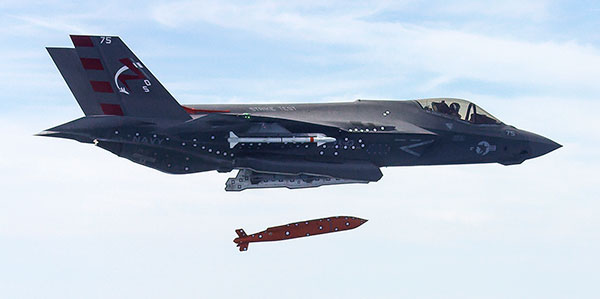
    Screenshot from U.S. Navy video of a March 2016 test of an F-35 releasing the AGM-154 Joint Standoff Weapon (JSOW).

    Raytheon Company and the U.S. Navy completed the final developmental test to integrate the Joint Standoff Weapon C onto the F-35 Joint Strike Fighter’s C variant, keeping the low-cost, air-to-ground missile on track for full deployment in 2019.

    The JSOW glide weapon uses a GPS-inertial navigation system with an imaging infrared seeker that can identify and track targets autonomously. JSOW C weighs 1,000 pounds and is effective against high-value land targets at ranges greater than 70 nautical miles, day or night, and in adverse weather conditions.

    “With JSOW C in its internal weapons bay, the Navy’s F-35C can now eliminate the toughest ground targets from significant standoff ranges,” said Mike Jarrett, vice president of Raytheon Air Warfare Systems. “JSOW’s advanced warhead and smart fuse provide fighter pilots with plenty of flexibility against hard and soft targets — plus, it has many programmable effects.”

    Lockheed Martin, manufacturer of the F-35, and the F-35 Joint Program Office participated in the latest test, which took place on the Navy’s China Lake ranges in California.

    https://youtu.be/IAzWKu_4njI