Tag: RF signals

  • RF terrestrial-based GPS packs a punch

    RF terrestrial-based GPS packs a punch

    Over time, GPS dependencies have become deeply embedded in much of the nation’s critical infrastructure, as shown in Figure 1 — from emergency services and transportation systems to critical manufacturing and logistics operations. For the past 20 years, however, efforts to protect these assets with a true backup system have stalled, despite the establishment of the U.S. Space-Based Positioning, Navigation and Timing (PNT) Policy in December 2004.

    With the recent Notice of Inquiry from the U.S. Federal Communications Commission (FCC), an updated list of technological options is now on the table. However, most would require building new infrastructure or rely on quantum-based technologies that are still years away from being practical or available.

    U.S. GPS Efforts Separating

    Since its inception in 1977, GPS has drawn from a single technology to serve civil and military sectors. Now, with space — particularly satellites — becoming physically contested in wartime scenarios, the military is embarking on its own approach. This includes pairing GPS with military- grade receivers to improve service and protection for the global GPS layer. And two new layers are being developed as part of a multi-layer approach, deemed the “regional” GPS layer (i.e., per country) and the “local” GPS layer (i.e., per metro).

    Yet, with this new system — although supporting modular, open-systems integration — the Department of Defense (DOD) is now distancing itself from other future endeavors, including supporting civil critical infrastructure. The future DOD PNT system will not follow the same path to civil/military use as was taken by GPS. The PNT capabilities employed by the DOD as such will be increasingly classified. The civil effort has not only been left to fend for itself, but it also has been tragically fragmented across many federal departments and agencies. We can only hope the recent FCC focus will help to solidify the civil GPS efforts.

    Doors Open for New Solutions

    The new orientation of the civil approach opens the door to significant focus on local and regional GPS services. Specifically, a new approach is based on data from the Earth’s “RF geospatial layer,” where geospatial is “relating to or denoting data that is associated with a particular location.” This layer’s data is about available RF signals, which can be used to derive the location of a particular end device anywhere in the blanket of signals. Devices using this new approach will be unencumbered by the intricacies and costs of satellite technology or having to be joint solutions required to meet military standards.

    This also opens the door to the power of solutions available through consortia, which can tap into an order of magnitude more benefits through hearty partnerships. All of which also leads to the much-needed speed-to-market.

    The Biggest Advantage

    In the U.S., more than 110,000 towers transmit a variety of RF signals available to derive PNT. These towers provide a wide range of three-tower geometries needed for PNT calculations and enable strong resiliency (as an adversary cannot disable them all).

    Two systems, in particular, are worthy of close consideration. The broadcast industry’s proposed Broadcast Positioning System (BPS) uses ATSC 3.0 infrastructure along with the existing MerlinTPS adaptive RF signal system. Both these systems take advantage of existing RF infrastructure prevalent in most developed and developing countries.

    Don’t Fall Into the eLoran Trap

    eLoran has been suggested by some as a viable alternative used for deriving PNT. However, this technology has notable shortcomings. The portion of the RF band it uses has several limitations. For example, eLoran is based on a 100 kHz signal, a low-frequency band that is highly susceptible to atmospheric noise.

    Although some propose the use of existing AM towers for the eLoran signal, most are ~300 ft, of which eLoran tends to operate with 1600 ft towers. Attempts to operate eLoran using these shorter towers will make for reduced efficiency. Another misconception is about the proposed use of existing AM tower guidewires for transmission. At these wavelengths, that would restrict the towers to be 900 miles apart, having an impact on maintenance.

    eLoran would require building new infrastructure for U.S. deployment, including 12 new towers and transmitters. The number of installations requiring significant maintenance and this low number can be taken out in physical warfare.

    The eLoran system requires tight synchronization of the signals between each of its towers and the national epoch, requiring additional infrastructure with its attendant maintenance. eLoran supporting position accuracy is rated at 10 m to 20 m CEP, which is not within the FCC requirement of less than 3 m CEP.

    Timing accuracy is +/- 50 ns, which meets today’s precision needs, although it is quickly becoming inadequate as needs in the precision timing market continue to increase.

    Finally, the eLoran service is transmitted on one known frequency and in a published format, making it more vulnerable to jamming.

    GPS RF Systems Pack a Punch

    Given the issues associated with eLoran, other technologies must be considered. One such technology is available today and provided by a commercial company, MerlinTPS, which can transfer market-available, precise timing down to +/- 10ns. Such as precise timing provided by another commercial entity, Hoptroff, for example. Both companies currently provide the necessary components of a viable terrestrial GPS.

    As a consortium, MerlinTPS/Hoptroff could deliver precise timing wirelessly to broadcast TV towers for BPS, while eliminating the need for signal conditioning and additional synchronization equipment at each tower, or any other related infrastructure.

    MerlinTPS combined with BPS could provide all GPS services for primary and backup (not just timing). MerlinTPS can also fill in services for BPS edge cases having poor geometries. These services include portable and mobile devices. MerlinTPS is also able to handle both the enterprise and civil approaches similarly.

    New open doors create freedom to quickly address the urgent national security need for reliable, alternative PNT. The consortium approach, adding commercially available technology to the broadcast infrastructure, allows for collaborative development while preserving individual market opportunities, making it an attractive proposition for all participants.

  • Trio of HawkEye 360 formation-flying microsatellites launched for RF geolocation

    Trio of HawkEye 360 formation-flying microsatellites launched for RF geolocation

    The HawkEye 360 constellation detects and geolocates RF signals for maritime situational awareness, emergency response, national security and spectrum analysis applications.

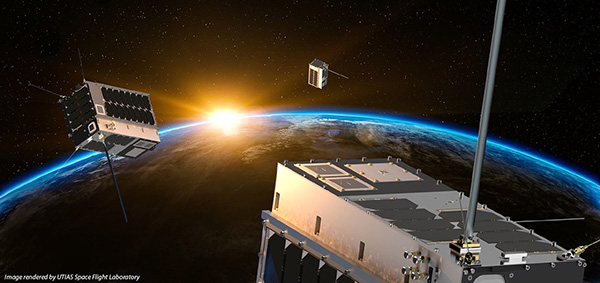
    Cluster 3 satellites fly in formation, joining Clusters 1 and 2. (Artist's rendering: Hawkeye 360)
    Cluster 3 satellites fly in formation, joining Clusters 1 and 2. (Artist’s rendering: Hawkeye 360)

    HawkEye 360 Inc. announced the successful launch of its Cluster 3 radio frequency geolocation microsatellites built by Space Flight Laboratory (SFL). Carried aboard the June 30 SpaceX Transporter 2 mission, the Cluster 3 formation-flying microsatellites quickly established communication with the company’s satellite operations center.  They join in orbit the HawkEye 360 Cluster 2 and Cluster 1 Pathfinder satellites.

    The HawkEye 360 Constellation detects and geolocates RF signals for maritime situational awareness, emergency response, national security and spectrum analysis applications. Cluster 3 significantly expands HawkEye 360’s capacity, and is part of its second generation of advanced RF-sensing satellites.

    “With the addition of our second-gen satellites, we’ll offer more frequent, timely and actionable data and insights to our government, commercial and humanitarian partners,” said CEO John Serafini.

    “The increased revisit frequency and capacity Cluster 3 brings to our constellation are essential to detecting, characterizing, and understanding the continuously changing RF activity important to our clients,” said Alex Fox, Executive Vice President for Sales and Marketing.

    Seven more clusters are fully funded and scheduled for launch in 2021 and 2022 to achieve collection revisits as frequent as every 20 minutes, Fox said. “Each cluster will offer new innovations to address a rapidly growing set of requirements needed by our defense, security and commerce clients. We plan on expanding the constellation past the initial 10 clusters to achieve near-persistent monitoring of global RF activity, which will drive even more value and ensure our continued dominance in the industry.”

    HawkEye 360 delivers a layer of intelligence to help understand human activity on Earth. The constellation detects, characterizes and precisely geolocates these RF signals from a broad range of emitters, including VHF marine radios, UHF push-to-talk radios, maritime and land-based radar systems, L-band satellite devices and emergency beacons.

    By processing and analyzing these RF data, the company delivers actionable insights for national, tactical and homeland security operations, maritime domain awareness, environmental protection and new applications in the commercial sector, the company said.

    The HawkEye 360 launch brings to 20 the total number of SFL satellites placed into orbit in less than a year. The Cluster 3 satellites were built on SFL’s 30-kg Defiant microsatellite bus.

    HawkEye 360 selected SFL due to the importance of formation flying by multiple satellites for successful RF geolocation. SFL is the acknowledged leader in developing and implementing high-performance attitude control systems that make it possible for relatively low-cost nanosatellites and microsatellites to fly in stable formations while in orbit.

    The previous HawkEye 360 satellite clusters built by SFL were the Pathfinder launched in 2018 and Cluster 2 in January. Each Cluster is comprised of three satellites.

    Other launches of SFL-built satellites in the past year include missions developed for the Norwegian Space Agency (NOSA) in Norway, the Dubai-based Mohammed Bin Rashid Space Centre (MBRSC) in the United Arab Emirates, GHGSat Inc. of Canada, Space-SI of Slovenia, and a Canada-based telecommunications company.

  • Microsatellite constellation geolocates RF signals

    Microsatellite constellation geolocates RF signals

    Space Flight Laboratory (SFL) has launched three formation-flying HawkEye 360 Pathfinder 15-kilogram, 20 x 27 x 44-centimeter microsatellites designed to detect and geolocate radio frequency (RF) signals.

    Hawkeye 360 Pathfinder satellite trio flies in formation, seeking RF signals from Earth.(Image: UTIAS Space Flight Laboratory)
    Hawkeye 360 Pathfinder satellite trio flies in formation, seeking RF signals from Earth. (Image: UTIAS Space Flight Laboratory)

    The target signals emanate from VHF radios, maritime radar systems, automatic identification system (AIS) beacons, very small aperture terminal (VSAT) communication systems and emergency beacons. HawkEye 360 applies advanced RF analytics to the data to assess suspicious vessel activity, survey communication frequency interference and direct search-and-rescue.

    Precise formation flying is critical, as the relative position of each satellite must be known to accurately geolocate transmission sources. The satellites carry space-qualified GPS receivers and high-performance attitude control systems to keep them stable in orbit.

    Flying in formation, two or all three satellites may receive the same transmission when it originates from their common footprint. The signal’s different times of arrival at each satellite and their different apparent center frequencies (Doppler) will enable onboard comparison of time-of-arrival and frequency-of-arrival measurements to then calculate the transmitter’s position.

    The onboard GPS receivers provide precise estimates for the position and velocity of the receivers, information required for multilateration. The satellites further synchronize their clocks using GPS receivers, which also stabilize the phase-locked loops governing the tuning frequency in the RF tuners.

    The satellites were built by Deep Space Industries of San Jose, California, and University of Toronto, Institute for Aerospace Studies/Space Flight Laboratory (UTIAS/SFL). They were launched in December 2018 into low-Earth orbit.

  • New JLT Micro-Transcoder provides GPS firewall retrofit

    New JLT Micro-Transcoder provides GPS firewall retrofit

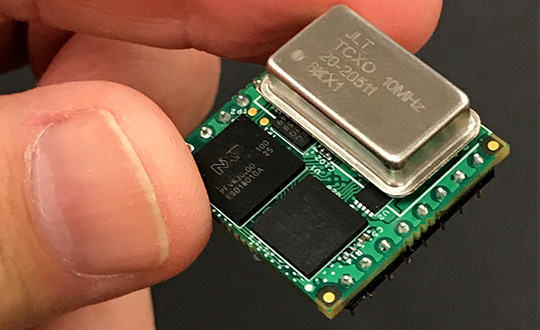
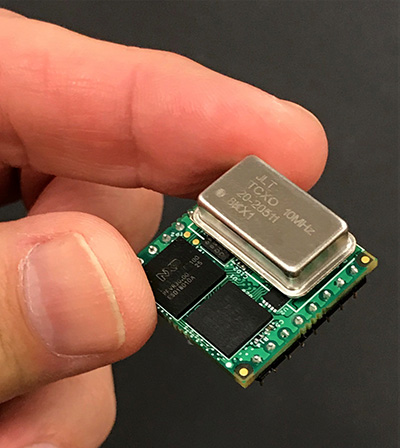
    Jackson Labs Technologies Inc. (JLT) released its tiny, new Micro-Transcoder, a full-constellation, stand-alone, real-time 10-channel GPS simulator. The unit can act as a GPS firewall to identify and block jamming and spoofing attempts, and to provide an alternate PNT source during fully GPS-denied operation.

    JLT is a designer and manufacturer of GNSS, timing and frequency equipment.

    Photo: JLT
    Photo: JLT

    The one-inch-square Micro-Transcoder module allows glueless retrofitting of existing GPS equipment by upgrading systems with secure and assured positioning, navigation and timing (PNT) capability, the company said. It achieves hardening of the customers’ GPS equipment by splicing the unit in between the existing antenna and the users’ GPS receiver.

    It takes the output of any secure PNT source — inertial navigation system (INS), SAASM, M-code, Iridium STL, or concurrent GNSS receiver — and encodes (RF modulates) the baseband PNT and UTC timing information into a standard GPS L1 RF signal.

    This RF signal can then be received by any legacy GPS receiver.

    The unit is based on JLT’s CLAW GPS simulator and RSR transcoder technologies, and includes a stand-alone full-constellation 10-channels real-time GPS simulator with integrated high-stability timing reference, as well as an internal GNSS receiver for monitoring the RF output signal for quality and accuracy.

    The unit will transmit a standard UTC time, position, velocity and heading GPS L1 RF signal by simply applying 3.3V power to it.

    The Micro-Transcoder can also be operated as a generic high-performance GPS simulator with built-in GPS Disciplined Oscillator, and is supported by a comprehensive free Windows application program downloadable from the JLT website.

    The Windows application allows control of all the simulation aspects, creating and storing simulation vector commands, and testing user equipment for leap-second and GPS week rollover event compatibility to identify weaknesses in user equipment.

    The unit does not require a PC to be connected to it to function. This makes embedded operation as easy as applying power, and connecting the units’ RF output to the antenna input of any GPS receiver.

    By generating a legacy RF GPS signal from any secure PNT source, the Micro-Transcoder allows users to maintain their investment in fielded legacy GPS equipment. Example applications include retrofitting financial transaction time servers with CSAC or rubidium atomic clock holdover capability, and adding GPS RF output capability to concurrent GNSS receivers to allow reception of L1, L2, L3, L5 GPS, GLONASS, Galileo, BeiDou, QZSS, Iridium STL, or any other satellite-based navigation signal to legacy GPS receivers.

    It can also be used to add inertial navigation system (INS) capability to vehicles and aircraft.

    None of these applications require any modifications to be made to the legacy GPS receiver system; all configurations are done externally using the Micro-Transcoder Windows application or a standard terminal program, and on the assured PNT source.

    A real-world customer application is a data-center where communications equipment required a GPS signal to operate. The user wanted to prevent vulnerabilities that an external antenna would have introduced. In this scenario, the Micro-Transcoder provided a fixed-position GPS RF signal to a number of the data centers’ GPS receivers, and allowed the GPS user equipment to operate properly without exposing it to the possibility of external jamming or spoofing.

    At 0.97 x 0.97 x 0.4 inches and with less than 0.95W power consumption, the Micro-Transcoder is small enough to be designed into emerging assured PNT products, allowing them to communicate gluelessly to existing legacy GPS infrastructure.

  • Aerospace wins U.S. Army contest to bring AI capabilities to soldiers

    Aerospace wins U.S. Army contest to bring AI capabilities to soldiers

    A team from Aerospace Corporation won a U.S. Army challenge designed to identify artificial intelligence and machine learning tools that could improve the speed and accuracy of electronic warfare operations.

    The Army Signal Classification Challenge invited participants to prove they had the best artificial intelligence and machine learning algorithms for performing “blind” radio frequency signal classification quickly and accurately.

    An Interim Armored Vehicle "Stryker" and AH-64 Apache helicopters with Battle Group Poland move to secure an area during a lethality demonstration as part of Saber Strike 18 in June 2018. (Photo: U.S. Army/Spc. Hubert D. Delany III, 22nd Mobile Public Affairs Detachment)
    An Interim Armored Vehicle “Stryker” and AH-64 Apache helicopters with Battle Group Poland move to secure an area during a lethality demonstration as part of Saber Strike 18 in June 2018. (Photo: U.S. Army/Spc. Hubert D. Delany III, 22nd Mobile Public Affairs Detachment)

    The goal was to find solutions that could reduce the cognitive burden placed on electronic warfare soldiers by identifying signals of interest in the electromagnetic spectrum.

    The Army , Rapid Capabilities Office (RCO) launched the challenge because the classic signal detection process is no longer efficient in understanding the vast amount of information presented to electronic warfare soldiers on the battlefield by an ever-increasing number of satellite signals, radars, phones and other devices.

    More than 150 teams from across universities, laboratories, industry and government participated. The first-place award of $100,000 went to Platypus Aerospace from Aerospace Corporation, a federally funded research and development center.

    Second place, with an award of $30,000, went to TeamAU, made up of a team of individual Australian data scientists. Third place and $20,000 went to THUNDERINGPANDA of Motorola Solutions.

    “The amount of interest and quality of performance was remarkable, including from nontraditional organizations,” said Rob Monto, Emerging Technologies director for the RCO. “In doing this as a challenge, instead of a traditional Request for Information, we were really modeling what industry does to get at a problem quickly. It was performance-based, open to anyone and implemented without a lot of cost or burden placed on those entering. And now, in a matter of less than four months, we know mathematically who has the best performance for this initial step of applying AI and machine learning to signal classification.”

    The challenge, which opened on April 30 and closed on Aug. 13, gave participants 90 days to develop their models and work with training datasets provided by the RCO. That was followed by two test datasets of varying complexity that were the basis for judging submissions.

    Participants’ overall challenge score was based on a combined weighted score for both test datasets. Participants were also able to see how they were performing in relation to others in real time, via the participant leaderboard.

    “This challenge targeted the upfront data collection, which is traditionally very labor intensive and time consuming,” Monto said. “Now we have a very accurate, very rapid algorithm for a specific problem set. With this research done on the front end, we can move forward with trying to build and integrate it into a real solution for the Army.”

    A second phase of the competition is planned and details will be announced later this year.

    “We’re thrilled to see our team win this competition through their novel application of artificial intelligence to secure the use and protection of the radio frequency spectrum,” said Steve Isakowitz, Aerospace president and CEO. “Their accomplishment is another great example of how Aerospace is employing cutting-edge technology to advance next-generation capabilities for the warfighter while solving one of our customer’s most difficult challenges.”

    Aerospace engineers, named “Team Platypus,” win the Army AI Challenge. From left: Eugene Grayver, Alexander Utter, Andres Vila, Donna Branchevsky, Esteban Valles, Darren Semmen, Sebastian Olsen, Kyle Logue (not pictured). (Photo: Aerospace Corp.)
    Aerospace engineers, named “Team Platypus,” win the Army AI Challenge. From left: Eugene Grayver, Alexander Utter, Andres Vila, Donna Branchevsky, Esteban Valles, Darren Semmen, Sebastian Olsen, Kyle Logue (not pictured). (Photo: Aerospace Corp.)

    The group, known as “Team Playtpus,” consists of eight Aerospace communications systems and artificial intelligence engineers: Andres Vila, Kyle Logue, Esteban Valles, Donna Branchevsky, Sebastian Olsen, Alexander Utter, Darren Semmen and Eugene Grayver.

    Out of more than 150 overall participants, including 49 teams that actively competed in the challenge, the Aerospace team won by correctly detecting and classifying the greatest number of radio frequency signals using a combination of signal processing and AI technologies.

    “In its challenge, the Army RCO released a training set with synthesized data that the teams used to build their algorithms,” said Andres Vila, Aerospace team lead. “Our goal was to combine the team’s deep history and expertise in advanced satellite communications with our practical knowledge of the latest in machine learning and deep neural networks to provide a best-in-class solution.”

    Vila added, “This win means that we have built a team that can excel in this new and exciting field of machine learning and specifically deep learning solutions for communication problems.”