Tag: Soyuz

  • Directions 2023: Galileo Offers New Services

    Directions 2023: Galileo Offers New Services

    In 2022, the Galileo GNSS continued to provide the world’s most precise satellite navigation information, to a user base that stands at more than 3.5 billion worldwide. Furthermore, provided services continue to improve and expand, with plans for high-accuracy positioning and signal authentication now reaching fruition.

    The European Union Agency for the Space Programme (EUSPA) and the European Space Agency (ESA) continue to enjoy an effective collaboration on the many development, deployment, and evolution activities of the Galileo Programme — each according to their respective responsibilities for service provision and system development with the European Commission (EC) acting as the program manager.
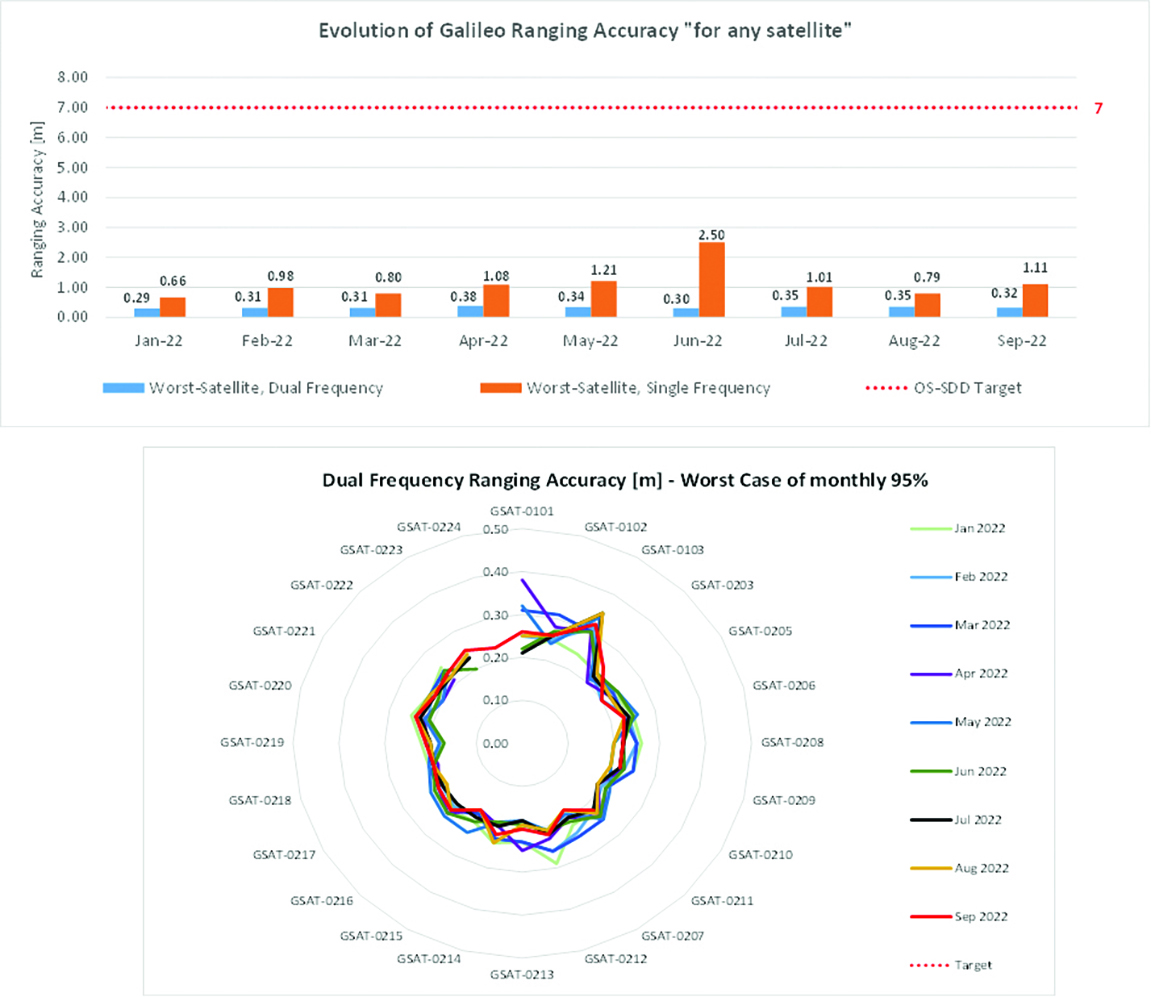
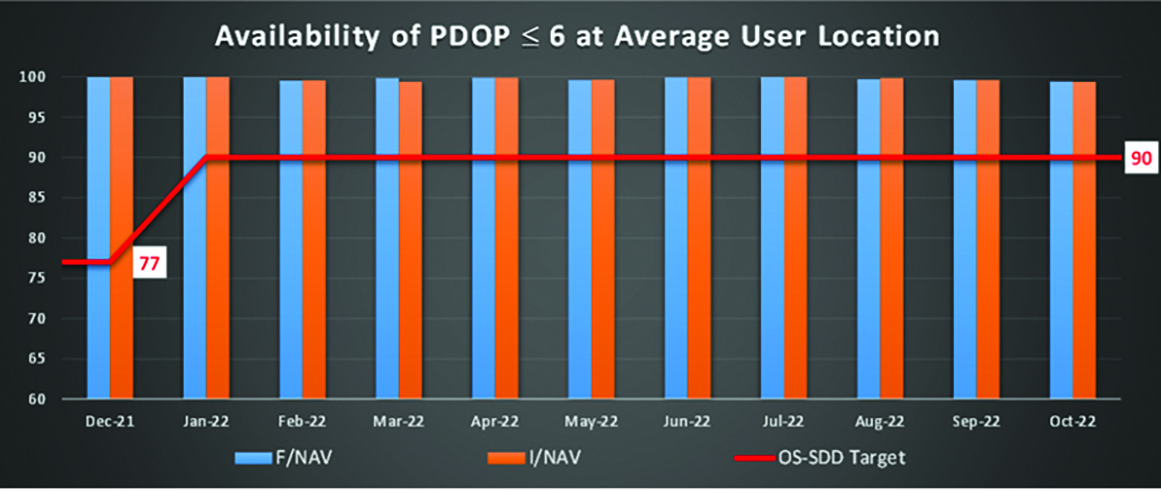
    Photo: Image 1 Directions 2023
    Ranging accuracy performance from January to September 2022.
    image002.Directions2023
    Positioning-related MPLS from January to October 2022.

    New Services Launched in 2022

    Excellent Performance
    Service delivery operations and maintenance of operational systems are managed by EUSPA, which supervises many contracts that carry out the day-to-day activities from dedicated control and monitoring centers throughout Europe. In 2022, Galileo timing, navigation, and SAR/Galileo services were delivered with excellent performances that continue to exceed the formal declarations for minimum performance levels (MPL), which were increased in January, both in terms of absolute accuracy and overall service availability. The entry into service of two additional satellites in May and August, have further consolidated the overall service availability to end users.
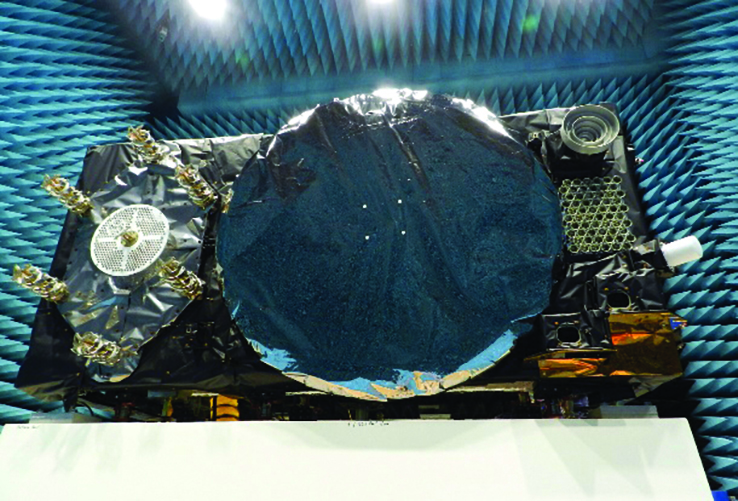
    image006.Directions2023
    Galileo FOC Batch 3 satellite under testing.

    Expansion of Service Portfolio
    The service provision teams have been able to focus on improvements to, and expansion of, the service portfolio.

    The I/NAV improvement will positively impact end users by enabling a faster time to first fix, and updates to the data validity status flags will lead to better protection of users against expired navigation data. These changes are implemented in updates of the onboard software of the satellites being rolled out across the constellation. At present, seven operational satellites have been successfully updated; the complete software upgrade campaign is planned to be completed this summer.

    Galileo’s new High Accuracy Service will provide free precise point positioning (PPP) corrections, in the Galileo E6-B data component and by terrestrial means, for Galileo and GPS (single and multi-frequency) to achieve real-time user position improved by up to 10 times. The infrastructure to support an initial service (Phase 1) is nearing completion, and the formal declaration of the service capabilities is planned for early this year.

    To provide users with a method of authenticating the received Galileo signals, especially the satellites ephemerides and the Galileo timing parameters, the new Open Service Navigation Message Authentication (OSNMA) service enables a receiver to confirm that a navigation message originated from the EU Galileo infrastructure. Many application areas are expected to benefit from this capability, including smart tachographs, telematics and logistics, UAVs, location-based services, and timing services. Having successfully demonstrated the technology behind the service in 2022, including a public observation phase, the roll-out of the Initial Service is planned to take place by the end of the year.

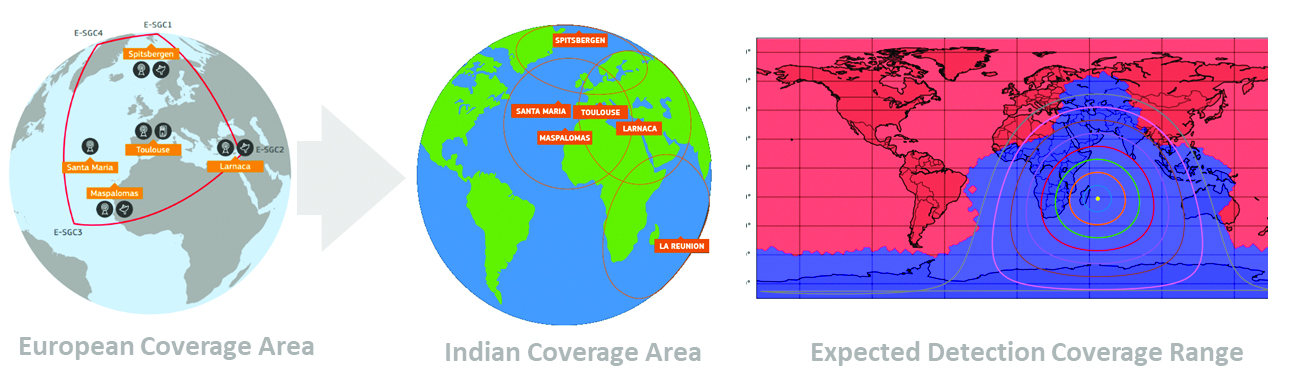
    A fourth Medium Earth Orbit Local User Terminal (MEOLUT) in La Réunion will extend the SAR/Galileo Forward Link Service Coverage Area over the Indian Ocean as part of the SAR/Galileo full operational capability (FOC) declaration expected in the first quarter of 2023. The Cospas-Sarsat commissioning of this new station was completed in September 2022, and operational data is already being distributed to Cospas-Sarsat.

    Reference documents for the above services can be found at the EUSPA European GNSS Service Centre website, including technical notes, interface control documents and service declaration documents.
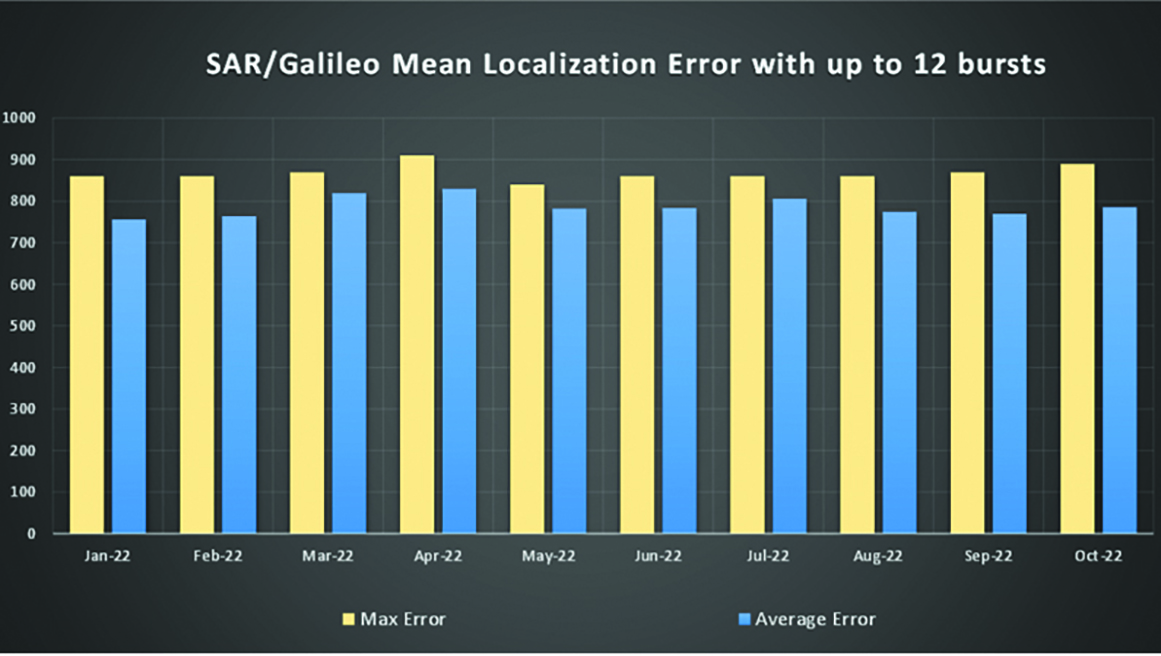
    SAR/Galileo-related metrics from January to October 2022.
    SAR/Galileo-related metrics from January to October 2022.
    image005.Directions2023
    Extension of the SAR/Galileo Forward Link Service Coverage Area over the Indian Ocean.

    FOC Infrastructure Development Nears Completion

    Satellite Production
    The production of the third batch of Galileo FOC satellites advanced further in 2022 with the completion of the environmental tests and the system compatibility test campaigns at the European Space Agency Test Centre in Noordwijk, The Netherlands. After 10 years of successful testing, on Oct.18, 2022, the last Galileo FOC satellite (flight model number 34) left the test center to return to the premises of the satellite manufacturer, OHB Systems, in Germany. Testing of the remaining 10 satellites has confirmed that they have been correctly built and will perform well in orbit. The acceptance review of the last couple of satellites will take place this summer.
    At the beginning of 2023, the plan is to start in-orbit testing of a quasi-pilot signal on the E5 frequency using the Galileo GSAT201/202 satellites in elliptical orbit. The provision of a signal offering coarse acquisition in Galileo E5-A/GPS L5 can be a distinguishing feature for Galileo with respect to all other constellations to further improve the capability to acquire the E5 signal at low complexity. Following in-orbit testing, the strategy for roll-out of this capability will be assessed with the involvement of receiver manufacturers.

    New SAR Galileo MEOLUT Facility in Réunion island
    New SAR Galileo MEOLUT facility in Réunion island.

    Access to Space
    The discontinuation of Soyuz launch services from the Kourou Space Centre in French Guiana, because of the Russia-Ukraine conflict, has caused delays in the two Galileo launches that had been planned for 2022. The Launch 12 campaign had to be interrupted and in March 2022 the FM25 and 26 satellites were put in storage at the Kourou launch base, then returned to Europe in November.
    Ariane 6 is the baseline launcher for Galileo satellites to ensure European independent access to space. The remaining Batch 3 satellites will be launched with the Ariane 62 launcher vehicle, the two strap-on solid booster variants of Ariane 6, now undergoing the final stages of development led by prime contractor Ariane Group. Ariane 6’s maiden flight is scheduled to take place in the fourth quarter of 2023.

    Ground Segment
    An upgrade of the ground control segment, in charge of command and control of the satellite constellation, is being developed by the industrial consortium led by GMV. The upgrades will address resolution of hardware and software obsolescence including cyber security, operability improvements, and a security monitoring overlay.

    With the planned increase in the number of satellites in orbit, an additional telemetry tracking and control facility (TTCF) is being deployed in Kourou leading to seven operational TTCF stations in early 2023.

    The ground mission segment, in charge of navigation control, is undergoing a complete technological refresh, including hardware/software virtualization performed by an industrial consortium led by Thales France. This upgrade will provide additional robustness, including a system extended contingency mode resilient to outages lasting up to seven days and a new state-of-the-art cyber security monitoring system. It will also provide ranging authentication through encrypted codes on the E6-C signal component for the implementation of the Commercial Authentication Service. Global coverage will be further increased with the introduction of two Galileo sensor stations in Wallis (Pacific Ocean) and Bonaire (Caribbean Sea), for a total of 15 sites around the globe.
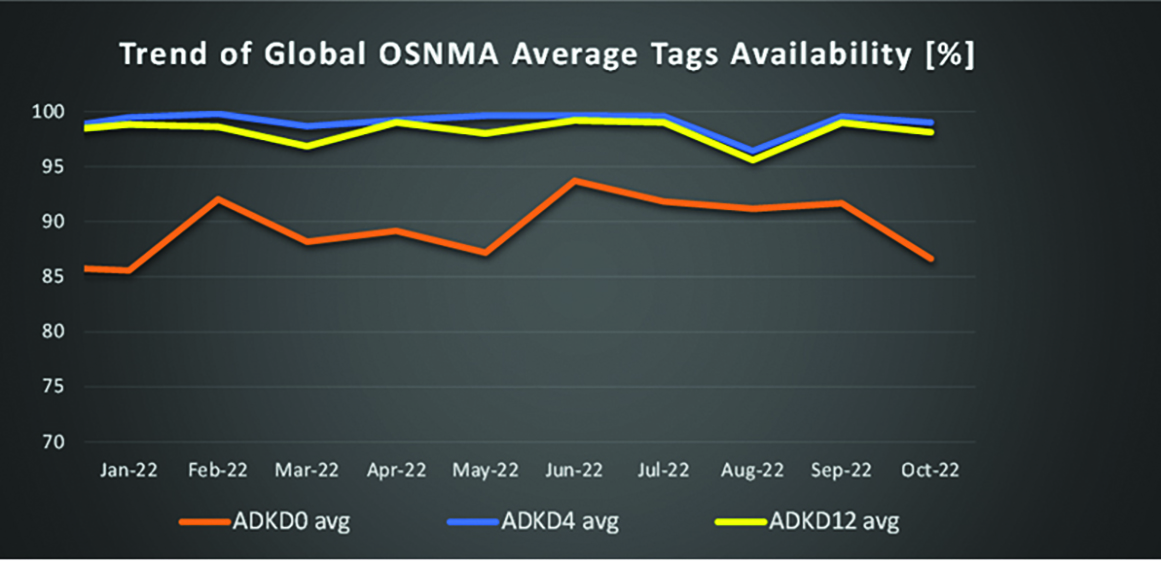
    image004.Directions2023
    OSNMA-related metrics from January to October 2022.

    G2G Development Started

    Galileo’s second generation (G2G) will introduce many innovative technologies to offer unprecedented precision, robustness, and flexibility.
    2022 was a key year for the evolution of G2G activities with the fast development cycles of the first batch of G2 satellites, beginning development of the associated G2G in orbit validation (IOV) ground segment and system test beds, and the consolidation of the G2G final system capabilities — including the coordination of the mission/service roadmaps with the EC, EUSPA, and the EU Member States delegates.
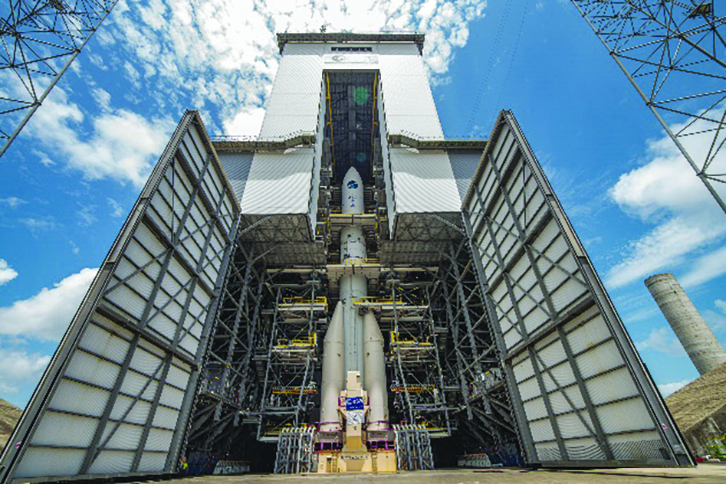
    image007.Directions2023
    Ariane 62 launcher.

    G2G Satellite Manufacturing
    From the satellite development point of view, the two parallel contracts to develop and manufacture each of the six G2G batch one (G2SB1) satellites are progressing in a fast development environment, with the first hardware units ready for integration and testing.
    Following the completion of preliminary design review, these two contracts (for six satellites each) are preparing for unit-level validation/testing, which will lead to the critical design review.

    These satellites will provide the following key innovations:

    • Reconfigurable fully digital navigation payload
    • Point-to-point connection between satellites by inter-satellite-link for command and control, and ranging functionalities
    • Electric propulsion for orbit-raising capabilities
    • Advanced jamming and spoofing protection mechanisms to safeguard.

    The Galileo signals will improve with:

    • On-board authentication capabilities
    • Increased ground-to-space data rate
    • Improved time reference (number of clocks and advanced clock monitoring functions).

    G2G IOV Procurements
    2022 was also the year in which two key events took place with respect to G2G in-orbit validation (IOV) ground segment and system test bed procurements:

    • Finalization of the procurement cycle, now in the final evaluation/award phase, to be kicked off in the first quarter of this year
    • Confirmation of the IOV design through different coordinated actions with the EC and EUSPA, including the G2 system preliminary design review.
    • The contracts will provide Europe with the following capabilities:
    • G2SB1 satellite launch and early orbit phase, in-orbit testing and enhanced legacy services provision
    • G2 new capabilities in-orbit validation, including prototyping and validation of all the novel technologies that can exploit the full capabilities of the G2SB1 satellites.

    Eleven contracts will be issued to manage in synchrony all the G1 and G2 assets for the coming years:

    • G2 IOV ground control segment (G2 GCS) for satellites monitoring and control
    • G2 IOV ground mission segment/secured facility (G2 GMS-GSF) for the production, dissemination and monitoring of all enhanced legacy services and the dissemination of new G2 advanced capabilities for validation
    • G2 IOV security monitoring (G2 SECMON), for the cyber/security monitoring of the system
    • G2 filling device (G2 FD), to ensure proper initialization of system assets
    • G2 system test bed (G2STB), to generate and monitor new G2 capabilities for validation of the G2G mission/services
    • G2 PRS test bed (G2PRSTB), similar to G2 system test bed but focused on advanced PRS capabilities for validation purposes
    • G2 security chain (G2SC), a test bed to ensure proper satellite-ground segment qualification before launch
    • Four system engineering support contracts (G2 SETA), where the main GNSS technical experts from different industries in Europe provide their support to ESA and EUSPA in their different fields of expertise.
    • These contracts are complemented by a significant set of system research and development and test tools, such as test user receivers and radio frequency constellation simulators.
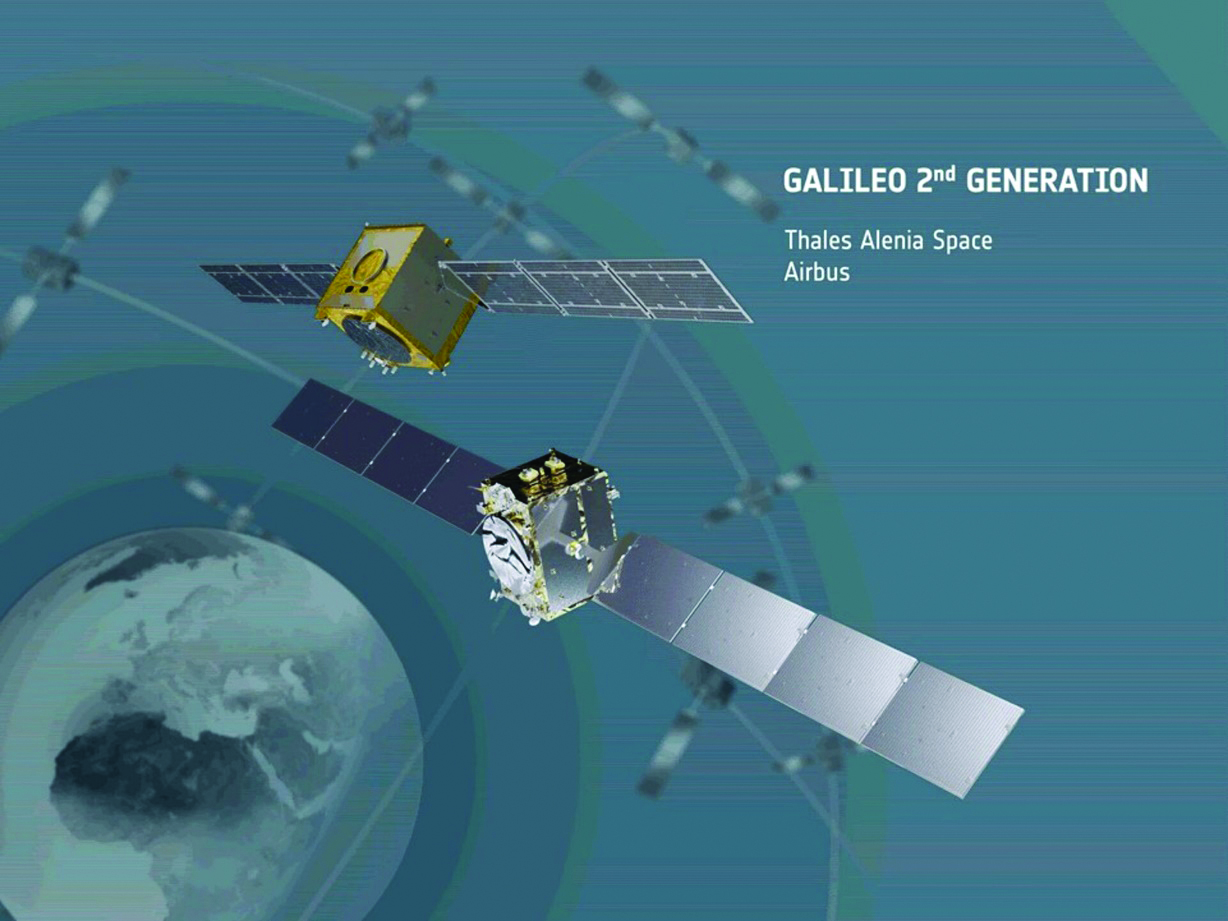
    Photo:
    G2G batch number one (G2SB1) satellites.

    Galileo Second Generation System PDR
    The Galileo Programme is not only focusing on short-term G2G development activities, but also looking forward to the future in terms of the consolidation and definition of G2G final operation capabilities. During the second half of 2022, more than 200 public representatives from the EC, EUSPA, ESA and Member States held countless meetings in the frame of the G2G system preliminary design review, which concluded in early December 2022.

    As part of this review, the long-term implementation (G2G in orbit capability, or IOC, and final operational capability, or FOC) was reviewed and an agreement was reached on future steps. The evolution of Galileo capabilities will not only provide better services through advanced technical solutions, but will also ensure continuity of service and enhanced backward compatibility for first-generation legacy users.

    Conclusions
    The efforts of ESA and EUSPA continue with the aim of providing users continuous and stable services and evolving space and ground infrastructure to maintain Galileo competitiveness with the other global navigation satellite systems.


    For analogous updates on the other three GNSS constellations, please see:

  • Payload integration begins next Galileo launch

    The first of two Galileo navigation satellites to be orbited on Arianespace’s May 24 Soyuz flight has been integrated on its payload dispenser system, marking a key step as preparations advance for this medium-lift mission from French Guiana.

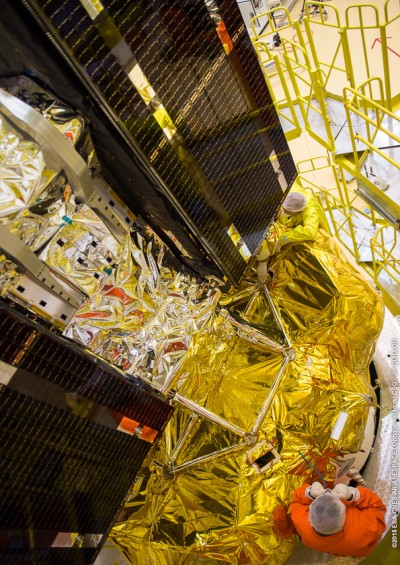
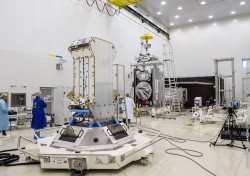
    Named “Danielė,” the Galileo 13 spacecraft was installed this week during activity inside the Spaceport’s S3B payload preparation facility. It is to be joined on the dispenser system by the mission’s other passenger, “Alizée” or Galileo 14, whose own installation is forthcoming, in a side-by-side arrangement.

    The pair — each named after children who won a European Commission-organized painting competition in 2011 — are then to be mated atop Soyuz’ Fregat upper stage and encapsulated in the protective payload fairing. Prime contractor OHB System in Bremen, Germany produced the satellites, and their onboard payloads are supplied by UK-based Surrey Satellite Technology Limited (SSTL) – which is 99-percent owned by Airbus Defence and Space.

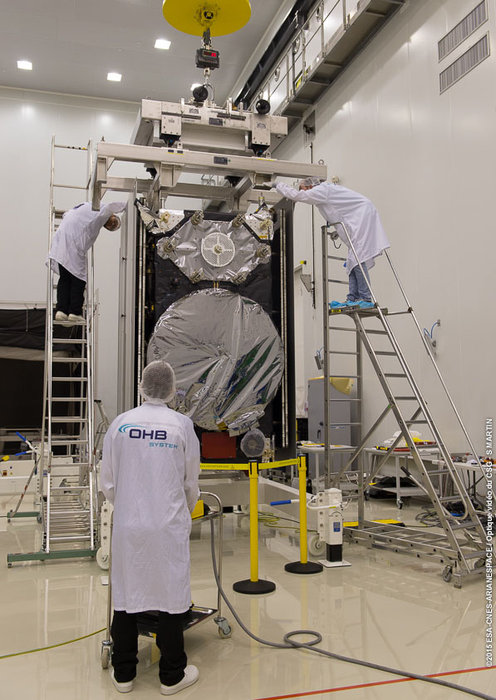
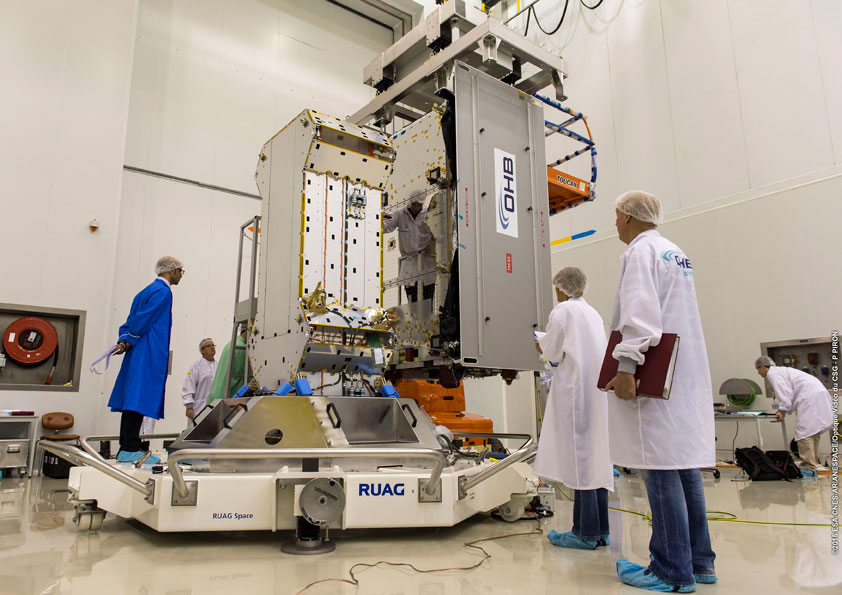
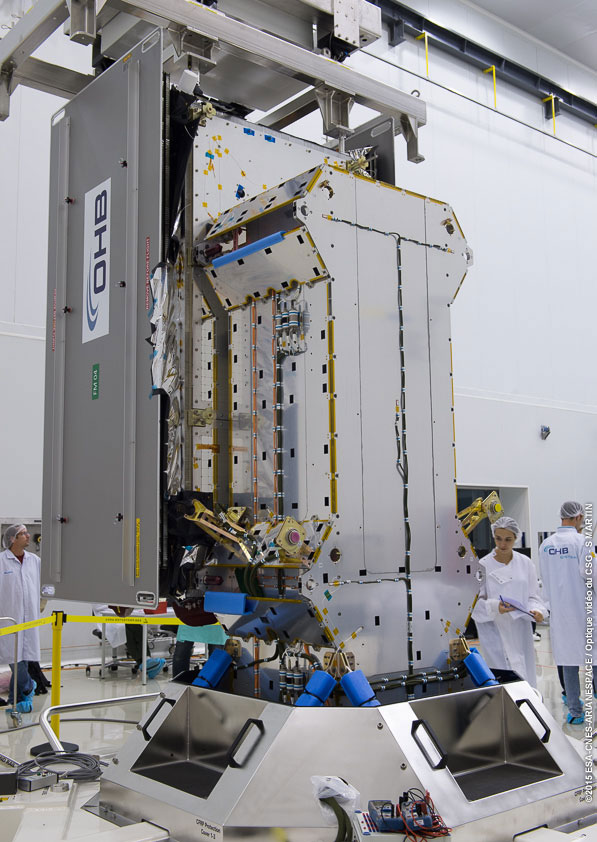
    The Galileo FOC satellite “Danielė” is moved into position, then integrated on its payload dispenser at the Spaceport’s S3B payload preparation facility. (Photo: Arianespace)
    The Galileo FOC satellite “Danielė” is moved into position, then integrated on its payload dispenser at the Spaceport’s S3B payload preparation facility. (Photo: Arianespace)

    “Danielė” and “Alizée” will become the 13th and 14th FOC (Full Operational Capability) spacecraft to join Europe’s Galileo navigation system, which was conceived to provide high-quality positioning, navigation and timing services under civilian control. Its FOC phase is managed and funded by the European Commission, with the European Space Agency (ESA) delegated as the design and procurement agent on the Commission’s behalf.

    The May 24 flight is designated Flight VS15, and will be performed from the purpose-built ELS launch complex at Europe’s Spaceport. Arianespace’s Soyuz will carry out a nearly 3-hour, 48-minute mission to place its Galileo passengers into a targeted circular orbit at an altitude of 23,522 kilometers, inclined 57.394 degrees to the equator. Total payload lift performance is estimated at 1,599 kg.

  • Galileos in the zone for Thursday’s launch

    Galileos in the zone for Thursday’s launch

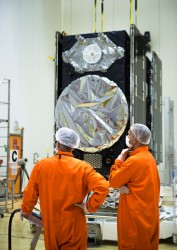
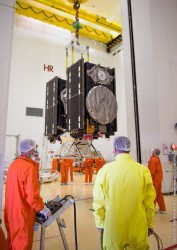
    Galileo satellites 11 and 12 are mated with their dispenser. (Photo: ESA)
    Galileo satellites 11 and 12 are mated with their dispenser. (Photo: ESA)

    News from the European Space Agency

    Galileos 11 and 12 are on the launch pad, attached to the top of their Soyuz rocket in readiness for this week’s launch. Europe’s next navigation satellites are due for launch at 11:51 GMT (12:51 CET, 08:51 local time) on Thursday, Dec. 17, from Europe’s Spaceport in French Guiana.

    On Dec. 10, the two satellites, already attached to their carrier, were fixed to the Fregat upper stage before the halves of the protective Soyuz fairing were closed around them on Friday. This marked the completion of the ‘upper composite’ — the combination of Galileo satellites, dispenser and the upper stage that will fly them the bulk of the way up to their medium-altitude orbit.

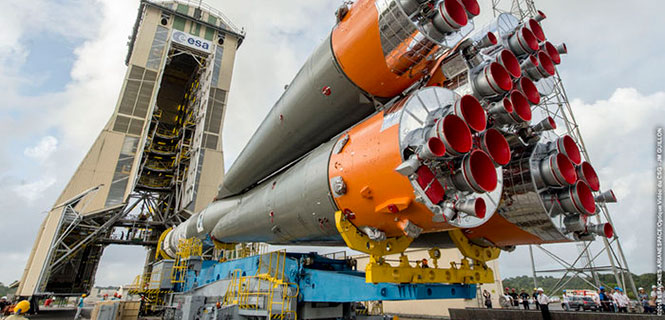
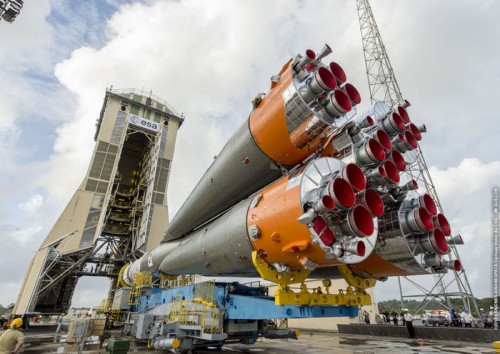
    Meanwhile, the first three stages of the Soyuz were assembled horizontally, rolled out to the pad, and raised to the vertical. The upper composite was moved to the pad on Sunday afternoon, hoisted to the top of the tower and then then carefully attached to Soyuz.

    The Dec. 14 Launch Readiness Review opened the way to Soyuz fueling and finally launch.

    Galileos 11 and 12 are on the launch pad, attached to the top of their Soyuz rocket in readiness for this week’s launch. (Photo: ESA)
    Galileos 11 and 12 are on the launch pad, attached to the top of their Soyuz rocket in readiness for this week’s launch. (Photo: ESA)

    This latest Galileo campaign began with the arrival of the satellites in French Guiana on Oct. 30. This is the sixth Galileo launch overall, and the third launch of 2015, and will bring the number of Galileo satellites in space to 12. It takes place just 11 days before the 10th anniversary of the liftoff of Europe’s very first navigation satellite.

    The experimental GIOVE-A took off on Dec. 28, 2005, to reserve operational frequencies, test key hardware and gather data on the orbital environment for the Galileo constellation to follow. GIOVE-B followed in April 2008.

    Since then, not only has the first third of the Galileo constellation reached orbit, but a network of Galileo ground stations has been erected across the globe.

    In future, the number of satellites that can be inserted into orbit with a single launch will double from two to four, when a customized Ariane 5 rocket becomes available to complement Soyuz.

    Follow the launch activity at www.arianespace.com.

  • Galileo satellites 11 and 12 integrated for Arianespace’s year-end mission

    Galileo satellites 11 and 12 integrated for Arianespace’s year-end mission

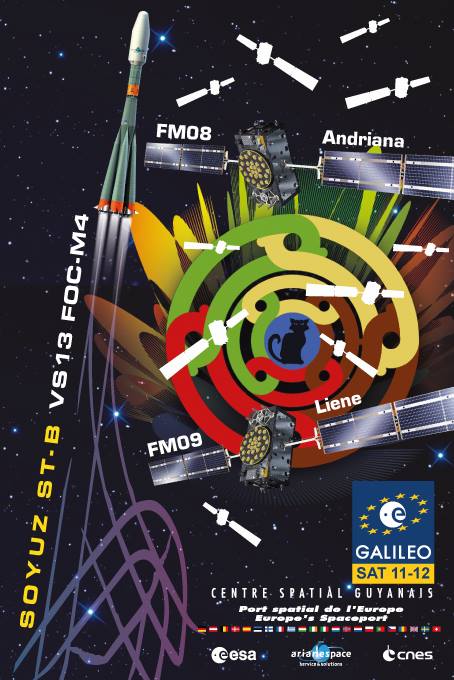
    Galileo-launch-11-12
    Launch poster for the upcoming launch of Adriana and Liene, also known as Galileo 11 and 12.

    The two spacecraft for Arianespace’s latest Soyuz launch at the service of Europe’s Galileo satellite-based navigation system — and the company’s record 12th mission overall in 2015 — have been integrated at the French Guiana Spaceport in preparation for their Dec. 17 liftoff.

    The launch of Galileo satellites 11 and 12 — dubbed Adriana and Liene — will conclude a year when the number of Galileo satellites in orbit will have doubled.

    With this launch, ten years after the launch of GIOVE A, on Dec. 28, 2005, the Galileo constellation will become a reality.

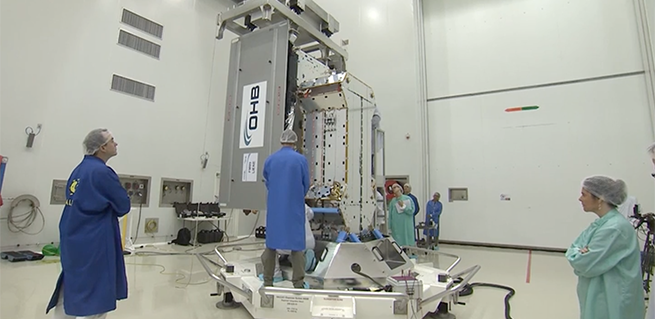
    During activity in the Spaceport’s S3B clean-room facility, the spacecraft pair was mated with their dispenser, which will deploy the satellites by firing a pyrotechnic system for separation in opposite directions at the orbital insertion point.

    The satellite/dispenser combination is ready for integration on Soyuz launcher’s Fregat upper stage, followed by the payload fairing encapsulation. This will create the “upper composite,” which is to be installed atop Soyuz once the vehicle has been moved to its Spaceport launch site.

    Arianespace’s Dec. 17 mission, designated Flight VS13 in the company’s launcher family numbering system, will orbit two Galileo FOC (Full Operational Capability) satellites, further augmenting the European constellation of navigation spacecraft.  The satellites are built by prime contractor OHB System in Bremen, Germany, with their onboard payloads supplied by UK-based Surrey Satellite Technology Ltd (SSTL), which is 99 percent owned by Airbus Defence & Space.

    Galileo-11-12-cleanroom
    Galileo 11 and 12 are prepared for launch in the clean room. (Video capture: ESA)

    The Galileo system is designed to provide high-quality positioning, navigation and timing services under civilian control. Its Full Operational Capability phase is managed and funded by the European Commission, with the European Space Agency (ESA) delegated as the design and procurement agent on the Commission’s behalf.

    Flight VS13 will close out a busy year — complementing the 11 previous missions in 2015, which were composed of two other launches with the medium-lift Soyuz, three using the light-lift Vega and six with the heavy-lift Ariane 5.

    Below is an ESA video about the upcoming launch.

    Follow Arianespace’s launch activity at www.arianespace.com.

  • Galileo Launch Maintains 2015 Record Pace for Arianespace

    Galileo Launch Maintains 2015 Record Pace for Arianespace

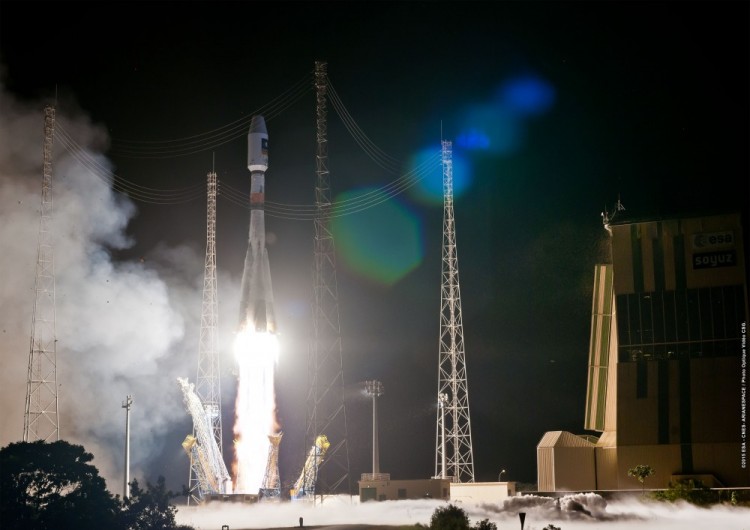
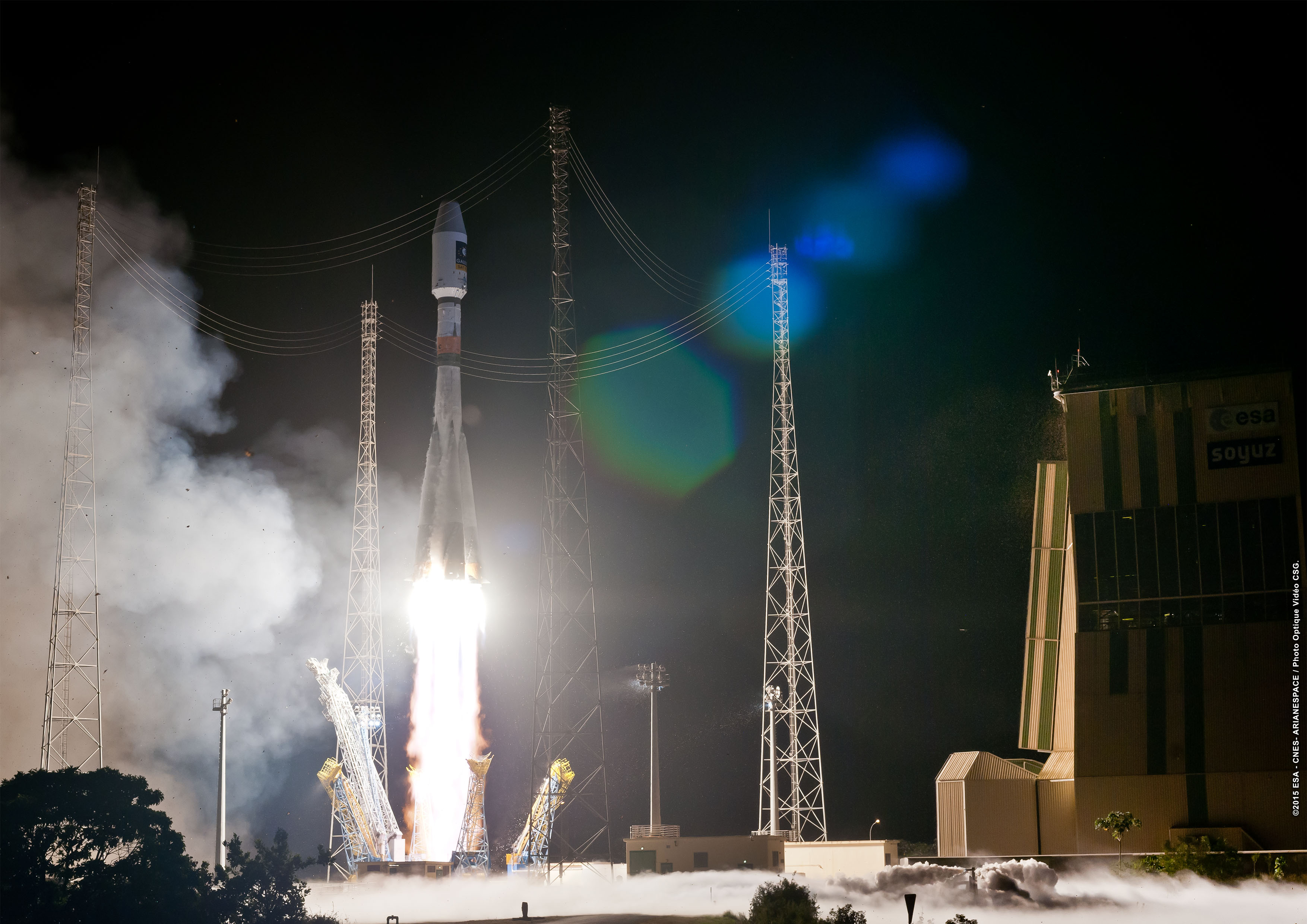
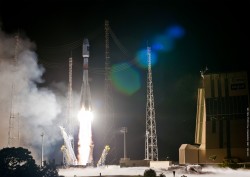
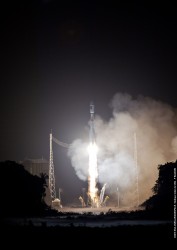
    Soyuz launches Galileo 9 and 10 into orbit on Sept.10. (Credit: Arianespace)
    Soyuz launches Galileo 9 and 10 into orbit on Sept.10. (Credit: Arianespace)

    Arianespace’s 12th Soyuz flight from the Spaceport in French Guiana orbited two more spacecraft for Europe’s Galileo satellite navigation system on Sept. 10.

    2015 is an important year for Arianespace at the service of European institutions, with 11 payloads to be orbited utilizing the company’s family of Soyuz, the heavy-lift Ariane 5 and lightweight Vega, Arianespace Chairman and CEO Stéphane Israël said after the liftoff.

    Departing the Spaceport’s ELS launch complex near the city of Sinnamary at the planned exact liftoff time of 11:08:10 p.m. (local time in French Guiana), Soyuz deployed its two latest Galileo passengers after a flight of just under three hours and 47 minutes. This included the propulsion of Soyuz’ first three stages and two burns of its Fregat upper stage.

    Israël noted these are the ninth and tenth Galileo spacecraft orbited by Arianespace, joining a constellation that ultimately will consist of 30 satellites. The satellites, named Alba and Oriana, are the latest FOC (Full Operational Capability) satellites, which are to operate in Galileo’s Orbital Plane A — one of three orbital planes being populated by the European navigation spacecraft.

    The European Commission is managing and funding Galileo’s FOC phase, during which the network’s complete operational and ground infrastructure is being deployed. Design and procurement agent responsibilities have been delegated to the European Space Agency (ESA) on the Commission’s behalf.

    Arianespace is set to launch two more satellites with Soyuz by year-end, before handing this task over to Ariane 5 beginning in 2016 with a launch carrying four satellites. One more Soyuz and two more Ariane 5s will continue the activity in 2017-2018.

    “Galileo keeps us busy, and Arianespace is very proud to be the reference partner of this European flagship space program,” Israël said.

    After expressing his appreciation to the European Commission and ESA for their confidence, he noted that 2015 is an important year for Arianespace at the service of European institutions, with 11 payloads to be orbited utilizing the company’s family of Soyuz, the heavy-lift Ariane 5 and lightweight Vega.

    “These satellites address all space applications: navigation, Earth observation, science and technology, meteorology and secured communications,” Israël explained. “Thanks to our launcher family, we are fully capable of addressing all needs of European institutions.”

    Soyuz’ flight with Galileo’s Alba and Oriana satellites occurred during the eighth of 12 Arianespace missions planned for 2015 — which will be a new record for the company’s launcher family.  Its preparations at the Spaceport included the first use of the new FCube fueling facility, which is part of improvements in French Guiana to increase launch capacity, flexibility and schedule robustness.

    Israël acknowledged those who contributed to this latest Arianespace success, including the Russian federal space agency, Roscosmos, and the country’s industrial partners; along with the European support companies; the French CNES space agency, and Arianespace own teams.

  • Galileo Satellites Topped off for Sept. 10 Launch

    Galileo Satellites Topped off for Sept. 10 Launch

    UPDATED 08/28/15 with information from the European Space Agency.

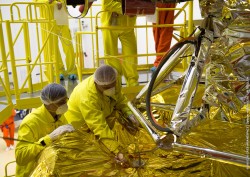
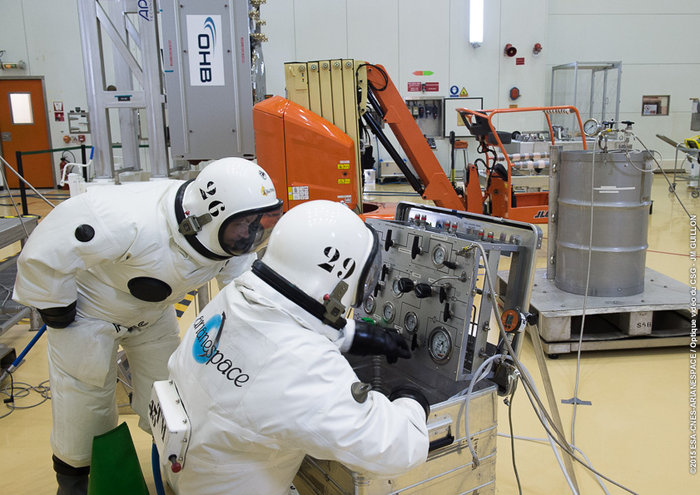
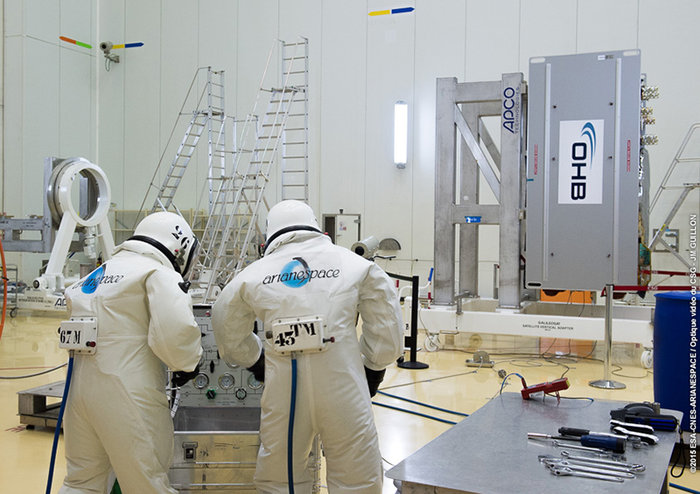
    Europe’s ninth and tenth Galileo satellites being fueled by technicians in protective SCAPE suits within the Guiana Space Centre’s 3SB preparation building on 24 August. This left them ready to be attached to their launcher upper stage in preparation for launch. (Photo:ESA)
    Europe’s ninth and tenth Galileo satellites were fueled Aug. 24 by technicians in protective SCAPE suits within the Guiana Space Centre’s 3SB preparation building. This left the satellites ready to be attached to their launcher upper stage in preparation for launch. (Photo:ESA)

    The two European Galileo navigation satellites for Arianespace’s next mission from French Guiana have been fueled at the Spaceport, readying them for integration with their Soyuz launcher.

    Galileo full operational capability (FOC) satellites 9 and 10 were “topped off” during activity this week at the Spaceport’s S3B payload preparation facility, further advancing preparations for the Sept. 10 mission — which is designated Flight VS12 in Arianespace’s launcher family numbering system, signifying the 12th liftoff of the medium-lift Soyuz vehicle from French Guiana. Lift-off is scheduled for 02:08:10 p.m. UTC.

    Galileo-sat-in-SoyuzFlight VS12’s satellites are the fifth and sixth in Galileo’s FOC phase. They were produced by OHB System, with Surrey Satellite Technology Ltd. supplying their navigation payloads that will generate precise positioning measurements and services around the world.

    The Sept. 10 mission will be the fifth Soyuz flight with Galileo satellites performed by Arianespace from French Guiana — a series that began with the Russian-built launcher’s inaugural liftoff at the Spaceport in Oct. 2011.

    At full deployment, the Galileo program will consist of 30 satellites — comprising operational spacecraft and reserves — situated on three circular medium Earth orbits at some 23,200 km. altitude inclined 56 degrees to the equator. The constellation — and associated ground infrastructure — will provide high-quality positioning, navigation and timing services under civilian control, and be interoperable with GPS and the Russian GLONASS.

    Galileo’s FOC phase is managed and funded by the European Commission, with the European Space Agency delegated as the design and procurement agent on the commission’s behalf.

    Arianespace Flight VS12 will be the company’s eighth mission this year, following the successful launches in 2015 of four heavy-lift Ariane 5s, two lightweight Vega vehicles, and one Soyuz.

    Technicians donned spacesuit-like SCAPE (Self Contained Atmospheric Protective Ensemble) suits to fill each satellite with sufficient hydrazine fuel for their planned 12 years of operations in space, the European Space Agency describes in a news release. This fuel is needed for fine-tuning of their orbital paths following their launch, followed by routine orbital and attitude control over the course of their working lives.

    Each Galileo satellite needs to keep its navigation antenna trained on Earth’s disc at all times, employing dedicated infrared Earth and Sun sensors for this purpose. This marked the first time Galileo had been fuelled within the Guiana Space Centre’s 3SB preparation building. Previously, the S5 fuelling building was dedicated to this purpose, but upgrades by Arianespace mean fuelling can now take place at the same location where they will subsequently be attached to their Fregat upper stage, streamlining the satellite preparation process. Completion of fuelling means the two satellites are essentially ready for launch — what needs to be accomplished now is to first attach the Galileos to their launch dispenser, then to fix this in turn to their Fregat.

    The satellites plus Fregat will then be encapsulated within the launcher fairing, after which this ‘upper composite’ can then be attached to the other three stages of the Soyuz ST-B launcher. The latest Galileo launch campaign commenced at the end of July, with the arrival of the satellites in French Guiana on July 24. A “fit check” followed, to confirm the satellites as delivered in Kourou did indeed fit onto the dispenser that will first secure them in place during launch and then pyrotechnically eject them into their orbits once their target 23 222 km altitude medium-Earth orbit has been reached. This was followed by in-depth system checks and final settings of onboard navigation and data handling software parameters.

    Two further Galileo satellites are still scheduled for launch by end of this year. One of these satellites is completing testing at ESA’s ESTEC technical centre in Noordwijk, the Netherlands, while the other one has already completed its testing and is awaiting transportation to Kourou in the second half of October.

    In addition the first satellite of the following batch has arrived at ESTEC and is currently undergoing its thermal vacuum test. Another flight model will arrive at ESTEC by mid-September.

    Fueling Galileo 9 and 10.(Photo:ESA)
    Fueling Galileo 9 and 10.(Photo:ESA)
  • Salvage in Space: Galileo Satellites Recovered

    In August 2014, they were considered lost: Two Galileo satellites ended in the wrong orbit after their launch by a Soyuz from Kourou, French Guiana. Now the two satellites have been recovered and should be able to fulfill, at least partially, their mission, according to the ESA (the European Space Agency) — a situation made possible by the extended Galileo team, ESA and agency partners.

  • Galileo Satellites Ready for Fueling as Launcher Takes Shape

    Galileo Satellites Ready for Fueling as Launcher Takes Shape

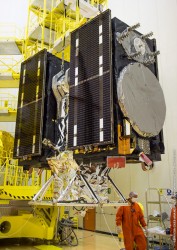
    Galileo satellite being prepared for fit check. This testing, to ensure the seventh and eight Galileo satellites fit onto their dual-launch dispenser took place in mid-February 2015. The dispenser sits atop the Fregat upper stage of their Soyuz ST-B launcher.
    Galileo satellite being prepared for fit check. This testing, to ensure the seventh and eight Galileo satellites fit onto their dual-launch dispenser took place in mid-February 2015. The dispenser sits atop the Fregat upper stage of their Soyuz ST-B launcher. Photo: European Space Agency

    By the European Space Agency

    All the elements for this month’s Galileo launch are coming together at Europe’s Spaceport in French Guiana. As the two satellites undergo final testing and preparations, the first part of their Soyuz launcher has also been integrated.

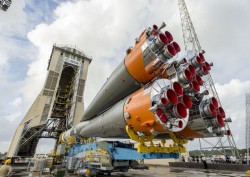
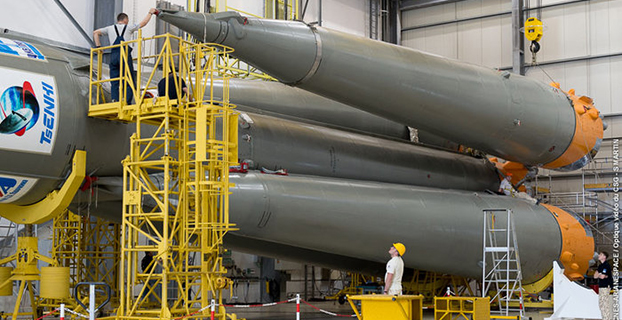
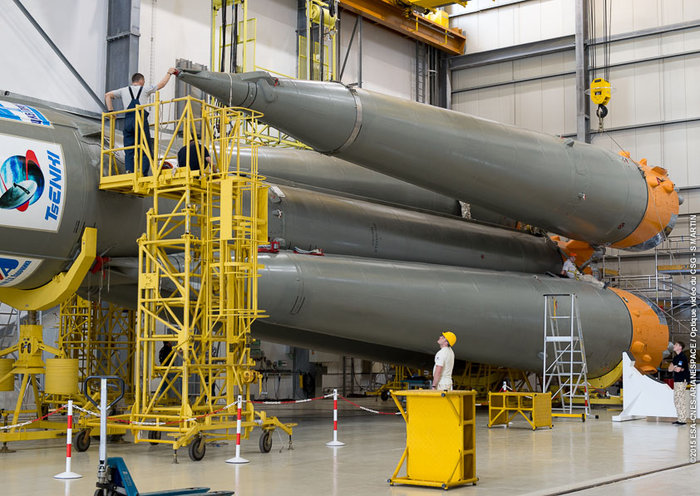
    Assembly of the Soyuz ST-B’s first two stages, plus its four first stage boosters, took place at the Spaceport’s Soyuz Launcher Integration Building last week. Assembly takes place on a horizontal basis, in the Russian manner.

    The next step will be the addition of the third stage, then the main part of the launcher will be complete, ready to be transported to the Soyuz launch pad and moved to the vertical position.

    The final fourth stage of the Soyuz is the reignitable Fregat, which will transport the two satellites to their final 23,222-km altitude medium Earth orbit. This will be attached to the Soyuz on the launch pad, once the satellites, their dispenser and launch fairing have been mounted on it.

    Since the seventh and eighth Galileo satellites arrived in French Guiana last month, they have undergone several tests – including one System Compatibility Test Campaign each, where they are linked up to the rest of the global Galileo ground segment as if they are already ‘live’ in orbit.

    Assembly of seventh and eighth Galileo satellites' Soyuz ST-B’s first two stages, plus its four first stage boosters, took place at the Spaceport’s Soyuz Launcher Integration Building in the first week of March 2015. Assembly takes place on a horizontal basis, in the Russian manner.
    Assembly of seventh and eighth Galileo satellites’ Soyuz ST-B’s first two stages, plus its four first stage boosters, took place at the Spaceport’s Soyuz Launcher Integration Building in the first week of March 2015. Assembly takes place on a horizontal basis, in the Russian manner. Photo: European Space Agency

    The all-important ‘fit check’ was passed in the middle of February. The two satellites were installed separately onto their dual-launch dispenser, to check they fitted correctly.

    This dispenser has the task of holding them in place atop the Fregat during the launch and flight to their final orbit, then releasing them. They will be installed together later this month, after the satellites have been fueled.

    Last week saw the finalization of their hardware and software, and the charging of their batteries — on which the satellites will be reliant from the short but crucial period from their launch to the unfurling of their solar arrays in orbit.

    The pair of satellites is now ready to be transferred to the Spaceport’s S5A fueling facility, where they will receive the fuel to keep them controllable during their 12-year working lives.

    After their fueling and final check, the pair of satellites will be in launch configuration. After a final review they will then become available for Arianespace teams to carry out the final preparation, known as Combined Operations, leading to the launch day.

    The launch of the seventh and eighth Galileo satellites will take place on Friday, March 27.

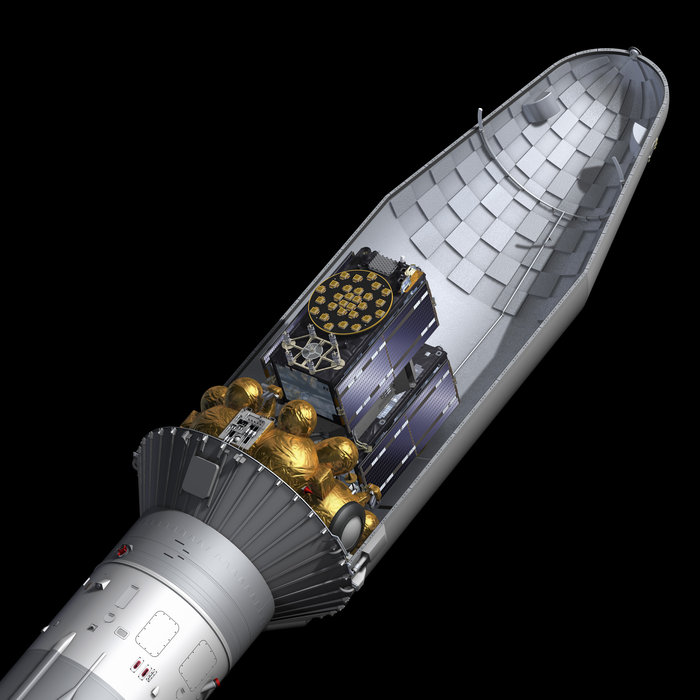
    Cutaway view of the Soyuz rocket fairing carrying a pair of Galileo satellites. Photo: European Space Agency
    Cutaway view of the Soyuz rocket fairing carrying a pair of Galileo satellites. Photo: European Space Agency
  • Arianespace Soyuz Begins Integration for March 27 Galileo Launch

    The Soyuz launcher for Arianespace’s upcoming mission with two European Galileo navigation satellites is taking shape at the Spaceport for a March 27 liftoff from French Guiana.

    “During activity in the Spaceport’s Soyuz Launcher Integration Building, the medium-lift workhorse began to assume its iconic form with integration of the four first-stage strap-on boosters to the Block A core second stage,” Arianespace wrote in an statement.

    “The next step will be the mating of Soyuz’ Block I third stage to the launcher’s core, completing the basic build-up, and readying the vehicle for its rollout to the launch pad — where the payload will be mated.”

    The March 27 flight will be the 11th Soyuz flight from French Guiana since the launcher’s introduction at the Spaceport in October 2011. It is designated Flight VS11 in Arianespace’s numbering system for its launcher family, which also includes the heavy-lift Soyuz and lightweight Vega.

    For the upcoming Soyuz mission, Arianespace will loft Galileo’s third and fourth Galileo Full Operational Capability (FOC) satellites to further expand the constellation. Flight VS11’s two satellites were built by OHB System, with Surrey Satellite Technology Ltd. supplying their navigation payloads.

    Galileo’s complete operational network and its ground infrastructure will be deployed during the program’s Full Operational Capability phase, which is managed and funded by the European Commission. The European Space Agency has been delegated as the design and procurement agent on the Commission’s behalf.

  • Third, Fourth Galileo FOC Satellites Confirmed Fit for Soyuz Launch

    Source: GPS world staff
    The Flight Model #3 (FM3) spacecraft is moved for positioning on the payload dispenser. (Photo credit: Arianspace)

    The third and fourth Galileo Full Operational Capability (FOC) satellites are a confirmed “fit” for their Arianespace Soyuz launch March 27, having made initial contact with the mission’s dual-payload dispenser in French Guiana, according to Arianespace.

    The fit check was completed over a two-day period inside the Spaceport’s S1A payload preparation building. The two satellites were installed separately, with the Flight Model #3 (FM3) spacecraft integrated on — and subsequently removed from — the dispenser on Feb. 9. Flight Model #4 (FM4) underwent the same process the following day.

    The payload dispenser for Galileo was developed by RUAG Space Sweden for Arianespace, and carries one satellite on each side. It will deploy the spacecraft during the Soyuz launch by firing a pyrotechnic separation system to release them in opposite directions at the orbital insertion point.

    Source: GPS world staff
    Flight Model #4 (FM4) after its integration. (Photo credit: Arianspace)

    Final integration on the dispenser is to be performed during upcoming processing at the spaceport, and will be followed by the completed unit’s installation on Soyuz.

    The March 27 mission — designated Flight VS11 in Arianespace’s numbering system — will be the company’s fourth launch carrying spacecraft for the Galileo constellation. FM3 and FM4 were built by OHB System, with Surrey Satellite Technology Ltd. supplying their navigation payloads.

    The Galileo network’s complete operational and ground infrastructure will be deployed during the Full Operational Capability phase, which is managed and funded by the European Commission. The European Space Agency has been delegated as the design and procurement agent on the commission’s behalf.

  • 2, 4, 6, 8 — Who Do We Appreciate?

    Galileo, that’s who! For dogged determination and persistent pushing-forwardness in the face of adversity, obstacles, and the occasional technical difficulty. That there may be occasional confusion, as well, or mixed messages as to just what the future may bring, is certainly understandable. In fact, it is to be expected, given the circumstances.

    Let’s review the math.

    Two

    Two for the two launch vehicles that Galileo may use in the near future, Soyuz Fregat and Ariane 5. The Soyuz rocket can lift two satellites of the Galileo punching weight. The Ariane 5 rocket can carry four into space.

    Soyuz Fregat has a losing record so far with Galileo, being responsible for the August 2014 loosening of the first two full-operational capability (FOC) satellites into the dangerous Van Allen Belt. The first of these satellites has been successfully repositioned by the European Space Agency (ESA) into a mostly-but-not-totally useable orbit, and the second is currently en route to a similar spot.

    We do not wish to say we told you so, but we will. Back on March 26, 2014, we wrote on these virtual pages, “ESA’s year-end plan calls for two more dual-satellite launches in October and December on Russian Soyuz rockets — new partners to the Galileo dance, bringing perhaps new technical connectivity issues.”

    “Rockets are tricky,” said Tesla/SpaceX CEO Elon Musk, after his Falcon 9 Reusable rocket exploded over Texas at roughly the same time that Soyuz Fregat mis-delivered two Galileo satellites into wrong orbits.

    Musk meant tricky in actual operation, but we may also add, tricky in scheduling, in getting a cargo aboard a spacebound vehicle. Arianespace’s calendar is particularly filled with telecomm satellites impatient to be put aloft, with Ariane 5 being the preferred launcher of many. Soyuz availability, understandably, is somewhat more open.

    Four

    Four for the total of four Galileo satellites now orbiting and broadcasting useable signals at all times for all users. These four come from the in-orbit validation (IOV) generation.

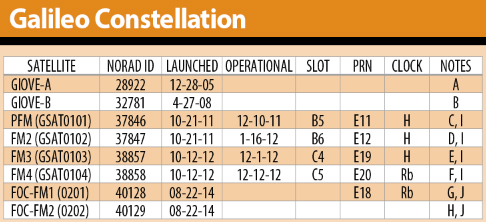
    Galileo-chart-Jan2015

    The two added FOC satellites, no longer in a bad orbit, now in a sort-of-pretty-good orbit, should be useable at some times, for some purposes, by some people. Peter Steigenberger and André Hauschild, researchers at the German Aerospace Center (DLR) / German Space Operations Center, wrote in this magazine in January that:

    “Despite the orbit injection error, the new Galileo FOC satellite has now been successfully activated and added to the Galileo constellation. Unfortunately, the current orbit is incompatible with the standard Galileo almanac format, which may cause restrictions for some commercial receiver types.

    “Nevertheless, the satellite can already be tracked by a wide range of geodetic receivers with existing firmware versions and it will, in fact, be possible to use the new satellite for diverse applications in surveying, precise positioning, and geodesy, as well as in general multi-GNSS studies. We now look forward to the activation of the second FOC satellite, which can be expected in early 2015 and will, for the first time, offer multi-frequency signals from a total of five Galileo satellites.”

    If you have four fully useable satellites and two partially useable satellites, what do you have? Does six = five functionally in this case? Or perhaps 5.5?

    Six

    Six for the oncoming new Galileo FOC satellites to be launched in 2015, according to some schedules and some official announcements.

    On a year-opening preview of operations given on Jan. 19, Thomas Reiter, Head of the European Space Operations Centre (ESOC) in Darmstadt, Germany, outlined the launch schedule for Galileo in 2015. Six new FOC satellites in total:

    • Galileo L4 with two on March 26
    • Galileo L5 with two in September
    • Galileo L6 with two in December.


    Now, six satellites divided by three launch dates gives two satellites per launch. Seeming to indicate a Soyuz rocket for all three dates. Reiter did not mention any rocket by name, but this would be the inference.

    That’s putting a brave face on the situation. Back in May, Russia suffered its fifth rocket launch crash in the past four years, raising serious concerns about the reliability of Russian rockets and launch procedures. Subsequently, the August Galileo launch that went so wrong was controlled by Arianespace, but it did use the Russian equipment.

    It strains credulity that an omission or oversight in the system thermal analysis  during stage design of a million-dollar rocket, designed to carry million-plus-dollar satellites in a 21st-century endeavor, could permit the creation of a thermal bridge between two feed lines, causing one of them to freeze during a crucial phase of space operations — but that is what apparently happened at some point at NPO Lavochkin in Russia, and that is what ultimately caused Galileo such misfortune. All parties concerned swear that this problem has been corrected in every other Soyuz Fregat, but who knows what other anomalies lie undiscovered therein?

    So putting all your 2015 money aboard Soyuzes is really rolling the marbles. Even if, as Elżbieta Bienkowska, Member of the EC in charge of Internal Market, Industry, Entrepreneurship and SMEs stated at this week’s 7th European Space Conference: EU Space Policy Confronted With the Rising Demand for Services and Applications, “We agreed to contract insurance for the next launches.”

    Eight

    Eight for the oncoming new Galileo FOC satellites to be launched in 2015, according to other schedules and other official announcements.

    “2015 will be a crucial year for the European space industry. We have big plans,” said Maros Sefcoviv, vice-president of the EC in charge of Energy Union, earlier at the very same 7th European Space conference, EU Space Policy Confronted With the Rising Demand for Services and Applications.

    “On the biggest one, we are planning five launches, which will bring up to space 10 satellites: eight for our Galileo constellation, and two for Copernicus. This is something that will put these programs over, I would say, over the edge, in a way, to be able to offer early services from Galileo, and to develop the program of Copernicus. It would prove the resilience and competitiveness of the European space industry, and its ability to serve the businesses, and what I think is most important, to offer new kinds of services to the citizens.”

    “For our flagship programs like Galileo and EGNOS, our priority must be to deliver services as soon as possible. That is why the satellites have to be delivered and operations must be ready as soon as possible.”

    Now, if you have eight satellites to go up in three launches, that would mean one of them has to go with four aboard. Thus, an Ariane 5 Galileo launch this year after all? Or possibly four Soyuz launches, although one more launch date could just just as hard to come by as a launch vehicle.

    Hard to tell. Very hard to tell. Extremely hard to tell, from the outside.

    Those who do not study history are condemned to repeat it, goes the dictum. Those who do study GNSS history, in this case, are likely only to repeat past pronouncements without any perceptible advance in clarity.

    Way, way back in March 2013, an EC program manager told GPS World, “Then, in 2014 [after four FOC satellites were to rise in 2013, which did not happen] we will see three Soyuz launches of two satellites each. We do not have the precise launch dates yet, but they are likely to be in April, June, and September. In December 2014, we expect to have the first launch using the Ariane 5 launcher, which is capable of deploying four satellites in one go. This means that by the end of 2014 Galileo will have deployed 18 satellites in orbit.”

    Now, the target has moved several times since then, and the schedule has slid accordingly.

    “In 2015, there will be two Ariane 5 launches, one in the middle of the year, one at the end, each carrying four satellites.”

    Six or Eight?

    Either number this year, we would surely appreciate. To return to Ms. Bienkowska, she left a little fudge room in her presentation: “We aim to launch at least six satellites this year.”

    Well, at least we are all moving forward. Resolutely.

    ——————————–

    I am indebted to Tim Reynolds, GPS World’s Brussels-based European correspondent, and to Peter de Selding, Paris bureau chief of SpaceNews, for their assistance in gathering diverse intelligence on this topic. Tim Reynolds will have an up-to-date view of this and other Galileo developments when we publish the next issue of the EAGER* newsletter at the end of March. Subscribe for free.

    * The European GNSS and Earth Observation Report

  • Improper Fuel Line Installation Led to Incorrect Galileo Orbit

    The cause of two Galileo satellites being released into the wrong orbit August 22 can be traced to improper installation of a hydrazine fuel line, according to Space News and the GalileoGNSS blog.

    The hydrazine fuel line was installed too close to a supercold helium line on the Fregat upper stage, which caused the hydrazine to freeze long enough to upset the Fregat stage’s orientation and cause the two satellites’ release into an orbit that is both too low and in the wrong inclination, officials said as reported on the websites.

    No official report has been issued; the board of inquiry is expected to release its findings this week. 

    The Euro-Russian inquiry board looking into the cause of the failure has discovered that one in four Fregat upper stages at prime contractor NPO Lavochkin in Moscow had the same fuel-line installation, according to the reports. “We have to assume that this was a practice that had gone on in perhaps a quarter of the Fregat stages produced in the past decade, but that it had not affected our launches up to now because of mission-specific aspects like coast time between burns, the number of burns and so on, which can influence the effect of the helium on the hydrazine,” one official is quoted as saying. “In any case, we’d like Arianespace, which currently has almost no inspection rights on the Soyuz, to be given more say in quality assurance.”

    In the stages without the installation issue, the hydrazine and helium lines were separated so that the supercold helium could not freeze the hydrazine. The design did not foresee any problem in putting the lines together, but in fact that is a problem for some missions.

    European Union government and officials are debating how to proceed, the reports said. The options are to continue, as scheduled, with the December launch of two more Galileo satellites aboard a Soyuz Fregat rocket, or to wait until next spring or summer and launch four Galileo satellites on a heavy-lift Ariane 5 vehicle.

    As for the two wayward satellites, in a presentation to the 65th International Astronautical Congress in Toronto September 30, OHB’s Galileo deputy program manager, Kristian Pauly, said he was optimistic that once the satellites’ perigee is raised and their orbit made less eccentric, they can be fitted at least partially into the Galileo program and perform a navigation function, Space News reported. OHB System is the prime contractor for the full operational capability (FOC) satellites.

    The first priority, Pauly said, is to take the two satellites out of regular contact with the Van Allen belts and adjust their Earth sensors to their new, unplanned view of Earth — which is much closer given the lower altitude.

    Pauly did not speculate on what the Galileo launch schedule would be. He said that OHB’s delivery schedule will not change much. “We have a delivery schedule that is extremely challenging and we will keep to it,” he said.