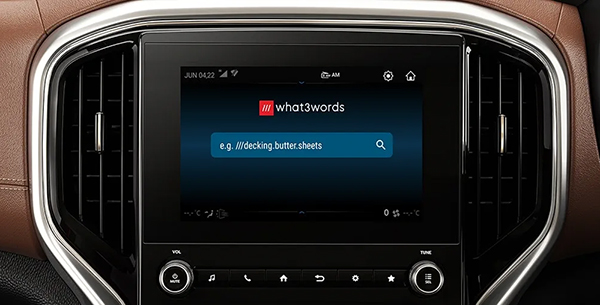
A cockpit platform from Qualcomm Technologies will power the navigation and infotainment system in the new Scorpio-N SUV from Mahindra Auto of India. The navigation system includes the option to use what3words.
Photo: Mahindra
The Scorpio-N features a 17.78-cm color driver information display and 20.32 -m infotainment system with navigation. Leveraging the third-generation Snapdragon Cockpit Platform, the Scorpio-N enables the latest in personalization and natural interaction between a vehicle and its driver. It provides virtual assistance and ultra-high-definition, as well as immersive audio and visual experiences.
The platform helps monitor driving and detect objects for the security of passengers and vehicular data. It features an advanced suite of wireless technologies to support multi-mode cellular connectivity, Wi-Fi 6, and enhanced Bluetooth technologies.
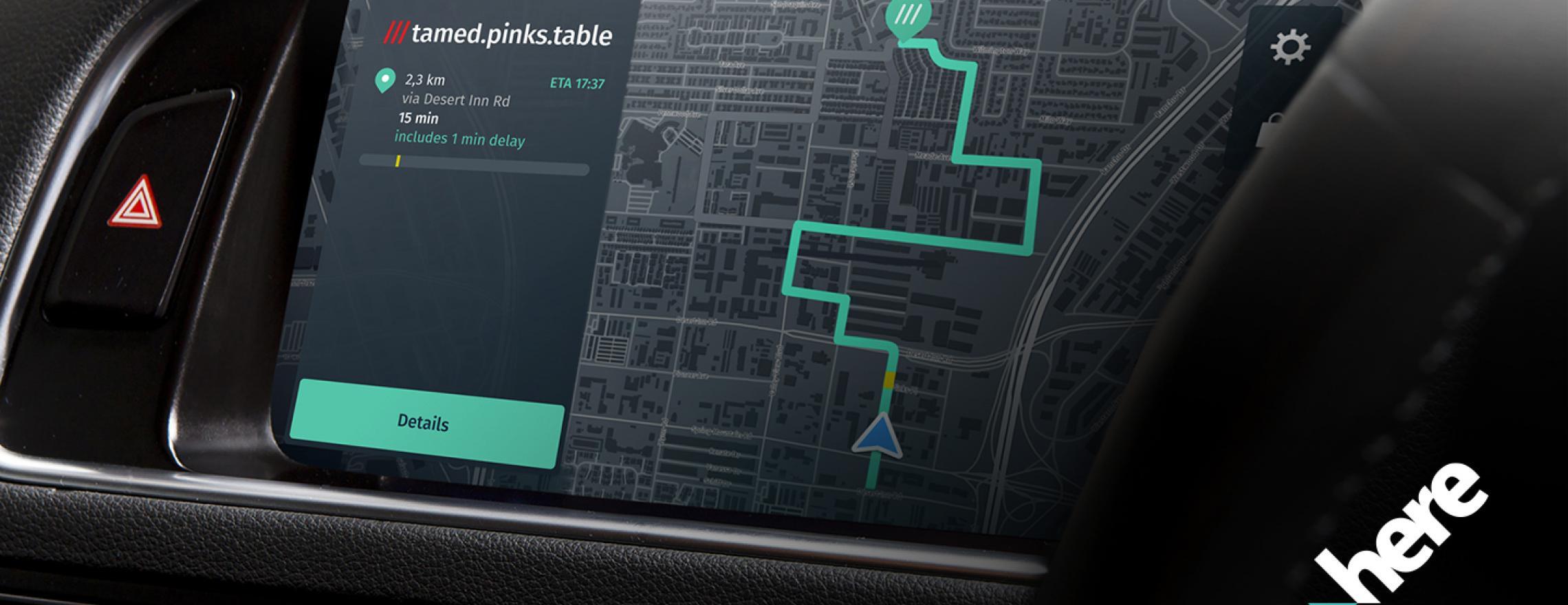
Drivers will now be able to enter what3words addresses directly into their in-car systems, allowing them to navigate to any destination
Image: HERE
HERE and what3words have partnered up to offer the next generation of precision in-car navigation. OEMs using HERE Technologies can now include what3words as an in-car navigation feature, with drivers of enabled vehicles able to navigate to any precise 3-meter square using a what3words address.
HERE is the world’s leading navigation platform with its map data services found in 150 million vehicles worldwide. The platform offers products designed to use the latest location content, such as road networks, buildings and traffic systems. The addition of what3words address entry means that drivers can experience the smartest mapping systems, alongside the break-through address system.
what3words is an innovative addressing system which has divided the world into a grid of 3-meter squares and given each square a unique combination of three words: a what3words address. For example, HERE’s Chicago office can be found at ///memory.traps.lease. what3words enables people to easily convey locations as specific as building entrances or parking spots and it provides easy location references in places with no street addresses, such as beaches, parks and remote hiking trails.
Drivers can input a what3words address directly into their car head unit or connected car app, just as they would a street address or point of interest. Millions of what3words addresses are being used over the world, with drivers finding them in booking confirmations, guidebooks, website contact pages or in messages sent by friends.
Drivers can also discover what3words addresses on the free what3words app or the online map. what3words’ technology has been adopted by global car companies, logistics providers and mobility apps, including Mercedes-Benz, Tata Motors, DB Schenker, Hermes and Cabify.
“HERE is the richest, most accurate and freshest mapping system on the market and it now comes with the easiest way to communicate a location,” Chris Sheldrick, CEO and co-founder of what3words said. “Using a traditional address in a vehicle can be a bad experience. They are clunky and lengthy to type, and even a voice assistant will often mishear you. Once the address is accepted, it won’t take you to a precise location, such as the specific entrance you need, it’ll route you to where the pin drops — which is often the centre of the building.
By using what3words, drivers need simply to enter three words and know they will arrive at that precise 3-metre square. We are seeing increasing demand from automakers and mobility services. Now that we are embedded in HERE, we can enable our address system simply and easily in both new and legacy vehicles.”
“Our partnership with what3words is a solid example of how HERE continues to innovate in the area of navigation,” said Jørgen Behrens, senior vice president and chief product officer at HERE Technologies. “Automotive OEMs and Tier 1 suppliers can now provide the what3words service to their customers with the help of HERE Professional Services instead of having to integrate it themselves. This will allow drivers to navigate easily in dense, urban environments with non-standard addressing schemes or seamlessly get to any location, be it a local pub or a trailhead.”
Incorporating this new feature is easily done for both new and existing clients, with what3words available as an add-on to HERE’s core navigation products.
TomTom and what3words will collaborate to bring what3words addressing to TomTom’s customers globally.
what3words addressing will roll out to TomTom consumer and automotive customers in the second half of 2018. TomTom made the announcement at TU Automotive Detroit.
what3words is a simple way to talk about location. The world is divided into a grid of 3 x 3-meter squares, and each square is assigned a unique three-word address. As such, what3words will complement TomTom’s existing maps, allowing people to accurately find any location and share it more quickly, easily and with less ambiguity than any other system.
The three-word address for TomTom’s head office, for example, can be found at ///pancake.climbing.beaker. The easy-to-use addressing system works well in areas where traditional maps and addressing don’t, including off-road locations and countries without standardized addressing systems such as India and the Middle East, the company said.
GPS World’s sister site, Geospatial Solutions, first discussed the innovation of what3words in 2015. It has since seen adoption by countries (such as Mongolia, Djibouti and Sint Maarten), and national mapping agencies of countries such as Norway and Switzerland. Sygic also adopted it for its fleet solutions.
“Whether you’re trying to find an address in the center of Turin, or on the streets of Tuvalu, TomTom wants to get you there quickly and efficiently,” said Antoine Saucier, managing director of TomTom Automotive. “Our collaboration with what3words demonstrates our commitment to embracing new addressing technology that is easy-to-use and integrates simply into our navigation offering.”
“We are delighted to partner with TomTom, and bring the benefits of more accurate addressing to their customers,” said Chris Sheldrick, CEO and co-founder of what3words. “By using what3words, drivers are able to navigate to any precise location — as specific as a side door, gate or parking spot. Equally, destinations that previously have been unaddressed now have a simple, reliable and easy-to-remember three-word address.”
Sygic is partnering with innovative addressing system what3words.
According to Sygic, its business solutions and consumer apps are used by more than 200 million drivers and 2,000 fleets worldwide including Amazon. Sygic is also the first GPS app to partner with Ford.
The partnership will initially focus on Sygic’s business solutions for taxi, public transport, delivery and construction clients with the aim of a wider integration into Sygic’s commercial products. Clients will be able to turn on three-word addressing within their existing solutions in the coming months.
what3words is a location reference system that has divided the world into 57 trillion 3 x 3-meter squares, each with a unique three-word address. For example, “///droplet.outings.panel” will take you to the front door of Sygic’s headquarters in Bratislava.
“Sygic is committed to exploring the boundaries of navigation, a philosophy that has directly contributed to our enduring reputation as the leader in navigation,” said Martin Strigac, Sygic CEO. “what3words is the simplest way to talk about location and its rapid adoption across sectors means it is quickly becoming a standard. To get from A to B,, you need a map, navigation and to know precisely where A and B are. With what3words, we can now offer a world-class solution across all of these.”
“In-car navigation relies on an antiquated street and postal address system that is no longer fit-for-purpose,” said Chris Sheldrick, CEO and co-founder of what3words. “Poor addressing leaves drivers frustrated and means businesses waste millions every year. We are delighted to partner with Sygic to offer their business customers a more efficient solution to the last-mile challenge.”
Sygic featuring what3words will be showcased at the Post & Parcel Conference, being held March 20-22 in Berlin.
Djibouti, a country located in the Horn of Africa with a population of about 850,000 citizens, adopted what3words as the addressing standard for its postal service.
what3words is a global addressing system that provides a fixed address for every 3-by-3 meter square in the world.
According to what3words, Djibouti is the fifth country in the world to accept its addresses. The country only has a few named streets, so delivering mail is a struggle for La Poste Djibouti, the nation’s official postal system, what3words added.
In addition, until recently, home delivery was restricted to express mail in Djibouti City, the capital of the republic. Any other post would be delivered to P.O. Boxes, where the recipient was responsible for collecting it. what3words provides an easy reference for international mail and enables home delivery for the country.
“Thanks to our partnership with what3words, every place in the country now has a fixed, accurate and immediately assigned address,” said Bahnan Ali Maidal, CEO at La Poste Djibouti. “Each inhabitant living in Balbala or Arhiba, Ali Sabieh or Obock, Randa or Assa Geyla will be able to quickly determine any address, write it on an envelope or communicate it by telephone.”
Available in thirteen languages, including English, French and Spanish, what3words is used by individuals, delivery companies, navigation tools, governments, logistics firms, travel guides and NGOs.
Caribbean Island Sint Maarten has become the third country in the world, and the first in the region, to adopt what3words for its national postal system.
With a population of more than 40,000 people, Sint Maarten is a constituent country of the Kingdom of the Netherlands. As with many of the Caribbean islands, much of Sint Maarten has no official addressing. As a result, the postal service persistently experiences high rates of failed deliveries. The renumbering of houses over past decades has left many homes with multiple addresses, forced different homes to share the same address, or left others with none. As Sint Maarten continues to develop, this patchy system is holding back the growth of ecommerce, tourism and government services.
By using what3words, every location in the country now has an instant address. what3words provides an accurate and fixed address for every 3-x-3-meter square in the world.
As a first step, PSSNV is accepting three-word addresses from all customers, extending the service to both commercial partners and private clients. Customers will be able to identify any three-word address using the free what3words app or website and write it on an envelope.
This gives every citizen a reliable address, whether they live on an unmarked road in the center of the island at overlays.campfire.sometime, are over the bank — a particularly poorly addressed quarter — at inkwell.residing.seabirds, or are moored for the night at music.crunchy.electing.
what3words will be integrated across PSSNV’s internal systems, while postal workers will use a three-word address to navigate directly to the 3-x-3-meter square of a customer’s front door.
“PSSNV is proud to be one of the first countries in the world to adopt this new method of addressing,” said Antonia Wilson, Director of Operations and Commerce for Postal Services Sint Maarten. “With what3words, PSSNV can instantly provide universal access to the postal service. This instant solution will immediately make us more efficient and reduce customer frustrations. We’ve already begun training our staff on this new system and will be communicating three-word addresses to customers across the country through our new website, radio and TV advertising, via leaflets and on all existing mail.”
Disaster Relief. what3words is already being used in the Caribbean to support disaster relief. It was used to support Haiti’s recovery in the wake of October’s Hurricane Matthew in a project funded by the Roddenberry Foundation. Following the recovery work in Haiti, disaster response specialists IHS (Infinitum Humanitarian Systems) made what3words its default service for tracking teams and reporting problems back to the United Nation’s WASH Cluster, a water sanitation task force.
“The entire IHS team converted to what3words while we were deployed. It proved very easy to communicate locations of issues while we were on the move,” said Eric Rasmussen, CEO of IHS. “The team was traveling to support an area out west of Jeremie where about 4,000 people were living in the coastal forest. There we rebuilt a water system for a destroyed school and medical clinic at ruminant.stronger.regularity, providing both power and the first clean water in the area since Hurricane Matthew levelled the place.”
Available in 13 languages, including English, French and Spanish, what3words is used by individuals, delivery companies, navigation tools, governments, logistics firms, travel guides and NGOs. It is more precise than traditional addresses, simpler than descriptions, and easier to communicate and remember than long strings of GPS coordinates. The system has built-in error detection and is available both as a mobile app and API integration. The system works offline without a data connection, ensuring it can be used everywhere. It means
“We are on a mission to change the way people communicate location,” said Chris Sheldrick, CEO and co-founder of what3words. “Sint Maarten has become a global innovator, joining Mongolia and Cote d’Ivoire in leapfrogging the hundreds of other nations that still rely on inaccurate, inconsistent or complex addressing systems. With our partners, from postal systems to ecommerce companies and disaster relief teams, we are making the world a more efficient, less frustrating and safer place.”
Last year, I wrote about a revolutionary addressing system called what3words. I thought that the concept was brilliant in its simplicity and was embarrassed that I didn’t think of it — or at least that someone with a GISP attached to their name didn’t think of it (certified geographic information systems professional).
What3words certainly made its mark. Since 2013, what3words has received numerous high visibility tech awards and raised more than $13.5 million to expand its use. It’s being used by the United Nations, many commercial shipping firms, Google and Esri. What3words even attracted the personal interest of Prince William and Kate.
Some naysayers point to the lack of accuracy and precision (only as good as GPS, so not perfect), but what3words has opened a lot of eyes and has even become the addressing standard for the entire country of Mongolia.
Although some parts of Mongolia are very modern, like the photo to the right, the majority of the country is still isolated with no street addresses, not to mention a nomadic population.
Other challenging location problems include specific homes in third-world shanty towns, such as Rio’s favelas, or weekend tailgating locations at college football games.
The bottom line is that we need reliable universal addressing primarily for locations that are not adequately served by conventional street addresses. Most agree that numeric Lat/Long coordinates are the simplest and shortest description of a position on Earth, but there is one big problem. Humans have a hard time remembering and relating to long strings of numbers. Additionally, communicating long number strings can be difficult with little or no way to error check the results other than maybe a checksum digit.
Numerous systems have been developed to provide understandable and memorable addresses, but what3words seems to have received a lion’s share of the public interest. Others on the “me too” wagon included systems such as Geohash, Mapcode, Openlocationcode and Xaddress. All encode a set of coordinates into more humanly memorable descriptors.
Although I’m pretty much sold on the utility of what3words, recently released Xaddress, which Paraguayan founder Roberto Dam placed into the public domain this year, has benefits that make it a strong contender.
Why Xaddress?
First, I have to preface that I’m not a programmer, and my experience with GitHub and the correspondingly technical community is limited. I struggled with the encoding and decoding process used in Xaddress, since its key selling point is that it is a process that doesn’t require a computer or even a smartphone.
After reading and mucking around the internet, I ran through a number of rabbit holes and trails with geohash, hash-tagging and spatial math discussions that led me to mathematician Felix Klein and his famous Klein’s bottle (which has nothing to do with this issue, but in which I felt trapped).
I then read discussions about the value of mnemonics and how it helps humans relate to complex numbers or other difficult memory tasks. This is where both what3words and Xaddress share a common trait — they both display locations using memorable words. But Xaddress adds four new wrinkles:
Although the encoding and decoding of a location into an Xaddress is most easily done using the algorithm on a computer or smartphone, the process can be done manually. It’s not quick and easy, but it can be done.
The Xaddress also contains a visual graphic object or avatar that is used as a visual error check. If you get the address slightly wrong, the avatar displayed will be completely different. Here is a sample showing slight differences in the number resulting in completely different avatars.
Xaddress also adds the city/country to identify the rough location. (Of course, this could also be done with what3words.)
Lastly, Xaddress is an open-source system, unlike the patented what3words system.
There is much more to Xaddress than I can cover in this short column, so you may want to read Roberto Dam’s more detailed article describing the inner workings of Xaddress. (The numeric to word-encoding process is a bit hard to follow, but give it a chance.)
Additionally, the Xaddress website has numerous other examples and references, and you can try encoding your own addresses.
According to NGOs, the majority of the Earth’s population, an estimated 6 billion people, have no address. In third-world countries of Africa, the Middle East, South East Asia and Latin America, it’s difficult to do the things we take for granted, such as receiving mail, getting parts or supplies to start even a simple business, and — even more critical — getting emergency responders to a fire or medical emergency.
Perhaps, like cellphone technology permitted third-world countries to skip the effort and expense of landlines, new addressing systems may be a shortcut to leapfrog universal addressing.
Six national mapping agencies have adopted what3words, a location reference system that uses three-word addresses. Used to input and share locations within national online geoportals, what3words is making it simpler for businesses, governments, and citizens to find, share and remember addresses, the company said.
Based on a global grid of 57 trillion squares, what3words gives a unique three-word address to every 3 square meters in the world. Available in 13 languages, what3words is used by consumers, delivery companies, navigation tools, governments, logistics firms, travel guides and NGOs. Its creators say it’s more precise than traditional addresses, simpler than descriptions, and easier to communicate and remember than long strings of GPS coordinates.
Geoportals are an integral part of any national, cadastral or commercial mapping agency’s offering, providing businesses and consumers with vital geographic information, the company said. The datasets range from information about land ownership, taxing of land parcels and defining borders, to providing population statistics, changes in land use and integration of transport networks.
Whilst geoportals offer a wealth of detail, the user experience can be complicated and confusing. Integrating what3words into geoportals systems makes it easier for individuals and businesses to share precise locations with a simple three-word address, the company said.
“Geoportals provide users with a huge amount of data that can sometimes alienate all but the mapping expert,” said Chris Sheldrick, CEO and co-founder of what3words. “What3words is making it simpler and easier for individuals and businesses to discover and share locations, helping unleash the power of geographic data.”
As three-word addresses are fixed and unique, meaning they can always be found. The system works offline, using GPS without needing mobile data, and has built-in error detection to ensure the user always selects the location they intended.
Since its launch in 2013, what3words has experienced tremendous success and with over twenty major awards has become one of the most lauded UK startups in recent times. In 2015, the company was awarded the prestigious Cannes Lions Grand Prix for Innovation and was named in the Nominet 100 alongside the likes of Google’s Project Loon. Earlier this year the business was awarded an exclusive D&AD Black Pencil, two prestigious Webby Awards and CEO Chris Sheldrick was named EY’s British Accelerating Entrepreneur.
what3word’s three-word addressing system has been integrated into numerous mapping and navigation services ahead of the Summer Olympics, being held in Rio de Janiero, Brazil, Aug. 5-21.
what3words is used in the RioGo app (which won the Rio Olympics Transport Challenge) and Navmii, an offline satnav app.
what3words makes it easy to find and get to any location in the world, the company explains. The service works both online and offline, and is based on a location reference platform that uses a global grid of 57 trillion 3 x 3-meter squares. Each square has a unique pre-assigned three-word address, no matter how remote. This makes it easy to both pinpoint an address and communicate it — in whichever of its nine different languages travelers prefer, including Brazil’s national tongue Portuguese.
At the Olympics, specifying exactly where to meet or where to go can be difficult. For example, there are four entrances to the Aquatic stadium: expired.stud.cucumber, carbon.padding.puddles, ducks.hillside.frocks and saying.rosette.slogged.
Meeting friends or family in the Olympic Park is easy — meeting at forgiven.milder.dragon (the handball entrance in the Future Arena). If medical attention is needed, tourists can navigate offline to the Jacarepagua Pharmacy is at hint.laws.squares, while the Victoria Hospital is at reheat.admit.take
Outside of the Olympic Park, tourists can park near the Christ the Redeemer statue at puff.goggles.really, or find the start of the walking trail to Sugar Loaf at replays.chain.assist.
Getting around with what3words
There are many different ways what3words will be used during the Olympics. what3words is in RioGo, the official Olympics public transit app — so visitors can use multi-modal journeys (bus, bike hire, walking, taxi…) to navigate around the city.
For navigation when walking or driving, users can type in three-word addresses into Navmii for offline routing to and from three-word addresses.
PocketEarth, an app available on Apple OS, lets users view worldwide street maps and key locations of hostels, cafés, bars, hiking trails and more. Guests simply download the offline map for Brazil and they can navigate the entire country simply, using 3 word addresses for every location.
When planning their trip, visitors can use TripUGo’s travel guide to find museums, swimming spots, adventure playgrounds, hiking and biking trails and much more. Every TripUGo location has its 3 word address listed — from the skatepark at akward.tilting.beams or the Casa do Pontal Museum at owner.includes.solo to the surf spot at Saquarema beach.
Guest houses are now listing their three-word addresses to make sure travelers can find them, even offline. Brazilrentmyhouse.com, for example, set up by entrepreneur Matthew Parker to help visitors find local accommodation during the Rio Games, lists three-word addresses for each rental.
Rio Security
DigitalGlobe has developed an extensive security package to ensure the safety of guests and athletes during Rio 2016. Using its fleet of WorldView satellites, DigitalGlobe’s package that detects disruptions to infrastructure, identifies high-crime zones and offers the most up-to-date imagery of Rio as seen from space, providing security officials with the information needed to formulate comprehensive security planning. It also will help people avoid mosquito zones (Brazil is facing a servere Zika virus outbreak).
what3words has been integrated into the platform. While GPS coordinates are accurate, communicating long strings of numbers between humans is prone to error. With what3words, security teams and those on the ground can quickly identify and easily communicate incidents, team rallying points, helicopter landing sites or temporary triage tents. They can share an accurate location with a paramedic, a security team member or even with civilians and guests.
The DigitalGlobe Rio Olympics security package consists of more than 100 geospatial layers containing over 80,000 features and 1.25 million building footprints, extracted and compiled from DigitalGlobe imagery and publicly available data.
Brazil doesn’t track addresses for its favelas, such as Rio’s largest, Rocinha.
what3words in the favelas
The residents of Rio’s largest favela, Rocinha, already know all about the efficiency of what3words. According to many official maps, Rocinha is just an empty space. More than 3,000 streets and the homes of more than 70,000 residents are invisible.
The Brazilian post office does not deliver in favelas, but a local co-operative, Carteiro Amigo, is using what3words to address every single house in the teeming favela to safely deliver letters and parcels.
Mongol Post, Mongolia’s national postal delivery service, has adopted the addressing platform what3words for postal deliveries to customers across the country.
The three-word address shops.maps.exonerates is a tent home. (Photo: what3ords)
Mongolia covers an area nearly the size of the European Union, but has no consistent addressing system. what3words has developed a accurate address for every 3 x 3-meter square in the world, and Mongol Post is now making this address system integral to its service and a part of the infrastructure that will help drive the country’s economic development.
Mongolia — known for its nomadic population and vast, sparsely populated landscape — faces unique challenges when it comes to postal services. In many parts of the country, citizens have to collect mail from post office boxes dozens of kilometers away from their homes.
The what3words address of this location is uniform.resettle.wakes. (Photo: what3words)
Other customers have no access to postal services or deliveries at all. When deliveries are made, descriptive directions (for example, “opposite the gas station, near the Internet Cafe”) and landmarks are often the only way to specify a location; customers regularly provide a mobile phone number on the envelope so the driver can call for directions.
Failed deliveries are commonplace, inconveniencing citizens, holding back the operations of both businesses and government, and raising the cost of deliveries.
Vast stretches of uninhabited land characterize much of Mongolia. (Photo: Wikimedia Commons, CC BY-SA 2.0)
Mongol Post is the country’s largest postal service provider, with 900 employees serving more than 3 million citizens, 30 percent of whom are nomadic, roaming an area of more than 1.5 million square kilometers. As a rapidly emerging market, Mongolia needs a functioning address system to sustain its economic development and attract investment.
what3words is a multi-award winning location reference system based on a global grid of 57 trillion 3 x 3-meter squares. Each square has been pre-assigned a fixed and unique three-word address. The system is available as a mobile app or API integration and works both online and offline. It makes it easy to discover an address, communicate it and deliver to it.
Mongol Post customers will be able to discover any three-word address using the free app, and write it on an envelope or enter it on the checkout page of a shopping website. Every citizen now has an address, whether they live in rural areas, the Ger districts (informal settlements in the capital) or the center of Ulaanbaatar, the capital of Mongolia.
what3words will be integrated across Mongol Post’s internal systems, while postal workers will use the three-word address to navigate directly to the 3 x 3-meter square where they will find the customer’s front door.
Clare Jones of what3words describes the latest developments in the new global addressing system. She was interviewed by GeoIntelligence Insider columnist Art Kalinski for geospatial-solutions.com at the Esri Federal GIS Conference, held Feb. 24-25 in Washington, D.C.
what3words will be providing its three-word address and location reference system to ArcGIS Marketplace. ArcGIS Marketplace is a destination that enables ArcGIS users to search, discover, and get apps and content from qualified providers.
what3words is an addressing and location reference system based on a global grid of 57 trillion squares of 3 x 3 meters. Each square has a unique pre-assigned three-word address. For example, recruiters.infusions.fastening is the location of a fire hydrant on inverness Drive East highway in Denver, Colorado. This what3words system is being used by Esri partner Metcom911 to manage 57,000 fire hydrants serving over a million people to ensure fast and effective response to emergencies.