Author: Eric Gakstatter

  • Survey & Construction Newsletter, Early August 2008

    The Latest from Moscow and JAVAD GNSS

    It seems every industry has at least one person’s first name that, when spoken, sparks recognition from anyone who has a reasonable amount of experience in that field. In the computer database industry, everyone knows that “Larry” is Larry Ellison of Oracle fame. In GNSS, Charlie Trimble has a street named after him, not to mention a company bearing his name. But no person’s first name carries as much recognition in the industry as Javad.

    I attended the First Annual JAVAD GNSS User Conference in Moscow a couple of weeks ago. The company is putting together a serious effort in order to compete in the survey/construction/engineering industries.

    Javad is a name synonymous with high-quality, high-precision GNSS receivers — and with some amount of controversy. No matter what you think of the history and circumstances, you have to appreciate the fine GNSS technology produced under the guidance of Dr. Javad Ashjaee.

    JAVAD GNSS is, perhaps, his most ambitious endeavor since he started Ashtech some 21 years ago.

    The reason I believe it’s his most ambitious effort since Ashtech is because although Javad’s companies have a proven history of providing high quality, state-of-the-art GNSS receivers to the world, everyone in the survey/construction industry knows that while a solid GNSS receiver is important, the software makes the solution. Solid data-collection software and PC processing software is a “must-have” in order to compete with the Trimbles, Leicas, Topcons, and Magellans of today.  A big reason Ashtech always played second fiddle to Trimble wasn’t due to the quality of the receivers themselves. In fact, many viewed Ashtech receivers as superior to Trimble’s in that era. But Trimble’s heavy emphasis and investment in developing a complete software solution and a powerful distribution channel are key reasons that Trimble is valued at ~$4 billion today.

    While you can debate whether Javad GNSS will ever achieve the same success as Trimble, you can’t argue about the effort that Dr. Ashjaee is putting forth. He doesn’t need to work and probably has enough money to last a couple of lifetimes, but I think he’s a competitor and he wants to win.

    First Annual JAVAD GNSS Conference

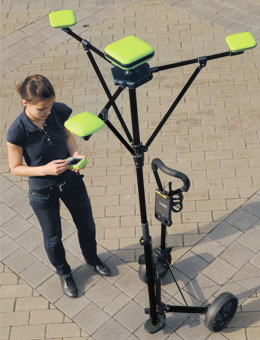
    The new Javad receiver design appears very nice from an ergonomic standpoint. The RTK communications antenna appears to be missing, but it’s actually integrated inside the rangepole. Last year, Javad bought ArWest Communications Corp., a maker of narrow-band and spread-spectrum radios, so JAVAD GNSS has the flexibility to integrate RTK communications in creative ways. Also, with a Bluetooth interface to the data collector, no external cables are required.

    In true Javad style, the Triumph series has 216 channels capable of tracking all existing signals and is prepared to track new signals as they come online, such as GPS L5 and Galileo E1/E5.

    From listening and talking with other attendees, there appear to be four areas they see where Javad is trying to set himself apart from the rest of the manufacturers:

    1. Pricing. Javad’s innovative pricing scheme. You can look for yourself at http://www.javad.com, although you might be somewhat confused with all of the options. The bottom line is that the system will be pretty competitive. Something unique, though, is that pricing is the same for every country in the world.
    1. “Instantaneous” RTK initialization. It’s hard to buy into this one at face value until I (or you) have tried it in true field conditions. Many other systems have pretty quick RTK initializations. “Instantaneous” re-initializations after loss in tree canopy or next to buildings would be very nice, and if it performs true to specs, would be an advantage.
    1. In Band Interference Rejection (IBIR). The claim is that RTK users experience times during the day when RTK doesn’t work, due to local RF (radio frequency) interference. In my experience, the most common RTK problem, by far, is the communications link between the base and rover, whether that link be UHF, VHF, spread spectrum, or GSM/CDMA. What Javad is referring to is jamming or harmonic interference at the GNSS frequencies that prevent your GNSS receiver from processing the signals from the satellites. Personally, I’ve never experienced this type of interference, that I’ve been aware of. Any time I’ve had a problem with RTK, I’ve always been able to trace it back to the RTK communications link. So, I’m not sure there is measurable upside to this claim.
    1. Superior use of GLONASS. You can read the explanation that JAVAD GNSS lays out in the company’s advertisement in GPS World. I can see that they are in a great position to capitalize on GLONASS given the long history that Javad has in Moscow. But the proof lies in how it performs in the field, so the jury is out on this one. I’ve used several GPS/GLONASS system in the field, and all performed superior to my GPS-only system. Whether Javad’s GPS/GLONASS technology is superior to other GPS/GLONASS receivers on the market is something we need more data on before that conclusion can be drawn. However, it is clear there is some wiggle room here, especially when it comes to resolving biases when the rover GNSS unit is of a different manufacturer than the manufacturer of the RTK network infrastructure receiver. Each manufacturer handles this differently and perhaps JAVAD GNSS has found a novel method.

    I haven’t mentioned the “antenna umbrella” that many of you have seen in advertisements or read about. First of all, this isn’t required in order to use JAVAD GNSS equipment. The Triumph-1 pictured earlier is the standard configuration. The “antenna umbrella” you’ve seen is used with the Triumph-4 (not released yet) so the user can benefit from multi-baseline redundancy and integrity with one GNSS receiver.

    The Triumph-4 includes four GNSS receivers, three accelerometers, and three gyros to allow positioning in adverse conditions. I really like the idea of the accelerometers and gyros to augment the GNSS measurements. I think this is the wave of the future. But I don’t think the antenna umbrella concept is going to fly, at least for mobile production work like topo surveys, construction staking, and high-precision GIS. I could maybe envision it for geodetic control, deformation monitoring, and machine control, given the right type of packaging.

    A Word about GLONASS

    Sergey Revnivykh from the Russian Federal Space Agency gave the audience an update on GLONASS. He reasserted the Russian government’s commitment to GLONASS and its intent to support CDMA to ensure “compatibility and interoperability with other GNSS and augmentations.”

    GLONASS currently has 12 operational satellites. Only one of those twelve is a legacy satellite that will probably fail in the next year. The other eleven are GLONASS-M satellites with a “guaranteed” life of seven years. Revnivykh says Russia expects to launch six more GLONASS satellites this year. Finally, it looks like we are moving beyond the GLONASS constellation vacillating between nine and fourteen satellites. We should have seventeen solid GLONASS satellites to with work in 2009. Another six GLONASS satellites are planned for launch in 2009, so by December 2009, the number of operational GLONASS could reach twenty-three.

    Post-conference Social Event

    A Saturday party took place at a lakehouse (the traditional Russian dacha, with modern accoutrements) about 90 minutes from Moscow. A tour bus ferried conference attendees and JAVAD employees to the catered event with activities ranging from miniature golfing to boat rides on the lake. Entertainment was provided by a Brazilian dance troupe and capped off by a trio of opera performers. It was a very well put-together family-oriented event.


    Javad Ashjaee in middle,
    wearing cap


  • Survey Perspectives – Late July 2008

    Software Receivers May Hold the Key to Multi GNSS

    It’s not often that I read a technical paper that really catches my attention to the point that I read and reread it, then write the authors to probe further. That happened to me last week.

    I’m on the IGS (International GNSS Service, formerly International GPS Service) email distribution list. IGS is a consortium of 200 world-wide agencies that combine resources and share GPS/GLONASS data in order to generate precise GPS and GLONASS products. According to the IGS website, you can think of the organization as the highest precision international civilian GPS community.


    The IGS GNSS Tracking Network

    If you’re signed up, IGS will occasionally send out informative emails about current GNSS events. To subscribe to IGSMAIL send an email to [email protected] with a line in the body following this format (substituting your own email address):
    subscribe igsmail [email protected].

    Last week, I received IGSMAIL-5791. It was a notice that a paper was posted from the IGS 2008 Workshop held in Miami, Florida last month. The paper was entitled Considerations for Future IGS Receivers. It was authored by Todd Humphreys of Cornell University, Larry Young at NASA’s Jet Propulsion Lab (JPL), and Thomas Pany with University FAF Munich, Germany.

    It’s a great paper to read if you are interested in the future of high-precision GNSS receivers. It touches on a lot of the subjects (GPS modernization, Galileo, GLONASS, etc.) that I’ve been writing about for awhile and also an interesting subject that I haven’t written about: GNSS software receivers.

    IGS is interested in being the gold standard of GNSS data: orbits, clocks, reference frame positions, and ionosphere/troposphere maps. A noble goal for sure, but most of the commercial GNSS applications don’t require the sort of accuracy the IGS is chasing after. Nonetheless, the paper discusses many of the issues that face the commercial GNSS industry, and even takes into account the very recent proposal by the Department of Defense to cease support of L1/L2 P(Y) semicodeless. Also, IGS isn’t heavily involved in real-time kinematic (RTK) applications, which have become very prevalent in the commercial GNSS industry.

    After reading the paper, I formulated a few questions and sent them to the authors. They promptly answered and I thought it would be insightful to include them in this column.

    Eric Gakstatter (EG): You touch on GLONASS and Galileo a bit, but don’t delve into current constellations, launch schedules, etc. This leads the reader to believe that you value GPS modernization over an increased number of observables from other GNSS (GLONASS, Galileo). Is that a correct assumption? The “more signals from the same number of space vehicles (SVs) vs. today’s signals on more SVs” debate is a hot one right now. Which do you value more?

    Larry Young: (LY) More satellites with at least two-frequency signals definitely trumps more signals per satellite. For ground uses I believe the limited number of satellites currently reduces our ability to estimate, for example, a spacially and temporally varying tropospheric delay.

    We concentrated on GPS because:

    1. We have excluded the current FDMA GLONASS signals as less accurate for high-accuracy science applications, but look forward to including possible future CDMA signals from GLONASS.
    2. We expect the Galileo signals will be very useful, but there are as of yet only two prototype Galileo satellites in orbit. Actually, we went to some length to describe benefits from the Galileo signal structure. I think any launch schedule for Galileo is even less certain than the schedule for GPS replenishment.


    (Editor’s Note: Larry’s reference to FDMA GLONASS accuracy (the current GLONASS architecture) doesn’t mean that GPS/GLONASS receivers sold today are less accurate than GPS-only receivers sold today for real-time kindematic RTK/machine control applications. Companies that design GPS/GLONASS receivers have developed methods to mitigate the internal biases that exist in the GLONASS broadcast signals.)

    EG: How did you determine 16 as the minimum requirement for the number of L2C SVs in orbit?

    Todd Humphreys (TH): We tried to temper the pressure to modernize the IGS network with an understanding that the IGS is a volunteer federation with enormous inertia, and so can’t be expected to respond to drastic requirements upheavals. The presence of 16 L2C-capable SVs (which implies 8 L5-capable SVs) on orbit is what triggers Event 2 in the minimum requirements schedule. The primary changes brought on by Event 2 are:

    1. newly incorporated IGS receivers must be L5-capable
    2. newly incorporated receivers are no longer required to track L2 P(Y).

    Change 1. keeps the IGS current by beginning to measure and characterize the L5 signal. Change 2. is meant to begin the inevitable conversion to a network that does not use P(Y)-code tracking. Change 2. also reduces the barrier to entry into the IGS network. By not requiring L2 P(Y) tracking, we open the IGS network to receivers without semicodeless tracking capability, such as some software receivers. It’s also a recognition that commercial receivers capable of P(Y) tracking will likely be more rare and more expensive after Event 2, given that semicodeless P(Y) tracking is slated for obsolescence.

    EG: Given the intention of the U.S. Department of Defense (DoD) regarding semicodeless access, do you think it will halt all development of GNSS software receivers in that area, and that they will focus purely on L1 C/A, L2C and L5 (and L1C)?

    TH: The paper mentions that software receiver developers are not as keen on codeless/semicodeless techniques as they are on standard coded tracking for two reasons:

    1. Software receiver designers want to get the most performance they can from their limited computational resources and so it makes sense to concentrate on coded tracking.
    2. The restrictions on use of proprietary codeless/semicodeless tracking techniques makes these techniques less attractive than standard coded tracking.

    Add to this that the DoD plans to discontinue semicodeless access by around 2020, and you can see why semicodeless tracking hasn’t been on the forefront of most software receiver developers’ minds.

    On the other hand, the IGS minimum receiver requirements schedule proposed in the paper would require semicodeless-capable receivers until 8 IIF SVs are in orbit (making a total of 16 L2C-capable SVs on orbit). Hence, if software receiver developers want to see their products used as stand-alone receivers in the IGS before then, they’ll have to provide semicodeless tracking.

    Thomas Pany (TP): Semicodeless access is an interesting topic on its own and software receiver research will continue on it (at UniFAF we got funding for it).

    LY: JPL needs to track P-codes in its software receiver in order to get the best accuracy for surface-reflection experiments. When this is done with post-processing, we are able – and others should be able – to obtain the actual Y-code chip sequences that had been used. We also implement semi-codeless processing into software receivers. Sometimes it’s just handy to have both the L2C and P2 signals, for example, to investigate effects of long-delay multipath.

    What is a GNSS software receiver?

    I think a real interesting part of this paper, and one I haven’t touched on yet, is the discussion of software GNSS receivers. A friend of mine has been putting the software receiver bug in my ear for some time. I’ve been dismissing it for the most part because he and I have been speaking in terms of the consumer GPS market. I hadn’t really thought of it with respect to the market for high precision commercial GNSS receivers, especially those that are in fixed installations like CORS.

    First of all, one of the reasons today’s complex GNSS receivers are so small is because there is a high level of electronics integration. What that means is that engineers design many different processing functions into one or two custom integrated chips. These chips are called application specific integrated circuits (ASICs). Using ASICs help reduce the size, cost and power consumption of complex electronic products such as GNSS receivers.


    The Cornell University GRID GNSS software receiver based on DSP technology.

    But an ASIC is not required to build a GNSS receiver. Granted, without an ASIC or two it might be larger and more power hungry, but you can build one nonetheless. A GNSS software receiver doesn’t mean you get a GNSS receiver delivered on a $2 DVD either. No sir, there are still plenty of electronic components involved. The core difference is that instead of one or two ASICs, there would be a series of off-the-shelf discrete components. There are essentially two different approaches in designing a GNSS software receiver; one uses a digital signal processor (DSP) and the other uses a field programmable gate array (FPGA). Sometimes both a DSP and FPGA are used in a design. The GNSS software is loaded in the DSP and/or FPGA and this is how the GNSS software receiver gets its name.

    Essentially, a GNSS software receiver is a design where all signal processing that comes after the analog radio frequency front-end is completely software re-configurable.

    Why use a GNSS software receiver?

    Higher power consumption, larger size and higher chip count doesn’t seem like a good argument in favor of GNSS software receivers. So what is? I posed that question to the paper’s authors.

    EG: What is the major attraction of GNSS software receivers? Cost? Flexibility?

    TH: From the point of view of the IGS, the major attractions are flexibility and transparency. The IGS’s goal is to deliver gold standard GNSS orbits, clocks, reference frame positions (and thereby contribute to gold standard Earth orientation parameters), and iono/tropo maps. For this, we need transparency into receiver operation so that we can better model the statistics of the receiver products that we use. Better yet, we’d like to implement our own specialized tracking loops and other specialized receiver features. Software receivers offer us this transparency and flexibility.

    Although it probably takes a back seat to transparency and flexibility, price is certainly an attraction. For example, the ASTRA software receiver mentioned in the paper is planned to be offered for around $1,200 (hardware) plus $200 or so per receiver for a software maintenance contract. This is about 10 times less expensive than the traditional receivers that the IGS buys. If ASTRA and others can really deliver at such reduced prices, you may see an exciting densification of IGS sub-networks for tropospheric and ionospheric study.

    EG: Do you think there is a strong possibility that GNSS software receivers are technically able to replace traditional GNSS receivers in fixed GNSS infrastructure environments (eg. CORS, IGS, JPL, SoPAC, etc.)?

    TH: Absolutely. The JPL BlackJack receiver is arguably the best-performing GPS receiver on the planet today, and it’s essentially a software receiver with an FPGA-based correlation engine (see the Montenbruck reference in the paper for a comparison of the BlackJack against other receivers). I suspect that the reference-frame receivers sold by some traditional vendors are, in fact, software receivers in the mold of the BlackJack. I predict a market-wide convergence toward FPGA/DSP-based software GNSS receivers over the next decade as the FPGS/DSP price per transistor count continues to fall.

    The real question is what kind of access the IGS will have to the software of these receivers. The traditional model is that the IGS has no control over their receiver’s software aside from setting a few parameters and downloading the occasional vendor-provided firmware update. Suppose vendors instead license their source code to the IGS, or provide “plug-ins” for IGS-specific routines. Such transparency and flexibility is just what the IGS needs to carry out its demanding mission.

    EG (following-up on Humphreys’ comment on a market-wide convergence toward GNSS software receivers over the next decade): If a vendor can sustain its business by licensing their source code, then it will happen. The alternative is a Linux-type approach where the development is a shared effort. The commercial demand will be great enough that I think one of these models will materialize.

    TP: If an open-source software receiver emerges in the near future, it has to overcome the following difficulties, which are not easy to solve (at least this is our experience at the University FAF Munich).

    1. The front-end development has to be done and drivers have to be developed.
    2. The software requires assembler programming skills including multi-threading.
    3. The software needs to have a high stability to run 24 hours per day with basically no failure. This all applies for FPGA, DSP or general-purpose based receivers, and are eventually most easily solved on the general-purpose processor.
    4. Last but not least, you have to implement competitive signal processing algorithms to achieve results similar to commercial receivers. So if one succeeds with all this stuff, it’s questionable, if the software will be free of charge.

    EG: I guess network RTK users would see some upside (to a densified reference station infrastructure)? How about static post-processing users? Maybe longer baselines?

    TH: Accurate estimates of SV clocks and orbits don’t depend strongly on dense networks. By extension, network RTK users or static post-processing users won’t see marked improvement just because the surrounding network is denser. What improvements come from denser networks will be due to a better characterization of the troposphere and its gradients. Such improvements will indeed allow longer baseline carrier-phase-differential techniques. One could imagine a dense regional network making possible carrier-phase-differential techniques with millimeter-level accuracy on baselines of up to 100 km. Whether this will be of great commercial interest, I can’t say. As a researcher, I’m interested!

    If the user has a single-frequency receiver, then dense networks help to mitigate both ionospheric and tropospheric errors in his RTK or static-post-processing solution.  If the user has a dual-frequency receiver, then he won’t see much reduction in his ionospheric errors, but will still benefit from reduced tropospheric errors.

    EG: Can you tell me a little bit about the computing platform required for a GNSS L1/L2/L5 receiver?

    TP: I strongly believe that a modern standard PC (four cores) has all the required processing power to do all-in-view L2P(Y) tracking at least with cross-correlation in addition to track the civil signals on L1/L2, but to which extent the computational resources can be exploited strongly depends on the developers’ capabilities. It’s my experience that PhD candidates who typically have a background in geodesy or communications are normally not experts in assembler language. For this type of work an experienced game programmer would eventually be more qualified.

    TH: Right now, a full L1/L2/L5 receiver requires either a multiple-core approach (see the description of the University FAF Munich receiver in the paper) or an FPGA. The wide bandwidth L5 signal drives this requirement. Tracking L5 requires 10 times more computational power than narrow-band tracking of L1 and L2C.

    EG: Do you have a schedule in place to perform the testing described in item 6. A. (from the paper)? Compare the performance of a software GNSS receiver with a traditional ASIC-based receiver?

    TP: A University FAF Munich software receiver will be installed at a EUREF site in Germany in September or October this year. I expect that the data will be available to IGS.

    TH: A dual-frequency version of the Cornell GRID receiver will be tested against traditional dual-frequency receivers in November of this year. It will be deployed to Brazil for ionospheric scintillation study in December of this year.

    Imagine All the Signals, Living in Harmony

    Imagine if you had a GNSS software receiver and a new signal such as L5 comes online. You wouldn’t need to change your receiver hardware (except the antenna), no boxes to unpack, no new hardware to figure out, only load new GNSS processing software into the DSP/FPGA.

    But I think low cost, rather than flexibility; might drive the GNSS software receiver into the commercial markets eventually. Not necessarily on the user equipment side of things such as machine control or portable applications, but rather on the infrastructure side of the business, such as CORS and other regional as well as world-wide networks where power and size can be traded for cost. Like Humphreys said, being 1/10th the cost of traditional GNSS receivers makes it feasible to create very dense networks of reference stations.

  • Survey Perspectives – Early July 2008


    PNT Advisory Board on the Virtues of 30 Plus

    Last fall, I wrote a column about the Civil GPS Service Interface Committee (CGSIC). Essentially, CGSIC is the forum for the civil community to communicate with the people who manage the GPS, and vice versa. In this column, I’d like to climb up the ladder, so to speak, and talk about the Space-Based Positioning, Navigation and Timing (PNT) National Executive Committee.

    The PNT Executive Committee was established by the president to “advise and coordinate federal departments and agencies on matters concerning” GPS. Specifically, its functions, according to the website, are to develop a national space-based PNT strategy, develop a five-year national space-based PNT plan, and conduct an annual assessment of the adequacy of the federal government’s department and agency budgets and schedules.

    Let me be clear, the Civil Global Positioning System Service Interface Committee (CGSIC) and NAVCEN are still together the clearinghouse for the public to communicate with the people who administer GPS and vice versa. That hasn’t changed. But monitoring PNT Committee activities, reading various presentations given by PNT Committee representatives, and reading minutes from PNT Committee advisory board meetings can give one a view into the thoughts of those who influence GPS policy.

    A Case in Point.

    Some of you in the user community have been around GPS for a decade or longer. You may recall that back in the 90’s, the U.S. government attitude towards other countries developing their own GNSS was quite cold and unsupportive.

    Since then, this attitude has changed 180 degrees. The U.S. GPS folks are reaching out and embracing GNSS development elsewhere. Joint working groups have been established that include U.S. GPS representatives and technical folks from the various GNSS programs to promote compatibility and interoperability between GPS and these other GNSS.

    There is no better example of this than when the United States and Russia formed the GPS-GLONASS Interoperability and Compatibility Working Group in December 2004. Remember that GPS and GLONASS were both deployed during the height of the Cold War, so no technical communication (at least non-adversarial) was possible at that time. Fast forward to 2007 when the Russian Space Agency indicated that GLONASS would be migrating towards CDMA so GLONASS would be compatible with GPS and other GNSS in development. This is a truly remarkable turnaround.

    Last September at the Institute of Navigation (ION) GNSS conference, Alice Wong, Senior Advisor on GNSS with the U.S. State Department, discussed many of the international cooperation arrangements the United States has with countries developing a GNSS. She made two revealing and significant statements. “The number of space-based signal providers will grow from two countries (the United States and Russia) to at least six or more by 2020,” she said. The United States has recognized that although it may have set the gold standard for GNSS, it’s growing beyond what it can control. That leads to Wong’s second statement, which described the U.S. attitude towards GNSS development and operation.

    Interoperable = Better Together than Separate

    I didn’t intend for this to become a column on U.S. international GNSS policy, but rather to illustrate the tremendous amount of information and links to be found on the PNT.gov website.

    Beside the presentations by PNT representatives, another part of the PNT.gov that’s very interesting to monitor is the PNT Advisory Board. NASA (National Aerospace and Space Administration) established the board on behalf of the PNT Executive Committee. The board members are non-government GPS experts who provide advice on GNSS from a technical as well as program and policy perspective. There are some well-known and well-qualified individuals on the board. Some you would know by name, such as Charlie Trimble (formerly of Trimble Navigation) and Brad Parkinson of Stanford University. But there are also many others from industries outside of surveying/construction that you may not recognize, but that represent significant industries or offer valuable perspectives.

    The board meets at least twice a year and PNT.gov publishes minutes from the meetings. Reading the minutes from these meetings is an interesting look at how future GPS policy may be shaped.

    The minutes from the March 2008 meeting (all 31 pages) are now available at PNT.gov. Please note that the board meetings aren’t limited to the PNT Advisory Board members. The meetings are open to the public, although audience members are asked not to interrupt the speakers. In the minute appendices, one can view a list of all who attended the March 2008 meeting.

    In reading the minutes, one sees that a substantial part of the discussion centered on the optimal number of satellites and configuration of those satellites. To wit:

    • Gerhard Beutler, President, International Association of Geodesy

    “Further, he reported that the scientific community, organized in IAG, was committed to exploiting the full potential of all GNSS systems: this, he said, required combining all systems measurements in a single analysis; placing laser reflectors on all GPS/GNSS satellites; and expanding the GPS constellation to 30-plus equally-spaced satellites.”

    • Bard Parkinson, Stanford University

    “Dr. Parkinson, panel chair, said the Independent Review Team (IRT) had identified the Big Five essential GPS performance criteria: assured availability, resistance to interference, accuracy, bounded inaccuracy (in particular, the limit on the “wild result”), and integrity.”

    • Michael Shaw, director, National Coordination Office for Space-Based PNT

    “Mr. Shaw commented that to meet a 30-satellite standard, 34 to 36 satellites would be required. Dr. Parkinson said he believed 33 would be sufficient; at present, he said, the commitment to 24 was not always maintained. Dr. Parkinson added that if the Federal government committed to 30, and didn’t always make it, ‘we would forgive you.’”

    • Capt. Joe Burns, United Airlines

    “Capt. Burns from United Airlines commented that the improvements in civil aviation expected from a space-based air traffic control system would not be realized with the current constellation. Dr. Parkinson urged civil aviation to undertake and make public a cost/benefit analysis on the subject: he asked Capt Burns how many satellites he believed were required. Capt. Burns said at least 27, preferably 30. Ms. Neilan said it appeared all present believed 30 satellites were needed. She asked Dr. Parkinson if his analysis had been intended to prompt persons at DoD to reconsider whether the 21 plus 3 constellation was indeed adequate to their needs. Dr. Parkinson said he did not know what affect his study might have.”

    The discussion time spent on the number of optimal GPS satellites is positive and I think it speaks to the future of what we can expect. Even though we enjoy 31 satellites today, the DoD only guarantees a 24-satellite constellation. I also like the fact that Parkinson is staying on target with the same message of the Big Five that I first heard at the ION GNSS 2006 conference.

    If you get a chance, take a break and read through the minutes. It’s worth the time.


  • Survey Perspectives – Late June 2008

    The Mobile Frontier in Field Data Collection

    The mobile phone business is going nuts. Makers are introducing powerful phones in groves. The sleek and stylish Motorola Razor is almost an antique now. Apple introduced their new iPhone G3 last week and Sprint is introducing the Instinct later this month, complete with streaming TV service. Blackberry is rumored to be coming out with a touch screen phone for Verizon. Nokia, well, they’re in the process of buying Navteq. Navteq map databases power the leading personal navigation devices (PNDs) like Garmin, Magellan and Navigon among others. ‘Nuff said.

    2008/2009 is going to be the year(s) of the smartphone, with manufacturers packing more and more into mobile phones. I saw this at the CTIA Wireless 2008 conference in Las Vegas a couple of months ago. I was blown away by the absolutely huge exhibition booths setup by Nokia, Motorola, BlackBerry/Research in Motion, Samsung, LG, etc. Their booths were like small metropolitan areas within the exhibition center.

    Okay, this is cool stuff, but how does this affect my business/organization?

    Mobile phones are becoming powerful enough to rival some of the most powerful field data collection devices ever made. Certainly orders of magnitude more powerful than those hand-held bricks we used a decade or so ago.

    Granted, most of the emphasis we see on the new mobile phones is geared towards the average consumer: texting, streaming video, e-mail, social networking, and web browsing. That’s where the huge volumes are, and that’s what gets the attention of the handset manufacturers and wireless service providers. Our industry is catching the attention of some software developers who are writing software for smartphones that can be very productive for field personnel. I think it is very early in this game and there is a lot of software yet to be released that will help us become more efficient in the field, though.

    One software company who has recognized the potential in this area is a little-known company called Telenav out of Sunnyvale, Calif. Last I heard, they had about 400 people and were rated the no. 1 fastest growing company in Silicon Valley by Deloitte for the period 2002 to 2006 in the technology, media, telecommunications, and life sciences category.


    You might have used its navigation product. Its flagship GPS navigation software provides the basis for navigation software that Sprint and others sell to their mobile phone customers. It provides many of the same functionality that today’s PNDs provide, such as voice-guided turn-by-turn navigation and points of interest (POI) lookup. The major difference between PNDs and mobile phone applications like Telenav is the up-front cost. PNDs cost from $100 to $1,000, whereas GPS navigation applications for your phone are sold on a subscription basis in the $10 month range. The subscription price in the industry has not settled yet. I think it will end up in the $2 to $3 per month range and/or come bundled with other services like social networking.

    To give you an idea of the market reach, Telenav claims their software runs on more than 200 different mobile phones on 12 different wireless carriers in 22 different countries. Competitor Networks in Motion (NIM) claims to have the largest mobile phone subscriber base in North America. They claimed that on the day before Mother’s Day, May 10, it recorded nearly five million server transactions.

    Onto Mobile Phone Applications Other Than GPS Navigation

    What interests me about Telenav is that unlike most other mobile phone software companies, it is paying a lot of attention to mobile resource management (MRM). In fact, it claims to be the market leader in MRM for mobile phone users. Its flagship product for this market is Telenav Track. Tracking assets and people using GPS is commonplace these days, and there are many, many companies currently offering solutions. Last year, Trimble spent $500 million to acquire @Road, a company specializing in MRM, for example. What differentiates Telenav Track is that all the software runs on mobile phones.

    More specifically, I’m really intrigued by the electronic forms aspect of MRM. Essentially, it’s taking a paper form, such as an inspection form, and programming it into an application on a mobile phone. Sound familiar? This is the same concept behind automating field data collection for surveying and construction. Just like 40 years old being the new 30, mobile phones are the new data collectors. Ok, you won’t see them replacing the data collector as you know it today, but I’m seeing a lot more crossover. More traditional field data collectors are now GSM/Wi-Fi capable and more mobile phones are becoming powerful field data collectors.

    A case in point: in 2007, the City of New York dedicated 15 inspectors to travel through the city and search for maintenance problems such as potholes, graffiti and excess litter. Traditionally, the city had relied on citizens to report these problem areas, but detailed information and location was often incomplete. The city outfitted the inspectors with BlackBerry mobile phones with custom data collection software installed. The electronic form allows the inspector to record the necessary details while the GPS records the location of the problem area. Unlike traditional data collectors where the data is batched and downloaded later in the day, the data collected on a mobile phone is sent to the server in the office immediately.

    The benefits are obvious. The electronic forms control the quality of the data collected by guiding the user through the inspection. The real-time aspect of data collection speeds up the entire process.

    Higher quality data + real-time data = better decisions made faster.

  • Survey Perspectives – Early June 2008

    Is Dual-Frequency GPS — As We Know It — Becoming Obsolete?

    On Friday, May 16, 2008, the Office of Space Commercialization issued a Notice for Public Comment. In it, the U.S. Department of Defense (DoD) proposes to discontinue supporting P(Y) codeless/semi-codeless on both GPS L1 and L2 frequencies on modernized satellites (Block IIR-M, Block IIF and Block IIIA/B/C) beginning December 31, 2020. After 2020, legacy dual frequency receivers may still work, but the DoD would no longer assure that P(Y) power levels and the navigation message would remain the same. Therefore, the civil GPS community has no assurance that legacy dual frequency receivers will operate as before.

    Essentially, this means that every dual frequency receiver designed in the 1980’s, 1990’s and many in the early 2000’s would become virtually obsolete. In the interest of disclosure, that includes my own legacy real-time kinematic (RTK) system.

    I caution you … it is very easy to rush to judgment regarding this proposal. When I first read it, my first response was “Whoa, dude, no way!” However, it’s important to take a deep breath and work your way through the logic. Your conclusion may be the same as your initial response, but at least you’ve thought it through. That being said, you must also realize that this is the first action, in the history of GPS, which will render a massive amount of GPS equipment obsolete.

    What is Codeless/Semi-codeless Processing?

    On L1, there is C/A code and P(Y) code. C/A is for civilian use, P(Y) for military use. On L2, originally there was no civilian code, only P(Y) for military use.

    Back in the 1980’s, engineers in the commercial sector were trying to figure out a way to utilize L2 because it would significantly increase the receiver’s performance. Some really smart ones figured out how to track the encrypted P(Y) code on L1 and L2. Then they figured out how to cross correlate the measurements on L1 and L2 and voilà, the modern dual frequency receiver was born. This technique is used in virtually all dual frequency equipment sold today in the commercial (non-military) market.

    All post-processing and RTK algorithms are based on using codeless/semi-codeless techniques of one sort or another.

    Codeless/semi-codeless processing would not have been needed if L2C had been around on the original GPS satellites. In fact, even today there are only six satellites broadcasting L2C. Every satellite launched since 2005 (six of them to date) and each launched in the future will broadcast L2C, so eventually every satellite will.

    What’s Being Proposed?

    After December 31, 2020, the DoD proposes to discontinue supporting P(Y) on L1 and L2 for the commercial market on all modernized satellites (Block IIR-M, Block IIF, Block IIIA/B/C). Block IIA/IIR satellites will continue to operate as they do today. However, unlike today where Block IIA/IIR account for 25 of 31 operational satellites, the youngest Block IIR satellite will be 16 years old in 2020, if any still exist at all.

    The DoD’s proposal assumes that most organizations will have upgraded their GPS equipment by 2020 and will be utilizing L2C (and other modernized signals), so that L1/L2 P(Y) codeless/semi-codeless processing won’t be needed any longer.

    In their synopsis, the DoD states that GPS manufacturers have indicated that the user community needs approximately ten years to replace legacy GPS equipment with equipment capable of utilizing modernized GPS signals. You can read the DoD’s full proposal here. It contains a lot of pertinent background information.

    Who’s Affected?

    Unfortunately for those of us in the survey/engineering/construction/deformation monitoring/high-precision GIS industries, we would be the ones affected the most.

    In real terms, this means that any dual frequency receiver not designed to use L2C will essentially become a paperweight after December 31, 2020. The receiver may still work after that date, but there is no assurance it will continue operating properly. The list of receivers affected is quite long and includes models from all major manufacturers, such as Trimble, Leica, Topcon, Magellan (Ashtech/Thales), and NovAtel among others. Check with the manufacturer of your equipment to determine if it is capable of utilizing L2C. If it’s not, then it’s considered a legacy receiver and would become obsolete.

    Also, one should be careful and not assume that all receivers sold today are capable of utilizing L2C. Ask your dealer or the manufacturer of the equipment before your purchase.

    No L1-only receivers, such as hand-held GPS units, car navigation systems, various tracking devices, GPS-enabled mobile phones, L1-only GPS mapping systems, and timing receivers are affected by this proposal. L1-only RTK receivers are not affected either. None of these use codeless/semi-codeless techniques. The exception is some of the newer GPS receivers designed for GIS data collection at the decimeter (or sub-foot) level. Although not actively marketed as such, these are dual frequency receivers and might be affected if this proposal is carried out.

    It doesn’t take long for one to think about the thousands and perhaps tens of thousands of reference stations worldwide that will need to be replaced. Just the United States CORS (Continually Operating Reference Stations) network alone comprises more than 1,000 receivers. Granted, some are modernized receivers that may only need a minor update, but many others are legacy receivers that will need to be replaced or risk obsolescence. Those 1,000+ CORS receivers service thousands of users monthly. In April 2008 alone, the National Geodetic Survey reported that more than one million FTP requests were made for CORS data.

    The DoD says that December 31, 2020 isn’t a “hard” date. In other words, GPS equipment using codeless/semi-codeless techniques may work just fine after December 31, 2020. What they are saying is that after December 31, 2020, they won’t guarantee they will not do something that will impact P(Y) code and subsequently prevent your receiver from performing like you’d expect.

    Timing Is Everything

    I think I understand the DoD’s logic. They are developing these modernized signals (L2C, L5, L1C) that should be commonplace by the time 2020 rolls around. Continued support of semi-codeless would interfere with some new features they want to play with on the military side of GPS. Why support the legacy stuff when the new stuff is better anyway?

    The first issue I thought of is what the status of the GPS constellation will be in 2020. Today, GPS users have 31 satellites to work with. As high-precision users, we need every one of those. Just last week, I was stuck in the middle of a GPS fieldwork day waiting for a sixth satellite to come into view so I could continue my RTK work.

    The DoD is still only committed to a 24-satellite constellation, but they’ve been spoiling us with 30 or more for quite awhile now. It would be hard to go back.

    So, of course, I started doing the math to guesstimate how many satellites will be operational in 2020, based on information provided in the DoD’s proposal and other sources. The DoD’s proposal states that they expect 24 satellites to be broadcasting L2C by 2016 and 24 satellites will be broadcasting L5 by 2018. We know that eight Block IIR-M satellites were built and twelve Block IIF satellites will be built. We also know that, as announced last month, eight Block IIIA, eight Block IIIB and eight Block IIIC satellites will be built. From this information, one can deduce that in 2016 the constellation will look something like this:

    • 8 ea. Block IIR-M satellites broadcasting L1 C/A, L2C
    • 12 ea. Block IIF satellites broadcasting L1 C/A, L2C, L5
    • 4 ea. Block IIIA satellites broadcasting L1 C/A, L2C, L5, L1C

    The above lists and the ones following the paragraph below are the civil signals. Of course we can assume that each satellite is still broadcasting military P(Y) code and M-code on L1/L2.

    Based on the exceptional life span of legacy Block IIA/IIR GPS satellites, there would still be approximately six to eleven of them still broadcasting L1 C/A code. By 2018 we can deduce that the remaining four Block IIIA satellites and four new Block IIIB satellites will have been launched, giving a total of 24 satellites broadcasting L5. The constellation would look something like this:

    • 8 ea. Block IIR-M satellites broadcasting L1 C/A, L2C
    • 12 ea. Block IIF satellites broadcasting L1 C/A, L2C, L5
    • 8 ea. Block IIIA satellites broadcasting L1 C/A, L2C, L5, L1C
    • 4 ea. Block IIIB satellites broadcasting L1 C/A, L2C, L5, L1C

    There should also be a handful of remaining Block IIR satellites available for service that are still broadcasting L1 C/A code.

    If I’ve done the math right and the DoD keeps this schedule, that’s not bad; not bad at all. In 2016, there would be somewhere between 30 and 35 operational satellites. In 2018, there would be somewhere around 37 operational satellites. In terms of sheer numbers, that’s equal to or better than where we are today.

    After working through this, I think it’s obvious that we will be better off than we are today with respect to the satellite constellation. As I’ve written before, triple frequency receivers (L1, L2, and L5) will be far superior to today’s dual frequency receivers that utilize codeless/semi-codeless techniques. If you add Galileo on top of that, it’s a no-brainer. I look forward to the day that I’m in the field and have 20 or more GPS/Galileo satellites in view when just last week I was struggling to find six.

    Lastly, in case you missed it ,the DoD stated that if the new satellite schedule were delayed, they would reassess the codeless/semi-codeless sunset date.

    It’s All About the $$$

    Alas, at the end of the day, this is where it’s going to hurt the user community the most.

    I think nearly everyone’s heard of the Spring 2009 sunset date for analog television in the US. On that date, full-power television stations will stop broadcasting on analog channels, rendering analog television sets obsolete. Congress was so concerned about consumer backlash that they are subsidizing analog-digital conversion boxes to the tune of $890 million, based on a price of $50 to $70 each. To put it in perspective, that doesn’t even cover the cost of 3-meter L1/L2 antenna cable.

    We are going to get hit in the wallet … hard.

    An argument in support of all this states that triple frequency GPS equipment will be much cheaper at that time. I agree it will be cheaper, but we are still talking about tens of thousands of dollars. The survey/engineering/deformation monitoring/high-precision GIS market is relatively limited in size, is highly technical, and requires complex software, training, and technical support. It’s not like spending $150 at WalMart for a Garmin receiver that you can figure out without reading a manual.

    Another argument in support of the DoD’s proposal is that 12 years gives us plenty of time to enjoy a solid return on investment (ROI) on our current equipment. While I follow that logic, I’ve seen a lot of GPS equipment in the field that is 15 years to 20 years old. The stuff just keeps working.

    I’ve been amazed that my RTK system, based on 12-year-old technology, still cranks up like it did the first time I used it. Maybe it’s more of an emotional feeling than anything else, but as much as I work through the logic, it’s hard to swallow that my $40,000 system has a date with the trash bin.

    I know codeless/semi-codeless dual frequency GPS is the core technology for thousands of small to medium sized businesses around the world. Outside of vehicles, GPS equipment may have been the largest capital investment for them. For those who made that purchase in the last couple of years, the codeless/semi-codeless obsolescence is not something they want to hear about even if it is 12 years away.

    The U.S. Department of Commerce has done a quick survey and prediction, to get a rough idea of the dollar-value of equipment that will need to be upgraded sometime toward the 2020 time frame. Its figure for the economic impact is $1.3 billion to $1.7 billion dollars per year if semi-codeless were taken away today. That’s the estimated value of at least 200,000 semi-codeless receivers out in the field today, a figure that it
    acknowledges to be conservative, by the way.

    According to the DoC analyst, if semi-codeless were taken away in five years, in the year 2012, using some growth rates and extrapolating, the estimate would grow to between 373,000 and half a million users worldwide, and the economic loss on a worldwide basis would be between $3.6 billion and $4.8 billion; within the U.S. alone, that portion would be between $1.1 billion and 1.9 billion.

    These figures formed the rationale for a proposed decision to push the discontinue date out to 2020, to give manufacturers and the user base adequate time to re-equip for using L2C and L5. Incidentally, a full-length interview on this topic with a senior DoC analyst and advisor to the National Coordination Office for Space-Based Positioning, Navigation, and Timing will appear in the July print edition of GPS World magazine.

    I don’t have an answer on the money issue. For the manufacturers and dealers, it’s going to a salesman’s dream, not unlike Y2K and GPS Week Rollover were. For the user community, it’s going to taste sour no matter how it goes down.

    You Have Your Chance: the DoD Is Listening

    It’s important to note that the DoD is seeking comments from everyone around the globe. The potato farmer in Argentina, the land surveyor in Australia, the geodetic surveyor in the United States, and the engineer in Denmark are all encouraged to comment. GPS is a tool that knows no boundaries.

    Col. Mark Crews, the U.S. Air Force GPS Chief Engineer, says the GPS Wing is keenly interested in public comment on the proposal. The Air Force estimates there are approximately 250,000 worldwide users of dual frequency receivers that use P(Y) codeless/semi-codeless.

    “We are trying to do everything absolutely the right way in pre-notifying everybody in the world. If anybody has any concerns, please notify us,” said Crews. “We are taking every precaution to transition semi-codeless users to civil coded signals in a stable, measured, and transparent manner by 2020. That’s why we’re taking action now to pre-notify semi-codeless users worldwide and ask for their input by means of the Federal Register’s request for comments.”

    Crews further says that the Air Force recognizes that that dual frequency GPS receivers are a “huge business.” It recognizes that these receivers “play an extremely positive role in survey, agriculture, and all high-accuracy augmentation systems. We are bending over backwards until we have at least two other civil signals, being L2C and L5, on 24 satellites in time for people to transition,” he said.

    The US Department of Commerce (DoC), on behalf of the DoD, is seeking public comments on the codeless/semi-codeless sunset proposal. Time is short though. You have until June 16, 2008 to submit your comments. I think that’s a mistake; it’s not enough time. They should allow at least 90 days so the word has a chance to spread.

    All comments submitted are a matter of public record and can be viewed by anyone at http://www.space.commerce.gov/gps/semicodeless/. As of June 1, 2008, there have been no comments posted and we are half way through the 30-day comment period already.

    That concerns me.

    Clarifications/Corrections to The Last Column Regarding L5

    In my last column I included a listing of satellite models and signals they broadcast. An astute reader was quick to point out two omissions, and I discovered an error as well. First, I neglected to list P(Y) on L1, which is especially important to note, given the subject of this newsletter.

    Second, I listed Block I/II/IIA as one group. There are no Block I/II operational satellites any longer. There is only Block IIA/IIR. For complete clarification and for no other reason than I’ve intended to do this for awhile now, I’ve provided a comprehensive table of operational GPS satellites below.

    Lastly, I stated last time that there are 26 Block IIA/IIR satellites broadcasting. There are actually 25. Below is a complete list of operational satellites.

    PRN

    MODEL

    OPERATIONAL

    PLANE/
    SLOT

    CIVIL
    SIGNALS

    MILITARY SIGNALS

    9

    Block IIA

    July 20, 1993

    A1

    L1 C/A

    L1 P(Y), L2 P(Y)

    31

    Block IIR-M

    Oct. 13, 2006

    A2

    L1 C/A, L2C

    L1 P(Y), L1M, L2 P(Y), L2M

    8

    Block IIA

    Dec. 18, 1997

    A3

    L1 C/A

    L1 P(Y), L2 P(Y)

    7

    Block IIR-M

    Mar. 15, 2008

    A4

    L1 C/A, L2C

    L1 P(Y), L1M, L2 P(Y), L2M

    <

    /td>

    25

    Block IIA

    Mar. 24, 1992

    A5

    L1 C/A

    L1 P(Y), L2 P(Y)

    27

    Block IIA

    Sept. 30, 1992

    A6

    L1 C/A

    L1 P(Y), L2 P(Y)

    16

    Block IIR

    Feb. 18, 2003

    B1

    L1 C/A

    L1 P(Y), L2 P(Y)

    30

    Block IIA

    Oct. 1, 1996

    B2

    L1 C/A

    L1 P(Y), L2 P(Y)

    28

    Block IIR

    Aug. 17, 2000

    B3

    L1 C/A

    L1 P(Y), L2 P(Y)

    12

    Block IIR-M

    Dec. 13, 2006

    B4

    L1 C/A, L2C

    L1 P(Y), L1M, L2 P(Y), L2M

    5

    Block IIA

    Sept. 28, 1993

    B5

    L1 C/A

    L1 P(Y), L2 P(Y)

    None

    None

    None

    B6

    None

    None

    6

    Block IIA

    Mar. 28, 1994

    C1

    L1 C/A

    L1 P(Y), L2 P(Y)

    3

    Block IIA

    April 9, 1996

    C2

    L1 C/A

    L1 P(Y), L2 P(Y)

    19

    Block IIR

    April 5, 2004

    C3

    L1 C/A

    L1 P(Y), L2 P(Y)

    17

    Block IIR-M

    Nov. 13, 2005

    C4

    L1 C/A, L2C

    L1 P(Y), L1M, L2 P(Y), L2M

    None

    None

    None

    C5

    None

    None

    29

    Block IIR-M

    Jan. 2, 2008

    C6

    L1 C/A, L2C

    L1 P(Y), L1M, L2 P(Y), L2M

    2

    Block IIR

    Nov. 22, 2004

    D1

    L1 C/A

    L1 P(Y), L2 P(Y)

    11

    Block IIR

    Jan. 3, 2000

    D2

    L1 C/A

    L1 P(Y), L2 P(Y)

    21

    Block IIR

    April 12, 2003

    D3

    L1 C/A

    L1 P(Y), L2 P(Y)

    4

    Block IIA

    Nov. 22, 1993

    D4

    L1 C/A

    L1 P(Y), L2 P(Y)

    24

    Block IIA

    Aug. 30, 1991

    D5

    L1 C/A

    L1 P(Y), L2 P(Y)

    None

    None

    None

    D6

    None

    None

    20

    Block IIR

    June 1, 2000

    E1

    L1 C/A

    L1 P(Y), L2 P(Y)

    22

    Block IIR

    Jan. 12, 2004

    E2

    L1 C/A

    L1 P(Y), L2 P(Y)

    10

    Block IIA

    Aug. 15, 1996

    E3

    L1 C/A

    L1 P(Y), L2 P(Y)

    18

    Block IIR

    Feb. 15, 2001

    E4

    L1 C/A

    L1 P(Y), L2 P(Y)

    32

    Block IIA

    Dec. 12, 1990

    E5

    L1 C/A

    L1 P(Y), L2 P(Y)

    None

    None

    None

    E6

    None

    None

    14

    Block IIR

    Dec. 10, 2000

    F1

    L1 C/A

    L1 P(Y), L2 P(Y)

    15

    Block IIR-M

    Oct. 31, 2007

    F2

    L1 C/A, L2C

    L1 P(Y), L1M, L2 P(Y), L2M

    13

    Block IIR

    Jan. 31, 1998

    F3

    L1 C/A

    L1 P(Y), L2 P(Y)

    23

    Block IIR

    July 9, 2004

    F4

    L1 C/A

    L1 P(Y), L2 P(Y)

    26

    Block IIA

    July 23, 1992

    F5

    L1 C/A

    L1 P(Y), L2 P(Y)

    None

    None

    None

    F6

    None

    None

  • Survey Perspectives – Late May 2008

    So, You’ve Been Hearing About L5

    It seems in the world of high-precision GPS, there is always something new to consider. A new satellite launched … a new signal being broadcast … a new whiz-bang product introduced.

    In fact, engineers are designing GNSS receivers to be “compatible” with signals that aren’t even being broadcast yet. Even more interesting is that salespeople are selling GNSS receivers that are “capable” of receiving these signals that aren’t being broadcast yet, and satellite navigation systems that don’t even exist yet, such as Galileo.

    The third civil GPS signal, L5, has been in the news lately, so hearing about it has probably got your antenna up. First of all, let me clarify that a useful L5 signal is still years away – several years.

    The L5 news you’ve been hearing about lately is a test of the L5 frequency from a modified Block IIR-M satellite built by Lockheed-Martin last year. For ~$6 million, Lockheed modified one of the Block IIR-M satellites to broadcast some test data on the L5 frequency (1176Mhz). The modified Block IIR-M satellite is scheduled to launch next month.

    However, the L5 test data being broadcast won’t be usable by your GNSS receiver that is capable of receiving GPS L5. In fact, I’m almost certain that even if you purchased an L5-capable GNSS receiver today, a serious software update (if not hardware) will be required even when usable data is eventually broadcast on L5.

    For a quick review, let’s summarize which satellite models are/will broadcast the various signals:

    • Block I/II/IIA (26 are broadcasting) – L1 C/A, L2 P/Y
    • Block IIR-M (six are broadcasting, two remain to be launched) – L1 C/A, L2 P/Y, L2C
    • Block IIF (12 are planned, first launch planned in 2009) – L1 C/A, L2 P/Y, L2C, L5
    • Block IIIA (eight or possibly 10, first launch planned for 2014) – L1 C/A, L2 P/Y, L2C, L5, L1C

    The first Block IIF is scheduled for launch in 2009. At an aggressive launch rate of three per year, all twelve wouldn’t be in orbit until the end of 2012. Even then, we’ll only have twelve satellites broadcasting on L5. Users will derive some benefit from those twelve, but nothing like you would with a full constellation.

    Since there are only twelve Block IIF satellites planned, having more than twelve satellites broadcasting L5 means we’ll have to wait for the Block III satellites to be launched. This could go well into the next decade as the U.S. Air Force awarded the contract to Block IIIA satellites to Lockheed just last week, with a first launch optimistically scheduled for 2014.

    Besides launching satellites, there are many other L5 technical issues that need to be addressed, such as the control segment infrastructure (software and hardware). There are also significant non-technical issues, money being a big one. Launching satellites is an expensive endeavor; up to $100 million per launch is the number commonly referred to. This is one major reason why GPS satellite launch schedules are a moving target. As much as I’d like to see more satellites in orbit, I understand why the bean counters might want to push out GPS satellite launches for a year when there are 31 operational satellites today, the most ever in history. For that reason, I wouldn’t care to place a bet on where we’ll be with L5 four years from now anymore than I’d bet on where Garmin stock will be four years from now.

    What’s so cool about L5 anyway?

    Setting launch schedules, infrastructure development, and funding aside, L5 offers some really significant benefits to the high-precision user. First and most significant is that the days of worrying about ionospheric activity will be over. At 1176 Mhz, the L5 frequency separation from L1 (1575Mhz) is significant enough that the ability of your receiver to directly mitigate the ionospheric refraction will render the iono beast essentially harmless.

    If you’re relatively new to GPS (in the last six years or so), you will experience the iono beast in the coming years before L5 is ready to help. The current solar cycle has just started and will continue for eleven years. It will peak around 2011 to 2012. The next solar cycle’s affect on GPS is worthy of a newsletter column by itself, and I will have one in the coming months.

    Another benefit of L5 is that its broadcast strength is about four times stronger than L2C. A stronger signal combined with a superior code structure means that you’ll get more robust performance in tough GPS conditions. That’s great news for high-precision users working in marginal GPS conditions.

    Breaking News on GPS modernization

    On Friday of last week, the Office of Space Commercialization published a notice in the U.S Federal Register requesting public comments from within the United States and beyond on the U.S. government’s plan to phase out codeless and semi-codeless access to GPS by December 31, 2020.

    This is an historic step. It will be the first time in history that GPS equipment will be rendered obsolete. Specifically, the units affected are high-precision, dual frequency GPS receivers that weren’t designed to use L2C or L5. For example, I have a set of dual-frequency RTK receivers that are about 12 years old – designed well before L2C and L5 specifications were finalized. They work great now, but would be affected by this change.

    Granted, we’re talking about 2020, twelve years from now. But there are a great number of you (and me, to a certain extent) that subscribe to the “if it ain’t broke, don’t fix it” philosophy, and even if we did upgrade, we’d hang on to the old equipment as a back-up.

    It’s important to recognize that the equipment will not stop working on December 31, 2020. The idea is that the DoD will no longer guarantee the availability of the Y-code on Block IIR-M, Block IIF and Block IIIA satellites that would used by codeless and semi-codeless receivers. Legacy Block II satellites would continue to broadcast Y-code until those satellites are decommissioned. But by 2020, not many legacy Block II satellites will still be operational. Legacy Block II satellites comprise 25 of the current 31 operational satellites today.

    After I digest the Office of Space Commercialization’s notice a bit more and talk to a few people, I’ll publish my thoughts in this newsletter in the coming weeks.

  • Survey Perspectives – Early May 2008

    What’s up with Galileo

    Given some recent events, it’s about time to check in with you regarding Galileo, Europe’s attempt at creating a satellite navigation system similar to GPS. There’s also been some activity on the GLONASS front that is worth writing about too.

    In my Directions 2007 article in the December 2006 issue of GPS World magazine, I wrote that Galileo has huge potential benefits for the survey/construction user. But I also wrote that the key new items to watch for would be significant delays. And the delays did come. The problem has been that Galileo is becoming known as the most talked about satellite navigation system that has never been … vaporware, if you will. The program has been belabored with delays and hiccups of both the political and financial sort for many years. One would surmise that after so many miscues that people would stop talking about it. The reason people don’t stop talking about it is that the benefits of Galileo to the satellite navigation user are so significant.

    One of the major challenges that Galileo faces is funding. Galileo is to be the first global, civilian satellite navigation system. While GPS and Russia’s GLONASS are both funded by their respective defense departments, Galileo was going to be funded by a partnership between civilian government and commercial entities referred to as the Private Public Partnership (PPP). Exactly how much was private funding and how much was public (government) funding was the question that was a moving target for years.

    Until May 2007, the PPP ball was in the hands of a consortium of private companies with the likes of Thales, Alcatel and Inmarsat among other members. Their job was to formulate a plan on how to operate Galileo; essentially, they were trying to figure out how to make it a viable commercial venture. They couldn’t come up with a plan, so in May 2007 Europe abandoned the PPP approach and conceded that the only way Galileo was going to get off the ground was via public funds, to the tune of €3.4 billion. In late 2007, the Galileo program was near death when the European Union (EU), comprising 27 countries, voted in November 2007 to keep Galileo alive, although funding was still an issue.

    Just last month, the European Union transport ministers approved the Galileo Implementation Regulation, which allocates that €3.4 billion taken from the EU agriculture and administration budgets. With the money flowing and all 27 countries of the EU in favor, the path to launching Galileo seems as clear as it’s ever been. The next step is releasing contracts for the ground infrastructure and satellites. The European Parliament subsequently cleared the last bureaucratic hurdle later in the month. It approved legislative regulations that lay down security requirements for Galileo and the European Geostationary Satellite Navigation Service (EGNOS), both of which will be managed by the European Commission and the European Global Navigation Satellite System Supervisory Authority.

    With the funding seemingly taken care of, however, the implementation schedule is less clear. The EU says the system will be ready by 2013. Folks, that’s only five years from now, not very long at all in the space systems business. They need to build the ground infrastructure, launch 30 satellites and write the software that needs to control and monitor all of the systems.

    As far-fetched as the schedule may seem, Europe is dangling the Galileo carrot and I’m still chasing after it.

    There is even a carrot dangling in orbit; the second Galileo satellite, GIOVE-B, lifted off late last month. Only 29 more to go — 28, if you count GIOVE-A, but it’s getting a bit long in the tooth.

    I have a lot of patience because I’ve bet all along that Galileo was going to materialize. The reason is because of one key application that no other country is going to rely on a U.S. military system for: aviation navigation. It’s abundantly clear that the future of aviation navigation will be based on satellite navigation. How comfortable would the U.S. Federal Aviation Administration be with basing their entire navigation system on a foreign, military-run navigation system? They wouldn’t be and they wouldn’t do it. I think that’s about as comfortable as the EU would be with banking its aviation navigation future on GPS. GPS was a great proof-of-concept tool for them, but I don’t see how it’s a long-term solution for them. Galileo is.

    We, as precision users of GNSS, would benefit greatly from Galileo. Frankly, if I had to choose between GPS modernization (L2C/L5/GPS III) and Galileo, I’d take Galileo. Even with 31 healthy GPS satellites broadcasting today, I still find myself losing productivity in the field because of the lack of satellite signals, and I hear similar complaints from others. If you’re trying to do elevation work, it’s even worse. Having ~30 GPS satellites and ~30 Galileo satellites available would mean your average number of satellites in view would be 20 plus. Your PDOP values would be ridiculously low throughout the day. Your redundancy and reliability would be ridiculously high. You wouldn’t have to choose a particular time of day to do your elevation work. Machine control wouldn’t be only usable in wide-open sky environments. These are days to dream about.

    One could argue that Russia’s GLONASS system is closer to achieving this than Galileo. With GLONASS having 14 operational satellites, it’s a valid argument. But GPS and GLONASS were designed when the US and Russia were Cold War enemies. You can bet that United States and Russian scientists weren’t cooperating at that time. On the other hand, once the U.S. government decided to support Galileo (they didn’t initially), United States and European scientists worked closely together to ensure that GPS/Galileo receivers would work efficiently.

    GLONASS/GPS receivers aren’t efficient by any stretch of the imagination. GPS is based on CDMA technology whereas GLONASS is based on FDMA technology. It’s kind of like designing a video cassette recorder (VCR) that accepts both VHS and Beta tapes in the same slot. You can design it, but there are consequences. One example in GPS/GLONASS receivers is that the receiver must use one GLONASS satellite to sync the two systems together. In real terms, if your GPS/GLONASS receiver is tracking three GLONASS satellites, only two are used. Power consumption is another issue.

    These are some of the reasons you’ll never see a GLONASS/GPS receiver in the consumer market from Garmin, TomTom, Magellan, etc.

    In response to pressure to be more compatible with GPS and Galileo, Russia announced earlier this year that they are near final approval in adding CDMA architecture to their GLONASS-K generation of satellites that are scheduled for launch in 2010. It’s a smart move on Russia’s part, as any system using anything other than CMDA in the next decade is going to be largely ignored by the manufacturers.

  • Business Outlook – RTK Crops Up in Precision Ag

    Most precision agriculture users have settled for 1-meter accuracy using GPS, made possible with the reliable and convenient corrections provided by WAAS (Wide Area Augmentation System).

    GPS/GNSS is important to key areas in agriculture, including field mapping, yield mapping, and guidance. Companies such as Hemisphere GPS (formerly CSI Wireless) did very well designing single-frequency GPS receivers for the precision ag market. Hemisphere is also a leading designer of radio beacon (Coast Guard) receivers. Radio beacons, in addition to WAAS, are a free source of corrections for 1-meter accuracy.

    Trimble was also an early supplier of precision ag GPS receivers and related equipment, offering single-frequency products such as the AG-132.

    While the real-time kinematic (RTK) technique has been around since the early ’90s, it didn’t gain wide acceptance in the precision ag industry. The accuracy was great, down to approximately 2 centimeters at the time, but the equipment was clunky. The user had to set up a reference station near the field he was working on. The communication link was complicated, and some types needed Federal Communications Commission (FCC) licensing. Consequently, there were several potential points of failure. Lastly, the cost for a complete RTK system (base, rover, and radios) was upwards of $50,000. It just wasn’t cost-effective.

    The term RTK network is ambiguous because it means different things depending on the industry. Essentially, the hardware setup is the same no matter the industry. An RTK network is a series of dual-frequency reference stations spaced optimally within a region to provide RTK corrections to subscribers in that region. The network subscriber is assigned a primary reference station.

    RTK networks for agriculture are single-baseline solutions; the subscriber can only use one reference station at a time. There is no “network solution” or redundancy like there is in RTK networks used in the surveying and construction industries. Therefore, when a single reference station goes down, the subscribers in that area are down also.

    Another major difference between RTK networks for agriculture and RTK networks for surveying and construction is the communication method. The latter primarily use data plans on mobile phones to receive corrections. Either the mobile phone is linked via Bluetooth to the receiver or a cellular modem is built inside the receiver.

    RTK networks for agriculture, on the other hand, primarily use spread spectrum radios (900 Mhz band) to transmit corrections to the receiver. Spread spectrum radios are free to use and don’t require a license from the FCC to operate. They are limited in their broadcast range, however, typically to two to three miles. To solve this problem, radio repeaters are used to extend the distance.


    The Wild, Wild West

    Bill Henning, real-time specialist with the National Geodetic Survey (NGS), said it best: the recent explosion of RTK networks is like the wild, wild West. They are proliferating so quickly that it’s hard to keep track of them. One of his tasks is to help develop guidelines for RTK network operators, and I think NGS is making inroads into the survey/construction industry with its initiative. People are looking for guidance with respect to RTK network setup, as well as monitoring for the networks once they become operational.

    RTK networks for agriculture seem less structured than in other disciplines, though, and administrators rely more heavily on vendor recommendations. For example, some are based on the ITRF reference frame, while others are based on some version of NAD83. Some networks hire land surveyors to establish their reference station locations, while others do it themselves using NGS’s OPUS program or other methods. Very few, I think, realize the resources available from the NGS, such as the Cooperative CORS program.One would think that ag and survey/construction would consolidate their efforts, since an RTK network can cover the same area for both fields, and the equipment is virtually the same. But a farmer isn’t going to pay the same RTK network subscription rate that a surveyor or construction company will. A farmer is hesitant to pay $4,500 annually when he can select a service such as OmniSTAR and pay $1,500 annually. Some industry folks say that aggressive subscription pricing is the reason RTK networks in the agriculture market have expanded rapidly in the past few years.

    The differences between the networks used in agriculture and those in survey/construction are mostly software related. RTK networks for survey/construction offer a true-networked solution, where several reference stations are used to compute a correction, compared to the single-baseline solutions used in ag.

    OmniSTAR (HP/XP), John Deere (Starfire), and Novariant (AutoFarm) offer GPS-based solutions for precision ag. They are not pure-play RTK solutions like RTK networks, but they do have RTK capability. True RTK networks are capable of constantly delivering ~2-centimeter accuracy day in and day out. These companies going after the precision ag market offer primarily decimeter-level services (1 decimeter being the equivalent of 10 centimeters), and then RTK solutions when needed.

    It will be interesting to see how pure-play RTK players respond as RTK networks for agriculture continue to expand — which they most certainly will.

  • Survey Perspectives – Late April 2008

    MSAS: SBAS in the Land of the Rising Sun

    Quietly, the Japanese Civil Aviation Bureau (JCAB) has been developing that country’s MTSAT Satellite-Based Augmentation System (MSAS) over the years. MSAS is Japan’s satellite-based augmentation system (SBAS) that is designed to enhance GPS for aviation navigation. It’s similar and compatible with the United States’ Wide Area Augmentation System WAAS, as well as Europe’s European Geostationary Navigation Overlay System (EGNOS). It became operational in September 2007.

    So, why am I writing about an aviation navigation system in Japan when this is a survey and construction column? Well, for the same reasons I’ve written about WAAS and EGNOS in the past. The use of SBAS by high-precision, non-aviation users is growing by leaps and bounds. I’m not talking about consumer GPS users. Autonomous GPS is so accurate these days that the average consumer doesn’t feel the benefit of SBAS vs. autonomous GPS. I’m talking about the professional users in mapping and surveying who require GPS equipment that will consistently deliver positioning at the meter-level and also at the centimeter-level. MSAS can help achieve both.

    MSAS Coverage Area
    MSAS was designed to be compatible with the United States WAAS program. Some of the same contractors, like Raytheon, for example, that helped develop WAAS were also involved in the development of MSAS. A GPS receiver designed to use WAAS, or EGNOS for that matter, can also be used to receive MSAS corrections.

    Like WAAS and EGNOS, MSAS is a regional SBAS. It serves the region around Japan in support of aviation navigation. Also like WAAS and EGNOS, MSAS is a powerful tool for non-aviation users who require a highly accurate source of GPS corrections in applications like mapping and surveying.

    If you are interested in using MSAS, the first question to answer is whether MSAS “covers” the area you are working in. Following is an MSAS coverage map:

    It should be noted that this is the minimum coverage area. Some manufacturers have developed schemes to extrapolate the ionospheric grid when working outside of the published coverage area as well. Using this scheme, the grid map can be expanded by approximately 10 degrees in latitude and longitude.

    For example, Thailand is slightly outside of the published MSAS coverage map. A typical GPS receiver designed for SBAS won’t be able to use MSAS corrections in Thailand. However, a GPS receiver designed to operate on the fringes of SBAS coverage areas may well be able to operate in areas like Thailand where there is no central SBAS for that country. Granted, this wouldn’t be useful for aviation users, but for ground users looking for meter-level accuracy, it may work just fine.

    Essentially, the official, published coverage area is determined when a GPS receiver is in a position where it can see GPS satellites that are in view of at least two MSAS ground reference stations. This is the same for all SBAS. Following is a map of the MSAS ground infrastructure as presented by a representative from the Japan Aerospace Exploration Agency at the Institute of Navigation conference last September in Forth Worth, Texas. The full presentation can be viewed here.

    Another factor in determining ability to use MSAS corrections is the visibility of the geostationary broadcasting satellites (GEOs). Like all SBAS, MSAS corrections are broadcast via geostationary satellites. To use MSAS, a GPS receiver must be able to receive corrections from one of those satellites. There are two satellites broadcasting MSAS corrections located at 140.0 degrees east longitude (PRN 129) and 145.0 degrees east longitude (PRN 137). Following is a map of the “footprint” that is covered by the two MSAS broadcasting satellites. Please not that just because a receiver located within the broadcasting satellite footprint does not mean it will be able to use MSAS corrections; it must also be within or on the fringe of the MSAS grid map discussed above.

    Finally, not only does a receiver need to be within the MSAS broadcasting footprint of one of the two broadcasting satellites (GEOs), the signal from the GEOs is line-of-sight. This means that buildings, terrain, trees/vegetation, etc. can block the signal. Some manufacturers have developed various schemes to overcome this, but others have not, so just because a particular receiver is not able to use MSAS corrections, doesn’t mean that MSAS is unusable in that area.

    MSAS Accuracy
    While the JCAB doesn’t make available test bed results like the FAA does for WAAS, I’ve seen results of data collected using high-performance GPS receivers and MSAS as the correction source. The results are on the same level as WAAS, being well under a meter horizontally. Of course, there are a million caveats when discussing GPS accuracy, so I’ll leave it at that for now, but it does demonstrate the potential accuracy that non-aviation users could realize when using MSAS as a source of GPS corrections.

    MSAS for Survey-grade GPS Receivers?
    Up until this point in the article, the discussion has been for those interested in sub-meter or meter-level positioning for mapping.

    Development efforts by some companies in the last couple of years have resulted in survey-grade GPS receivers with centimeter-level accuracy, benefiting from SBAS signals. One example is the Magellan PM3 RTK. It was introduced last year as one of the first L1-only real-time kinematic (RTK) systems. A key innovation in the PM3 RTK technology is its ability to use SBAS GEOs as a source of ranging measurements. Essentially, the two MSAS GEOs are treated as another constellation of satellites to augment GPS satellite measurements.

    According to Magellan, the addition of SBAS makes a significant difference in resolving ambiguities for centimeter-level positioning. Following is a chart from a Magellan white paper.

    SBAS for Non-aviation Users Continues to Strengthen
    The utility of SBAS in the mapping/surveying/construction industries continues to grow. One indicator of a successful technology is that it spurs the development of other technologies around it. MSAS and SBAS in general have certainly done that.

    Japan’s MSAS is the latest SBAS to become operational. Look for future reports on other SBAS, as India develops and introduces its system called GPS and Geo Augmented Navigation (GAGAN), which is referenced on the first graphic above.

  • Survey Perspectives – Early April 2008

    RTK Crops Up in Precision Agriculture

    Take a look at the major manufacturers of multi-frequency GNSS equipment and the markets they serve. Obviously, surveying is an important market; construction is a major one too. Maybe you’ve noticed that agriculture is also making its way up the food chain, so to speak. Trimble, Topcon, Leica/Novatel, Deere/Navcomm, and Hemisphere GPS are all pursuing the precision agricultural market with RTK-like precision.

    The terms “precision agriculture” and “precision farming” have been around for a long time. There are conferences dedicated solely to sharing information on this topic, such as the 9th International Conference on Precision Agriculture. The classic precision ag market has been relatively unchanged for the past decade or so. Yes, in the past few years WAAS (Wide Area Augmentation System) has made a substantial impact with respect to a reliable and convenient source of corrections for one-meter accuracy using GPS, but all in all, one-meter accuracy is what most precision ag users have adapted to.

    Stepping back, GPS/GNSS is only one component of the precision agriculture puzzle. Remote sensing (aerial photography/LIDAR), various sensors, and GIS (geographic information systems) software all play a key role in enabling people to record, analyze, and apply data used to make decisions that optimize the output of a particular agricultural area.

    There are a few keys areas where GPS/GNSS is used in agriculture, though. These aren’t all-inclusive, but cover significant tasks where GPS has been very beneficial.

    1. Field mapping: there have always been field maps of some sort, whether they were hand-sketched or derived from an aerial photo, but GPS has improved the precision substantially. Not only can one map the perimeter of the field, but also infrastructure such as roads, drain tile, outlets, wells, buildings, etc. The farmer doesn’t necessarily do this, but fertilizer distributors have become GPS-savvy and offer this service.
    2. Yield mapping: as crops are harvested, a GPS receiver connected to a yield monitor sensor records a coordinate along with the yield data. This data is combined and analyzed to create a map of how well different areas of the field are producing.
    3. Guidance: when spreading fertilizer or planting, equipment operators have traditionally used markers such as foam or other visual aids to mark where they’ve been to try and avoid overlap. The assistance of GPS and onboard guidance systems, such as a light bar, can further reduce overlap.

    As I mentioned before, for many years precision ag users have settled for one-meter precision. Companies like Hemisphere GPS (formerly CSI Wireless) did very well designing single-frequency GPS receivers for the precision ag market. Hemisphere is also a leading designer of radio beacon (Coast Guard) receivers. Radio beacons, in addition to WAAS, are a free source of corrections for one-meter accuracy. Trimble was also an early supplier of precision ag GPS receivers and related equipment, typically offering single-frequency products like the AG-132.

    While the real-time kinematic (RTK) technique has been around since the early 90s, it didn’t gain wide acceptance in the precision ag industry. The accuracy was great, down to approximately 2 cm at the time, but the equipment was clunky. The user had to set up a reference station near the field he was working on. The communication link was complicated, and some types needed Federal Communications Commission (FCC) licensing. Consequently, there were several potential points of failure. Lastly, the cost for a complete RTK system (base, rover, and radios) was high, upwards of $50,000. It just wasn’t cost-effective.

    What is an RTK Network?

    It’s an ambiguous term, because it means different things depending on the industry, but essentially the hardware setup is the same no matter which industry we are discussing. An RTK network is a series of dual-frequency reference stations spaced optimally within a region so as to provide RTK corrections to subscribers within that region. Following is an illustration of an RTK network for agriculture in the Ohio area.

    All the reference stations are surveyed (more on that below) with respect to one another.

    The network subscriber is assigned a primary reference station to use. RTK networks for agriculture are single-baseline solutions; the subscriber can only use one reference station at a time. There is no “network solution” per se, or redundancy like there is in RTK networks used in the surveying and construction industries. Therefore, when a single reference station “goes down,” the subscribers in that area are down also. There is software available from RTK network vendors that allows the administrator to monitor all reference stations via the Internet, but some networks don’t have that feature implemented. In that case the administrator hears about problems when subscribers have problems.

    Another major difference between RTK networks for agriculture and RTK networks for surveying and construction is the communication method. The latter primarily use data plans on mobile phones to receive corrections. Either the mobile phone is linked via Bluetooth to the receiver or a cellular modem is built inside the receiver.

    RTK networks for agriculture, on the other hand, primarily use spread spectrum radios (900 Mhz band) to transmit corrections to the receiver. The benefit of a spread spectrum radio is that they are free to use and don’t require a license from the FCC to operate. They are limited in their broadcast range, however, which is typically two to three miles. To solve this problem, radio repeaters are used to extend the distance. Depending on the topography, as many as four repeaters may need to be permanently mounted to effectively cover the broadcast range needed, based on the spacing of the reference stations. Even then, there may still be some areas that are not fully covered. In that case, temporary mobile repeaters may be used to provide coverage to that area.

    The Wild, Wild West of RTK Networks

    Bill Henning, real-time specialist with the National Geodetic Survey (NGS), said it best: the recent explosion of RTK networks is like the Wild, Wild West. They are proliferating so quickly that it’s hard to keep track of them. One of his tasks is to help develop guidelines for RTK network operators, and I think NGS is making inroads into the survey/construction industry with their initiative. People are looking for that sort of guidance with respect to RTK network setup, as well as monitoring for the networks once they become operational.

    RTK networks for agriculture seem less structured than in other disciplines, though, and administrators rely more heavily on vendor recommendations. For example, some are based on the ITRF reference frame, while others are based on some version of NAD83. Some networks hire land surveyors to establish their reference station locations, while others do it themselves using NGS’s OPUS program or other methods. Very few, I think, realize the resources available from the NGS, such as the Cooperative CORS program.

    Separate Industries, Separate RTK Networks

    Even this early in the RTK network game, the duplicity of networks between agriculture and survey/construction is interesting. For example, an RTK network for agriculture can cover the same area as an RTK network for survey/construction. In the state of Georgia, there are several RTK networks for agriculture and several for survey/construction, some of which overlap. In fact, one would think that these folks (ag and survey/construction) would consolidate their efforts. The RTK network equipment is virtually the same. But alas, the manufacturers don’t want this. Why not? To answer that question, just employ the old adage: follow the money.

    The fact is that a farmer isn’t going to pay the same RTK network subscription rate that a surveyor or construction company will. The numbers are vastly different. The typical subscription rate for access to an agricultural RTK Network is $1,300 to $1,500 per unit per year. Subscription rates for access to a survey/construction RTK network are as high as $4,500 per unit per year.

    Some industry folks say that aggressive subscription pricing is the reason RTK networks in the agriculture market have expanded rapidly in the past few years. A farm is very hesitant to pay $4,500 annually when they can select a service like OmniSTAR and pay $1,500 annually.

    Again, there are differences between the networks used in agriculture and those in survey/construction; most, if not all, are software-related. RTK networks for survey/construction offer a true networked solution, where several reference stations are used to compute a correction, whereas RTK networks for ag are single-baseline solutions, like users would normally set up as a base rover for their own use.

    Others at the Party

    Of course, OmniSTAR (HP/XP),Deere (Starfire), and Novariant (AutoFarm) offer a GPS-based solution in the precision ag industry. They are not pure-play RTK solutions like RTK networks are, although they do have RTK capability. True RTK networks are capable of constantly delivering ~2 cm accuracy day-in and day-out. These folks going after the precision ag market offer decimeter-level services primarily (1 decimeter being the equivalent of 10 cm), and then RTK solutions when needed.

    It will be interesting to see how pure-play RTK players respond as RTK networks for agriculture continue to expand … which they most certainly will.

  • Survey Perspectives – Late March 2008

    From A to B with PND

    I covered this subject a while back, but I think it’s time to revisit it. Personal navigation devices (PNDs) are still selling like crazy. If you don’t have one, someone you know does. Tens of millions of these things are being sold per year.

    If you don’t have one yet, you’ve got some options, because you can take it as a tax deduction. Perhaps a bit of “consult your accountant” verbiage should go here, but any time you need to drive from Point A to Point B for your job, I think you can take it as a deduction. Even if you do pay full price, it’s still a bargain.

    First of all, you must be aware of the explosion in the number of consumer navigation units recently — you know, the Garmins, TomToms, Magellans, Mios, and Navigons of the world. If you go to Best Buy, Fry’s, Circuit City — even Radio Shack — you’ll see a bazillion of them on the shelf.

    Disregarding the personal benefits of having one, I think they are one of the biggest bangs for your buck today, in terms of job efficiency. With labor being so expensive, I don’t see how a company can afford not to have one of these in each rig that’s headed to a job site. How many times have you (or one of your crew) gotten lost trying to find a job site, the local Home Depot, an ATM, or whatever? You aren’t just wasting your own time by being lost; it has a ripple effect.

    I agree that PNDs aren’t for everyone. The solo surveyor working in his or her hometown and immediate surrounding towns probably knows the area better than Rand McNally. I’m thinking more along the lines of a contractor (be it a survey company or whatever) that has multiple people going in and out of a project. Maybe some employees are commuting directly from their homes, some are coming from the office, etc.

    I think it’s hard to measure the stress, time spent, and other impacts of figuring out directions when working in an area that is not well known to the driver. Ever since I started carrying a little GPS navigator with me, I’ve virtually stopped using MapQuest or worrying about dealing with directions of any sort. Maybe you’re not like me, where you want to have all directions planned out in advance so you can stick to a tight schedule. To accomplish that, part of my preparation once included printing out all the directions and maps from MapQuest. I don’t bother with any of that now.

    Even if you don’t use the directions feature, you’ve got a complete, nationwide electronic map at your fingertips. You can zoom out, zoom in, and pan around the screen. Following are some sample screens:


    Which One Is Best?

    Well, it depends. I hate that answer when I hear it, but it’s true. But this shouldn’t lead to “analysis paralysis,” where you can’t decide what to do so you don’t do anything. For me, there are four general features that are important to consider, no matter which additional bells and whistles you desire:

    1. Display size. There is nothing worse than having to squint and try to focus on a micro-map when you are supposed to be driving. I like a large (relatively speaking), bright display. There are a couple of very common display sizes: 3.5-inch and 4.3-inch. Of course, the larger the display is, the larger the overall unit size is (and usually, the more expensive). I think the tradeoff is worth it for the larger screen size.
    2. Ruggedness and reliability. It’s no better than a rock on your dashboard if it doesn’t work. I hate the flip-up antennas. Not many of the newer units have those any longer, but some of the older ones do. They are begging to get snapped off, unless you leave them permanently mounted on your dash. Also, some of the windshield mounts are pretty hokey, so be aware. In general, the various cable connections should appear solid.
    3. Battery life. I guess this one depends on how you are going to use it. Personally, I like to take it from my dash and throw it in my laptop bag when I’m traveling by air. I dislike battery chargers in general (a necessary evil in this business), so I prefer a unit that will operate for at least five hours on one charge so I don’t have to cart the charger around with me.
    4. Spoken street names. This is called “text-to-speech.” You can live without it, but it’s a nice feature. Instead of telling you “turn right in 500 feet,” it says “turn right in 500 feet on Main Street.” The lower-priced models typically don’t have this option.

    There are many, many other bells and whistles you might like, such as real-time traffic data, Bluetooth for hands-free phone use, MP3 players, an FM interface to your vehicle sound system, etc., but those are more a matter of personal preference.

    As coordinate-centric people, a lot of surveyors and mappers like to use State Plane. Very few navigation units support this sort of feature, although some support loading USGS topo maps in the background. I’m of the mindset that you really don’t want to try to do too many things with a PND, though. Call it a navigator and let it go at that. If you want a more coordinate-centric unit, then you’ll have to buy something other than a PND, like a Garmin GPSMAP 60CSx, DeLorme PN-20, or Magellan Triton.

    I’ve put together a partial list of units with different features. The links are generally to the manufacturers’ websites, so don’t use the prices listed there as a reference.

    3.5″ Display Units

    TomTom ONE 3rd Edition (2-hr battery life, no text-to-speech, street-priced under $200).

    Garmin Nuvi 200 (up to 5-hr battery life, no text-to-speech, street-priced under $200).

    Garmin Nuvi 260 (up to 5-hr battery life, text-to-speech, street-priced under $300).

    Magellan RoadMate 1200 (2-hr battery life, no text-to-speech, street-priced under $200).

    Magellan CrossoverGPS (8-hr battery life, text-to-speech, IPX-4 waterproof rating, can load USGS topos, street-priced under $300).

    Mio C220 (4-hr battery life, no text-to-speech, street-priced under $200).

    Mio C310x (4.5-hr battery life, text-to-speech, street-priced under $250).

    4.3″ Display Units

    TomTom ONE XL (2-hr battery life, no text-to-speech, street-priced around $200).

    TomTom GO 920 (up to 5-hr battery life, text-to-speech, street-priced under $500).

    Garmin Nuvi 200W (up to 5-hr battery life, no text-to-speech, street-priced under $200).

    Garmin Nuvi 880 (up to 4-hr battery life, text-to-speech, street-priced under $1,000).

    Magellan Maestro 4200 (up to 4-hr battery life, text-to-speech, street-priced under $400).

    Magellan Maestro 4250 (up to 4-hr battery life, text-to-speech, street-priced under $500).

    Mio C320 (4-hr battery life, no text-to-speech, street-priced under $200).

    Mio C720t (up to 3-hr battery life, text-to-speech, street-priced under $400).

    There are many other navigator units on the shelves at the store. I’ve just listed ones from the top four market leaders.

    You’ll notice I didn’t mention anything about the software interface. There are many opinions floating around about Brand X interface being better than Brand Y. After using a lot of different PNDs, I think the argument is about the same as Brand X total station/GPS vs. Brand Y total station/GPS. Most have very similar functionality, and their own idiosyncrasies, so it’s just a matter of getting used to it. One thing is for sure: the user interfaces are all different.

    Don’t be stymied by analysis paralysis. A PND is the sort of tool (or toy) that once you get used to it, you can’t imagine working without it. Remember when folks fought against the electronic data collector, back when it was first introduced?

  • Survey Perspectives – Early March 2008

    Catching Up

    There has been a lot of activity on both the civilian and military sides of GPS/GNSS these past few weeks. Instead of a central theme to this newsletter, I’m going to comment on three points of interest: a DoD directive regarding position, navigation, and timing; PRN32; and some new product developments.

    New Department of Defense Directive

    On February 19, 2008, the Deputy Secretary of the U.S. Department of Defense (DoD) issued Directive #4650.05, which addresses, among other things, the “policy, procedures and responsibilities” for GPS. Although there will be many who will dissect and analyze the Directive for weeks to come, it’s clear that civilian influence on GPS continues to rise. You can read our Military and Government Editor Don Jewell’s initial comments here.

    Of interest to the survey/construction/mapping community is the fact that the Department of Transportation is specifically mentioned as a key external agency (external to the DoD) to have a say in GPS activities. The Department of Homeland Security and NATO were the other two key external agencies named.

    There is nothing earth-shattering about the directive, but it certainly sends a strong message that the federal government wants the civilian community — domestic and perhaps more so, international — to feel more comfortable about GPS, even though it’s still a U.S. military program.

    PRN32

    After a few months of waffling and discussion and announcements, PRN32 was finally set healthy. It’s been ready to go, but there has been concern about the effect that it would have on GPS receiver firmware. It was suspected that some GPS receivers wouldn’t be able to handle it, or would be adversely affected by it, because they may interpret PRN32 as PRN00.

    This isn’t the first time that DoD has used PRN32. PRN32 was used temporarily in the early 90s until it was discovered that some GPS receivers interpreted it as PRN 00. It hasn’t been used again until now, some 15 years later.

    Chances are that your receiver should be able to handle PRN32, given the event back in the early 90s and the DoD memo released more than a year ago. The satellite in question was set healthy on February 26, 2008. If your receiver is tracking but still not using PRN32, it may be worth a call to the dealer or manufacturer of your equipment to see if there is a firmware update available.

    Depending on your location, PRN32 may help you. I was in the field in the western United States a couple of weeks ago, for example (before PRN32 was set healthy). I was only using five GPS satellites with an RTK receiver while down in a hole, and my receiver was tracking PRN32. It was in a perfect part of the sky that would’ve probably allowed me to get the tough shot I wanted, had it been set to healthy at that time, but no dice. I’m going back to the same site in a few weeks, and I’ll be watching for it. The RTK receiver I was using is more than 10 years old, so it will be interesting to see how it handles a healthy PRN32.

    Product Announcements

    Normally, I leave the new product announcements out of the editorial area, but three recent ones deserve particular attention. I mentioned two of them, from Javad GNSS and Magellan, in my December column of who to look out for in 2008. Both companies have come through in short order.

    Javad GNSS. Early last month, Dr. Javad Ashjaee — former Trimble engineer and founder of Ashtech, Javad Positioning Systems (which was sold to Topcon in 2000), and Javad Navigation Systems — introduced the world to products developed by his new venture: Javad GNSS. In true Javad style, he’s pushing the envelope on both the technical side and the business side of the equation.

    Of course, it’s expected that Javad’s new product line would account for every signal available, and probably every one that is planned. No disappointment there. His Triumph technology sports 216 channels to track everything from GPS L1/L2/L5 to Europe’s E1/E5 Galileo to GLONASS L1/L2, as well as all SBAS signals. That’s no big news, though, as all the other major manufacturers offer similar products.

    What’s new and unique about Javad’s offering is the “RTK Umbrella.” The concept makes sense. The idea behind the RTK Umbrella is to increase the reliability of RTK positioning. A cluster of four antennas (on the rover) is used to compute sixteen baselines for every RTK measurement. Here is what the umbrella looks like.

    After looking at it, you’re probably thinking the same thing I am: How am I going to cart that thing around all day? The short answer is, you won’t. But I can see an application where one could use the RTK Umbrella for setting control and performing other geodetic functions that require a higher degree of reliability and integrity. Then, you could toss it into the back of the truck and just use the single antenna for the production work.

    It’s an interesting concept. I’ve got to give the guy credit for being creative.

    Magellan. Magellan has been noticeably quiet in the high-end, survey-grade survey business for quite a while. The roots of their high-end business came from Ashtech, which they acquired many years ago. Yes, they have the Z-Max.Net that they announced a couple of years ago, but in a world where multi-constellation GPS and GLONASS receivers are the norm, it’s a me-too product at best. To give credit where credit is due, Magellan has continued to dominate the lower-end L1 survey-grade receiver market with its ProMark series of receivers and more recently, its ProMark 3 RTK product.

    Now, as the company has been threatening to do (albeit under its breath), it has placed both feet squarely back in the high-end survey receiver business with the ProMark 500, a multi-constellation receiver that places Magellan in the same class as the best Trimble, Topcon, and Leica receivers. Granted, there is not a lot of information available on the ProMark 500, other than the video on its website. The real test will be when Magellan starts to ship the product, and dealers and users begin to run it in production mode.

    My guess is that the technology will be pretty good. I think one of the biggest challenges will be to rebuild their surveying distributor network. With Topcon and Leica buying up distributors like candy in the past twelve months, the pickin’s are getting pretty slim.

    Trimble. Remember when the Trimble ProXRS was the cream of the sub-meter mapping crop of receivers? It was a L1 C/A code workhorse of the past decade around the world. Then, it faded away when the ProXT/ProXH receivers were introduced. But neither of those really replaced the ProXRS.

    Now, Trimble has upped the ante by introducing the ProXRT. The ProXRT offers users a range of accuracy depending on their needs, from sub-meter down to decimeter (10cm) accuracy. Perhaps the most significant feature is that the ProXRT is capable of using the Russian GLONASS satellites as well as GPS. The product announcement implies that GLONASS signals are used when GPS satellite availability is impaired. I have two comments about GLONASS on mapping-grade receivers.

      1. Unless you are using your own GPS/GLONASS reference station, the GLONASS signals used on a mapping-grade handheld will be uncorrected (autonomous). Virtually no CORS receivers have GLONASS capability; neither NDGPS nor WAAS/EGNOS use GLONASS. So, there are no free public correction sources for GLONASS like those we are used to with GPS. However, many RTK networks are broadcasting both GPS and GLONASS corrections.


    1. Autonomous GLONASS measurements offer much worse accuracy than autonomous GPS measurements, by a factor of five. This is because of the inferior clock and ephemeris data.

    However, if used in the right circumstances, tracking a GLONASS satellite(s) can be the difference between getting a measurement or no measurement at all — even if the accuracy of the position takes a hit.

    Another feature that the ProXRT brings back, which was curiously missing from the ProXT and ProXH, is OmniSTAR capability. The ProXRT is capable of using OmniSTAR’s VBS, XP, or HP service. This, of course, means that the ProXRT is a GPS L1/L2 receiver.

    I’ll be attending the annual ACSM Conference on Thursday of this week. I’ll keep my eyes open for any other new developments. I’ll probably blog or otherwise comment on the conference somewhere on the GPS World website, as that is becoming our modus operandi when attending conferences. I like that format, and it brings you a bit closer to what’s happening if you are unable to attend the conference yourself.