Author: Eric Gakstatter

  • The Struggles of a City GIS Manager

    This is real. The names have been omitted, but this is happening as I write at one city and I’m willing to bet many, many more cities around the world. The city is typical in the US. Its population is ~23,000. Geographic area is ~8 square miles. There are 430 acres of parkland, over 150 acres of designated openspace and 110 miles of sewer pipe pumping 2.3 million gallons per day.

    The issue at hand? These economic times are tight and the city is considering cutting back the GIS department.

    To me, an interesting fact is that this is not a city that’s behind the technology curve. In fact, I think they’re ahead of it. Has the GIS Manager (current and previous) done such a good job that they’ve worked their way out of a job? They’re using state-of-the-art GIS software products such as ArcGIS Server, ArcGIS desktop, ArcPad and even developed their own custom app using MapObjects that’s in use on 100+ computers throughout the city departments. They’re also using high performance GPS/GIS receivers to keep their GIS up-to-date.

    To give you an idea, following is a graphic illustrating the layout of their GIS:


    They serve up and make available data to the public much more than other municipalities that I’ve dealt with. In addition to their internal users, they serve this data up to the public 24/7 via an online, interactive web interface. Their data layers include:

    Utilities – Sewer, storm, water, streets, street signs.
    Land use – city-owned land, parks, open space.
    Environmental – Contours, slope, wetlands, streams.
    Planning – Zoning, comprehensive plan, buildable land.
    Parcel mapping – Taxlots, easements, property info, plat info.
    Boundaries – City limits, neighborhood assoc, special districts.
    Site Addresses – Master address file, geocoding.
    Digital imagery – Orthophotography, LiDAR, DEMs.

    They also develop and support applications for other city departments. Users of the custom mapping application developed in MapObjects include the police (in patrol cars on rugged laptop computers), EOC (Emergency Operations Center), public works, parks, planning, engineering in addition to managers and office staff who are able to print their own maps instead of relying on other city personnel.

    Earlier this year, the city conducted a survey to measure GIS usage. Following are the results:

    GIS as a business tool image
    How does this compare to your GIS user base?

    Do you know how many people are utilizing your GIS and understand what they are using it for?
    Does the city management/city council understand the benefits the GIS provides?

    In a conversation I had with the GIS Manager, I think it was summarized best in the following statement:

    “How do you put a price on instantaneous information?”

    An example was used regarding utility infrastructure. How would one, without a GIS, communicate the status of the utility infrastructure system for a maintenance or development project? It would involve finding, organizing and collating paper maps (probably from different departments and maybe from different agencies, including utility companies) in a manner that would effectively and efficiently serve the requestor. That process would take several “man-days” and painfully slow interdepartmental/interagency coordination. And, at the end of the day, the product would most likely be substandard to a GIS-derived product.

    I equate it to, if I may be so bold and over-simplistic, to maintaining ones vehicle. You can choose to spend the time and money to change the oil, maintain the brakes, change the transmission fluid, change the windshield wipers, wax the exterior, vacuum the interior, etc. and the vehicle will run smoothly and reliably and serve you well. On the other hand, if one does none of the above maintenance, there is a high probability that you’ll have several catastrophic vehicle failures that will consume time, money and add undue stress in dealing with ongoing problems. Dealing with emergency situations is always orders of magnitude more expensive than regular maintenance.

    To me, that’s the issue.

    So, while you’re focused on building your GIS, it’s easy to get caught up in the technology and forget about the economics behind it. Someone is paying the bills and those folks need to understand the benefits of maintaining an up-to-date GIS if you expect them to continue to provide funding.

    Thanks and see you next week.

  • ION GNSS/CGSIC annual conference

    I realize the GIS world doesn’t revolve around GPS but I’m going to spend some space on it this month. Currently, I’m in Savannah, Georgia at the annual ION GNSS/CGSIC conference.

    This is where one can peer into the future of where GPS technology (and positioning technology in general) is heading. This is where all of the GPS and GNSS brainpower get together every year. There are a lot of military folks here. The GPS Chief Engineer (Col. David Goldstein), GPS Wing Commander (Col. David Madden), Boeing scientists (GPS satellite builders), Lockheed Martin scientists (GPS satellite builders) and all companies and organizations involved in designing and building GPS infrastructure are here. These are the true rocket scientists. I bet the average IQ would be a pretty good bowling score.

    The way this conference works is that the CGSIC meetings take place on Monday and Tuesday. The ION GNSS meetings take place on Wednesday through Friday.

    CGSIC is an acronym for the Civil GPS Service Interface Committee. CGSIC is coordinated by the US Coast Guard. According to its website, it’s the “recognized worldwide forum for effective interaction between all civil GPS users and the U.S. GPS authorities. It was established and chartered to identify civil GPS user needs (e.g. navigation, timing, and positioning) in support of the Department of Transportation’s (DOT) program to exchange information concerning GPS with the civil user community as part of the GPS “outreach” program. In fulfilling this responsibility, the CGSIC reports its activities to the National Space-Based Positioning, Navigation, and Timing (PNT) Executive Committee and the Office of the Assistant Secretary for Transportation”.

    The CGSIC meetings on Monday and Tuesday consist of briefings from government officials on the status of GPS and various related programs like NDGPS, WAAS, OPUS/CORS and many more. You can view the CGSIC meeting agenda here. There are also many user presentations from various government and commercial entities discussing how they are using GPS/GNSS in their work.

    I’ve been blogging about the meetings while I’ve been in Savannah. You can read my blog here. Of particular interest was the focus on RTK Networks in the Surveying, Mapping and Geosciences Session. RTK is an acronym for Real-Time Kinematic. Essentially, it’s real-time positioning at the centimeter level.

    With respect to GIS and infrastructure mapping, RTK Networks are one of the most significant advancements in GPS you will encounter over the next few years in the Geospatial business. They have the potential to significantly transform the accuracy of infrastructure data that is collected. If you want to learn more about them, you can read some of what I’ve written before about RTK Networks as well as the webinar I conducted on the subject.

    RTK Networks: The Wild, Wild West

    What RTK Users Want; Prospects for Network RTK (Rob Lorimer)

    Webinar – RTK Networks: What, Where, Why

    Here were the subjects discussed regarding RTK Networks at CGSIC:

    PANEL SESSION: Guidelines for Real Time GNSS Networks (RTN)
    A. Site Considerations – Dan Martin, NOAA’s National Geodetic Survey
    B. Planning & Design – Gavin Schrock, Washington State Reference Network
    C. Administration – Gary Thompson, North Carolina Geodetic Survey
    D. Best Methods for Users – Bill Henning, NOAA’s National Geodetic Survey
    Question & Answer Session with Speakers

    Interactive Sessions within Small Discussion Groups
    Group 1. CORS/OPUS
    Group 2. RTN Site Considerations and RTN Planning & Design
    Group 3. RTN Administration and RTN Best Practices for Users
    As I wrote in my blog, this was the place to be if one is interested in Real-Time Networks, from the user perspective to the administrator perspective. There’s a tremendous amount of interest and activity on the RTN space right now.

    While the CGSIC meetings are all about what’s happening now, the ION GNSS meetings are all about what’s going to happen in the future. At ION GNSS, researchers present the results of their hard work. The result of some of this research will be the technology we are using tomorrow.

    Be sure to check my ION GNSS blog. There will be some lag time, but it should all be up by early next week.

    Thanks and see you next week.

  • GIS + GPS+ GSM = LBS

    Location-Based Services (LBS)…

    Make no mistake about it, LBS is a monster and it’s not even started to ramp up yet. The pieces are there…GIS for the map database, GPS for positioning, and wireless networks for communicating.

    It’s a super-dynamic scenario where all three technologies are changing, if not structurally, at least at the content level. For example, the trend in the GIS component isn’t necessarily structural (eg. database technology), but the content is evolving rapidly. Remote sensing data is more accurate, has greater coverage and is readily available. Digital map data in general is much more available and much more accurate.

    The current scenario takes me back to the 1980’s when the Personal Computer was in its infancy. I remember a friend of mine purchased a new PC in 1986. I had some experience on a TRS80 (remember that one?) via a college course. We unpacked his new toy, plugged it in, and turned it on. After booting up, no Windows interface (not invented yet), no friendly prompt guiding us to the next step. Just this…

    C:

    It took me awhile (months) to figure out that computer hardware and computer software were two completely different animals. In fact, not until I started working for a computer manufacturer did I really understand the importance of computer software. Without application software, a PC is just an expensive box that takes up space and eats electricity.

    Do you see where I’m going with this?

    Today, we have all the components to make a good PC box (GIS+GPS). What we are sorely lacking, and I believe very early (similar to where we were with the PC in 1986) is LBS application software.  The PC has transformed our lives in the last 20 years…and LBS will transform our lives in the next 20 years.

    As my compatriot Kevin Dennehy reported in his GPS World LBS newsletter this month, Nokia held their Nokia World 09 conference.
    At the conference, Nokia held a worldwide “Calling All Innovators” developer contest to promote the technology.

    “For all the noise about its dominant market share, Nokia could not shake the public feeling that it was losing ground in the hearts and minds of developers and the public in general. It is in part rooted in its poor performance in the United States, where most of the social networking application have the roots, and also the largest user communities,” Babcock said. “With its current 5 percent to 7 percent market share, Nokia has its work cut out for it.”

    Why the focus on Nokia? If you recall, in 2007 Nokia acquired Navteq for US$8.1B. Navteq is one of two street-level map database companies (the other being TeleAtlas) in a duopoly magnified by the explosive growth of automobile GPS navigation devices. Nokia are also the largest mobile phone producer in the world. They understand the GIS+GPS+GSM=LBS formula and they’re betting the farm on it (or at least the livestock).

    The technology and infrastructure are set, now it’s a matter of creating applications. Nokia is smart enough to create some of the obvious ones. But, they (and the consumers) need unorthodox and creative start-up companies to start offering LBS products/services to see what sticks. Clearly, the next LBS-style Facebook, Myspace, etc. is out there waiting to be plucked and brought to market. It’s not Loopt, it’s not Google Latitude.

    But make no mistake about it, knowing where you are, where your assets are and where your family members are in relation to everything around us is going to be as ubiquitous as the mobile phone you carry today. You will know where your kids, your spouse and your friends are (if include them in your personal network), at anytime. You will know where your vehicles are, at any time. And if you allow it, a coupon will pop-up on your phone display giving you a few bucks off your lunch order at the McDonalds you’ll be passing in a mile.

    And, believe it or not, GIS is the foundation on which all of it is built.

    Thanks and see you next week.

  • A Little Catch-up on New GPS/GNSS Products

    It’s been awhile since I covered new GPS/GNSS products on the market. Following are some recent introductions. Please note I’ve only included major features. Click on the links to view the datasheets of the products for detailed specifications and features.

    Navcom Technology introduces the SF-3050. Supports GPS L1, GPS L2C, planned GPS L5, GLONASS, planned Galileo and SBAS. Basic receiver is GPS L1. Customer can add signals/constellations as they need.

    JAVAD GNSS introduces the GISmore. Standard configuration supports GPS L1 and GLONASS L1. Customer can add Galileo E1, update rates to 100Hz, internal memory, Advanced Multipath Rejection, SBAS, RTK.

    Topcon Positioning Systems introduces the GRS-1. Standard configuration supports GPS L1, SBAS, 2MP camera, and magnetic compass. Customer can add GPS L2, GPS L5, GLONASS and update rates to 100Hz.

    Geneq introduces the SXBlue II-L GPS. Standard configuration supports GPS L1, SBAS and OmniSTAR VBS. Customer can add RTK and update rates to 20Hz.

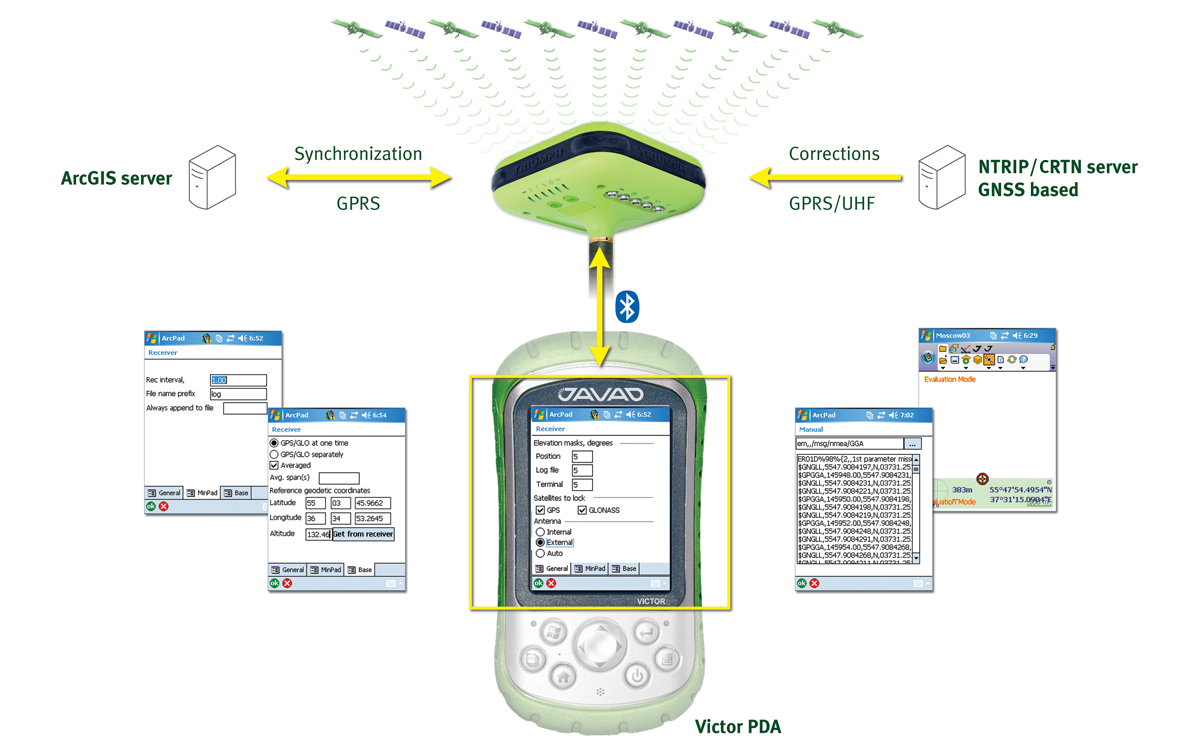
    Javad GNSS introduces Javad ArcPad Extension. JAVAD ArcPad Extension controls the GNSS receiver to manage the surveying process. Synchronizes ArcPad with ESRI’s GIS server by utilizing integrated wireless communication technology.

    NovAtel introduces the SMART-AG. Standard configuration supports GPS L1, GLONASS L1, and SBAS. Customer can add update rates to 20Hz.

    Magellan Professional introduces the ProFlex 500. Standard configuration supports GPS L1, GPS L2, and SBAS. Customer can add GPS L2C, planned GPS L5, planned Galileo and updates rates to 20Hz.

    Hemisphere GPS introduces the XF-101 for Juniper Systems Archer. Standard configuration supports GPS L1 and SBAS.

    Pacific Crest introduces the Advanced Data Link (ADL) UHF radio. Standard configuration supports a 0.1 -4.0 Watt programmable transceiver, a 40 MHz frequency range and support for both 12.5 and 25 kHz channel bandwidth. It is compatible with existing products from Pacific Crest.

    Topcon Positioning Systems introduces the Net-G3A. Standard configuration supports GPS L1, GPS L2C, GLONASS, planned GPS L5, planned Galileo, SBAS and updates rates to 100Hz.

    Just a reminder that next week is the annual ION (Institute of Navigation) GNSS conference in Savannah, Georgia, as well as the annual CGSIC (Civil GPS Service Interface Committee) meetings. We’ll be blogging daily from CGSIC and ION. Keep your browser pointed at the GPS World website all week and hit the refresh button occasionally to see what’s going on at the conference.

  • Navigating the World of GNSS

    Editor’s note: This article was orginally written in April 2006. Although the basic premise of the article stands, some of the information is dated. We plan on updating it in the next couple of months.

    The world of satellite positioning is changing . . . a lot. Global Navigation Satellite System (GNSS) is slowly but most certainly replacing GPS as the acronym used when discussing satellite navigation. The annual ION (Institute of Navigation) GPS conference is now known as the ION GNSS conference. The International GPS Service is now called the International GNSS Service. For the time being, GPS is still the only game in town. However, a revamped Russian GLONASS (GLObal NAvigation Satellite System) program and the European Galileo program will change the landscape of satellite positioning forever. What’s more, GPS itself is undergoing significant enhancements over the coming decades that will improve the integrity and accuracy of the data it produces.

    With respect to surveying and mapping, these new systems and enhancements raise many questions about accuracy, tracking performance, cost, upgrades, and other issues: “Should I wait for a full L2C constellation before upgrading my receivers? Should I wait for Galileo to be operational before making my next major GPS equipment purchase decision?”

    Predicting the Future

    First of all, Galileo, GPS L5 and GPS III (L1C) are still several years away from having constellations substantial enough to make a difference. A lot can happen with receiver technology before then, so placing any significant weight on the “L5/Galileo-ready” feature of a receiver today may not make much sense. In fact, they are sort of “vaporware” because no L5 signal exists yet to test with and the Galileo folks have been reluctant to even release the signal specification to developers.

    Additionally, the competitive landscape could change dramatically. L2C opens the market for other companies to design dual-frequency receivers without having to develop the L2 semicodeless techniques used today (techniques that are technically challenging and filled with a minefield of patent blocks). Granted, it’s not just receiver hardware that makes a GPS survey solution, but L2C certainly eliminates
    a major roadblock for companies interested in competing in the survey market space.

    Whereas the survey-grade GPS equipment manufacturers have been quick to announce products that are L2C/Galileo/GLONASS-capable, it’s interesting to note that very few mapping-grade (meter-level differential GPS) and no consumer-grade (autonomous) equipment companies have given GNSS the same attention. Why? Because today’s GPS is good enough for consumers. They can live with intermittent GPS coverage and still navigate from Point A to Point B. Survey-grade GNSS doesn’t work that way. It’s a satellite-hungry technology.

    For mapping-grade product lines, there is technical value in using the GPS, GLONASS and WAAS, such as being able to work more productively under trees and around buildings. As I wrote in the original 2006 article, mapping-grade receivers will eventually exploit GNSS and that has started. Manufacturers have introduced GPS+GLONASS mapping-grade receivers in the past year. But remember that there are limited sources of differential correction data for GLONASS data. WAAS doesn’t support it. OPUS doesn’t support it yet. NDGPS doesn’t support it. There are a few CORS stations that support GLONASS and the National Geodetic Survey (NGS) said it’s going to offer GLONASS orbits by the end of 2009. But, essentially, one would have to setup their own reference station in order to post-process GLONASS data, or use an RTK Network that is broadcasting GPS+GLONASS corrections.

    The killer app for GNSS — and what has driven companies to buy GNSS equipment now — is centimeter-level, real-time positioning (or RTK, RealTime Kinematic, as it’s commonly referred to). GPS/GLONASS receivers have existed in the survey and precise-positioning market space for many years, and they have finally proven their value after years of GLONASS uncertainty. Using only GPS, RTK still has “brownout” times during the day, especially in tough GPS environments in which satellite visibility is limited. Simply put, there are not enough operational
    GPS satellites to fully meet the demands of real-time, centimeter-level positioning in many cases.

    A System Primer

    The following will discuss the different GNSS implementation benefits and rough schedules.

    GLONASS: The RTK Partner. GLONASS is Russia’s version of GPS. It may surprise you to know that the first GLONASS satellite was launched more than 25 years ago (1982), but due to political and economic issues in Russia, the system never reached maturity as a standalone system. In recent years, however, GLONASS has earned consumer confidence and has proven to be a useful augmentation to GPS for applications using RTK.

    Outside of RTK applications, GLONASS hasn’t been shown to add value to GPS. Markets such as survey-grade postprocessing,  mapping-grade GIS don’t have the cost–benefit payoff for GLONASS that RTK does. Therefore, very few GPS/GLONASS receivers are sold outside of the RTK market space.

    For a long time, GLONASS was stagnant in terms of market acceptance. Without going into too much history, credit the increased popularity of GLONASS in RTK applications to the marketing of Javad Positioning Systems’ technology by Topcon Positioning Systems beginning early this decade. Javad and Topcon have since split (2004) but enough GPS/GLONASS systems had been fielded by then that the GPS/GLONASS RTK solution had proven to be effective and reliable. Today, nearly all major GPS manufacturers offer a GPS+GLONASS RTK system.

    There are currently 17 operational GLONASS satellites and six more are scheduled for launch by the end of 2009. A full 24-satellite GLONASS constellation is scheduled to be in orbit by the end of 2010. The legacy and unreliable GLONASS satellites have been retired. The current GLONASS-M satellites have a design life of seven years. GLONASS-K satellites, with a design life of 10 years and sporting a new CDMA design for close compatibility with GPS, is due to launch at the end of 2010.

    Since the 2006 article, Russia made an historic announcement that they will begin including CDMA signal structure on their next generation GLONASS-K satellites that are scheduled to begin launching at the end of 2010. This is a very significant development that will ease the complexity of designing GPS+GLONASS receivers. It will also result in newer


    There is one serious technical consideration regarding GLONASS. Unlike GPS and Galileo, which use CDMA (Code Division Multiple Access) signal structure, GLONASS uses FDMA (Frequency Division Multiple Access) signal structure. With GPS and Galileo providing 57 satellites using CDMA, will the additional receiver complexity required to process GLONASS data motivate manufacturers to ignore GLONASS in the future? It’s a valid question.

    Galileo Gets Started. Galileo is the European counterpart to GPS. Unlike GPS and GLONASS, which are financed and controlled by their countries’ respective military organizations, Galileo is controlled by civilians; the majority of the system development and all of the system maintenance are funded with commercial capital. It is a GNSS that has been targeted at commercial applications since its inception. It’s
    designed to have a 30-satellite constellation (27 plus three spares), as well as a complement of groundstation equipment. The satellites orbit at slightly higher altitudes than GPS, but the operating principles are the same. The proposed constellation is designed so at least eight satellites are in view at all times.

  • ION GNSS Conference Peers into the Future of Surveying

    The Institute of Navigation’s Global Navigation Satellite Systems (ION GNSS) conference is one of my two favorite industry events of the year; the other being the ESRI conference. At ESRI, I mix it up with GPS technology users, listen to what they are doing and what they want to do with the technology. At ION, I listen to GNSS designers and researchers.

    ION GNSS is where these heady folks come together to share ideas and show the fruits of their labor. It’s also a place where GNSS policy-makers and administrators meet and share ideas. As with GNSS engineers, the administrators and policy-makers are an important part of the future of GPS technology. If a budget gets whacked on a certain GNSS program (say, for example, NDGPS), do you think companies will continue to spend R&D dollars on that technology? If you want to know the future of GNSS and how it will affect surveying, look at R&D today.

    What’s so fun for me about ION GNSS is seeing where engineers spend their money and time. The research they present today will be in products you can use tomorrow.

    But first, be sure to sign up for my free webinar to be held on September 15. I’ll be talking about modernized GPS signals (L2C, L5) and GLONASS. Do they (or in the case of L5, will it) really make a difference? Let’s talk. I’ll take your questions online after making a presentation.

    I hope I’ve made this clear in the past and if not, here goes. I’m not a GNSS scientist. Not even close. Yes, I’ve managed product development where we integrated GPS technology and software to create surveying and mapping products. Yes, I managed the software and hardware engineers who made those products come to life. But if you asked me to write a line of C code or design a circuit, my 17 year old could finish it before I could start. I’m a block diagram sort of person that sees the big picture and communicates my vision reasonably well. And I listen to people, a lot.

    Look at some of the ION GNSS presentation tracks below. Keep in mind that each one of these tracks has six to a dozen research papers within it — and these are only 11 of the more than 40 tracks at the conference. A full list of panel descriptions and speakers is available.

    • Multi-sensor Navigation
    • Urban & Indoor Navigation Technology I
    • Surveying & Geodesy
    • GNSS Space-Based Augmentation Systems (SBAS)
    • Multipath Effects and Mitigation
    • Next-Generation GNSS Integrity
    • PPP and Network-based RTK
    • Software Receivers
    • Atmospheric Effects and Modeling
    • GNSS Inertial Navigation Systems
    • GLONASS Modernization, QZSS & other GNSS

    Just as a sampling, here are a few abbreviated abstracts from the above sessions:

    Development and Field Testing of a DSP-Based Dual-Frequency Software GPS Receiver
    B.W. O´Hanlon, Cornell University; T.E. Humphreys, University of Texas at Austin; M.L. Psiaki, P.M. Kintner, Jr., Cornell University
    A real-time software GPS receiver for the L1 C/A and L2 C codes has been implemented on a Digital Signal Processor (DSP) and tested in a scintillation environment. This receiver is being developed as a low-cost space weather instrument with improved tracking robustness in comparison to a traditional semi-codeless dual-frequency receiver and with flexibility in its choices of signal tracking algorithms and data outputs. The receiver is capable of tracking 12 L1 C/A and 12 L2 C channels while also calculating receiver position and velocity and total electron content (TEC). The current work is a direct continuation of the work presented in Ref. 1. This work discusses several modifications to the software developed earlier, challenges addressed in updating the receiver to be easily adapted to new GNSS signals (e.g., L2C), and lessons learned from operation during ionospheric scintillation.

    Improving Real-Time Kinematic PPP with Instantaneous Cycle-Slip Correction
    S. Banville, R.B. Langley, University of New Brunswick, Canada
    Over the last decade, precise point positioning (PPP) proved to be a powerful processing strategy. It vastly spread in several fields of applications such as atmospheric sciences, geodynamics, surveying in remote regions, processing of large networks, etc. On the other hand, the success of this technique in kinematic mode (with a moving receiver) is still muted due to a rather long convergence period required to obtain a centimetre level of precision. Several efforts were mounted to overcome this limitation, which led to the possibility of fixing carrier phase ambiguities to integers, which is the key to reducing the convergence period. In our approach, both carrier-phase and pseudorange measurements are included in the processing which allows estimating, not only receiver position change and receiver clock offset variation, but also cycle-slip parameters. Since time-differencing over short time spans is used, the assumption that instrumental biases cancel out seems reasonable. Hence, the cycle-slip parameters estimated are integers and conventional ambiguity search methods can be used to statistically determine the optimal cycle-slip (ambiguity) combination. Once the correct combination of integer cycle slips has been determined, their effects can be removed from the carrier-phase measurements, and the PPP processing can be executed without having to introduce new ambiguity parameters in the estimation filter. The benefit of this additional step is that a continuous time series can be obtained for the receiver coordinates, without the need for a new undesirable convergence period.

    Augmenting Low-cost GPS/INS with Ultra-wideband Transceivers for Multi-platform Relative Navigation
    A. Vydhyanathan, H. Luinge, M. Tanigawa, F. Dijkstra, Xsens Technologies B.V., The Netherlands; M.S. Braasch, M. Uijt de Haag, Ohio University, USA
    This paper explores the use of impulse radio based Ultra-wideband transceivers to augment the low-cost GPS/INS navigation estimates in GPS-challenged/denied environments for multi-platform relative navigation. Such low-cost GPS/INS systems are increasingly being used in automobile, aerospace and marine applications for vehicle dynamics analysis, performance testing, Unmanned Aerial Vehicles (UAV) and Unmanned Ground Vehicles (UGV), autonomous attitude and navigation control and camera/LADAR stabilization and correction. The architecture and algorithm developed in this paper has independent ´loosely-coupled´ GPS/INS EKF´s running on each platform. A separate filter then takes the independent filter outputs and combines them with the ranges derived from the Ultra-wideband broadcasts to output relative navigation estimates.

    The Benefits of Multi-constellation GNSS: Reaching up Even to Single Constellation GNSS users
    B. Bonet, I. Alcantarilla, GMV, Spain; D. Flament, C. Rodriguez, EGNOS Project Office, ESA, France; N. Zarraoa, GMV, Spain
    Europe has launched, under the European Space Agency’s (ESA’s) European GNSS Evolution Programme, the MRS initiative. MRS standing for Multi-constellation/multi-frequency Regional System, the initiative is putting different teams of experts into the exciting goal of defining the paths for the most successful GNSS usage on a future of multiple choices.  ESA has prepared a detailed experimentation plan aimed to proof the benefits that the multi-constellation approach can provide to today´s GNSS users. This plan covers a wide range of objectives covering different user domains (aeronautical, land mobile, maritime) eq
    uipped with different types of receivers. This set of experimentations will rely on the deployment of several Test Beds combining multi constellation multi-frequency processing and several broadcast channels (GEO, MEO, terrestrial). Among the first experimentations planned, there are some devoted to experiment and validate the performance benefits for SBAS users (GPS L1 only first then GPS/GLONASS or GPS/Galileo — dual-frequency SBAS users). This paper presents the outcome of the first step of this experimentation campaign, which has been performed based on the magicSBAS tool, a flexible SBAS processing platform, able to acquire single and dual frequency GLONASS data, in addition to GPS, to compute and provide both standards SBAS corrections and integrity, as well as augmentation to GLONASS.

    From studying the track titles and abstracts, one can read between the lines and take a peek into the future of GNSS products. It’s clear to see that software receivers, SBAS, other GNSS, other sensor technology, PPP, atmospheric modeling and mitigation, and more reliable positioning all are active R&D topics that will mold the products in our future…some now and some a few years out.

    I really enjoy this “look into the future” and will do my best to communicate the highlights to you. Our GPS World team will be at the ION GNSS conference in full force. Daily blogs will be written by several editors including myself. The GPS World website will be updated daily so be sure to check in throughout the week (September 21-25.)

    The ION GNSS conference doesn’t actually start until Wednesday (kick-off is the plenary Tuesday evening) of that week. The Civil GPS Service Interface Committee (CGSIC) schedules their annual meeting on the two days prior to the ION GNSS conference. If you aren’t familiar with the CGSIC, I wrote an article about it a couple of years ago. Briefly, CGSIC is the body through which the civil GPS community can communicate with GPS authorities.

    The two days of CGSIC meetings are chocked full of fantastic presentations from the status of GPS/GLONASS/Galileo/SBAS/NDGPS programs to presentation by users of GNSS. Normally I see the agenda posted on the CGSIC website, but I haven’t seen it there ye but check back in a day or two and I bet it will. Typically, the first day are program status briefings (GPS, GLONASS, QZSS, Galileo, SBAS, NDGPS, etc.). The second day contains breakouts sessions from the different subcommittees (US States and Localities, Survey Mapping & Geosciences, International and Timing). I’ll be giving a briefing on RTK Networks Tuesday at the US States and Localities subcommittee breakout session.

    The guy who kicks my butt all over the landscape when I don’t file this column on time, GPS World editor Alan Cameron, also presents at CGSIC on Monday afternoon, with the topic “User Concerns.” For a preview of his presentation, see the latest installment in his Wide Awake blog, Wide Awake on the Midnight Train to Georgia [[http://stage.globalpositioningnews.com/gnss-system/wide-awake/wide-awake-midnight-train-georgia-8807]], in which he plays back results from a magazine survey of readers who answered the question, “Where is society going with GPS/GNSS use, and how will that change the GPS/GNSS industry?”

    We’ll be blogging on the CGSIC meetings as well. Cameron and I will both have digital video recorders in our traveling bags, and we’ll post footage of highlights during the week. That’s another great way for you to get a bit closer to this goldmine of a conference.

    In other notes, only 10 days after it was launched, the latest and last Block IIR-M GPS satellite was declared healthy and ready for service on August 28. Your receiver should be already tracking it and using it. It is identified as PRN05.

    Meanwhile, the status of PRN01 (SVN49) that was launched back in March is still unhealthy and not usable. There’s been no significant news since the flurry of reports detailing its flaw a month ago. I suspect the Air Force will make some sort of announcement at the ION GNSS conference later this month with an update and/or plan to deal with the sick bird.

    And again lastly, be sure to sign up for my free webinar to be held on September 15. I’ll be talking about modernized GPS signals (L2C, L5) and GLONASS. Do they (or in the case of L5, will it) really make a difference? Let’s talk about it. Sign up here.

  • ESRI Conference and SVN-49 Troubles

    I had a great visit at the ESRI User Conference earlier this month. If you recall last year, I wrote:

    “As much as surveyors, engineers, and constructors may not appreciate geographic information systems (GIS) technology, at some point everyone should attend at least the ESRI Survey/Engineering Summit and the first couple of days of the ESRI User Conference held every summer in San Diego, California. This is not a GIS sales pitch. It’s a networking sales pitch. When other conferences are struggling to maintain attendance levels, the ESRI conferences seemingly never fail to grow in attendance. This year, it attracted some 15,000 people from 120 countries. That means gobs of GIS people, and also gobs of surveyors and engineers.”

    The statement rang true this year too. Even in today’s economy where conferences are severely impacted or even cancelled due to travel budget cuts, the ESRI User conference still attracted ~11,000 people this month.

    On another note, I think conference organizers are getting the message. People just can’t justify attending so many conferences. Next Spring, the ACSM (American Congress for Surveying & Mapping) is combining with the GITA (Geospatial Information & Technology Association) conference in Phoenix, AZ. Instead of 1,000-1,500 for each conference, it’s a larger event at 2,000-3,000. Even more interesting is talk in the rumor mill about a joint conference including ACSM and the ESRI Survey Summit in 2011. Include the GITA conference with those and that makes a lot of sense to me.
    As usual, there were many things happening at this year’s ESRI UC conference and I attended many briefings. I’ll try to stay focused on the highly GPS/GNSS-related subjects:
    Javad GNSS. One of the bigger news items on the GPS front was the joint Javad/ESRI effort in developing an ArcPad extension for Javad’s line of receivers. The demonstration was very cool. We loaded up a local map (San Diego) from their server located in Moscow (Russia) then took a Javad RTK receiver outside with the data collector (running ArcPad w/Javad’s extension). I collected data on a few points. The data was sent off to Moscow from the data collector (via GPRS while we were outside) to update the map. After we walked back into the convention center, the demonstrator clicked the workstation “refresh” button and viola, the map was updated with the points I collected at the cm-level.
    According to the JAVAD engineer, “we make it look easy.” I agree. There’s a lot of heavy-lifting going on in the background to make this happen. With the heavy-lifting done, it still needs a bit of tweaking. There weren’t any quality control indicators (RMS values) on the data collector for the operator to reference and also ArcPad doesn’t recognize GLONASS satellites so while the GNSS receiver was utilizing GPS and GLONASS, ArcPad only reported GPS satellites. The operator really does need to know what’s going on before tapping on the STORE button. But, 95% of the work is done and the heavy lifting is complete so I don’t doubt they will finish off the last 5% in short order.
    Topcon Positioning Systems. I’ve had a few questions from readers on Topcon’s new GRS-1 receiver. Is it single frequency? Is it dual frequency? Is it for GIS? Is it for survey?
    The answers are Yes, Yes, Yes and Yes.
    The entry-level GRS-1 is a single-frequency hand-held GIS data collector. That’s about US$5,000.

    Add US$4,000 and you get a 5cm high accuracy GIS receiver.

    Add another US$2,500 and you have a full-blown, cm-level RTK rover.

    There are other options beyond this (eg. GLONASS), but I think you get the picture as I did. It’s a full L1/L2 GPS and GLONASS receiver. You pay to have features activated (plus some added hardware/software).

    I haven’t tried one yet so I couldn’t tell you how it performs, but it’s worth a look.

    Juniper Systems. Although they don’t design GPS receivers, their Archer hand-held is starting to show up in a lot of places. Hemisphere GPS has designed the XF-101 receiver as a plug-in for the Archer as well as having a similar model for the Trimble/TDS Recon and Nomad hand-helds. Javad was also offering the Archer with their systems. IkeGPS also introduced a new hand-held mapping system named the Ike1000 that is based on the Archer.

    Geneq. Their flagship product, the SXBlue GPS, seems to be gaining momentum in the GIS marketplace. They have introduced a new model that utilizes the OmniSTAR correction service called the SXBlue II-L GPS. Their use of WAAS (via Hemisphere GPS Coast technology) and performance under tree canopy has created some buzz.

    Trimble Navigation. It’s hard to leave Trimble out of the conversation, but nothing really new in the GPS product area. However, they continue their run of acquiring companies with the latest being Farm Works Software in the precision agriculture industry. In 2009, they’ve acquired four niche-market companies.

    Magellan Professional. Introduced an upgrade to support ArcPad 8.0 for post-processing on their Mobile Mapper 6 hand-held for sub-meter accuracy. FYI: Magellan consumer GPS products is no longer part of Magellan Professional. Rumor has it that Magellan Professional will revert back to the Ashtech brand name of the1990’s.

    Leica Geosystems. Where were they?

    SVN-49 Troubles, Solar Cycle 24, GAO Report

    I gave a presentation at the ESRI UC on Tuesday morning as part of the Survey (SUR) track. I focused on three core issues listed above. You can view my presentation here.

    I’ll stick to the highlights…

    <
    p>SVN-49 troubles. It’s broke and will never be as good as the other Block IIR-M satellites. Don’t expect it to be declared healthy in the immediate future. Even if a patch is developed and it’s declared healthy, it’s likely that pseudorange-based safety-of-life applications like SBAS (WAAS, EGNOS, MSAS) and NDGPS will not incorporate it into their solutions. Although more study is necessary, it appears that carrier-phase applications (cm-level real-time and post-processing) will be able to utilize SVN-49.

    Solar Cycle 24. NOAA reports that the number of sunspots during the next solar cycle (2009-2020) will be the fewest since the 1920’s. That doesn’t mean the next solar cycle will be any easier on GPS than the last one. On the contrary, it could be worse for GPS. No one knows at this point. High performance GPS L1 receivers are the most exposed. Those utilizing NDGPS, WAAS and OmniSTAR’s VBS service need to be watchful. You can sign up to receive alerts from NOAA giving a three-day forecast of activity. NOAA predicts the peak of the next solar cycle will be in May 2013. Note that typically the geomagnetic activity that most affects GPS occurs after the peak. Links and more details are in the presentation.

    GAO Report. I wrote an article on this subject back in June as it relates to medium and high precision users. You can read it here. High precision users will be affected more than other users because high precision GPS receivers perform better with a lot of observables. A loss of 2-3 GPS satellites can be significant and require users to begin using GPS mission planning software again to optimize the use of field time. Survey receivers using GPS and GLONASS will be less affected. The presentation references a report from the University of New Brunswick that takes a look at how GLONASS can compensate for a loss of GPS satellites.


  • GPS Receivers for GIS Data Collection

    In my last issue, I proclaimed the start of GPS/GIS month, with a focus on the subject in three of my newsletters. This is the second in that series. The first column can be read here. Also, I’m hosting a webinar June 30 to discuss using GPS receivers and technology for GIS data collection. In my last newsletter I discussed the use of consumer GPS receivers for GIS data collection. Remember the analogy I used…a Volkswagen Beetle wasn’t designed to run in a Formula One race? This column is going to focus on the Formula One cars, not the Volkswagen Beetles. In other words, it will focus on the GPS receivers on the market that are designed for GIS data collection. I will refer to them as GPS/GIS receivers.

    What differentiates a GPS/GIS receiver from any other GPS receiver?

    The number-one differentiator is that GPS/GIS receivers are designed do a better job of optimizing tracking and accuracy in areas where GIS data collection is performed. The operative term is “are designed.” Specifically, engineers who designed GPS/GIS receivers do so with different design criteria than engineers who design consumer GPS receivers and even survey GPS receivers. For example, a GPS/GIS receiver must be designed to operate where GIS data is collected and with reasonable accuracy. On the other hand, consumer GPS receivers are designed to track in tough conditions, but at the expense of accuracy. Furthermore, survey GPS receivers hold accuracy as the number-one priority so they sacrifice the ability to track in many environments.

    The following matrix illustrates my point (1 = Highest priority design consideration, 5 = Lowest priority design consideration):

    There are thousands of designers of consumer GPS receivers (Garmin, TomTom, Magellan, etc.) and probably only 10 designers of GPS receivers for surveying (Trimble, Leica/NovAtel, Topcon, Magellan Professional, Septentrio, JAVAD GNSS, NavCom, etc.). There are even fewer designers of GPS/GIS receivers — less than 10 (Trimble, Magellan Professional, Topcon, Geneq, Sokkia, Hemisphere, JAVAD GNSS, ViaSat).

    The market for GPS/GIS receivers is a complicated one. That’s the primary reason why there are only a few manufacturers. Here are some of the reasons why it is complex:

    • Users require a GPS receiver that will work effectively in many different and challenging environments such as under trees, in mountainous areas and near buildings. There is not one product on the market that will meet every user’s requirements.
    • Users have various needs for the type of GIS data collected. For example, some only need two or three attributes for a utility pole and others may need to collect dynamic line segments such as speed zones and road lane types.
    • There is not an effective way for manufacturers to distribute such products. The traditional survey instrument dealers (not all) are not typically trained or experienced in GPS/GIS technology. Since there is not an effective distribution channel, the alternative is to create a grass-roots distribution channel, which is very time-consuming.

    There are many factors to consider when attempting to determine what sort of GPS/GIS data collection system best fits a user’s requirements. Here are some in order of priority:

    1. Budget. One could argue that data collection requirements should be #1. Maybe, but that depends on what stage of planning you’re in. If you are in the budget planning phase and are able to influence it, then I agree that user requirements should be the first priority. However, the vast majority of people I encounter are given an established budget to work within. In that case, budget should be #1 because it’s a waste of time to consider solutions outside of the budget constraint.
    2. Accuracy. When I ask a potential GPS/GIS user what their accuracy requirement is, the typical answer is “as accurate as I can get”. Of course, you can imagine the ensuing conversation…Me: Well, Ok, you can achieve results around a centimeter.
      Them: That’s great. A centimeter is perfect.
      Me: Ok, here are the cost and training requirements.
      Them: Wow, why is it so expensive???????
      Me: There is a direct relationship between accuracy and cost. The more accurate you want, the more expensive it’s going to be.
      Them: Well, Ok, we reeeeally only need to be within about three feet.
      Me: Do you need elevation values within three feet?
      Them (now leery of the response to their answers): Will those cost more?
      Me: Yes, probably quite a bit more.
      Them: No, we don’t need elevations.
    3. Data collection requirements. Essentially, consumer GPS receivers and survey GPS systems “think” in terms of points. More specifically, consumer GPS receivers operate in terms of waypoints and survey GPS systems operate in terms of point averaging.
      Some of the more sophisticated survey GPS systems offer Field-to-Finish (F2F) capability whereas points are automatically connected to form a line back in the office such as with curbs and property lines.GIS data collection systems are different. GIS “sees” the world in one of three ways; points, lines (or polylines) and areas (or polygons). All have some level of database information attached. For example, a fire hydrant is a point on a map but there is also information in the GIS about that fire hydrant such as condition, last inspection date, etc. A parcel is a polygon on a map but there is also information in the GIS about that parcel such as ownership, tax id, etc.
      Additionally, there are several methods to record all three.For example, a wetland biologist may be mapping the perimeter of a wetland area but wants to “take points” on certain habitat nests he/she sees while walking the perimeter. Some of the more powerful GIS data collection software is built so the biologist can temporarily suspend mapping the perimeter and be allowed to map the next site and resume mapping the perimeter when point recording is finished.

      Using the proper data collection software that matches the user requirements can save a significant amount of time and energy.


    4. Data collection conditions. This is the biggest “gotcha” for GPS/GIS receivers. A certain GPS receiver designed for GIS data collection may perform flawlessly in the open-sky and works perfectly well for uses such as agriculture or other open-sky environments. However, most uses consist of some or all work done in “less-than-ideal” GPS conditions. Tree canopy is the biggest culprit. In that scenario, receiver performance can differ significantly. Some won’t track at all in those environments and some will track very well, but accept excessively noisy satellite measurements (which significantly degrades accuracy). The best ones are designed with a keen balance of satellite tracking and accuracy – with settings the user can change depending on the environment.

    Why are GPS/GIS receivers so much more expensive than consumer GPS receivers?

    Part of the reason that consumer GPS receivers are adapted to GPS/GIS data collection is the significant difference in cost. A consumer GPS receive
    r can be purchased for well under US$200. The entry level price for a GPS receiver with comparable accuracy, but with GIS data collection features is four times that. Furthermore, the entry level price for a GPS/GIS receiver capable of sub-meter accuracy is about $2,000.

    There are several specific and justifiable reasons for the price difference, but suffice to say that significantly more design engineering, technical support and sales effort is involved with GPS/GIS receivers. Furthermore, the volume of GPS/GIS receivers is miniscule compared to consumer receivers. If there were tens of millions of GPS/GIS receivers manufactured and sold every year, the price would be under US$200 each. But the GIS market just isn’t that large. Therefore, GPS/GIS manufacturers have to charge more per unit to account for engineering, technical support and sales overhead.

    Lastly, as mentioned above, there are not very many manufacturers of GPS/GIS receivers. Lack of competition usually results in higher prices to the end user.

    What sources of GPS corrections are available?

    Autonomous (no differential correction applied) GPS is pretty accurate these days…on the order of a few meters. For this reason, consumer GPS receiver manufacturers tend to leave out information on GPS corrections in their specifications. Their rationale is that consumers don’t really care as long as they can navigate effectively.

    However, the GPS/GIS receiver market is much more concerned with accuracy. Therefore, some sort of GPS correction source is highly recommended and necessary to achieve the desired accuracy.

    There are essentially two types of GPS corrections: real-time and post-processing.

    Throughout the 1980s and 1990s, post-processing was the dominant method of correcting GPS data. Even then, 2-5 meter accuracy was the norm for GPS/GIS receivers after post-processing was applied. Sub-meter GPS technology (using GPS/GIS receivers) only became possible towards the end of the 1990’s. Users were accustomed to going through the post-processing exercise (downloading base station data, QAing post-processed data, etc.). At that time, the only option for using real-time corrections were commercial services such as OmniSTAR.

    In the mid-1990s, the U.S. Coast Guard (USCG) established the DGPS system that broadcast real-time GPS corrections free of charge along the US coastlines and major waterways. The user only needed to purchase equipment (beacon receiver) to receive the signal. The success of that program lead to the U.S. Department of Transportation (DOT) to expand the program to cover inland regions that were out of the USCG domain. That was the GPS/GIS user’s first taste of free DGPS corrections…and they liked it because it eliminated the time-consuming (and sometimes painful) process of post-processing.

    The break-out milestone for real-time corrections came in 2003 when the Federal Aviation Administration (FAA) declared the Wide Area Augmentation System (WAAS) operational. WAAS took real-time GPS corrections to another level of simplicity. Not only is WAAS free of charge to users, but unlike the USCG DGPS and commercial DGPS services, it’s broadcast on the same frequency as GPS. This means that no extra antenna or receiver is required to utilize the signal. Furthermore, it’s broadcast nation-wide in the US where ever the WAAS satellites are visible to the user. Due to the success of WAAS, several other regions in the world have deployed similar systems; EGNOS in Western Europe, MSAS in Japan/Korea and GAGAN in India.

    Finally, in the early part of this decade, local networks of reference stations began springing up. These are called RTK Networks. While built primarily for users of survey GPS receivers who require cm-level accuracy, there is a growing population of GPS/GIS users who are connecting their GPS/GIS receivers to these networks to obtain GPS corrections. However, the costs can be expensive. Some network operators charge a fee to access their network and the user must also have a data subscription with a wireless provider (GSM or CDMA) which has a monthly fee associated with it — similar to a mobile phone.

    The Future is Clear

    The trend is clearly towards using real-time GPS corrections no matter which source is used. The time consumed by post-processing and the expense of maintaining software and training requirements adds too much overhead in most applications for organizations to consider it.Although not the dominate correction technology any longer, post-processing in the GPS/GIS segment still has a niche – the so-called “sub-foot” niche. While the majority of GIS applications are satisfied with “sub-meter” (or even 1-3 meter) accuracy, there are certain applications where “sub-foot” accuracy is required. With these receivers, the users must post-process against several reference stations or tie into an RTK Network.

    Integrated “All-in-one” GPS/GIS receiver or separate stand-alone receiver?

    In the GPS/GIS receiver market, there are clearly two types of systems. The “All-in-one” receivers have the GPS receiver, antenna and data collector built into a hand-held format. These are products such as the Trimble GeoXT/XH, Magellan Mobile Mapper CX/6 and Topcon GMS-2.

    The “stand-alone” receivers are a “black box” which houses only the GPS receiver, GPS antenna and optionally a battery. Other devices such as PDAs, tablet computers and notebook computers receive GPS data from these stand-alone receivers typically via Bluetooth interface or cable connection. These are products such as the Trimble ProXT/XH, Geneq SX Blue, Sokkia GIR1600, Hemisphere A100 and Javad GISMore.

    There are advantages and disadvantages to both.

    “All-in-one” receivers house everything one needs in a single hand-held unit. The advantage is that the data collector, GPS receiver, antenna, battery system, etc. are all designed by one company to work together. On the other hand, designing all of these components into a single hand-held can make for a somewhat heavier unit. Also, PDA technology is evolving rapidly. “All-in-one” receivers aren’t updated nearly as fast as PDA technology so an “All-in-one” unit may have an out-dated operating system and/or processor if the design is a few years old.

    “Stand-alone” receivers are separate receivers that send GPS data to a PDA, tablet computer or notebook computer via wireless Bluetooth or cable connectio
    n. The advantage of these systems is flexibility. On one project, they can be interfaced to a PDA. On the next project, they can be interfaced to a notebook computer running different mapping software. They aren’t affected by the advancement of PDA, operating system or computer processor technology.

    The Final Analysis — GPS/GIS Receivers for GIS Data Collection

    There a myriad of GPS receiver technologies being used for GIS data collection. It’s a complex industry. Some receivers being used are purpose-built and others have been adapted from other industries like consumer GPS.

    There is no magic formula to determine which GPS receiver will work best because it really depends on the user’s requirements and in GIS, the user requirement vary greatly. “Try before you buy” is the best advice to follow when going through the equipment/software selection process.


    If you have time, I’m conducting a GPS/GIS receiver webinar on June 30 (next Tuesday) at 10:00 a.m. Pacific time. I will continue the discussion of GPS/GIS receiver selection. Register for the webinar here.


  • Consumer-Grade GPS Receivers for GIS Data Collection

    Consumer-Grade GPS Receivers for GIS Data Collection

    I hereby proclaim June GPS/GIS month (at least for me). I’m dedicating the next three newsletter columns (early June, mid-June, and early July) and a webinar (June 30) to discussing using GPS receivers and technology for GIS (geographic information systems) data collection. Why, you may ask?

    First of all, I realize my domain is typically the high-precision survey/construction arena, but the boundary isn’t so clear cut any longer. Many surveyors, engineers and construction crews use less accurate GPS receivers for activities such as GIS data collection, recon, and navigating — so the topic is relevant.

    Secondly, ’tis the season. The ESRI User Conference is in mid-July this year — about six weeks from now. Although high-precision GPS has a firm place there and is growing, the ESRI UC is the largest conference in the world where non-survey GPS is near center stage. It is one of the primary data-gathering tools that fuels a GIS.

    There have been some really significant changes in the last 10 years. GPS data-collection tools for GIS have expanded. At that time, consumer receivers couldn’t be used because Selective Availability (SA), the intentional degradation of GPS accuracy by the Department of Defense, was still active. Also, “submeter” GPS mapping systems were backpack-based, contained a “rat’s nest” of cables, required camcorder batteries to run, and were generally bulky. Data collectors were based on DOS instead of Windows. Lastly, users were primarily using post-processing to differentially correct their GPS data or using Marine DGPS/NDGPS in select locations or commercial DGPS services like OmniSTAR for real-time DGPS.

    Fast forward to today. Three categories of GPS are being used to populate GIS databases: consumer-grade receivers, GPS receivers designed specifically for GIS data collection, and survey receivers used for GIS data collection. In this column, I’ll discuss using consumer-grade receivers for GIS data collection. In my mid-June column, I’ll discuss the class of GPS receivers designed specifically for GIS data collection.

    Consumer-Grade Receivers

    Overnight, when SA was turned off in May 2000, consumer-grade GPS receivers became a viable option for GIS data collection where accuracy is not of the highest priority. Today, due to improvements to the GPS itself as well as GPS receiver technology and along with the maturation of WAAS/SBAS, consumer-grade GPS accuracy is even better.

    Thousands, maybe tens of thousands, of consumer-grade GPS receivers are being used to collect data used for GIS. They are easy to use and the price is attractive.

    Understanding the accuracy of a consumer-grade GPS receiver is not a simple task. In fact, if you’re not careful, you can be easily misled. For example, take a receiver out to the parking lot and wait for it to obtain enough satellites and a WAAS/SBAS correction. You may be impressed with its precision as it might be within a couple of meters or even better. There are two issues with this:

    • Repeatability…accuracy vs. precision. Precision is a group of points that are tightly clustered but not in the right place. For example, you may have a cluster of 10 points all within two meters of each other, but they are five meters from the true location. This is not necessarily desirable, but quite typical for consumer-grade GPS receivers. Some receivers offer an “EPE” (Estimated Positional Error) value on the display to provide you and indication of accuracy. Absolutely do not rely on this value in an attempt to estimate the position accuracy of the receiver. It is a rough guess at best.
    • Performance in less-than-desirable GPS conditions. Surprisingly, or not, users assume that performance in a grove of trees is going to be similar to performance in a parking lot with a wide open view of the sky. This is not the case.

    I’ll give you a real case study. Several years ago I was helping a company setup a GPS system to map utility poles. Their required accuracy was +/- 3 meters. A local survey equipment salesperson suggested they use a consumer-grade Compact Flash (CF) GPS receiver plugged into the top of a ruggedized PDA. The salesperson demonstrated the receiver in the client’s parking lot. The performance, in the client’s eyes, seemed like it would meet the +/- 3 meter requirement. The price was right at $250 per receiver and they need upwards of 15 receivers. There were a couple of alternative proposals that cost significantly higher per receiver ($2,000-$4,500 each). The price difference was too great for the client not to be tempted to try the $250 receiver so they purchased six of them. They ended up using them for only 60 days. The bottom line was that the receiver performed very poorly in the field in two areas. First, many of the utility poles were located in areas where there were many trees. The client found that the CF GPS receiver performed very poorly in that environment. Some positions were off by more than 50 meters. Secondly, the client found that the CF GPS receiver had a difficult time maintaining lock on the WAAS satellites used for corrections even in relatively wide open areas where this shouldn’t have been a problem.

    In this case, the lesson is to try the receiver in an environment where you will be using it. All GPS receivers will perform worse under tree canopy as compared to their performance in an open area. This is the Achilles heel of GPS. That being said, some GPS receivers perform better under tree canopy than others. The ones that do perform better under trees were designed to do so. Using a consumer-grade GPS in that environment is sort of like trying to compete in a Formula One race with a Volkswagen Beetle. The design criteria of the Beetle was fuel economy and low cost, not acceleration and cornering. The same applies to consumer GPS receivers. Accuracy is not one of the top criteria for consumer GPS receiver designers. They are much more concerned with low cost, low power consumption, small antenna size and fast satellite acquisition, as they should be. My wife, for example, really doesn’t care if it’s accurate to 15 meters vs. 1 meter as long as she arrives at the destination she plugs into the system. On the other hand, high-performance GPS receivers designed for GIS data collection sacrifice some features such as power consumption, antenna size, and small size in order to optimize accuracy.

    This is not to say that consumer GPS receivers have no place in GIS mapping. On the contrary, they have a very important place. My point is that your expectations should match reality when evaluating receivers to use for your project. The accuracy specifications on consumer GPS receiver datasheets are essentially meaningless. The only way to truly understand the performance of a particular receiver is to try it yourself.

    One final note on this. Many commercial (typically survey equipment dealers) and academic entities have published accuracy comparisons of different consumer GPS receivers. You really have to take these reports with a grain of salt. Sometimes the reports are intentionally biased and other times they are biased due to lack of knowledge or experience. They are also based on an environment that may not be similar to yours. “Heavy” tree canopy is a subjective term. Tree canopy in Oregon is different than tree canopy in Alberta and is different from tree canopy in Austria.

    The Final Analysis

    Upside:

    • Low cost
    • low power
    • user-friendly
    • small

    Downside:

    • Poor accuracy in challenging GPS conditions
    •  inconsistent accuracy in non-challenging GPS conditions
    • unable to post-process (with a few exceptions)
    • no on-board GIS data collection functionality


  • Survey Perspectives: RTK Networks Webinar Q&A Follow-Up


    I really enjoy doing webinars and the RTK Network webinar on April 21 was no exception. One of the reasons I really enjoy them are the questions and comments I receive because it gives me some feedback as to what the user community is thinking and wondering about. Clearly, RTK networks are a hot topic these days. The registration for the RTK Networks webinar was one of the highest in history for GPS World.

    If you missed the webinar, you can still download the file and listen to it.

    Now without further ado, following are questions that listeners sent in and my comments from the RTK Networks webinar.

    Question #1: Can you say anything about the proposed National Geodetic Survey Real-Time Networking (NGS RTN) guidelines?

    Gakstatter: The NGS is still in the early stages of developing the RTN guidelines so the agency would prefer public comment be withheld at the moment. It’s are working on guidelines to cover four areas: site considerations; planning and design; administration; and users. The agency has assembled quite a team of government and industry people to develop these guidelines. The team hopes to have draft versions ready by September 30, 2009.

    However, the NGS Real-Time User Guidelines (Ver. 2.0.4) is available to the public. Though these guidelines are targeted at classical RTK users (non-RTK network), it contains some solid procedures.

    Also, an interesting study was published recently by Newcastle University Civil Engineering and Geosciences specific to network RTK. Stakeholders in the report include The Survey Association (UK), Ordnance Survey (UK), Leica Geosystems, Trimble, and Royal Institute of Chartered Surveyors. They did some extensive testing and generated basic guidelines:

    1. Configure the rover according to manufacturer guidelines. According to the report, significant deviations from recommended settings can introduce unacceptable errors.
    2. Consider lowering the GDOP (PDOP) mask to 3 instead of 5. Generally, in a clear-sky environment, you’re going to get this anyway and it will increase the robustness of solutions in challenging areas.
    3. Pay close attention to quality indicators on the rover (for example, RMS values). They generally reflect actual performance of the rover. An RMS value more than 10 centimeters generally indicates there is a problem such as loss of ambiguity resolution or other satellite loss of lock. Those positions should not be used. However, in challenging environments (such as obstructed satellite visibility and multipath) quality indicators (especially vertical) maybe be “overly optimistic” by a factor of 3 to 5.
    4. The report commented on occupation times, which I’ve written about in a previous article. Using a 5-second average on topographic will reduce the effect of individual epoch variations.When vertical is important (as in establishing secondary control), two different sessions of at least 180 seconds should be recorded. The report indicated that a time separation between sessions of 20 minutes will yield an accuracy improvement of 10 to 20 percent. A time separation of 45 minutes will yield an accuracy improvement of 15 to 30 percent. A time separation of greater than 45 minutes did not provide “appreciable further improvement. This was very interesting to me as most guidelines I’ve read (including NGS guidelines) dictate a four-hour separation between sessions.
    5. GLONASS improves satellite visibility (thus increasing productivity), but doesn’t necessarily improve accuracy. *
      This conclusion doesn’t surprise me, but I think there needs to be an asterisk here since there are significantly more GLONASS satellites available now than there were a year ago. In a scenario where there are only five GPS satellites and four GLONASS satellites, my guess is that at least the robustness of the solution will be better, and generally the accuracy as well, due to the improved geometry (PDOP).

    Their recommendations make a lot of sense to me. Probably the most controversial is the separation time (45 minutes versus four hours) between sessions. This is against most standard practice that I’ve read, but then again I don’t have empirical data to support it either way, whereas the report does. It is clearly an area that needs a closer look. The time savings in the field could be reduced considerably for setting secondary control if this practice was adopted.

    Question #2: What manufacturers for RTK-network implementation would you recommend?

    Gakstatter: Well, there aren’t many choices. The market is dominated by Trimble and Leica Geosystems, with Topcon on the fringe.

    I don’t know if anyone can say with confidence which one is better from a technology standpoint. I’ve used rovers on all three networks and all seemed to behave as expected.

    Both Trimble and Leica networks have been implemented in large geographic areas (state-wide, country-wide) so they’ve experienced the growing pains and presumably have worked out any major issues.

    There are many issues other than which network software vendor you select. A big one is the information technology (IT) component. Without support from your IT department (or control over IT with a competent IT project manager), getting a network to run smoothly will be a really rough road. I don’t pretend to have gone through the process of setting one up, but I’ve talked to enough people to know this is a common theme among them.

    Trimble VRS

    Leica Spider

    Topcon TopNet

    Question #3: How different is the RTK processing for network versus cluster?

    Gakstatter: A cluster is essentially a group of reference stations set up in a geographic area. The user selects which reference station to use (usually the closest one) and receives corrections just like a user would from a reference station he set up himself. Communications from reference station to user is generally accomplished via UHF/VHF/spread spectrum radio or wireless network (GSM, CDMA).

    With a network, data is collected by all reference stations and sent to a central server where the data is processed; corrections are generated and sent to the user. Sophisticated atmospheric modeling is done and incorporated into the corrections. In theory, this eliminates distance-dependent errors within the network.

    Question #5: Does anyone know of any other published RTN user guidelines?

    Gakstatter: See answer to #1. The Newcastle University report is available here.

    Question #6: Could you talk a little about post-processing?

    Gakstatter: Well, it’s a subject worthy of more space than can be accommodated here, but it certainly has its place in setting primary survey/geodetic control and is the preferred method.

    Also, single-frequency GPS units are still the price leaders for entry-level GPS surveying. Even today, many people use GPS L1 units with post-processing for collecting topo survey data.

    Question #7: We are in Philadelphia and we use the Trimble VRS Network. We download and import a .dc file into Trimble Office. I don’t feel as confident using this network as I did when we got an OPUS solution and adjusted the base station. Procedure-wise, do you have any advice on how to capture the data? We are doing a morning session and an afternoon session and averaging the results.

    Gakstatter: I deferred to Bill Henning who is the RTK network specialist with the National Geodetic Survey. NGS has developed RTK user guidelines. Here is Bill’s opinion:

    “RTK will give you coordinate information and not much else. You can set the data collector to keep covariance records, which will allow you to dump the data in the office program and actually perform a tweaking of the coordinate positions if you have redundancy in some form (another location on the point of interest). I would never use just one RTK location for any significant point — there are too many variables. Any point that you will reuse or that is important in itself to the job should be located redundantly (see the summary table in Section V. of the single base guidelines).  Also, any point whose elevation is important to less than 3 centimeters should be leveled (or produced from a total station shot from a known point, and so on). In another vein, typical RTK accuracies (say 0.03′ horizontal, 0.05′ vertical) can be achieved through a localization to known and trusted passive monuments surrounding the project.

    My recommendation for a project site without existing trusted control would be:

    • Perform two OPUS-RS set-ups on the site control points. These would be 15-minute sessions staggered by 4 hours. Even better (but not usually in the cards), perform the second session on a different day and/or with different weather (still staggered by 4 hours, though). Site control should form a rectangle around the project with additional internal control for large sites.
    • Use the RTN to check values on the OPUS-derived coordinates. This is where the datums and epochs of the RTN come into play! If the RTN is using coordinates aligned to the NSRS within a couple of centimeters, all should be well (to that accuracy). Search for outliers. Evaluate these for the error source (user, OPUS, RTN) and correct or discard.
    • Perform a site “localization” to the site control from the RTN. This will let the user now use the RTN for internal work based on the site control as the “truth.” This is most important for the verticals. All features that require an elevation accuracy RMS less than 0.05′ (say 1.5 cm), should be done redundantly or better, by more precise means such as leveling or total stations.
    • Make sure of the integrity of the site control for future work. Points should be outside of the disturbance area with good stability.

    Question #8: How do you feel about the appropriateness of RTK for “boundary” locations? What QA/QC can be done in the field?

    Gakstatter: Many surveyors I know use RTK for setting boundaries. Some even use single-baseline RTK for this task, which is essentially just a radial survey (no redundancy). I’d say that almost all who I know that are doing this have used their RTK systems enough to understand the limitations. In fact, I think most have run RTK and total stations side-by-side on jobs to gain confidence and understand RTK in the field.

    I’m sure I’ll get blasted by some folks for not downplaying RTK for determining boundary locations, but I don’t think it serves any purpose to ignore what’s actually happening in the field. There is so much pressure, especially in these economic times, to reduce field time and increase efficiency that RTK ends up filling that need.

    At a minimum, I would occupy each point at least twice with the base station set up on two different monuments. If you’re using corrections from an RTK network, I’d occupy twice with a 4-hour separation between occupations (for example, once in the morning and once in the afternoon). I’d even dump the antenna a couple of times with each occupation to get two or three “fresh” measurements.

    The above assumes that you have a clear view of the sky (no blockage by trees or buildings), are tracking at least six GPS satellites, and have a PDOP of 3 or less. If you’re up against a tree line, tracking five satellites, and the PDOP is 5, I wouldn’t accept it even if the RMS indicators looked good.

    I’ll leave at that for now, as I could write a column just on this subject. I certainly would not support someone new to RTK to cut their teeth on boundary locations. I’d suggest building confidence and experience with RTK on applications where there is more wiggle room.

    Question #9: Could you address the ability of the RTK network or cluster to adequately service dynamic surveys verses static?

    Gakstatter: Dynamic is really the issue here. In my experience, there are at least a couple of issues to be aware of.

    1. There’s generally a “lag time” between when you press the button on the data collector and when the measurement is taken. I don’t have any empirical data on this, but it’s something I’ve experienced and I’ve seen that some make and models of equipment do better than others. If you’re moving at 8 mph on a 4-wheeler and the lag time between pressing the data collector button and the actual measurement is 1 second, you will travel approximately 12 feet before the measurement is recorded.
    2. A few years ago, a client of mine wanted to measure the acceleration of a vehicle after it was impacted by another vehicle. We determined that recording data at 1 Hz (one measurement per second) wouldn’t provide sufficient resolution. Nearly all RTK systems come preset to record at 1 Hz. However, most RTK equipment is able to record faster than 1 Hz. We ended up recording at 10 Hz (10 measurements per second).

    Question #10: It is possible to use a single-frequency receiver as a rover in the RTK technique, or it is a limitation?

    Gakstatter: I’ve got just a little experience in attempting to use L1 RTK on an RTK network. It didn’t work very well for me for centimeter-level accuracy, but worked OK for sub-foot accuracy.

    L1 RTK systems generally have some specific needs in order for them to work optimally. For example, some are able to utilize SBAS satellites as observables. RTK networks don’t support this type of observable (at least the ones I know of), so optimal performance from L1 RTK is achieved when the user operates his or her own reference station instead of using an RTK network.

    Question #11: You should discuss the advantages of using PPP if a reference survey monument is not available when setting up/initializing RTK.


    lign=”left”>Gakstatter: PPP (precise pointing positioning) is a very interesting subject and I intend to dedicate a column to it in a few months. In the meantime, GPS World Contributing Editor Dr. Richard Langley provided a column on PPP in the April 2009 issue of GPS World.

    Question #12: For the states out west, any challenges you are aware of in collaborating with the PBO on upgrading stations to real time and receiving the raw data?

    Gakstatter: Plate Boundary Observatory (PBO) has a tremendous number of reference stations in the Western United States, I think more than 800. I’ve spoken to a few different RTK network administrators in the Western U.S. who have incorporated PBO reference stations into their RTK networks. The general consensus is that PBO site communications is the major challenge. RTK networks require that the data stream travels from each reference station to the network server and then to the user within two seconds, so reliable communications is very important. PBO sites weren’t designed for this sort of communications in mind so that portion has to be upgraded in order for it to serve in an RTK network.

    For new PBO sites, I’ve talked to an RTK network operator who has collaborated with PBO successfully in building the site and including “RTK-network compatible” communications facilities during site construction.

    Question #13: Do you foresee penetration of GNSS RTK network technology in mass-market applications such as location-based services (LBS)?

    Gakstatter: Not in the near future. LBS are not yet as much about accuracy as they are about applications — mostly navigation, family tracking, and social networking applications but many more are to come. None of these applications require the high degree of accuracy that RTK networks are built for.

    Question #14: What is the estimated number of users in America? Say this year and three years later.

    Gakstatter: I don’t have specific numbers, but I would say that this is one of the fastest growing areas in GNSS. It crosses many different industries such as survey engineering, construction, mining, and agriculture. Also, machine control is expected to grow worldwide at a CAGR of 23%-28% in the next five years and real-time positioning is a critical component for this.

    Question #15: Does latency in cell signals affect accuracy in clusters or networks?

    Gakstatter: Yes, very much so. The industry standard latency ceiling seems to be two seconds from the time the data leaves the reference station, travels back to the server, is processed, then is received by the user. Any hiccup in the communications process will affect accuracy.

    Question #16: Our network recently performed a readjustment. This shifted the H by .08′ and the V by .10′. If you are using the network for real property boundaries, do you want to stay on a current epoch? Or have your property move with the crust, thus forcing recalibration on every readjustment?

    Gakstatter: Again, I deferred to Bill Henning who is the RTK network specialist with the National Geodetic Survey. NGS is developing user and administrator guidelines for RTK networks. Here is Bill’s opinion:

    “What has happened is either the RTN needed to be readjusted to be more accurate — due to new data, perhaps — or the RTN adopted a new realization [say NAD 83(NSRS2007) from NAD 83 (HARN)], or due to significant movement of the stations it was felt the coordinates should be maintained as current rather than at a prior epoch. For whatever reasons, you can see that the metadata on the RTN stations would be critical to consistent positioning. Because as the NGS CORS network is referenced to a particular epoch of time (ITRF 2000 realization of the ITRS at epoch 1997.0 transformed to NAD 83 realized at CORS adjustment 1996 at epoch 2002.0), with velocities supplied in both datums, the user can position from these stations to his epoch of survey by applying the shifts in coordinates produced by applying the velocities. All RTN should do the same.

    “We have been spoiled in most of the U.S.A. by having a datum that moves with us and therefore has little residual movement relative to our position. NGS is now moving towards adopting a true geocentric datum aligned either to a certain epoch of a certain ITRF realization and fixed on a stable North American tectonic plate, or one that will adopt the worldwide velocities referenced in the ITRS datum. To be consistent, surveyors (and all geospatial professionals) should be sure to provide the proper metadata on their work, which will state the coordinate datum basis, source of coordinates, epoch date of the coordinates, estimated velocities as published, and whether the distances reference grid or ground coordinates. They can opt to provide coordinates based on the epoch date of the RTN or they can provide them for the date of survey, but they must provide the metadata for those following afterwards — including planners, designers, engineers, GIS, and future boundary retracers.

    Question #16: Will network RTK win (render obsolete) or improve SBAS?

    Gakstatter:  I don’t think so. SBAS (WAAS, EGNOS, MSAS) was designed and built to serve the aviation community. That is a separate and distinct system that will be stand-alone. Aviation navigation system infrastructure won’t (and shouldn’t) share resources like we do in the commercial sector. Aviation navigation infrastructure needs to be a stand-alone system under full control of the governing aviation authority (for example, in the United States, it’s the Federal Aviation Administration).

    Question #17: Are RTK clusters/networks providing services for users that were once only available through the National Differential GPS stations?

    Gakstatter: Not really. NDGPS is one source of DGPS corrections. WAAS is another source, and there are also commercial DGPS correction providers such as OmniSTAR. RTK networks are one more that can be added to the list.

    Although RTK networks were created to provide centimeter-level accuracy. They are also able to provide DGPS corrections (sub-meter accuracy) like NDGPS, WAAS, and OmniSTAR. But unlike NDGPS and WAAS (which are free), it costs money to utilize an RTK network. Even if a subscription to an RTK network is free, the user still must pay for access to the GSM/CDMA network.

  • Survey Perspectives: RTK Networks: The Wild, Wild West

    What can you say about RTK Networks, except wow! They have popped up everywhere and continue on a path of rapid growth. In the last five years, I’d say it’s clear that two GNSS technologies have changed the survey/construction industry more than any others; machine control and RTK networks.

    As a follow-on to our GNSS Precise Positioning Market Report, Rob Lorimer and I have produced another market research report entitled GNSS Augmentation and Infrastructure. In addition to CORS, SBAS, and other infrastructure, it includes quite a bit of information about RTK networks, growth projections, and technology trends. You can download an abstract here. RTK networks is a very complex subject. A full discussion would much more space than this newsletter can accommodate. In that light, I’m going to keep it as simple as I can make it while touching on the hot points I’ve heard about and experienced.

    RTK Clusters vs. RTK Networks

    RTK clusters are a set of strategically spaced GNSS reference stations set up and operated by an entity within a specific geographic region. They were first conceived for the survey engineering industry as a solution to the headache of operating a reference station. RTK clusters provide single-baseline RTK correctors within that region. It’s worth emphasizing that it is a single-baseline solution similar to when a user operates his own reference station. By single baseline, I’m referring to the rover receiving correctors from the closest reference station in the cluster. If the user moves significantly within the cluster region, he must manually select another reference station. RTK performance in RTK clusters is the same as traditional base-rover RTK configurations, in that position accuracy is subject to degradation (“ppm error”) as the user moves further from the reference station being utilized.

    RTK networks are also a set of strategically spaced GNSS reference stations within a specific geographic region. The advantage of an RTK network over an RTK cluster is that the RTK network utilizes all of the reference stations, included in the network. Unlike RTK clusters, RTK networks are driven by a sophisticated suite of network software (such as VRS, SpiderNET/SmartNet, or TopNET). The network software significantly reduces “ppm error” that is introduced by the ionosphere, troposphere, and satellite orbits the further one travels from a reference station. In essence, if you are working within an RTK network coverage area, the distance from the nearest reference station becomes somewhat of a moot point, certainly much less of an issue than when discussing traditional RTK and RTK clusters.

    The graphic below illustrates a simple RTK network. Data is collected by the reference stations and sent to a central processing server where it is compiled, and correctors are sent to all of the rovers that are subscribed to and logged onto the service. The number of users using the service at any one time can be several hundred or more. In an RTK cluster, the graphic would look similar to below but without the central processing server. The data link to the user wouldn’t be from a central processing server but rather directly from one of the reference stations.


    Source: Trimble Navigation Ltd.

    The National Geodetic Survey published its latest versions of “User Guidelines For Classical Real-Time GNSS Positioning” in September 2008. It’s good reading for anyone using RTK and RTK networks. Appendix A of the document discusses RTK and RTK network testing done by the Vermont Transportation Department in 2006/2007.

    Another notable report that is worthwhile to read was published by The Survey Association (UK) and University of New Castle. It was conducted in 2008. It contains empirical data collected and analysis of RTK network performance. One particular point of interest in the report stated that using GLONASS observations do not improve RTK accuracy. I’ve always subscribed to the notion of “the more observables, the better” for RTK, because it improves productivity (field work is not shut down from lack of satellites). With respect to the accuracy, I think you have to take the above conclusion with a grain of salt. I’m not claiming GLONASS will improve accuracy, but I think we have to be careful using such a statement categorically. For example, would I rather use a five-satellite GPS-only solution up against a tree line vs. a five satellite GPS and three satellite GLONASS solution in the same location? I would choose the latter. Which would fare better with respect to accuracy? Well, satellite positioning accuracy is all about confidence and I’d have much more confidence in an eight-satellite RTK position than a five-satellite RTK position…especially when working up against a tree line.

    Evolution

    Before RTK networks/clusters were developed, all survey/construction RTK users had to manage their own reference stations (setup, manage, protect, etc.). Once this became accepted as mainstream technology, survey/construction managers began to understand the time investment, potential blunders, and risks associated with each crew operating their own reference station. The next logical step was for survey/construction managers to establish permanently (or semi-permanently) mounted reference stations in offices or temporary trailers with the antennas tied to the desired reference datum and a reliable power supply so one could merely “flip the switch” and be broadcasting RTK correctors within minutes. Risk of having a reference station stolen and risk of a blunder in the setup was greatly reduced.

    Permanently and semi-permanently mounted reference stations managed by smaller organizations for their specific application soon morphed into departments of Transportation and other organizations setting up a number of permanently mounted reference stations in highly populated areas that covered entire cities. These were the first RTK clusters. They broadcast RTK correctors similar to the way that traditional base-rover RTK users do…mostly UHF and VHF data radios which have a limited broadcast range. Also, these systems were still subject to “ppm errors” described above. These two factors meant that the permanently mounted reference stations needed to be located a relatively close distance from each other to ensure full coverage of the areas.

    Two technology developments enabled the transition from RTK clusters to RTK networks.

    First of all, mobile phone networks have experienced explosive growth in the past five years. This was critical in overcoming the distance limitations of UHF/VHF radios. Using a mobile phone network, I can log onto an RTK network 1,000 miles away. Granted, the positioning would be useless (way outside of the network) but my point is that it was a huge step forward in RTK communications technology. It’s true that mobile phone networks still don’t provide coverage everywhere that survey/construction people want to work, but they do cover a significant portion of it and, where they don’t, other communication technologies such as RTK bridges are being developed.

    Second, manufacturers such as Trimble, Leica, and Topcon began developing highly sophisticated RTK network software to optimize accuracy and reliability of positioning within the network coverage area regardless (for the most part) of distance to the nearest reference station.

    Who Runs the Networks an Clusters?

    Worldwide there are literally hundreds (maybe more than a thousand) RTK networks/clusters. The growth rate is astounding.

    Today, I would venture to state that all RTK systems setup by survey/engineering-based organizations are RTK networks. For example, departments of Transportation, survey equipment dealers, cooperatives, and even GNSS manufacturers set up and operate RTK networks.

    Here are some examples of RTK networks:

    Ordnance Survey (UK)

    Can-Net (Canada)

    ORGN (USA)

    Geotop (Italy)


    RTK clusters still exist. In fact, they are proliferating in the precision agriculture market. There are huge RTK clusters being run by agriculture equipment dealers and agricultural cooperatives. Cost is a major issue why RTK networks have rarely been installed for precision agriculture. RTK network systems are significantly more expensive and technically complex to install and manage than RTK clusters. Farmers are less apt to pay the higher subscription rates charged by RTK network service providers.

    Here are some examples of RTK clusters:

    Tri-State RTK (USA)

    South Plains Precision Ag (USA)


    Largely, precision agriculture and survey engineering/construction RTK systems are operated separately and independently. It seems odd that given the significant cost of the infrastructure that this wouldn’t be a shared resource. In many cases, RTK clusters and RTK networks overlap themselves.

    In rare cases, the RTK network owner/operator services both the survey engineering/construction and precision agriculture markets. Here is an example:

    eGPS Solutions (USA)

    Subscription Costs

    What are the costs of subscriptions to RTK networks and RTK clusters?

    The answer to this question varies widely. If the RTK network used public funding, many times there is no cost to subscribe to the network. However, the user must obtain a wireless network (mobile phone) data plan to access the network.

    If the RTK network is operated by a survey equipment dealer, there is a subscription cost that varies with each service provider that can run as much as US $500 per month per receiver.

    Subscription fees to RTK clusters are generally lower than RTK Nnetworks…on the order of US$1,500 per year.

    Where Are We Heading?

    This technology is developing and deploying rapidly and on a worldwide basis. Entire countries such as Croatia and Turkey have invested in nationwide RTK networks.

    I think it’s clear that RTK networks are the foundation of real-time precise positioning in the future. They will replace RTK clusters…or RTK clusters will be upgraded to RTK networks. There are just too many benefits for that not to happen.

    It will be interesting to see how the subscription rates are settled, as well as the competition between public and private networks.

    As I wrote in the beginning, this is a complex subject worthy of words way beyond what is written here. I only hoped to provide a broad view. For those of you who are interested, I’m conducting a webinar on the subject later this month, April 21. You can register here.

    Eric

  • Survey Perspectives: About Alaska

    I wish I could share with you what I’m seeing right now. I’m on a scenic train in Alaska, traveling from Anchorage to Fairbanks. From someone who usually travels by air, scurrying through airport security at the last minute, this is the way to travel…truly relaxing. There’s lots of space to walk around and a dining car to boot. The views are fantastic. The special cars of the Alaska Railroad are built with large picture windows for soaking in the scenery. On a good day, you can see Mount McKinley (Denali, at right) along the route. We won’t see it today. It’s cloudy and snowing. But we have seen moose (and even had to stop for one that didn’t want to get off the tracks). The train will stop for residents who flag it down and need a ride to the next town. The conductor will even stop the train for picture-taking if the view warrants, which it did when we saw a wolf trying to chase down three sheep on a rock slope along a river.

    One thing we shouldn’t expect is to be in a hurry. We left at 8:30 a.m. and we’ll arrive 11.5 hours later. We’ll probably arrive later than that, according to the conductor, “due to circumstances along the way.” He says, “If you’re in a hurry, you’re traveling the wrong way.”

    There will be many stops along the way. At the moment, we are stopped for a few minutes in Wasilla…of Sarah Palin fame. It’s a small town. The train has stopped in the middle of Wasilla, holding up all traffic, while 26 Boy scouts come on board only to get dumped off 45 minutes later in the middle of nowhere to camp for the weekend in the harsh Alaskan weather. Today, the temperature is rather balmy at 20° F. A month ago, it was -40° F in Fairbanks for a couple of weeks. As one resident exclaimed, “Once it’s below 0° F, it’s all about the same…really cold.”

    Rudy Musial lives along the tracks about 30 minutes or so north of Wasilla. To you baseball fans, his family name may sound familiar. According to Conductor Steve, Rudy is a cousin of Stan Musial, the famous professional baseball player of the earlier part of last century. From what Conductor Steve says, who’s spent some time fishing with Rudy, Rudy was a formidable baseball player himself. Now retired at 78, Rudy was a surveyor for the Bureau of Land Management.

    When the train passed by Rudy’s house a few minutes ago, at 60 mph, Steve tossed a newspaper to Rudy. It’s something he does for Rudy and many others who live along the tracks. They don’t subscribe to the newspaper, and Conductor Steve isn’t obligated; he does it out of kindness and in the name of fellowship. It’s a central theme I’ve noticed on this trip to Alaska and the several times I’ve been here before. Alaskans are generally very kind, warm people.

    I tell people Oregon is for people who love Mother Nature and the outdoors. Alaska is Oregon on a grand scale, and you develop a new respect Mother Nature. She is beautiful, yet deadly. One wrong turn here and you might not make it back home.

    The reason I came to Alaska was for the annual Alaska Surveying and Mapping Conference. I normally don’t take the time to attend state conferences because there are so many, but Alaska is unique. From a mapping standpoint, the state’s been somewhat “left in the cold.” There’s not much state-level data available like there is in the lower 48 states. The density of GPS CORS is sparse and only improved recently with the inclusion of the four new WAAS Reference Stations (WRS) in Barrow, Bethel, Kotzebue, and Fairbanks.

    There is good orthophotography in the metro areas, but metro areas are few (Anchorage, Fairbanks, and southeast Alaska). Much of Alaska is a vast amount of wilderness. Height modernization is only a distant dream. I heard that only 1% to 2% of the USGS quad sheets have been field checked, and some elevation busts are on the order of hundreds of feet. That’s sort of scary when you consider that the Alaskan terrain database for aviation is based on the USGS elevation data. You may not know it, but flying in Alaska is some of the most treacherous flying in North America. The weather is largely harsh and unpredictable and there are a lot of small commercial and private planes buzzing around because the road infrastructure is scarce.

    GPS, along with WAAS corrections, have become a must-have tool for Alaskan aviators. GPS accuracy and coverage far exceeds any previous aviation navigation technology. It’s so accurate, in fact, that it’s flushing out the USGS quad sheet errors. Actually, that’s been happening for years. I recall, “GPS putting me on the wrong side of the river” in the ‘90s. But as our lives become more dependent on digital map data, the consequences have become more severe. In Alaska, it’s a life-or-death proposition because aviation terrain databases used by pilots are based on those legacy USGS quad sheets. Flying low in inclement weather using accurate GPS positioning + inaccurate digital terrain maps = an intersection with the ground at some point.

    Accurate positioning within less accurate maps is a theme that’s central to the surveying/mapping community. GPS accuracy has improved and will continue to improve. In the next decade, a nominal constellation of GPS satellites will exist that are broadcasting the new L5 signal. Everyone will enjoy accuracy at the decimeter level, not just those with expensive “survey-grade” equipment. Pinpoint GPS accuracy will expose glaring errors in our existing map databases. Reconciling those maps is a scary proposition and to most I’ve spoken to, a task that is unfathomable at this point.

    Geodesists and geodesy tools that can help tackle this problem, I suspect, will be in great demand.


    Also in the March newsletter:Follow up on the GPS/GNSS Buyer’s Guide Webinar