Author: Kevin Dennehy

  • Companies Looking to Profit with Niche Fleet Markets

    Companies Looking to Profit with Niche Fleet Markets

    Logo: American Towman ExpositionNiche markets for location companies are sometimes hit-and-miss. One real opportunity that is gaining more traction among location companies is towing. There are legions of Duck Dynasty-type of towing trade show attendees, but you shouldn’t judge a book by its cover. There is tons of money in the towing industry as banks, insurance companies, motor clubs and other technology entities are flocking to these shows. Many times that scruffy-looking guy in a Duck Dynasty T-shirt is a multi-million-dollar owner of a big towing company. Companies such as Verizon are ramping up their fleet opportunities for more conventional markets, which leads one to say, once again, that the fleet, mobile resource management market is still growing and lucrative.

    BALTIMORE — Although it is a strong niche market, the towing industry is gaining traction among the dozen or so location companies that were exhibing at the recent American Towman Exposition here.

    Location companies exhibiting asked towing operators to look at the usual benefits of their products: fuel savings, dispatching tow trucks to the nearest incident, reducing idle time, reduced overtime hours, monitoring of speeds and other features. The location companies present were TomTom, Teletrac, Fleetmatics, Progressive Platforms and others.

    Several financial institutions were on site who acknowledged the importance of tracking and monitoring technology in towing company fleets and headquarters. One banker said that he will not give a loan to a towing company unless it has, across a fleet, a real-time tracking system. The same goes for many insurance companies.

    TomTom Business Solutions is offering its Webfleet product to tow companies. The company recently integrated the unit with Service Station Computer Systems Digital Dispatch software to reduce administrative tasks between an office and tower site. At the conference, towing software and services companies such as FTI Groups are integrating location company products from BudgetGPS, Geotab, TomTom and sureFleet Mobile into their offerings for transportation markets.

    One challenge that location companies may have in smaller niche markets is volume. One company says it cannot sell to fleets with five or fewer trucks.

    Verizon Partnering with Samsung and XRS on Trucking Product

    Verizon recently partnered with Samsung Telecommunications America and XRS Corp. on a mobile software product, called NXT, for the transportation industry. The unit uses Verizon’s 4G LTE network and works on Samsung Mobile’s devices.

    NXT allows drivers and fleets to use Samsung Mobile devices with an XRS trucking software subscription. The unit is available on the Samsung Galaxy Tab 7.0 and has a $54 per month data and subscription plan. Other fees include $39 for a monthly XRS fee and $15 for wireless data.

    The NXT rollout doesn’t affect sales or shift away from in-vehicle hardware now offered by Verizon, said Michael Toto, Verizon Enterprise Solutions director of strategic global alliances. “We view this as a complementary addition, not a shift away from our in-vehicle solutions,” he said.

    Toto says that the company’s partnerships, with Samsung and XRS, allow Verizon to provide a broader portfolio that allows its customers more business options. With best-in-class partnerships, such as Samsung and XRS, it can provide a broader solution portfolio allowing its customers to select a solution that closely matches business needs.

    Toto believes the NXT deal is a big deal and differentiates Verizon from other wireless carriers’ fleet offerings. “NXT is a game changer in the fleet industry because it is a comprehensive solution to help transportation companies be MAP 21 compliant,” he said. “The elements are available separately, but have never been offered before as a complete end-to-end solution.”

    Toto says Verizon provides high-speed wireless connectivity right now for operators. “Tomorrow we will further integrate the solution with Verizon technologies,” he said.

    Echoing what Toto said, NXT also offers integration with many enterprise transportation products. Over time, the platform collaboration will expand to introduce additional components, including MDM and wearable products, the companies said in a prepared statement.

    The product, which was developed through the Samsung Solutions Exchange program, works in both over-the-road and private carrier configurations — and according to the companies — is tailored to fleets of all sizes. The companies say that since the unit works on certified smartphones, tablets and handhelds, it allows companies to comply with the pending Electronic Logging Device, or ELD, mandate for recording driver’s hours-of-service.

    In other location news:

    • The Federal Communications Commission (FCC) recently said that more than two-thirds of the calls to 911 emergency centers in Texas from wireless phones do not include the accurate location information necessary to find a caller in crisis. The data, provided to the FCC by state and local 911 agencies, show a dramatic drop in more accurate “Phase II” data in Texas from 67 percent of all wireless calls in January 2011 to just 33 percent in June 2013, despite a dramatic increase in cell phone calls over the same period.
    • C.J. Driscoll & Associates released a new multi-client marketing research study covering U.S. fleet operators with Mobile Resource Management systems and services. The 2013-14 Survey of Fleet Operator Interest in MRM Systems and Services assesses fleet operator interest in GPS fleet management, driver behavior management, and GPS-equipped handset/portable solutions for managing mobile workers. The study was partially funded by 14 companies, including major cellular carriers, GPS fleet management solution providers, suppliers of driver behavior management systems, and other leading telematics suppliers to the fleet market. The following are among the key findings of the study: More than three-fourths of the fleets that are using a GPS fleet management system reported a high level of satisfaction with their system and two-thirds reported that they have recouped their investment in the system. Another study finding indicates participating fleets that have never used a GPS fleet management system expect to deploy a system in the next 12-18 months.
    • MapQuest, which hasn’t gotten the publicity of Google Maps or Apple, recently rolled out a new mapping application, which was a nine-month project. The new mapping app features layers of information “around” a user such as coffee, bars, gas, banks and parking. The new app gets traffic updates on the fly and works more like a standard GPS system, according to published reports. MapQuest is still the number 3 mobile map provider, which is a quiet stat given how long the company has been around in the location industry.
  • Google Rolls out Maps Engine Pro for Small Businesses

    Google Rolls out Maps Engine Pro for Small Businesses

    Google-Map-O

    Google Maps aren’t just for finding directions for consumers. The company is courting small businesses to grab a greater market share and provide differentiation from its competitors. In a slow news month, it appears Google, the 800-pound gorilla in the location industry, has a strong start in business markets.

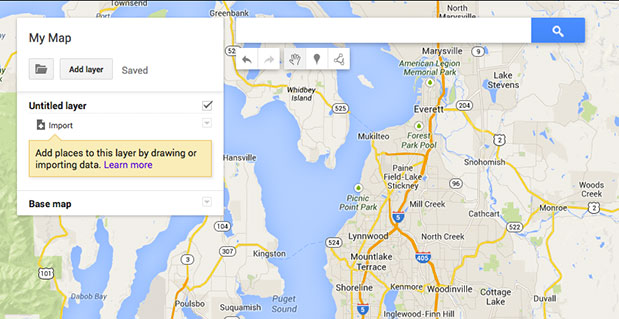
    Google’s recent decision to roll out Maps Engine Pro, its software that allows small business to use the company’s location tools to create maps from location databases, is a solid step in the business-to-business market. However, the company also said there will be a mobile application for Maps Engine Pro, called Google Maps Engine, which will allow small businesses and users to edit and create maps while mobile.

    Companies can use the app to optimize personnel and assets, build mapping apps, and create internal and external maps that use data layers to make business decisions. Depending on licensing, Maps Engine Pro costs $5 per user, per month — or $50 per user, per year.

    One reason to roll out the enterprise product: Brian McClendon, vice president of Google Maps, said that there are 1 billion monthly active Google Maps users, making the business product familiar to companies who want to plot location data.

    Magnetic Indoor Positioning? 

    Although much-hyped in the last two years, most indoor positioning has been powered by both GPS and Wi-Fi positioning in most tests and rollouts worldwide. However, a startup called IndoorAtlas, which recently opened an office in Sunnyvale, California, and partnered with Finnish grocery chain Fonella, according to published reports, is using magnetic technology via compass chips in smartphones.

    Rather than using Wi-Fi signals to triangulate a device’s location, IndoorAtlas tracks differences in the Earth’s magnetic field to pinpoint location within a building. The magnetic field is all around most objects and animals. On the company website, this tidbit is found: “Many animals utilize local variations in the Earth’s magnetic field to find their way around. These magnetic variations commonly exist inside buildings as well. Many sources can contribute to these variations including Earth’s magnetic field, and the structures of the building. Modern smartphones can sense and record these magnetic variations to map indoor locations.”

    IndoorAtlas’ technology doesn’t require additional infrastructure like wireless access points, so the technology can be used by retailers. Other markets include search and rescue, museum tours, and a navigation aid for disabled people.

    Location Companies Going After Higher End Markets As Commoditization Settles In      

    As location technology, specifically GPS, becomes more of a commodity as many industry observers say, companies are looking at higher-margin market segments. For instance, Garmin, which has seen the portable navigation device market decrease, has been focusing on more expensive and specialized products.

    While still a big business for Garmin, PNDs’ market share has been eroded by tablets, smartphones — and even expensive installed telematics systems, which have grown with the connected vehicle’s rise.

    Garmin has offered several different types of high-end watches for swimmers, pilots, runners, golfers and others in the outdoor market. The newest entry is a $450 watch called Tactix, which any Navy SEAL could love. It features an altimeter, barometer, and jumpmaster software for airborne operations, and it’s even waterproof to a 50-meter depth.

    LBS Insider to Cover CES in January

    LBS Insider will be on site in Las Vegas to cover the huge Consumer Electronics Show. At CES, the connected vehicle market continues to be showcased. In published reports, Scott Keogh, Audi USA president, said that the company will make announcements about Audi Connect at the show.

    T-Mobile US provides 3G connectivity to Audi’s Connect service in the United States through an embedded SIM in the car’s dash. T-Mobile’s plan, which includes Wi-Fi for as many as eight devices, is offered to new and existing owners of cars equipped with Audi Connect. It costs $450 for data services for 30 months — or users pay $30 per month if they select the month-to-month option. Some of the features includes access weather, real-time news and fuel prices. Both Google Earth and Google Voice are offered.

    At CES, the LBS market has been de-emphasized by wireless carriers in the past three years.  Instead, most location-related panels have been dedicated to connected vehicles.

  • Nokia’s Mapping Business Has Options, Issues

    Kevin Dennehy
    Kevin Dennehy

    In the wake of Microsoft’s recent purchase of Nokia’s mobile phone business, the Nokia unit formerly known as Navteq, and now know as HERE, has opportunities, but also a hard-to-guess future. At least one industry analyst believes that Navteq/HERE was not included in the Microsoft deal because it was too expensive.

    “While much ado has been made of the Nokia/Microsoft deal in the press, I was interested in why Mr. Softy did not acquire Navteq/HERE with the other assets of interest. There are several possibilities to explain this omission,” said Mike Dobson, TeleMapics president.  “First, it could be the case that Nokia did not want to sell Navteq/HERE. Second, it is possible that Microsoft had no interest in acquiring its current map database supplier. Third, maybe the price for Navteq/HERE was too high. My vote is for number three.”

    Dobson said that Nokia clearly would like to sell HERE, as it does not fit with the company’s profile, growth strategies, or competencies, on a going-forward basis.  “Just as Navteq was not a good fit for Nokia in 2007, it is now a less comfortable fit for the reconstituted company, which is being focused on network infrastructure services,” he said.  “Conversely, I suspect Microsoft was ambivalent about a deal that included [Navteq/HERE].”                           Under the proposed Nokia/Microsoft deal, Nokia’s mapping assets are to be licensed for a four-year term by Microsoft, which gives them time to firm up their future strategy for spatial data.  Note that the price of the license for the mapping products was not part of the $7.1 billion transaction, Dobson said.

    “Why was Mr. Softy gun shy? First, I suspect that Microsoft concluded that owning a mapping company was not core to any of Microsoft’s current initiatives, including its bumbling approach to location and connected car services,” Dobson said.  “Next, Microsoft has enough problems competing with companies in its distribution chain, without adding another business that would serve to complicate its relationship with manufacturers and resellers. Of course, all of these objections could have been overcome if the price was right, it wasn’t, but that does not mean it won’t be in the future.”

    Where Does Navteq Go from HERE?

    Dobson says Navteq, Nokia and HERE are in a world of pain. “While the ‘new’ Nokia will have the ability to fund all of the development to enhance the Navteq database that it has deferred over the past five years, I think it is unlikely to do so. Nokia does not appear to understand the fundamentals of the location market, the automotive navigation market, or the connected car market,” Dobson said.  “Perhaps most importantly, they have lagged Google in evolving their map compilation process into a modern, synergistic, information sourcing engine. The Navteq approach to crowdsourcing hinders their potential speed to market with updated map information and has allowed Google to reach parity with Navteq in some areas, while exceeding it in quality in other markets.”

    The future battleground in the location markets will devolve into a scarp for ownership of the last mile, Dobson said.  “The type of thinking that believes that the ‘last mile’ is all about road geometry, simply does not understand the problem. People want to know that the map will support their journey to a destination, but they are focused on the destination and the various opportunities that it presents,” he said.  “For example, the mobile phone has promoted an egocentric view of the world focused on ‘what’s around me?’  Providing the spatial detail of the total environment that surrounds the user is key to winning the last mile battle and I do not see Nokia having the assets to participate in this market.”

    Nokia announced that HERE, at the recent Frankfurt Motor Show, partnered with Mercedes Benz, Continental Corporation and Magneti Marelli to offer connected products and services beyond navigation.  Nokia believes that connecting the car to the cloud is one of the biggest opportunities for the automotive industry.

    “Whether the concept of the connected car offers Nokia a lifeline is unclear. Connectivity may suck the spatial data out of the car and into phone based systems,” Dobson said.  “Others would argue that smart cars will require a detailed, highly accurate database of spatial information to manage the safety systems in the automobile of the future.  I’m not wise enough to predict the future, but I think the Nokia is going to have a rocky road with Navteq/HERE.”

    Dobson said that it is interesting that Microsoft has loaned Nokia 1.5 billion Euros in three tranches of convertible bonds.  “The bonds will be redeemed and netted against the deal proceeds, although the loan is not conditional on the deal closing, nor is Nokia obligated to exercise its option,” he said.  “However, it would appear that Mr. Softy and Nokia are not quite through with each other:  if Nokia exercises these options, Microsoft will become a shareholder in Nokia.”

  • Mobile Resource Market Shows Largest Growth in Location Industry

    Mobile resource management has never been a sexy market full of buzz and excitement — we are talking tracking trailers and containers. However, it is on pace to see double-digit growth through 2020. Led by a handful of companies in local fleet, long haul, cellular and trailer tracking, MRM has never faced ups and downs like other location market segments. In fact, acquisitions and growth appear to be in the future for this market segment.

    With more than 5.7 million tracking units nationwide, and 9 million more expected to be sold by 2015, the mobile resource management market continues to be one of the steadiest, and profitable, location businesses.

    In one of the bigger MRM deals earlier this month, Danaher Corp. purchased Garden City, California-based Teletrac, which was owned by Vector Capital. Teletrac, which offers a cloud-based software as a service (SaaS), has units installed in more than 200,000 vehicles in 87 countries.

    In terms of segments within MRM, the local fleet market continues to be the largest, according to Clem Driscoll, president of CJ Driscoll and Associates, who is completing a multi-client study of U.S. fleet operators that is sponsored by two major wireless carriers.  Local fleet operators had more than 3 million units installed in 2012. In 2000, local fleet companies had about 250,000 units installed, according to Driscoll.

    Another growing MRM market segment include cell-phone-based systems with 1 million units.  Long-haul trucking and trailer tracking both have less than 1 million units installed in 2012. The major players in long-haul trucking markets have included Qualcomm, PeopleNet and XRS (Xata), but Qualcomm just announced that it is selling its fleet management and tracking business Omnitracs to Vista Equity Partners for $800 million in cash.

    Driscoll says the largest GPS fleet management company is Fleetmatics, which recently went public, raising $94.3 million. The company has 331,000 units installed worldwide, and had $127.5 million in revenue last year.

    Driscoll has identified several MRM trends: hardware prices are declining, MRM service providers are bundling the hardware; leveling off of equipment purchases for local fleet markets as suppliers transition to third-generation devices; increased integration with Android; smartphones and tablets; and more acquisitions.

    Speaking of acquisitions, the past year was a busy one for MRM. Telogis bought Maptuit and NavTrak. CalAmp bought Wireless Matrix, which is a GPS-cellular tracking company.

    For long-haul trucking acquisitions, the biggest deals came from Trimble, which purchased TMW Systems, ALK Technologies and GEOTrac, an oil and gas monitoring company.

    In Europe, the United Kingdom and France could see growth, but Spain has economic problems. Germany still is a strong long haul market, Driscoll says. In Asia, there should be 9 million potential units sold in the next few years, with China being the dominant player. Korea and Japan are maturing markets.

    Overall, by 2020, MRM could achieve the same level of penetration as the smartphone market.  Today’s smartphone may be the ultimate telematics equipment, and future MRM equipment of choice, as the automotive OEMs have found out by listening to their consumers, Driscoll said.

    Google Maps Already Using Waze 

    In other location industry news, Google Maps this week is using Waze real-time traffic reports on its app for Apple iOS and Android, according to a blog post from Google. The announcement constitutes the first significant use of the Waze app since Google purchased the Israeli startup for $1 billion in June.

    While Google Maps users will be able to use reports about accidents, construction and road closures, Waze consumers will be able to get access to Google search and Street View. According to published reports, more than 15,000 new map editors joined the Waze editing community this month, which is a 43 percent month-over-month increase.

    Intel Shuts Down Telmap

    Late last month, after our LBS Insider deadline, Intel announced it was shutting down Telmap, an Israel-based company it acquired in 2011 for a reported $120 million. The move signals the end of Intel’s navigation business, which had hoped to offer end-user tools and white label technology for developers.

    Telmap employed 150 people at its development center in Herzliya, Israel, and had dozens of other employees at various Intel branches throughout Europe and the United States. Telmap rolled out a free navigation app called M8, which was launched earlier this year. The app drew revenue from advertising and was marketed to wireless carriers for rebranding.

    In Israel, Orange, Cellcom and Pelephone, the country’s largest wireless carriers, all use Telmap’s white-labeled product, according to published reports.

    According to published reports, some of the Telmap employees will be placed in other positions within Intel Israel. The reports said that Intel was too late with its free app and was way behind crowdsourced traffic providers such as Waze.

    Telmap, founded in 2000, was viewed as an up-and-coming player in the location industry. It supported wireless carriers mainly outside of the United States such as Orange FT Group, SingTel, MTS, Vodafone, Vodacom, SFR, Telefonica-02 and others. Its U.S. partners included Nokia (Navteq), MapQuest and Inrix.

    Is the Location Industry Conference Dead?

    After working overseas for nearly a year, I have noticed that there are not a lot of industry events to cover, particularly pure location conferences. There may be a connected vehicle panel at the Consumer Electronics Show or a CTIA trade show.

    However, the location-centric conference appears to have died in the wake of industry consolidation (and Google’s giving navigation away for free). Replacing these conferences are connected vehicle and insurance telematics conferences that feature an occasional wireless, or LBS, panel.

  • Apple Maps Another Foray, Still Needs Google

    Kevin Dennehy
    Kevin Dennehy

    By Kevin Dennehy

    Trying to shake off last year’s mapping debacle, Apple recently bought two companies, HopStop and Locationary.  The purchases, whose financial details were not disclosed, get Apple rooted once more in the location business; how firmly those roots prove to be, and how well they serve the company against arch-rival Google, time will tell.

    Apple has been stockpiling companies and mapping software since last year’s introduction of Apple Maps on iOS devices, which turned out to be a big fiasco. GPS World’s LBS Insider reported extensively on the problems Apple encountered with its mapping software. Some of these problems included sending drivers to a wrong location and direction.

    After the mapping software problems were made public, Apple CEO Tim Cook apologized for the mapping software’s problems and even suggested that users go to such competitors as Waze, MapQuest and Microsoft’s Bing. The fallout from the Maps debacle was swift.  Apple fired Richard Williamson, who oversaw the company’s Maps team, according to Bloomberg.  The company put pressure on Apple partner TomTom to update mapping data and consulting with third-party mapping experts.

    The fiasco proved how important maps and navigation are to users of mobile phones.  Industry experts noted two further points:

    • Maps are extremely hard to do, and
    • Maps are really important for a major platform to own, rather than rent from Google.

    Hopping Forward. The HopStop app provides directions to users in 600 urban areas, with an emphasis on mass transit — real-time transit maps and schedules —  as well as pedestrian- and bicycle-oriented guidance.

    HopStop’s purchase may be Apple’s answer to Google’s recent purchase of Waze.  HopStop traffic data, like Waze, is based on updates from people using the application; that is, crowd-sourced data.

    Staying With It. The Locationary acquisition constitutes a further measure to keep current, going beyond the pressure Apple put on partner TomTom.  Locationary checks on and seeks to eliminate out-of-date points of interest and business data with a platform that collects and verifies crowd-sourced and other data. It also checks the actual physical location of businesses and other places.

    Coming Inside. To top off the company’s location awareness, Apple is even getting into the hotly-contested indoor positioning and navigation space, spending $20 million for Silicon Valley start-up WiFiSLAM in late March. According to published reports, WiFiSLAM can pinpoint a user’s indoor location to within 8 feet, using Wi-Fi. Apple rival Google already has been in the indoor positioning and navigation market, mapping shopping malls, airports and sports venues in several countries.

    Google Maps Now Major Apple Feature

    Speaking of the strange bedfellows, Google recently rolled out an iOS version of Google Maps for use on the iPad. For the last nine months, iPad users who wanted to use Google Maps have been required to use one designed for the iPhone, according to published reports.  Google also updated the iPhone version of Google Maps.

    Both the iPhone and iPad mapping software feature live traffic updates during turn-by-turn navigation.  The app includes live incident reports, road closure information, construction sites, accident reports and other features.  Apparently, Apple users won’t get the rerouting capability that Android folks will get, according to published reports.

    Real Power. The cool factor, and one that industry experts believe is the real power of location-based services, is an “explore” function that both Apple and Android have with Google Maps. This proximity feature allows users to find nearby restaurants, shopping areas, gasoline and other sites. Google also introduced a rating system for the iOS application that allows users to rate restaurants and other businesses.

    The Google Maps for iOS also has turn-by-turn directions for bicyclists, featuring more than 330,000 miles of bike paths and trails worldwide.

    Previous versions of Google Maps, which were designed for the iPad, were removed by Apple last September.  Apple, to replace the version, brought out the infamous mapping software that featured many errors.


  • Google’s $1.1 Billion Purchase of Waze Under FTC Scrutiny

    Google’s $1.1 Billion Purchase of Waze Under FTC Scrutiny

    Kevin Dennehy
    Kevin Dennehy

    In a year of ho-hum location deals, or the lack of any, the recent Google purchase of Waze for more than $1 billion is a big one. In fact, readers of GPS World magazine’s LBS Insider would have to go back to the summer of 2007, when TomTom purchased Tele Atlas and Nokia bought Navteq, to find an industry acquisition as big as this one.

    The Federal Trade Commission is reviewing Google’s $1.1 billion acquisition of Israel-based mapping startup Waze, according to published reports.  The big issue is that while Waze’s revenue was too low to trigger automatic review by the FTC, it may have hundreds of millions of users worldwide.

    The fact that Google’s acquisition of Waze has caught the FTC’s attention is not unusual, said Mike Dobson, TeleMapics president, who authors a location industry blog at www.telemapics.com. “Google, in an attempt to speed the acquisition, declared that the assets of Waze based in the United States are worth less than the $70.9 million that requires an antitrust review. Google maintains, and I agree, that the majority of the [intellectual property] for which they were willing to pay $1 billion was created in Israel, where it is currently located, and in that location it continues to be revised and enhanced,” he said.

    One of the supposed reasons, which were publicized in media reports, is that the deal with Facebook fell through because the social media giant wanted to relocate the Waze development activities to the U.S. and the Israel-based company declined.

    Google’s purchase of Waze ends months of rumors and stops other suitors, including Facebook, Apple and Microsoft, from moving in on the mapping startup. Google has said that its mapping technology will be incorporated into Waze.

    The Waze deal may strengthen Google, but won’t be the deciding factor on whether it has an unfair advantage in the [location] market, said Marc Prioleau, president of Prioleau Advisors. “They will have that regardless of Waze. I am not sure the criteria for the FTC, but I think Waze is just a spark to trigger a look at Google’s mapping position overall,” he said. “The FTC will have a hard time making the case that Google dominates the industry when Google can point to market share for Apple Maps, Nokia/Here [through its own sites as well as Bing, Amazon, Facebook and others] and even MapQuest, which stubbornly hangs on to a high market share with the over-50 demographic.”

    When it comes down to it, it is all about money. “It appears that the FTC’s preliminary interest in the Google acquisition of Waze is in determining if the U.S.-based assets are worth more than $70.9 million, and whether or not Google’s position regarding the Waze IP being located in Israel is justified,” Dobson said. “Many would argue that a considerable portion of the value of the Waze IP affects consumers in the United States, resides on cell phones of users in the United States, and has a functional impact in the United States beyond the $70.9 million that Google is claiming. Functional impact is a difficult issue, but since Waze generates little income, Google is probably in a good position here.”

    Dobson said that other pundits are commenting that the problem here is that Noam Bardin, Waze CEO, described Google as its only competition during a recent press conference. “Oh, how unusual, someone selling their company trying to increase the value of the company,” he said. “Has everyone forgotten about Nokia and TomTom? Does anyone really think they are incapable of competing with Google, Waze or the combination of both companies?”

    Google Made Strategic Decision Not to Buy Tele Atlas and Navteq                          

    Dobson said that, more troubling for the FTC and other antitrust interests, is this:  If Google wanted to monopolize the mapping world, why did it not choose to bid (or counterbid) when Navteq and Tele Atlas were sold in 2007?

    “I think the answer to this question is quite plain. Google did not participate in either acquisition because it had tried both companies’ data and found that the content quality and spatial coverage was not quite what Google had set as goals when developing its strategy for mapping. Instead, Google built its own ‘map machine’ and has managed to out-innovate either of these companies over the last several years,” Dobson said. “In addition, both Nokia and TomTom have fallen on hard times, not because of Google’s success, but because both companies overpaid for the assets they acquired, just before a worldwide economic downturn. Reduced budgets (for research and compilation) at TomTom and Nokia have had a lot to do with Google’s success in the mapping world.”

    The big deal in Google’s interest in Waze lies in the success that the mapping startup has had in capturing traffic information, as well as how it has attracted a large user community willing to contribute traffic data, Dobson said.

    “I doubt that Google will find that the map coverage provided by Waze has data they have not already mapped and mapped more exhaustively than Waze. However, it is somewhat camp to be an ‘anybody but Google’ fan boy and I suspect conspiracy theories about the acquisition will abound,” Dobson said. “I doubt that the FTC will find anything actionable. If Google were to announce next week that it was acquiring Inrix, I suspect that the FTC might have a real case with real antitrust issues.”

    While Waze hasn’t generated much revenue, its real-time maps and traffic information are valuable. This value was magnified last year when Apple tried to replace Google Maps on the iPhone with a not-so-good alternative.

    Analysts are looking around at what other companies are out there as potential acquisition targets — particularly as the smartphone industry becomes even more competitive. The apps on the smartphones will need to be distinguishable, particularly the mapping systems and capability, say several analysts.

    One company that stands out as a potential acquisition target is TomTom, which is the last independent provider of digital maps, now that Navteq was gobbled up by Nokia.

    Send all of your LBS stories to [email protected].

  • Google and Facebook Eye Waze as Potential Purchase

    waze_logoSince the recent CTIA conference wasn’t the buffet of location news, one potential deal could really set the industry on fire going into the summer months. Google and Facebook both are rumored to be in talks to purchase Waze. Some say this would mean Facebook would transform into a mobile advertising company, with local ads, if it were the winning bidder. Google’s rumored interest would block the social media giant’s momentum in that marketplace.

    by Kevin Dennehy

    In what could be one of biggest deals in the location industry, both Google and Facebook have been rumored to be interested in buying Israel-based mapping and navigation company Waze. Published reports indicate the deal could be worth $1 billion.

    Some industry analysts are skeptical that a deal could be valued that high, which would place it in the same realm as Facebook’s $1 billion purchase of photo-sharing service Instagram.

    “We really do not know if Facebook is willing to spend a billion dollars on Waze, but if the deal happens, (Facebook) must have considered its options. How could this be? First, I suspect that Facebook is certain it will grow beyond its current boundaries to become the world’s most valuable company,” said Mike Dobson, Telemapics president. “Operating under this mindset, a billion dollars is peanuts, and they will not care if everyone else thinks they overpaid. In other words, Facebook might not be basing its calculation on the same ‘time-value of money’ that the rest of us are using. Second, if the economics do not really matter to Facebook, the more important question is ‘What advantages would Facebook accrue by acquiring Waze?’”

    Dobson believes that Waze map databases are not competitive with Google or such commercial providers as Nokia or TomTom. “In essence, Waze does not offer competitive map coverage, competitive data quality, competitive data attributing, or a useful source of POI data. More importantly, I suspect that the Waze database will be a major league headache if Facebook plans to use it as the basis for its mapping activities supporting local search,” he said. “Further, I doubt that Waze understands enough about local advertising to help Facebook realize its most important goal of becoming a powerhouse ad agency capable of creating its own captive local search market, comparable or exceeding that enjoyed by Google.”

    Another industry insider, Marc Prioleau of Prioleau Advisors, said that quality and coverage of the maps would make the deal successful — if it really is going to happen. “The rumor mill on Waze seems to be quite active so it is hard to know if there is substance there. Waze has built a very innovative traffic application, and they use the user data to build a digital map data set,” he said. “The value of the company would be tied largely to the quality and coverage of that data set and the perceived ability of a big platform like Facebook to build that out into a truly serviceable worldwide map.”

    Waze is a mapping company built through crowdsourcing map and traffic data over mobile phones, which is the “magic” Dobson believes Facebook finds beguiling about the company.  While Waze claims 45 million users, its active base is more likely around 10-15 million, Dobson said. “Conversely, if you stop to consider the amount of data you could generate if all of Facebook’s mobile users were gathering mapping data through an app built on Waze, then the company might be willing to gamble on the acquisition,” he said. “Providing analytics on the behavior and location of its mobile users to advertisers and other interested parties could be a huge opportunity. On the other hand, there are numerous paths to this endpoint, not just Waze.”

    Dobson said if he were to advise Facebook on the acquisition, a suggested course of action would be that the company write their own crowdsourcing application and build a good quality map database through licensing and direct and indirect map compilation techniques.  “My off-the-cuff estimate is that this could be done for less than the cost of the Waze acquisition. Beating Waze into a quality map database is going to be an expensive — well beyond the acquisition cost — and time consuming effort. Perhaps the most glaring lack in the potential Waze acquisition is the absence of a suitable POI database, which, in my opinion, is the most critical need that Facebook will have in local search.”

    Dobson said he suspects that Facebook’s competitors are not concerned about the company’s potential acquisition of Waze. “Those who already in the mapping business — Google and Apple — will anticipate that it is likely that Waze could become a significant distraction for Facebook and delay the company effectively competing in the local search market. As far as the competitors are concerned, the longer it takes Facebook to mobilize its efforts in local search, the better,” he said. “In business, as in life, strange choices are made. Perhaps Facebook sees a future in Waze that depends on strategies being implemented by the company that we know nothing about. I hope so, as a good dose of innovation is just what the local search market needs.”

    Distinguishing itself is another reason Facebook may be interested in Waze. Providing mapping and traffic capabilities may bring more consumers to its mobile users.

    The company is also is redesigning its mobile pages platform to enable local merchant information, according to published reports. These new improvements may even challenge Foursquare and Yelp.

    There were questions whether the deal with Facebook will go through as published reports indicated that Waze’s research and development activities would remain in Israel rather than go to California, where Facebook’s headquarters are based.

    Google Interested in Waze to Cut off Facebook at the Location Pass?

    The rumor mill is heating up as Internet giant Google and Apple are said to also be interested in Waze.  “I saw a report indicating that Google was interested. If so, it would seem that this would be a move to deny Facebook access to Waze,” Dobson said.  “Google already derives a significant amount of information from passive crowdsourcing — recording the GPS traces of the devices of their users — and I am not sure that the acquisition would provide them any opportunities that they are not already exploiting. Of course, we might remember that Garmin, who had no intention of buying TeleAtlas, made a bid and significantly raised the price that TomTom paid for the mapping company.”

    Other analysts say while there have been several news articles on why Google should buy Waze, it all could be poorly informed speculation. Others say that the Israel tech press is quick to spread rumors. One analyst said, “I hear that the talks are legit, but my guess is that the deal in discussion is not $1 billion.”

  • Competition to PNDs Coming from All Angles

    It isn’t the same old news that the portable or personal navigation device, PND, has lost a lot of ground to mobile applications found on smartphones. The reason it isn’t old news is that the drop in sales is being measured by the millions — from a high of 33 million in 2011 — to a little more than half of that amount. While consumers’ tastes are shifting, often to automobiles equipped with connected features, a smartphone is still the device of choice for quick navigation, location-based services and other features.

    While stand-alone portable navigation systems seem to be a fading market driver, connected units seem to be the rage at trade shows and other venues. One example is the recent partnership of Audi of America and T-Mobile USA, who announced a data plan that includes real-time news, weather and fuel prices, Google Earth access and Google Voice Local Search.

    The marriage of usually two distinct industries the past three or so years has generated new interest in telematics, which has always been a catch-all term for an automobile’s mobile information features.

    While not exactly an eye-opening finding, Berg Insight says sales of PNDs are set to significantly decrease in coming years as consumers choose alternatives. The company says that PND sales will fall to 17 million units, down from the more than 28 million sold last year — and 33 million in 2011.

    Berg says PNDs will face stiff competition from lower-cost embedded systems. The company says 150 million people use smartphone navigation apps, compared to 105 million in 2011.

    Such companies as Dutch PND manufacturer TomTom said it posted a 13 percent fall, to $262 million, in first-quarter sales. The company is diversifying its product line to counter the loss of revenue from falling PND sales.

    To diversify, TomTom rolled out a GPS watch recently to compete with rival Garmin, which has similar products on the market. According to published reports, the company said it is competing with mobile phones for the navigation market.

    To echo the Berg findings, TomTom said about 2.1 million navigation units were sold in Europe last year, but in the United States, the drop was even more significant. The company’s PND products fell from 1.5 million units in 2012 to 1.1 million in 2011.

    The competition to PNDs is coming from a number of areas. In the recent Audi and T-Mobile deal, users can retrieve information over Wi-Fi for $15 a month (the company says new and existing owners can receive full data services for 30 months for $30 a month). Through the Audi Connect system, users can get connectivity for as many as eight devices.

    Audi Connect, which first went on the market in 2011, allows users to gain access to real-time localized weather, news and fuel prices.

    Apple Buys Indoor Navigation Company WiFiSLAM

    Say what you want about the recent surge in interest of indoor navigation. Some call it an over-hyped fad — or not technically ready for market. The bottom line is that Apple thinks enough of the market to have spent $20 million for Silicon Valley start-up WiFiSLAM in late March.

    According to published reports, WiFiSLAM can pinpoint a user’s indoor location to within 8 feet, using Wi-Fi.

    Apple has made several inroads to enhance its location portfolio since its Apple Maps debacle in 2012 when users complained about inaccurate directions.

    The problems were so acute for Apple Maps that its CEO told potential customers to buy navigation from its rivals, including Waze.

    Apple rival Google already has been in the indoor positioning and navigation market, mapping shopping malls, airports and sports venues in several countries.

    DeCarta Launches Local Search Engine

    DeCarta has launched the L2 Local Search Engine. L2 offers companies the ability to index their own data and make it searchable via a sophisticated single-line search, said Kim Fennell, deCarta president and CEO. Those companies might include local search, vertical search (hotels, restaurants), classifieds, newspapers, Internet yellow pages and others.

    “Single-line search is the standard for most web search and for the big mapping portals, but is oddly missing from most local search sites,” Fennell said. “They still use a two-line entry, first specifying what you want and then where you want it. The main reason for that disconnect is that the technology to do good single-line geo-search requires a pretty deep understanding of geospatial data and technology, and is hard to do well. L2 solves that problem. We provide a fully featured local search engine with baseline map and POI data,” he said.

    “The local site can clean and index their proprietary data using our tools and then host the search engine in the cloud,” Fennell said. “They get the control of the data and the user interface that the big map portals use.”

    Some examples of a deCarta Local Search Engine point of interest entry may be, “coffee near XYZ company,” “restaurants on Main Street,” and “parking near AMC Theater.”

    In other LBS news:

    • Telenav introduced its embedded product for the Scout for Cars product line. The embedded product features in-dash navigation with mobile and cloud services for real-time, personalized information, the company said. Marketed to automakers, the company said installers can connect Scout for Phones service in their cars for real-time services and personalization. The company said the unit comes with flexible branding so OEMs can offer embedded navigation in their vehicles through their own brands.
    • Audiovox’ $169.99 Car Connection kit tracks vehicles and monitors the driver with a built-in GPS unit and a two-way cellular data connection, without a smartphone, the company said. Once an account is established, and the unit is recognized by the Car Connection service, owners can track their cars’ movements and receive e-mail or text alerts in the event the car is stolen or used without permission. An interesting feature is a free app that allows users to find the car via a smartphone. Car Connection costs $10 a month, or $90 per year, and has a $20 activation fee.

    Send your LBS news and announcements to Kevin Dennehy at [email protected].

  • MWC: Is the Connected Car the New Mobile Phone?

    This year’s Mobile World Congress, held late last month in Barcelona, featured the world’s largest mobility conference. While there was not a lot of strictly location-based services news, connected vehicles seemed to be the big deal. Ford and GM both made important announcements, sending a signal that wireless information and connectivity is here to stay in a vehicle — and location will be a big part of the growth. On the downside, MWC is becoming a mini Consumer Electronics Show with hotels gouging attendees, long cab lines, heavy traffic, expensive meals and long commutes to the show for those wanting to pay less than $400 a night for a room. Sounds like Las Vegas in January.

    By Kevin Dennehy

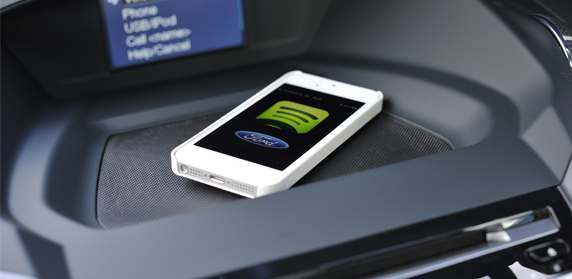
    The recent Mobile World Congress, held at Barcelona’s Fira Gran Via conference center, featured big connected vehicle announcements from Ford and GM. Ford announced a slew of deals, one partnering with Spotify to make Spotify Premium available through its Sync AppLink. GM’s big announcement is that its OnStar safety, security and navigation service will use AT&T Mobility’s network for LTE modules in 2014.

    Ford launches Spotify connection.
    Ford’s partnership with Spotify gives drivers access to millions of tunes on the road.

    Industry observers believe that GM’s announcement indicates the new AT&T deal could give the connected vehicle market a big boost as the units will go into most cars, including entry-level vehicles. Wireless carriers have indicated that transportation remains one of the key vertical markets they are aggressively getting in to.

    AT&T pulled a big coup as GM uses Verizon Wireless for its OnStar service. However, published reports indicate that the company has been disconnecting subscribers who are not currently using the service. Verizon said it had lost 490,000 connections in late 2011 — and said the losses were due to decline in telematics customers.

    There is no word on whether 2012’s $617 million purchase of Hughes Telematics had any effect on the Verizon-GM relationship.

    Overall, OnStar, which costs $18.95 per month, has more than 6 million customers worldwide.

    A concern with connected vehicles, and this is an issue that has been around for the past few years, is that automobile manufacturers do not believe the vehicle isn’t the new mobile phone — though some carriers believe it will be. Another concern is the form factor itself — what is better? What will the winner be? An embedded system or a system that integrates with a user’s smartphone?

    Not to be outdone by GM, Ford also said its 2104 Ford Ecosport will feature AppLink capabilities. The company also said it would be offering, in Europe, applications from Kaliki, Glympse and Aha. Ford says it now has 2,500 folks registered in its developer program — doubling the numbers from last month.

    Ultimately, many analysts say that two major market issues will need to be resolved for the connected vehicle segment to take off. One is what will consumers want? The other is standardization — will every vehicle have the same system in use? Already Ford and GM seem to have differing technology and business models for this market.

    Is Mobile World Congress Getting Too Big to be Useful?

    With more than 72,000 attendees this year, which is a little more than half the size of the gigantic Las Vegas-based Consumer Electronics Show, is MWC becoming too big and less focused for wireless application developers, LBS companies looking to partner and other location company entities?

    Does this sound like a mini CES? The Fira Grand Via had 1 million square feet of exhibit space, 1,700 exhibitors and 72,000 attendees from 200 countries. All of this is puzzling for a conference that had no Google (the company had a big exhibit last year) or Microsoft.

    In addition, there were no huge announcements — even the connected vehicle news would be mid-level news at CES. Does it say something strange about a big wireless show when your main news is connected vehicles?

    Deciding not to get lost in the hugeness of a big trade show, most of the wireless companies and handset manufacturers choose to make their own product and deal announcements at their own branded shows or independent press conferences. Outside of a handset having LBS capability rolled out, and companies saying they are rolling out capability in European nations, there wasn’t much location-specific news.

    With no big indoor position news at MWC, does that spell a struggle for the new technology and potential gigantic market? Many publications, including this one, has touted indoor positioning as one of the technologies that will spur LBS’ market growth.

    A few smaller companies did display indoor positioning products at MWC. Rx Networks rolled out its Xybrid Synchro that allows a device to self-located without an active data network connection. The company also rolled out a cloud-based GNSS systems that allows users to determine a location even when weak location signals are available, the company said.

    Another indoor positioning company, Insiteo, showed off its products that work on iOS and Android devices to allow users to find booths at MWC. The company says product finding, location-based marketing and data mining are all applications for the platform.

    In other Mobile World Congress news:

    • Telit launched m2mLOCATE, a feature that adds Cell-ID location for a range of its cellular connectivity modules. The company uses RX Networks’ XYBRID RT service, a database that encompasses 40 million cell-IDs.
    • CSR demonstrated its Location Services Platform, which features context detection and user self-learning to deliver indoor and outdoor location for the consumer and enterprise markets. The company says the platform has an indoor accuracy of less than 10 meters.
    • TeleCommunication Systems shopped its LBS suite of services at MWC to both enterprise and consumer companies. TCS recently deployed four new mobile operators on its hosted cloud LBS product. The company says it offers revenue-producing branded and private-labeled applications for navigation, hyper-local search, enterprise and family locators.
    • ALK Technologies, now owned by Trimble Navigation, said its CoPilot GPS navigation apps for smartphones and tablets will be available for Windows Phone 8 and Windows 8. The company said it’s always been high on Microsoft’s mobile products, as CoPilot was originally developed for Microsoft’s Pocket PC. CoPilot features voice-guided GPS navigation, turn-by-turn guidance, trip planning and automotive-grade street maps, the company said. The unit’s live services include Yelp, ActiveTraffic, Wikipedia and Google Search.
  • Facebook to Roll out Location App

    Facebook to Roll out Location App

    Kevin Dennehy
    Kevin Dennehy

    There always is a lull in news between the Consumer Electronics Show and the Mobile World Congress, which is later this month in Barcelona. However, published reports that Facebook plans to launch a location application is big news. The social network giant, with more than 1 billion mobile users worldwide, could conceivably generate huge advertising revenue through the location-based friend-finder app. Facebook has a number of competitors, but with the sheer number of worldwide users, it has to make the industry take strong notice.

    Facebook to Roll Out Location Application for Mobile Users

    Facebook is attempting to grab a big piece of the mobile location market with a new app that will track users to perhaps boost mobile advertising sales.  The news, first reported by Bloomberg, indicates that Facebook is adding location features to perhaps take a chunk of profit from 1 billion mobile users who use the social network.

    The new feature, expected to be launched in March, will work with smartphones, even when the user is not using the application, according to the Bloomberg article.  This may raise some privacy hackles, as competing services have opt-in functions. In addition, some handset manufacturers and carriers require user opt-in as part of privacy agreements.

    Facebook already purchased two location companies in Glancee and Gowalla. Glancee is a location-tracking startup Facebook bought in May 2012. Gowalla, a location-based social network, was purchased in December 2011.

    Facebook Has Competitors in Location Market

    The new Facebook location app will be an answer to Google Latitude, which was launched in early 2009. Latitude, a feature for Google Maps, is an opt-in mobile app that allows users to see the location of friends and family, who also allow the service to track them. Google’s premise, four years ago when it launched Latitude, was that many users wonder where their friends and family are — and what they are doing.

    Because it is an opt-in service, Google said users could find out where a spouse was stuck in traffic on the way home from work, knowing when a loved one’s flight landed safely, or if a buddy was in town. Although it has been around for more than four years, Latitude was innovative with the concept that not only can you see friends on a map, but you can get in touch with them via SMS, Google Talk, gmail and  updating a status message.

    “While Google quietly improved its databases, tools and location services, most other players in the location industry were slipping further behind, apparently involved in a frenzy of disorganization prompted by a lack of skills in strategic planning,” said Mike Dobson, Telemapics president, in a recent interview.

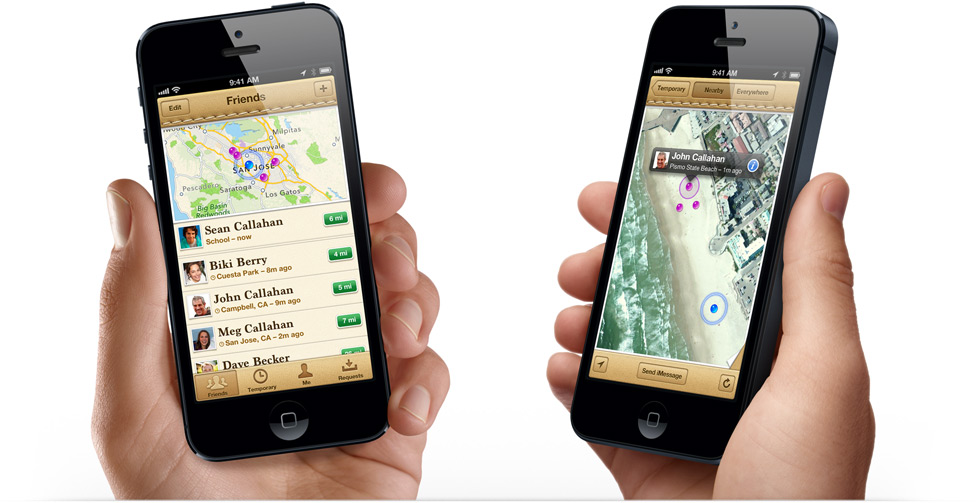
    Another similar service, Find My Friends from Apple, runs on the iOS 5 operating system.  It is another location share service that attempts to allow users to find friends in real time, according to published reports.

    Apple needs to hit a home run in the location and mapping market. Last year, the controversy surrounding Apple Maps caused a shake up at the company and industry because of faulty map data. The incident made manufacturers realize that digital maps are a very important feature for smartphones. It also made many of these giant companies, who believe that location isn’t that big of a deal, sober up to the fact it is hard to make quality maps.

    A number of other companies are offering friend and family finder apps, namely Location Labs, Life360 and Loopt.

    Still, while such companies as Facebook, Apple and Google give away maps and navigation for free, which destroyed smaller companies and caused a huge consolidation of the industry starting in 2008, some believe that maps are too hard to produce for free. Some analysts, Dobson included, think that “free” maps and navigation services may not stay that way as consumers and enterprise customers demand better accuracy.

    Tablet Owners Spend More than Smartphone Buyers

    In advance of the Consumer Electronics Show, analysts were saying not only that flatscreen TVs sales were dropping, but the champion of the previous shows, the tablet, also was to see a downward trend. Not so, says ABI Research, which estimates nearly 200 million tablets shipped worldwide since 2009, with an additional 1 billion tablets forecast to ship over the next 5 years.

    What’s interesting, or not, depending on your location company’s strategy, is that ABI says 22 percent of users spend $50 or more per month and 9 percent spend $100 or more on purchases ordered from their tablets. That’s higher amounts than from even smartphones, the company says.

    As we reported last fall, the next edition of Amazon’s Kindle Fire tablet introduced mapping services in partnership with Nokia, which snubbed technology from Google, which is funny because its mobile operating system powers the platform. But it was an indicator of how much promise companies are still seeing in adding location-based services capability to tablets.

    In other LBS news:

    • Sense Networks released the results of a location-based mobile advertising campaign for Denver-based fast food chain Quiznos. The campaign, conducted in Portland, Oregon, placed ads on mobile devices of people 18-34, who eat at competing, and similar, restaurants such as Subway. The company said Quiznos had a 20 percent gain in coupon redemptions.
    • TeleCommunication Systems, Inc. (TCS) is providing map, local search, location services and navigation applications for the new BlackBerry 10 smartphone. The TCS-based mapping application will ship with the new smartphones, which are scheduled to roll out in mid-March. TCS’ APIs are also available for Blackberry 10 developers. This leads many in the industry to believe that if this smartphone is a much-needed home run for Research in Motion, the TCS partnership could be a big deal.
    • Locaid plans to provide GTECH with secure mobile location, IP location and other LBS to include geofencing and location authentication. What’s cool about this deal is GTECH designs and sells lottery technology. Its service includes a geo-complaince engine that ensures a mobile or Internet-connected device is within state lines.

    If you have news, or tips, or gossip, please contact me at [email protected].  The Mobile World Congress in Barcelona is coming up this month, so get me your story ideas and product news.


  • CES Continues to Showcase Connected Car Products

    Kevin Dennehy
    Headshot: Kevin Dennehy

    CES is big, loud and happens every year. For the past three or so years, the largest tradeshow in the United States has become a showcase for automobile manufacturers’ product rollouts…which is a far cry from the traditional car stereos and mega-huge flat-screen TVs you see walking the several football field-sized show floors. CES may not be everyone’s idea of a good time — hotels are expensive, you can’t get a cab as lines are a quarter-mile long, and much of the action for location may not even be in the show itself anymore. But it would be hard to say it’s a boring week.

    The Consumer Electronics Show in Las Vegas had lot of everything: 150,000 people, nearly 3,300 exhibitors and almost 2 million square feet of exhibit space. What it didn’t have was a ton of location-based services news.

    Most of that action came at off-site meetings such as the AT&T Developer’s Summit and other venues. Still, a lot of auto manufacturers, partnered with the wireless carriers, use the nation’s largest trade show as a launching pad for infotainment units that feature two-way connectivity.

    This connectivity will be important for hybrid navigation, both automotive and fleet management users and service providers who want the best of both worlds, said Kim Fennell, deCarta president and CEO. “[This means] off-board search and navigation to get real-time content, traffic, search along a route for current information such as parking spaces near a theater, as well as proper on-board capabilities when no wireless connection is available,” he said. “Companies ‘talk’ a good story, but the ability to do real hybrid is difficult technologically and so this conversation will gain prominence [this year].”

    Ford and GM both touted their developer programs at CES. Ford’s developer program allows users to work with SYNC and AppLink application programming interface. GM plans to offer developers an SDK.

    At CES, not a lot of new handsets were launched, as many manufacturers use their own events or other trade shows for launch. One of the biggest trends of 2013, Fennell believes, is the movement by handset manufacturers to launch their own LBS apps and services. “Of course, Apple made a mess of it — and the result is that companies now recognize that geospatial is hard to do…well,” he said. “This will get some companies to back off doing their own, while it will get others to continue, but with more care and attention to what it takes to do it right.”

    CES always announces what companies think is going to be the next big thing. Unfortunately, consumers sometimes don’t always agree. A year ago, the big deal was Ultrabook computers, which were supposed to be the one-up to tablets and smartphones, but lackluster sales have diminished that fledgling market.

    Two years ago, the big thing was 3D TV, which turned out to be expensive and lacked content. “3D is overblown. Not at scale yet,” Fennell said.

    Maybe the PND Isn’t Dead Yet

    The lag in portable navigation sales and the rise of the smartphone as the navigation platform of choice signaled that maybe the end was near for PNDs. In fact, many companies said consumers would rather pay the extra money for manufacturer-installed infotainment products with two-way connectivity than a PND.

    This means that PNDs couldn’t traditionally receive current traffic, weather or new driving information on roads, restaurants and other services.

    To start competing with the auto manufacturers, at CES such companies as Magellan rolled out PND models with Bluetooth that connects to a customer’s smartphone. The $249 SmartGPS uses a consumer’s cell phone data connection to receive social and LBS. It will soon offer Foursquare alerts and Yelp restaurant reviews.

    Another PND giant, TomTom, partnered with Telenav at CES to provide its Live Traffic service to Telenav, which makes Scout, an application for iPhone, Android and Windows mobile devices.

    In other CES news:

    • Garmin rolled out the K2 platform, a customizable unit that offers digital displays, voice control, infrared buttons, and smartphone integration. The unit features navigation, vehicle diagnostics, music and real-time information.
    • Subaru introduced Starlink, a new in-car connectivity product. The unit includes Aha by HARMAN integration that allows drivers to access tens of thousands of stations of Web-based content, from radio stations, podcasts, and weather sites to social media feeds.
    • Chrysler upgraded its Uconnect infotainment system with dealer-activated navigation, which allows Chrysler Group dealers to activate the navigation functions in vehicles equipped with certain systems.
    • One question mark at CES was the absence of Microsoft, which didn’t exhibit for the first time in years. In years past, reporters would stand in line to listen to Bill Gates, who usually opened the conference with a speech or product roll-out the day before.

    End of an Era

    One of the pioneer companies to integrate GPS into wireless devices, as well as take a big chunk of the enterprise market has been sold. As GPS World reported, Princeton, N.J.-based ALK Technologies was purchased by Trimble for an undisclosed figure.

    ALK’s transportation, logistics and mobile workforce products are going to Trimble’s Transportation and Logistics division. No word about what is happening to ALK’s consumer products.

    ALK’s two flagship products, CoPilot and PC Miler were sold in North American and overseas. Approximately 64 percent of North American for-hire motor carriers use ALK products, the company said.

    ALK Technologies founder and long-time industry veteran, Alain Kornhauser, said last year that location markets had been good for the company. The company’s CoPilot Live had been seeing good sales in Europe, he said.

    Kornhauser was a dynamic speaker at the GPS-Wireless conference for 13 years, informing and enraging attendees alike with his great quotes. One favorite:  “Telematics is a Stalinist term.”

    Barry Glick, former MapQuest executive who was hired in 2011 as CEO, ran the company’s day-to-day operations. In December 2012, ALK established a new group, Enterprise Solutions, which combined its PC Miler, CoPilot Truck and CoPilot Live Professional Product lines plus supporting map data, software tools and professional services.

  • Apple Maps Debacle Top Location Story of 2012

    Kevin Dennehy
    Kevin Dennehy

    Looking back at 2012, and this is our last column of the year, a number of stories in the location industry spring to the front. The rise of indoor positioning as a potential lucrative market is one. Another is perhaps Samsung’s purchase of CSR to give a major consumer electronics manufacturer even more location capability. Or the continued story of Google as the 800-pound gorilla in the location room. But, resoundingly, the top story probably has to be the controversy surrounding Apple Maps, which caused a shake-up at the company and industry. The incident made manufacturers realize that digital maps are a very important feature for smartphones. It also made many of these giant companies, who believe that location isn’t that big of a deal, sober up to the fact it is hard to make quality maps.

    The top location industry story of 2012 may be a cautionary one for the industry. The big story was the release of Apple Maps in September, which was criticized by consumers for inaccurate driving directions, among other problems.

    Apple had replaced Google Maps on its iPhone 5. But the criticism for the phone’s maps forced Apple CEO Tim Cook to apologize and even tell consumers to use such competitor’s maps as Waze, MapQuest or Microsoft’s Bing.

    The controversy plagued Apple Maps app.

    Since the last LBS Insider column, Apple fired Richard Williamson, who oversaw the company’s Maps team, according to Bloomberg. The initial report indicated that Eddy Cue, Apple senior vice president, is looking for a new management team to replace Williamson. The company is putting pressure on Apple partner TomTom to update mapping data and consulting with third-party mapping experts.

    Marc Prioleau, managing director of Prioleau Advisors, said there are two basically two key points surrounding Apple Maps: “Maps are really hard to do. Maps were deemed to be an important asset for a major platform to own versus rent from Google.”

    So what does that mean for Facebook, Amazon, Twitter and others dabbling in the location industry? “Can they get [quality] by using a potential competitors maps/local search or do they have to build their own? And if they build their own, how do they avoid the problems Apple has had?” Prioleau said.

    The Apple Maps fiasco proved how important maps and navigation are to users of mobile phones, said Mike Dobson, TeleMapics president and author of an industry blog, which received huge readership during the incident. “In doing so, the company generated more ill will than I thought was possible when dealing with maps and navigation,” he said.

    Industry Expert Looks Back on 2012

    There were two significant trends in LBS in 2012, Dobson said. “The first was that the industry has transformed from a domain of specialists who seemed to be working underground to an industry that has caught the world’s eye as one of the most important technology families now in existence. It is a rare year when The Economist magazine writes an analysis that is focused on location as it did in its 2012 Technology and Geography Special Report,” he said.

    Economist’s Annual Innovation Awards were dominated by people in the location industry, Dobson said. Computing and Telecommunications awards went to Jack Dangermond (ESRI) and John Hanke (Google), while Gary Burrell and Min Kao (both from Garmin) won awards for Consumer Products, he said.

    “The second biggest trend in 2012 was the inexorable rise of Google to the top of the location chain. While Google quietly improved its databases, tools and location services, most other players in the location industry were slipping further behind, apparently involved in a frenzy of disorganization prompted by a lack of skills in strategic planning,” Dobson said. “What this torpor has led to is an apparent inability to produce market-leading products, as Apple has shown with Apple Maps and Nokia has shown with its negatively received mapping service. I suppose the rumor that the company is considering renaming the service ‘Here?’ is untrue.”

    Through hard work related to early disappointments with the accuracy of its mapping products, Google has managed to learn a number of important lessons related to map compilation and data quality, Dobson said. “Perhaps the greatest lesson it had to learn was that algorithms used in mapping and navigation often need the intervention of an operator who understands geography, mapping and navigation. In addition, map compilation systems often need the assistance of a human with local knowledge to prioritize data solutions. Put simply, Google has confronted map accuracy issues and is rounding the curve on improved product quality.” To most everyone else, the main exception being ESRI, Dobson said he awards a hearty “shame on you.”

    A final 2012 trend is that numerous capable leaders who led the “Location Revolution” are now on the sidelines or out of the industry completely, Dobson said. “For example, the majority of the ‘brain trust’ from Navteq, those contributors who understood the nature of mapping and navigation, are no longer with Nokia, a company that appears rudderless in the location marketplace. Just as it shows that most of the people who understood mapping and navigation at Tele Atlas are no longer with TomTom,” he said. “Other acquisitions produced similar results, as they always do. However, the crucial issue here is that losing history often means losing perspective and I am concerned that LBS is on this destructive path. While we always would like to think that as an industry we have institutionalized or memorialized personal contributions, problem-solving methods and other individually oriented contribution to products, this is never really true.

    “While each new management team should have the right to rearrange the pebbles on the beach and say that the new organization of pebbles solves the problems of the previous organization, this is rarely the case. Innovation, not reorganization, are what makes a difference in all industry segments. As 2012 closes, I am tempted to ask, “Where are these market-making innovations in LBS?”

    2013 and Beyond

    While it was a big part of the LBS landscape in 2012, Dobson believes the current emphasis on indoor location is both overblown and being overhyped, but it will remain the focus of the industry in 2013. “This is yet another example of smaller players in the location world trying to find something new that they feel might help to get them acquired, while the larger players are hoping it is something that might provide a sustainable competitive advantage over Google,” he said. “I suspect that Nokia and Apple might now know what Microsoft knows — that in order to catch Google in location, you need to have a search engine that can successfully perform local queries that is tied to a source of revenue such as mobile advertising. My belief is that Google will continue forward integrating location as part of its effort to dominate advertising globally and locally. Until the other players catch on to this differentiator and field a powerful advertising-based competitor, they cannot be considered in the same league as Google.”

    As a final shot, Dobson said he brought a lump of coal for those who enjoy “free” maps and navigation services. “My belief is that within the next decade mapping and navigation services will be fee-based. The addition of all the bells and whistles to online mapping services, in addition to other negative factors, are making the game too expensive to continue to give the product away for free,” he said. “Consider this bit of history. In the United States, before the Arab oil embargo of the 1970s, paper maps were given away free at gas stations. Also forgotten by many is the fact that someone pumped the gas, cleaned the car’s windows, checked the engine oil level and inflated tires to their proper pressure.

    “After the oil embargo, price increases helped to beat the profit out of the system, as well as all of the other services it once offered such as free maps. Issues of net neutrality, telecom’s desire to recover infrastructure costs related to providing Internet services, indoor location infrastructure, and the decline of competition in the world of map and navigation data will inexorably lead to maps and navigation services that we will be required to pay for with real money, at least if we want the premium blend with all the bells and whistles.”

    2013 Will Be a Big Year for Indoor Positioning

    Because “outdoor” map solutions may be done because solutions only tell consumers how to get from Point A to Point B, indoor positioning is the future for LBS, said Kris Kolodziej, aisle411 vice president of location services. “Google already has about 10,000 maps worldwide. Aisle411 has 10,000 in the United States alone. It shows that retailers/indoor venues are using LBS and maps to engage the consumers and fight off the likes of Amazon,” he said. “Finding things indoors, inside stores and malls like products and offers. Retailers will need to get even more engaged and relevant if they want the consumer to shop at their store versus Amazon.”

    Indoor positioning will be the big deal in 2013, said Mike Flom, LBS/Wireless App Consulting managing director. “Given its incorporation by major OS/smartphone manufacturers in their maps products and at least some progress on indoor location precision and quality, the usage growth and indoor map quality and coverage improvements should be exponential by year end,” he said. “A runner up to indoor positioning is built-in rich wireless maps and navigation for automobiles. There’s probably a higher expectation from consumers due to smartphones than delivery by automakers, but since when has the auto industry operated at consumer electronics speed?”

    Smartphone Market Still Going to Drive LBS

    The biggest trend of 2012 was the adoption of wireless GPS maps and navigation as a standard and differentiated feature on smartphone operating systems, said Flom, who believes that Apple’s introduction of their own free maps and navigation on iOS was the biggest event of 2012, along with Microsoft’s use of Bing Maps/Nokia Maps on Windows Phone 8.

    “Why is this important? Approximately 85 percent to 90 percent of the U.S. smartphone OS market now has access to exceptionally rich, free wireless voice navigation. Penetration is similar in developed and growing fast in many developing countries,” Flom said. “The enormous penetration of smartphones means wireless voice navigation has gone from a crude novelty in 2002 to a sophisticated service with widespread penetration in under 10 years. The implication is all tablets, an extraordinarily fast growing product, now has rich, location-based map support. While only a small percentage currently have precision location functionality, such as a GPS chip or bluetooth GPS receiver, this is destined to change over time. Now that the basics are in place, more sophisticated features and content have a huge path to an enormous market,” Flom said.

    Flom does not believe that the industry has been overhyped. “Given the extraordinary expense Google, Apple and Microsoft have gone to generate their own maps and voice navigation features, and the high rates of adoption, the hype was if anything too low. Each OS manufacturer could have simply let third parties continue to offer an app in their store,” he said. “The decision not to give third parties including Google the traffic indicates the importance of location and maps. The Apple Maps quality debacle, which eclipsed almost every controversy in the smartphone world, including patent wars and Siri limitations, showed that great maps are difficult and expensive. Apple’s adoption of their own map product cemented Google’s introduction of wireless GPS navigation as an essential and differentiated standard feature of smartphones.”

    Mobile Advertising Still Looking for Market Share

    Mobile advertising still is searching for a successful business formula, Prioleau said. “Every year it gets better but there is no sense that that has been cracked, at least if you look at advertising spend on mobile. The mismatch between time spent on mobile and ad spend on mobile has been well documented, but the gap isn’t closing fast,” he said.

    In terms of location context, many companies don’t get it, but some do, Prioleau said. “It’s not just about where you are, and what’s nearby, but what does your location tell you about why you’re there, what you’re doing, and what or who you might be interested in,” he said. “Many companies are working on using location, along with other signals, to define context and from that pushing interesting information to the user — Highlight, PlaceIQ, Niantic, etc. It is early and it isn’t clear that anyone has got it right, but this will be an area of evolution going forward.”

    In other LBS news:

    • Sprint Nextel rolled out its in-vehicle platform, Velocity, which allows auto manufacturers to offer buyers navigation, security, remote diagnostics, emergency services and infotainment. The unit, which was rolled out at the 2012 Los Angeles Auto Show, will be available worldwide to allow network providers to add connectivity, the company said. Sprint has been getting into the auto arena in a big way this year with its partnership with Chrysler Group’s Uconnect voice-activated vehicle communications system.