Author: GPS World Staff

  • Lockheed completes COTS upgrade of ground control system

    Lockheed completes COTS upgrade of ground control system

    Lockheed Martin has completed a major upgrade to modernize the current ground control system of the U.S. Air Force’s GPS constellation.

    The Commercial Off-the-Shelf (COTS) Upgrade #2 (CUP2) project is the latest step in the Air Force’s multi-year plan to refresh technology and transform the legacy Operational Control Segment — known as the Architecture Evolution Plan (AEP) — into a modern, high-performance command and control system.

    On Oct. 15, CUP2 became fully operational and began managing the 31 GPS IIR, IIR-M and IIF satellites that make up today’s GPS constellation.

    Capt. Adam Moody, 2SOPS GPS Operations Support flight commander, and Staff Sgt. Carl Ellinger, 2 SOPS GPS mission chief, review a checklist of procedures for a transfer operation at Schriever Air Force Base. (U.S. Air Force photo/Dennis Rogers)
    Capt. Adam Moody, 2SOPS GPS Operations Support flight commander, and Staff Sgt. Carl Ellinger, 2 SOPS GPS mission chief, review a checklist of procedures for a transfer operation at Schriever Air Force Base. (U.S. Air Force photo/Dennis Rogers)

    The Air Force awarded Lockheed Martin the CUP2 project in November 2013 under its GPS Control Segment (GCS) contract, and the system is now fully deployed into the AEP’s GPS Master Control Station and the Alternate Master Control Station.

    This is the third major technology refresh of the GPS command and control system since the GCS contract began in January 2013.

    This upgrade to the existing ground control system provides the Air Force with flexibility. In May, as part of Contingency Operations (COps) under the GPS III contract, Lockheed Martin demonstrated a preliminary design to build off CUP2 and further upgrade the AEP to support next-generation GPS III satellites as they perform their positioning, navigation and timing mission. COps is a temporary gap filler prior to the entire GPS constellation’s transition onto the next-generation Operational Control System (OCX) Block 1, which is currently in development.

    “Under CUP2, Lockheed Martin and the Air Force installed modern commercial hardware and a major software upgrade that enhances the system’s ability to protect data and infrastructure from cyber threats, as well as improves its overall sustainability and operability,” said Vinny Sica, vice president and general manager of Mission Solutions for Lockheed Martin. “Continued modernization and cyber-hardening of the GPS control system is vitally important to the sustainment of navigation services for our military and all global GPS users.”

    The GPS Directorate at the U.S. Air Force Space and Missile Systems Center contracted the CUP2 upgrade. Air Force Space Command’s 2nd Space Operations Squadron (2SOPS), based at Schriever Air Force Base, Colorado, manages and operates the GPS constellation for both civil and military users.

  • In memoriam Don Jewell, 1949–2016

    don_jewell_4cFriends and colleagues of Don Jewell have sent these messages on learning of his unexpected passing in October. Below is a collection of memories and appreciation from readers and friends of Don.

    To add your tribute, send to [email protected].


    His is truly a loss for the entire GPS community.

    He will be greatly missed. Like a Brother.


    With great sadness I just learned of the passing of my Mentor and Friend Don Jewell.

    He was the voice of the Warfighter and would always talk to the troops and get their input of the many devices he would review. Much to many manufacturers chagrin he published those against their glowing reviews.

    Don and I became friends during my time at Trimble Navigation.
    He became my mentor and my friend.
    For 1 interview and demonstration of products he had me up for lunch in his house in Colorado Springs. I ended up being there for hours.
    I especially enjoyed his company after I left Trimble and I became his escort at Trimble Dimensions in Las Vegas. It was there I introduced him to Tweeting.
    He thought that was the funniest thing!

    Don will be missed and I hope someone steps up to take his place as a technological voice of the Warfighter.


    unknown-1There are many men of talent and ability. There are many men of accomplishment. Many, too, of experience.  There are fewer men of integrity, and even fewer who combine all of these things with humor and friendship. This is what made Don Jewell a rare and unique friend and colleague.  While it is natural to mourn that his time among us is ended, there is also an undercurrent of joy that we shared time together.


    Don was a real pillar for the PNT community and consummate spokesman for the truth, always offering constructive criticism where needed. An exemplary personality who always ‘did the right thing.’


    Don was  quite active as a volunteer in the Military Division of the Institute of Navigation (ION). From 2010 through 2015, he and I worked together to assemble and co-chair the Warfighter Crosstalk Panel in the Military Division’s annual Joint Navigation Conference (JNC), which was then and remains today one of the most interesting and informative sessions of that conference. It focused on needs of military and first responder users for positioning, navigation, and timing (PNT). We would ask potential panelists to speak freely about their experiences with PNT to support them in operations – what has worked well, what has not worked so well, and what they would truly like to have … then we would tell them to focus on the latter two. The panel was always a big highlight of the conference. Don’s popularity within the community helped us attract some great panelists.

    We often traveled together, and it was during our off hours when the work was done that we would relax and chat over a meal. Don was passionate about family, particularly his wife Linda and daughter Dawn. When talking about good times with family, there was always a sparkle in his eyes, incredible joy and pride. Whenever we would have meetings in the Colorado Springs area, he and Linda would invite the team members to their home for an evening get-together, a great way to relax after intense work. Whenever he would come to IDA for work, he would swing by offices of the colleagues and friends he had made over the years, just to say hello.

    Rest in peace, Don, and know that you made a big difference for so many in this world — indeed you did for me.


    Don was one of those rare individuals that you just wanted to spend hours with listening to his take on life. My big regret is that I couldn’t have more of those hours.


    His use of PNT as a vehicle for constant improvement was driven by Don selflessly serving our National Security through helping our soldiers, sailors, marines, and airmen and others operating in harms way to serve our country well in his passionate and very candid role with his “Constructive Criticism” counsel to Air Force and DoD leadership to assure the troops mission success, returning home safely often after intense combat.
    A tragic loss to our Nation, as he did this for many, many years.

    As a vocal and outspoken  member of the AF Space Command GPS Independent Review Team, Don was a key player in all the tasks undertaken to respond to tasking by the Commander Space Command.

    One of many significant roles was to be the key IRT debriefer of warriors returning to the US through Ft Carson following operational deployments to get candid inputs on what shortfalls in PNT they had using GPS to execute their missions, so that Don could make sure DoD leadership didn’t get complacent in management and operation of GPS.


    unknownI’m glad I had the pleasure of meeting him. Really nice guy.

    Don was a very kind man and very supportive when I worked with him. This is very sad news.

    He held tremendous respect in the GPS Control Segment community.  Many of us were regular readers.

    We’ll all miss him.

    Sad news. I’m sorry to hear this. It was always a fun conversation with him and was one of the reasons I looked forward to attending ION. Our one hour lunch get-togethers would always turn into 2+ hours.

    He was such a nice guy, and fun to work with.

    We lost a wonderful friend.


    May I respectfully suggest advocacy for naming the GPS AMCS at Vandenberg as the Don Jewell GPS AMCS.

    I know that would bring a smile every time I heard or read of this honor to Don’s and his world-wide contributions to GPS/GNSS across all segments of navigation and for his service to our nation.

    I suspect Don would have been humbled by this well deserved honor.

    I will miss Don, and the opportunity for more occasional chats.  I suspect many others will as well and I hope will endorse this recognition.

  • Jackson Labs enters GNSS simulation market with CLAW

    Jackson Labs enters GNSS simulation market with CLAW

    Jackson Labs Technologies Inc. (JLT) has entered the GNSS simulation and synthesis market with the small size, weight and power (SWAP) CLAW GPS/GNSS simulator. The CLAW is only slightly larger than a standard deck of cards.

    CLAW targets applications that require small, low-power and low-cost GNSS synthesis with repeatable and highly accurate GNSS RF signals such as production testing of GNSS receivers, simulating GNSS anomalies such as leap-second events, 1023 GPS Week roll-overs, simulated operation in inaccessible locations around the world, real-time transcoding of different GNSS systems, and testing using dynamically user-configured RF signal levels.

    jackson_labs-claw-wWith nanosecond-accurate encoding, CLAW is particularly suited to allow easy stress-testing of GPSDO Frequency and Timing Reference products such as JLT’s GNSDOs under various different mission scenarios, the company said.

    The CLAW GNSS simulator is a no-frills solution that contains real-time processing hardware to simulate GPS constellations without the need to connect any external equipment other than a USB power source or power supply.

    Providing a real-time computed RF output signal rather than an offline file-playback differentiates CLAW from competitive solutions that are only capable of recording and playback operation in non-real-time, or require offline computation of data files using external computers that are played back on the simulation device.

    CLAW is a completely self-contained, ruggedized, miniature, real-time hardware GPS simulator.

    Navigation coordinates and 1PPS timing pulses can be provided in real-time through the NMEA and SCPI compatible USB interface or via the built-in RS-232 interface, and are encoded in the CLAW into RF GPS signals in real-time with nanosecond-level accuracy and minimal delay.

    Position, velocity and timing (PVT) information may be provided as a simple NMEA stream from an external source such as an inertial navigation system (INS), Galileo/GLONASS/BeiDou/SAASM GNSS receiver, and CLAW will encode this PVT data into standard L1 C/A GPS RF signals in real-time with minimal phase/position shifts. This allows real-time GNSS transcoding of any other GNSS standard simply by connecting an external GNSS receiver, INS system or PVT source to the RS-232 inputs of the CLAW, allowing retrofit of existing legacy equipment with the latest GNSS systems.

    CLAW includes glueless drivers for Rockwell Collins Remote Secure Receiver (RSR Puck) among others, allowing transcoding of assured, secure L2 P(Y) code into legacy L1 C/A code in real time to retrofit commercial receivers with military P(Y) capability. CLAW also allows user-entry of ephemeris and almanac information, providing a means to simulate any past or future GPS constellation and time/date event.

    CLAW was designed with a particular emphasis to encoding the optional externally-provided 1PPS GPS system time with nanosecond-level accuracy targets, allowing accuracy testing of GPS timing and frequency devices on top of simply providing a positioning/velocity reference. CLAW initially will support GPS L1 C/A code encoding with up to 12 satellites, and later versions will support additional GNSS systems such as L2 GPS, GLONASS, BeiDou and Galileo.

    A comprehensive cost-free optional user application for Windows will be offered that allows control and monitoring of the unit, creation of simulation scenarios using Google Earth and manual waypoint entry, among other options. The unit also can be controlled via simple serial terminal commands, or various other available public-domain freeware programs.

    Once position information is stored in the units’ NVRAM, the unit will generate GPS RF constellations within seconds upon power-up and thus does not require any user interaction other than plugging in the power supply.

    CLAW contains a highly accurate and stable internal 10-MHz reference oscillator that may optionally be synchronized by an external 1PPS reference, 10-MHz reference, or both. CLAW supports a user-selectable RF signal attenuation range of 63 dB in 0.5-dB steps, allowing a wide range of RF signal levels to be generated with high accuracy and power-level resolution. Antenna DC power consumption also can be controlled via software command.

    CLAW can be powered by its USB interface, or by a 6.5V to 28V DC power feed, and consumes less than 1.7W allowing extended operation of 24 hours or more from low-cost ubiquitous USB consumer battery packs.

    CLAW pre-production GPS simulator evaluation units are shipping to select customers, and are priced at $2,995 each.

  • Europe EGNOS technology sold to South Korea

    Europe EGNOS technology sold to South Korea

    News from the European Space Agency

    Technology developed as part of Europe’s satellite navigation-augmenting EGNOS system has been sold to South Korea to serve its national equivalent system.

    Thales Alenia Space has signed a contract with South Korea’s space agency, the Korea Aerospace Research Institute, to supply ground infrastructure for the Korea Augmentation Satellite System (KASS) on behalf of the South Korean Ministry of Land, Infrastructure and Transport.

    EGNOS is Europe’s first venture into satellite navigation. EGNOS broadcasts augmented information through a trio of geostationary satellites linked to a network of monitoring ground stations, to sharpen the accuracy and reliability of GPS signals across the continent.
    EGNOS is Europe’s first venture into satellite navigation. EGNOS broadcasts augmented information through a trio of geostationary satellites linked to a network of monitoring ground stations, to sharpen the accuracy and reliability of GPS signals across the continent.

    The infrastructure is derived from that developed by Thales Alenia Space under contract to ESA and in its role as prime contractor for EGNOS, which has been operational since 2009 for general use and since 2011 for safety-of-life applications, including aviation.

    Designed by ESA and being exploited by Europe’s Global Navigation Satellite System Agency, EGNOS improves the precision of GPS signals over most European territory, while also providing continuous and reliable updates on the integrity of the GPS signals.

    A network of 40 ground monitoring stations throughout Europe performs an independent measurement of GPS signals, so that corrections can be calculated and then passed to users immediately via a number of geostationary satellites.

    The result is that the EGNOS-augmented signals are guaranteed to meet the extremely high performance standards set out by the International Civil Aviation Organisation standard, adapted for Europe by Eurocontrol, the European Organisation for the Safety of Air Navigation.

    Satellite Based Augmentation Systems (SBAS) such as EGNOS and the U.S. Satellite Wide Area Augmentation System (WAAS) operate by ensuring the integrity and positioning accuracy of GPS, as well as, in the decade to come, the European Galileo, Russian GLONASS and Chinese BeiDou systems.

    KASS is projected to be the ninth regional SBAS in service when it becomes operational at the end of the decade. The various systems are designed to be fully interoperable, ensuring air traffic safety as aircraft move between different zones, and jointly providing an almost worldwide service.

    Below is a video about EGNOS.

  • TerraGo includes Trimble GNSS Direct SDK in mobile products

    TerraGo has joined Trimble’s Developer Partner Program, bringing Trimble GNSS Direct SDK to TerraGo’s mobile solutions. TerraGo Edge and TerraGo Magic now include Direct SDK to deliver high-accuracy positioning data from Trimble survey-grade receivers to iOS and Android mobile devices.

    “We are excited that TerraGo is now part of our developer program. This relationship will enable TerraGo to embed Trimble technology into their products, and deliver GNSS position data that is fully integrated with TerraGo applications,” said Dan Colbert, manager of Partner Programs at Trimble. “The goal of this partnership is to create new opportunities and added value for TerraGo customers desiring to seamlessly bring Trimble GNSS receivers into their existing workflows by providing any level of accuracy they need for the job at hand.”

    “This is great news for customers, resellers and integration partners that want the highest levels of GNSS performance from Trimble combined with the ease of use of TerraGo’s iOS and Android apps,” said Dave Basil, vice president of Product Development at TerraGo. “Many TerraGo Edge customers need better accuracy and richer positioning data than can be achieved with consumer devices. Now they can get the best of both worlds with ‘out-of-the-box’ survey-grade accuracy for all types of demanding applications including survey, utilities, energy and engineering work. At the same time, TerraGo Magic enables organizations to build their own branded, customized apps in minutes that integrate with Trimble GNSS devices, without writing any code.”

    TerraGo Edge and TerraGo Magic including the Trimble GNSS Direct SDK are available today. Download the free iOS or Android app.

    TerraGo is offering a live demonstration of the Trimble GNSS Direct SDK with TerraGo Edge in a Dec. 13 webinar.

  • New GNSS weather datasets available from TechDemoSat-1

    New GNSS weather datasets available from TechDemoSat-1

    GNSS-R Data collections. The measured reflection tracks are shown in yellow over the Globe. A sequence of Delay Doppler Maps from one track is shown below — the spread of each is related to the sea surface roughness and surface wind speed.
    GNSS-R Data collections. The measured reflection tracks are shown in yellow over the Globe. A sequence of Delay Doppler Maps from one track is shown below — the spread of each is related to the sea surface roughness and surface wind speed.

    New weather datasets, which could prove highly valuable for weather forecasting and for longer term climate monitoring, have just been made available from the Space GNSS Receiver-Remote Sensing Instrument (SGR-ReSI) instrument on board TechDemoSat-1, a small technology demonstration satellite launched by Surrey Satellite Technology Ltd (SSTL) in 2014.

    With support from the European Space Agency, SSTL and the National Oceanography Centre (NOC) are continuing to work on the data received from TechDemoSat-1 and have been steadily improving the calibration of the measurements and researching new techniques and applications.

    New data, including delay Doppler maps and wind speed analysis over oceans, has been released on the MERRYBS website (Measurement of Earth Reflected Radio-navigation Signals By Satellite).

    Looking to the future, the NASA CYGNSS mission due to launch later this year will fly eight satellites carrying SSTL’s SGR-ReSI instrument to measure the winds within cyclones, hurricanes and typhoons.

    The SGR-ReSI instrument was developed by SSTL and is able to calculate TechDemoSat-1’s position and speed in much the same way as does a car-based SatNav, by measuring ranges and triangulating its position from high-altitude GNSS satellites orbiting 20,000 km above the satellite itself. The SGR-ReSI also carries a high-gain nadir (downward-pointing) antenna to utilize GNSS reflectometry, a technique where the GNSS signals scattered off the Earth’s surface are collected and measured.

    A calm ocean will give a clean reflection, while a rough, wind-driven ocean will spread the signal out. SSTL’s partner, the National Oceanography Centre in Southampton, has developed an algorithm that calculates from the signals the ocean roughness and in turn estimates the wind speed at the surface of the ocean.

    To validate the algorithm, NOC has compared the wind speed measurements from the SGR-ReSI against radar measurements from EUMETSAT’s MetOp satellite. These wind speed measurements are valuable for weather forecasting, and could also prove to be of significant benefit to the scientific community for climate monitoring.

    The GNSS reflections off ice are much stronger than reflections off the ocean, and it has been possible to demonstrate from the results a new method for measuring the changing location of ice edges over time, and the potential for a new method of measuring ice height and thickness.

    GPS reflections are not only collected by the SGR-ReSI over the ocean, but over land, where measurements to date show strong variations that could contain valuable geophysical information about the land surface. For instance, healthy vegetation will absorb more of the signal while damp soil can cause stronger reflections. Soil moisture is considered an essential parameter for climate monitoring, and is not currently measured with sufficient coverage over the globe.

    TechDemoSat-1 was in part funded by Innovate UK and is jointly operated by SSTL in Guildford and by the Satellite Applications Catapult in Harwell.

    SSTL received funding to support the development of the SGR-ReSI and ground processing from the UK CEOI, SEEDA, Innovate UK and the European Space Agency.

    The below videos show processing and application of the SGR-ReSI data.

    Video 1: This video shows in about 20 times real-time speed the motion of the TechDemoSat-1 satellite over an orbit, indicated by a white cross on the world map. The specular reflections targeted by the SGR-ReSI are shown by yellow spots, and the measurement tracks are shown in yellow.

    The four Delay Doppler Map channels from measurement tracks are shown in yellow. The four Delay Doppler Map channels from the SGR-ReSI are shown at the top right.

    The spreading horseshoe shape is caused by reflections being received away from the specular point, and a rougher ocean causes more spreading. When reflections are received from over land and over ice, there is much less spreading.

    The red band on the map indicates the collection of “raw” unprocessed data, which takes a few minutes to transfer before the processed Delay Doppler Maps resume.

    Video 2: This video shows reflections over the Northwest Passage, with and without ice.

  • Microsemi Enhances Software Capabilities for Integrated GNSS Master Portfolio for Mobile Edge Deployments

    Microsemi Corporation has enhanced its Integrated GNSS Master (IGM) software, expanding capabilities and key features in the new version 2.

    The company’s IGM product portfolio enables coverage and capacity at the edge of mobile networks to serve mobile operators preparing for 5G through densification, as well as enterprises seeking enhanced indoor capacity and coverage on LTE and LTE-Advanced (LTE-A) networks.

    “While the first version of our IGM software demonstrated innovative algorithms for indoor operation, the enhancements in v2 enable mobile operators to leverage enhanced management options, more reliability through GPS back up, better scalability with Internet Protocol (IP)v6 and increased client support to facilitate densification,” said Eric Colard, director of business development for Microsemi’s Frequency and Timing division. “By leveraging the newest software release on our entire IGM product portfolio, mobile operators can implement a wide range of deployment scenarios ― indoor, outdoor, in-building and in cabinets and huts ― with small form factor products which are also highly cost-effective.”

    Mobile operators are in the process of deploying phase for LTE and densifying their networks with small cells to enable 4.5G, 4.9G and 5G capabilities. LTE-A and video are driving the need for precise time requirements that are very stringent. The potential for interference in dense deployments also means strict phase specifications for mitigation.

    Finally, spectrum is a precious resource that requires usage optimization leading to a need for precise timing. The new IGM software enables mobile operators to deploy these smaller grandmasters at the edge of their networks, lowering associated costs and enabling them to serve customers with enhanced coverage and performance.

    According to the Global Mobile Suppliers Association (GMSA), LTE has experienced the fastest growth of any mobile infrastructure technology, with 503 networks launched to date in 167 countries and 550 networks expected by the end of 2016. It is estimated that 25 percent of LTE operators have already upgraded to LTE-A, driving the need for Microsemi’s leading phase synchronization technology.

    Market research firm IHS Infonetics forecasts 2.2 million small cell units in 2016, reflecting a growth rate of 54 percent compared to 2015 and totaling $1.6 billion for the market. The firm estimates the market to hit $2.6 billion in 2020 at a compound annual growth rate (CAGR) of 15 percent, with more than 5 million units.

    The new software can be loaded on any of the three hardware versions of Microsemi’s IGM product portfolio, the IGM-1100o (outdoor version), the IGM-1100x (with support from external antennas) and the IGM-1100i (indoor version), to support the latest requirements.

    Features include support for IPv6, support for the latest Precision Time Protocol (PTP) profiles (G.8275.2) and increased client count from 16 to 32. It also offers the unique ability to provide backup to GPS in case of outage or jamming by accepting a PTP (1588v2) input that will provide a source of time from the network timing infrastructure already deployed.

    Primary Reference Time Clock (PRTC) compliance is available for IGM 1100x and 1100o as required by ITU, and the system includes cable compensation to address the length of GPS cables.

    IGM-1100o Outdoor Version Availability

    In addition to the software update announcement, Microsemi also announces the availability of its IGM-1100o device to complement the IGM-1100i and IGM-1100x, available since May. IGM 1100o is a carrier-grade 1588 PTP GrandMaster integrated with a GNSS antenna in a form factor to deploy in outdoor environments. The IGM1100o is designed for outdoor deployment where extended temperature ranges of -40 degrees Celsius to 70 degrees Celsius and ruggedization are critical factors.

    The IGM-1100o can be installed at an outdoor location such as on top of a cabinet or hut to serve a cluster of eNodeBs or on locations such as a rooftop. IGM-1100o, like all models in the portfolio, is powered by Power-over-Ethernet (PoE). The integrated device is connected to the network through an Ethernet cable instead of a GPS cable to simplify deployments and lower costs. It also offers a high level of integration and plug-and-play capabilities.

    Microsemi’s new device adds to the recently launched indoor versions, IGM-1100x and IGM-1100i, and each delivers a solution when a cost-effective, precise timing master at the mobile edge is needed. The entire IGM portfolio leverages the same v2 software, delivering consistent behavior and performance for each form factor. The indoor versions of Microsemi’s IGM devices have been adopted and successfully deployed in the past six months by several top mobile operators, with numerous upcoming deployments worldwide.

    The IGM product leverages Microsemi’s broad portfolio for mobile deployment, which includes:

    • TimePictra, a modular web-based synchronization management system that scales and evolves with operational requirements, monitoring the IGM family as well as other Microsemi IEEE 1588 Grand Masters;
    • Indoor managed PoE midspans, which allow upgrading the network to support PoE with virtually no downtime. The family includes products with port densities of up to 24 ports and 60 watts per port, to power small cells and the IGM-1100i; and
    • Outdoor PoE switches, hubs, midspans and surge protectors, a complete outdoor PoE portfolio, essential for the deployment of the IGM-1100o.

    Microsemi’s IGM-1100o, IGM-1100x and IGM-1100i are available now with version 2 software.

  • Editor Alan Cameron to speak at IGNSS 2016 in Sydney

    Alan Cameron
    Alan Cameron

    GPS World Editor and Publisher Alan Cameron will deliver the keynote address at IGNSS 2016, which will be held Dec. 6-8 at the Colombo Theatres, UNSW Australia, Sydney. Cameron will speak on “The Future — Navigated Autonomously.”

    The International GNSS Society (IGNSS) hosts the event, which is the Southeast Asian region’s premiere conference on GNSS and related position, navigation and timing (PNT) technologies.

    The conference will bring together leaders in GNSS and PNT to examine the latest technology, present cutting-edge research and discuss in open forums the implications for policy, market development and positioning infrastructure deployment.

    IGNSS 2016 will showcase a number of contemporary topics including, the role of PNT in automated land and aerial vehicles, the growing range of commercial precise positioning services, hard infrastructure issues such as space based augmentation systems, and soft infrastructure issues such as datum modernization and mitigation of system vulnerabilities. These hot topics will be discussed in the context of the latest system developments fueling the multi-GNSS era.

    Topics will include the following:

    • Emerging Application Areas for GNSS
    • Key Industries and their Reliance on GNSS
    • Aviation and Avionics
    • Cooperative Intelligent Transport Systems
    • Maritime Applications
    • Unmanned Aerial Systems
    • Alternatives to GNSS
    • National Positioning Infrastructure
    • Policies and Standards
    • GNSS Augmentation including SBAS
    • Datums and Geodesy
    • National and International GNSS Developments
    • Embracing the Multi-GNSS Era
    • GNSS Receiver Development
    • GNSS Vulnerability
    • Machine Guidance in Agriculture, Construction and Mining

    Learn more at the conference website.

  • GNSS spoofing will attain virus status, warns expert

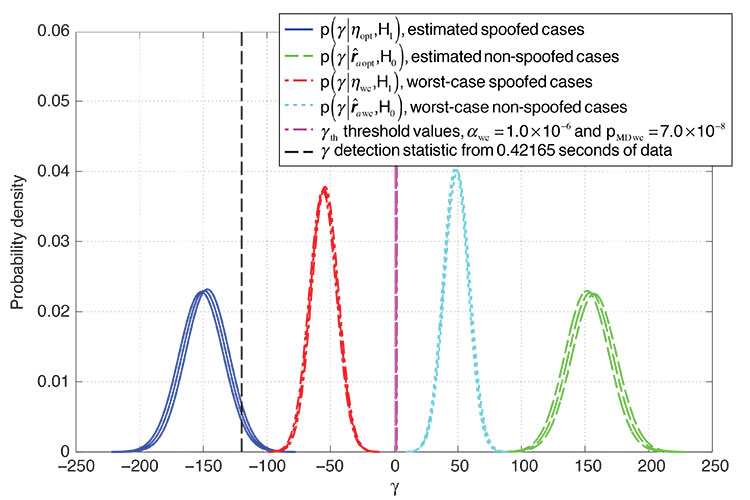
    Figure 6. Performance of a typical spoofed case with live data: spoofing detection statistic, threshold, and related probability density functions.

    As manufacturers convert machines and appliances into remotely controllable objects (the Internet of Things), the potential for spoofing expands, perhaps exponentially. Hackers could interfere with the data supplied to autonomous cars or tracks, remotely forcing them to crash.

    Although the dangers of GPS spoofing have been pointedly discussed in may technical papers and articles in GPS World since the early 2000s, manufacturers have not devoted much attention to them because there weren’t many devices making use of location-based technologies, according to associate professor Dinesh Manandhar of the University of Tokyo.

    With the proliferation of GPS-capable smartphones and other networked devices, “anyone can become a target of the attack,”  Manandhar told the Japan Times in a recent interview.

    “Too many things today use GPS as a reliable source of location information,” Manandhar said.  “People trust the location information from GPS satellites like God. When PCs became common for many people, the sudden outbreak of computer viruses became an issue around the world, and anti-virus software become an essential tool for everyone to protect their data,” he added. “The same thing is now happening around GPS. We need a system to fight back against the risk.”

    Manandhar cited some possible examples of spoofing, both by consumers — “You can falsify your smartphone’s information and make it look like you are going back and forth between Tokyo and Hawaii within just three minutes,”  and by sophisticated criminals. “Let’s say I were a top manager of a major bank. I could access all the information while sitting at my desk, but I wouldn’t be able to access it from the room next to it. But people could get access to such information if they disguised the location information received by computer.”

    Manandhar and many other researchers around the world are developing and testing anti-spoofing techniques, but it is a long step from demonstrated results to integration into products reaching market. “The products we are designing today are ones that we will use five years later. So we must assume the possible risks and prepare for the threats that might jeopardize our society in the future.”

    Manandhar co-authored the article “Opening Up Indoors: Japan’s Indoor Messaging System, IMES” in the May 2011 issue of GPS World. The graphic heading this news story is drawn from “GNSS Spoofing Detection: Correlating Carrier Phase with Rapid Antenna Motion,” the Innovation column in the June 2013 issue.

  • Nevada UAS Test Site leads UAS detection at airports

    Nevada UAS Test Site leads UAS detection at airports

    Testing took place both day and night under severe cold-weather and snow conditions.  (Image: NIAS)
    Testing took place both day and night under severe cold-weather and snow conditions. (Image: NIAS)

    The Counter Unmanned Aerial Systems — cUAS — industry is gaining momentum. This month, the Federal Aviation Administration (FAA) and the Nevada Institute for Autonomous Systems (NIAS) — managers of the FAA-designated Nevada UAS Test Site — teamed with Northern Plains UAS Test Site to test counter-UAS (unmanned aerial systems) technology at the Denver International Airport.

    UAS that enter the protected airspace around airports can pose a serious threat to manned aviation safety. The FAA and its partners are working to evaluate new technologies for detecting unmanned aircraft near airports, and the Denver airport test represented a milestone in developing minimum operational performance standards for drone detection at major airport and critical infrastructure locations.

    “With the FAA UAS Test Site designation, Nevada was given an incredible opportunity to lead in the research and development of a commercial drone industry,” said Tom Wilczek, Aerospace and Defense Industry Specialist for the Governor’s Office of Economic Development. “This latest test proves that safety and privacy remain paramount concerns in developing a thriving unmanned aerial systems industry, and Nevada is grateful and excited to be a lead participant in these groundbreaking efforts.”

    “We flew over a half dozen fixed-wing and multi-rotor drones during the ground detection system testing in Denver,” said Chris Walach, director of the Nevada UAS Test Site. “As the FAA-designated Air Mission Lead for both UAS Test Sites, our mission was to fly the scenarios per the FAA test cards under every imaginable flight profile that an airport would see [drones] intruding in their airspace. During the main FAA Pathfinder demonstration on Nov. 16, the flight crews experienced high winds with gust over 20-25 knots and winds at the maximum for the smaller drones; however, despite the high winds, all Nevada flight teams executed their test cards with precision and a high-degree of safety.

    “This was a first: two UAS Test Sites jointly executing a very high profile FAA Pathfinder mission in Class B Airspace,”Walach continued. “The Nevada Team did exactly what a World Series UAS Team could have done in any high-profile scenario —achieving the first to fly in the Class B National Airspace which occurred day and night through multi-aircraft operations under severe cold-weather and snow conditions. Simply put, these tests mark a big step forward in developing a Counter Unmanned Systems industry.”

    The Nevada Team included Nevada-based Eye in the Sky UASUSA, Colorado-based UAS, North Dakota-based ISight RPV Services and the Nevada UAS Test Site flight team.

    Eye In The Sky UAS flew the first series of rotary-wing UAS in Class B airspace, as part of the FAA’s Pathfinder Program for UAS Detection at Airports and Critical Infrastructure. Selected by the Nevada UAS Test Site, the Eye In The Sky flight team flew the various test cards using the InstantEye Gen3 and DJI Advanced platforms at the Denver airport.

    “This is a major milestone for the Unmanned Aerial Systems Industry and for safely integrating UAS into the National Airspace System,” said Rinaldo F. Brown, director of UAS Operations for Eye In The Sky.

    “This project was an exciting chance for us to help advance the UAS industry, while also expanding our own technical capabilities. That combination made it a valuable and rewarding project for our team,” said Adam Overvold, chief pilot, ISight RPV Services.

    Nevada’s Silver Springs Airport participated as the primary training location for all flight crews.

  • Ubiqomm and Skyriver team on ‘Wi-Fi in the sky’ BVLOS drone flights

    Ubiqomm has unveils its ubiquitous high-speed data connectivity solution, especially designed for enterprise drone fleets engaged in present line of sight (LOS) and, in the future, beyond visual line of sight (BVLOS) flights.

    “The application for drones is increasing exponentially as companies apply drone technology for surveying and performing emergency operations in remote locations, and other use cases including traffic monitoring in cities, and above stadium live-streaming of sporting events. Consistent high-speed data connectivity between drones and ground control centers is becoming mission critical,” said Saum Vahdat, VP of Marketing and Business Development at Ubiqomm.

    Ubiqomm’s wireless solution encompasses a network of base stations on the ground and communications devices mounted on drones. Each base station is capable of supporting all drones within its 25km+ coverage radius. The seamless handoff with the adjacent base station ensures ubiquitous coverage in a large area while connecting drones to a cloud backhaul.

    Ubiqomm’s unique patented solution uses multiple techniques, such as innovative antenna design for both base stations and drones, mobility management, and interference mitigation, together achieving very high bandwidth efficiency. Vahdat added “Dubbed as “Wi-Fi in the Sky,” Ubiqomm’s solution enables 10x lower CapEx and OpEx as compared to terrestrial LTE networks while enabling very high-data rates of 200 Mbps between drones and base stations.”

    Ubiqomm is partnering with Skyriver, an affiliated company in the Bridgewest Group portfolio of businesses with expertise in wireless broadband network design and deployment, in the millimeter wave and lower spectrum bands. Together, the two companies are offering demonstrations to companies that are interested in leveraging Ubiqomm’s technology for their own products and services.

    The demonstration includes multiple drones flying within a region approximately 25km away from their San Diego base station. Each drone will be transmitting multiple 1080p video streams to the base station, utilizing secure high-speed links (200+ Mbps).

    Ubiqomm and Skyriver are seeking industry partners for development, testing and trials of UAV traffic management (UTM) protocols in addition to the “Wi-Fi in the Sky” network solution, paving the way for BVLOS flight operations.