Author: GPS World Staff

  • Automotive abstract: INS to protect against GNSS spoofing

    Automotive abstract: INS to protect against GNSS spoofing

    iongnss16_manickam

    Using Tactical and MEMS Grade INS to Protect Against GNSS Spoofing in Automotive Applications

    By Sashidharan Manickam and Kyle O’Keefe PLAN Group, Department of Geomatics Engineering, University of Calgary

    This paper analyzes the GNSS signal authentication limits in using different grades of IMU (Tactical and MEMS) to detect errors in combination with different grades of GNSS receiver (Geodetic grade and Automotive). To test these combinations, a tightly-coupled 23 state navigation Kalman Filter is implemented with a constant velocity dynamics model for the position, velocity, attitude and clock states and first-order Gauss-Markov processes to model the 12 sensor errors.

    Presented at ION GNSS+, September 2016.

  • Mapping system for self-driving cars developed by Nvidia and TomTom

    NVIDIA and TomTom announced they are partnering to develop artificial intelligence to create a cloud-to-car mapping system for self-driving cars.

    The work combines TomTom’s HD map coverage, which spans more than 120,000 kilometers of highways and freeways, with the NVIDIA DRIVE PX 2 computing platform. Together, the solution accelerates support for real-time in-vehicle localization and mapping for driving on the highway.

    “Self-driving cars require a highly accurate HD mapping system that can generate an always up-to-date HD map in the cloud,” says Rob Csongor, vice president and general manager of Automotive at NVIDIA. “DRIVE PX 2 for AutoCruise provides TomTom with a real-time, in-vehicle source for HD map updates.”

    The NVIDIA DriveWorks software development kit now integrates support for TomTom’s HD mapping environment. The open solution is available for all automakers and tier 1 suppliers developing autonomous vehicles.

  • Precision GNSS in phones, drones and cars forecast by 2021

    UAV-opening-O

    Low-cost, precision GNSS receivers will become a reality in the driverless car, drone and even smartphone markets by 2021, finds ABI Research. The automotive industry will be the main driver behind precision GNSS receiver adoption, in which centimeter-level accuracy is essential to complete driver safety systems with the redundancy necessary for autonomous vehicles.

    “There is a variety of competing technologies currently under investigation by the automotive industry, but ABI Research forecasts it will move to a hybridized approach, combining LIDAR, HD maps, sensor fusion, machine vision and precision GNSS,” says Patrick Connolly, principal analyst. “As the receivers’ average selling price drops below $50, we expect to see a more immediate market for location technology services, such as AR Heads Up Displays (HUDs), in high-end vehicles. Vehicle-to-Vehicle, or V2V, communication might constitute another use case for high-precision GNSS.”

    In addition to autonomous vehicles, the report also identifies opportunities for low-cost, precision GNSS receivers in autonomous unmanned vehicles (AUVs), as well as commercial and consumer devices. Though the average selling prices of such GNSS receivers is $1,000 and higher, ABI Research finds the cost to be one of the most addressable inhibitors to market growth today.

    “Precision GNSS achieves sub-meter accuracy through a variety of methods, including a network of reference stations,” Connolly says. “The biggest question mark today is not cost-related, but instead how to achieve reliable, worldwide satellite navigation coverage to support correction techniques, such as real time kinematic, or RTK, and precise point positioning, or PPP. This is an extremely expensive undertaking, with currently no guarantee of a return on investment.”

    Competition in the location technologies market ranges from crowdfunded startups to Internet giants, reflecting the scale of the opportunity. Traditional precision GNSS receiver vendors like NovAtel have the intellectual property, engineering experience and ownership of correction networks.

    In the consumer GNSS receiver market, u-Blox and Skytraq lead the way, according to the report. Each developed low-cost single frequency PPP and RTK receivers, with a clear roadmap toward dual-frequency. Other consumer GNSS providers, like ST Microelectronics, Broadcom and Qualcomm, also appear active in this space.

    Start-ups like North Surveying, NVS Technologies, REACH, and Swift Navigation continue to disrupt the industry, bringing low-cost precision receivers to market, said ABI Research.  Their goal is to hit an ASP below $100 in the near future. And Radiosense is a startup that received a lot of attention for its previous work concerning precision GNSS on smartphones. It is now working on automotive solutions in a pilot in Austin, Texas.

    Locata has the potential to be the wildcard in the deck, working on a powerful synchronization and location technology that may find its way into consumer technologies by 2021.

    “Most interesting in the location technology competitive landscape is the involvement of Internet giants Google and Alibaba,” concludes Connolly. “Google recently announced it will make GPS pseudoranges available to developers, which, although extremely nascent, could open up the door for a lot of innovation. And in China, Alibaba is a major partner in the roll-out of Continuous Operating Reference Stations, or CORS, networks in the region.”

    These findings are from ABI Research’s Precision GNSS in Automotive and GNSS IC Design Trends: Modules, Standalone, Combo, and Embedded reports.

  • Beacons by Waze counter tunnel blackout

    Beacons by Waze counter tunnel blackout

    fort-pit-tunnel

    To assist drivers losing their navigation assistance in tunnels such as those in New York, Baltimore, Boston and Pittsburgh, app maker Waze has begun pilot projects installing electronic beacons. Each about the size of an E-ZPass, the beacons are installed within tunnels to guide the way via Bluetooth. No GPS signal in the tunnel means no directions upon emerging into daylight. That can cause a missed exit — or worse.

    Waze spokesperson Meghan Kelleher said one beacon is placed every 40 feet or so to provide seamless smartphone navigation throughout the tube and to allow people to note traffic troubles on the crowdsourcing app. But even non-Waze users can benefit.

    “It’s actually an open technology,” Kelleher says. “We’re making it available free of charge to other navigation services.”

    Each mile of beacons costs about $300 per year. The hardware is made by Bluvision with batteries are designed to last about six years.

    Waze has just switched them on in the Fort Pitt and Liberty tunnels in Pittsburgh with an eye on getting governments and other agencies to foot the bill in the rest of the world’s tunnels.

    Photo: the justified sinner via Foter.com / CC BY-NC-SA

  • Rocket readied for 4 at once for Galileo

    The first rocket to loft four global positioning satellites at once has begun its build-up at the European Space Agency’s Spaceport in French Guiana.  The milestone mission, scheduled for Nov. 17, will carry four Galileo satellites into orbit.

    Ariane 5’s core stage is transferred for positioning over a mobile launch table inside the Spaceport’s Launcher Integration Building. Flight VA233 will carry four Galileo satellites.
    Ariane 5’s core stage is transferred for positioning over a mobile launch table inside the Spaceport’s Launcher Integration Building. Flight VA233 will carry four Galileo satellites.

    This launcher  began the integration process with the cryogenic core stage’s positioning over a mobile launch pad, followed by integration of the vehicle’s two solid propellant boosters. Designated as Flight VA233, the Ariane 5 rocket is being assembled inside the Spaceport’s Launcher Integration Building. Once completed, it will be moved into the Final Assembly Building  for installation of the four Galileo spacecraft.

    Arianespace already has orbited 14 Galileo spacecraft, all lofted in pairs on seven missions aboard the company’s medium-lift Soyuz launcher, with the most recent conducted last May.

    For its maiden Ariane 5 mission at the service of Galileo, Arianespace’s workhorse heavy-lift vehicle will be equipped with a dispenser system that secures the quartet of Galileo satellites in place during ascent, and deploys them in rapid sequence at a targeted release altitude of 23,222 kilometers.

    The four spacecraft were built by OHB System in Bremen, Germany, with their navigation payloads provided by Surrey Satellite Technology in the U.K.

  • GPS III 9 and 10 procured, targeting 2022 launch

    GPS III 9 and 10 procured, targeting 2022 launch

    The first eight GPS III satellites are under contract and in production at Lockheed Martin’s GPS III Processing Facility outside of Denver.
    The first eight GPS III satellites are under contract and in production at Lockheed Martin’s GPS III Processing Facility outside of Denver.

    The U.S. Air Force Space and Missile Systems Center awarded a contract option to Lockheed Martin Space Systems Company to procure two additional GPS III satellites, space vehicles nine and 10 of the next generation. The contract option procures long lead and production hardware.

    “The GPS III SV 9 and 10 satellites are expected to be ready for launch in 2022, thus sustaining the GPS constellation and the global utility the world has come to expect,” said Lt. Gen. Samuel Greaves, the Space and Missile Systems Center’s commander and Air Force program executive officer for space.

    The Lockheed Martin team is finishing up final testing and integration activities on the first GPS III satellite, GPS III SV01, and is preparing to deliver it to the Air Force later this year. The second satellite, GPS III SV02, is poised to have its major functional systems fully integrated into one space vehicle prior to starting its own environmental testing. GPS III SV03 also is beginning to take form in the company’s production clean room as its major subcomponents are being assembled.   \All eight of the first set of GPS III satellites are in various stages of production at Lockheed Martin’s GPS III Processing Facility outside of Denver.

    190921-f-zz999-108The government expects to compete future purchases of GPS III satellites, beginning with GPS III SV 11. This competition will maintain the current technical baseline of GPS III and will add additional hosted payloads to increase system accuracy, search and rescue capability, and universal S-band compatibility.

  • High-accuracy, intelligent performance with sensor fusion

    High-accuracy, intelligent performance with sensor fusion

    Inertial navigation

    geo_fog_single-3d-wThe GEO-FOG 3D inertial navigation system (INS) uses sensor fusion to deliver reliable, high-accuracy navigation and control to a wide variety of unmanned, autonomous and manned aerial, ground, marine and subsurface marine applications and platforms. Other applications include navigation and control, positioning and imaging, georeferencing, land surveying, robotics, underground navigation, stabilization and orientation.

    Designed for demanding navigation and control applications, the GEO-FOG 3D has performance monitoring and instability protections to ensure stable and reliable data. Using an innovative artificial intelligence algorithm, its intelligent high-performance filter is capable of extracting significantly more information from the 1750 IMU core processor than a typical Kalman filter.

    The GEO-FOG 3D is built upon the high-performance fiber-optic gyro (FOG)-based 1750 inertial measurement unit (IMU). It contains three DSP-1750 fiber optic gyros integrated with three very low noise micro-electro-mechanical systems (MEMS) accelerometers as well as a pressure sensor, a three-axis magnetometer, and a triple-frequency GNSS receiver.

    The triple frequency receiver provides 8 millimeters of positioning accuracy and supports all GNSS systems. It also offers data rates up to 1000 Hz; data can be output over a high-speed RS-422 interface or optional RS-232 interface. The rugged GEO-FOG 3D INS is protected from reverse polarity, overvoltage, surges, static and short circuits on all external surfaces.

    Key Features

    • Core processor: KVH 1750 IMU
    • 6 degrees of freedom (DoF) IMU consisting of integrated FOGs and accelerometers
    • Triple-frequency Trimble GNSS receiver
    • Sensor fusion algorithm delivers accurate, reliable data for navigation, orientation, and control
    • North-seeking gyrocompass
    • Attitude and Heading Reference System (AHRS)

    KVH, www.kvh.com/unmanned

  • Harris delivers first OCX receiver

    Harris delivers first OCX receiver

    Photo: Harris
    Photo: Harris

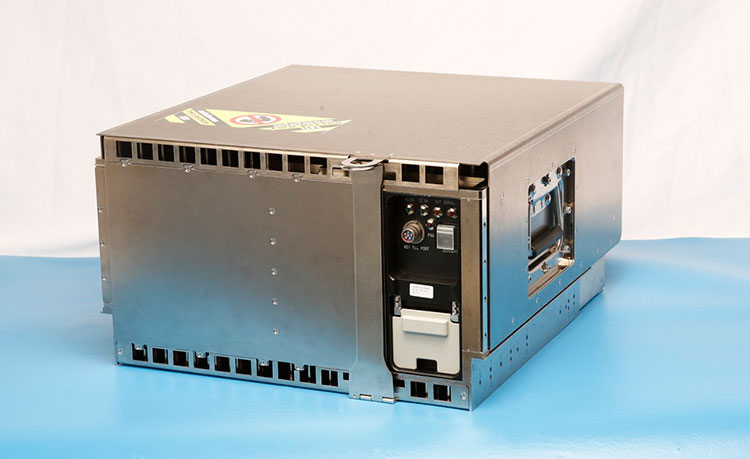
    Harris Corporation delivered the first of 34 modernized receivers to support the GPS Next-Generation Operational Control System (OCX). They will receive the signals sent by the current GPS satellite constellation plus the new signals sent by the next generation GPS III — 13 military and civilian signals in all.

    The receiver was shipped to the prime contractor, Raytheon Company, in Aurora, Colorado, after it passed a critical electromagnetic interference test, the first of many stringent qualification requirements. Though the receivers will be placed throughout the world, this first production unit will be installed in Aurora as OCX software development and integration continues.

    OCX will replace the existing ground control system that receives signals from the 31 operational GPS satellites already orbiting Earth. Only OCX will be able to receive and decrypt all GPS III military and civil signals, however.

    In addition to receivers, Harris has delivered 14 ground encryptors that will help protect the GPS signal. Harris also is providing critical software elements, which provide the fundamental navigation data to the GPS satellites and enable U.S. Air Force operators to better know and monitor the exact position and timing of the GPS constellation.

    Pictured here is the advanced MDU on navigation payloads being delivered for GPS III Space Vehicles 1-10. (Photo: Harris)
    Pictured here is the advanced MDU on navigation payloads being delivered for GPS III Space Vehicles 1-10. (Photo: Harris)


  • Launchpad: TraceME TM-178 is upgraded with LoRa technology

    Tracking with options

    The TraceME module TM-178, targeted for tracing and controlling vehicles and other powered equipment, is now upgraded with optional LoRa, Wi-Fi, Bluetooth Smart (BLE), ANT/ANT+ and proprietary RF. The upgrades enable integration with existing wireless networks and specific custom mobile apps on smartphones and tablets.

    productheader-r9hc-kcsbv-wThe KCS BV LoRa technology offers a communication range up to 60 kilometers, line of sight. The module offers an advanced indoor and outdoor location-based positioning solution, which covers a variety of Internet of Things (IoT) applications and enables stolen object or vehicle recovery.

    The TM-178 is equipped with external power and battery backup connection, basic I/O-connectivity and multiple on-board sensors. The unit contains multiple integrated antennas for GPS/GLONASS, GSM (2G/3G) and RF functionality. The functionality of the module can be remotely programmed to fit any job. From basic/general functionality to advanced/low-level application specific detailed functionality.

    With a compact size of 91 x 40 millimeters and weighing 30 grams, along with a battery lifespan of more than 10 years, the module offers endless OEM integration possibilities. Optionally, the module can be ordered in a robust IP67 housing.

    TM-178 Features

    • GPS
    • GSM/GPRS/EDGE coverage
    • Basic I/O-connectivity
    • Long-range RF coverage

    Optional Features

    • GPS + GLONASS
    • UMTS/HSPA+
    • LoRa
    • Bluetooth Smart (BLE), ANT/ANT+, iBeacon
    • Wi-Fi
    • Robust IP67 housing
    • External RF antennas
    • Internal battery, no need for external power supply

    KCS BV, www.trace.me

  • Inertial, gyroscope take to space

    Inertial, gyroscope take to space

    nea-scout-1-piece-sailSensonor AS of Norway has partnered with the U.S. National Aeronautics and Space Administration (NASA) to supply current and future low- and near-Earth orbit space missions with inertial and gyroscope modules.

    The Norway-based company first began supplying its standard inertial measurement unit (IMU) and gyroscope modules for low Earth orbit (LEO) space applications in 2012, Sensonor’s STIM300 and STIM210 inertial products now fly aboard several NASA spacecraft. Current projects using STIM inertial systems include the Raven technology demonstration and Near Earth Asteroid (NEA) Scout.

    Raven, which launched to the International Space Station in September, will test key elements of an autonomous relative navigation system. Its technologies may one day help future robotic spacecraft autonomously and seamlessly rendezvous with other objects in motion, such as a satellite in need of fuel or a tumbling asteroid.

    The NEA Scout is a robotic reconnaissance mission that will be deployed to fly by and return data from an asteroid representative of NEAs.

    The STIM gyroscope modules are often used in combination with GPS or a Star Tracker and Kalman Filter to orient and stabilize the satellite, as well as to provide feedback on satellite motion induced by its reaction wheels. In some applications, the gyroscopes are used to stabilize satellite-to-satellite communications.

  • New GPS study finds 200 gigatons of ice missing

    A new study based on GPS measurements of the Earth’s crust suggests the Greenland ice sheet is melting 7 percent faster than previously believed and may contribute more to future sea level rise than predicted, reports the Canadian Broadcasting Corporation.

    “We’ve underestimated the rate of ice loss by about 7.6 percent,” says Michael Bevis of The Ohio State University, one of the study’s co-authors.

    The research found that Greenland lost close to 2,700 gigatons of ice from 2003–2013, rather than the 2,500 gigatons figure that scientists previously believed. The study, published in the journal Science Advances, is an international effort that started in 2007, with contributions from the U.S., Denmark and Luxembourg.

    Over the past two decades the Greenland ice sheet has been shrinking — partly due to accelerated glacier flow and partly because of surface melt. However, scientists have not been able to pinpoint exactly how much the melting ice sheet is contributing to global sea level rise — information key to making predictions about future sea rise levels.  Part of the challenge has been a lack of on-site data.

    For this study teams of scientists spent years installing GPS devices around the  perimeter of the Greenland ice sheet to collect new data. The team discovered that the hotspot in the Earth’s mantle that feeds Iceland’s active volcanoes has been distorting data.

  • Launchpad: Multi-frequency GNSS RF front-ends

    Launchpad: Multi-frequency GNSS RF front-ends

    4- and 7-channel research and evaluation platforms

    The NT1065_USB3 and Multi_GNSS_Grabber_Board are research and evaluation platforms for professional navigation receivers, based on NTLab’s RF front-end integrated circuits: the NT1065 “Nomada” (4-channel GPS/GLONASS/Galileo/BeiDou/IRNSS/QZSS, L1/L2/L3/L5 band) and NT2024 (3-channel GPS/GLONASS L1/L2 and S-band).

    Both boards support USB3 connection, thus allowing the user to process captured satellite signals on a PC.

    NT1065_USB3

    Multi-band multi-system 4-channel coherent GNSS RF front-end based on NT1065 “Nomada” IC.

    nt1065_usb3-nt-labs-wFeatures

    • 4 coherent GNSS channels
    • IF bandwidth up to 32MHz for each channel
    • Acquisition of wideband signals up to 64 MHz (such as Galileo E5) with 2 coherent channels
    • Built-in 2-bit ADC
    • USB3 interface (up to 800 Mbit/s)
    • Ability to connect 4x CRPA

    Multi_GNSS_Grabber_Board

    All-band, all-system 7-channel GNSS software-defined receiver platform based on RFFE ICs: NT1065 “Nomada” and NT2024.

    multi_gnss_grabber_board-nt-labs-wFeatures

    • All NT1065_USB3 features, plus:
    • Two additional L1/L2 GNSS channels
    • IRNSS S-band support
    • Built-in FPGA for pre-processing and channel synchronization

    NTLab, www.ntlab.com