Author: GPS World Staff

  • 7-Eleven, Flirtey make first FAA-approved drone delivery to home

    Convenience retailer 7-Eleven and Flirtey, an independent drone delivery service, completed the first fully autonomous drone delivery to a customer’s residence to advance research toward integrating drones into the National Airspace System.

    The July 22 delivery to a Reno, Nevada, home is the first time a U.S. customer has received a package to a residence via drone — a historic milestone in both U.S. and global commerce. The delivery was conducted in celebration of the convenience store chain’s 89th birthday.

    The goal of advancing drone deliveries as well as further refining Flirtey’s delivery technology and packaging were highlighted when Flirtey teamed with the Nevada Institute for Autonomous Systems (NIAS) for the delivery.

    “This delivery required special flight planning, risk analysis, and detailed flight procedures ensuring residential safety and privacy were equally integrated,” said Chris Walach, director of operations for NIAS.

    From a Reno 7-Eleven store, two deliveries were successfully completed. 7-Eleven merchandise — including hot and cold food items — were loaded into a unique Flirtey drone delivery container and flown autonomously using precision GPS to a local customer’s house.

    Once at the family’s backyard, the Flirtey drone hovered in place and gently lowered each package. The purchases were delivered to the family in the span of a few minutes.

    Products included Slurpee drinks, a chicken sandwich, donuts, hot coffee and 7-Select candy. In the future, both companies expect drone packages to include “everyday essentials” such as batteries and sunscreen.

    “My wife and I both work and have three small children ages 7, 6 and 1. The convenience of having access to instant, 24/7 drone delivery is priceless,” said Reno resident Michael, who received the Flirtey delivery. “It’s amazing that a flying robot just delivered us food and drinks in a matter of minutes.”

    The deliveries also mark Flirtey’s largest commercial relationship to date and bring the drone delivery startup even closer to its vision of reinventing the delivery process for humanitarian, online retail and food delivery industries.

    “We’re absolutely thrilled to have 7-Eleven, the largest convenience chain in the world, embracing new technologies and working with us at Flirtey to make drone delivery a reality for customers all over the world,” said Flirtey CEO Matt Sweeny. “This is just the first step in our collaboration with 7-Eleven. Flirtey’s historic drone deliveries to date have been stepping stones to store-to-home drone delivery, and today is a giant leap toward a not-too-distant future where we are delivering you convenience on demand.”

    Building on this initial collaboration, the two companies have plans to expand drone delivery tests and work closely together, according to 7-Eleven EVP and Chief Merchandising Officer Jesus H. Delgado-Jenkins.

    “Drone delivery is the ultimate convenience for our customers and these efforts create enormous opportunities to redefine convenience,” said Delgado-Jenkins. “This delivery marks the first time a retailer has worked with a drone delivery company to transport immediate consumables from store to home. In the future, we plan to make the entire assortment in our stores available for delivery to customers in minutes. Our customers have demanding schedules, are on-the-go 24/7 and turn to us to help navigate the challenges of their daily lives. We look forward to working with Flirtey to deliver to our customers exactly what they need, whenever and wherever they need it.”

    “I congratulate Nevada-based company Flirtey on making history yet again – this time by collaborating with the world’s largest convenience retailer to complete the first store-to-home drone delivery in Reno, Nevada,” said Nevada Governor Brian Sandoval. “Through our FAA Test Site designation, Flirtey has cemented Nevada’s position as the leader in the commercial Unmanned Aerial Vehicles (UAV) industry and I look forward to seeing them continue to grow and bring jobs to our region.”

  • Elliptically orbiting Galileo satellites to start broadcasting navigation messages

    News courtesy of CANSPACE Listserv.

    According to two Notice Advisories to Galileo Users (NAGUs), the two Galileo satellites launched into elliptical orbits in August 2014, GSAT0201 using PRN code E18 and GSAT0202 using PRN code E14, will start transmitting navigation messages for test purposes this Friday, Aug. 5.

    The Signal Health Status (SHS) flags will be set to “Test” and the Data Validity Status (DVS) flags will be set to WWG (working without guarantee).

    The satellites will not be included in the broadcast almanacs.

    Users are requested to provide feedback on usage of GSAT0201 and GSAT0202 by contacting the help desk on the European GNSS Service Centre web portal.

  • Australia drifts away from GNSS measurements

    Australia drifts away from GNSS measurements

    Australia is moving north at the rate of approximately 2.75 inches per year, causing it to be out of sync with GNSS positioning by nearly five feet, reports the BBC. Scientists are working to correct the measurement problems this situation creates.

    The shift, caused by normal tectonic movement, is causing a discrepancy that would interfere in the future use of self-driving cars. Another affected industry is precision agriculture, where self-driving tractors till fields.

    The Australian government has launched a project to align with GNSS. To do this, the Geocentric Datum of Australia will need to be updated with correct coordinates — which hasn’t been done since 1994 — despite the fact that Australia rests on the fastest moving continental tectonic plate on Earth.

    On Jan. 1, 2017, Australia’s local coordinates will be shifted north by 5.9 feet. The update to the local coordinate system will overshoot to account for more movement and predict where the continent will be in 2020.

  • Verizon to acquire fleet management company Fleetmatics

    Verizon to acquire fleet management company Fleetmatics

    Transaction to accelerate Verizon’s position as a provider of fleet and mobile workforce management solutions, companies say

    Verizon Communications Inc. and Fleetmatics Group PLC have entered into a definitive agreement under which Verizon will acquire Fleetmatics, a global provider of fleet and mobile workforce management solutions, for $60 per share in cash — representing a value of approximately $2.4 billion.

    In June, Verizon Telematics announced the acquisition of Telogis Inc., a global, cloud-based mobile enterprise management software company based in Aliso Viejo, California. That transaction closed on July 29.

    With approximately 1,200 employees, Fleetmatics is headquartered in Dublin, Ireland, with North American headquarters inWaltham, Massachusetts. The company’s web-based solutions provide fleet operators with visibility into vehicle location, fuel usage, speed and mileage, and other insights into their mobile workforce, helping them to reduce operating costs, as well as increase revenue.

    Verizon Telematics, a subsidiary of Verizon Communications, operates in more than 40 markets worldwide and offers comprehensive wireless, software and hardware solutions to consumers, enterprises, automakers and dealers to power connected-vehicle products around the world.

    “Fleetmatics is a market leader in North America — and increasingly internationally — and they’ve developed a wide-range of compelling SaaS (software as a service)-based products and solutions for small- and medium-sized businesses,” said Andrés Irlando, CEO of Verizon Telematics.

    “The powerful combination of products and services, software platforms, robust customer bases, domain expertise and experience, and talented and passionate teams among Fleetmatics, the recently-acquired Telogis, and Verizon Telematics will position the combined companies to become a leading provider of fleet and mobile workforce management solutions globally,” Irlando added.

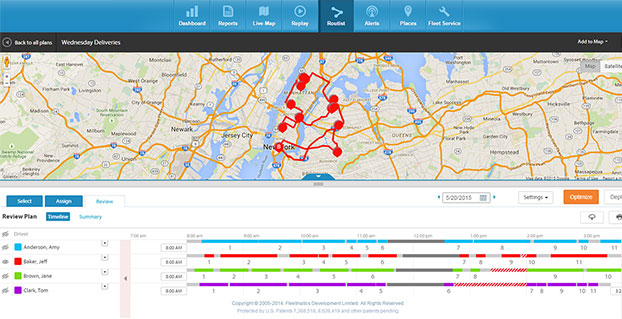
    Fleetmatics Routist is an intelligent routing optimization tool for fleet management.
    Fleetmatics Routist is an intelligent routing optimization tool for fleet management.

    “Verizon and Fleetmatics share a vision that the SaaS-based fleet management solution market is extraordinarily large, lightly penetrated, global and fragmented which can best be attacked together with a world class product offering and the largest distribution channel in the industry,” said Jim Travers, Chairman and CEO of Fleetmatics.

    “Fleetmatics brings over 37,000 customers, approximately 737,000 subscribers, a broad portfolio of industry leading products, and a team of 1,200 professionals focused on solving the critical challenges of businesses that deploy mobile workforces. We are excited to partner with Verizon in fulfilling the mission of becoming the largest mobile workforce management company in the world,” Travers added.


    The acquisition is subject to customary regulatory approvals and closing conditions, including the approval of Fleetmatics’ shareholders and the sanction of the Irish scheme of arrangement by which Verizon will acquire Fleetmatics by the Irish High Court, and is expected to close in the fourth quarter of 2016.

    PJT Partners and Wells Fargo Securities, LLC are acting as financial advisors to Verizon. Cleary Gottlieb Steen & Hamilton LLP, A&L Goodbody and Macfarlanes LLP are acting as legal advisors to Verizon. Morgan Stanley is acting as financial advisor to Fleetmatics. Goodwin Procter LLP and Maples and Calder are acting as legal advisors to Fleetmatics.

  • Launchpad: OEM, UAV and survey/mapping products

    OEM

    Geodetic Antennas

    For RTK, PPP, and other precision applications

    TW6000 rendered[1]

    The VP6300 is a triple-band antenna for reception of GPS L1/L2/L5, GLONASS G1/G2/G3, BeiDou B1/B2 and Galileo E1/E5a+b (1165MHz to 1254MHz + 1560MHz to 1610MHz). The VP6200 is a dual-band antenna for reception of GPS L1/L2, GLONASS G1/G2, BeiDou B1/B2, Galileo E1 and the L-Band correction services (1195 MHz to 1254 MHz + 1525 MHz to 1610 MHz). Both antennas have been calibrated by the U.S. National Geodetic Survey and are designed for high-precision applications such as real-time kinematic, precise point positioning and other applications where precision matters. The antennas feature an available, uncommitted printed circuit board for integration of custom electronics such as precision GNSS receivers. Both antennas feature the VeraPhase technology used in the VP6000 all-band reference antenna.

    Tallysman, www.tallysman.com


    ‘Future Proof’ RTK

    For rover or base station

    Image_Altus_APS3G_external_use

    The Altus APS3G is a real-time kinematic (RTK) receiver that brings technology from scientific receivers into the field for professional surveyors. The new multi-constellation APS3G addresses major concerns about compatibility with new satellite constellations, as well as interference and jamming. Built on Septentrio’s AsteRx4 engine, the APS3G tracks all-in-view GPS, GLONASS, BeiDou, IRNSS, SBAS, Galileo and QZSS, including E6/L6 and all other signals known to be available in the medium term. The APS3G incorporates Septentrio’s AIM technology with three notch filters for in-band jamming and chirp jammer resistance, ensuring the highest possible levels of accuracy and resilience under all conditions. It provides optimum GSM signal reception, as well as a built-in advanced UHF receiver for reliable performance on longer baselines, yielding real-time 25-Hz RTK.

    Septentrio, www.septentrio.com


    GNSS Receiver

    Offshore surveys, machine control, crustal deformation

    N72_Hi-res

    CHC’s N72 GNSS series offers high-end receivers for GNSS applications including offshore surveys and machine control, national geodetic networks, crustal deformation monitoring and bathymetry. It was designed to provide all the necessary technical features required for geodetic surveying and demanding applications such as Continuously Operating Reference Stations (CORS), on-board machine control and disaster monitoring. Embedded battery supports 15 working hours without external power supply; 32-GB internal memory integrated and 1TB+ external memory supported; Eight threads of logging with circulating storage and FTP push functions; Wi-Fi, LAN, Bluetooth and serial ports for data communications; and LCD display and function buttons for direct configuration.

    CHC, www.chcnav.com


    Anti-Jam Antenna

    Suitable for airborne platforms

    GAJT-AE 34 view

    The GAJT-AE-N anti-jam antenna is designed for size- and weight-constrained applications such as small airborne and ground unmanned platforms where it is preferable to mount the antenna electronics inside the vehicle. Users can select from a variety of four-element Controlled Reception Pattern Antennas (CRPA) and cabling lengths to meet the form factor requirements of their installation. Interference mitigation is achieved by applying proprietary digital beamforming algorithms to the signals, creating dynamic nulls to give protection against narrowband and broadband interference sources. GAJT-AE-N comes in variants that protect L1 and L2 signals in wide or narrow band. The wide bandwidth version ensures future compatibility with M-code GPS.

    NovAtel, www.novatel.com


    Transportation

    GNSS Modules

    Automotive-grade positioning modules

    UB052(Fig1)

    The NEO-M8Q-01A and the NEO-M8L-01A positioning modules provide concurrent reception of GPS, GLONASS, Beidou and Galileo. The NEO-M8L-01A is suited to providing 100 percent dead-reckoning positioning coverage even in areas of weak signal such as in tunnels or multi-story car parks or those experiencing poor signal quality such as caused by multipath reflections. This module is qualified to operate in the -40 to +85 degrees temperature range. The NEO-M8Q-01 GNSS module is the first GNSS module able to operate across the extended automotive temperature range from -40 to + 105 degrees Celsius.

    u-blox, www.u-blox.com


    Connected Car Reference Platform

    Simplifies integration of advanced connectivity technologies into new vehicles

    2016-06-06-ch-qualcomm-cc-reference-platform

    The Qualcomm Connected Car Reference Platform is aimed at accelerating the adoption of advanced and complex connectivity into the next-generation of connected cars. The product is designed to maintain pace with an ever-increasing set of automotive use cases facilitated by the latest advances in 4G LTE, Wi-Fi, Bluetooth and vehicle-to-everything (V2X) communications. The platform is also designed to solve for challenges such as wireless coexistence, future-proofing and support for a large number of in-car hardware architectures. The Connected Car Reference Platform is built upon Qualcomm Technologies’ broad automotive product and technology portfolio, including quad-constellation GNSS, Snapdragon X12 and X5 LTE modems, and 2D/3D dead-reckoning location solutions, Qualcomm VIVE Wi-Fi technology, Dedicated Short Range Communications (DSRC) for V2X, Bluetooth, Bluetooth Low Energy and broadcast capabilities such as analog and digital tuner support using software-defined radio via Qualcomm tuneX chips. In addition, the platform features in-vehicle networking technologies such as Gigabit (OABR) Ethernet with Automotive Audio Bus (A2B) and Controller Area Network (CAN) interfaces.

    Qualcomm Technologies, www.qualcomm.com


    SURVEY & MAPPING

    TotalStationSurveyTotal Station App

    Connects Android device to information gathered 

    Total Station Survey helps land surveyors and civil engineers view and inspect on any Android device the information gathered by the total station. It connects to the total station using Bluetooth or a USB-serial adapter/converter cable. It can measure horizontal and vertical angle, slope and horizontal distance, and set the horizontal angle on the total station. The app is available free on Google Play.

    Systranova Software, play.google.com


    Laser and Android App

    Collect survey-grade accuracy with an Android device 

    TP300_QM3D_Cedar_TriPod_CloseUp_001

    The TruPoint 300 is a lightweight, compact point-and-shoot laser with survey-grade accuracy. It measures the distance between two remote points and has onboard solutions for volume, heights and 2D and 3D areas. Users can collect 3D measurements from a single location using a personal smart device and capture a photo of every shot taken, using LTI’s MapSmart on Android software. MapSmart combines sophisticated technology typically required to collect field data and puts it into a straightforward app for smart devices. It simplifies the mapping process by allowing users to establish an origin quickly and begin mapping in just minutes. Users can integrate location data using the GPS from a smart device or improve accuracy with an external antenna.
    Laser Technology, www.lasertech.com

    Laser Technology, www.lasertech.com


    Smartphone App

    Quick land measurements 

    GPS Fields Area

    GPS Fields Area Measure Pro is easy, intuitive, app to manage area, distance, perimeter. It enables fast area/distance marking, and ha a Smart Marker Mode for accurate pin placement. Its GPS tracking enables auto measurement while walking or driving around a boundary. Users can share an auto-generated link with boundary/selected area/ direction/route. GPS Field Area Measure useful as map measurement tool for outdoor activities, sports, range finder applications, bike tour planning, or run tour planning, explore golf area, land survey, golf distance meter, field pasture area measure, garden and farm work and planning, area records, construction, agricultural fencing, solar panel installation – roof area estimation, trip planning.

    Studio Noframe, play.google.com


    Dedicated 3D Tablet

    Capture and review 3D images in the field  

    3DTablet

    The EyesMap tablet is a versatile instrument for modeling 3D scenes indoors and outdoors. It provides results while working in the field with real-time measurements. The tablet has a stereocamera, depth sensor scanner, GPS and inertial measureent unit. It also supports external cameras and other topographic instruments. Applications include crime scene investigation, archaeology and architecture documentation, as-built measurements and inspections, industrial and civil maintenance.

    eCapture, www.ecapture.es


    Handheld Collector

    Entry-level GNSS device for GIS 

    TDC100_FrontThe TDC100 handheld data collector is an entry-level GNSS device for a variety of geographic information system (GIS) applications. It combines both smartphone and ruggedized data collection capabilities in a single, mobile device. The Android-based TDC100 can run commercially available or in-house developed applications on a professional, IP-67 ruggedized platform with a sunlight readable display and user replaceable batteries. The built-in GNSS receiver also provides real-time accuracy. It supports GPS, GLONASS and BeiDou, as well as satellite-based augmentation system (SBAS) capabilities.

    Trimble, www.trimble.com


    UAV

    RedHen-UAVreconnaissanceReconnaissance Kit

    Situational awareness for disaster relief

    The Digital Mapping Reconnaissance Toolkit (DMRT) provides real-time reconnaissance for disaster relief and other time-sensitive situations. . It is a custom configuration of cameras, laser rangefinder, GPS unit and software all linked through the Red Hen VMS-333 multiplexing system. Users can create up-to-date orthomosaic maps and 3D models, as well as geotag reference points in impacted areas without a time lag. Users can create search patterns and map with situational awareness. Both modular aerial and land-based solutions are available

    Red Hen Systems, www.redhensystems.com


    UAV Backpack

    Intelligent Obstacle Navigation

    Yuneec Typhoon H with Intel RealSense Technology (PRNewsFoto/Yuneec International)

    The Typhoon H UAV with Intel RealSense Technology comes with a factory installed Intel RealSense R200 Camera and quadcore Intel Atom processor, an ST16 controller with a Wizard controller for dual operator mode, two batteries and extra propellers, all packed in a custom designed backpack. RealSense Technology enables Typhoon H to fly autonomously, intelligently navigating around objects. The Intel RealSense R200 Camera and the Atom processor work seamlessly with the flight-control firmware to add intelligent obstacle navigation. With a combination of specialized cameras and sensors, this Intel system maps and learns its environment in 3D, recognizing each obstacle, planning an alternative route, and safely navigating around it — an advancement over ultrasonic collision prevention, which automatically stops short of obstacles but cannot model the environment or intelligently reroute around obstacles. The module also adds downward facing sensors to improve stability, enabling flight indoors or outdoors close to the ground, even with poor GPS reception.

     Yuneec International, www.yuneec.com


    Intelligence Platform

    Insight for complex missions

    Advanced alerting

    Mission Insight provides UAS operators in deployed situations with a common operating picture in a customized graphical interface. The commercial off-the-shelf application processes and analyzes large streams of data from disparate sources in real-time. It ensures real-time, in-depth data access for mission-critical events even in remote environments or low-bandwidth situations. Complex data filtering, advanced processing and timing techniques enable Mission Insight to prioritize data and allow transmission as low as 2400 baud. The complete information management solution —including archival and replay capabilities in addition to the correlation, fusion and analytical tools — aid in training, post-operation analysis, incident investigation and review of operational effectiveness.

    Simulyze, www.simulyze.com


    Multi-Spectral Camera

    Situational awareness for disaster relief

    Sensefly_Camera_2

    Sequoia is a small, light multispectral UAS sensor that captures images of crops across four highly defined, visible and non-visible spectral bands, plus RGB imagery. Sequoia is fully compatible with the eBee Ag and other eBee platforms via senseFly’s proprietary Integration Kit. It has four 1.2 megapixel sensors (near-infrared, red-edge, red and green) plus one 16 megapixel RGB sensor, providing multispectral and RGB imagery from a single flight. An upward-facing Sunshine Sensor automatically calibrates Sequoia’s multispectral sensors for accurate imagery, whatever the light conditions. The camera unit can be configured over Wi-Fi and has 64-GB of built-in storage; the Sunshine Sensor has GPS, an IMU, a magnetometer and SD card slot

    senseFly, www.sensefly.com


  • Spirent presented with RIN award for technical achievement

    Spirent Communications plc’s Positioning Technology Unit, a company that provides solutions for improving positioning, navigation and timing (PNT) system performance, was yesterday presented with the Royal Institute of Navigation (RIN) Duke of Edinburgh Navigation Award for Technical Achievement.

    The award was presented at the Institute’s Annual Meeting, held at the Royal Geographical Society in London Jul.y 21, by the Institute’s Patron, His Royal Highness The Duke of Edinburgh. It was received by Eric Hutchinson, Spirent’s chief executive officer.

    Eric Hutchinson, Spirent CEO, (left) receives the RIN Duke of Edinburgh Navigation Award for Technical Achievement from the Institute’s Patron, His Royal Highness The Duke of Edinburgh (right). Looking on is the President of the RIN, Captain James Taylor.
    Eric Hutchinson, Spirent CEO, (left) receives the RIN Duke of Edinburgh Navigation Award for Technical Achievement from the Institute’s Patron, His Royal Highness The Duke of Edinburgh (right). Looking on is the President of the RIN, Captain James Taylor.

    Spirent was selected for this year’s award to recognize its leading role in the evolution of global navigation satellite systems (GNSS) since 1985, and joins the European Space Agency, the UK National Air Traffic Services (NATS), the Russian GLONASS system, and others who have previously received the award.

    “We are extremely honoured to have been recognized by the Institute in this way,” said Martin Foulger, general manager of Spirent’s Positioning Technology Unit. “Spirent has been at the forefront of GPS and other GNSS development for 30 years, so to join the other winners of this award is a great acknowledgement of the technical innovation and commercial success driven by the Spirent team in Paignton.”

    His Royal Highness The Duke of Edinburgh (right) congratulates Eric Hutchinson, Spirent’s Chief Executive Officer (left), after receiving the Royal Institute of Navigation (RIN) Duke of Edinburgh Navigation Award for Technical Achievement.
    Peter Chapman-Andrews, Director of the Royal Institute of Navigation, commented: “Spirent is a well-known and well-respected leader in PNT testing. This wholly-deserved award is the Institute’s way of recognizing Spirent’s significant contribution over many years towards helping the world evaluate and improve performance of navigation and timing receivers, systems and applications.”

    Spirent delivers navigation and positioning test equipment and services to governmental agencies, major manufacturers, integrators, test facilities and space agencies worldwide. Spirent’s portfolio has recently been updated with new technology that includes innovations not seen elsewhere, including the most flexible simulation systems covering the full range of GNSS signals and the world’s smallest hi-fidelity, portable PNT record and playback system. Spirent has recently opened three services labs, in UK, USA and China, to further support positioning and timing development and innovation.

  • Esri and Leica partner to offer GIS/GPS grants to governments

    Geographic information system (GIS) provider Esri has partnered with Swiss-based spatial measurement instrument manufacturer Leica Geosystems to encourage innovation of mobile field data collection in government by offering grants totaling $143,250 in goods and services.

    Projects should combine GIS and GPS.

    esri-logo

    Known as the Smart Communities Innovation Challenge, 10 governments that submit detailed project proposals demonstrating increased efficiencies in collecting data for decision support or improved productivity in delivering governmental services will be selected to receive a grant.

    Project proposals will be accepted from Aug. 15, 2016, until the official submission deadline at 5 p.m. (Pacific daylight time) on Oct. 14, 2016. Grant recipients will be announced on Oct. 31.

    leica_logoTo be entered for consideration, proposal submissions must be uploaded in conjunction with the organization’s identifying information through a form on the Smart Communities Innovation Challenge landing page.

    So long as operations are based in the United States, any government or department, whether municipal, regional, special districts, state, city, county, or otherwise, is qualified to receive a grant.

    To be selected, it is necessary that a project confirm the value of combining GIS and Global Positioning System (GPS) technologies for data collection, optimizing workloads, and providing real-time information that supports field mobility. Proposal reviewers will look for ideas that support complete workflows extended to back-office processes such as operational dashboards.

    Priority will be given to projects that tie GIS and GPS to daily workloads, influence sharing of geographically enabled data across multiple jurisdictions or interdepartmental ventures, and clearly convey a perceived benefit or return on investment.

    The intent of the joint program is to supply governments with the tools to succeed as they implement progressive methods to streamline workflows. By providing technology, training, and technical support grants, Esri and Leica aim to inspire legislative bodies to devise transformational approaches to improving the efficiency of mobile fieldworkers.

    As innovative ideas from the government community are brought forward for solving real-world problems, the best applications will be those of universal appeal and the ability to be shared between governments through an open exchange hub.

    The challenge’s grant winners will be thought-leading governments that have plans in place to jump-start projects such as facility inspections, emergency reporting, asset inventory, environmental management and monitoring, efficient employee routing, code enforcement, population and housing enumeration, mosquito abatement and/or sign inventory.

    To learn more about the Smart Communities Innovation Challenge and other grants sponsored by Esri, visit go.esri.com/pr-mobilegrant.

  • Trimble acquires Axio-Net GmbH to reinforce European presence

    Trimble acquires Axio-Net GmbH to reinforce European presence

    Trimble has acquired Axio-Net GmbH from Airbus Defence and Space. Based in Hannover, Germany, Axio-Net is a provider of GNSS corrections and professional data services serving Germany, the United Kingdom and Benelux. Financial terms of the transaction were not disclosed.

    AXIO-NET_logoAxio-Net, founded in 2008, delivers both real-time and post-processed network real-time kinematic (RTK) solutions to a broad range of users including surveyors, GIS professionals and farmers. In addition to traditional correction services, Axio-Net performs a variety of data-based professional services for the geospatial market, including coordinate transformation services as well as network set-up, configuration and operations consulting.

    “Our philosophies are highly complementary and together, we will extend Trimble’s position as a global leader of GNSS corrections,” said Patricia Boothe, general manager of Trimble’s Advanced Positioning Division. “We are committed to supporting Axio-Net’s brand-agnostic position, while we leverage their experience with professional services, not only in traditional markets such as geospatial and agriculture, but in emerging high-accuracy GNSS markets such as automotive.”


  • Take part in our rewarding State of the Industry Survey

    October2014_cover_enewsWhat are your challenges this year? How are you driving business in today’s economy? What issues are you concerned about? How much accuracy do you require?

    We want to know, and so does the rest of the industry.

    GPS World is asking PNT professionals about the state of their business, the economic climate for GNSS products and services, driving market factors, the effects of jamming, the Issue of the Year — and more! Please take the 2016 State of the Industry SurveyIt should take approximately 10 minutes, and your responses are confidential.

    A handful of lucky participants drawn at random will win:

    • TWO $100 gift cards good (virtually) anywhere;
    • a pair of tickets to GPS World’s 2016 Leadership Dinner held during ION GNSS+ (or a voucher for a comparable dinner in your hometown).

    Complete the survey by August 17 — not much time! Then look for a complete report of our findings in the September issue of GPS World. If you have any questions, please don’t hesitate to contact me.  

    Thank you for taking the time to share your feedback and help us improve our magazine content, industry awareness — and your own business! 

    Please click here to begin the survey.

  • Intergeo TV: German Association of Surveying (DVW) VP Jens Riecken

    IGTV Career interview: Why should young people opt for a career in geodesy and geoinformation? See the latest from INTERGEO TV, the Newschannel for the Geospatial Community. View all the latest videos and news on: http://intergeo-tv.com

    SPONSORED CONTENT

  • Into the cold zone: UAV platform flies high in Antarctica

    Into the cold zone: UAV platform flies high in Antarctica

    In February, mechatronics lead Kevin Bass of Intuitive Machines and contracted pilot Mike Laible successfully flew multiple runs with an unmanned aerial vehicle platform, Tiburon Jr., on the coast of Antarctica.

    The long-range Tiburon Jr. takes Antarctic ice sheet studies to new heights.
    The long-range Tiburon Jr. takes Antarctic ice sheet studies to new heights.

    From Wilkins Aerodrome in the southeast, the team launched Tiburon Jr. and collected valuable testing and environmental data. Battling harsh weather and constantly changing conditions, the team flew the UAV several times, allowing tests of all aspects of its platform.

    “These flights provided us with valuable insights into cold-weather flight characteristics,” Bass said. “We successfully demonstrated that our onboard flight system is hardened the proper amount for the harsh environment.”

    The onboard software also proved to be robust as it dealt with sensors whose response to the extreme conditions was not previously known.

    With an 80-knot cruise speed and a 15-minute assembly, deploying a Tiburon Jr. UAV saved time and is significantly safer than manned flights in hazardous environments such as Antarctica, Bass explained.

    Tiburon Jr. can be assembled in 15 minutes, an important feature in extreme environments.
    Tiburon Jr. can be assembled in 15 minutes, an important feature in extreme environments.

    The carbon-fiber Tiburon Jr. has a swappable nose cone, enabling a modular ISR sensor pod including visible, infrared and multispectral options. A remote ground station can accompany the ground transportation trailer for a portable stand-alone solution. Aircraft operations can be fully autonomous or man-in-the-loop.

    The flight was conducted in cooperation with the University of Texas Institute for Geophysics and ICECAP (Investigating the Cryospheric Evolution of the Central Antarctic Plate).

    For its climate change studies, ICECAP currently uses an upgraded World War II era DC-3 with a suite of geophysical instruments to map the thickness of the ice sheet and measure the texture, composition, density and topography of rocks below the ice.

    Beginning in summer 2017–18, Tiburon Junior’s big brother, Tiburon, will join the survey team.


  • KCS TraceME upgrades TM-178 with LoRa technology

    KCS TraceME upgrades TM-178 with LoRa technology

    KCS BV has upgraded its successful TraceME module TM-178, targeted for tracing and controlling vehicles and other powered equipment.

    TM-178_R9H7-KVS-TraceMeThe TM-178/R9H7 module has been upgraded with optional LoRa, Wi-Fi, Bluetooth Smart (BLE), ANT/ANT+ and proprietary RF, which enables easy integration with existing wireless networks and specific custom mobile apps on smartphones and tablets.

    The LoRa technology offers a communication range up to 60 kilometers line of sight. The module offers an advanced indoor and outdoor location-based positioning solution, which covers a variety of Internet of Things (IoT)-applications and enables stolen object and vehicle recovery.

    The TM-178 is equipped with external power and battery backup connection, basic I/O-connectivity and multiple onboard sensors. The unit contains multiple integrated antennas for GPS/GLONASS, GSM (2G/3G) and RF functionality. The functionality of the module can be remotely programmed to fit any job, from basic/general functionality to advanced/low-level application-specific detailed functionality.

    With a compact size of 91 x 40 millimeters, weight of 30 grams, and a battery lifespan of more than 10 years, the module offers endless OEM integration possibilities. Optionally, the module can be ordered in a robust IP67 housing.