Author: GPS World Staff

  • GPS Pill Bottles to Be Placed in NYC Pharmacies

    Take two in the morning and we’ll catch up with you.

    Pill bottles fitted with GPS trackers are going to be used by the New York Police Department to combat the theft of painkillers and other addictive prescription medicines, according to the Associated Press. Pharmacies will be asked to hide the GPS bottles amid the legitimate supplies on their shelves. If stolen, the “bait bottles” could help investigators track stolen drugs and locate suspects.

    The plan will be unveiled today at a La Quinta, California, conference on health issues hosted by former President Bill Clinton’s foundation, the AP reports.

    The GPS bait-bottle initiative is an effort to curb crimes associated with the black market for prescription drugs. Similar attempts to track prescription drugs on a limited basis have been undertaken before, but the NYPD said this would be the first widespread effort.


  • GPS Insight Adds Hours of Service to Tracking Platform

    GPS Insight, a GPS fleet tracking solution provider, announced its new GPS Insight Hours of Service Solution as an addition to its award-winning GPS Tracking software intended for fleets that need both electronic driver logs and GPS tracking combined.

    The EOBR-1000 device combines GPS tracking with an Electronic Onboard Recorder and Electronic Driver Logs. The application also integrates electronic Driver Vehicle Inspection Reports (DVIR) in a workflow environment ensuring compliance with inspections and omitting cumbersome paper forms. The HOS Solution is used to significantly reduce HOS violations, eliminate driver paperwork, and reduce log auditing time, the company said.

    GPS Insight is hosting a webinar to introduce the GPS Insight Hours of Service Solution on January 17 at 10 a.m. PST. The webinar will include an update on FMCSA rules, how an HOS solution will benefit fleets that need to be compliant, and a demonstration of the GPS Insight Hours of Service Solution. Register Here.

  • Spirent Announces Support for BeiDou-2 Testing

    Test solutions company Spirent Communications plc today announced the availability of test systems with support for China’s BeiDou Navigation Satellite System in addition to GPS, GLONASS and Galileo.

    Spirent started shipping BeiDou-ready test systems to customers in 2012. The solution will now be upgraded to full-BeiDou capability using the information from the recently released first full issue of the BeiDou-2 Signal-In-Space Interface Control Document (ICD).

    “Spirent has successfully demonstrated BeiDou-2 in simulation systems at its offices in Beijing, China,” said Stuart Smith, product manager for Spirent’s positioning and navigation group. “Prior to the ICD release we used recorded navigation data to enable our systems to drive a full BeiDou receiver and qualify the implementation. With the release of ICD information, navigation data is generated automatically, as with the other constellations that the system simulates.”

    Spirent’s BeiDou-2 system includes testing for GPS, GLONASS and Galileo, as well as IRNSS, QZSS and SBAS along with options such as interference generation, MEMS sensor simulation and systems targeted at transport segments.

    Background on BeiDou. The BeiDou navigation system, sometimes known as Compass, is a project by China that is being deployed in three phases. BeiDou-2 (the second phase) supports regional operation from a network of geostationary, medium earth orbit and inclined orbit satellites. BeiDou-2 adds to the benefits from “Multi-GNSS” where increased accuracy, availability and integrity are possible from using separate, but interoperable GNSS systems.

    As with any other GNSS, systems using BeiDou require testing. As well as testing the BeiDou stand-alone operation, Spirent’s systems enable testing of interoperability and co-existence testing with other navigation systems and sensors.

  • Septentrio Demonstrates BeiDou+GPS+GLONASS Positioning

    Septentrio announced on January 7 that it has successfully implemented BeiDou support in the company’s high-precision receiver software, taking advantage of the recent official release of BeiDou’s Interface Control Document (ICD) to including the Chinese satellite navigation signals into its position-velocity-time (PVT) solution.

    According to the Belgian GNSS receiver manufacturer, its engineers “are currently processing further data sets to finalize the implementation of full BeiDou support. Although the BeiDou constellation is still being deployed, the data analysis already shows promising results.”

    The top panel of Figure 1 compares the height from a stand-alone solution of GPS-only with a GPS+GLONASS solution and a third (in light blue) including BeiDou. “The value added by BeiDou is more than what was expected from a constellation that is still being deployed,” according to Septentrio business development manager Laurent Le Thuaut. “Although the solution is not aided by differential corrections, the position shows an increase in accuracy when sufficient BeiDou satellites are included.”

    The bottom panel of Figure 1 shows that, even with the current BeiDou constellation (15 satellites total, of which five are geostationary over China, five in full mid-Earth orbit similar to GPS and GLONASS, and five in inclined geosynchronous orbit over Asia), the total number of satellites used over the European region reached 26 for a short moment.

    Figure 2 shows the L1 pseudorange residuals for all constellations individually. This comparison highlights the advantage of the GPS constellation, which builds on two decades of real-time orbit prediction. The BeiDou orbits are “quite accurate for a relatively young constellation, but show typical meter-level jumps when ephemerides are updated,” according to Septentrio.

    Septentrio says that the new feature will soon become available on selected company platforms. Users of its multi-constellation receivers will then benefit from improvements in urban availability and signal integrity, thanks to the augmented signal coverage.

  • JAVAD GNSS Tracks Compass B3 Signals

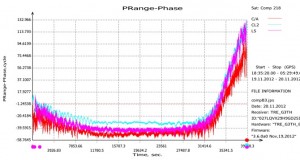
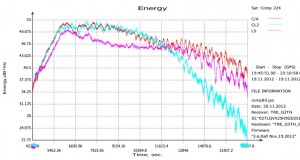
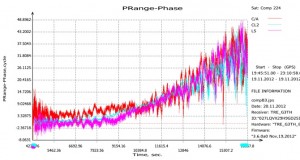
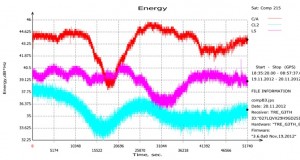
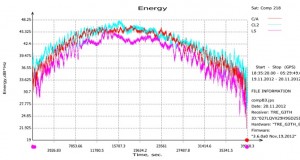
    On December 29, two days after the Compass Interface Control Document (ICD) was made publicly available, JAVAD GNSS announced that it had tracked “B3 signal from all launched Compass satellites, using TRE-G3T-E E6-band capable receiver.  Graphs shows SNR and ‘code-minus-phase’ combination of GEO svn #5 (sat #215 on graph), IGSO svn #8 (sat #218) and MEO svn #14 (sat #224). ‘C/A’ stands for B1, ‘L5’ for B2, ‘CL2’ for B3.”

    Javad1 Javad2 Javad3 Javad4 Javad5 Javad6

  • UK Switches on eLoran for Backup in the English Channel

    The General Lighthouse Authorities of the UK and Ireland (GLA) have announced that ships in the Port of Dover, its approaches and part of the Dover Strait can now use eLoran radio navigation technology as a backup to satnav systems like GPS and Galileo. What is considered the world’s busiest shipping route is the first to deploy eLoran to counter jammers and space weather, the GLA said in a statement.

    The ground-based eLoran system provides alternative position and timing signals for improved navigational safety. The Dover area, the world’s busiest shipping lane, is the first in the world to achieve this initial operational capability (IOC) for shipping companies operating both passenger and cargo services.

    Today’s announcement represents the first of up to seven eLoran installations to be implemented along the East Coast of the United Kingdom. The Thames Estuary and approaches up to Tilbury, the Humber Estuary and approaches, and the ports of Middlesbrough, Grangemouth and Aberdeen will all benefit from new installations, and the prototype service at Harwich and Felixstowe will be upgraded, the GLA said.

    Although primarily intended as a maritime aid to navigation, eLoran could become a cost-effective backup for a wide range of applications that are becoming increasingly reliant on the position and timing information provided by satellite systems.

    “Our primary concern at the GLA is for the safety of mariners,” said Captain Ian McNaught, Chief Executive of Trinity House. “But signals from eLoran transmitters could also provide essential backup to telecommunications, smart grid and high frequency trading systems vulnerable to jamming by natural or deliberate means. We encourage ship owners and mariners to assess eLoran in this region and provide feedback to the GLA on its performance.”

    P&O Ferries has installed an eLoran receiver on its new vessel Spirit of Britain. She will be based at Dover and is one of the largest passenger ships the busy Dover/Calais route has ever seen.

    “Accurate real-time positional information is essential for the safe navigation of ships with modern electronic charts,” Captain Simon Richardson, head of Safety Management at P&O Ferries, said. “Satellite navigation systems are vulnerable to degradation of signal strength and our ships have also experienced occasional loss of signal. We welcome the development of a robust alternative to provide redundancy in real-time positional information and we see eLoran as the most effective solution to countering the problem.”

    Commenting on the announcement Stephen Hammond, Minister for Shipping, said, “I congratulate the General Lighthouse Authorities on this initiative that seeks to improve navigational safety in what is the busiest shipping channel in the world, through the development and deployment of technology. I look forward to receiving reports of its effectiveness.”

  • GPS Plotter iPhone App Enables Quick Plotting

    GPS Plotter makes it easy to plot longitude and latitude coordinates using iPhone, according to app developer Make It Digital. Using the mobile phone’s in-built GPS system, users can plot their current location at the touch of a button. Multiple sessions can be used to create maps plotting anything, and easy export of longitude and latitude coordinates is made possible by utilizing the universal CSV data format.

    GPS Plotter is designed for:

    • Orienteering
    • Outdoor wayfinding
    • Tracking unmarked trails
    • Detailing longitude and latitude on the move

    The app is available for 69p ($0.99 US) in the App Store and is compatible with iPhone 4, 4S and 5 running iOS 5 or later.

  • Researchers Use Traffic App Data to Identify Accident Hotspots

    Researchers at Israel’s Ben-Gurion University of the Negev (BGU) say reveal that data culled from geosocial networks like the GPS traffic app Waze can help prevent traffic incidents with better deployment of police resources at the most accident prone areas.

    “Only now are we beginning to discover the potential in the huge amount of data collected daily,” explains BGU researcher and Ph.D. student Michael Fire. “Studies of this kind, which monitor events such as traffic accidents over time, can help the police identify dangerous sections of roads in real time, or alternatively, locations where few police are needed.”

    The paper, “Data Mining Opportunities in Geosocial Networks for Improving Road Safety,” was presented at the IEEE 27th Convention of Electrical and Electronics Engineers in Israel.

    Waze records location data and enables users to upload and share comments on any detail, including traffic alerts, accidents or police presence. According to its website, Waze has 30 million worldwide users and describes itself as “a community-based traffic and navigation app whose users share real-time traffic and road info, saving time and gas money.”

    Using Waze data and Google Earth, the BGU researchers determined that three-quarters (75 percent) of the locations in Israel with the highest number of accidents were intersections. They then analyzed references to a police presence to determine if the police were present at the spots that had the worst traffic accidents.

    “There were numerous instances where the police were manning quieter intersections, while busier intersections went unmonitored,” Fire explains.  “According to the data, police response time varied from 20 minutes to 40 minutes in some situations.”

    Using Waze, data from May and June 2012 was collected and analyzed on accident reports, police presence, traffic jams, and speed traps. BGU researchers identified 579 different locations in Israel that had at least five reoccurring accidents during this time where 5,156 reported accidents occurred. Police were reported at least 15 times at more than 3,500 locations.

    Other researchers involved with the study from BGU’s Department of Information Systems Engineering and BGU’s Telekom Innovation Laboratories include Prof. Yuval Elovici, head of the lab, as well as Dr. Rami Puzis, Prof. Lior Rokach as well as student Dima Kagan.

  • Report Looks at Indoor Location Positioning and Mobile Markets

    In December 2011, Grizzly Analytics released its first comprehensive report on indoor location positioning technology, predicting that indoor location services were ready to revolutionize the mobile market. The five months that followed have shown how true this was, with new initiatives announced on a regular basis and numerous demonstrations at industry conferences, Grizzly Analytics says.

    In a fully revised and updated 163-page report, Grizzly Analytics gives an up-to-date analysis and comprehensive overview of indoor location positioning R&D. Included is information on the research activity of all the major mobile companies — Google, Microsoft, Samsung, Apple, Nokia, RIM, Cisco, Qualcomm, Broadcom, STMicroElectronics, Sony Ericsson and others — and also more than 30 start-up companies that are actively bringing indoor location services to market.

    “These technologies are poised to revolutionize smartphone usage by enabling GPS-style mapping, navigation, local search, check-ins, location-sharing and other location-based services to work indoors in malls, megastores, offices, airports, casinos and other big indoor places,” according to a statement by Grizzly Analytics. “Indoor location will also transform commerce, enabling searching for items on store shelves, sending deals and promotions to nearby customers, advertisements for nearby stores in malls, and more. Location services are also entering the enterprise, with indoor asset tracking, employee search, and more.

    “In this updated technology trend report, Indoor Location Positioning: Research Pipelines, Start-ups and Predictions, Grizzly Analytics answers the questions you have about this new technology. What approaches are being researched by different companies? Which companies have mature research? What are the gaps in each company’s research that they are likely to fill by acquiring start-up companies? Which start-up companies are likely to be acquired or to emerge successful in the market? What areas of technology are not yet addressed by start-ups, and remain open to new entrepreneurs and investors?”

    A related report, Indoor Location Solutions and Services: Challenges, Opportunities and Market Outlook, is also available from Research and Markets.

  • Advanced Navigation, KVH Release Spatial FOG GNSS/INS

    Advanced Navigation, in collaboration with KVH Industries, has announced its new Spatial FOG GNSS/INS. Spatial FOG is a ruggedized GNSS-aided inertial navigation system and AHRS that provides accurate position, velocity, acceleration and orientation under demanding conditions. It combines the new KVH Industries 1750 fiber-optic gyroscope-based inertial measurement unit with magnetometers, a pressure sensor and a dual-frequency RTK GNSS receiver. These are coupled in a sophisticated fusion algorithm to deliver highly accurate and reliable navigation and orientation, the companies said.

    Spatial FOG contains a dual-frequency RTK GNSS receiver that provides 1-centimeter accuracy positioning and supports all of the current and future satellite navigation systems, including GPS, GLONASS, Galileo and Compass.

    A next-generation memory backup system allows Spatial FOG to hot start inertial navigation from its last position in 2 seconds and obtain a GNSS fix in as little as 3 seconds. The memory backup system lasts for the lifetime of the product and will provide backup for 24 hours without power.

    Spatial FOG’s internal filter runs at 1,000 Hz, and data can also output at this rate over high speed RS232 or RS422. This allows for control of dynamically unstable platforms, the companies said. Spatial FOG is also highly tolerant to both shock and vibration thanks to the performance of the KVH 1750 IMU design and advanced filtering.

    Spatial FOG supports a wide range of peripherals including external GNSS receivers, odometers, DVLs, USBLs and NMEA devices. It also supports both industry-standard NMEA output and a binary protocol. Spatial FOG also is easily integrated into retrofits or new designs, said Advanced Navigation.

  • Telit Introduces Qualcomm-Based HSPA Modules for Global M2M Markets

    Telit Wireless Solutions today introduced the UE910 V2 HSDPA (High Speed Downlink Packet Access) and HE910 V2 HSPA+ (High Speed Packet Access) modules based on Qualcomm Technologies, Inc. chipsets, each to be banded for European and North American markets.

    The MDM6200-based HE910 V2 supports both GPS and GLONASS location technologies, is fully digital audio capable, and provides full-duplex PCM input and output. With these features — combined with the up to 14.4Mpbs downlink and 5.76Mbps uplink data rates — the HE910 V2 is designed for applications such as video surveillance and security, and emerging applications areas such as healthcare, Smart Home, and Smart Grid.

    Both products feature dual-band 3G and GSM/GPRS/EDGE support. The entry-level 3G UE910 V2 is based on Qualcomm Technologies’ QSC6270 chipset and delivers a top 3.6Mbps downlink data rate.

    The new products are fully compatible with Telit’s xE910 family and can be easily dropped into existing or planned designs for xE910 modules requiring no additional rework. Positioned at entry-level and mid-range respectively, the new Qualcomm Technologies-based UE910 V2 and HE910 V2 modules enable the Telit xE910 family to enhance cross-technology compatibility with its other popular global air-interface technologies. The application of the Qualcomm Technologies chipsets improves interchangeability between CDMA (1xRTT, EV-DO) and UMTS (HSDPA, HSPA+) variants making the adaptation of customer applications to regional technical requirements quick and easy, minimizing time to market and total cost of ownership.

    The QSC6270-based UE910 V2 is to be positioned as a 2G to 3G migration path product, and includes high-value features such as analog audio, making it ideal for applications from home and commercial security and surveillance systems, to asset monitoring, logistics, and mass-transit monitors. Telit is planning a UE910 V2 variant based on QSC6270-Turbo with additional support for Java J2ME 3.2 and eCall.

    Both the UE910 V2 and HE910 V2 will be available in local band-group variants as required for all major carriers and partner networks in North America and Europe. The Qualcomm Technologies-based products will be available in North America with 850/1900MHz and in Europe with 900/2100MHz dual-band combinations. Both regional variants will be available in data-only as well as data & voice variants.

    “The Qualcomm Technologies-based entry-level 3G UE910 V2 and mid-range HE910 V2 are Telit’s new 3G products launched in response to increasing demand for dual-band HSDPA, and HSPA+ modules,” said Dominikus Hierl, chief marketing officer at Telit Wireless Solutions. “They come to address the need from application areas and regions requiring easy interchangeability between CDMA or UMTS lines of air interface technology, particularly in United States, Europe and key opportunities.”

    “Qualcomm Technologies’ fully-integrated QSC6270, QSC6270-Turbo and MDM6200 chipsets support the bandwidth and feature requirements of a broad range of M2M applications, and we are pleased to enable  HSDPA, and HSPA+ products in the xE910 family,” said Nakul Duggal, vice president of product management for IOE, Qualcomm Technologies. “By using Qualcomm Technologies’ Gobi 3G solutions in its xE910 product family, Telit will be able to offer its customers the technology flexibility to address M2M products and drive 2G to 3G migration in Europe and North America.”

  • Trimble, ng Connect Collaborate on Connected Service Vehicle Demo

    Trimble’s ThingMagic Mercury6 (M6) RFID Reader will be part of the ng Connect Program’s Connected Service Vehicle, which showcases a full suite of cloud-based services designed to deliver office productivity to vehicle-based workers. In this concept vehicle, the ThingMagic reader will be used to support work-order based inventory management and tool tracking applications to illustrate aspects of a typical service visit.

    The ng Connect Program, founded by Alcatel-Lucent, is a multi-industry ecosystem dedicated to the creation of the new generation connected user experience. ng Connect is comprised of more than 190 Contributing and Associate member companies including network, consumer electronics, application and content providers. Twelve proof of concept demos will be featured this year in the Alcatel-Lucent CES booth at the 2013 Consumer Electronics Show, January 8-11, in Las Vegas.

    As a collaborating member of the ng Connect program, Trimble is providing the development platform for in-vehicle RFID solutions and sensor technology for high-volume commercial, industrial and enterprise applications. Achievements in the automotive market include receiving the Ford World Excellence Award for contributions to a first-to-market RFID-enabled solution designed to help contractors track and manage their tools.

    “We’re honored to join the ecosystem of innovative, market-shaping companies in the ng Connect program,” said Bernd Schoner, vice president of business development at Trimble’s ThingMagic Division. “Using the vehicle as the basic point of data capture can enhance productivity. Uploading asset information from the vehicle to a central data aggregation layer for anywhere, anytime consumption by a variety of applications is the future.”