Author: GPS World Staff

  • Sygic Launches Location Sharing and Family Safety App

    Family,” a new app by GPS navigation software company Sygic, is designed to help parents keep their children safe and simplify the way families stay in touch. The app is now live on the Apple App Store and Google Play Store.

    The app shows the real-time location of all the family members on the map. It allows parents to set up Safe / Unsafe zones and sends automatic notifications when kids enter or leave a zone. Geofence is useful for one-time notification when users enter certain areas. Augmented reality shows family members in the real surroundings — for example, if kids are running around in a park. Navigation to the family member’s location can be launched from within the app. The app also features free family messaging.

    “We wanted to create an app that will help its users in their everyday life,” said Sygic’s CEO Michal Stencl. “As parents we want to raise our children to be self-reliant but we also need to have confidence that they are safe. Family by Sygic gives parents this peace of mind, while kids will appreciate that parents don’t feel the need to call them all the time to check where they are.”

    The app is free until January 31st on Google Play and App Store. Afterward, the price will be 2.99 Euro per year/family.

  • Agero Unveils Auto Infotainment Development Kit

    Agero Connected Services has announced the development of the AgeroView DevKit, a new cross-platform toolkit designed to accelerate the deployment of cloud-based automotive infotainment system applications. The DevKit includes specialized APIs (Application Programming Interfaces) and associated support to enable access to a variety of in-vehicle platforms ranging from safety and GPS positioning to multimedia and climate control.

    The DevKit, which will include an application software development kit (SDK) as well as a hardware evaluation kit, will be evaluated by select automakers during the first half of 2013 before its release.

    According to Agero, the launch of the AgeroView DevKit will remove significant barriers that constrain today’s in-vehicle infotainment systems. Until now, infotainment system features have always remained relatively static over the course of the vehicle’s lifetime. With the DevKit, automakers and developers can deploy more exciting and convenient experiences even years after the vehicle is sold. Drivers and passengers will be able to personalize their device interfaces on demand, and dealers will have the opportunity to introduce new content and interfaces.

    The AgeroView DevKit will allow the deployment of far more efficient and practical applications, particularly those involving navigation, messaging, and safety/diagnostics. Motorists will receive  the added value created by the vehicle’s ever-improving array of functions, content, and service offerings.

    “With the AgeroView DevKit, automakers will now be able to target the applications critical to their brand and quickly deliver a user experience that builds brand equity,” said Frank Hirschenberger, Agero’s senior director of Innovation. “Moreover, the DevKit lets developers create apps with a simple, easy-to-learn interface that takes into account evolving knowledge on minimizing driver distraction.”

    The AgeroView DevKit also provides the critical portal between Agero’s AgeroView in-vehicle cloud services and the in-vehicle electronics. The DevKit makes it simple for developers to write and validate production-ready, automotive-centric apps through the use of standard Web technologies, the company said.

    The AgeroView DevKit resides as a component in the AgeroView cloud platform developed by Agero in partnership with M-Way Solutions, GmbH. The platform gives automakers and vehicle owners the flexibility to substitute providers of specific content such as navigation, entertainment, and news as well as customize graphic and audio interfaces whenever desired.

  • Qualcomm, AT&T Support Internet of Everything Development Platform

    Qualcomm Incorporated, through its wholly-owned subsidiary Qualcomm Technologies, Inc., has announced an Internet of Everything (IoE) development platform based on Qualcomm Technologies’ QSC6270-Turbo chipset that supports Oracle’s Java ME Embedded 3.2. The IoE development platform features support for standalone GPS.

    The platform, which uses Qualcomm Technologies’ Gobi modem solution for 3G, enables developers to accelerate development efficiency and decrease time-to-market for a wide range of applications and devices to connect to the AT&T mobile internet. AT&T and Qualcomm Technologies expect this IoE development platform to be available to developers in the second quarter of 2013.

    The IoE development platform provides a starting point for creating a range of cellular-connected products and applications for IoE verticals such as tracking, industrial controls and health care. With this platform being capable of supporting Oracle’s Java ME Embedded 3.2 software release, developers with little mobile development experience can quickly go from concept to writing and executing Java applications directly on the QSC6270-Turbo chipset.

    In North America, this IoE development platform will be supported by AT&T, allowing developers to test their solutions and demonstrate functionality on a live network in the design and development phases, which can reduce complexity, cost and time for developers as they drive to get their solutions to market. With access to the various hardware interfaces and capabilities of the 3G modem via the application environment hosted on the QSC6270-Turbo chipset, developers can also customize and optimize end-product PCBs without the need for additional discreet processors or micro-controllers, thus cost-effectively integrating cellular capabilities into a wider range of devices and solutions.

    The platform includes several onboard sensors and indicators, including an accelerometer, light sensor and temperature sensor. The Java ME 3.2 software release, which can run on this platform, includes several new JSRs for IoE applications, as well as Device Access and AT Command Pass Through APIs that give developers access to a large number of chipset IOs and interfaces, such as GPIO, I2C and SPI. The platform supports cellular coverage for tri-band UMTS/HSDPA – 2100/1900/850 MHz – and quad-band GSM – 850/900/1800/1900 MHz – support, as well as 2.4GHz Wi-Fi a/b/g/n via a Qualcomm Atheros, Inc. AR6103 module.

    “This IoE development platform opens a world of opportunity for equipment makers who want to connect their devices to the mobile internet,” said Chris Penrose, senior vice president, emerging devices, AT&T. “Wireless connectivity makes products better, and this IoE development platform makes it easier for both existing and new AT&T developers to embed wireless into their products.”

    “Qualcomm Technologies sees the Internet of Everything as having significant potential. In addition to large IoE verticals like automotive and energy that have established industry players, application developers are key to creating future IoE verticals and applications that haven’t even been thought of yet,” said Kanwalinder Singh, senior vice president of business development, Qualcomm Technologies, Inc. “This IoE development platform with Java support is a tool to extend the power of our integrated chipsets to application developers. We are excited that AT&T shares our vision of a cellular-connected IoE, and by the opportunities that will be created by the AT&T developer community.”
  • iOnRoad Steers iPhone Navigation Towards Safer Driving

    iOnRoad,  the maker of the iOnRoad app that improves driving in real-time using the power of modern computer vision algorithms and smart-phone cameras, has released its award-winning app on iOS 6 operating systems. iOnRoad, now available for immediate download in the App Store, is taking advantage of the leap in processing power of the iPhone 5 and  new navigation integration offered on iOS 6, the company said.

    iOnRoad’s new iOS 6 features bring about a whole new depth to driving assistance applications. The iOnRoad application’s advanced fusion with iOS 6 navigation allows the driver the benefit of turn-by-turn navigation along with iOnRoad’s augmented driving UI. Furthermore, iOnRoad’s new “black-box” like video recording feature acts as a virtual driving log, archiving users’ driving history. Should an accident occur, drivers may now be given a greater understanding of the events leading up to it.

    “We have serviced hundreds of thousands of mobile users over the past year and are excited to provide iPhone users an enhanced version of iOnRoad,” said Alon Atsmon, CEO of iOnRoad. “In addition, the new in-phone analytics dashboard tells a driver how safe and ‘green’ the drive was and can even estimate gas prices, which is quite useful given the fluctuation in gas prices today.”

    iOnRoad uses the iPhone camera and sensors to detect lanes and vehicles in front of the vehicle, alerting drivers when they are in danger. The app provides a range of personal driving assistance functions including augmented driving, collision warning, speeding alert and safety scoring.

    “We are witnessing a trend in which  systems and features that we used to find in jet-planes such as navigation, collision warnings, HUD and night vision are increasingly finding their way into the driving environment,” says Atsmon. iOnRoad’s innovation and market leadership has been validated by numerous industry awards including the 2012 CTIA E-Tech Award, CES 2012 showcase award, and one of Gartner’s cool vendors in automotive for 2012.

    View a video of iOnRoad in action.

  • GPS Autopilot Copter Marketed to Consumers

    DJI, developer and manufacturer of UAV systems, today announced the launch of the Phantom, the company’s first easy-to-fly, consumer quadcopter. Accorrding to DJI, before the Phantom, building and flying multi-rotor aircraft was a complex task only performed by professionals and extreme hobbyists.  With the Phantom, DJI brings professional-level multi-rotor flight control technology to the average person by incorporating DJI’s intelligent, GPS-based autopilot system into the Phantom. This provides for simple, ultra-stable and reliable flight characteristics right out of the box. Priced at $679, the Phantom is also half the price of competing units that require complex building and soldering to assemble.

    The Phantom comes with a remote-control unit containing pre-programmed autopilot parameters and a GoPro camera mount, making aerial cinematography easy for almost anyone, the company said. With the built-in DJI Naza-M autopilot system with GPS module, the Phantom has both GPS Attitude and Attitude Control Mode. Pilots can switch between the two modes to achieve particular flight experiences. Also incorporated are safety parameters, such as a failsafe feature that will bring the Phantom back to its take-off point and land itself if it loses signal from the remote control unit for any reason.

    Features of the Phantom:

    • Highly integrated design with high intensity orientation-aiding LED indicators
    • Ready-to-fly right out of the box – no programming needed
    • Stable and easy to fly with agile performance
    • Multiple flight modes, including GPS position hold
    • Intelligent Orientation Control (IOC)
    • Failsafe and auto go-home/landing
    • Camera mount included for GoPro.

    “DJI has always been at the forefront of both UAV flight control systems and innovative airframe technology,” stated Colin Guinn, CEO of DJI North America.  “The PHANTOM is more than an evolution of our existing technology, it is a quantum leap forward in bringing professional-level, multi-rotor aircrafts to the average consumer.”

  • LiveViewGPS Transforms Cell Phone into Location Device

    LiveViewGPS, a GPS tracking company for business, government and individuals, is unveiling a prepaid Mobile Phone Locate Card in Booth #75015 in the Eureka Park area at the International CES Show in Las Vegas this week. The card allows users to transform a cell phone into a 24-hour safety location device for families and businesses without having to buy a $100 locator or expensive apps.

    Mobile Phone Locate capitalizes on the location technology already built into cell phones to instantly locate single or multiple phones, explained George Karonis, LiveViewGPS CEO. It uses both Assisted GPS and cell network data to ensure fast, accurate locates for discreet monitoring when and where it’s needed. Because location accuracy depends on cell phone reception, GPS settings, environmental conditions and more, results can vary from a few feet to several thousand feet.

    Under the program, a customer purchases a prepaid LiveViewGPS Mobile Phone Locate card either online or at a retail store. After signing up, users select a locate plan and register the phones they want to locate. An SMS text is sent to the target phone(s) requesting a reply. Once the phone users opt in, the Mobile Phone Locater service is immediately activated. With a single click, the target phone’s location is displayed on a high-resolution graphic or satellite view map. There is no software to install, no battery draining app to download, no expensive devices to buy, and no contract to sign.

    The Mobile Phone Locate service is approved for use and works with Tier 1 carriers in North America including AT&T, T-Mobile, Sprint PCS, Verizon, Boost Mobile and TracFone in the United States; and Rogers and Telus in Canada. More carriers and countries will be added as they become available.

    “For businesses, keeping track of a mobile workforce is easier than ever,” Karonis added. “Mobile Phone Locate is a cost-effective, in-the-field management solution that’s fast, easy and reliable. It offers value-driven, on demand mobile location services businesses can trust. Deployment is easy across one or 1000 phones, with no additional hardware to purchase or battery draining apps to install.

  • TI’s Wi-Link 8Q Provides Wireless Connectivity for Auto Infotainment

    Wireless connectivity is becoming a key feature in automobiles for sharing and viewing content from smartphones and tablets to in-car systems, easy pairing of devices, navigation and replacement of expensive cables for in-car communication. To answer this need, today Texas Instruments Incorporated (TI) introduced the WiLink 8Q family of wireless automotive connectivity solutions.

    “GNSS technology combines GPS and GLONASS signals with the on-chip positioning engine producing a more accurate fix of your location, making “urban canyons” non-existent,” according to the TI Behind the Wheel blog. TI is demonstrating WiLink 8Q and other technologies at the Consumer Electronics Show this week in Las Vegas.

    With its multi-radio technology, the WiLink 8Q family reaches new levels of cross platform scalability and delivers advanced features including in-car multimedia streaming video in parallel with Bluetooth hands-free calling and advanced audio distribution profile (A2DP) stereo sound. Additionally, with near field communications (NFC) for easy Wi-Fi and Bluetooth pairing, WiLink 8Q solutions enable an easy connection between a smartphone or tablet and the automobile, providing a seamless user experience, according to TI.

    The WiLink 8Q family is designed for Wi-Fi Certified Miracast operation. With an integrated power amplifier (PA) and complete software reuse across all family members, WiLink 8Q solutions provide a full range of products for wireless automotive infotainment including:

    • Super-combo SoCs with Wi-Fi, Bluetooth, Bluetooth low energy, NFC, and GNSS support.
    • Combo-connectivity system-on-chips (SoCs) with Wi-Fi and Bluetooth support.
    • More integrated combo-connectivity SoCs with Wi-Fi, Bluetooth, Bluetooth low energy and NFC.

    “Delivering the familiar experience consumers have with smartphones and the tablets into the automobile to share information and content from drivers’ and passengers’ devices is driving the need for strong wireless connectivity solutions. Wi-Fi, Bluetooth, NFC and GNSS have to work together seamlessly as integrated parts of the entire system,” said Mattias Lange, automotive connectivity product line manager, Wireless Connectivity Solutions, TI. “The WiLink 8Q family takes our expertise in wireless connectivity and automotive applications to the next level with support of four different RF technologies on one SoC – a truly integrated approach to automotive infotainment.”

  • Unmanned Innovation Autopilots Integrate VectorNav IMU into Its INS/GPS

    Unmanned Innovation, a provider of Development Platforms for unmanned aircraft systems (UAS), announced that it has partnered with VectorNav Technologies to integrate VectorNav’s VN-100 inertial measurement unit (IMU) into its os-Series Autopilots. Unmanned Innovation’s os-Series Autopilots offer a customizable solution that enables rapid prototyping and cost-effective production of fixed-wing, helicopter, multi-rotor, and custom configuration UAS. Unmanned Innovation has integrated VectorNav’s VN-100 miniature, calibrated MEMS-based, surface-mount IMU to provide customers the option of a fully calibrated and thoroughly tested IMU.

    Unmanned Innovation’s os-Series Autopilots, made commercially available for the first time in November 2012, combine modular hardware with an open architecture, making each autopilot a development platform.

    The os-Series Autopilots are offered in multiple form factors with features tailored for various vehicles, payloads, and applications. Each os-Series Autopilot is a complete integrated solution and contains an INS/GPS with air data incorporating the VectorNav VN-100, a datalink radio, payload interfaces, and a Linux computer within one miniature package, starting at 32 grams. The os-Series Autopilots come with professionally written flight control and mission software that Unmanned Innovation provides under a royalty-free license that allows for easy modification, extension, and inclusion in proprietary products.

    The partnership between the two companies began during AUVSI’s Unmanned Systems North America 2012 conference in August, where Unmanned Innovation was introduced to VectorNav’s VN-100 and recognized it as an attractive alternative to its existing inertial measurement sensors due to its small form factor, low-cost, and high-precision calibration. Unmanned Innovation’s flexible architecture allowed for quick integration of the VN-100 and VectorNav provided custom firmware with a faster update rate to make the IMU compatible with Unmanned Innovation’s requirements.

    The VN-100 IMU, calibrated for bias, scale factor and misalignment errors at room temperature or over the entire thermal operating range of the sensor increased the accuracy of the os-Series Autopilot navigation solution. After a short development cycle, testing and verification, VectorNav’s VN-100 IMUs are now fully integrated within Unmanned Innovation’s os-Series Autopilots. The complete os-Series product line is shipping to customers in the USA and abroad and is free of ITAR restrictions.

    “We are very pleased to be working with Unmanned Innovation on their os-Series Autopilot, which we find to be a very unique and high-value product that fills a significant gap in this market,” said John Brashear, VectorNav’s president. “We hope that the VN-100 adds to this value by allowing Unmanned Innovation to focus on its strengths improving the os-Series while securing a long-term, dependable sensing solution and partnership with our company.”

  • Maritime Access for the North Sea with e-Navigation Conference Set

    ACCSEAS is hosting its first conference, “Pioneering safer maritime access for the North Sea with e-Navigation,” to be held in Flensburg, Northern Germany, March 5-7, 2013.

    What is expected to be a first annual conference of the ACCSEAS (Accessibility for Shipping, Efficiency Advantages and Sustainability) project will examine how to address significant current and future issues which may impact on safe navigation in the North Sea and western Baltic Sea by pioneering safe regional access through the use of e-Navigation.

    Themes for the March 2013 Conference will include:

    • Defining regional e-Navigation for safe and efficient access to ports in the North Sea;
    • Providing an innovative approach to North Sea accessibility and efficiency challenges; and
    • The use of e-Navigation as a sustainable way forward for improving navigational safety within our region.

    A recent ACCSEAS project workshop in the Netherlands in December 2012, which was attended by representatives from major North Sea ports, well known shipping companies, navigation authorities and equipment suppliers, identified significant issues which may interfere with safe navigation in the North Sea and the neighbouring area of the Western Baltic.

    The issues identified by the workshop that can be further explored within the conference included:

    • Implications of renewable power generation, particularly the proliferation of wind turbines and potential  reductions in navigable “sea room”;
    • The prediction that an increase in ship size, particularly amongst container vessels, is unlikely to reduce shipping traffic densities;
    • The need to recognise the complexity of bridge systems in the training of seafarers;
    • Questioning by mariners of their trust in the accuracy of existing onboard navigation systems;
    • Provision of a navigational back-up in the event of failures, jamming or “spoofing” of vulnerable satellite based systems;
    • Identifying the need to provide better links between mariners and policy makers at national, European and International levels;
    • Better provision of information between ship and shore personnel, particularly with respect to routing and weather information.
    • The conference will also include the establishment of the first North Sea e-Navigation Forum to bring together users, stakeholders and navigation authorities and provide a voluntary arena for discussing and advising on the future implementation of e-Navigation in the region.

    The ACCSEAS Project, which seeks to improve maritime access to the North Sea Region of Europe, is run by a partnership of navigation and maritime authorities, academic institutions and industry from Denmark, Germany, Netherlands, Norway, Sweden and United Kingdom.

    Within this area, ACCSEAS aims to implement and demonstrate a practical test-bed for e-Navigation prototype services in order to demonstrate proof-of-concept solutions to existing and potential navigation issues within the region.

    Commenting on the ACCSEAS Project and the first annual conference, Roger Lockwood, Chief Executive of the Northern Lighthouse Board, stated:

    “The ACCSEAS project is an exciting opportunity to put the maritime community at the centre of future innovation in navigation safety for efficient access to North Sea ports.”

    Further information and registration details for the conference will shortly be available on the ACCSEAS website.

  • Trimble Acquires Transportation Company ALK Technologies

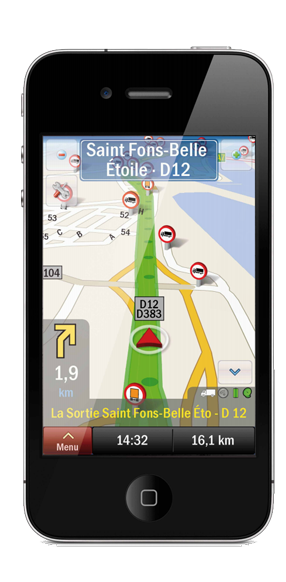
    iphone-RenaultApp .Credit: ALK Technologies
    ALK Technologies CoPilot Live software enables OEMs to bring own-brand turn-by-turn navigation apps to market.

    Trimble has announced that it has acquired privately-held ALK Technologies Inc. of Princeton, New Jersey. ALK Technologies specializes in routing, mapping, mileage and navigation technologies. ALK Technologies offers proprietary routing and international map-based solutions for transportation, logistics and mobile workforces.

    The addition of ALK is expected to extend and complement Trimble’s Transportation and Logistics product portfolio, including TMW Systems’ transportation management solutions, PeopleNet’s integrated onboard computing and mobile communications systems, and GEOTrac’s fleet management and worker safety solutions for the oil and gas industry. Financial terms were not disclosed.

    ALK software products include CoPilot Live, which offers onboard GPS navigation for professional drivers, and PC*MILER, a truck-specific mileage solution recognized as an industry standard for logistics, manufacturing, government and transportation operations. ALK offers a consistent data platform for operational planning activities, such as mileage and routing and in-cab navigation applications used by fleet drivers. ALK products are sold worldwide and feature extensive international map data. Approximately 64 percent of North American for-hire motor carriers use ALK solutions, including 98 of the top 100 largest for-hire carriers, 47 of the top 50 logistics companies and 77 of the top 100 private fleets.

    “The addition of ALK Technologies expands the portfolio and scope of innovative solutions we can offer transportation providers, logistics companies and shippers,” said David Wangler, president of TMW Systems, a Trimble Company. “The combination of ALK’s routing, mapping, mileage and navigation capabilities with our enterprise transportation management software and the mobile communications solutions under the Trimble Transportation and Logistics umbrella supports our comprehensive and industry-focused technology approach.”

    “This is a significant milestone in ALK’s long history in transportation,” said Barry Glick, president of ALK Technologies, who will continue to lead the organization. “We are excited to join our well-known and respected partner TMW Systems under the global umbrella of Trimble. These organizations share our passion and vision for how location information can transform business and productivity.”

    ALK Technologies business will be reported as part of Trimble’s Mobile Solutions segment.

  • Galileo E6 Signal Tracking Announced by JAVAD GNSS

    An announcement on the JAVAD GNSS website states “On December 21, 2012, we have tracked E6 B/C signal from all launched Galileo satellites, using TRE-G3T-E E6-band capable receiver.

    “The following graphs shows SNR and ‘code-minus-phase’ combination of svn #11 (sat #81 on graph), svn #12 (sat #82) , svn #19 (sat #89) and svn #20 (sat #90). C/A stands for E1, P2 for E5B, CL2 for E6, L5 for E5A.”

    The announcement includes a link to a short article describing how these codes were found. The Galileo E6 codes have not been published by the European Space Agency.

  • BeiDou ICD Released

    News compiled with assistance of CANSPACE Listserv.


    Logo: Beidou
    Beidou

    The interface control document (ICD) describing the details of the BeiDou B1I open service signal on 1561.098 MHz was released December 27 at a news conference held in Beijing by the Chinese State Council Information Office. Download the English version here. The ICD specifies the relations of the signal in space interface between BeiDou Navigation Satellite System and users’ terminal receivers. It is the essential technical document to develop and make receivers and chips.

    Anyone who has questions about the ICD is invited to submit them to this email: [email protected]

    The document, BeiDou Navigation Satellite System Signal In Space Interface Control Document — Open Service Signal B1I (Version 1.0), includes a system introduction, signal standards and navigation message, which defines the related contents of the open-service signal B1I between the BeiDou Navigation Satellite System and users’ terminals.

    In a previous presentation given at the Seventh Meeting of the International Committee on Global Navigation Satellite Systems (ICG) held in Beijing November 5-9, 2012, BeiDou officials stated that by 2020 there will be five GEO and 30 non-GEO satellites. The number of IGSO and MEO satellites isn’t stated, but previous presentations have said three IGSOs and 27 MEOs. This is also stated in the official ICD.

    Goodbye, Compass. At the news conference, Ran Chengqi, the director of the China Satellite Navigation Office, announced that the English name of the system is henceforth the BeiDou Navigation Satellite System. A new, slightly modified logo for the system was also introduced by Ran. The new version drops the parenthetical “Compass” translation of BeiDou.

    Also, the China Navigation Satellite Office now has a new English-language website.